
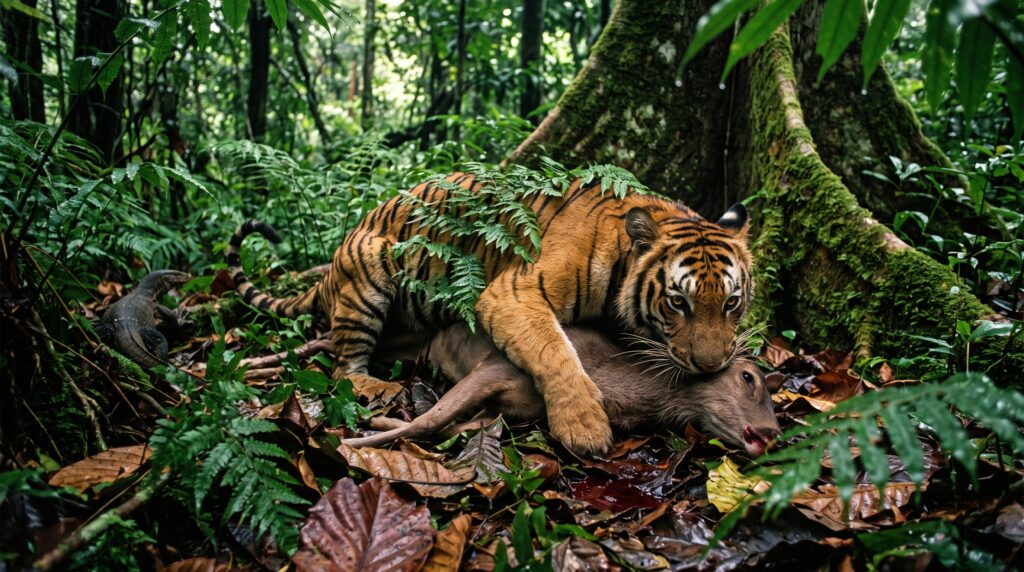
Bengal tigers in tropical rainforests feed primarily on large ungulates, hoofed mammals like sambar deer, chital, and wild boar. They prefer prey over 60 kilograms for energy efficiency. A single sambar sustains a tiger for days. Wild boar often dominate rainforest diets, sometimes exceeding half of local prey intake. When large prey grows scarce, tigers adapt. They’ll take fish, birds, turtles, and small mammals. Monsoon floods force this shift. Fish remains appear in 3% of scat samples. A 15 pound catfish can become a meal. This flexibility has limits. Tigers cannot survive on rodents alone. Prey scarcity increases hunting frequency and energy costs. The consequences extend beyond individual hunger. Their choices reveal how predator and prey remain connected in fragile ecosystems, and what follows explains why that connection matters.
Key Takeaways
- Large ungulates form the dietary core: sambar deer, chital, and wild boar are preferred prey.
- Wild boar often comprise over half the diet in rainforest habitats due to their abundance.
- Tigers opportunistically hunt smaller prey like fish, birds, and rodents when larger animals are scarce.
- Monsoon flooding forces seasonal shifts toward aquatic prey including catfish, turtles, and waterfowl.
- Domestic livestock are targeted occasionally when natural prey populations decline or become inaccessible.
What Bengal Tigers Actually Eat in the Rainforest
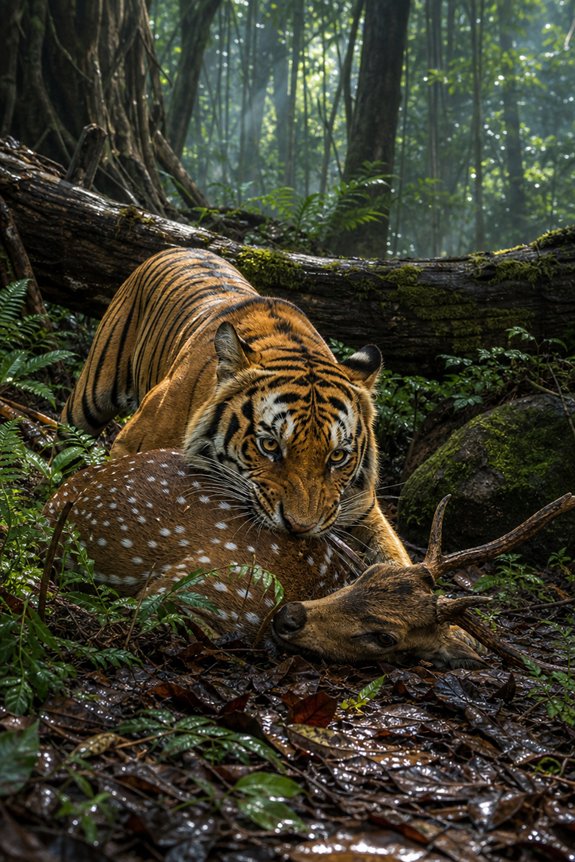
In the dense forests of the Indian subcontinent, Bengal tigers hunt prey across varied terrain. Their diet centers on large ungulates, hoofed mammals including sambar deer, chital, and wild boar. These animals provide substantial caloric returns. A single sambar can sustain a tiger for several days.
Tigers select prey based on availability and energy efficiency. They prefer animals weighing over 60 kilograms. Domestic livestock occasionally becomes targeted when natural prey grows scarce. This creates human wildlife conflict near forest edges.
Hunting success is modest and hard to pin down. Published estimates range widely depending on prey and study site, and most fall well below half. Patience defines their method. They stalk, then ambush with explosive speed, and that sprint lasts only about twenty metres before it fails.
The rainforest’s biodiversity supports this predatory role. Tigers regulate herbivore populations. This balance matters. Without it, vegetation suffers, and the ecosystem unravels.
| Prey | Typical adult weight | Role in the diet |
|---|---|---|
| Sambar deer | 135 to 250 kg (300 to 550 lb) | The largest routine kill. One carcass feeds a tiger for several days. |
| Chital (spotted deer) | 50 to 75 kg | The most frequently taken prey across much of the range. Herds of 30 to 50 near water. |
| Wild boar | 70 to 135 kg (150 to 300 lb) | Often over half the diet in wetter forest. Abundant and fast breeding. |
| Gaur and water buffalo | 500 to 1,000 kg | Rare, high risk, high reward. Taken by large males, usually by suffocation. |
| Muntjac (barking deer) | 15 to 35 kg | Small but abundant, and a common first prey for young tigers. |
| Fish, turtles, waterfowl | under 10 kg | A monsoon fallback in the Sundarbans when floods scatter the deer. |
| Livestock | varies | Taken when wild prey declines, and the main source of human conflict. |
Do Bengal Tigers Eat Fish, Birds, or Smaller Animals?
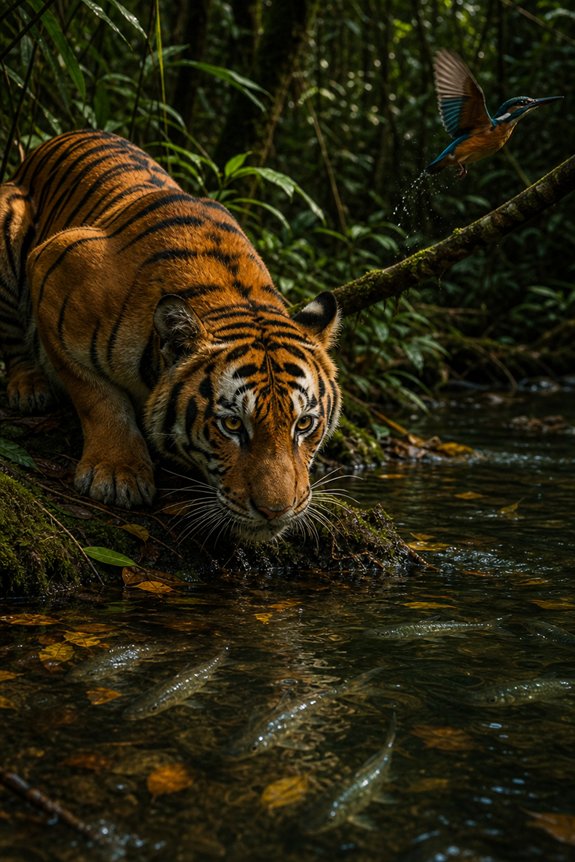
Bengal tigers aren’t picky eaters. They’ll catch fish when larger prey proves scarce, snatch birds from the ground or low branches, and hunt small mammals like hares and porcupines.
This dietary flexibility, or ability to switch food sources based on availability, helps them survive in habitats where biodiversity has declined.
Fish in Diet
Venturing beyond buffalo and deer, Bengal tigers supplement their carnivorous diet with fish, birds, and smaller animals when opportunity arises. Fish consumption remains relatively uncommon. Tigers aren’t specialized fishers. They lack the aquatic adaptations of fishing cats. Still, tigers wade into shallow streams. They snatch fish during dry seasons. Prey scarcity drives this behavior.
Water levels drop in drought. Fish become concentrated. Tigers exploit this vulnerability. Scat studies in the Bangladesh Sundarbans have recorded fish among tiger prey, though it makes up only a small fraction of what they eat. This isn’t negligible. It shows dietary flexibility. Biodiversity shapes what’s available. Tigers adapt. They aren’t picky. Survival matters more than preference. Fish provide protein. They sustain tigers when larger prey proves scarce.
Birds as Prey
Tigers snatch birds when larger prey eludes them. These opportunistic hunters don’t discriminate when hunger strikes. Peacocks, jungle fowl, and waterfowl fall within their grasp. Birds offer limited nutrition compared to deer or wild boar. A single peacock weighs roughly four kilograms. That is a meagre return for a predator averaging over 200 kilograms. Still, tigers pursue avian prey with surprising agility. They stalk quietly through undergrowth. They pounce with explosive speed.
Wetland birds prove especially vulnerable near water sources. Tigers exploit this predictable behavior.
Biodiversity shapes these interactions. Rainforests host countless bird species. Tigers benefit from this abundance. They adapt. They survive. This flexibility matters. Habitats shrink. Prey populations fluctuate. Tigers can’t afford to be choosy. They take what nature provides.
Small Mammal Hunting
Scavenging through leaf litter reveals another side of predation. Bengal tigers aren’t selective hunters. They’ll pursue small mammals when larger prey grows scarce. Rodents, hares, and porcupines become fair game. A single jungle cat’s nightly foray might yield a muntjac fawn or young wild pig. These creatures offer protein without the risk. Biodiversity supports this flexibility. Tigers adapt their menus. They don’t specialize. Territory size affects access to small game. Young tigers hone skills on manageable prey. Adults supplement diets opportunistically. Field studies record tigers taking a long tail of smaller species alongside their main prey. Rainforest understories hide abundant opportunities. Each kill matters. Survival demands pragmatism.
Deer Species That Fuel Bengal Tigers in Dense Forests
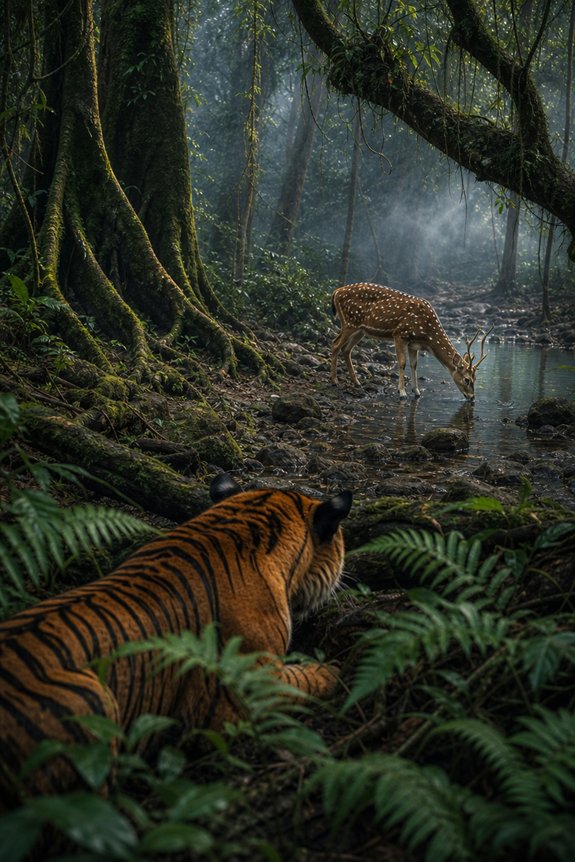
Prey availability shapes where Bengal tigers establish territory.
Deer species form the backbone of their diet in dense forests. Chital, or spotted deer, dominate this category. They gather in herds of 30 to 50 animals near water sources. Tigers exploit these predictable patterns.
Sambar deer offer larger meals. An adult sambar weighs 300 to 550 pounds. One kill sustains a tiger for several days. These deer prefer thick undergrowth. Tigers use forest cover to ambush them.
Muntjac, or barking deer, fill ecological gaps. They’re small but abundant. Biodiversity guarantees deer populations remain stable. This stability matters. Without reliable prey, tigers can’t survive.
The relationship feels ancient. Predator and prey move through shadows together. Neither exists fully without the other.
Why Wild Boar Are a Favorite Rainforest Meal
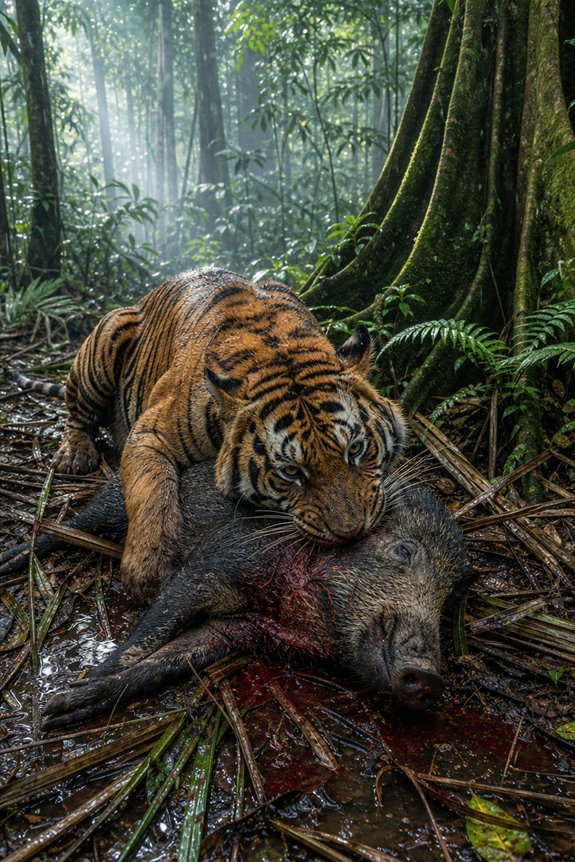
Often, wild boar comprise over half of a Bengal tiger’s diet in rainforest habitats. These animals thrive in dense vegetation. They offer substantial caloric returns. An adult boar weighs 150 to 300 pounds. This size matches what a single tiger can subdue alone, which is part of why tigers grew heavier than lions in the first place.
Wild boar reproduce rapidly. Their populations withstand predation pressure. This abundance is what supports a predator as large as a tiger. Tigers encounter boar frequently near water sources and wallowing sites. These locations concentrate both species.
Boar possess poor eyesight. They rely on hearing and smell. Tigers exploit this weakness. They approach from downwind. Boar are among the easier large prey to catch, though no reliable species specific success rate exists.
The meat provides fat and protein. Tigers gain energy for territorial patrols. This relationship shapes forest dynamics. It reminds observers that survival follows practical patterns, not drama.
How Tigers Hunt Buffalo and Massive Prey
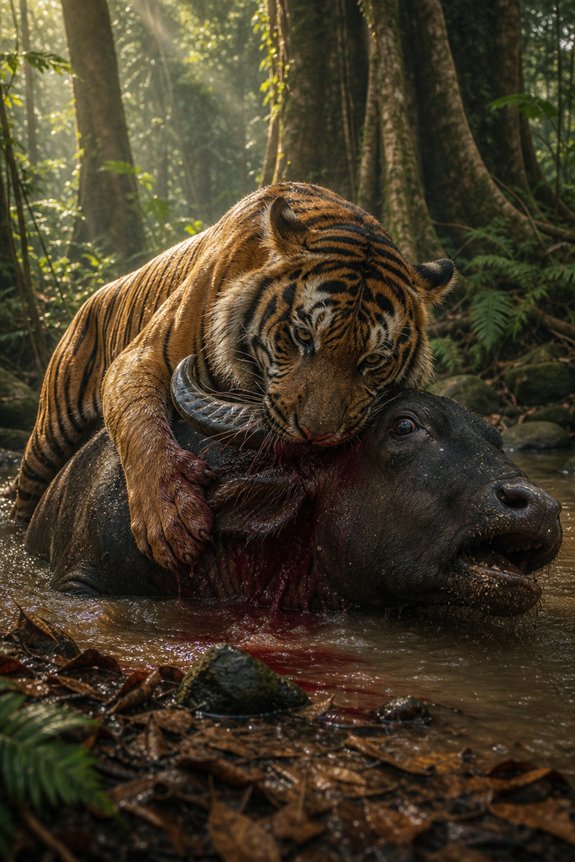
Wild boar feed one tiger well, but larger prey demands different tactics. Tigers hunting buffalo, gaur, or water buffalo use stealth, not speed. They stalk through dense cover. They wait for hours. They strike at the throat or neck.
A tiger’s bite is among the strongest of any cat, though no peer reviewed measurement of a live big cat bite exists and the psi figures in circulation are estimates. Whatever the number, it crushes windpipes. It severs arteries. Large prey often dies from suffocation, not blood loss. Tigers avoid frontal attacks. Hooves and horns kill them.
Biodiversity shapes these hunts. Fewer large prey species force tigers to travel farther. They expend more energy. They fail more often.
Success rates drop below 10 percent for buffalo hunts. Tigers accept this. They rest. They try again.
How Much Meat a Bengal Tiger Needs to Survive
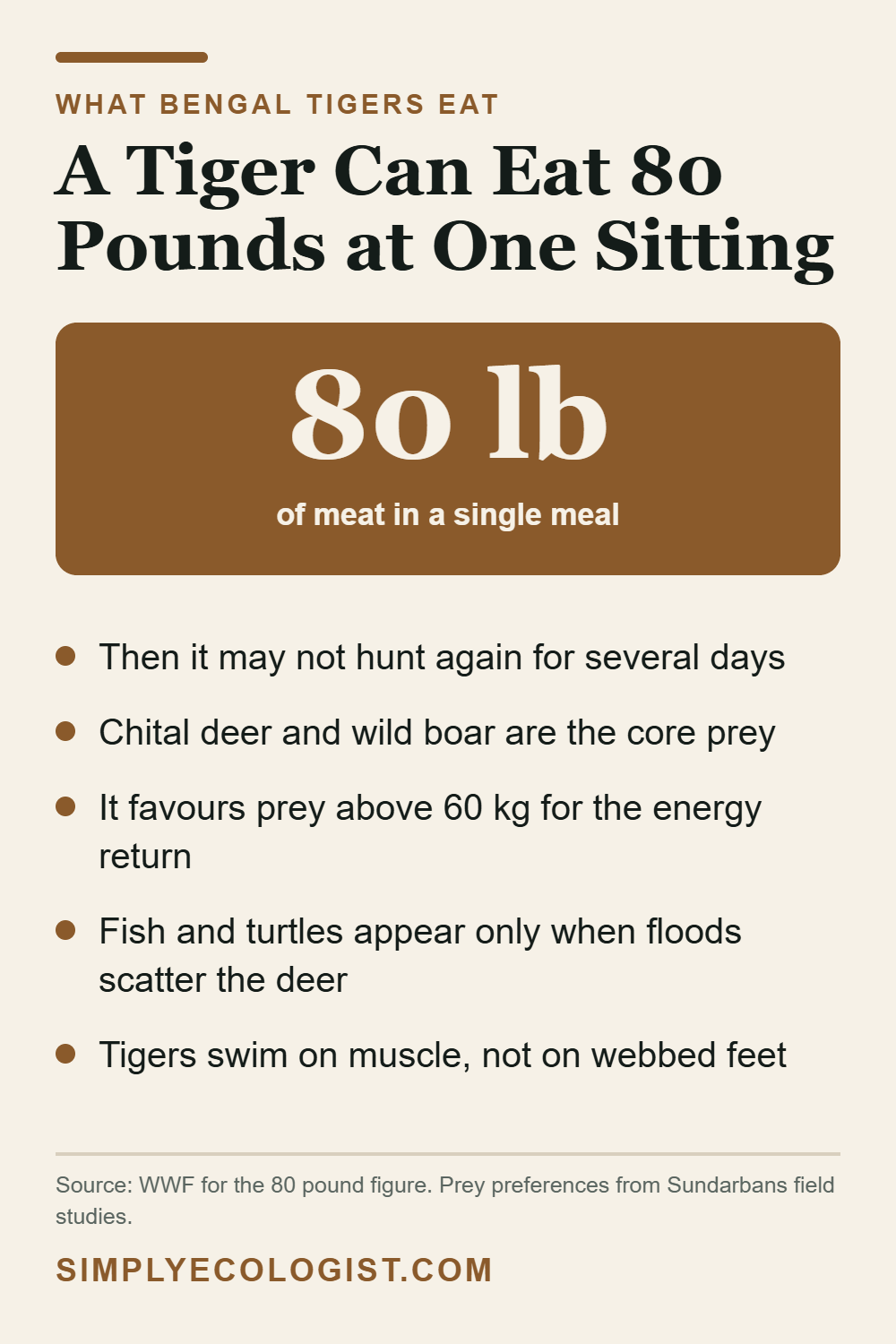
A Bengal tiger can eat more than 36 kilograms, about 80 pounds, of meat at a single sitting, then go days without hunting again. Averaged out, its daily requirement is far lower than that meal size suggests.
It hunts every five to eight days on average, though this frequency shifts dramatically based on prey size and hunting success.
Large kills, such as buffalo or gaur, sustain the tiger for nearly a week, while smaller prey demands more frequent effort and greater energy expenditure.
Daily Meat Requirements
Stalking through dense undergrowth, a Bengal tiger burns immense energy. The confusion in most sources comes from mixing up meal size with daily need. WWF puts the single sitting figure at more than 80 pounds, about 36 kg. Spread across the days between kills, the average daily intake is a fraction of that. These figures vary with activity level and reproductive status. A nursing tigress demands substantially more.
Tigers don’t eat daily in practice. Their stomachs hold vast quantities. One large kill sustains them for several days. However, the biological need remains constant. Metabolism drives this requirement. Muscle maintenance demands protein. Cold rainforest nights increase caloric needs.
In biodiversity tigers occupy a critical position. Their appetite regulates prey populations. Without sufficient meat, tigers weaken rapidly. They can’t survive long on small portions. This reality shapes their entire existence.
Hunting Frequency Patterns
Bengal tigers typically hunt once every five to eight days. A single kill delivers enough sustenance for this interval. An adult tiger can take more than 36 kilograms of flesh at one sitting. They don’t eat daily. This pattern emerges from their digestive efficiency and energy conservation.
Metabolic rate governs the schedule. Large carnivores, including tigers, evolved to endure prolonged fasting between successful hunts. The tropical rainforest biome (meaning a large community of plants and animals in a specific climate) provides irregular prey encounters. Tigers adapt through patience.
Hunting frequency fluctuates with age, health, and reproductive status. Females raising cubs hunt more often. Their bodies demand additional nutrition. Success rates vary widely between individuals, prey species and sites. The rhythm reflects biological necessity, not choice.
Prey Size Impact
Whether a tiger survives depends heavily on what’s available to eat. Averaged over time a Bengal tiger needs far less per day than it eats at a single kill. Large prey changes everything. A single chital deer, weighing 110 pounds, feeds one tiger for nearly a week. Smaller animals force more frequent hunts. More hunts mean more energy spent. More energy spent means less gained.
Biodiversity affects these calculations directly. Rainforests with diverse species offer options. Tigers adapt their choices. They prefer prey weighing 130 to 550 pounds. Sambar deer fit this range well.
When large prey grows scarce, tigers struggle. They can’t survive on rodents alone. The math becomes simple. Size determines survival.
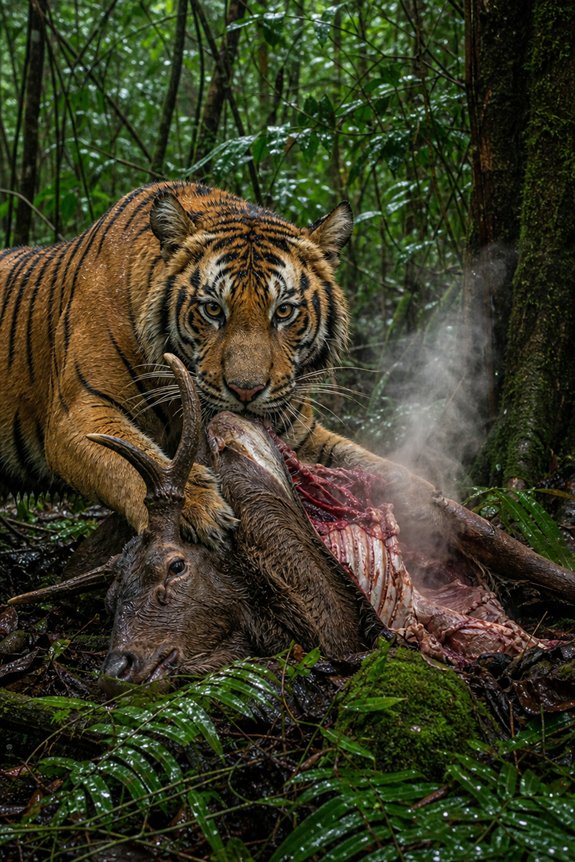
How Bengal Tigers Hunt When Prey Is Hidden
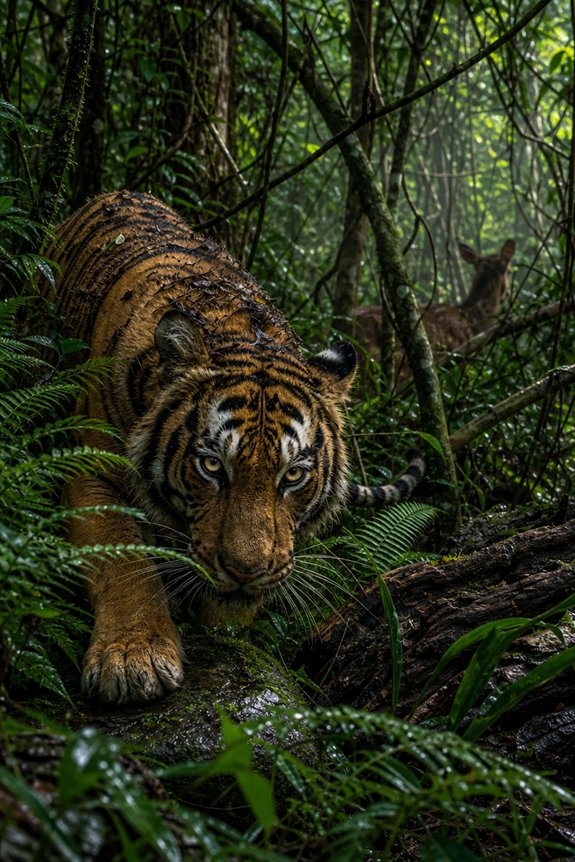
Moving through dense undergrowth demands patience from these predators. Bengal tigers can’t rely on sight alone when prey hides behind thick vegetation. They adapt. Their hearing detects subtle movements. Their whiskers sense air currents. They’ll stalk for hours. Tigers use stealth, not speed, in closed forests. They crouch low. They pause between steps. Prey rarely spots them until it’s too late. Ambush becomes essential. Tigers position themselves downwind. They attack from behind. A bite powerful enough to crush a windpipe ends struggles quickly.
Failed hunts outnumber successes. Tigers accept this. They rest. They try again. This persistence defines their survival. One might reflect quietly on such dedication. It mirrors what patience requires in any difficult pursuit.
How Flooding Changes What Bengal Tigers Eat
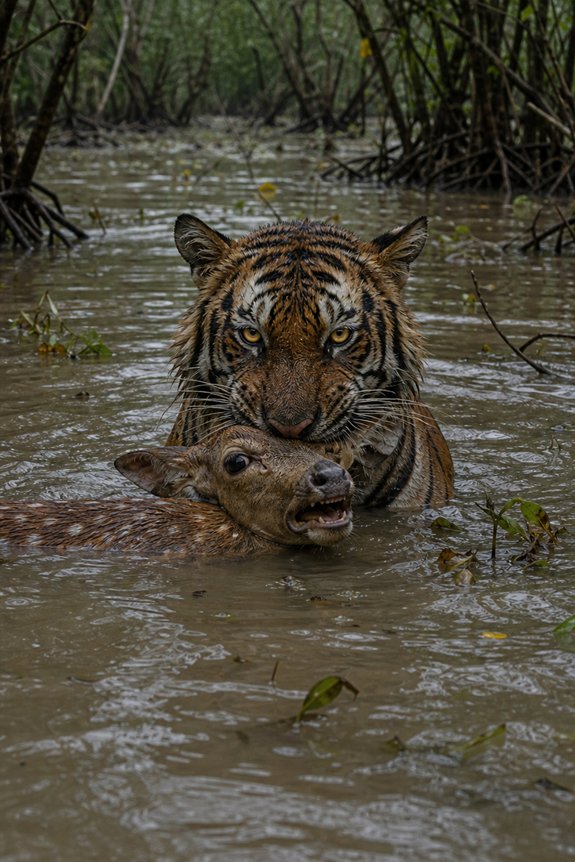
Flooding reshapes the tiger’s world. Prey animals flee to higher ground, forcing tigers to follow or adapt.
They develop aquatic hunting skills, and their diet shifts with the seasons.
Prey Displacement Effects
When monsoon rains swell the rivers of the Sundarbans, the landscape transforms. Rising waters displace prey species from their usual territories. Deer, wild boar, and other ground dwelling animals flee to higher ground. They cluster on narrow ridges and embankments. This concentration changes tiger hunting patterns dramatically.
Biodiversity shrinks in flooded zones. Tigers can’t find their normal prey in submerged forests. They must travel farther. They expend more energy. Some tigers shift to hunting smaller animals. Others target livestock on village edges. This creates human tiger conflict.
The displacement effect lasts months. Waters recede slowly. Prey returns gradually. Tigers adapt, but stress increases. Population biologists note temporary weight loss in monitored cats. The ecosystem’s balance proves fragile. One sees how water reshapes everything.
Aquatic Hunting Adaptations
Monsoon waters transform the tiger’s world. These cats don’t retreat from rising rivers. They adapt.
Tigers swim well, and not because of webbed feet, which they do not have. They are simply large, powerful and untroubled by water, unlike most cats. They’ll pursue prey through floodwaters for hours. Their striped coats provide camouflage in dappled, submerged forests.
Flooding changes available prey. Deer cluster on shrinking islands. Tigers exploit this concentration. They’ll also hunt fish, turtles, and waterfowl. Tigers in the Sundarbans have been recorded taking sizeable catfish.
- A mother tiger carries her cubs across torrents, neck fur gripped in her jaws
- An old male drowns in a flooded gully, too weak to reach high ground
- Villagers find pugmarks on their boats, proof that hunger overrides fear
Biodiversity means tigers can’t afford to specialize. They eat what water allows.
Seasonal Diet Shifts
Though the landscape transforms beneath their paws, Bengal tigers don’t simply endure the monsoon’s floods, they recalibrate their entire hunting strategy. Water levels rise dramatically. Dense forests shrink to islands.
Prey populations scatter. Tigers must adapt.
During dry months, they hunt chital and wild boar on forest floors. Flooding changes this. Deer flee to higher ground. Tigers follow. They swim between land patches. They target different animals.
Aquatic hunting increases. They catch fish. They snatch turtles. They ambush prey at water edges. Biodiversity shifts underwater. Tigers notice. They exploit new opportunities.
Their diet diversifies temporarily. Flood seasons bring hardships. Prey becomes harder to find. Tigers cover more territory. They lose weight sometimes.
Yet they persist. Adaptation defines survival.
How Leopards and Dholes Steal Food From Bengal Tigers
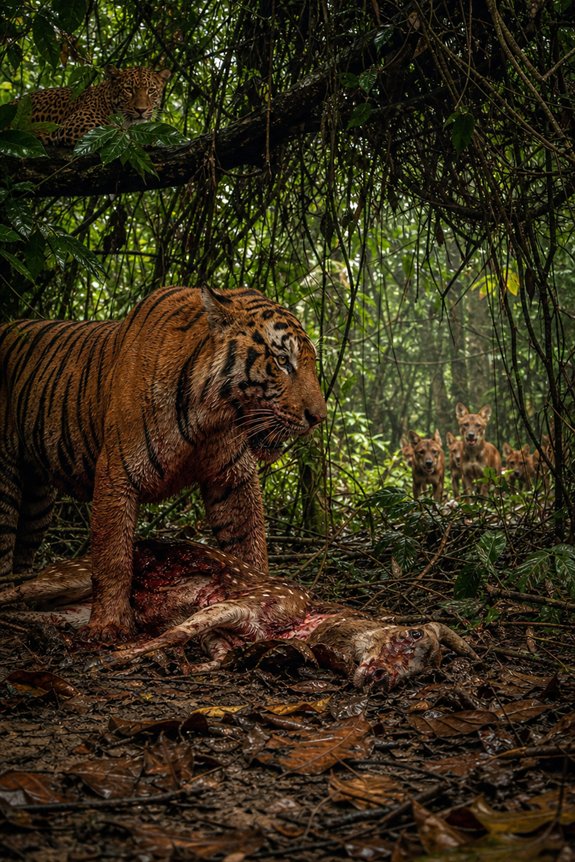
Leopards and dholes compete directly with Bengal tigers for prey across shared ranges. These smaller predators can’t overpower tigers. Instead, they steal kills through opportunism and numbers.
Dholes, or Asian wild dogs, hunt in packs that usually run from about five to twelve animals, occasionally far larger. They harass solitary tigers until the big cats abandon their meals. Dholes are recorded displacing tigers from kills, though the frequency varies by site and reliable figures are scarce.
Leopards use stealth. They approach abandoned carcasses or distract tigers with alarm calls. Both species target tiger kills rather than hunting fresh prey. This kleptoparasitism (stealing food from another predator) reduces tiger nutrition. Tigers lose a meaningful share of their kills to competitors.
- A mother tiger returns to find dholes devouring her only kill in days
- Cubs grow thin while competitors feast on stolen deer
- Forests fall silent where three predators once coexisted
How Human Activity Is Shrinking Tiger Menus
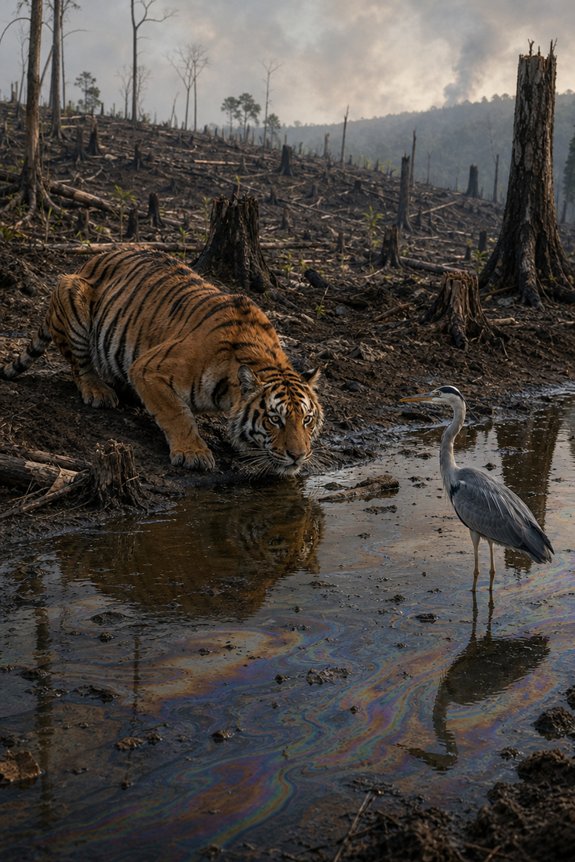
As forests fragment into islands of green, Bengal tigers find their pantries growing bare.
Roads slice through habitat. Settlements expand. Logging strips the canopy. Each act shrinks the tiger’s domain and erases its prey. Biodiversity plunges when humans develop land. Deer vanish. Wild pigs retreat. The tiger’s menu narrows.
Hunting compounds this loss. Poachers target sambar and gaur, the tiger’s core prey. Fewer animals remain. The tiger hunts harder. It travels farther. Energy spent yields less food.
Agriculture replaces forest. Fields offer no cover for stalking. Livestock replace wild herds. Conflict follows. The tiger’s natural diet disappears.
The loss is measurable. In some reserves prey density has fallen sharply. The tiger’s world grows smaller. Its options diminish.
What Bengal Tigers Do When Prey Runs Out
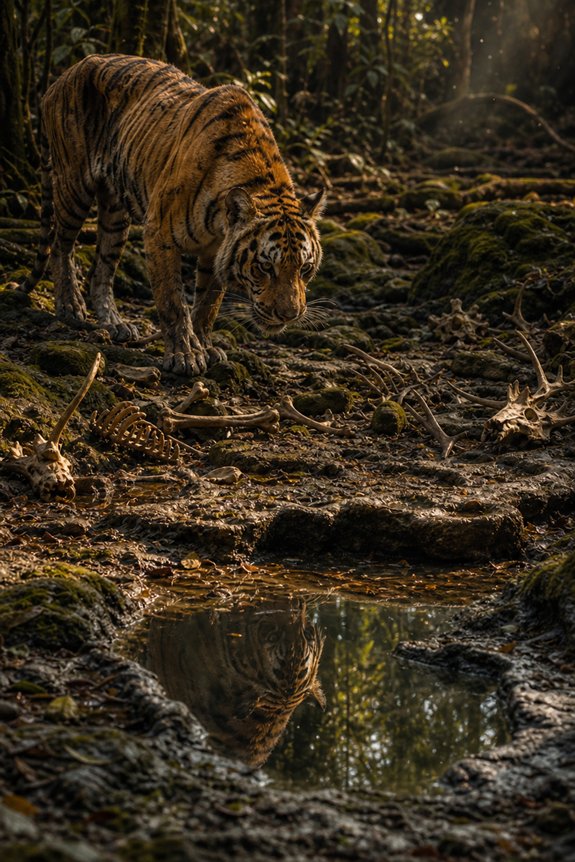
When prey grows scarce, the tiger doesn’t simply fade. It adapts, shifts, struggles. The animal expands its range, sometimes traveling 20 miles in a single night to locate food. It targets smaller animals: fish, frogs, even crabs. Hunger forces desperate choices.
Tigers also enter villages. They kill livestock. They encounter humans. Conflict follows. Each interaction risks death for both species.
The animal loses condition. Reproduction drops. Cubs die. The population contracts.
- A mother tiger abandons her young, her body too depleted to nurse
- An old male collapses on a forest trail, his muscles consumed by his own metabolism
- A cub cries at dusk, waiting for a parent who won’t return
This isn’t adaptation. It’s erosion. The tiger endures, but barely.
Why Saving Prey Means Saving Bengal Tigers
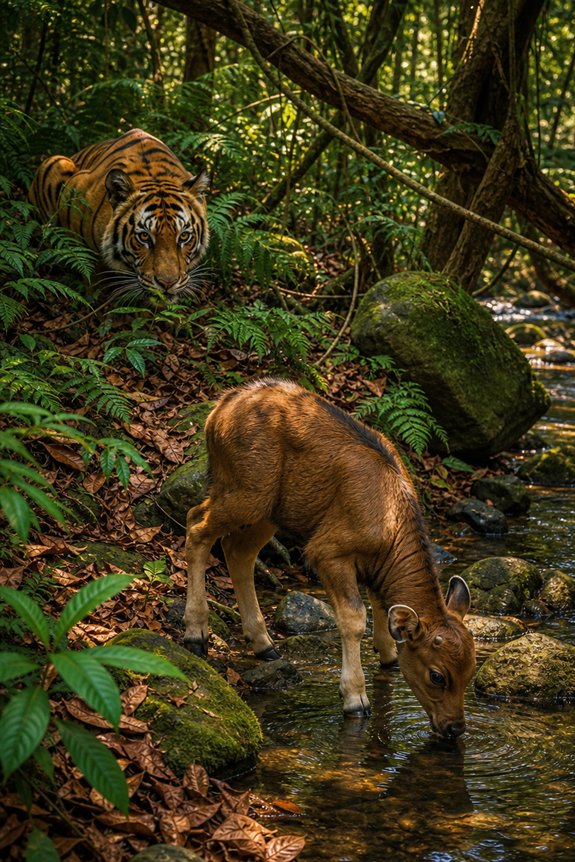
At the core of every tiger conservation effort lies a less visible priority: protecting the animals it hunts.
Bengal tigers need large prey populations. An adult tiger kills fifty to sixty large animals yearly. Without sufficient deer, wild boar, or gaur, tigers starve. They also wander into villages. Human tiger conflicts rise. Prey scarcity threatens cubs most, and prey depletion is now treated as a primary driver of tiger decline. Mothers can’t nurse properly. Mortality rates climb.
Biodiversity depends on predator prey balance. When tigers vanish, herbivore populations explode. Vegetation suffers. The entire forest changes.
Conservationists now protect prey habitats first. They establish corridors connecting forest fragments. Prey numbers recover. Tigers follow.
This approach works. It costs less than rescue operations. It respects the ecosystem’s design. Saving prey isn’t secondary. It’s foundational.
Final Thoughts
Bengal tigers thrive on diverse prey. Deer, boar, and buffalo build their bodies. Biodiversity sustains them. When prey populations plummet, tigers perish. Forest fragmentation shrinks hunting grounds. Conservation counts. Protecting prey protects predators. The future remains fragile. Tigers teach patience. Their survival signals ecosystem health. Each species saved strengthens the whole. The rainforest’s rhythm relies on this balance. Time tells.

Erzsebet Frey (Eli Frey) is an ecologist and online entrepreneur with a Master of Science in Ecology from the University of Belgrade. Originally from Serbia, she has lived in Sri Lanka since 2017. Eli has worked internationally in countries like Oman, Brazil, Germany, and Sri Lanka. In 2018, she expanded into SEO and blogging, completing courses from UC Davis and Edinburgh. Eli has founded multiple websites focused on biology, ecology, environmental science, sustainable and simple living, and outdoor activities. She enjoys creating nature and simple living videos on YouTube and participates in speleology, diving, and hiking.
🌿 Explore the Wild Side!
Discover eBooks, guides, templates and stylish wildlife-themed T-shirts, notebooks, scrunchies, bandanas, and tote bags. Perfect for nature lovers and wildlife enthusiasts!
Visit My Shop →