
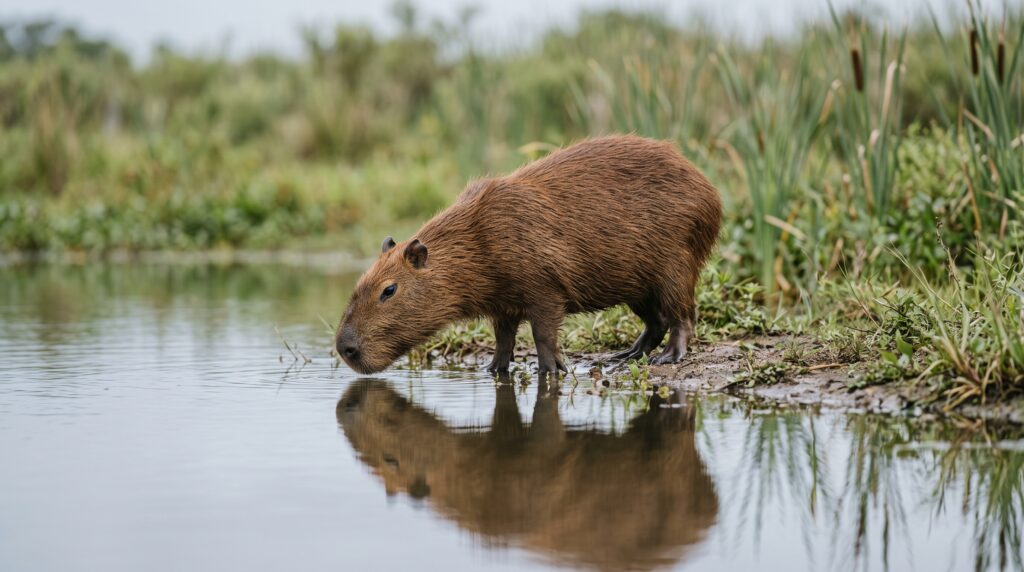
Several mammals resemble capybaras in their stout, rounded bodies and plant based diets. The Patagonian mara tops the list of misidentifications; it weighs just 8 to 16 kg compared to the capybara’s 35 to 66 kg. The paca carries distinctive white flank spots and lives alone, while the agouti sprints through rainforests at 30 to 35 km/h. Semi aquatic beavers, muskrats, and nutria share wetland habits but differ in tail shape and ecological roles. Biodiversity, meaning the variety of life in an area, benefits from these species in unique ways. Guinea pigs stand as the capybara’s closest relatives within the Caviidae family. Each look alike occupies its own niche, and further exploration reveals how to distinguish them quickly in the field.
Key Takeaways
- Patagonian maras share the Caviidae family but have long legs, rabbit like ears, and weigh 8 to 16 kg.
- Guinea pigs are the closest domestic relatives, though the wild rock cavy is the capybara’s closest living relative overall.
- Pacas and agoutis are Neotropical rodents with stout bodies but display spotted flanks and faster speeds.
- Beavers, muskrats, and nutria are semi aquatic with robust builds but possess distinctive tails and dam building behaviors.
- North American porcupines resemble capybaras in stout body shape but are solitary, nocturnal climbers armed with quills.
The 13 Animals That Look Like Capybaras (Quick Scan List)
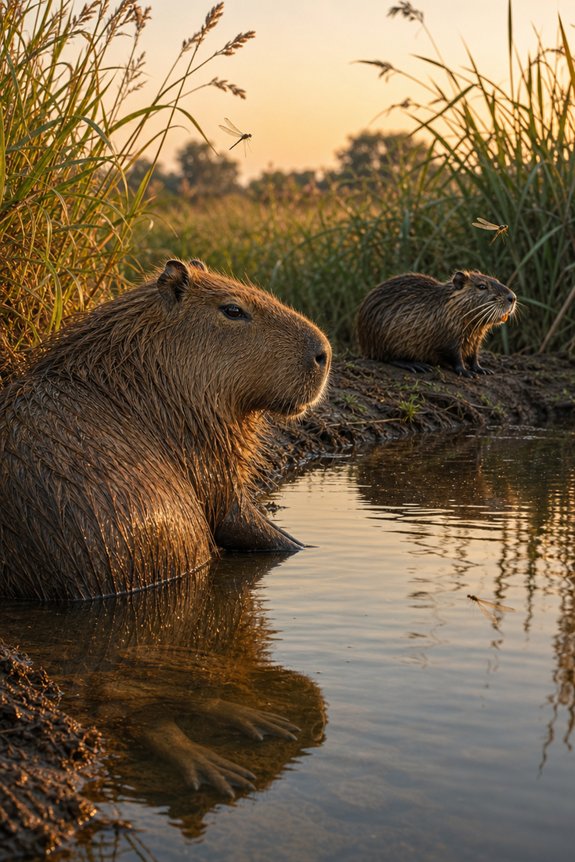
Although capybaras hold a unique place as the world’s largest rodents, several species share enough physical traits to prompt second glances from observers. Biodiversity, the variety of life forms in an ecosystem, creates these visual echoes across continents and habitats.
The North American porcupine presents a stout, rodent bodied silhouette superficially similar to capybara proportions. It’s protected by sharp quills and leads a solitary, forest dwelling existence.
Paca and agouti species, medium sized Neotropical rodents with compact bodies and seed eating diets, mirror capybara ecology closely.
Semi aquatic mammals including beaver, muskrat, and nutria share robust builds and wetland affinities, though their tails differ markedly.
Guinea pigs, close Caviidae relatives though not the closest, demonstrate how taxonomic kinship produces familiar forms. These comparisons reveal how evolution shapes convergent solutions across unrelated lineages.
| Animal | Scientific name | Weight | Actually related to a capybara? |
|---|---|---|---|
| Rock cavy | Kerodon rupestris | 0.9 to 1 kg | Yes, the closest living relative |
| Guinea pig | Cavia porcellus | 0.7 to 1.2 kg | Yes, same family, one branch further out |
| Patagonian mara | Dolichotis patagonum | 8 to 16 kg | Yes, same family Caviidae |
| Paca | Cuniculus paca | 6 to 12 kg | Distantly, same rodent suborder |
| Agouti | Dasyprocta spp. | 1 to 4 kg | Distantly, same rodent suborder |
| Chinchilla | Chinchilla spp. | 0.4 to 0.8 kg | Distantly, same rodent suborder |
| Nutria | Myocastor coypus | 4 to 9 kg | Distantly. The resemblance is convergence. |
| Beaver | Castor canadensis | 16 to 30 kg | No. Different family, converged on wetland life. |
| Muskrat | Ondatra zibethicus | 0.6 to 1.5 kg | No. A vole relative. |
| Groundhog | Marmota monax | 2 to 4 kg | No. A squirrel relative. |
| North American porcupine | Erethizon dorsatum | 5 to 16 kg | Distantly, same rodent suborder |
| Warthog | Phacochoerus africanus | 50 to 150 kg | No. Not a rodent. A pig. |
| Tapir | Tapirus spp. | 150 to 300 kg | No. Not a rodent. An odd toed ungulate. |
| Quokka | Setonix brachyurus | 2.5 to 5 kg | No. Not even a placental mammal. A marsupial. |
| Capybara | Hydrochoerus hydrochaeris | 35 to 66 kg | The benchmark |
1. Patagonian Mara: The Number One Capybara Misidentification
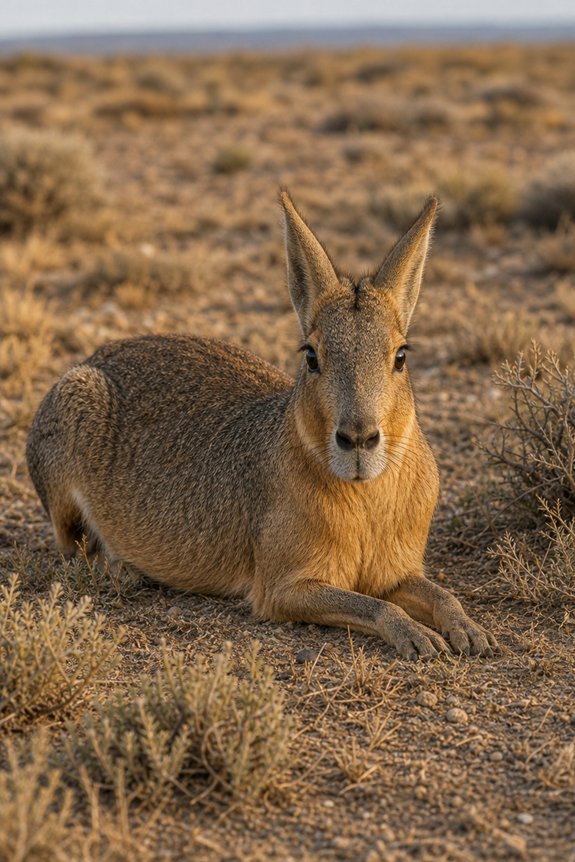
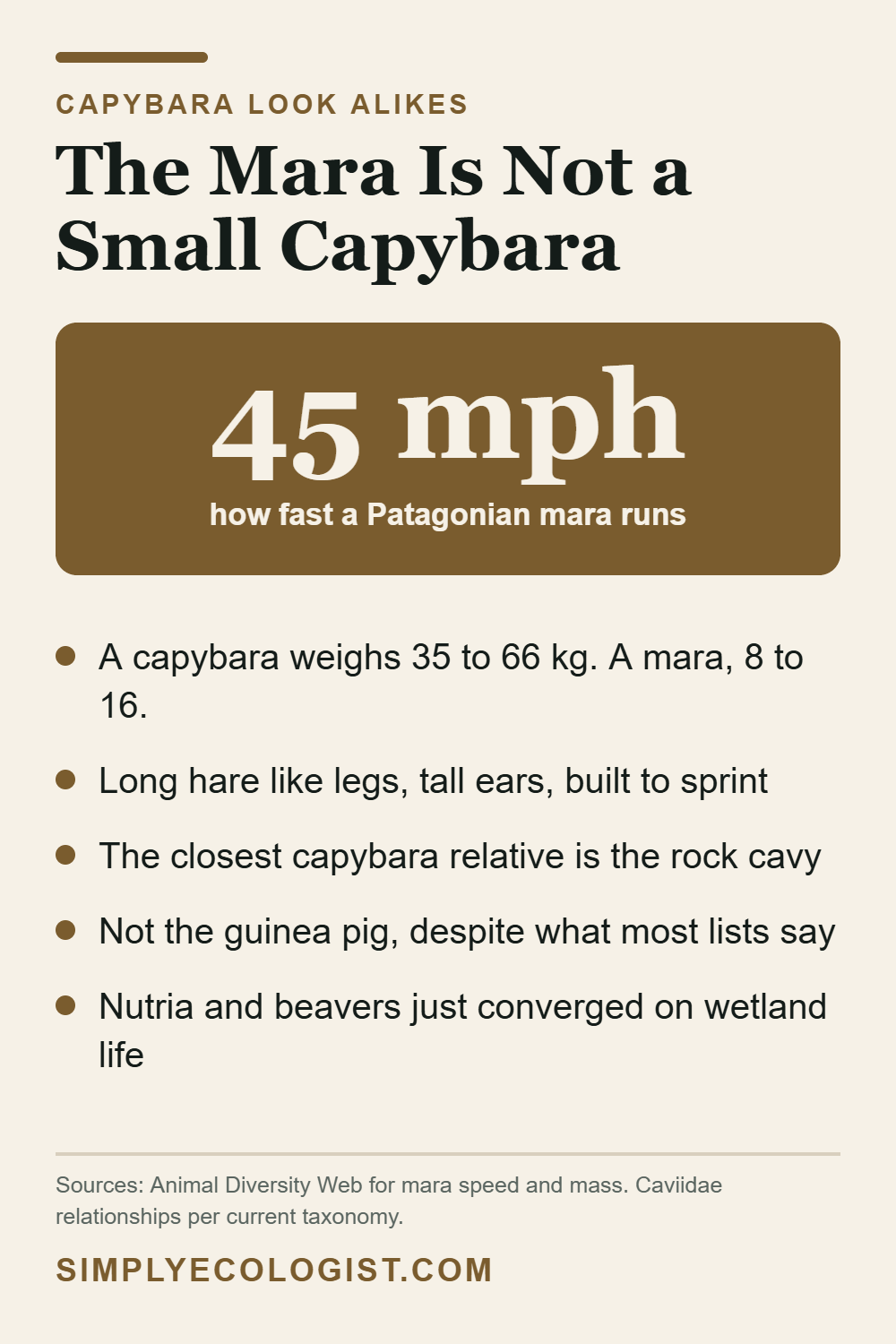
Among the animals frequently confused with capybaras, the Patagonian mara stands out as the most common misidentification. Native to Argentina, this rodent shares grazing habits and a compact body with capybaras. Animal Diversity Web puts its top speed at 45 mph, which is well beyond anything a capybara attempts. Yet maras differ sharply. They weigh 8 to 16 kg, far less than capybaras exceeding 50 kg. Their limbs are long and hare like, built for speed. Maras sprint across arid scrubland at up to 45 mph, around 72 km/h, which is faster than any capybara could manage. They’re cursorial, meaning adapted for running, not swimming. These creatures form monogamous pairs. They dig burrows in communal warrens, a habit shared with other stout bodied grassland mammals.
- Ears like a rabbit’s, tall and alert above the grass
- Legs stretched mid stride, kicking up Patagonian dust
- A gray brown back fading to pale belly, motionless at dusk
The resemblance causes real confusion. Observers must look closer.
How to Tell a Mara From a Capybara in 3 Seconds
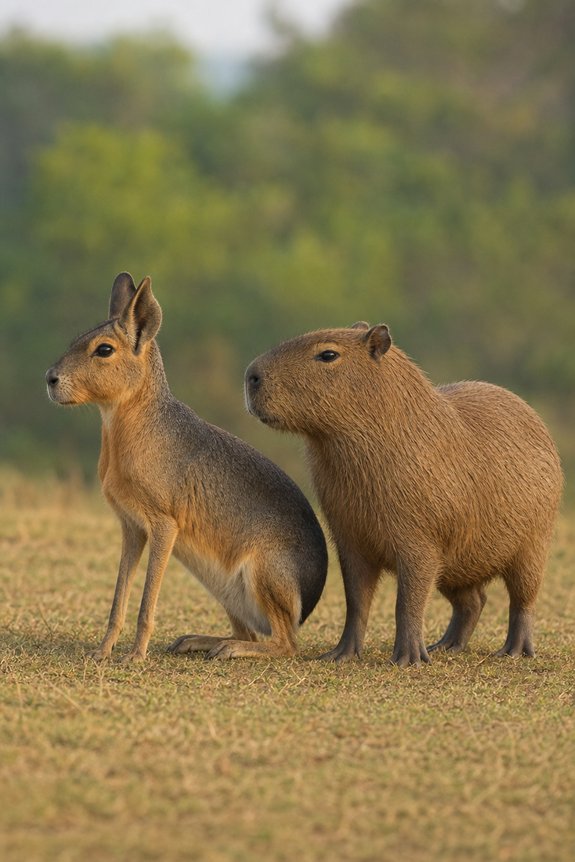
Spotting the difference between a mara and a capybara demands attention to proportion, not color or fur.
Look first at the limbs. Maras display long, hare like hind legs and elongated forelegs. They stand upright. Capybaras possess short, stout legs and a low, barrel shaped body.
Check the head next. Maras show a pointed muzzle with large, rabbit like ears. Capybaras reveal a blunt snout and small, rounded ears.
Watch the movement. Maras bound with an upright gait and carry a very short tail. Capybaras waddle slowly, showing virtually no tail.
Consider size. Maras weigh 8 to 15 kg. Capybaras reach 35 to 66 kg. The mass difference strikes immediately.
These contrasts clarify identification in seconds.
2. Paca: Spotted, Solitary, and Often Confused
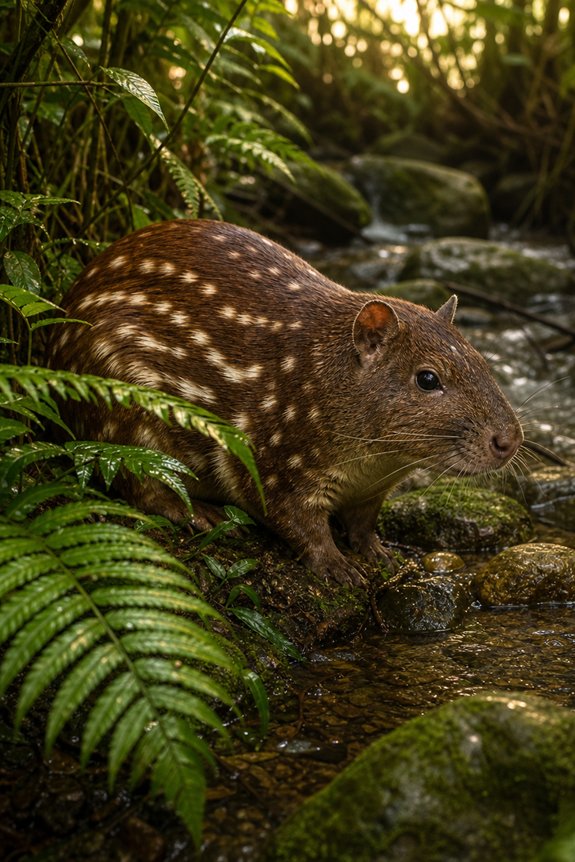
Size and shape alone don’t separate capybaras from every lookalike. The paca, *Cuniculus paca*, weighs 6 to 12 kg and carries a stout, rounded body built for forest floors, not water. Its dark brown coat bears 4 to 5 white flank spots and lighter stripes. These markings create a visual signature. Pacas live alone. They’re territorial, using burrows for shelter, emerging at night to eat fruits and seeds. Their reproductive strategy differs sharply from capybaras’. Pacas bear just 1 to 2 precocial young after 114 to 119 days. This K selected approach invests heavily in few offspring. Spotting one proves difficult. Their camouflage and nocturnal habits hide them in dense understory. Misidentification happens often.
- Moonlight catching the white spots as it freezes mid step
- Heavy body pressed against leaf litter, stripes breaking its outline
- Single paca vanishing into a burrow before dawn breaks
3. Agouti: The Speedy Rainforest Look Alike
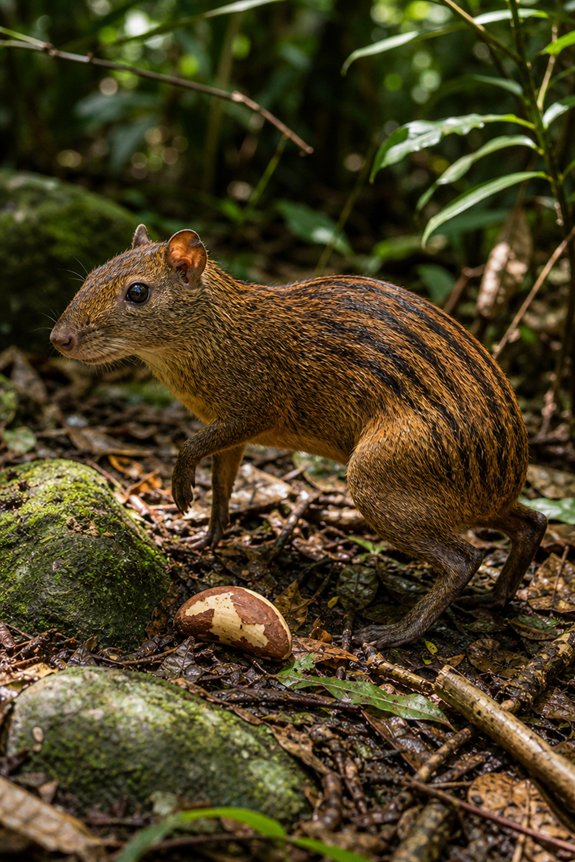
The agouti moves fast. It sprints through rainforest undergrowth on powerful hind legs, dodging predators with bursts of speed that match its hare like build.
This agility serves a deeper purpose: the agouti buries seeds across its home range, and many germinate into new trees, quietly sustaining forest biodiversity, the variety of living things that keeps ecosystems healthy.
Agile Forest Dwellers
Darting through the understory with explosive speed, agoutis demonstrate how survival in dense rainforest depends on physical adaptation. These medium sized rodents, weighing 1 to 4 kg with bodies stretching 40 to 60 cm, navigate Central and South American forests with remarkable agility. Their powerful hind legs propel them in fast, jinking bursts through the understory. This speed matters. Predators lurk everywhere.
Agoutis possess long, slender frames built for sudden movement. They’re diurnal, active during daylight hours. Communication happens through high pitched squeaks and scent markings from specialized anal glands. Solitary or in small family groups, they maintain territories with quiet determination.
Their strong, chisel like incisors crack hard shells with mechanical precision. This physical toolkit enables access to resources others can’t reach.
- Hind legs coiling like springs before explosive leaps between root buttresses
- Whiskers brushing against fallen leaves while ears rotate to catch approaching danger
- Claws scraping limestone as they vanish into hollow logs
Seed Dispersal Role
Beyond their speed, agoutis shape the forest itself. They disperse seeds across Central and South American rainforests. Each year, they bury thousands of seeds. They favor large fruits like Brazil nuts and palms.
Their caching creates new trees. Scatter hoarding means hiding food in many spots. Agoutis forget some caches. These seeds germinate. Studies show high seedling growth near forgotten stores.
Their jaws crack tough pods. They eat some seeds immediately. They save others for later. This behavior determines which plants thrive. It maintains plant variety, or biodiversity, in simple terms.
They carry seeds meters to hundreds of meters away. This distance connects tree populations genetically. Predators and seasons change their habits. During mast fruiting, they cache more. Seed survival rises. Forests persist because of this quiet work.
4. Guinea Pig: Your Pet’s Wild Capybara Cousin
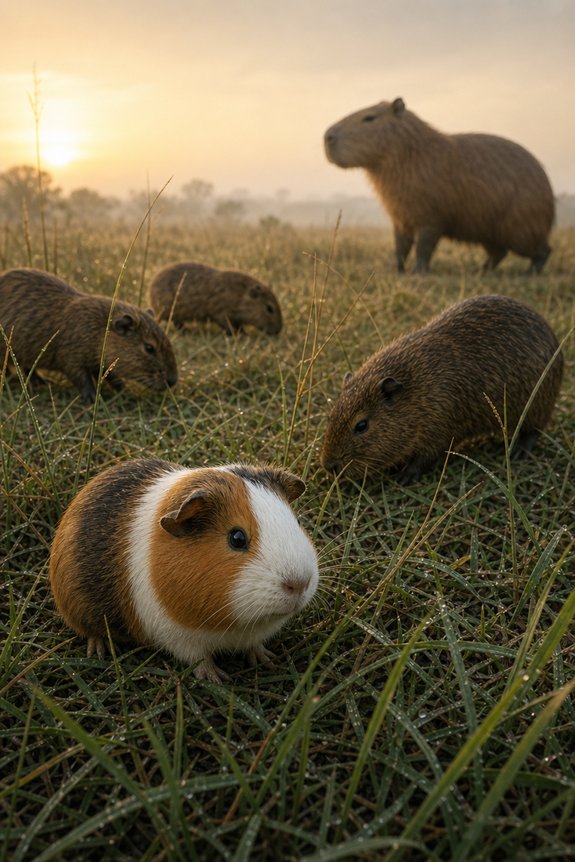
Domestic guinea pigs share more than an enclosure with their wild capybara cousins. Both belong to the Caviidae family, one of many groupings that make sense of how species get named and sorted. Guinea pigs weigh 700 to 1,200 grams. Capybaras reach 35 to 66 kilograms. This size gap illustrates biodiversity, the variety of life within one family.
Both species eat grasses and hay. Neither synthesizes vitamin C. Guinea pigs need 10 to 30 mg daily. They’re social animals. They live in pairs or small groups. They communicate through wheeks and purrs. Capybaras form herds. The parallels run deep.
Reproduction shows similar patterns. Guinea pigs gestate 59 to 72 days. Their pups are precocial, meaning born developed and mobile. Capybara young share this trait.
- A guinea pig’s small paws mirror the capybara’s webbed feet, scaled down for carpet instead of marsh
- Their wheeking calls echo across a living room the way capybara barks travel across wetlands
- A cluster of guinea pigs huddled in bedding recalls the capybara’s dense riverbank gatherings
5. Beaver: North America’s Dam Building Double
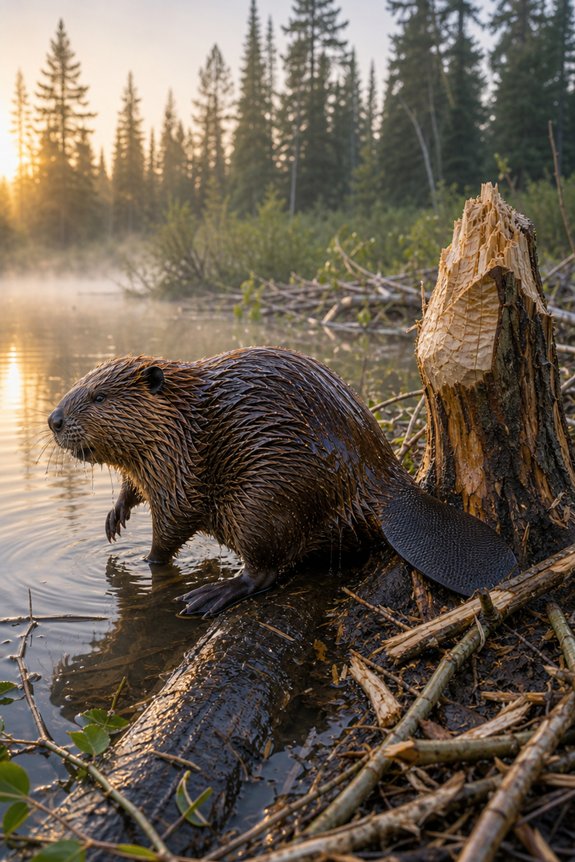
Beavers build dams that reshape entire landscapes. A single structure can stretch over 500 meters, creating ponds that boost wetland habitat and biodiversity, the variety of living species in an area.
They’re North America’s largest rodents, and they’re related to capybaras through shared family ties in the rodent order.
Dam Engineering Marvel
Transforming streams into thriving wetlands, North American beavers reshape entire landscapes through instinctive engineering. They fell trees up to 30 cm (12 inches) in diameter using continuously growing incisors. They build dams that impound water for their lodges.
A single dam can raise water levels by several meters. It slows stream flow. Beavers use mud, sticks, stones, and vegetation. They pack material with their powerful tails. Some dams stretch tens to hundreds of meters across small streams.
These structures store thousands of liters of water. They increase groundwater recharge and reduce downstream erosion. They buffer drought impacts too.
- Gnawed stumps ring pond edges like wooden sentinels
- Mud packed walls hold back shimmering pools at dusk
- Tail slapped water echoes through half flooded forests
The work is methodical. The results last generations.
Wetland Ecosystem Architects
Casting up from streambeds, beavers shape living landscapes. North American beavers (Castor canadensis) are keystone wetland engineers, meaning their presence supports entire ecological communities. They build lodges and dams using branches, mud, and stones, creating ponds covering several hectares that persist for decades.
A single family fells dozens of trees yearly, often aspen, willow, and birch. Their dams raise water tables, expanding marsh habitat for amphibians, waterfowl, and fish. Biodiversity (the variety of living species) increases markedly. Studies show amphibian and macroinvertebrate richness runs 2 to 5 times higher in beaver ponds than adjacent streams.
Beaver dams slow water flow, trap sediment, and improve downstream water quality. They reduce peak flood flows, offering natural flood mitigation. These rodents influence carbon and nutrient cycling, though their net greenhouse gas effects vary with pond age and temperature.
Rodent Family Ties
Kinship binds the animal kingdom in unexpected ways. Beavers and capybaras share semiaquatic lives yet occupy separate branches of Rodentia. Castor canadensis belongs to Castoridae, while Hydrochoerus hydrochaeris claims Caviidae. An adult beaver weighs 16 to 30 kg, matching smaller capybaras. Both wear dense, water resistant fur and paddle with webbed feet. Convergent evolution explains these parallels, not close ancestry.
Beavers diverge dramatically. Their orange enameled incisors grow endlessly, built for gnawing wood. Their broad, scaly tails propel, balance, and warn through slaps. A single family fells dozens of trees yearly, constructing dams that reshape entire watersheds. These structures create wetlands, boosting biodiversity, the variety of living species in an area.
- Amber incisors flash against bark as wood chips spray like snow
- Flat tails crack the water’s surface, sending ripples through dawn mist
- Dams transform streams into shimmering ponds, new worlds for frogs and fish
One sees nature’s quiet persistence here.
6. Muskrat: Mini Capybara of the Wetlands
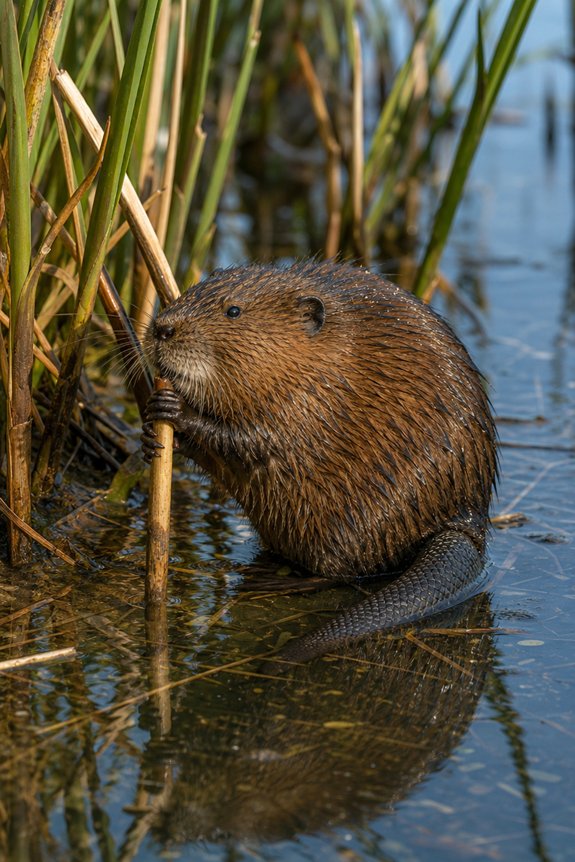
Gliding through murky water with their flattened tails steering like rudders, muskrats occupy North American wetlands with a quiet persistence that mirrors the capybara’s South American domain.
The muskrat (Ondatra zibethicus) is a medium sized semi aquatic rodent. It measures 30 to 45 cm long, plus a 20 to 30 cm tail, and weighs 0.6 to 1.5 kg. Its hind feet are partially webbed. The tail is laterally flattened. It works like a rudder for swimming and diving.
Muskrats eat mainly aquatic plants. Cattails, pondweeds, and water lilies form their diet. They also consume small aquatic animals. An adult eats several hundred grams of plant matter daily.
They build dome shaped lodges from vegetation and mud. Some burrow into banks instead. Family groups share these shelters in winter. They huddle together for warmth and protection.
Their rounded bodies and water centered lives earn them the nickname “mini capybara.”
7. Nutria: Invasive Look Alike or Ecological Threat?
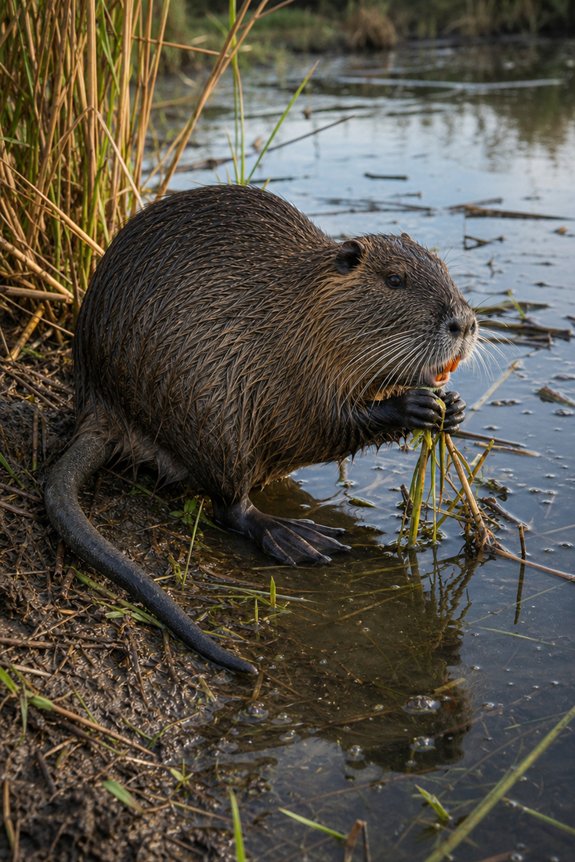
Muskrats aren’t the only rodents mistaken for capybaras. Nutria also share that bulky, rounded silhouette. These large South American natives weigh 4 to 9 kg and stretch 40 to 60 cm long. They’ve invaded wetlands across four continents.
Nutria eat voraciously. They’ll consume their body weight in marsh plants daily (biodiversity: the variety of life in an ecosystem). Their feeding destroys root systems. Banks collapse. Wetlands erode.
- Dense brown fur glistening in murky water
- Webbed hind feet paddling through submerged vegetation
- Orange yellow incisors gnawing through thick reed stems
In Louisiana alone, they’ve degraded tens of thousands of hectares. Females breed year round. They produce multiple litters of 4 to 13 young annually. Populations explode quickly. Native muskrats and waterfowl lose ground.
Control isn’t easy. It demands sustained trapping, removal, and habitat repair. Some regions fund eradication campaigns. Results remain mixed.
8. Porcupine: Quills on a Capybara Shaped Frame
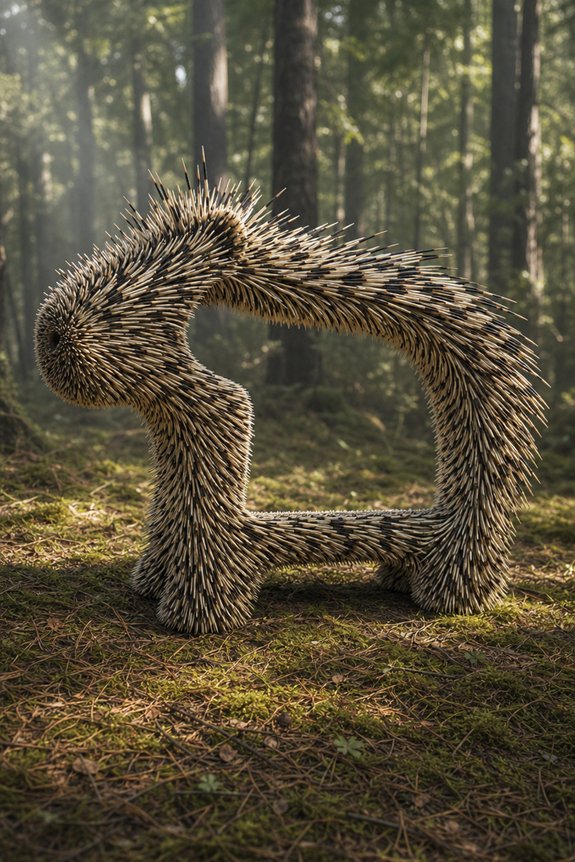
Picture a capybara, then shrink it and cover it in needles. The North American porcupine weighs 12 to 35 pounds. Its stout, rounded body resembles a capybara’s silhouette from certain angles.
Unlike capybaras’ smooth fur, porcupines carry up to 30,000 quills. These modified hairs measure 3 to 4 inches long. They embed in predators as defense.
Porcupines climb trees at night. They eat bark, twigs, and buds. Capybaras graze by day in water. The contrast is stark.
Both animals are rodents. Porcupines belong to family Erethizontidae. They reproduce slowly. One offspring follows a 112 day gestation.
Porcupines live in Canadian and U.S. forests. Capybaras inhabit South American wetlands. The resemblance ends at body shape. Their worlds differ entirely.
9. Chinchilla: Fluffy Andean Cousin
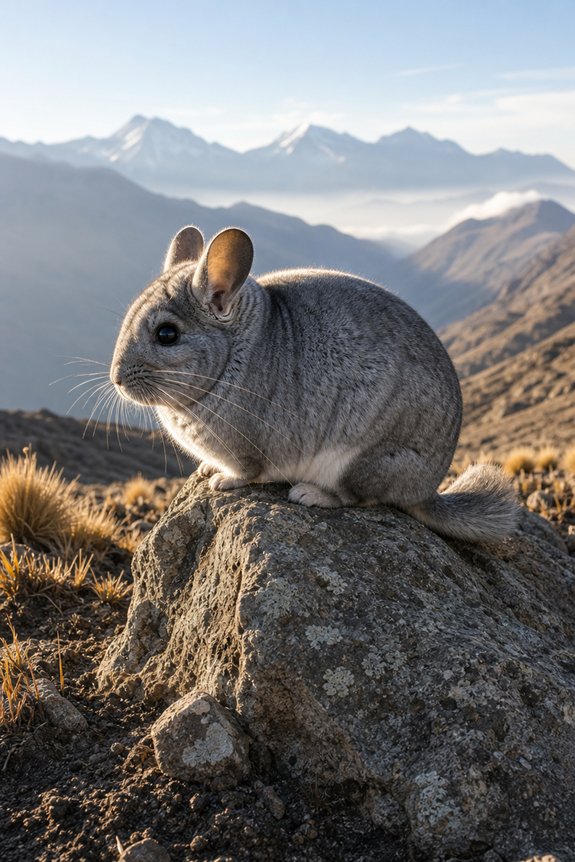
The porcupine’s quills contrast sharply with another South American rodent’s coat. The chinchilla wears the softest fur of any mammal. Sixty to ninety hairs sprout from each follicle. This density creates a coat humans once coveted.
Wild chinchillas occupy rocky Andean crevices at 3,000 to 5,000 meters. They eat grasses and bark. They’re crepuscular, meaning active at dawn and dusk. Cool, dry conditions keep their fur healthy. Humidity causes fungus.
They reproduce slowly for rodents. Gestation lasts 111 days. Litters hold one to six pups.
- Silver gray clouds of fur dusting volcanic stone at sunset
- Precocial pups (born fully furred and eyes open) huddling in granite hollows
- Fragmented colonies clinging to protected slopes where hunters no longer climb
The fur trade devastated wild populations. The long tailed species is now Endangered and the short tailed one Critically Endangered. Some find this loss quietly sad.
10. Groundhog: The Look Alike You See Every February
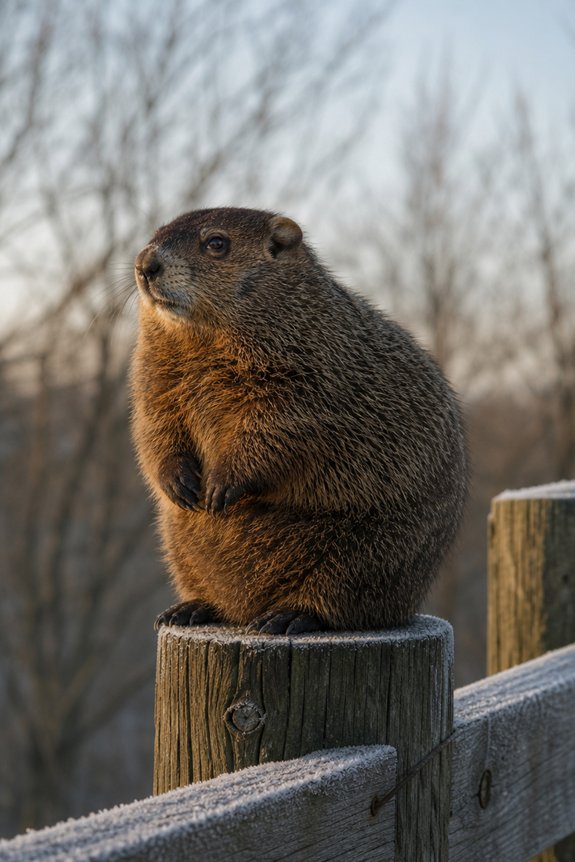
Groundhogs share a rounded, barrel shaped body with capybaras, though they’re smaller at 16 to 26 inches long. They’re famous for Groundhog Day each February 2, when people watch for their shadow. This tradition’s not scientific, but it shows how rodents capture public attention.
Groundhog Day Connection
Every February 2nd, North Americans look to groundhogs for a weather forecast. This tradition, rooted in Pennsylvania Dutch customs, elevates Marmota monax to celebrity status each year. The ritual’s simple premise captivates: if the groundhog sees its shadow, winter supposedly extends six more weeks. Groundhog Day brings unique attention to this rodent. It doesn’t celebrate capybaras, despite surface similarities between the species.
The ceremony highlights biodiversity, meaning the variety of living things, in unexpected ways. One animal dominates February’s cultural imagination.
- A groundhog emerges, whiskers trembling, from its burrow’s dark mouth
- Crowds gather in predawn cold, breath visible, cameras ready
- Shadows stretch or shrink across frozen grass, deciding seasons
This annual focus reminds viewers that familiar animals carry surprising cultural weight.
Physical Similarities Explored
Although separated by millions of years of evolution, groundhogs and capybaras arrived at remarkably similar body plans through convergent evolution, meaning unrelated species develop comparable traits to solve shared environmental challenges. Both display stocky, barrel shaped bodies and short legs. Groundhogs weigh merely 2 to 4 kg. Capybaras reach 35 to 66 kg. The silhouette remains strikingly alike.
Both species evolved as herbivores. Groundhogs graze on grasses and clover. Capybaras feed in wetlands and grasslands. Their diets parallel closely.
Yet their habitats diverge sharply. Groundhogs dig extensive burrow systems for shelter and hibernation. Capybaras seek water edges and dense vegetation. These similar forms solve different problems.
Groundhogs hibernate through winter. Capybaras stay active year round. One sees this contrast in their native ranges.
The Punxsutawney tradition makes groundhogs visible each February. They’re sciurids, not caviids. Taxonomy separates them clearly.
11. Warthog: African Pig With a Rodent Resemblance
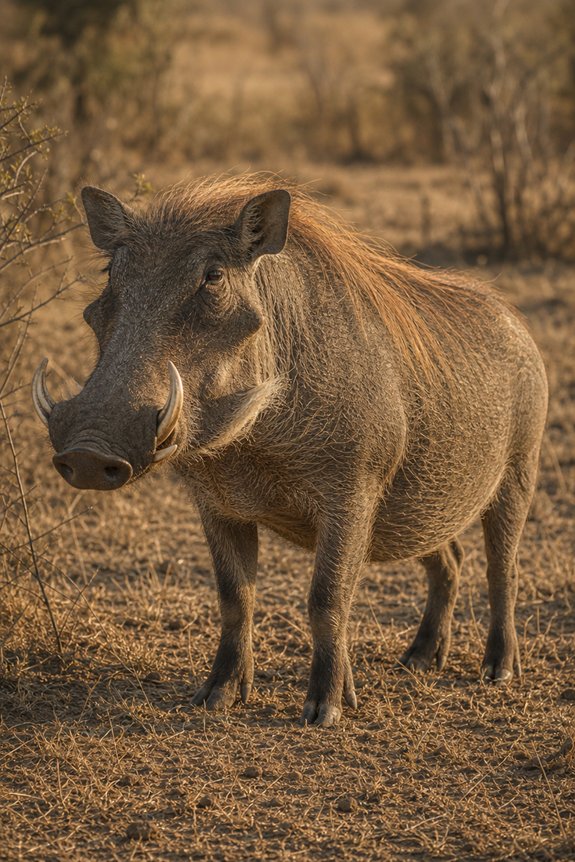
Because they share a squat, heavyset frame with short legs and a rounded back, warthogs often draw casual comparisons to capybaras. These African wild pigs weigh 50 to 150 kg and measure 0.9 to 1.3 meters long. They’re bigger than capybaras but share that same ground hugging, barrel bodied look.
- Dust clouds rise behind running warthogs as their tufted tails stick straight up like antennae
- Curved ivory tusks gleam against dry savanna grass during morning grazing
- Rough facial warts cast small shadows across their snouts in harsh midday sun
Yet the resemblance ends there. Warthogs are ungulates, members of family Suidae, not rodents. They dig burrows in sub Saharan savannas and woodlands rather than wallowing in wetlands. Their tusks serve defense, not gnawing. The comparison is skin deep, not scientific.
12. Tapir: Supersized Capybara of the Rainforest
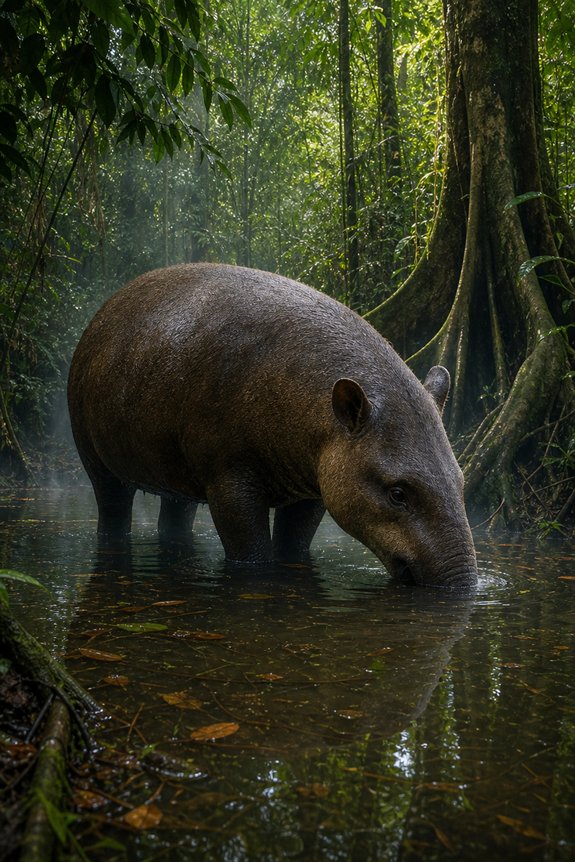
Tapirs lumber through rainforest shadows with the same heavy grace that makes capybaras so recognizable. These mammals weigh 150 to 300 kg. Their rounded bodies and short legs create familiar silhouettes.
Unlike capybaras, tapirs carry a flexible proboscis. This short trunk grasps leaves and fruit. Their teeth show browsing adaptations. Four species survive today. They live in Central and South American rainforests, plus Southeast Asian forests.
Tapirs serve as seed dispersers. One individual spreads large seeds across long distances. This supports forest regeneration. It maintains plant diversity, or the variety of life forms in an ecosystem.
They’re largely nocturnal and solitary. Three species face Vulnerable or Endangered status. Habitat loss and hunting threaten them. Their conservation matters deeply. Rainforest ecosystems depend on their survival.
13. Quokka: Australia’s Smiling Marsupial Match
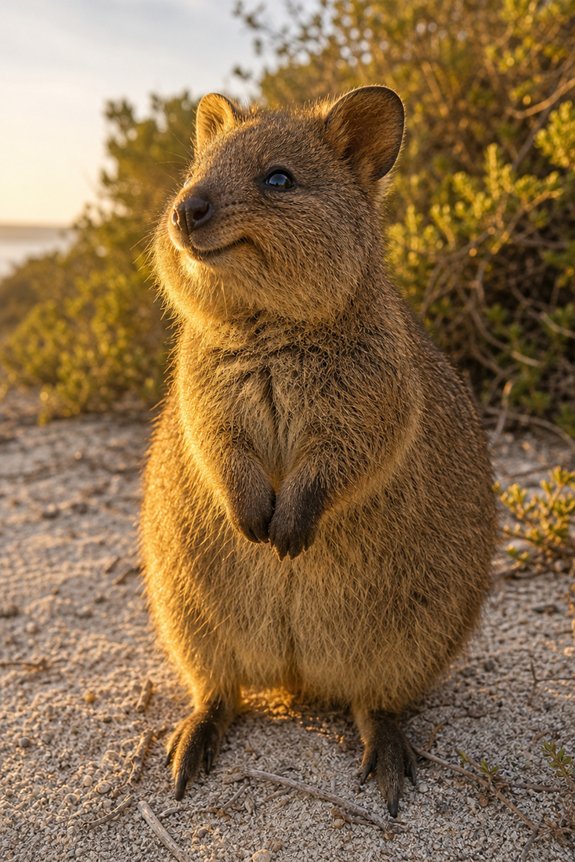
Quokkas often appear in photographs with curved mouths that suggest human smiles. This small macropod, *Setonix brachyurus*, weighs 2.5 to 5 kg and measures 40 to 54 cm in length. Its round, friendly looking face draws comparisons to capybaras. The species lives on Rottnest Island and isolated mainland pockets in Western Australia. Habitat loss and predation threaten its survival. The quokka is Vulnerable, meaning it faces a high risk of extinction in the wild.
These nocturnal herbivores eat grasses, leaves, and shrubs. They survive without free water for long periods. They extract moisture from food instead.
- A joey no larger than a jelly bean crawls into the pouch
- Moonlight catches coarse brown fur as the quokka forages
- Tourists kneel, cameras ready, while the animal sniffs a sneaker
Human interaction creates problems. Feeding disrupts natural behavior. Brief reflection: protecting this species matters for biodiversity, the variety of life in an area.
South American Rodents Compared: Mara, Paca, and Agouti
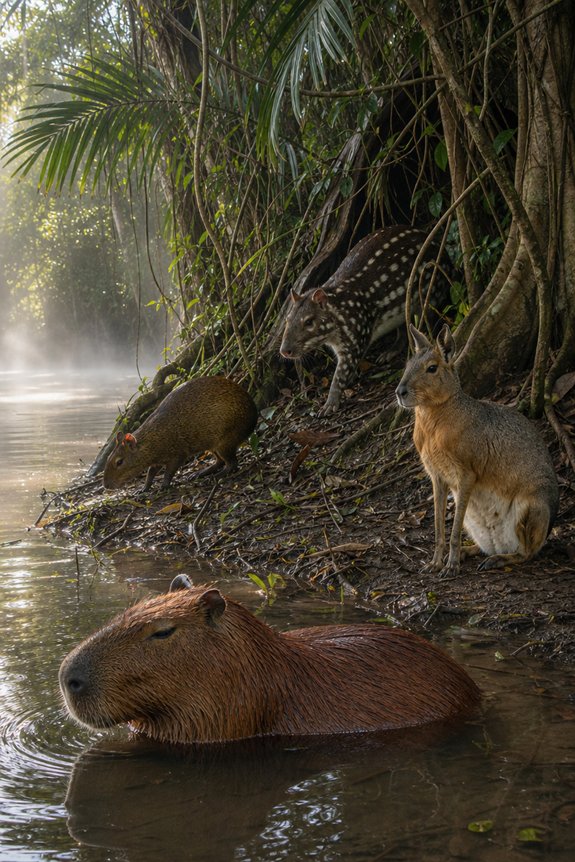
Three South American rodents share distant kinship with the capybara yet carve out distinct lives across the continent.
The Patagonian mara weighs 8 to 16 kg. It resembles a cross between hare and capybara. This long limbed rodent inhabits arid grasslands. It forms monogamous pairs. It grazes and digs burrows.
The paca weighs 6 to 12 kg. It bears white spotted flanks. This nocturnal forest dweller forages alone beneath dense canopy. It consumes fruits, seeds, and tubers.
Agoutis weigh merely 1 to 4 kg. They’re agile, diurnal, and scatter hoard seeds. They bury nuts, then forget them. This forgetfulness plants trees. It sustains forest biodiversity, the variety of living things.
Each species shapes its ecosystem differently. One reflects: small differences in habit yield large consequences for the living world.
Semi Aquatic Specialists Compared: Beaver, Muskrat, and Nutria
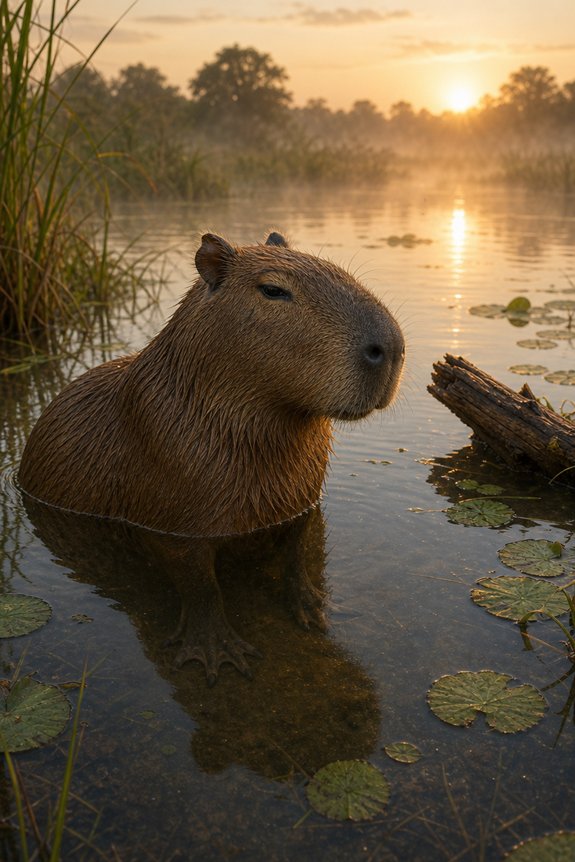
Semi aquatic rodents have colonized freshwater edges across continents. Beavers, North America’s largest at 16 to 30 kg, reshape landscapes entirely. They fell trees with ever growing incisors and construct dams, creating wetlands where countless species thrive, biodiversity means the variety of living things in one place.
Muskrats weigh far less, roughly 0.7 to 2 kg. They compress vegetation into dome lodges and slice through water with flattened tails.
Nutria, South American natives now invasive worldwide, carry distinctive orange teeth and devour marsh plants destructively.
All three possess dense waterproof fur. Their tails differ sharply: flattened in beaver and muskrat, round in nutria. Reproduction separates them too. Beavers pair for life. Muskrats breed communally. Nutria reproduce year round, exploding unchecked.
- A beaver’s tail slaps the pond surface at dusk, warning kin of danger
- Muskrat lodges rise like small haystacks from frozen winter marshes
- Nutria whiskers twitch orange in murky water as they strip vegetation bare
Size Comparison: All 13 Ranked by Weight
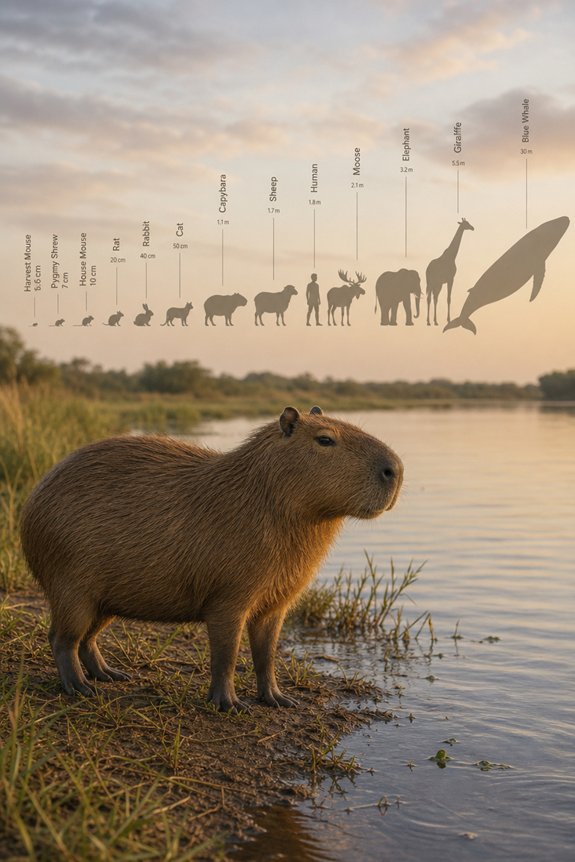
The heaviest look alikes first reveal a striking spread. Tapirs outweigh capybaras by roughly four to one, reaching 300 kg, while beavers and nutrias cluster near or below the capybara’s 35 to 66 kg benchmark.
Mid size rodent contenders like pacas and maras drop to 6 to 15 kg, and the smallest capybara resemblers (guinea pigs, chinchillas, and large rats) barely reach 5 kg, a mere fraction of the original.
Heaviest Look Alikes First
Thirteen species share enough resemblance to capybaras that they’re often mistaken for them, yet they span a remarkable weight range. South American tapirs dominate at 150 to 300 kg, dwarfing capybaras by nearly fivefold. Warthogs follow, their 50 to 150 kg frames bulking larger in dry seasons. These two alone establish the upper tier of look alike mass.
- A tapir’s barrel shaped torso submerges like a brown boulder in Amazonian streams
- Warthog tusks curve upward through coarse facial manes as they kneel to graze
- Capybaras themselves rest at 35 to 66 kg, mid list anchors in this comparison
Beavers and nutria trail behind, then maras, pacas, agoutis. The remaining five, porcupines, chinchillas, groundhogs, guinea pigs and quokkas, all sit under about 16 kg, and the chinchillas and guinea pigs under one.
Biodiversity, the variety of living forms, reveals itself through such scale. One learns that resemblance need not mean equivalence.
Mid Size Rodent Contenders
Several species cluster in the middle weights, bridging the gap between capybaras and smaller relatives. Beavers lead this group at 16 to 30 kg, reaching the top of that range in northern populations. The Patagonian mara follows at 8 to 16 kg. Nutrias weigh less at 5 to 9 kg. Muskrats drop to 0.6 to 2 kg.
Weight shifts with geography and season. Northern beavers grow heavier than southern ones. This variation matters. Heavier rodents reshape ecosystems more dramatically. Beavers build dams. Nutrias graze marshes. Their size drives this engineering. Lighter species simply lack the mass for comparable impacts.
Compared to a 50 kg capybara, only beavers approach familiar bulk. Most mid size contenders remain distant. Yet they occupy a meaningful middle ground. They aren’t capybaras. They aren’t mice. They exist between.
Smallest Capybara Resemblers
Moving downward from beavers and nutrias, the scale drops sharply. Chinchillas and guinea pigs represent the lightest capybara relatives. Chinchillas weigh 400 to 800 grams. Guinea pigs average 700 to 1,200 grams. Both animals equal roughly 1 to 2% of a capybara’s 35 to 66 kilogram mass.
Muskrats and groundhogs occupy the middle ground at 1 to 9 kilograms. Pacas follow at 6 to 12 kilograms and agoutis stay lighter at 1 to 4.
- A chinchilla’s compact body fits in one palm
- A guinea pig’s rounded silhouette mirrors its giant cousin’s proportions
- A paca’s low slung posture echoes the capybara’s semi aquatic stance
Biodiversity, the variety of life within a family, reveals itself here. The Caviidae family spans fiftyfold weight differences. One observer might find this range quietly astonishing.
Social or Solitary? Behavior Breakdown by Species
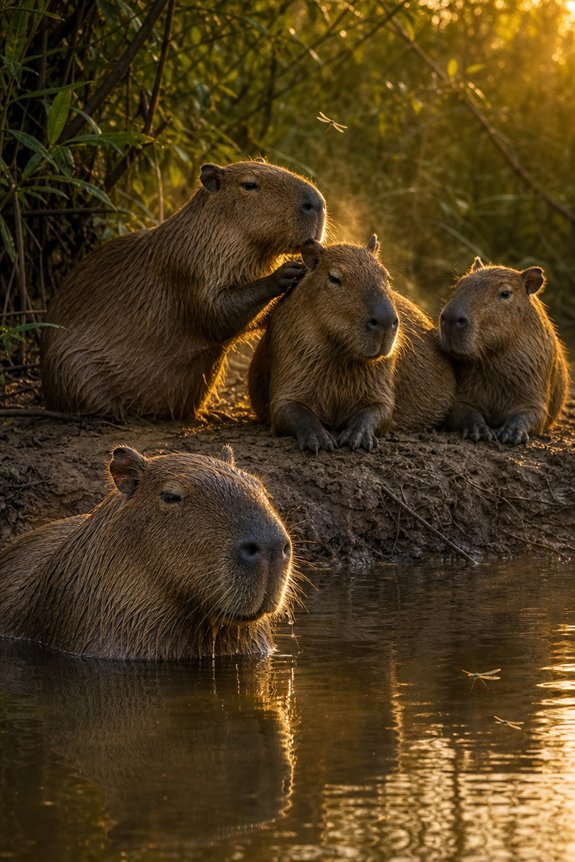
Social behavior varies dramatically across rodent species, often shaping how they interact with their environment and each other. Capybaras exemplify extreme sociality, forming cohesive groups of 10 to 20 individuals that sometimes swell to 100 members. They display strong affiliative behaviors, bonding activities like grooming and huddling that reinforce group cohesion.
Patagonian maras present a striking contrast. They’re socially monogamous, maintaining long term pairs while living communally in large colonies of shared burrows. This differs sharply from solitary pacas and agoutis.
Beavers show cooperative family structures, with mated pairs and offspring jointly maintaining dams and lodges. Porcupines and chinchillas remain largely solitary, foraging alone or in small crevice colonies.
Nutria demonstrate flexible sociality, adapting group size to habitat abundance. These behavioral patterns reveal how social needs evolve differently across similar species.
Seed Dispersers and Grazers: Why These Animals Matter
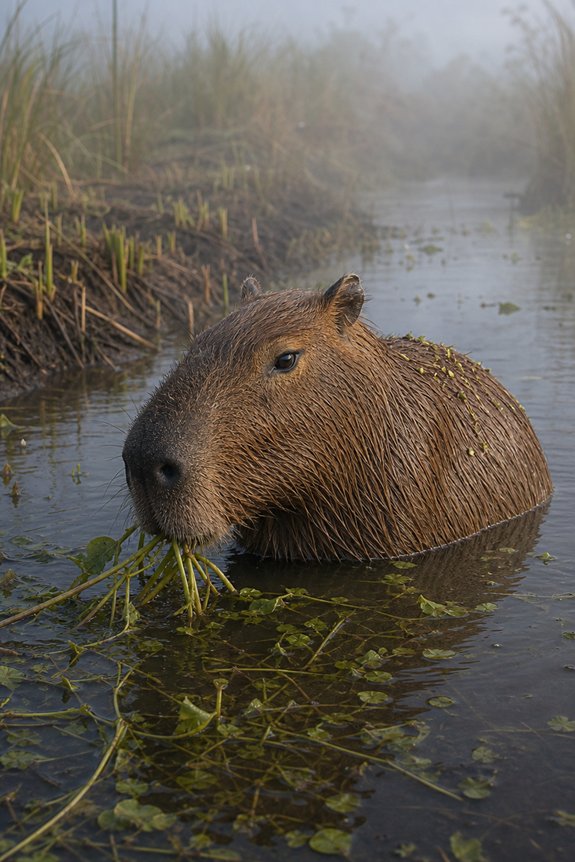
Beyond how these animals organize themselves lies what they actually do in their environments. Capybaras, tapirs, agoutis, and peccaries disperse seeds through their digestive systems, moving them hundreds of meters to kilometers. This increases plant gene flow, which helps populations stay healthy and adapt. Agoutis and pacas cache seeds underground, burying hundreds per hectare and accidentally planting Brazil nut trees.
Large grazers alter plant communities by eating grasses and seedlings. They reduce woody encroachment, which keeps habitats open. This supports biodiversity, or the variety of life in an area. Beavers and nutria engineer ecosystems by building dams and grazing aquatic plants, creating wetlands where flood tolerant species establish.
- Seeds pass through digestive tracts and sprout miles from parent trees
- Teeth clip grass to stubble, sunlight reaches tender shoots below
- Dams flood dry ground, turning forest floor into standing water pools
Balanced grazing helps seedlings survive. Too much causes erosion.
Which Look Alikes Are Endangered (And How to Help)
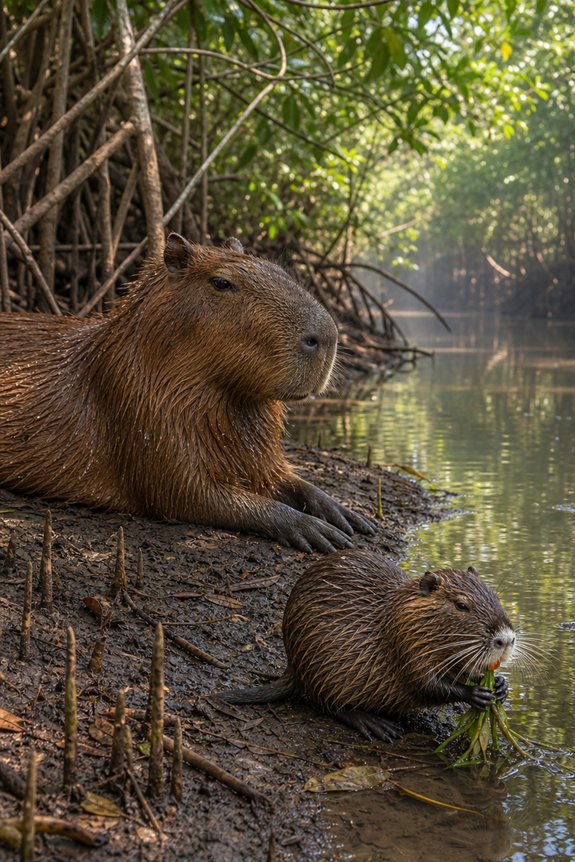
Vulnerability defines many capybara relatives today. The Patagonian mara, a Near Threatened species, faces shrinking grasslands and hunting pressure in Argentina. Conservation groups work to protect these open habitats, and readers can support their efforts directly.
Lowland tapirs carry Vulnerable status; deforestation and road collisions threaten their survival. Biological corridors (connected strips of habitat) help them move safely between forest patches.
Pacas endure overhunting in Central and South America, making sustainable management programs essential.
Wild chinchillas represent the most dire situation. The short tailed chinchilla is Critically Endangered and the long tailed chinchilla Endangered, both after centuries of fur trade and habitat loss. Captive breeding and anti poaching patrols offer hope.
Nutria aren’t threatened globally, but they’ve invaded wetlands outside their native range. Science based control protects native species there.
Small actions (donations, conscious purchasing, advocacy) matter measurably.
Capybara or Imposter? Field ID Tips That Work
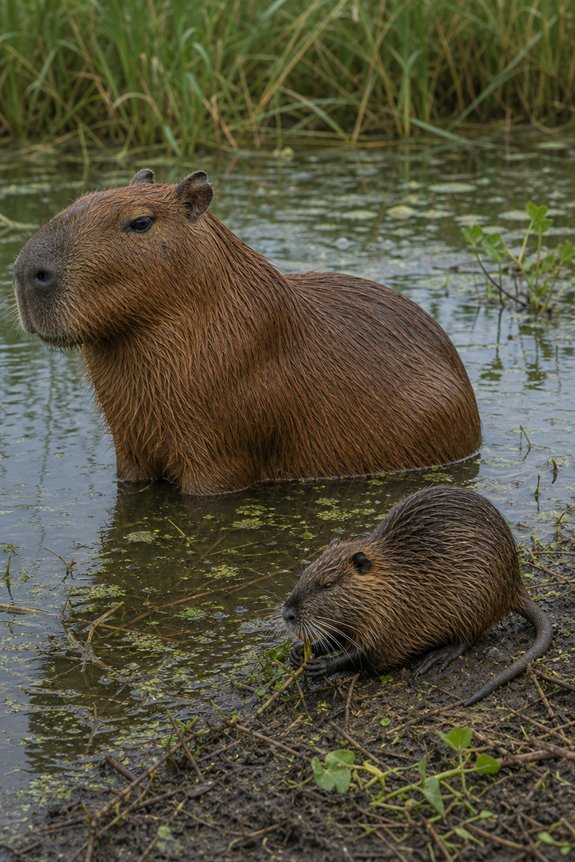
Field identification (telling a true capybara from its look alikes) requires attention to size and build clues, habitat and behavior signs, and key feature comparisons.
An observer’s first step is noting the animal’s bulk: true capybaras stand 50 to 64 cm at the shoulder and stretch 100 to 130 cm long, dwarfing any agouti or guinea pig that might cause confusion.
The combination of social grouping near freshwater, virtually absent tail, and partially webbed feet separates them cleanly from beavers with flat tails, pacas with spotted coats, and maras with elongated limbs.
Size And Build Clues
A field biologist’s first task is size assessment, and capybaras make this straightforward. They carry unmistakable bulk. An adult weighs 35 to 66 kg. Anything under 20 kg isn’t a capybara. It’s that simple.
The body itself tells stories. Capybaras show a barrel shaped torso that sits low to the ground. Their legs stay short and sturdy. No tail worth mentioning extends behind them. This differs from nutria, whose flattened tails drag visibly.
- Coarse brown fur hangs uniformly across the body, never spotted like a paca or quilled like a porcupine
- Partially webbed feet and facial features set high on the head suggest semi aquatic life
- A blunt, square muzzle pairs with small rounded ears pressed close to the skull
These details separate capybaras from elongated tapirs or tusked warthogs. Shape reveals truth.
Habitat And Behavior Signs
Moving beyond body shape, observers find habitat and behavior equally telling.
True capybaras swim with a smooth, low profile. Often only their eyes and nostrils break the water’s surface. This contrasts with nutria and muskrats. Those species show pronounced tail driven undulations.
Check the feet. Capybaras have partially webbed toes. Beavers and muskrats display fully webbed, flattened tails. The tail itself provides another clue. Capybaras carry an almost invisible stub. Imposters reveal long, visible tails from 10 to 30 meters away.
Activity patterns distinguish clearly. Capybaras are diurnal, meaning active during daylight. They gather in groups of 10 to 20 individuals. Pacas and agoutis prefer night hours. They live alone. Group size and timing offer strong identification tools.
Social behavior matters. It reflects genuine ecological niche, not mere preference.
These observations complete the picture. They distinguish the world’s largest rodent from its lookalikes.
Key Feature Comparisons
When distinguishing a capybara from its imposters, observers can’t rely on a single trait; they must weigh several features together. Size matters first. True capybaras reach 35 to 66 kg, dwarfing most mimics. Biodiversity, the variety of life in an area, creates many look alikes. Observers should scan for the stumpy limbs and nearly invisible tail that distinguish capybaras from beavers with their flattened paddles or maras with their hare like haunches.
Coat texture offers another clue: uniform brown coarseness signals capybara, while spots or stripes suggest paca. At close range, the broad blunt muzzle with forward incisors confirms identity. Narrower snouts or tusks mean imposter. Patient observation rewards the careful watcher.
- A barrel shaped silhouette floating at dawn, half submerged like a brown boulder in still water
- Webbed feet splayed in mud, toes spreading wide as the animal climbs a riverbank
- Small ears twitching above coarse fur, the whole herd grazing shoulder to shoulder in silent synchrony
Why These Resemblances Aren’t Coincidence
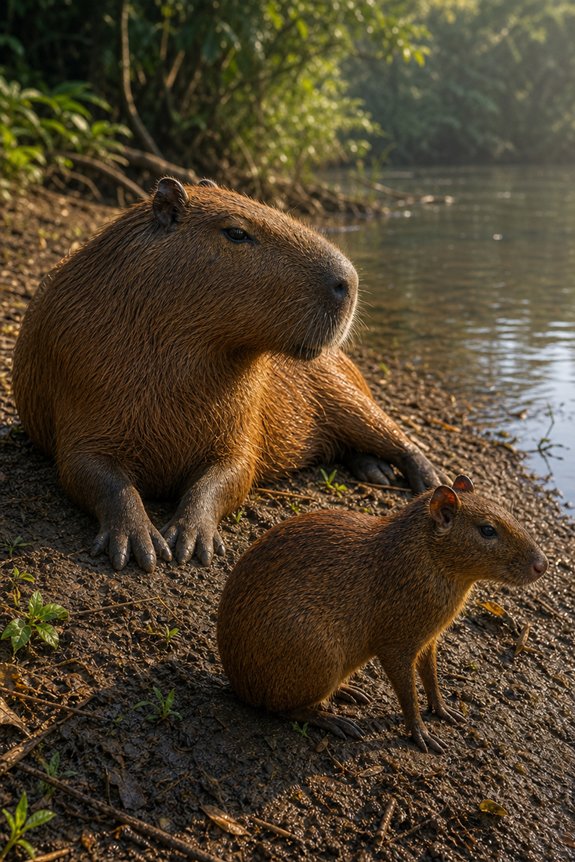
Because nature often produces similar solutions to similar challenges, the animals that look like capybaras aren’t merely accidents of chance. Many share ancestry. Pacas, agoutis, and guinea pigs belong to Caviomorpha. This clade, a group of related species, produces similar body plans. Stout bodies and short limbs reflect shared genes.
Other resemblances emerge from convergence. Nutrias, muskrats, and beavers aren’t close relatives. Yet wetlands select for webbed feet and dense fur. Swimming demands efficiency. Thermoregulation matters in water.
Large herbivores like tapirs and warthogs show ecological convergence. Grazing favors bulky bodies. Predator pressures encourage group living. Defense drives social behavior.
Coat patterns evolve independently. Spots and quills serve camouflage. Parallel diets shape similar teeth. Ever growing incisors process tough plants. Nature repeats what works.
What Is the Closest Animal to a Capybara? (Taxonomy Deep Dive)
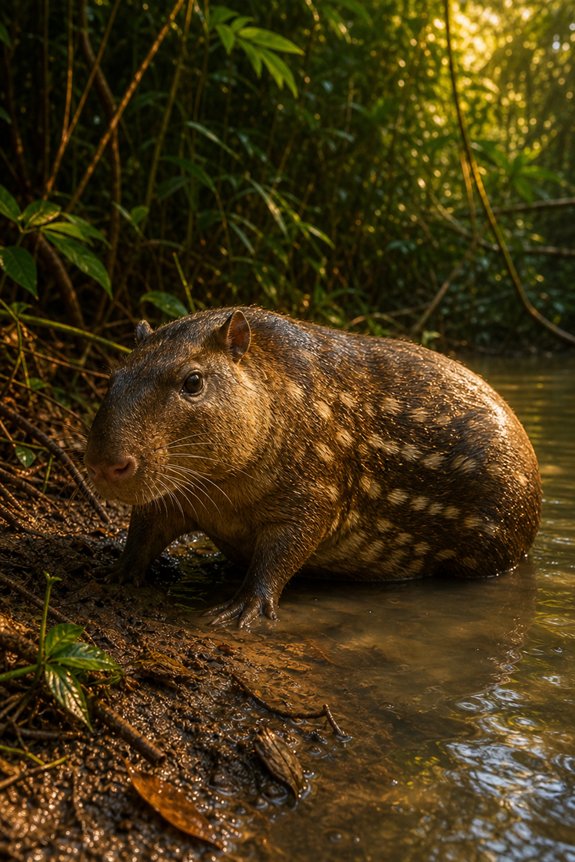
Although capybaras resemble oversized guinea pigs, this comparison holds more truth than appearance alone suggests. Capybaras belong to the family Caviidae, and so do guinea pigs and rock cavies. The closest living relative is the rock cavy, genus Kerodon, which shares the capybara’s own subfamily Hydrochoerinae. Guinea pigs sit one branch further out, in the sister subfamily Caviinae. Most articles on this subject get that wrong.
These animals descend from a common caviid ancestor. They share skull and dental features. Ever growing incisors distinguish them from many rodents. Heavy bodies and short limbs mark the group. Their bilophodont cheek teeth grind abrasive grasses. This adaptation suits herbivorous diets.
The suborder Hystricomorpha contains them all. It diverged from other rodents 40 to 45 million years ago. African ancestors colonized South America once. Molecular studies place capybaras in the subfamily Hydrochoerinae alongside the rock cavy. Guinea pigs and maras occupy Caviinae instead.
Unique aquatic traits set capybaras apart. Webbed feet, dense fur, and elevated facial features enable semiaquatic life. Terrestrial caviids lack these specializations.
Ratzilla Explained: Urban Legend or Real Rodent?
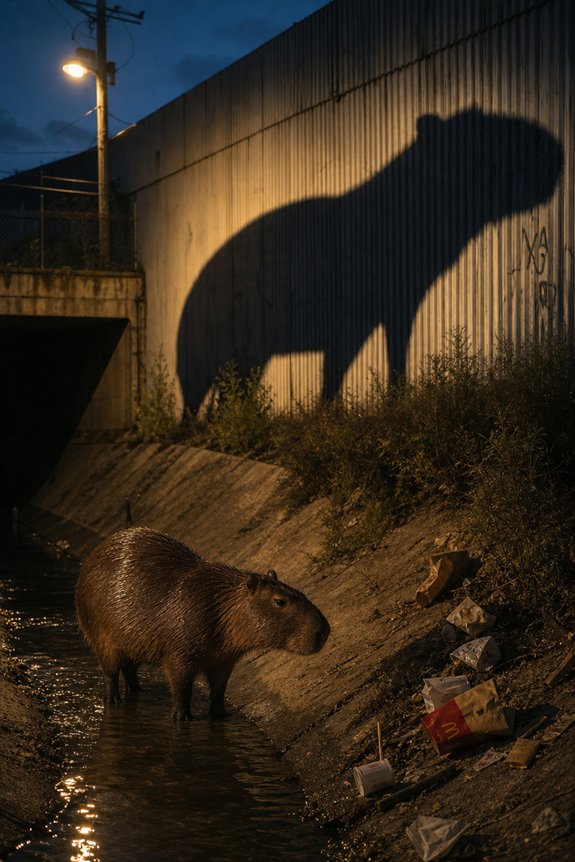
When city dwellers spot rats the size of small cats, they often label the creature “Ratzilla.” This nickname describes unusually large Norway rats, not a separate species. These animals typically weigh 300 to 500 grams, though unverified claims suggest individuals exceeding one kilogram. Urban environments with abundant food and few predators produce bigger rats. DNA studies consistently identify “Ratzilla” specimens as common Norway rats (*Rattus norvegicus*), not novel taxa, groups of organisms classified together. Biodiversity, the variety of life in an area, doesn’t include these oversized individuals as distinct species.
- A rat’s tail thick as a man’s thumb drags behind a garbage bin at midnight
- Yellow streetlight glints off coarse brown fur stretched over visible ribs
- Small paws press wet prints across a subway platform’s concrete edge
Media sensationalism amplifies public concern. Effective control requires sanitation, exclusion, and professional pest management rather than alarm.
Cutest Capybara Look Alikes: Beyond the Top 13
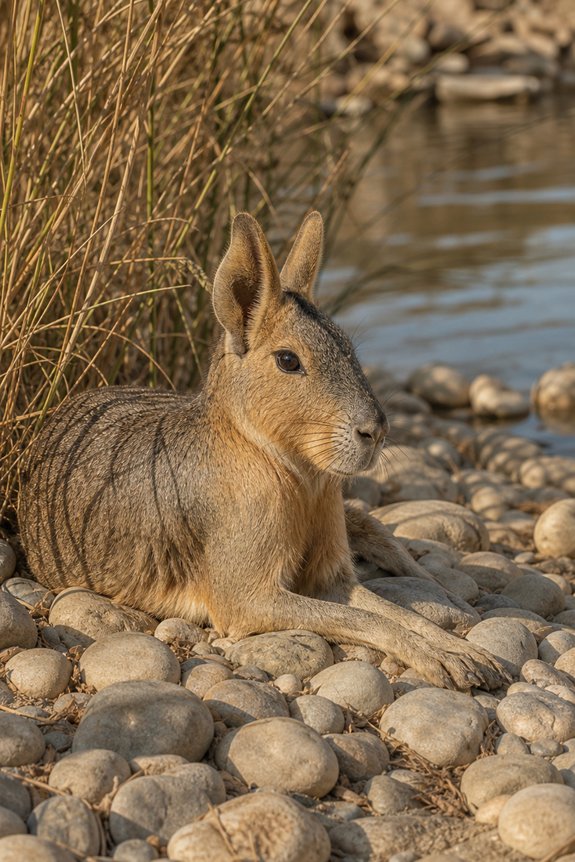
Because capybaras have become internet celebrities, many people now seek animals with similar appeal. Guinea pigs, close relatives in family Caviidae though the rock cavy is closer still, share herbivorous diets and social behaviours. They’re roughly 1/50th the size.
Patagonian maras resemble capybaras in facial structure and grazing habits. They’ve developed long limbs for running. These animals reach speeds of up to 45 mph.
Pacas and agoutis display the same compact, rounded body plan. They share seed eating ecology. Pacas have distinctive white spotted coats. These patterns provide nocturnal camouflage.
Nutria, also called coypus, mimic capybaras’ semi aquatic lifestyle. Both possess webbed feet and dense fur. Nutria typically weigh 5 to 9 kg. Capybaras reach 35 to 66 kg.
Quokkas and koalas are often cited as “cute” look alikes. They share rounded faces and gentle expressions. However, they’re marsupials. Their diets and evolutionary histories differ greatly.
Biodiversity, the variety of life in a particular habitat, reveals how similar traits emerge across unrelated species.
Final Thoughts
The world’s capybara look alikes number far beyond twelve, each species representing biodiversity, the variety of life forms in an ecosystem. Patagonian maras, pacas, and agoutis demonstrate convergent evolution, where unrelated animals develop similar traits in shared environments. These rodents matter. They shape habitats, disperse seeds, and maintain ecological balance across Central and South America. Understanding them means understanding connectedness. One might pause here, considering how many unrecognized species still await discovery in shrinking forests.

Erzsebet Frey (Eli Frey) is an ecologist and online entrepreneur with a Master of Science in Ecology from the University of Belgrade. Originally from Serbia, she has lived in Sri Lanka since 2017. Eli has worked internationally in countries like Oman, Brazil, Germany, and Sri Lanka. In 2018, she expanded into SEO and blogging, completing courses from UC Davis and Edinburgh. Eli has founded multiple websites focused on biology, ecology, environmental science, sustainable and simple living, and outdoor activities. She enjoys creating nature and simple living videos on YouTube and participates in speleology, diving, and hiking.
From the shop
Gifts for people who love the wild
Wildlife themed t-shirts, notebooks, tote bags, bandanas and guides, designed by an ecologist.
Visit the shop