
Before you choose your refugia or transect design, it is worth comparing the options side by side. This free guide to ecological survey methods covers 188 field techniques with effort, season, kit and a printable datasheet for each one.
Conservation context
More than one in five reptile species are threatened with extinction, according to the first global reptile assessment, which makes understanding them matter more than ever.
Reptile surveys require planning between March and October when temperatures reach 9 to 20°C. You’ll need artificial refuges like felt squares and corrugated sheets placed in ideal habitats such as grasslands and woodland edges. Survey during early morning or late afternoon when reptiles bask, avoiding rain and strong winds.
You do not need a licence to survey common reptiles in either the UK or the US, but you do need one for protected species and for anything involving handling, so check the rules for your country and species before you start. Proper execution guarantees accurate species identification and fulfills legal requirements for development projects.
Planning Your Reptile Survey Objectives
Before commencing a reptile survey, you’ll need to establish clear objectives that satisfy both scientific and regulatory requirements. Start by confirming your obligations under local wildlife laws and protected species regulations to avoid potential fines for habitat disruption.
Your survey should be designed to detect presence/absence of reptiles with high confidence while estimating minimum population size and distribution. Focus on evaluating habitat suitability across various environments including grasslands, heath, and brownfield sites.
Align your objectives with conservation priorities for threatened species and integrate appropriate biodiversity assessment methodologies.
Your data will ultimately guide mitigation measures, so plan to collect information that can inform habitat preservation zones and species credit calculations.
Remember to structure your survey to minimize false negatives through systematic design, as this will be vital for developing effective relocation plans and habitat compensation strategies later in your project.
Essential Equipment and Field Materials
Once you’ve established your survey objectives, you’ll need to gather the right tools for the job.
Start with artificial refuges: corrugated reptile refugia, felt squares, or carpet tiles provide shelter and basking spots that attract reptiles. For handling, invest in snake hooks of 100 to 130cm and tongs of 91 to 120cm, plus HexArmor guards if venomous species are present.
Measurement tools are essential: Pesola spring scales for weighing specimens, tape measures for size documentation, and waterproof notebooks for recording data. Our department provides a variety of precision scales and balances for accurately weighing reptile specimens in the field.
Consider using the Dragon Finder App to submit sightings digitally.
For effective detection, pack torches for illuminating refuges, amphibian nets for difficult terrain, and camera traps to monitor without disturbance.
If you’re surveying protected species like sand lizards or smooth snakes, carry your licensing documents.
Always check weather conditions before heading out. Surveys are most productive when air temperature sits between 9 and 20°C, with bright sun on the cooler days and hazy or broken sun when it is warmer.
Selecting Optimal Survey Locations and Habitats
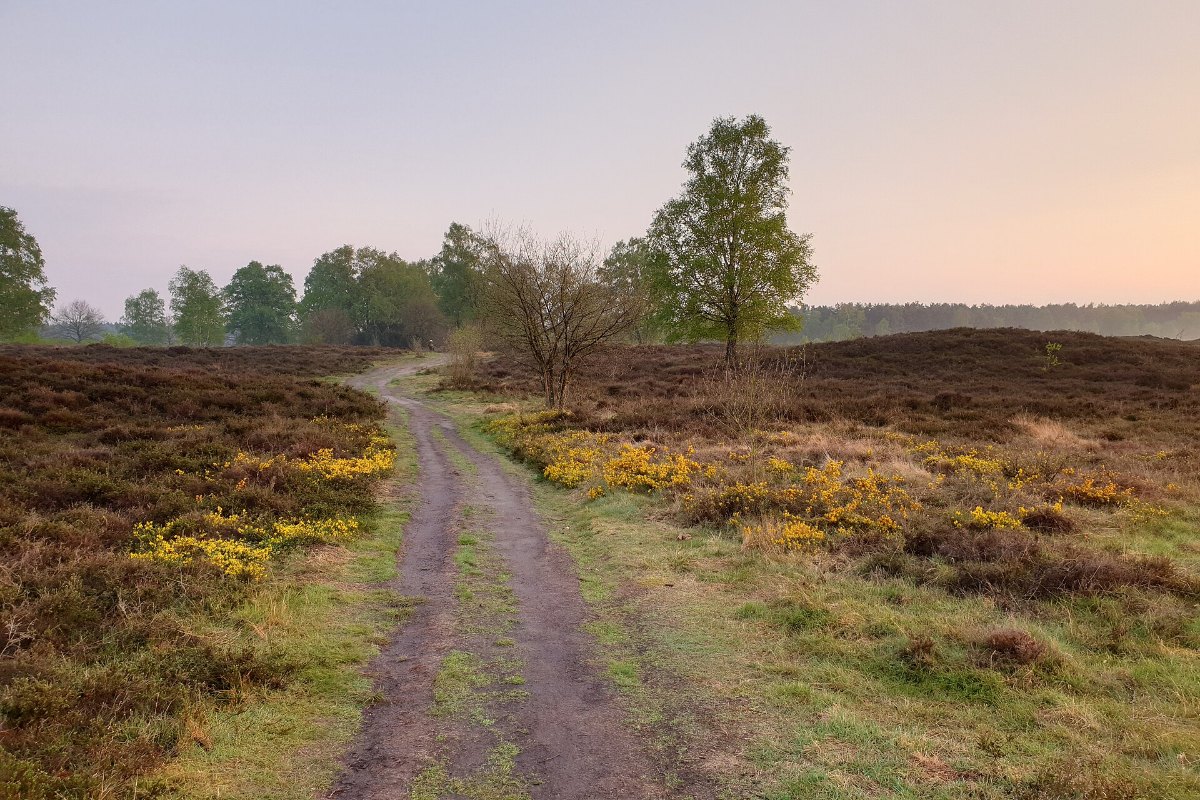
Choosing the right locations considerably increases your chances of encountering reptiles during surveys. Focus on open grasslands, south facing chalk downland, woodland edges, and even brownfield sites where reptiles can thermoregulate effectively.
These are often the same margins that produce for other groups, so if you are also running a mammal survey on the site, the two transect networks can share a route.
Target specific microhabitats within these areas. Examine south facing embankments, log piles, stone walls, and shifting zones between different habitat types. These edges, particularly woodland/grassland boundaries and wetland interfaces, create ideal conditions for various reptile species. The most productive survey sites are often found in transitional zones between different habitats.
Pay special attention to topography. South facing slopes with well drained soils offer maximum solar exposure, while elevated features provide vantage points. Don’t overlook artificial structures like railway verges and managed but untamed private gardens.
For seasonal success, search damp microhabitats during cooler months for grass snakes and adders. Remember that different species prefer different conditions. Grass snakes favor wetland proximities, while common lizards thrive along scrubby margins.
When Is the Best Time to Survey Reptiles?
Survey from March to October, with April and May the most productive months, in air temperatures of 9 to 20°C, in the morning or late afternoon, on days with sun and little wind. Successful reptile surveys depend heavily on timing and weather conditions that align with reptile behavior patterns.
Reptiles are active from March to October, and that is the outer window. The productive core is April and May, when animals bask heavily before summer vegetation closes in.
Late August to late September is the second window and the best time to find the year’s juveniles. None of this is a legal restriction; it is simply when the animals are findable.
Focus your efforts during early morning and late afternoon when many species emerge to bask in the sun while avoiding midday heat. Temperature considerably affects reptile activity.
Conduct surveys when air temperature sits between 9 and 20°C (48 to 68°F), with bright sun on the cooler days and hazy or broken sun when it is warmer.
Reptiles are hard to find in the cold, and above roughly 20°C many species stop basking in the open and retreat into cover, so a hot afternoon is not the bonus it looks like.
Avoid surveying during heavy rain, strong winds, or overcast days when reptiles typically remain hidden. Instead, target days following light rainfall when humidity is higher.
The weather rules run in the opposite direction to a bird survey, where the dawn chorus is the target and sun is irrelevant. Here the sun is the whole point.
Spring and early summer are particularly productive periods as many species engage in breeding activities and territorial displays, making them more conspicuous and easier to document during your survey efforts. Specifically, April and May are considered optimal months for reptile surveys as activity levels peak during this time.
How Many Refugia Do You Need, and Where Do They Go?
About 10 refuges per hectare, laid out in groups of up to 10 with 2 to 5 metres between sheets, on south facing slopes and scrub edges. Effective refugia placement forms the cornerstone of any thorough reptile survey, providing artificial shelters that attract species for easier identification and counting.
Two separate numbers govern this, and they are usually run together into one wrong sentence. The density is a baseline of about 10 refuges per hectare of suitable habitat.
The arrangement is groups of up to 10 sheets, with the sheets inside each group spaced 2 to 5 metres apart. Put the groups in hotspots: south facing slopes, scrub edges, and the boundaries between habitat types.
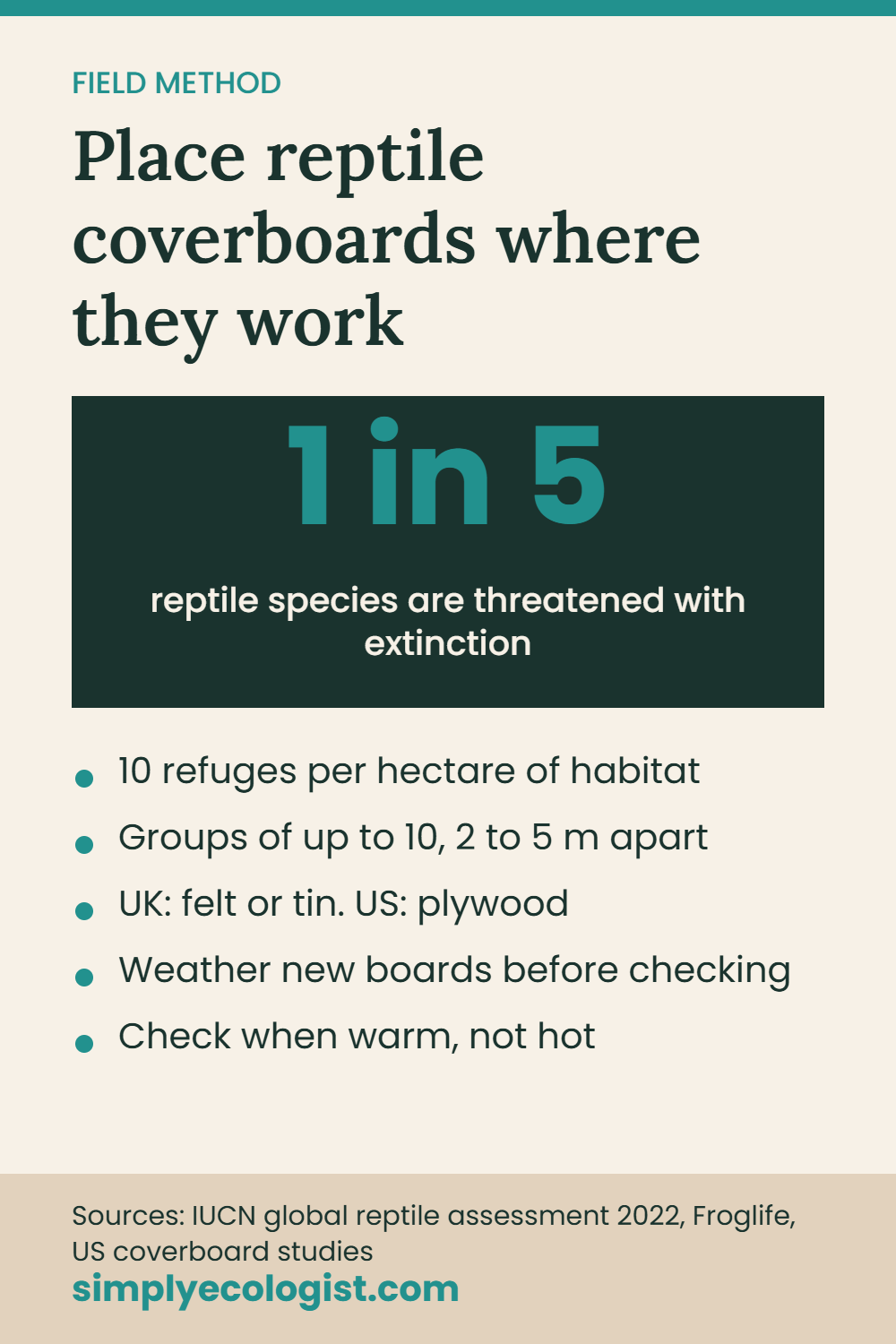
Use dark, heat absorbent materials (felt or tin) sized 50x50cm to 100x50cm, placing them on short grass partially overgrown with vegetation.
Avoid high disturbance areas and map each refugia with GPS for consistent tracking.
When monitoring, check refugia when surfaces feel warm but not hot, ideally after cold or rainy days.
Tilt edges vertically when lifting to avoid startling reptiles, using tools when necessary near adder habitats. Allow 2 to 4 weeks after deployment before your first check, and always replace refugia exactly as found, maintaining vegetation cover to preserve microhabitat conditions.
Refugia in the UK, coverboards in the US: the same technique, two vocabularies
UK guidance calls them artificial refugia and reaches for roofing felt or corrugated tin at roughly 50x50cm. US herpetologists call the same things coverboards or artificial cover objects, and the standard unit is a sheet of plywood, often around 2 by 4 feet and half an inch thick.
The material differs mainly because of climate: tin heats fast and works well in a cool British spring, while plywood buffers temperature and survives a hotter summer.
One detail carries across both traditions and is regularly skipped: boards need to weather before they work. A published Californian coverboard study seasoned its plywood in place for three months before collecting any data.
UK guidance similarly asks for 2 to 4 weeks between deployment and the first check. A board put down last week is not a survey, it is a piece of wood.
Layout in that Californian study is a useful worked example: 72 boards per reserve, arranged as paired transects 25 metres long and 15 metres apart, with six boards on each transect spaced every five metres, checked once a week from December through July.
That array recorded 17 amphibian and reptile species and over a thousand observations across a single wet to dry season. The principle behind the geometry is the same one behind the UK grouping rule: clusters of boards along a habitat edge, not boards scattered evenly across a field.
Species Identification and Data Recording Methods
Accurate species identification and meticulous data recording form the twin pillars of any successful reptile survey.
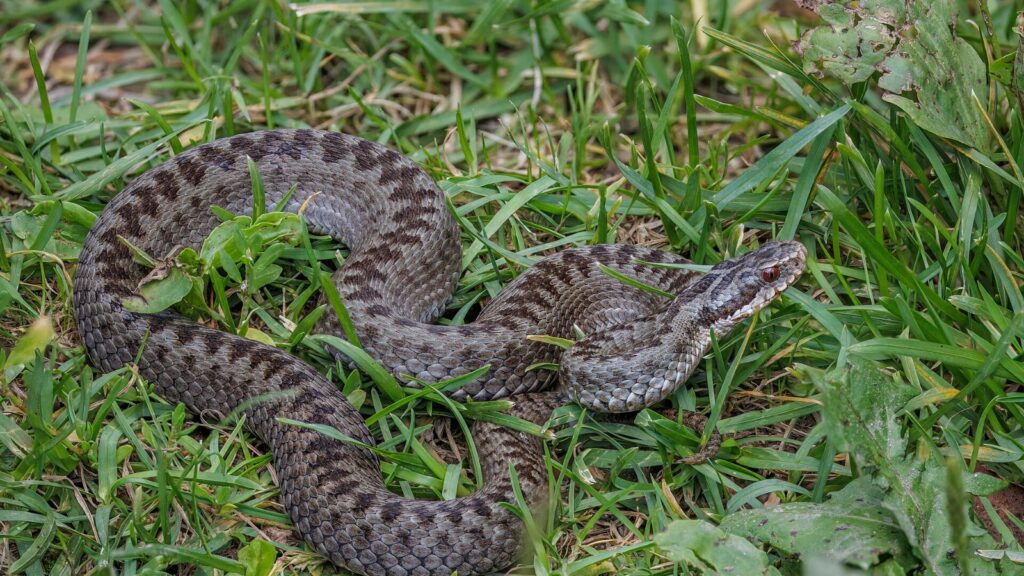
Learn to distinguish species by their visual characteristics. Adders display a distinctive dark zigzag down the back and a vertical pupil with a reddish iris, while grass snakes have a yellow and black collar just behind the head and a round pupil. Focus your searches on habitat edges and basking sites like logs and artificial refugia.
When recording observations, use standardized tools like the Dragon Finder App or forms that capture site conditions, habitat types, and precise grid references.
Remember to submit all surveys, even those without sightings, to increase data accuracy.
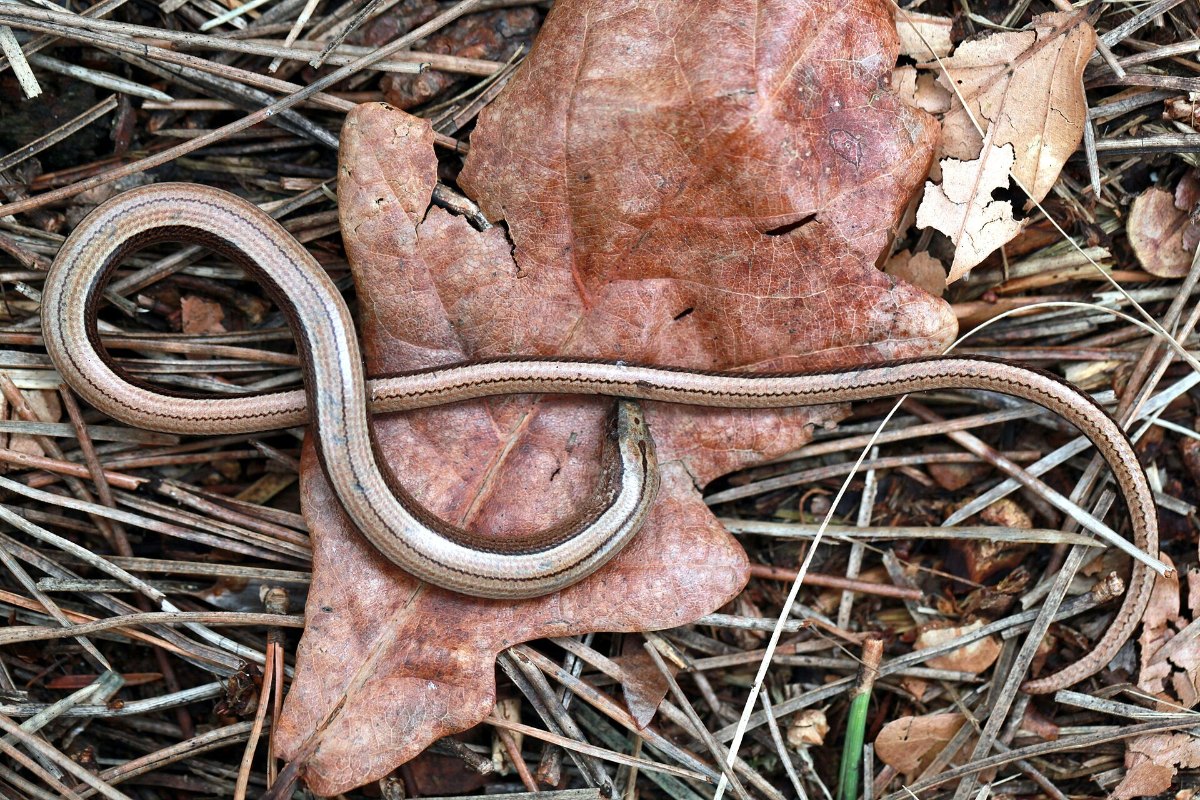
For identification, know key differences between venomous and non venomous species. The quickest separation is legs: common lizards have four, slow worms have none. Slow worms are legless lizards, not snakes, and unlike a snake they can blink.
Document life stages accurately, noting morphological differences between juveniles and adults.
When encountering rare species like sand lizards or smooth snakes, remember you’ll need special licenses to conduct formal surveys for these protected reptiles.
The six British reptiles
| Species | Look at this first | Habitat | Licence to survey? |
|---|---|---|---|
| Adder (Vipera berus) | Dark zigzag down the back, vertical pupil, reddish iris. Venomous. | Heath, moor, woodland edge, coastal dune | No |
| Grass snake (Natrix helvetica) | Yellow and black collar behind the head, round pupil. Not venomous. | Wetland margins, ponds, compost and manure heaps | No |
| Smooth snake (Coronella austriaca) | Slim, grey brown, paired dark blotches, dark eye stripe. Not venomous. | Dry lowland heath, mainly southern England | Yes, for refugia surveys |
| Common lizard (Zootoca vivipara) | Four legs. Males spotted with an orange belly, females striped. | Heath, grassland, scrub margins, embankments | No |
| Sand lizard (Lacerta agilis) | Stockier, boldly blotched flanks, males green in spring. | Sand dune and lowland heath | Yes, for refugia surveys |
| Slow worm (Anguis fragilis) | No legs, but a lizard: it can blink, which no snake can. | Grassland, gardens, allotments, compost heaps | No |
Common US survey species
The US has no equivalent short list, since the fauna is far larger and varies by state, but these are the species a coverboard array in the eastern and central states most often turns up.
| Species | Look at this first | Note |
|---|---|---|
| Common garter snake (Thamnophis sirtalis) | Three pale stripes, keeled scales | The default snake under a board almost everywhere |
| Eastern fence lizard (Sceloporus undulatus) | Rough keeled scales, blue belly patches on males | Basks on logs and stumps rather than under cover |
| Five lined skink (Plestiodon fasciatus) | Smooth shiny scales, blue tail on juveniles | Common under boards and bark |
| Dekay’s brownsnake (Storeria dekayi) | Small, brown, paired dark spots along the back | Very frequently recorded under coverboards |
| Eastern ratsnake (Pantherophis alleghaniensis) | Large, loaf shaped in cross section, climbs well | Often found under larger boards and tin |
| Copperhead (Agkistrodon contortrix) | Hourglass crossbands, vertical pupil, heat pit. Venomous. | Use a hook; lift the far edge of the board first |
Do You Need a Licence to Survey Reptiles?
Understanding the legal framework matters as much as the field technique, and it is the part most guides get wrong. The rule of thumb in both countries is the same: looking is rarely regulated, touching almost always is.
If you are surveying in the UK
All six native British reptiles are protected under the Wildlife and Countryside Act 1981, but the level of protection differs. The four widespread species, adder, grass snake, common lizard and slow worm, are protected against intentional killing and injury.
You do not need a licence to survey them, including surveys using artificial refuges, and you do not need one to record what you see.
Sand lizard and smooth snake are the exception. Both are European Protected Species, and a licence from Natural England, NatureScot or Natural Resources Wales is required for refugia based survey work targeting them. Observation without disturbance or handling is not licensable.
Penalties are frequently misreported as a £5,000 maximum. That cap was removed in England and Wales on 12 March 2015, and fines at this level are now unlimited in the magistrates’ courts. Scotland retains its own scale, and custodial sentences remain available in both.
If you are surveying in the US
There is no federal permit for surveying reptiles generally. Regulation sits mostly at state level and is triggered by capture and handling rather than by observation. Most states require a scientific collecting permit from the state wildlife agency to capture, mark or handle native reptiles.
Illinois, for example, issues a Herptile Scientific Collection Permit for handling non listed species, and a separate permit for endangered and threatened species. Names and categories vary considerably between states, so read your own state agency’s rules rather than a neighbouring state’s.
Federally listed species are covered by the Endangered Species Act. Work that would take a listed species, including capture for survey purposes, needs a section 10(a)(1)(A) recovery permit from the US Fish and Wildlife Service.
Survey work on federal land, including national parks and national forests, usually needs a separate research and collecting permit from the managing agency whatever the species.
Deploying coverboards is not itself licensed in the US, but putting anything on land you do not own needs the landowner’s or the agency’s permission, and on public land that permission is often part of the same permit as the survey.
Safety, wherever you are
Venomous species change the risk profile. In the UK that means the adder. In the US it means copperheads, cottonmouths and rattlesnakes across much of the country.
Use a hook rather than hands, never lift a refuge towards yourself, tilt the far edge up first so the animal has an escape route away from you, and know the distance to the nearest hospital before you start.
If your survey confirms reptile presence on a development site, expect to be legally required to implement mitigation such as habitat creation or relocation, and to report species and density to the planning authority.
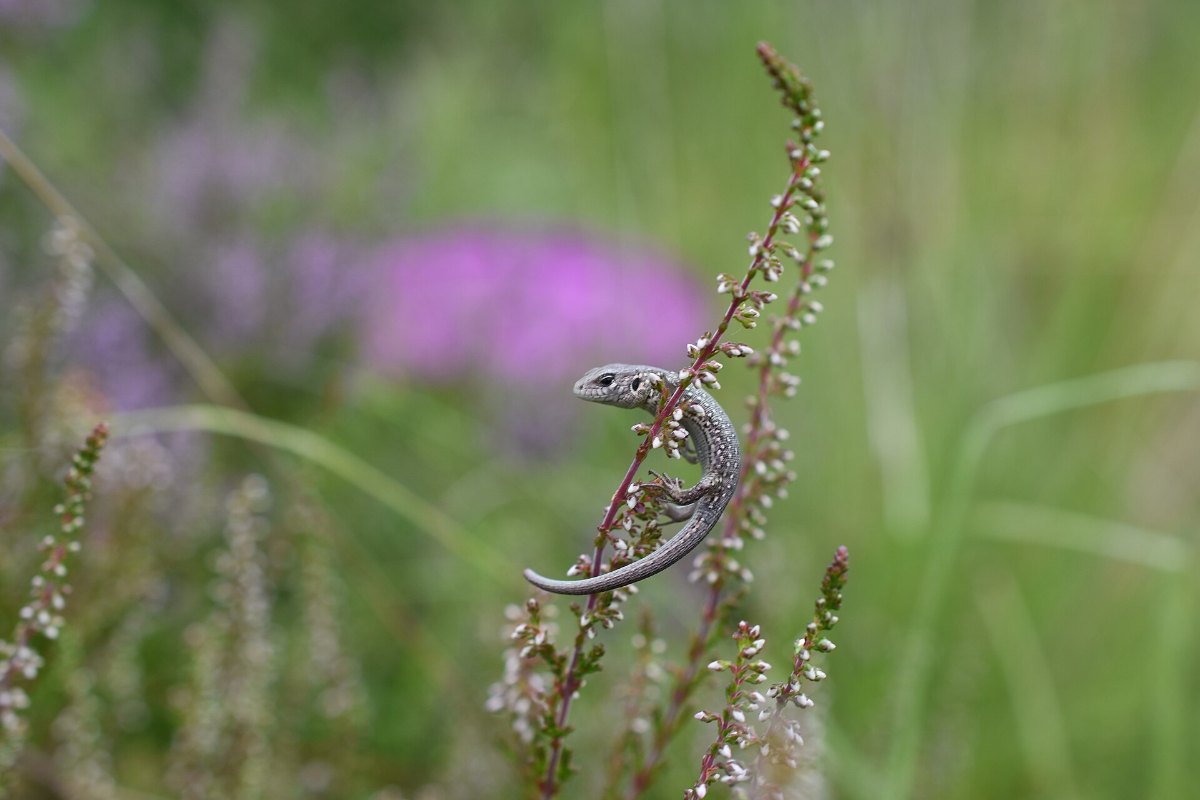
Header image: Charles J. Sharp, CC BY-SA 4.0, via Wikimedia Commons
References
- https://arbtech.co.uk/protected-species/reptile-survey/
- https://www.froglife.org/wp-content/uploads/2013/06/Reptile-survey-booklet-3mm-bleed.pdf
- https://www.froglife.org/2022/02/28/a-beginners-guide-to-reptile-surveying/
- https://www.wildcare.co.uk/media/wysiwyg/pdfs/froglife_advice_sheet_10_-_reptile_surveys.pdf
- https://www.environment.nsw.gov.au/-/media/OEH/Corporate-Site/Documents/Animals-and-plants/Biodiversity/threatened-reptiles-biodiversity-assessment-method-survey-guide-20220563.pdf
- https://www.nhbs.com/en/1/amphibian-reptile-survey
- https://www.nhbs.com/en/blog/nhbs-guide-to-reptile-survey-equipment
- https://www.legislation.gov.uk/ukpga/1981/69/contents
- https://www.gov.uk/government/news/unlimited-fines-for-serious-offences
- https://www.fws.gov/library/collections/permits-native-endangered-and-threatened-species
- https://naturalheritage.illinois.gov/permits/herp-permits.html
- https://theoryandpractice.citizenscienceassociation.org/articles/10.5334/cstp.131

Erzsebet Frey (Eli Frey) is an ecologist and online entrepreneur with a Master of Science in Ecology from the University of Belgrade. Originally from Serbia, she has lived in Sri Lanka since 2017. Eli has worked internationally in countries like Oman, Brazil, Germany, and Sri Lanka. In 2018, she expanded into SEO and blogging, completing courses from UC Davis and Edinburgh. Eli has founded multiple websites focused on biology, ecology, environmental science, sustainable and simple living, and outdoor activities. She enjoys creating nature and simple living videos on YouTube and participates in speleology, diving, and hiking.
From the shop
Gifts for people who love the wild
Wildlife themed t-shirts, notebooks, tote bags, bandanas and guides, designed by an ecologist.
Visit the shop