
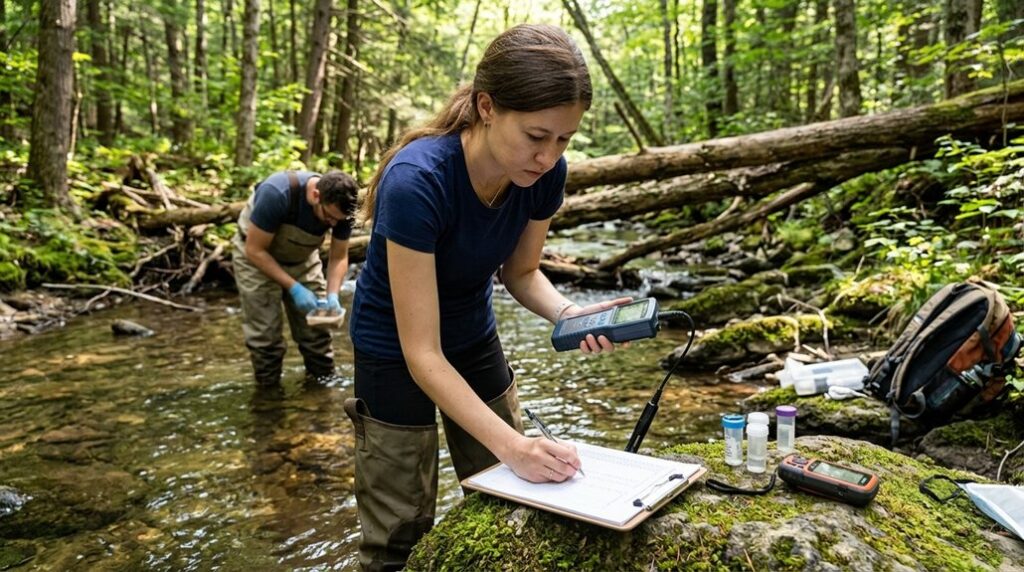
Quick answer: The highest demand ecology jobs are environmental scientists (the largest group, about 80,000 jobs and ~8,500 openings a year), hydrologists (highest pay, ~$88,770), and environmental engineers (~$100,090), alongside steady demand for restoration ecologists, consultants, and compliance specialists. You can break in with a bachelor’s degree plus practical skills, wetland assessment, GIS, and data analysis, and demand clusters in coastal cities, Western public lands, and energy hubs.
You’ll find the strongest demand among environmental scientists, roughly 80,000 positions with nearly 8,500 annual openings through 2034, where you’ll conduct monitoring, analysis, and policy recommendations for agencies and consulting firms.
Hydrologists command the highest median pay at $88,770, though competition intensifies in this smaller field of just 6,800 workers. Climate impacts and regulatory requirements from the Department of Interior are steadily expanding opportunities for restoration ecologists who rebuild damaged ecosystems, while compliance roles sustain long term hiring for monitoring and remediation specialists who make certain environmental laws are followed.
The gap between academic training and employer needs means you’ll advance faster by building practical skills, wetland assessment, GIS mapping, data analysis, through internships and microcredentials rather than relying solely on degrees. Federal positions at the U.S. Fish and Wildlife Service or National Park Service offer stability and pensions, while private clean tech firms provide quicker salary growth and bonuses, with geographic hotspots clustering in coastal cities, Western public lands, and energy hubs like Houston. In this landscape, understanding the highest demand ecology jobs will guide you through the specific pathways that transform these opportunities into your own career.
Key Takeaways
- Environmental scientists hold the largest ecological workforce with ~80,000 jobs and ~8,500 annual openings through 2034.
- Hydrologists command highest pay among environmental roles at $88,770 median wage despite limited annual openings.
- Environmental engineers exceed $100,000 median pay with steady growth designing green infrastructure and clean water systems.
- Field ecologists and biological technicians offer accessible entry points requiring only bachelor’s degrees for seasonal hiring.
- Natural resource managers and conservation scientists integrate climate adaptation, indigenous knowledge, and private land conservation initiatives.
What Makes an Ecology Job “High Demand” Right Now?
When you’re considering where ecology might take you, it helps to understand what actually drives demand in this field, not just which jobs exist, but which ones employers are actively trying to fill. The Labor Market responds to real pressures: Climate Impacts accelerate, and ecosystems need repair, so restoration ecologists and hydrologists, who earned the highest median wage among environmental roles at $88,770, find employers competing for their expertise.
You’ll notice Regulatory Drivers matter too, as compliance requirements, especially across Department of Interior bureaus, create steady openings for environmental scientists, who average 8,500 annual positions.
Yet Skill Mismatch persists: many graduates lack applied training in assessment or field methods that these roles require.
Without Funding Stability, reliable government budgets and green sector investment, even growing demand can collapse.
Fastest Track Ecology Degrees: From Bachelor’s to Job Offer
Figuring out how to move from coursework to a paycheck can feel like negotiating a maze without a map, yet the path becomes clearer once you recognize that speed and strategy matter more than perfection.
You begin with skills mapping, identifying which capabilities employers actually want, such as wetland assessment or data analysis, and you align your coursework, like Saint Leo’s ecology specialization, to build those competencies deliberately.
Next, you pursue portfolio building through internships with Pheasants Forever or USDA ARS fellowships, creating tangible evidence of your field readiness.
You leverage alumni networking to learn hiring timelines and unposted opportunities, while a microcredentials strategy, short, focused certifications in GIS or water quality monitoring, adds specialized credibility without delaying your degree.
Finally, you complete mock interviews, practicing how you’ll articulate your mixed field and office preparation, so when openings arise among environmental scientists or hydrologists, you’re not merely qualified, you’re unmistakably ready.
Entry Level Ecology: Breaking In Without Experience
Breaking into ecology without experience might seem like you’re starting from scratch, but you’re actually standing on more solid ground than you realize, most entry level roles, positions like field ecologist or biological science technician, open their doors with nothing more than a bachelor’s degree and genuine curiosity.
You can strengthen your path through volunteer surveys and community science projects, where you collect real data for conservation groups while building practical skills. Invest in basic field gear, binoculars, sturdy boots, a waterproof notebook, and you’ll signal readiness to employers.
Develop networking strategies by attending local ecological society meetings, where professionals share openings before they post publicly. Practice resume tailoring by mirroring language from each job description, emphasizing coursework in wetlands or species identification.
These quiet, persistent steps transform your unfamiliarity into grounded potential.
Salary Ranges Across Top Ecology Roles
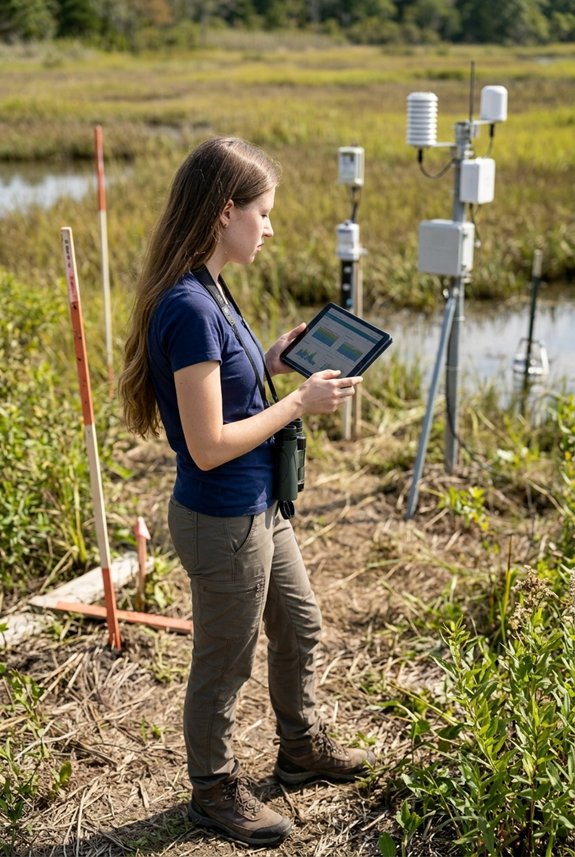
Once you’ve found your footing in entry level ecology work, you’re likely wondering what financial stability looks like as you advance, whether your passion for watersheds, wildlife, or contaminated sites can sustain a life with reasonable comfort. You deserve salary transparency when weighing your options, so consider this: hydrologists earned the highest median wage at $88,770 in 2024, though they’re fewer in number. Environmental scientists, the largest group at roughly 80,000 employed, see solid pay with room to grow.
Marine biologists and zoologists typically earn around $63,420, while conservation scientists approach $61,340. You’ll notice pay equity varies across these paths, with engineering focused roles commanding premiums. Geographic premiums matter too, coastal or urban positions often pay more. Benefit structures and contract variations (think government versus private sector) will shape your total compensation, so evaluate the full package, not just the salary figure.
| Role | Median pay (US) | Demand notes |
|---|---|---|
| Environmental scientist | $80,060 | ~80,000 jobs, ~8,500 openings/yr |
| Hydrologist | $88,770 | Small field (~6,800), strong demand |
| Environmental engineer | $100,090 | Steady growth, premium pay |
| Environmental consultant | ~$87,620 | Strong private sector demand |
| Conservation scientist | ~$61,340 | Steady, public + private land |
| Marine biologist / zoologist | ~$63,420 | Competitive, fewer openings |
The Highest Demand Ecology Roles
Environmental Scientist: 80,000 Jobs and Growing Fast
Where might you find the most open doors in ecology’s expanding landscape? You’ll discover them as an environmental scientist, 80,000 strong and still growing fast, with roughly 8,500 openings yearly through 2034.
You’re stepping into work that demands only a bachelor’s degree, no experience required, yet offers impact far beyond those modest entry gates. You’ll conduct research, systematic investigation to understand natural systems, monitor conditions, analyze results, and recommend protections for both ecosystems and human communities.
Your path weaves through community science, where you’ll collaborate with everyday people collecting essential data, through policy advocacy that translates findings into law, and through environmental justice, ensuring burdens don’t fall unfairly on vulnerable groups.
You’ll embrace technology integration, remote sensing, data modeling, to build climate resilience, helping communities withstand and adapt to environmental changes.
The median wage is $80,060 (May 2024), solid ground for meaningful work.
Hydrologist: Highest Pay in Ecology Careers
Turn your attention toward water itself, and you’ll discover hydrology, the science of how water travels through soil, rock, and atmosphere, where the highest paychecks in ecology quietly await. You’ll find that hydrologists earned a median wage of $88,770 in 2024, the highest among green careers, though only 6,800 people held these positions nationwide.
Your work would center on five essential practices: groundwater modeling, using computer simulations to predict underground water flow, ensures communities understand their drinking water supply. You’ll monitor water quality, tracking pollutants and temperature shifts that threaten ecosystems. Climate impacts demand your attention as droughts and floods reshape water availability across regions.
Aquifer recharge projects let you restore depleted underground reservoirs, while remote sensing, analyzing satellite imagery and aerial data, reveals patterns invisible from the ground.
Most employers require your bachelor’s degree, though a master’s enables advancement. The field offers limited annual openings, so you’ll compete for specialized roles where technical expertise meets environmental stewardship.
Environmental Epidemiologist: Health Focused Ecology Work
Why does illness cluster in certain neighborhoods, and what invisible threads connect polluted air to asthma, or contaminated water to birth defects? You’re looking at the core questions of community epidemiology, systematic study of how environmental hazards shape population health.
As an environmental epidemiologist, you’ll conduct exposure assessment to trace pollutant pathways from source to body, and apply biomonitoring methods, testing blood, urine, or tissue samples, to measure actual chemical absorption in exposed groups.
Your findings demand skilled risk communication: translating data into clear guidance for worried residents. Through policy translation, you’ll help regulators turn evidence into protective rules.
You’ll need a master’s degree, but prior experience isn’t typically required, this path welcomes you with strong analytical training and a commitment to public voice. Government agencies, health departments, and research institutions seek these skills.
Field Ecologist: Entry Level Ecology Roles With Real Impact
Step out into the field, and you’ll find ecology happening in real time, beneath your boots, drifting on the water’s surface, rustling through the canopy overhead.
You’ll wade through wetlands, navigate forests, and collect specimens that reveal how living systems function, turning raw observation into understanding through careful data management, organizing, analyzing, and reporting what you’ve gathered so it shapes real conservation decisions.
Your bachelor’s degree opens doors here, especially with coursework in botany, the study of plants, and zoology, which examines animal life.
You’ll learn field safety protocols, keep up with equipment maintenance, and often find positions through seasonal hiring cycles.
Community partnerships connect you with local stakeholders who depend on healthy ecosystems.
These entry level roles build skills that matter: your work directly informs resource management without yet focusing on rebuilding damaged systems.
Restoration Ecologist: Rebuilding Ecosystems Through Ecology Work
Breathe life back into damaged places, and you’ll discover restoration ecology, the practice of healing landscapes when industry, development, or natural disaster has disrupted their balance.
As a restoration ecologist, you’ll lead community led restoration projects, guiding neighbors toward shared stewardship of wounded lands. You’ll oversee soil microbiome recovery, reviving the hidden bacterial and fungal networks that feed plants from below, while applying phytoremediation techniques, which means using specific plants to draw pollutants from contaminated ground.
Your work spans coastal dune stabilization, anchoring shifting sands with native grasses against wind and tide. You’ll track progress through restoration monitoring, measuring how ecosystems rebuild their strength across seasons.
Whether designing habitat plans or planting species that belong, you’re stitching resilience into places once broken.
Park Naturalist: Education Focused Ecology Jobs
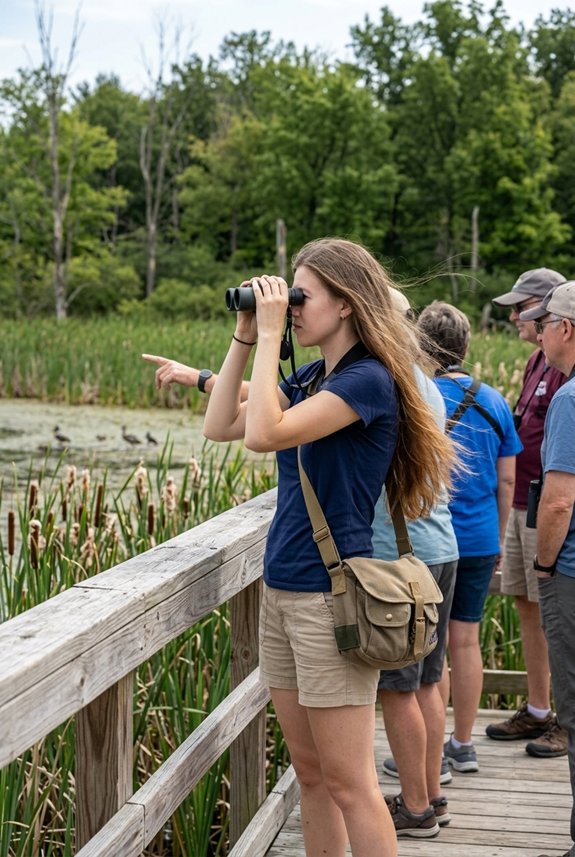
Often, when you walk through a forest trail or stand at a canyon’s edge, you’ll notice someone guiding a group, pointing out the way lichen clings to granite, or why a particular flower blooms only in autumn shade. That guide is likely a Park Naturalist, and you’d step well into this education focused role by mastering interpretive storytelling that transforms ecological facts into living narratives your listeners carry home.
You’ll craft seasonal programming, summer night hikes, winter tracking workshops, that meets visitors where they are, building visitor engagement through wonder rather than lecture. Your work demands accessibility inclusion: you’ll adapt trails and materials so every body, every ability, experiences the park fully. You’ll coordinate citizen science projects too, inviting amateur observers to collect data that matters. Through clear, warm communication, you’ll translate stewardship into action, one curious mind at a time.
Marine Biologist: Ocean Ecology Career Paths
From forest trails to shorelines, you’re exchanging quiet canopy shade for the weightless susurrus of salt water moving against your body. As a marine biologist, you’ll study life in aquatic environments, organisms ranging from microscopic plankton to vast whales, often concentrating on particular species or entire ecosystems.
Your days blend immersion with analysis: you’ll collect samples through coastal restoration projects, pursue deep sea exploration in submersibles, and examine fish physiology to understand how marine creatures thrive under pressure, all while crafting marine policy recommendations based on your findings. Aquaculture innovation offers another path, as you’ll help develop sustainable farming methods for ocean species.
A bachelor’s degree in biology, zoology, or oceanography opens entry level positions, though graduate degrees enable research leadership. You’ll find employers across government agencies, universities, and private companies, earning roughly $63,420 annually while contributing to ocean health.
Environmental Consultant: Private Sector Ecology Jobs
Swap your wading boots for business casual, and you’ll step into a role where ecology meets commerce: as an environmental consultant, you’ll guide companies toward practices that heal rather than harm.
You’ll balance fieldwork, sampling soil, inspecting sites, with office duties analyzing data and drafting reports. Your client communication builds trust as you translate technical findings into clear guidance. Through careful liability assessment, you’ll spot environmental risks before property deals close, protecting buyers from costly surprises.
You’ll navigate market niches by specializing, perhaps in urban redevelopment or industrial compliance, while shaping pricing strategies that value your expertise fairly. Vendor management keeps your projects flowing, coordinating laboratories and contractors who support your work. With steady demand and strong median salaries near $87,620, this path rewards those who bridge science and business with quiet confidence.
Environmental Protection Specialist: Federal Ecology Careers
While private consulting draws some toward corporate partnerships, others find their purpose in public stewardship, where your work serves lands held in trust for generations beyond your own.
As an Environmental Protection Specialist, you’ll join agencies like the U.S. Fish and Wildlife Service or National Park Service, conducting field sampling to gather data on air, water, and waste pollution. You’ll master policy translation, turning complex test results into clear guidance that shapes regulations and informs communities. Your role encompasses compliance auditing, ensuring industries follow federal environmental laws, while lab accreditation protocols guarantee your data holds scientific weight. You’ll navigate hazard communication, conveying risks with precision to protect both ecosystems and public health.
Most positions require a bachelor’s degree in environmental science and reward your technical skills with wages exceeding the national median.
Natural Resource Manager: Ecology Jobs Balancing Use and Conservation
Stepping into the role of Natural Resource Manager means you’re entrusted with a living puzzle, one where every piece is a species, a watershed, or a stretch of forest that must thrive today while remaining intact for those who’ll walk these paths decades from now.
You’ll practice sustainable harvesting, ensuring resources taken now don’t deplete what’s needed later, while your habitat monitoring tracks wildlife numbers through field surveys that inform careful decisions.
Stakeholder engagement becomes your bridge, connecting agencies, communities, and industries who each hold stakes in these lands.
You’ll lean on ecosystem valuation, the process of measuring nature’s worth in dollars and services, to justify protection.
Through adaptive management, you adjust strategies as conditions shift, keeping forests, waters, and wildlife resilient under your watchful care.
Conservation Scientist: Land and Wildlife Ecology Careers
Where might you find yourself when the workday begins as a Conservation Scientist? You’ll monitor wildlife populations across national parks, forests, and rangelands, tracking how species thrive or struggle under shifting conditions.
Your work weaves together indigenous stewardship, honoring traditional ecological knowledge that has sustained lands for generations, and conservation finance, securing investments that keep ecosystems intact.
You’ll craft climate adaptive management plans, strategies adjusting resource use as weather patterns transform familiar landscapes, and balance urban rewilding projects that invite nature back into cities.
Private land conservation lets you partner with ranchers and farmers, protecting critical habitat beyond public boundaries.
With a bachelor’s degree in forestry or natural resources, you’ll earn around $61,340 while ensuring sustainable land use for generations ahead, quiet work with lasting resonance.
Environmental Engineer: Technical Ecology Jobs With Premium Pay
Imagine yourself standing at the edge of a reclaimed industrial site, testing equipment in hand, where you’ll spend your days bridging technical precision and ecological restoration as an environmental engineer, a specialist who designs systems that protect clean air, safe water, and healthy communities.
You’ll master Fieldwork Logistics, coordinating site visits where you collect samples and assess contamination, while your Regulatory Liaison skills help you navigate government standards, translating complex rules into actionable plans.
Through Risk Assessment, you’ll evaluate potential hazards before they threaten ecosystems or public health.
Your designs for Green Infrastructure, natural systems like constructed wetlands that manage stormwater, will reshape urban landscapes.
Lifecycle Analysis guides your choices, weighing environmental costs from creation through disposal.
With median pay near $100,090 and steady growth ahead, you’re building a career where technical expertise serves lasting ecological good.
Urban Ecologist: Bringing Ecology to City Development
Beneath the hum of traffic and between the gaps of concrete, you’ll find the work of urban ecologists, scientists who study how living things, from bacteria and insects to birds and trees, interact with their surroundings in cities.
You’ll conduct field surveys across rooftops and riverbanks, measuring how green infrastructure, nature based systems like parks and rain gardens, supports urban biodiversity while filtering pollutants.
Your analyses shape stormwater management plans, revealing how soil and vegetation absorb rainfall that’d otherwise flood streets.
Through community engagement, you’ll translate complex data for neighbors and planners alike, building consensus around living shorelines or native corridors.
Adaptive planning becomes your rhythm: adjusting designs as climates shift and cities grow.
With a bachelor’s degree and skills in project management, you’ll bridge ecology and development, crafting cities where people and wildness coexist.
Zoologist: Research Focused Ecology Careers
Track a wolf pack through autumn forests, and you’ll begin to understand how zoologists unravel the lives of animals, their feeding patterns, seasonal movements, and social bonds.
You’ll delve into behavioral ecology, studying how creatures interact with each other and their environments, while sensory ecology reveals how they perceive the world through sight, sound, or smell.
Your work might involve captive research at wildlife facilities, where you’ll observe reproductive strategies up close, or comparative anatomy in the lab, examining body structures across species to understand adaptation.
You’re patient, methodical, collecting data that informs conservation decisions.
With a bachelor’s degree you’ll start in the field; advance to a master’s or Ph.D. for independent research.
You’ll earn around $63,420, with government, universities, and conservation groups waiting for your discoveries, quiet, essential work that sustains the wild world you study.
How to Choose: Matching Your Skills to the Right Ecology Role
Because the ecology field stretches from misty shorelines to fluorescent lit laboratories, you’ll want to weigh what truly suits you before committing to a path.
Begin with honest skills assessment: inventory what you’ve mastered, data collection, public speaking, lab techniques, and identify gaps needing growth.
Consider personality fit carefully: thriving in unpredictable weather suits Field Ecologists and Marine Biologists, while structured analysis appeals more to Environmental Consultants.
Reflect on work life balance too, since field heavy roles demand irregular hours and travel, whereas office based positions offer steadier routines.
Leverage your transferable skills, project management from any job translates directly into Natural Resource Management.
Finally, engage in career mapping: trace how a bachelor’s degree opens entry points, while graduate study liberates epidemiology or senior hydrology, letting you envision your trajectory with quiet confidence and clear purpose.
Top Certifications: Salary Boosts for Ecology Careers
Once you’ve mapped where your skills and temperament might take you, you’ll naturally wonder how to stand apart in a field where many share the same foundational degrees. Certification ROI becomes clear when you consider how credentials like CERP or SER status boost your credibility in restoration circles, project managers with these seals often command higher salaries.
You’ll find Skill Stacking especially potent: combine your ecology background with GIS certifications, like those from Esri, and suddenly you’re handling spatial analysis that others can’t touch. The Microcredentials Value of HAZWOPER safety training or boat operation certificates opens doors to hazardous fieldwork that pays premium rates.
You’re building Credential Portfolios, really, layering EP status, project management credentials, and compliance certificates creates a compelling narrative of competence. Continuing Education isn’t mere obligation; it’s strategic investment, each certificate expanding what you’re qualified to bid for. Your credentials talk when you can’t.
Geographic Hotspots: Where Ecology Jobs Concentrate
Across the American landscape, ecology careers cluster where human ambition meets natural constraint, cities grappling with pollution, coastlines defending against rising seas, and federal lands demanding stewardship.
You’ll find thriving opportunities in coastal metropolises like San Francisco and New York City, where clean tech, energy efficiency, and dense infrastructure drive demand for environmental scientists and engineers. Houston’s oil and gas sector likewise needs specialists who’ll earn over $80,000 managing ecological impacts.
Federal agencies, the U.S. Fish and Wildlife Service, National Park Service, Bureau of Land Management, and U.S. Geological Survey, create concentrated hiring near public lands across the West and Alaska, often at remote research stations where you’ll study fragile ecosystems.
University towns like Flagstaff support restoration ecology roles, while climate migration patterns increasingly reshape where expertise becomes urgent. You’ll recognize urban greenways and indigenous stewardship programs as emerging focal points, weaving traditional knowledge with modern conservation where communities reclaim ecological relationships.
Sector Comparison: Federal Stability vs. Private Growth
Whether you’re drawn to the vast public lands of the West or the pulse of coastal cities, your next decision shapes not just where you’ll work, but who you’ll work for, and this distinction matters more than many recognize.
Federal stability attracts those seeking predictable hiring cycles and structured advancement across bureaus like the U.S. Fish and Wildlife Service or USGS, where compliance and conservation missions anchor your daily work.
Yet private growth surges through consulting firms and renewable energy companies, rewarding adaptation with faster salary progression and roles in booming fields like solar and wind deployment.
You’ll weigh benefit tradeoffs, government pensions and job security against private bonuses and rapid scaling, and recognize that sector mobility, while possible, demands deliberate planning since federal and corporate cultures diverge sharply in pace and purpose.
Remote Ecology Work: Real Opportunities and Limits
Although you might picture ecology work as something you can do from anywhere with a laptop and a coffee, the reality is more grounded than that dream allows. Telework limitations hit hard when you realize most ecology jobs, field ecologist, restoration ecologist, marine biologist, demand muddy boots, wet waders, and hands in the soil collecting real data.
Yet you shouldn’t abandon hope for flexibility. Hybrid roleexamples surface in environmental consulting and policy jobs, where you’ll analyze data, write reports, and advise clients from home, but expect field trip exceptions, because site visits still pull you outdoors. Federal positions blend desk and fieldwork too, so full remoteness stays rare.
Build remote capability through remote skilltraining: master GIS mapping, statistical software, and remote sensing interpretation. Some programs now offer virtual fieldlabs to practice analysis skills digitally before you step outside.
Ecology Internships: Direct Paths to Full Time Jobs
Breaking into ecology work often starts with an internship that lets you test the field while building skills employers actually want.
Take habitat restoration internships, like those with Pheasants Forever in Idaho, you’ll earn $22 $26 hourly while learning mentor matching systems that pair you with seasoned ecologists who guide your growth.
These roles often include seasonal housing, removing financial barriers as you master community science methods, where volunteers and professionals collect data together, and equipment logistics, the practical art of managing tools across remote sites.
Meanwhile, USDA fellowships and entry level positions with firms like MIG offer modest stipends but something rarer: career mapping, the intentional planning of your professional journey.
You’ll practice wetland monitoring and wildlife surveys, skills that translate directly into full time roles as restoration ecologists or natural resource managers, especially when internships emphasize field techniques and public outreach that parks and universities actively seek in permanent staff.
Future Outlook: Ecology Sectors Poised for Growth
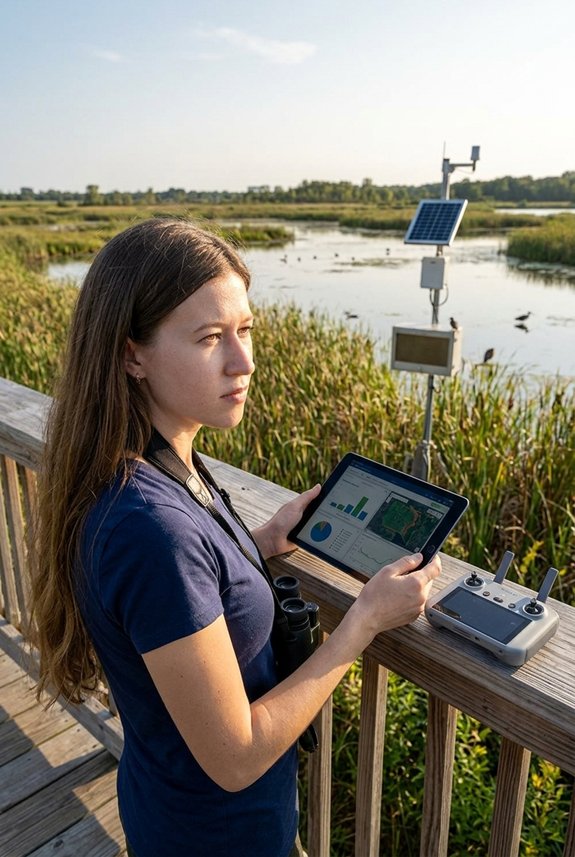
As you look ahead to where ecology careers are heading, you’ll find the field branching in directions that reward both curiosity and practical skill, environmental scientists remain the backbone of this workforce, with roughly 80,000 people employed and about 8,500 openings projected each year through 2034, meaning steady opportunity even as specialties evolve.
You’ll want to watch five sectors closely: climate resilient agriculture, farming systems designed to withstand droughts and floods, needs ecologists who understand soil and water cycles; blue carbon projects, which store carbon dioxide in coastal ecosystems like mangroves and seagrasses, are expanding rapidly; green infrastructure finance, the funding of parks and urban forests, blends ecology with economics; decarbonization job pathways connect remediation skills to emission reduction goals; and climate driven species shifts require you to track how warming habitats redistribute wildlife.
Frequently Asked Questions
What are the highest demand ecology jobs?
Environmental scientists are the largest group (about 80,000 jobs and ~8,500 annual openings), followed by strong demand for hydrologists, environmental engineers, restoration ecologists, environmental consultants, and compliance and remediation specialists.
Which ecology job pays the most?
Among in demand ecology roles, hydrologists (median ~$88,770) and environmental engineers (~$100,090) lead, while environmental scientists earn a median of $80,060.
What degree do you need for an ecology career?
Most entry level roles require a bachelor’s degree in ecology, environmental science, or a related field. Hydrology, epidemiology, and senior research roles often need a master’s or PhD.
How do you break into ecology without experience?
Start with field technician or biological technician roles, build skills through internships, volunteer surveys, and microcredentials in GIS or water quality monitoring, and tailor your resume to each posting.
Where are ecology jobs concentrated?
Demand clusters in coastal cities like San Francisco and New York, Western public lands and Alaska (federal agencies), and energy hubs such as Houston.

Erzsebet Frey (Eli Frey) is an ecologist and online entrepreneur with a Master of Science in Ecology from the University of Belgrade. Originally from Serbia, she has lived in Sri Lanka since 2017. Eli has worked internationally in countries like Oman, Brazil, Germany, and Sri Lanka. In 2018, she expanded into SEO and blogging, completing courses from UC Davis and Edinburgh. Eli has founded multiple websites focused on biology, ecology, environmental science, sustainable and simple living, and outdoor activities. She enjoys creating nature and simple living videos on YouTube and participates in speleology, diving, and hiking.
For your next application
Keep applying and hearing nothing back?
The Biology Job Application Kit shows you which stage of your applications is failing and how to fix it. 46 guides, 22 editable templates, an application tracker and an ATS CV Creator licence.
See the Job Application Kit