

Quick answer: You can start an ecology or environmental career without a four year degree. The most accessible, well paid no degree roles include wind turbine technician (~$61,770), environmental and waste technicians (~$45,000 to $50,000), solar installer (~$48,800), and forest, conservation, and wildlife field assistants. Most need only a high school diploma plus short certifications (HAZWOPER, GIS, OSHA, renewable energy training) and hands on field experience through internships or volunteering.
You can start an ecology career without a four year degree by using hands on training, certifications, and on the job experience that let you monitor habitats, collect samples, and support sustainability projects, while federal agencies like the Forest Service and private firms hire technicians with a high school diploma and a year or two of related work; key skills include GIS mapping, data analysis, and field sampling, and certifications such as OSHA HAZWOPER or an Associate Environmental Professional can boost your hiring, so keep exploring the pathways that lead to higher pay and advancement.
What “Ecology Jobs Without a Degree” Means
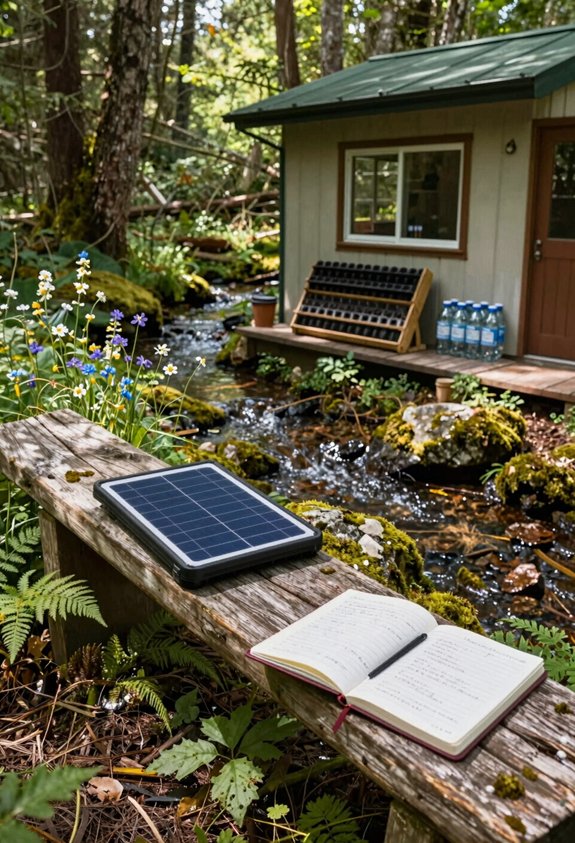
You’ll find that agencies like the Forest Service, Bureau of Land Management, and USDA hire biological science technicians without a degree, expecting one to two years of related work. instead of formal credentials.
Environmental technicians, who test and manage pollutants, typically earn around $50,000 a year and can start with a high school diploma, while certifications, apprenticeships, and online courses give you the specialized training needed to qualify for roles such as recycling workers, hazardous materials managers, or waste management staff, allowing you to build credibility through experience and advance toward supervisory positions over time. Invasive weed removal is a common task for Biological Science Technicians. Demand for green talent is growing twice as quickly as supply.
Why Demand for No Degree Ecology Careers Is Rising
Often, you’ll notice that the surge in demand for ecology jobs that don’t require a four year degree isn’t just a fleeting trend but a structural shift, driven by the rapid growth of green talent needs that outpace the supply of formally educated workers.
You see, global demand for green talent grew twice as quickly as supply between 2023 and 2024, and U.S. green jobs are projected to reach nearly 24 million by 2030, about 14 % of all employment, so companies are scanning wider pools. Green skills have moved from niche specialties to core business competencies, meaning even non green roles now need environmental knowledge, data analysis, and sustainability thinking.
Corporations are adding sustainability staff across departments, integrating eco expertise into strategy to meet climate transition goals, regulatory pressure, and competitive advantage, which together fuels the rise of no degree ecology careers. (The energy efficiency sector alone employs nearly 18 million people globally.)
Top Technical Skills Employers Want for No Degree Ecology Jobs
Explore the tools that let you turn raw field data into clear, actionable insights, because employers in ecology without a four year degree are looking for practical technical abilities rather than formal credentials.
You’ll need GIS skills, using Geographic Information Systems to map habitats and analyze spatial patterns, plus GPS know how for precise field navigation and data capture, and familiarity with free GIS programs that let you visualize environmental impacts.
Data analysis follows: you should be comfortable with statistical software that turns measurements into trends, manage databases that store observations, and write reports that summarize findings for diverse audiences.
Sampling and lab work also matter: you’ll collect soil or water samples, identify pollutants, follow safety protocols, and use basic office, design, and web tools to share results.
These combined abilities show you can turn raw science into clear, useful information.
Habitat assessments provide a foundation for understanding ecosystem health and guide targeted conservation actions.Cross cutting skills such as organisational ability and teamwork are essential for success in these roles.
Fast Track Certifications for Entry Level Ecology Careers
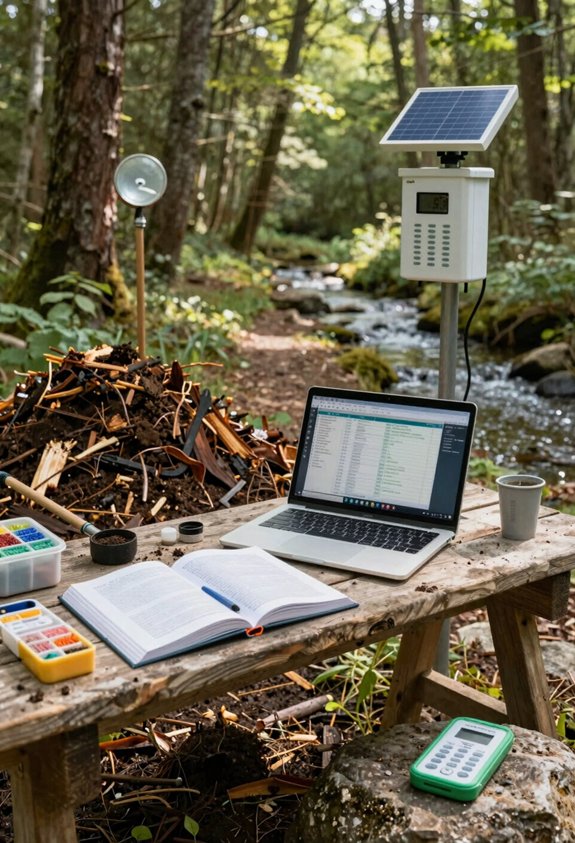
Start by looking at the certifications that can fast track you into entry level ecology work, because they give you a concrete credential while you build experience on the job.
The Associate Environmental Professional (AEP) from NREP, for example, requires either a year of college study or three years of relevant work, and its exam covers emergency preparedness, pollution prevention, hazardous materials, toxicology, chemistry, and regulations, showing you can assess environmental risks and explain the rules.
The Environmental Professional In Training (EPI) certification from IPEP offers a written exam on general environmental science and serves as a first step toward Qualified Environmental Professional status, bridging school and work.
Au Sable Institute’s certificate programs provide hands on field training in wetland science, wildlife biology, GIS mapping, and ecological restoration, aligning with credentials like Certified Wildlife Biologist®.
Community college certificates, typically 15-26 units, include courses in environmental biology, sustainable systems, and physical geography, preparing you for roles such as educator, consultant, or restoration technician while offering field trips to real sites.
These pathways give you a recognized credential, practical knowledge, and a clear entry point into ecology without a full degree.
Urban Agroecology certificates also require a 28 unit curriculum that blends field work with sustainable food system studies.
| No degree role | Median pay (US) | Typical entry route |
|---|---|---|
| Wind turbine technician | ~$61,770 | Technical certificate, on the job |
| Environmental science & protection technician | ~$50,660 | HS diploma + training |
| Solar panel installer | ~$48,800 | Short course, on the job |
| Forest & conservation technician | ~$46,000 | HS diploma + seasonal training |
| Recycling / waste technician | ~$45,000 | On the job training |
| Wildlife monitoring assistant | ~$42,000 | Volunteer + field training |
No Degree Ecology Roles, Profiled
Environmental Technician: Daily Tasks, Pay & How to Start
When you step into the role of an environmental technician, you’ll find yourself moving between a lab, an office, and the field, collecting air, water, soil, and hazardous material samples with portable pumps, vacuums, and other specialized tools, then analyzing those samples on a microscope or a computer program that translates raw data into clear reports, so you can spot pollutants, assess risks, and help companies stay within environmental laws. Your daily routine mixes field inspections, where you walk sites, note potential pollution sources, and set up instruments, with lab work that demands meticulous attention to detail, strong analytical skills, and the ability to turn numbers into actionable findings. You’ll travel to remote locations, often in harsh weather, carry heavy gear, and wear protective clothing like masks and coveralls, while also reviewing permits and suggesting corrective actions to guarantee compliance. Fieldwork often includes sampling at construction sites and natural habitats. Salaries typically range from $40,000 to $55,000, and you can start by earning an associate degree or certification in environmental science, completing on the job training, and building a network with engineers, scientists, and regulators.
Occupational Health & Safety Technician: Core Duties & Salary
If you’re drawn to keeping workplaces safe, an Occupational Health & Safety Technician blends inspection, education, and problem solving to protect workers from chemical, physical, biological, and ergonomic hazards, essentially ensuring that every tool, procedure, and environment meets government safety standards such as those set by OSHA. You’ll spend much of your day inspecting and testing equipment, evaluating work areas against regulations, and creating checklists with safety managers, while also investigating complaints to identify unsafe conditions. Designing programs to control risks, you’ll draft safe work procedures, develop emergency drills, and partner with health professionals to prevent injuries. Training sessions let you teach employees how to use protective gear correctly, and incident investigations require you to write clear reports, pinpoint causes, and suggest corrective actions. You’ll also manage records, track accident data, and stay current on OSHA and DOT rule changes, ensuring all reports and logs are filed on time. Salary varies by region and experience, but the role offers steady demand and the satisfaction of protecting people’s health. The field is very fast growing, with a projected job growth of +1.5% in North Carolina. Clinical & Emergency Care is also a key component of the role, providing rapid first aid treatment and coordinating care with physician escalation services as needed.
Waste Management Technician: Responsibilities & Growth Outlook
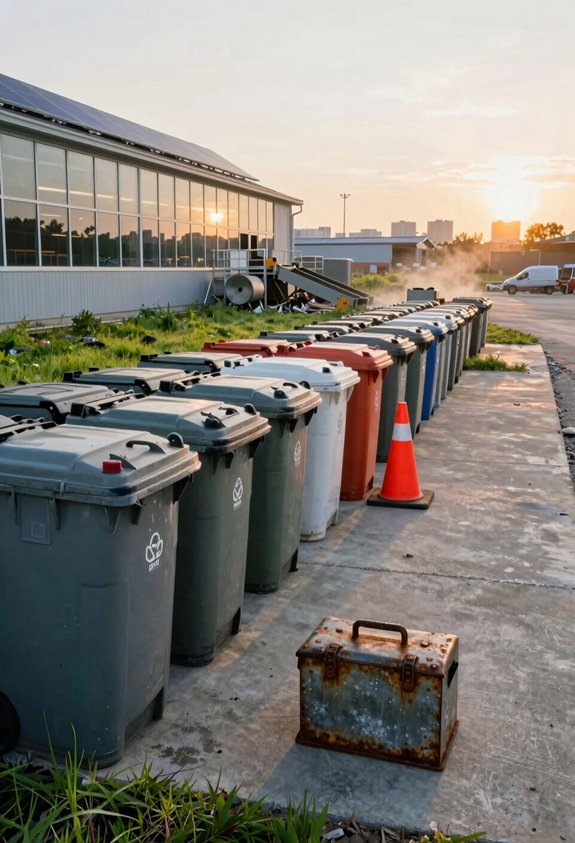
Guiding waste streams safely begins with understanding the core duties of a Waste Management Technician, a role that blends hands on equipment operation, careful handling of hazardous materials, and diligent regulatory compliance, all aimed at protecting both the environment and public health.
You’ll inspect landfills, transfer stations, and hazardous waste collection sites, noting environmental conditions and ensuring proper procedures; you’ll also transport and label chemical drums, lift up to fifty pounds, and operate pumps, vacuums, bobcats, and forklifts, all while wearing protective gear that may feel uncomfortable.
Your work includes running landfill gas wells, maintaining leachate recovery systems, and using computer reporting tools to document compliance. OSHA HAZWOPER training is essential for safely handling hazardous waste. RCRA compliance is a key responsibility for maintaining regulatory standards.
Forest & Conservation Technician: Role, Pay & Training Path
Because forests are living systems that need careful stewardship, a Forest & Conservation Technician works hands on to protect soil, water, and trees, providing technical assistance that translates scientific guidance into everyday actions such as planting seedlings, thinning over grown stands, and monitoring ecosystem health.
You’ll assist foresters by maintaining forest plots, operating safety checked equipment, and gathering data on tree growth, soil moisture, and water quality, which helps guide larger conservation plans.
Median pay sits around $51,880 per year, about $24.94 an hour, with government roles averaging $56,970 and benefits like health insurance and 401(k) matches.
Entry usually requires a high school diploma, a driver’s license, and 1-2 years of vocational school, associate degree, or on the job training, often in forestry or wildlife management.
Idaho has the highest location quotient for this occupation, reflecting a strong regional demand.training is typically provided through vocational schools, apprenticeship programs, or on the job experience.
Agricultural Technician: Field Work, Pay & Entry Requirements
You’ll spend most of your days out in the fields, collecting crop and animal samples, operating tractors or sprayers, and setting up simple lab gear to test for disease or boost yield, tasks that blend hands on work with basic scientific analysis.
The median pay sits around $46,800 a year, roughly $21 an hour, and it can rise quickly if you add a bachelor’s degree or specialize in a niche area such as soil health or animal nutrition.
Most employers prefer an associate’s or bachelor’s in biology, chemistry, or agriculture, yet a high school diploma paired with solid farm experience and on the job training can also open the door, especially when you earn voluntary certifications that signal competence. The occupation’s projected growth of 5% from 2024 to 2034 reflects strong demand for research into water resources, pests, and climate impacts. Hands on problem solving is a key skill that technicians use to notice issues and determine the best solutions.
Field Duties Overview
When you step onto a farm’s fields, you’ll find that the core operations, land preparation, equipment handling, and crop monitoring, form a seamless rhythm that keeps the whole system moving, and each task, from plowing and discing to setting up research plots, is guided by clear objectives and safety standards.
You’ll start by preparing the ground, using tractors to plow, discing and level the soil, and contouring fields for orchards or vineyards, while checking for erosion and applying conservation tillage methods that protect topsoil.
Operating heavy machinery such as backhoes, sprayers, and balers, you’ll apply fertilizers and pest control chemicals with proper equipment, then maintain and repair tools, even welding when needed.
Throughout, you’ll monitor crops, prune, weed, harvest, and collect samples of soil, water, and insects for lab analysis, recording data and drafting clear reports that help scientists improve practices.
Laboratory/field testing is also part of the routine, ensuring that any collected samples are analyzed for nutrient levels and contaminants.Field work requires frequent face to face discussions with team members and supervisors.
Salary & Advancement Pathways
Start by recognizing that an agricultural technician’s field work pays a modest but steady wage, about $44 k per year on average in 2026, which translates to roughly $17.80 $19.95 per hour for the middle half of earners, and that a high school diploma or equivalent is enough to begin.
You’ll find that entry salaries range from $26,980 to $31,200, and that the median sits near $43,180, while the 90th percentile can reach $65,470, showing a clear but limited ceiling unless you specialize. Advancement often means moving into equipment focused roles, which can boost earnings to $69,822 or higher, or shifting to scientist or engineer positions that command six figure salaries.
- Base pay: $44 k average, $17.80 $19.95 /hour
- Entry requirement: high school diploma only
- Geographic variance: New Jersey $54 k, Oklahoma $30 k
- Equipment specialization premium: $69 k $105 k
- Upper class ceiling: $53 k within technician tier, $106 k+ for advanced roles
Earn about the same as related careers in the United States. Recruiter.com offers a certification program that can help you advance faster.
Solar Panel Installer: Why It’s a Smart No Degree Choice & Pay
If you’re looking for a career that blends hands on work with growing demand, becoming a solar panel installer can be a smart choice even without a college degree, because the field values practical skills and on the job learning over formal credentials.
You’ll need only a high school diploma, a clean driving record, and a valid driver’s license, while many employers provide paid, on site training that teaches panel assembly, mounting, and basic electrical knowledge, so prior experience isn’t required.
In Chicago, entry level wages range from $21.50 to $28.25 per hour, and Illinois offers positions that start at $19 and can climb to $62 per hour, with national salaries reaching six figures for specialized roles.
The job market is robust, with over 1,300 no experience listings nationwide and 60+ openings in Illinois alone, ensuring steady work and clear pathways to senior or supervisory positions as you gain confidence and competence.
Wind Turbine Technician: What It’s Really Like & Certification Steps
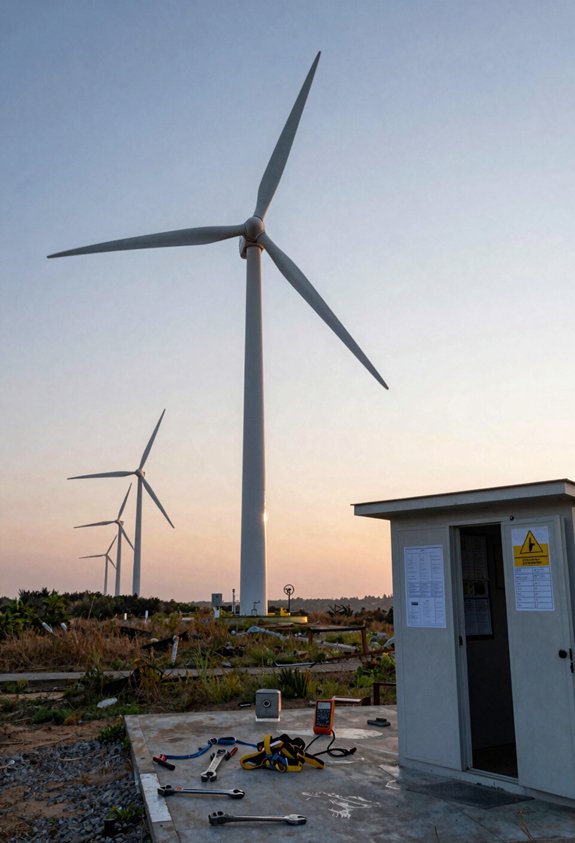
You’ll find that working on a wind turbine demands you be comfortable high at heights, often suspended hundreds of feet, and ready to climb ladders that reach 260 feet or more, which means you must have both physical stamina and a calm mindset to handle confined spaces and heavy tools. The certification path is straightforward: after earning a high school diploma you can enroll in an apprenticeship registered through Apprenticeship.gov, code 49-9081.00, where you’ll receive on the job training, and you may also pursue a non degree postsecondary program that awards a credential recognized by employers. The industry expects a 68% growth in employment through 2030. Safety inspections are performed regularly to ensure turbines operate reliably and safely.
Job Site Requirements
When you step onto a wind farm site, the first thing you’ll notice is how the work blends physical challenge with technical precision: you’ll be climbing towers that reach 200-400 feet, a height that feels like a gentle reminder of both the power of the wind and the importance of safety, while also handling tools and equipment that often weigh up to 50 pounds above your head, a load that tests your strength and stamina but is essential for maintaining the turbine’s mechanical, hydraulic, and electrical systems. You’ll work outdoors in rain, heat or snow, often inside cramped nacelles, and you’ll need a high school diploma, a valid driver’s license, a passport for overseas jobs, and basic computer skills for SCADA monitoring, plus a willingness to travel on rotating schedules.
- Climb 200-400 ft towers, using ladders and harnesses, with safety gear that supports 50 lb lifts.
- Operate in confined spaces inside turbine nacelles, handling hydraulic, electrical, and mechanical components.
- Use Microsoft Office and SCADA software to log data, troubleshoot faults, and follow quality assurance checklists.
- Accept on call duties, including evenings and weekends, and be prepared for offshore or underground assignments.
- Maintain fitness through post offer functional evaluations and stay ready for travel rotations of six weeks on site, two weeks off.
- Safety audits are conducted regularly to ensure compliance with industry standards.
- The role offers a high growth career path due to the rapidly expanding wind sector.
Certification Pathways
Because the wind energy field demands both safety and technical skill, the certification pathways for a wind turbine technician start with clear, standardized steps that guide you from basic safety awareness to hands on equipment expertise.
You first need a high school diploma, pass an 18 plus physical exam, and complete a GWO (Global Wind Organization) safety course that covers fall protection and rescue basics.
Programs such as Pinnacle Career Institute offer a forty week curriculum, mixing online theory with a ten day boot camp, teaching mechanical, hydraulic, and electrical systems, plus applied math for measuring tools.
The program includes a 10 day boot camp that provides hands on training and certification preparation.
After graduation you must finish a year of on the job training, earn OSHA 30, First Aid/CPR, NCCER Power Industry, and the WTT I (Wind Turbine Technician I) certification, all of which confirm you meet industry standards and are ready to work safely on turbines.
Membership information is available via the membership page or by contacting the membership team.
Habitat Restoration Assistant: Field Projects & Salary Range
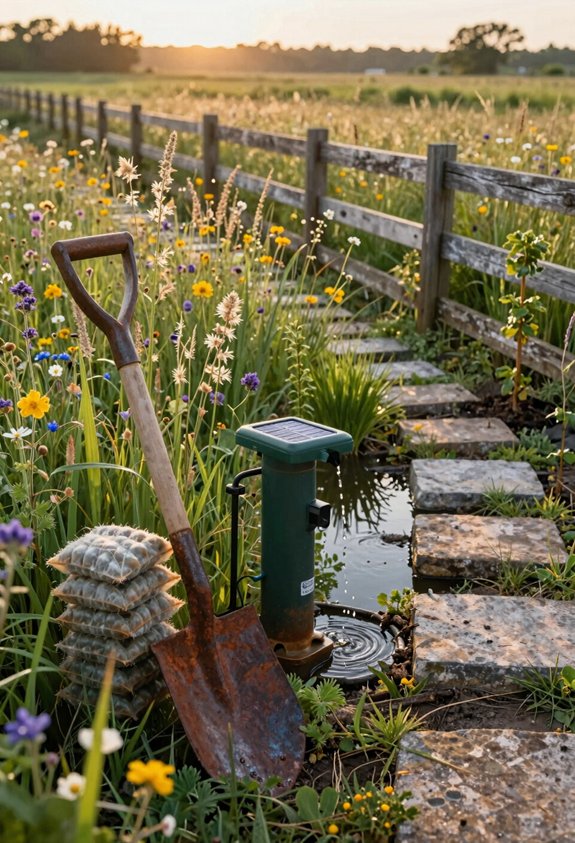
Helping restore habitats means joining field projects that blend hands on work with ecological insight, and as a Habitat Restoration Assistant you’ll spend your days removing invasive species, maintaining trails, and supporting broader restoration plans that aim to revive natural ecosystems, tasks that require practical skill more than a formal degree, and that often include on the job training to teach you the basics of vegetation management and strip mine reclamation.
You’ll earn roughly $20 per hour on average, with pay ranging from $9.86 to $31.01 depending on region, and annual salaries hovering around $42 k, while top earners can reach $55 k; entry level roles may start at $40-$43 per hour, especially in paid housing crew positions that offer $360 weekly.
- Invasive species removal: clearing non native plants that outcompete locals.
- Trail maintenance: repairing paths to reduce erosion and improve access.
- Vegetation management: pruning and planting native flora for ecosystem health.
- Strip mine reclamation: restoring land after mining, using soil and seed mixes.
- Utility right of way care: keeping corridors clear for power lines while protecting habitats.
The organization’s overall satisfaction rating is 3.7 out of 5.
Urban Green Space Maintainer: City Jobs, Duties & Pay
You’ll find yourself stepping into a role that blends hands on care of city parks with the quiet responsibility of keeping urban ecosystems healthy, an Urban Green Space Maintainer works on lawns, shrubs, trees, and storm water structures, using power tools like mowers and hedge trimmers while also performing manual tasks such as cleaning catch basins, picking up litter, and inspecting drainage for damage.
You’ll mow, prune, and seed, using, maintain catch basins, clean trash racks, and pick up debris, often using hand tools and power equipment such as leaf blowers and mulchers.
Your day may include inspecting storm water wetlands, culverts, and fences for damage, recording findings in work order software, and ensuring security to public property.
Pay varies: NYC salaries range $47,684 $54,837 annually, Chicago hourly $21 $27.50, and entry level positions start around $18 per hour, reflecting location, experience, and employer. The BWSO also oversees the Bluebelt program that integrates natural streams and wetlands for flood control and storm water management.
The position often requires a minimum eighth grade education and at least one year of experience in landscape or grounds maintenance.
Wildlife Monitoring Assistant: Typical Projects, Tools & Earnings
When you step into a wildlife monitoring assistant role, you’ll find yourself moving through forests, wetlands, and fields, gently tracking animals while using tools that turn raw observations into useful data, GPS devices, for example, let you pinpoint a bird’s nest on a digital map, and iPad apps equipped with ESRI Field Maps software help you record that location instantly, turning a simple sighting into a precise coordinate that researchers can analyze later.
You’ll trap, tag, and band species, collect telemetered data from collars, and assist with burns and restoration, while learning to operate chain saws, tractors, and pesticide sprayers safely. Earnings vary: seasonal work pays $12-$18 per hour, full time state jobs start around $35 k and can rise with experience.
- Tagging and banding animals for identification
- Using GPS and iPad apps for spatial mapping
- Operating hand tools and motorized equipment for habitat work
- Recording observations on digital forms or paper sheets
- Participating in prescribed burns and invasive species control
Your commitment may be a 16 week summer stint or a year round position, each offering hands on experience and a steady path toward deeper conservation roles. The organization has installed six bat maternity colony structures to support river dependent wildlife.
Security service detected a potentially harmful input.
Park Ranger Assistant: Entry Path, Salary Expectations & Licensing
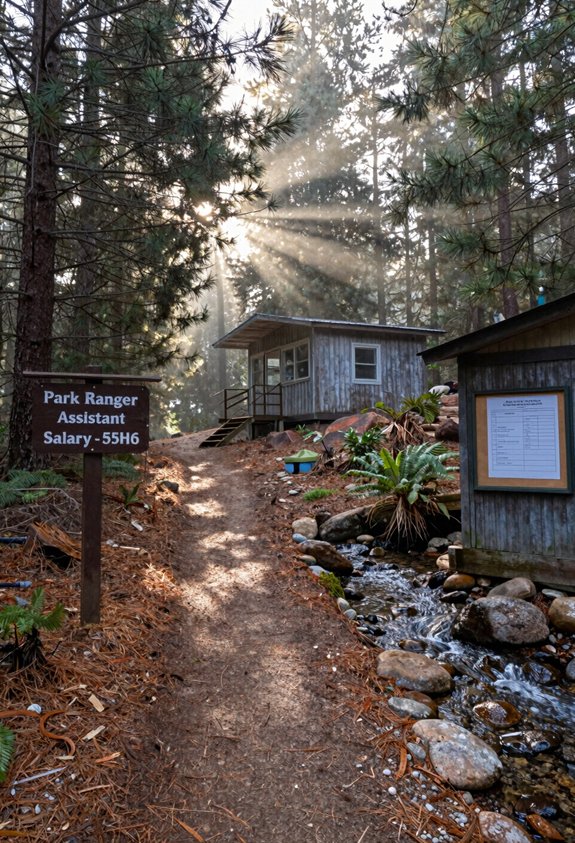
You’ll find that the entry requirements and training for a Park Ranger Assistant focus on a high school diploma or equivalent, on a few weeks of on the job instruction that covers safety, visitor service, and basic conservation, so you can start without a four year degree, yet still learn the essential skills. The typical salary range sits between $30,000 and $65,000 a year, depending on the park’s location, classification, and whether it’s a federal or state position, and it usually rises as you move into higher ranger grades. Licensing and certification needs may include a basic emergency medical responder credential and a 24 month probationary period, while the USAJOBS website serves as the central portal for applying and tracking these requirements. Many park services also offer trail crew positions as an entry point for those interested in hands on maintenance work. Park Rangers are also tasked with public lands stewardship, ensuring the protection and accessibility of millions of acres.
Entry Requirements & Training
If you have a high school diploma or its equivalent, you can start the park ranger assistant path without a college degree, because many seasonal and entry level positions, especially in urban parks and federal agencies, accept that credential as long as it’s recognized by the state education department or an accredited body, and while the basic requirement is simple, you’ll also need to meet a series of certifications, medical checks, and background screenings: a basic police or peace officer training certificate (MPTC), a six month residential police school, and a one year traineeship after that school are all mandatory for state appointments, and the process also includes a medical exam, vision test, psychological evaluation, drug screen, and often a polygraph, all of which guarantee you’re physically and mentally prepared for the duties of protecting natural resources and public safety.
- MPTC certificate and six month police academy completion
- One year traineeship with physical performance tests
- Medical, vision, and psychological examinations
- Drug screening and polygraph background investigation
- Minimum 70 % score on qualifying multiple choice test
New York State park police require a six month residential police basic school for all new recruits.Education requirements often include an associate’s degree in natural sciences for advanced conservation tracks.
Typical Salary Range
Having secured the required certifications and cleared the medical and background checks, you can now focus on what the job actually pays, and the numbers vary by federal grade, state system, and region, so it’s helpful to break them down into clear categories.
Federal entry level ranger assistants start at GS 5, earning $30,113 to $39,149 a year, but locality pay in high cost areas like Washington D.C. pushes that range to $39,291 $51,082, while a GS 7 position at the Fish and Wildlife Service begins at $46,499.
State parks differ: Oklahoma pays $22,844 $33,504, Washington State $41,352 $55,524, and California peace officers earn $66,756 $88,380 annually.
Hourly, the average is $21.38, with entry level rates around $13.11.
Bonuses, longevity pay, and education incentives can add a few hundred dollars per month and raise total compensation by 15 30 % as you advance.
Overtime can significantly increase monthly earnings during peak visitor seasons.
The median hourly rate across the United States is $22.53.
Licensing & Certification Needs
When you start the path to a park ranger assistant role in New York, the first hurdle is securing the required licensing and certification, which means completing the Municipal Police Training Committee (MPTC) Basic Police Officer or Peace Officer program, a structured course that teaches law enforcement basics, safety protocols, and community interaction, and that must be finished before you can be appointed or during your training period.
You’ll also need a valid New York driver’s license with a clean record, an associate degree or 60 college credits, and you must pass medical, physical agility, psychological, and drug tests, all while maintaining U.S. citizenship and a clean criminal history.
- MPTC certification (required before or during appointment)
- NY driver’s license (must stay current)
- 60 college credits or high school plus one year experience
- Medical, physical, psychological exams (pass to qualify)
- Background check (no felonies, good moral character)
The NYS Civil Service examination is also a prerequisite for appointment.
Relevant experience in natural resource management can further strengthen your application.
Environmental Compliance Inspector: What You’ll Inspect & Pay
You’ll spend most of your day walking through factories, construction sites, and treatment plants, watching for signs that air, water, or soil might be polluted, and you’ll use simple tools, like flow meters that measure water speed or portable kits that detect chemicals, to collect samples that reveal hidden contaminants; by comparing what you see and measure with the rules set by the EPA, state water boards, and local agencies, you’ll be able to spot violations early, document them clearly, and help keep the environment safe for everyone.
You’ll inspect storm water drains, hazardous waste storage, and emission stacks, noting any discrepancies between permits and reality, while recording flow meter readings, chemical levels, and photographs that become legal evidence; your reports, often concise but thorough, guide enforcement actions and corrective plans.
Pay typically ranges from $45,000 to $70,000 annually, reflecting experience, certification, and region, and overtime or specialist duties can raise earnings, rewarding diligent, detail oriented work. Bachelor’s degree is typically required for this role.
Enforcement hearings are often part of the process when violations are identified.
Water Quality Tester: Sampling Methods, Pay & Career Outlook
You’ll start by learning the main sampling techniques, grab and hold methods like grab sampling, where you collect a single water grab at a specific point, and continuous methods such as composite sampling, which mixes several grabs over time to get an average picture of water quality. In situ sensors provide near continuous data and can measure parameters that change during storage, such as pH and dissolved oxygen. From there, you’ll see how the salary range, typically quoted as an annual figure, reflects experience, certifications, and the type of employer, while advancement pathways might include moving into supervisory roles or specializing in laboratory analysis. Finally, the career outlook ties these elements together, showing that demand for skilled testers is growing as regulations tighten, and that you can progress without a degree by gaining on the job training and industry recognized credentials.
Sampling Techniques Overview
At the heart of water quality testing lies a set of sampling techniques that turn a fleeting glimpse of a river or well into reliable data, and understanding each method, grab, composite, integrated, continuous, and in situ, helps you capture the true condition of the water while minimizing distortion from transport or timing.
You’ll find that a grab sample is a single, moment specific collection, ideal when conditions are stable; a composite sample mixes several grabs taken over time to represent an average; an integrated sample gathers water from many points to address spatial variation; continuous sampling uses automated devices for real time monitoring; and in situ sampling measures parameters directly in the field, avoiding changes during transport.
- Grab: single point, quick, simple
- Composite: multiple times, mixed for average
- Integrated: many locations, captures spatial diversity
- Continuous: automated, real time data stream
- In situ: on site measurement, reduces transport distortion
The laboratory recommends flushing each sample bottle with source water several times before filling to contamination and ensure accurate results.
Salary & Advancement Pathways
When you look at the pay landscape for water quality testers, you’ll see that the average annual salary sits around $43,280, roughly $21 an hour, while the broader range stretches from $5.29 to $29.33, with most jobs clustering near $28.85; this modest baseline, however, masks the fact that geographic location, employer type, and experience level can shift earnings dramatically, especially in high cost California cities like San Jose and Oakland, where salaries exceed the national average by 25 percent or more, and in specialized roles such as water consultants or resource developers, where annual pay can top $100,000, highlighting that true career advancement often requires moving beyond the standard tester title into niche positions that reward expertise and regional demand.
You’ll notice that entry level specialists start near $47,000, while senior experts can earn $133,000, so gaining specialized certifications or shifting to federal or consulting firms, where pay often surpasses $100,000, creates the most meaningful salary jumps, especially when you leverage high pay regions like Vallejo or San Jose to maximize earnings while building expertise.
The ERI salary data shows a shift differential of 10 % can add $2.08 per hour to the average pay. Field sampling is a core responsibility that directly influences data quality and, consequently, salary potential.
Soil Sampling Technician: Field Techniques, Salary & Advancement
Mastering the art of soil sampling begins with understanding the tools and techniques that let you capture a true picture of the ground beneath your feet, hand probes, which let you collect surface soil at 0-12 inch depths; shovels, which let you dig trenches or pits to see layers directly; trowels or scoops, which provide a clean, stainless steel or plastic method for gathering small amounts; and garden spades, which let you remove a thin surface layer before scooping.
You’ll also use cylindrical tubes to drive into the earth, preserving the natural layering, and augers for deeper cores, while direct push hammers give continuous samples in compact soils. Direct push technology is especially effective for contaminated sites because it minimizes disturbance while retrieving relatively undisturbed cores. Variable rate sampling allows the capture of soil variability within smaller management zones. Sampling strategies vary from grid based cell sampling to point and zone methods, ensuring each 25-40 acre field is well represented.
- Hand probing for shallow layers
- Shovel excavation for visual inspection
- Trowel or scoop for clean, small collections
- Garden spade for surface removal before scooping
- Tube and auger methods for deeper, layered samples
Salary typically ranges from $35 k to $48 k, and advancement can lead to supervisory or data analysis roles, especially if you master both field techniques and reporting.
Recycling Operations Coordinator: Role Overview & Pay Scale

You’ll oversee curbside and drop off recycling programs, coordinating schedules, compliance checks, and community outreach while translating waste management data into clear reports. The role typically offers a salary ranging from $45,000 to $65,000, plus benefits such as health insurance, retirement plans, and paid time off, reflecting the blend of technical expertise and public service impact. Supervise recycling technicians to ensure efficient material handling and equipment operation.
Core Responsibilities
Because recycling programs shape both community health and environmental sustainability, a Recycling Operations Coordinator must weave together planning, management, and compliance into a seamless daily rhythm; you’ll find yourself designing waste reduction strategies that meet local laws, supervising staff who sort and transport materials, and ensuring that every piece of equipment, from sorters to balers, operates safely, all while educating the public and coordinating with vendors, health and safety teams, and government agencies to keep the system efficient and compliant.
- Program development: you create recycling plans, run waste audits, and explore new material recovery opportunities.
- Staff management: you hire, train, schedule, and evaluate technicians, drivers, and volunteers, assigning routes and safety lessons.
- Regulatory compliance: you monitor local, state, and federal rules, investigate violations, and conduct inspections.
- Operational oversight: you supervise sorting, baling, equipment maintenance, and material logistics, keeping logs and storage organized.
- Community outreach: you give presentations, run campaigns, and liaise with vendors, health teams, and agencies to promote best practices.
Salary & Benefits
When you look at the pay picture for a Recycling Operations Coordinator, you’ll see a national average that falls between $54,988 and $58,223 per year, which translates to roughly $26-$28 an hour, and you’ll notice that the range stretches from an entry level $42,000 (about $20 an hour) up to top earners who can make $77,000 a year at $37 an hour, reflecting how experience, location, and industry sector shape earnings.
For example, utilities companies often pay a premium, up to $82,550 annually, while nonprofit or organic farm positions tend to sit near the lower end of the scale, and geographic differences are evident as Alaska’s average tops $72,640, whereas many states sit 12-15 % below the national figure, underscoring that a coordinator’s compensation is a blend of baseline qualifications, skill development, and regional market forces.
You’ll also see monthly pay around $4,600, weekly $1,100, and hourly wages ranging from $8.41 to $41.59, with mid range earners at $64,500 a year ($31 an hour).
Industry nuances matter: utilities and health plans can add 30-40 % more than nonprofit roles, while certifications and technical expertise push you toward the upper $80 k tier, especially in high cost urban centers.
Stormwater Management Assistant: Duties, Training & Salary
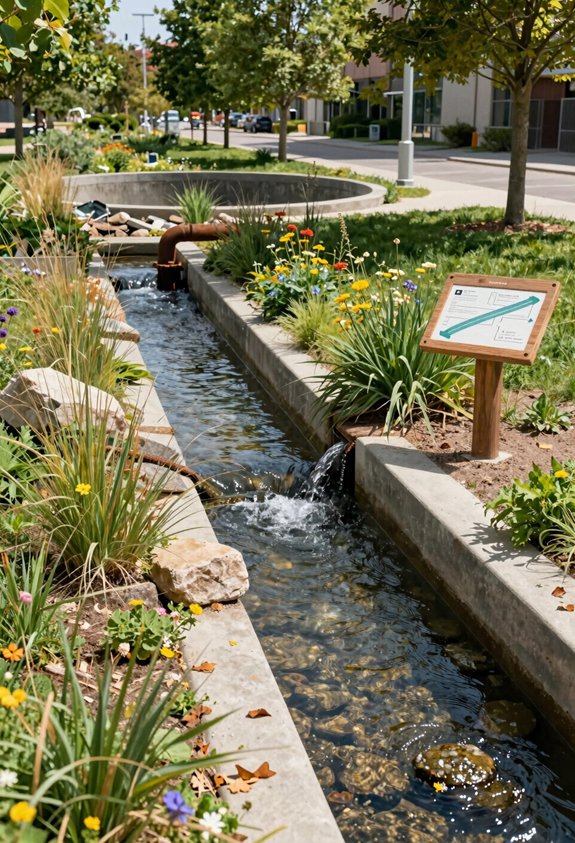
Stormwater Management Assistants step into the rhythm of city infrastructure, helping keep runoff channels clear and functional, and they do so by performing semi skilled maintenance on drainage systems, streets, and rights of way, tasks that include inspecting and repairing post construction stormwater structures, removing debris to preserve flow, and supporting engineers and project managers with reports and documentation, all while learning on the job through specialized training programs that require no formal degree but often ask for a Commercial Driver’s License (CDL B) and a couple of years of related experience.
You’ll find entry level roles that pay $21 $28.50 per hour, while project manager assistants can earn $50 $55 per hour, and you can advance to higher pay positions with experience and certification.
- Hold a CDL B and at least two years of maintenance experience.
- Perform inspections, debris removal, and repairs on stormwater systems.
- Prepare clear reports and documentation for engineers and stakeholders.
- Receive on the job training from specialized companies like AQUALIS.
- Expect a career path that can lead from operator to foreman, then to manager roles.
Sustainable Landscaping Crew Member: Job Description & Pay
You’ll find that the core responsibilities of a sustainable landscaping crew member, installing patios, walls, and water features, removing invasive plants, and operating heavy duty tools like skid steer loaders, are all hands on tasks that blend physical work with ecological care, while the required skills such as lifting 50-80 pounds repeatedly, coping with all weather, and reading basic design plans are built on a high school education and a few years of practical experience.
The position offers a starting salary of about $18 per hour, plus paid time off, group health insurance, and on the job training, which together form a benefits package that supports both immediate needs and long term growth.
As you gain experience, you can specialize in native plant selection, storm water management, or stonework, and you may advance to crew leader or foreman roles, turning an entry level job into a sustainable career pathway.
Core Responsibilities
Although the role may seem straightforward, a Sustainable Landscaping Crew Member actually balances several interconnected duties, overseeing a small team of field technicians, managing equipment and supplies, ensuring safety and quality, communicating with clients, and tracking project details, all while keeping the worksite efficient and the environment protected.
You’ll assign tasks, monitor progress, and resolve disputes, while also inspecting tools, loading trucks, and keeping inventory up to date, so every job runs smoothly.
Safety checks, PPE enforcement, and quality standards become your daily rhythm, and you’ll act as the main contact for clients, updating them and handling concerns promptly.
Documentation, from timesheets to material logs, ties everything together, ensuring projects stay on schedule and within budget.
- Supervise 2-5 technicians, assign work, and report performance.
- Maintain equipment, operate machinery safely, and manage supplies.
- Enforce safety protocols, verify PPE use, and address quality issues.
- Communicate with clients and stakeholders, resolve complaints, and ensure satisfaction.
- Record timesheets, material usage, and project progress for accurate tracking.
Required Skills
Having outlined the day to day duties, it’s helpful to see how those responsibilities translate into the skills you’ll need to succeed. You’ll need leadership and team management abilities: supervising crew members, assigning workloads, training newcomers, and spotting performance gaps, all while making quick scheduling decisions during emergencies or weather changes.
Technical expertise is essential, operating landscaping tools, understanding construction techniques for retaining walls, irrigation, and pavers, and following safety protocols to avoid accidents.
Environmental knowledge matters too: identifying native versus invasive plants, selecting species that fit climate and soil, and even collecting seeds for propagation to support sustainable ecosystems.
Strong communication lets you translate client visions into clear plans, coordinate schedules, and keep safety front and center.
Finally, physical fitness and OSHA approved safety training, plus a valid driver’s license, make certain you can handle heavy equipment, work outdoors in varied conditions, and transport materials safely.
Salary and Benefits
When you consider a career as a sustainable landscaping crew member, the pay picture unfolds as a blend of steady base wages and potential growth, with the national average annual salary hovering around $35,614 as of March 2026 and a typical monthly paycheck of $2,967, which translates to roughly $684 per week.
You’ll notice hourly rates sit near $17.12, ranging from $14.90 at the 25th percentile to $18.51 at the 75th, while entry level work can start around $10.82 per hour and top earners may exceed $20.
Geographic differences matter, with places like San Francisco paying $23.72 per hour and South Florida offering $15.78 per hour.
Advancement to crew leader or manager can lift annual earnings well above $40,000, and many companies add health, retirement, and bonus perks to the base salary.
- Base pay averages $35,614 yearly, $2,967 monthly, $684 weekly.
- Hourly wages typically fall between $14.90 and $18.51, with $17.12 as the median.
- High cost cities such as San Francisco reach $23.72 per hour; rural areas stay near $14.18.
- Promotion to crew leader or manager can raise earnings to $41,500-$63,500 annually.
- Benefits packages often include health insurance, retirement plans, and occasional bonuses, supplementing the hourly wage.
Eco Tourism Guide: Skills Needed, Certification & Earnings
If you’re drawn to the idea of guiding people through wild places while sharing the stories of the ecosystems that sustain them, you’ll find that the role of an eco tourism guide blends communication, knowledge, and physical readiness into a single, rewarding path.
You’ll need clear speaking skills, the ability to explain complex environmental ideas in plain language, and confidence speaking front of groups; multilingual fluency, Spanish, French, Portuguese, Mandarin, opens more tours.
Deep local species knowledge, hiking stamina, navigation, and wildlife observation keep trips safe and engaging, while calm crisis management protects guests during sudden weather or medical events.
Certifications such as Wilderness First Responder, Leave No Trace Trainer, and Certified Interpretive Guide boost marketability and earnings, which rise from $23 K at entry to $50 K for senior leaders, especially when you add niche credentials in birding, marine biology, or botany.
Community Outreach Coordinator: Environmental Education Role & Pay
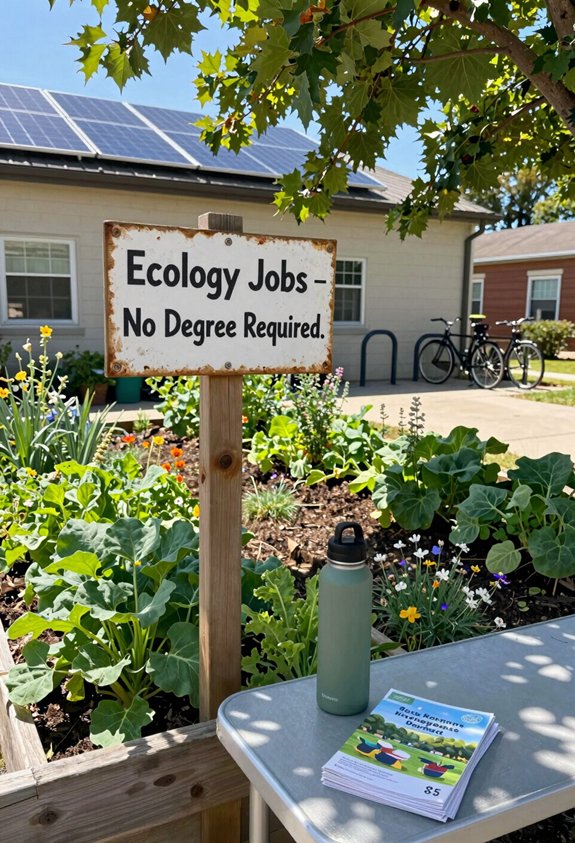
In today’s environmental education field, a Community Outreach Coordinator serves as the bridge between nonprofit, government, or grassroots groups and the neighborhoods they aim to empower, translating complex policies, like clean air standards and water quality regulations, into clear, actionable messages for residents, while designing workshops, webinars, and events that build local capacity.
You’ll find that full time roles typically offer a 40 hour week, contracts of four years, and salaries between $50,000 and $60,000, while part time gigs start at $25 an hour and may begin on dates such as April 15, 2026, with flexible schedules. Benefits often include 401(k) matching, and you don’t need a college degree, hands on experience in environmental justice, grant writing, or event planning can qualify you.
- Coordinate community workshops and webinars
- Manage media outreach and newsletter distribution
- Maintain partner relationships and databases
- Plan events that foster local environmental learning
- Translate policy language into everyday actions
Green Construction Laborer: On Site Responsibilities & Salary
You’ll find that a Green Construction Laborer moves seamlessly between tasks, cleaning up the site, handling materials, and supporting structural work, while keeping the project’s eco goals in mind, so you’ll be removing debris, digging trenches, and compacting earth according to precise specifications, all the while operating hand tools like nail guns and power tools such as cement mixers, and occasionally steering larger equipment like forklifts or skid loaders; this blend of physical effort and environmental awareness, coupled with strict safety compliance, following blueprints, monitoring air quality, and reporting hazards, creates a role that not only builds structures but also protects the surrounding habitat, and you’ll typically earn between $35,000 and $45,000 a year, with hourly rates around $18 to $22 for part time work, reflecting the skill and responsibility involved.
You’ll start each shift by clearing waste, which means removing broken concrete, wood, and metal to keep the area safe, then you’ll set up temporary barriers to guide traffic and protect nearby streams, while using a compacting tamper, an instrument that presses soil down, to make certain a stable foundation.
Handling materials includes loading pallets of recycled lumber onto a skid loader, a small machine that lifts and moves heavy loads, and positioning pipe sections with a level, a tool that checks if surfaces are flat. Throughout, you’ll follow a recycling plan, separating wood for reuse, metal for scrap, and concrete for crushing, thereby reducing landfill waste and supporting green construction standards.
Renewable Energy Site Inspector: Day to Day Tasks & Pay
After spending a day on the construction site, cleaning debris and moving materials, you’ll notice that the next step in a green building career often shifts toward ensuring the finished solar arrays work safely and efficiently, and that’s where a Renewable Energy Site Inspector comes in.
You’ll walk the roof, check structural capacity, note shading from HVAC units, and map cable routes, all while confirming that the installed panels and inverters meet manufacturer specs, using tools like infrared cameras and digital clamp meters to catch hidden faults.
Your reports will compare actual work to code approved plans, flagging any safety concerns for engineers and contractors, and your findings will become the baseline for future performance checks.
- Verify compliance with local, state, and federal codes
- Conduct shading analysis and roof condition assessments
- Perform IV curve tracing, thermal imaging, and resistance testing
- Inspect switchboards, grounding, and electrical infrastructure for safety
- Document findings, recommend corrective actions, and coordinate with project teams
GIS Mapping Assistant: Using Tech Without a Degree & Salary

Start by exploring how a GIS Mapping Assistant can launch a rewarding career without a formal degree, using tools like ArcGIS, software that lets you view, edit, and analyze geographic data, while learning on the job through hands on training and mentorship.
You’ll need only a high school diploma or GED, basic familiarity with ArcGIS or similar software, and the willingness to learn spatial projections (how maps translate earth’s surface onto flat paper) and topology (how features connect).
Employers often provide extensive on the job training, and many positions are remote, requiring high speed internet and multiple monitors.
Entry level hourly pay ranges from $20-$57, and full time salaries can reach $57,000-$85,000, with contractor roles offering flexibility and possible full time conversion.
This path lets you grow into senior technician roles that command higher compensation.
Drone Pilot for Conservation: Licensing, Tasks & Pay
You’ll need the FAA Part 107 certification, an exam that costs about $175 and proves you understand airspace rules, weather, and emergency procedures, which is the baseline for any commercial drone work in the U.S.
Once licensed, you’ll fly drones for tasks like pollution monitoring, forest fire spotting, and power line inspection, always staying within visual line of sight and respecting local airspace limits, while specialized skills such as thermal imaging or 3D mapping can boost your pay.
In this field, entry level salaries start around $30 k, but with experience and extra certifications you can earn $100 k or more, reflecting the growing demand for precise, low altitude data collection in conservation.
Regulatory Requirements
When you decide to use a drone for conservation work, the first step is getting the FAA’s Part 107 Remote Pilot Certificate, the official license that proves you’ve passed the 60 item aeronautical knowledge test, which covers everything from airspace rules to weather effects, and that you’ve been cleared by the TSA during the brief online application (FAA Form 8710-13) completed through the IACRA system in about ten to fifteen minutes.
You’ll also need to register each drone on FAADroneZone, pay the $5 fee, and carry the registration card while you fly, staying under 400 feet altitude, 100 mph speed, and within visual line of sight, only in daylight and Class G airspace.
Keep records of pre flight checks, weather assessments, and emergency plans, and remember the knowledge test recurs every 24 months to keep your certification active.
- Minimum age 16, English proficiency required
- TSA background vetting occurs automatically during application
- Registration valid for 36 months, renew before expiration
- Physical and mental fitness needed for safe operation
- Flight must be daytime, with anti collision lights at twilight
Typical Mission Types
If you’ve earned your Part 107 Remote Pilot Certificate, you can now focus on the kinds of missions that make a real difference for conservation, and the tasks you’ll perform fall into several clear categories: wildlife population monitoring, where you fly over habitats to count animals such as guanacos or sandhill cranes using high resolution cameras and GPS tagged flight paths; species behavior and health documentation, which often involves thermal infrared sensors to capture nocturnal activity and computer vision software that flags injuries or abnormal movements in real time; habitat and ecosystem management, where LiDAR (laser based mapping) and multispectral imaging help you assess forest health, coral reef condition, or invasive species spread; anti poaching and human wildlife conflict prevention, where autonomous threat identification algorithms alert herders to nearby lions or other dangerous animals, and coordinated response systems share that data with both conservation teams and local communities; and marine and aquatic resource management, which includes FAA approved flights over Arctic waters to monitor seal populations and oil rig safety.
Environmental Sales Representative: Selling Green Products & Earnings
Because the demand for sustainable solutions keeps growing, many companies now hire Environmental Sales Representatives to promote green products such as energy efficient lighting, biodegradable packaging, and renewable energy systems, a role that blends product knowledge with persuasive communication.
You’ll find that the median salary sits around $67,073 a year, roughly $32.25 per hour, while top earners can reach $81,000, and entry level positions at specialized firms often start near $97,000, showing how skill, location, and experience shape earnings.
Benefits typically include health coverage, 401(k) matching, mileage reimbursement, and performance bonuses, making the career both financially and personally rewarding.
- Median pay: $67,073 / yr ($32.25 / hr)
- 90th percentile: $81,000 / yr ($38 / hr)
- Entry level specialized: $97,000 / yr (+50 % above average)
- Top locations: Sitka, AK ($80,802 / yr) and San Francisco, CA ($79,024 / yr)
- Benefits: health, dental, 401(k) match, mileage & phone reimbursements, bonuses.
Green Supply Chain Assistant: Sustainable Logistics Role & Pay
Launching into the world of a Green Supply Chain Assistant means you’ll help companies move products in ways that cut waste, lower emissions, and respect the planet, a role that blends traditional logistics, coordinating shipments, tracking inventory, and managing paperwork, with sustainability goals such as reducing carbon footprints and choosing eco friendly packaging.
You’ll analyze routes, suggest greener transport modes, and work with vendors who use recyclable materials; you’ll monitor energy use, calculate emissions, and report findings to managers, turning data into actionable plans.
No degree is required, but a high school diploma, basic computer skills, and a willingness to learn environmental standards will get you started; entry level pay typically ranges from $38,000 to $48,000 annually, with room for growth into sustainability analyst or logistics manager positions as you gain experience and certifications.
Climate Data Entry Clerk: Managing Big Data Sets & Salary

After exploring how a Green Supply Chain Assistant blends logistics with sustainability, you can see how the next step, working as a Climate Data Entry Clerk, shifts focus from moving products to handling the numbers that track our planet’s health.
You’ll enter temperature readings, precipitation totals, and carbon emission figures into databases, often using spreadsheet software and simple cloud tools, while learning to spot errors, verify sources, and keep records organized, which builds a foundation for larger scale analysis.
Salary ranges typically sit between $35,000 and $48,000 annually, depending on location, experience, and whether you work for a nonprofit, government agency, or private research firm.
- Verify data accuracy by cross checking entries with original reports.
- Use basic cloud platforms (e.g., Google Sheets) to store and share files.
- Apply simple data cleaning steps, such as removing duplicates.
- Follow naming conventions that make datasets easy to locate.
- Track your hours and output to support salary negotiations.
Eco Product Tester: Testing Sustainable Materials & Pay
Evaluating sustainable materials, whether they’re biodegradable plastics, recycled textiles, or low impact composites, means you’ll spend your days testing product samples, recording performance data, and comparing results against environmental standards, a process that blends hands on experimentation with careful documentation.
You’ll learn to set up controlled experiments, use simple instruments like tensile testers to measure strength, and note how quickly a material breaks down under compost conditions, which is called biodegradability.
Although exact salaries vary, many firms list entry level pay between $35,000 and $45,000 annually, with higher rates for those who master data analysis software or earn certifications in environmental testing.
You’ll also find that some companies offer overtime or project bonuses when you meet tight deadlines, so your earnings can grow as you gain experience and demonstrate reliable, accurate results.
Non Profit Volunteer Coordinator: Transition to Paid Ecology Work
When you step into a non profit volunteer coordinator role, you’ll find yourself at the intersection of community outreach and environmental action, balancing the practical tasks of recruiting, screening, and scheduling volunteers with the larger goal of advancing ecological projects, you’ll quickly see how managing a single event every six weeks, fostering relationships with schools, and supporting participants during implementation builds the project management and relationship building skills that nonprofits value, while the flexible hours and commission based pay, often $12 $40 per hour and up to $30,000 annually in placement fees, let you earn while learning.
- Recruit, screen, and place volunteers, earning placement fees and bonuses.
- Coordinate fundraising drives, gaining event planning experience.
- Build partnerships with schools and community groups, enhancing engagement expertise.
- Leverage experience to move into paid communications or environmental manager roles.
- Use the network of organizations like The Nature Conservancy to find lateral, paid opportunities.
Building a Targeted Resume for No Degree Ecology Jobs
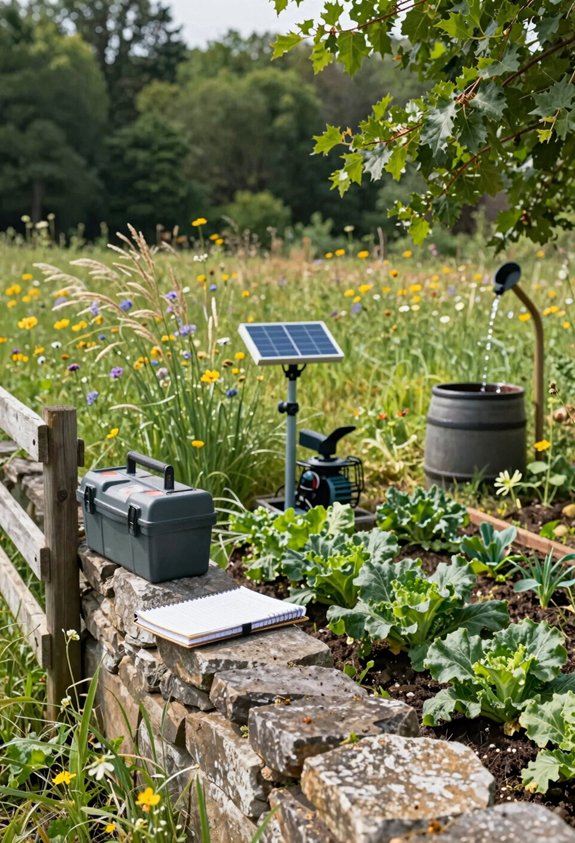
Craft a resume that reads like a concise story of what you can do, because employers in ecology value proven ability over formal credentials, and you can showcase that by foregrounding the technical skills, hands on experience, and certifications you’ve earned on the job.
List GIS mapping, data analysis, and laboratory techniques, these are marketable competencies that show you can turn raw data into actionable insight.
Highlight on the job training, noting how you learned sample collection, field testing, and lab analysis from seasoned colleagues, and add any environmental technician certification that proves you can identify and manage pollutants.
Include concrete field work: planting trees, timber operations, wildlife tours, or recycling logistics, each demonstrating stewardship and operational know how.
Finally, weave in knowledge of regulations, safety guidelines, and transferable construction or solar installer skills, using brief explanations to clarify each term for the reader.
Crafting a Portfolio That Shows Real Field Experience
You’ll start by gathering work documentation, photos, reports, and notes that record what you did in each field project, so potential employers can see concrete evidence of your skills.
Then you’ll build a visual project gallery, arranging those images and short descriptions into a clean digital showcase that highlights wildlife photography, green infrastructure work, and any data collection tasks you performed, with each piece labeled clearly to explain its context.
Work Documentation
Even if you haven’t earned a formal degree, you can still demonstrate your readiness for ecology work by assembling a clear, evidence rich portfolio that showcases real field experience, and this process begins with gathering concrete records of the projects you’ve helped on, photos of habitats you surveyed, data sheets you collected, and brief field notes that explain your role and the methods you used, such as transect sampling (a systematic way of counting organisms along a line) or water quality testing (measuring pH, temperature, and dissolved oxygen).
Keep each entry organized by date, location, and purpose, then write a short reflection that links the activity to broader ecological concepts, showing you understand why the work matters and how it fits into larger research goals.
- Include a one page summary that lists every project, the skills you applied, and the outcomes you helped achieve.
- Attach scanned copies of data sheets, charts, or spreadsheets that illustrate your quantitative contributions.
- Add annotated photographs with captions that describe the habitat, the species observed, and the sampling method used.
- Provide a concise narrative for each field note, highlighting your specific tasks, the tools you handled, and any challenges you solved.
- Link each piece of evidence to a relevant competency, such as “species identification,” “water quality analysis,” or “GIS mapping,” so reviewers can quickly see your capabilities.
Visual Project Gallery
How can you turn scattered field notes, photos, and data into a visual project gallery that truly conveys your hands on ecology work? Start by selecting a handful of projects that showcase a range of habitats, species, and methods, then organize each into a clean, digital page where you place a brief description, a map of the site, and a series of images that illustrate key moments, photos of a stream, a close up of a plant, a screenshot of a data plot.
Use captions to explain what each picture shows, defining terms like “transect” (a line you walk to record observations) in plain language. Link to raw data files or short videos when possible, but keep the layout simple, letting the visual story lead, while the text offers context and shows your analytical thinking.
This balanced approach lets hiring managers see both your field presence and your ability to communicate science clearly.
Networking Strategies for Non Degree Ecology Professionals
When you step into an industry conference or a local summit, events where sustainability experts, policy makers, and innovators gather, you instantly tap into a vibrant network that can shape your ecology career even without a formal degree, because these gatherings blend learning with relationship building, offering workshops, panel discussions, and informal chats that let you introduce yourself, ask thoughtful questions, and exchange business cards, all of which turn a brief encounter into a lasting professional connection that can lead to mentorship, collaborations, or job opportunities.
- Arrive early, introduce yourself, and follow up with a personalized email within 48 hours.
- Join professional groups like the National Registry of Environmental Professionals to access webinars and certification events.
- Optimize your LinkedIn profile, add relevant keywords, and comment on posts from thought leaders.
- Volunteer for fieldwork or outreach projects, showing commitment while meeting peers.
- Attend local chapter meetings, ask questions during panels, and exchange cards to stay on people’s radar.
Leveraging Green Jobs Boards & ZipRecruiter for No Degree Roles
You can start by focusing on Green Jobs Boards, which are dedicated sites that list environmental positions and let you filter by “no degree” requirements, location, or job type, think of them as specialized marketplaces where you can match your skills to entry level roles.
At the same time, ZipRecruiter’s filter tools let you narrow searches by experience level, salary range, or contract type, so you can quickly spot seasonal, apprenticeship, or permanent openings that fit your background without needing a degree.
Targeting Green Jobs Boards
- Register on niche sites (Remote Climate Jobs, EcoJobs.com, Conservation Job Board, Green Jobs Board) to access curated listings.
- Use built in filters to select “entry level” or “no degree required” categories, narrowing results quickly.
- Sign up for daily or weekly email alerts so fresh openings arrive directly in your inbox.
- Explore employer bios and mission statements to make certain their values align with your ecological interests.
- Save or bookmark promising roles, then tailor each application to the specific duties and required skills.
Optimizing ZipRecruiter Filters
Targeting Green Jobs Boards gave you a solid list of niche sites, and now you can sharpen that list by using ZipRecruiter’s built in filters, which let you combine location, salary, and experience criteria in a single search, so you’ll see only the roles that truly match a no degree, entry level path in ecology; the “No Degree” filter, for instance, pulls conservation, environmental, and wildlife jobs that don’t require a college credential, while the “No Experience” option opens doors to positions where on the job training is the norm, and by adding the “Entry Level” tag you further narrow the pool to listings that explicitly welcome newcomers, all of which can be refined by state or city, like Raleigh or Charlotte, to make certain the opportunities you pursue are both geographically convenient and financially realistic, with salary ranges that span from $31 k to $101 k for entry level ecology work in North Carolina, and hourly rates that can reach $54 for environmental roles, giving you a clear, calm roadmap to focus your applications without getting lost in a sea of unrelated postings.
Next, apply the “No Degree” filter to surface conservation positions ranging $34k $78k and wildlife roles that can reach $259k, then layer the “No Experience” option to capture environmental science jobs paying $68k $165k, and finally select “Entry Level” to lock in listings that explicitly welcome beginners, while using city filters, Raleigh’s hourly $16-$54 or Charlotte’s $31k $101k, to keep travel costs low and income realistic, ensuring every click aligns with your skill set and geographic preferences.
Common Interview Questions for Eco Field Positions?
When you walk into an eco field interview, the first thing interviewers usually explore is your motivation: why you’re drawn to ecology and what you hope to achieve in the next five years, a question that lets you explain, personal passion for studying relationships among organisms and their environments while also outlining a realistic career trajectory.
You’ll then hear questions about your field experience, data skills, and how you stay current on research, each designed to gauge both technical competence and personal drive.
Answer calmly, linking past projects to future goals, and be ready to discuss GIS, Geographic Information Systems, the mapping tools that help visualize habitats, in plain language.
- Why are you interested in this ecology role and the field overall?
- Where do you see yourself in five years, and how does this position fit that plan?
- What fieldwork or outdoor experience have you had, and how did you manage data collection?
- Which software, GIS, or remote sensing tools have you used, and can you explain them simply?
- How do you stay up to date on ecological news, and what recent issue excites you most?
Salary Negotiation Tips for Entry Level Ecology Jobs

You’ll start by researching market rates, checking job boards, industry reports, and salary surveys to see what entry level ecology positions pay in your region, and you’ll note any certifications you hold, like GIS or wildlife monitoring, because those credentials can boost your value.
When the conversation turns to compensation, you can ask the recruiter for the salary range first, then frame your request as a collaborative discussion, highlighting how your relevant certifications and any hands on experience justify a figure toward the higher end of that range.
Research Market Rates
Start by gathering concrete market data, salary ranges, average pay, and compensation packages, for the specific entry level ecology role you’re eyeing, because knowing the numbers lets you speak confidently about what’s fair, and it helps you avoid lowballing yourself or overreaching.
You’ll find that field technicians and research assistants typically earn $35,000 $50,000, while specialists and wildlife biologists can reach $56,000 $62,000, and government jobs often add strong benefits.
Use these figures to set a realistic target, compare them with your location’s cost of living, and note any bonuses or health plans that boost total compensation.
When you enter negotiations, reference the data calmly, explain why your skills match the higher end, and ask for a clear breakdown of each component.
- List the exact salary range for the role you want.
- Compare that range with national averages and local cost of living indexes.
- Identify any extra benefits (health, retirement, travel) that affect total pay.
- Prepare a short, factual statement linking your experience to the higher end of the range.
- Ask politely for a written offer that details base salary, bonuses, and benefits.
Leverage Relevant Certifications
Gathering market data gave you a solid baseline, and now you can boost that foundation by highlighting the certifications that set you apart, because a recognized credential, such as the Certified Ecological Technician (CET) or a GIS (Geographic Information Systems) certificate, signals that you’ve mastered specific tools or methods, which employers often translate into higher pay.
When you bring up a CET, explain that it proves you can conduct field surveys, identify species, and write technical reports, all of which cut training time and reduce errors; similarly, a GIS certificate shows you can map habitats, analyze spatial data, and produce visualizations that help managers make decisions.
During negotiation, cite these achievements, compare your package to industry averages, and politely request a salary range that reflects the added value, remembering that confidence and clear evidence make your ask reasonable and compelling.
Continuing Education Options to Advance Without a Bachelor’s
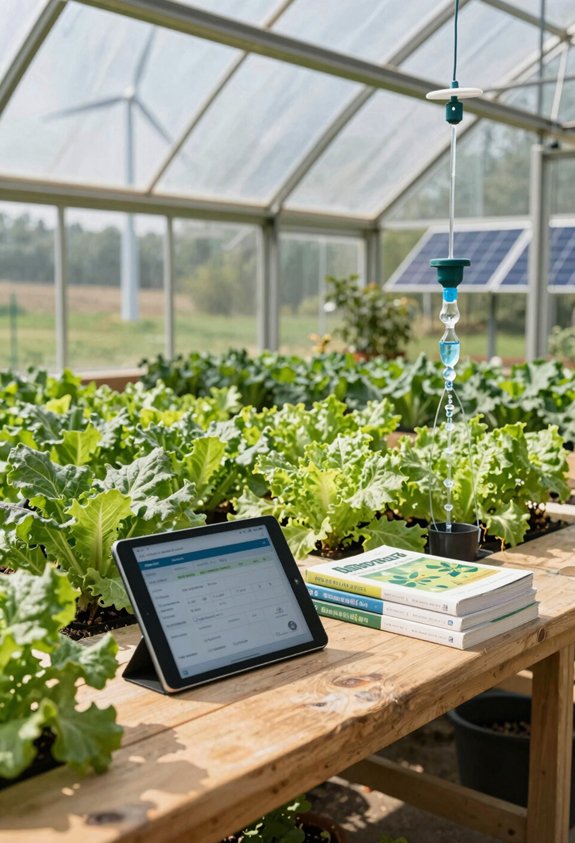
Embracing online learning and MOOCs, massive open online courses that let you study at your own pace, offers a practical pathway to deepen environmental knowledge without a bachelor’s degree, and platforms like ESRI and MIT’s open source repository provide free or low cost materials that cover everything from basic ecology to specialized topics such as wildlife rehabilitation or green HVAC systems.
You can also blend community college courses, trade school workshops, and professional certifications that validate specific skills, while flexible scheduling lets you keep your current job.
Consider joining professional groups that host webinars and field trips, because networking often reveals hidden learning resources and mentorship opportunities.
- ESRI and MIT MOOCs for self paced study
- Community college classes focused on immediate job needs
- Trade school programs teaching hands on environmental techniques
- Certifications from recognized bodies confirming technical competency
- Professional organizations offering workshops, field trips, and networking events
Long Term Career Paths Starting From a No Degree Ecology Job
After exploring the online courses and community college classes that can boost your knowledge, you’ll notice that many of those same skills open doors to longer term career tracks, even if you began without a bachelor’s degree.
You can start as a forest worker, learn field sampling and equipment use, then accumulate experience that lets you move into a natural resource scientist role, where you’ll apply data analysis to protect ecosystems; similarly, an environmental technician can, a few years, earn certifications, and become a senior scientist, earning $84 K on average.
Recycling and waste management staff often progress to supervisory positions, while wildlife technicians advance into conservation leadership through hands on species and.
The renewable energy boom, solar installers projected to grow 27 %, offers a parallel path, letting construction trades shift into green construction roles that pay up to $95 K, all while building a sustainable, long term ecology career.
Frequently Asked Questions About No Degree Ecology Careers?
If you’re wondering whether a formal degree is truly required to build a career in ecology, the answer is a reassuring no, many rewarding roles welcome people with a high school diploma, hands on experience, and a willingness to learn on the job.
You’ll often ask if you can start without a degree, what jobs exist, which certifications help, and how other skills fit, and the answers are clear: entry level positions like logger, forest worker, recycling worker, environmental technician, or natural resources technician pay from $26 k to $71 k and value experience over paperwork.
Certifications from sustainability programs, MOOCs, or community colleges boost credibility, while transferable skills from tech, business, or media enrich the field.
- Logger: harvests trees, operates equipment, earns $26,913 / yr
- Forest & conservation worker: plants trees, collects data, earns $57,756 / yr
- Recycling worker: sorts materials, runs machines, earns $31,876 / yr
- Environmental technician: tests pollutants, handles samples, earns $50,630 / yr
- Natural resources technician: assesses resources, advises policy, earns $71,557 / yr
Final Checklist: Launch Your Ecology Career Without a Degree
Often the most effective way to launch an ecology career without a degree is to treat the process like a step by step checklist, where each item builds on the last and keeps you moving forward with confidence.
First, pick a free or low cost online course, MIT’s open source modules or ESRI’s GIS training, so you gain foundational knowledge in chemistry, biology, geology, and statistics, which are the basic sciences that underpin environmental work.
Next, earn a relevant certification, such as an environmental management or carbon accounting credential, because over 400 recognized certifications signal proven ability to employers.
Then, secure practical experience through internships, volunteer projects with The Nature Conservancy, or personal field studies, building a portfolio that showcases real world skills.
Finally, join professional groups like the National Association of Environmental Professionals, attend local green meet ups, and use specialized job boards (Climatebase, Conservation Job Board) to network, apply, and shift smoothly into your new role.
Final Thoughts
You’ve seen how a no degree path can lead straight into ecology, offering hands on experience, modest pay to and clear routes for growth; by mastering field tools, earning short certifications, and staying curious, you’ll build a solid foundation that employers value. Remember, each step, whether collecting soil samples or learning GIS (geographic information systems, software that maps data), adds confidence and competence. Are you ready to turn your passion for nature into a purposeful career, one thoughtful step at a time?
References
- https://careerkarma.com/blog/environmental jobs without a degree/
- https://www.indeed.com/career advice/finding a job/jobs that help the environment no degree
- https://www.youtube.com/watch?v=YxxmkE_CIYs
- https://getschooled.com/article/5800-10 green economy jobs that don t require a 4 year degree
- https://www.indeed.com/q wildlife entry level no degree jobs.html
- https://www.ziprecruiter.com/Jobs/Environmental No Degree/ in Los Angeles
- https://www.greenworkx.org/article posts/green jobs for the eco conscious no degree required
- https://sercal.org/job openings
- https://www.youtube.com/watch?v=COR4WISN6ew
- https://www.theenvironmentalcareercoach.com/blog/get an environmental job without a degree
Related career guides on Simply Ecologist:
Frequently Asked Questions
Can you get an ecology job without a degree?
Yes. Many environmental and ecology roles, such as environmental technician, wind turbine technician, solar installer, recycling and waste technician, and field or wildlife assistant, hire with a high school diploma plus short certifications and hands on experience.
What is the highest paying ecology job without a degree?
Wind turbine technician is among the best paid, with a median near $61,770, followed by environmental science and protection technicians (~$50,660) and solar panel installers (~$48,800).
What certifications help you get hired without a degree?
HAZWOPER safety training, OSHA certification, GIS short courses, renewable energy and wind or solar credentials, and pesticide or water quality certificates all boost no degree applications.
How do you start an ecology career with no experience?
Volunteer with conservation groups and community science projects, take seasonal technician roles, earn one or two targeted certifications, and build a simple portfolio of field and data work.

Erzsebet Frey (Eli Frey) is an ecologist and online entrepreneur with a Master of Science in Ecology from the University of Belgrade. Originally from Serbia, she has lived in Sri Lanka since 2017. Eli has worked internationally in countries like Oman, Brazil, Germany, and Sri Lanka. In 2018, she expanded into SEO and blogging, completing courses from UC Davis and Edinburgh. Eli has founded multiple websites focused on biology, ecology, environmental science, sustainable and simple living, and outdoor activities. She enjoys creating nature and simple living videos on YouTube and participates in speleology, diving, and hiking.
For your next application
Keep applying and hearing nothing back?
The Biology Job Application Kit shows you which stage of your applications is failing and how to fix it. 46 guides, 22 editable templates, an application tracker and an ATS CV Creator licence.
See the Job Application Kit