
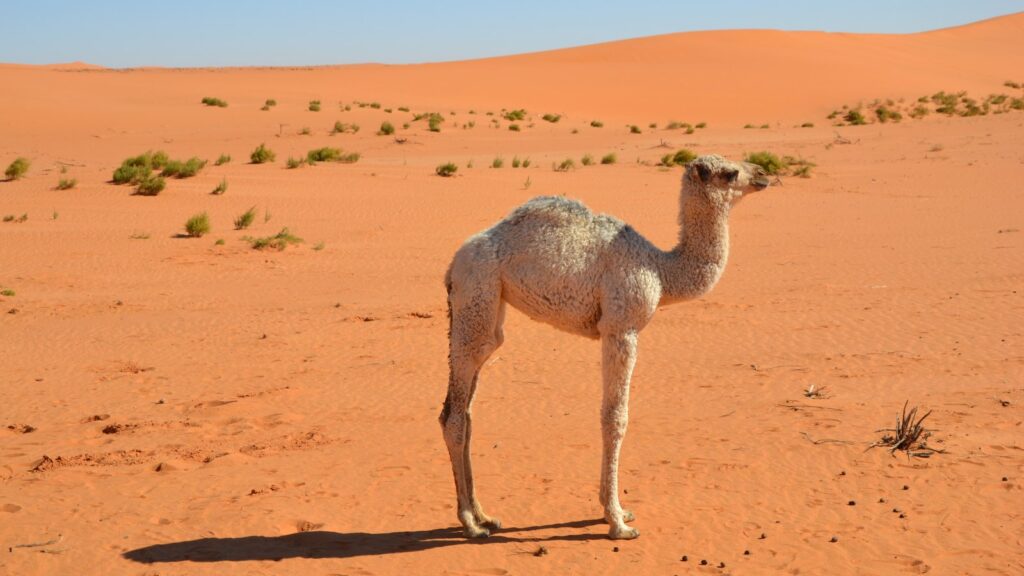
Part of my complete guide to camels, covering hump biology, water physiology, the three species and the wild camel’s conservation status, with sources.
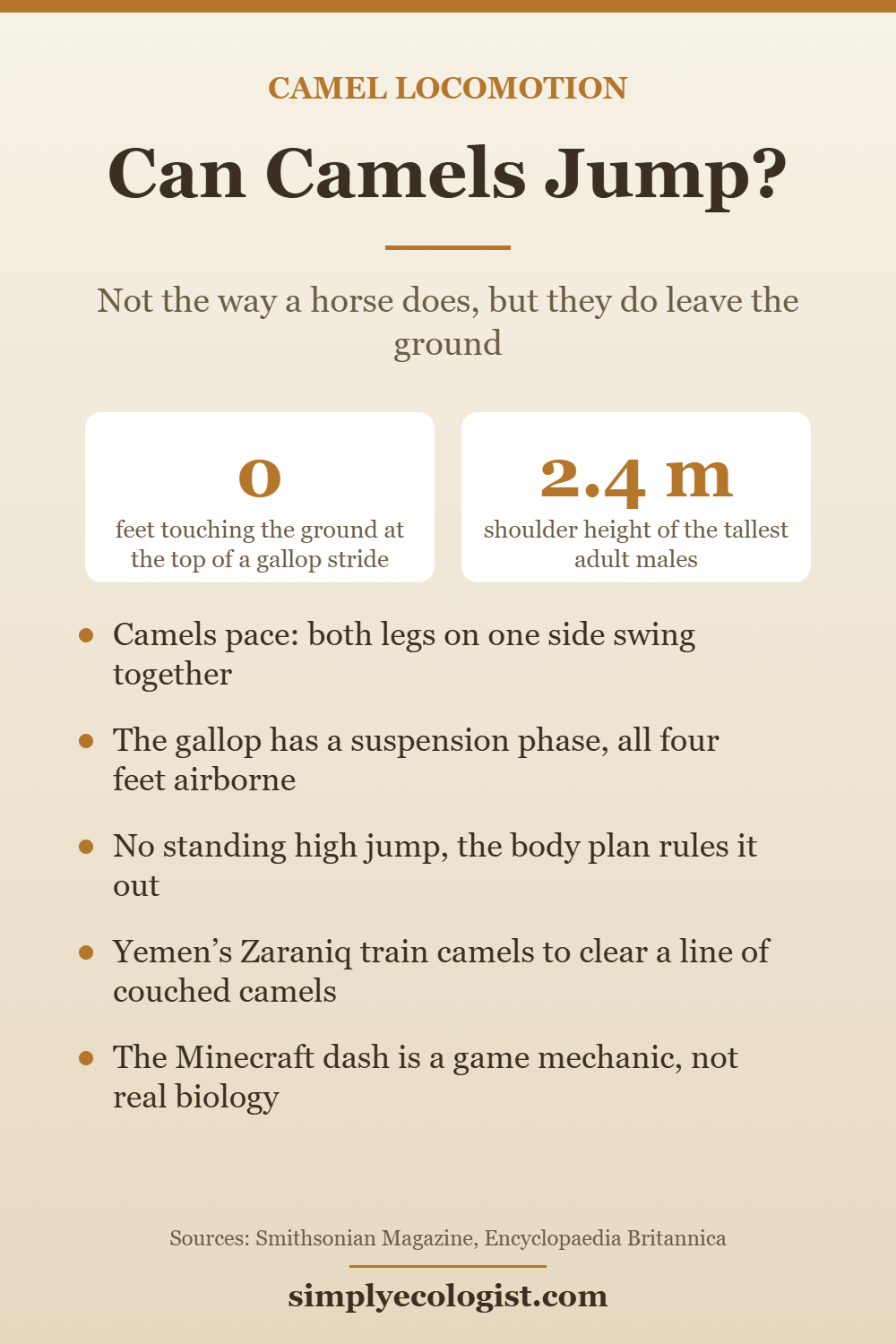
Camels don’t jump like horses or deer. Their bodies evolved for endurance, not vertical leaps. A full gallop creates a brief airborne phase, milliseconds with all four feet off the ground, but this serves forward motion, not ascent. The dromedary’s heavy frame and long curved neck make controlled jumps mechanically awkward. Yemen’s Zaraniq tribe turns this limitation into sport: barefoot athletes vault over standing camels at weddings and festivals. Real camels stay earthbound by design; any flight comes from speed, not choice. What follows explores how biology and culture shape this remarkable animal’s relationship with gravity.
People arrive at this question from three different directions, and they want three different answers. Some mean the biomechanics: can a camel physically leave the ground. Some mean the Yemeni sport of camel jumping, where the humans jump and the camels stand still. And a large share mean the Minecraft camel, which dashes on command in a way no real camel can. This post answers all three, in that order.
Key Takeaways
- Camels cannot jump from a standing start. The long straight legs and the pacing gait that make them efficient walkers rule out explosive vertical power.
- A galloping camel does become airborne. All four feet leave the ground during the suspension phase of the stride, for a fraction of a second, without the animal ever jumping on purpose.
- Pacing means both legs on one side swing together, so at every speed below a gallop at least one foot stays down.
- In Yemen, the Zaraniq tribe of Tihama practise camel jumping. The humans jump. The camels stand still.
- The Minecraft camel dash is a game mechanic: 12 blocks forward, 1 block upward, on a 2.75 second cooldown. No real camel does anything like it.
Do Camels Actually Jump?
Camels do jump, but only in a limited sense. They don’t leap vertically from standing like horses or deer. Their airborne moments come during a gallop. All four feet leave the ground briefly. This isn’t true jumping. It’s a byproduct of speed and stride.
In Yemen, athletes practice camel jumping, a tradition documented by Smithsonian Magazine along the Red Sea coast. They vault over stationary dromedaries. The camel stays earthbound. It serves as obstacle, not performer.
Camels evolved for endurance. Their bodies prioritize long distance travel over explosive power. Vertical clearance remains minimal. A Turkish proverb captures this reluctance. It suggests camels resist jumping by nature. This reflects both physical limits and temperament.
The distinction matters. Galloping flight differs from intentional leaping. Understanding this clarifies what camels can and can’t do.
Speed is the variable that decides it. Working dromedaries walk at about 4 km per hour, jog at 8 to 12, and manage a fast run of 14 to 19 km per hour, all of it in the pacing gait that keeps at least one foot on the ground. Only the canter, which the animal can hold for short bursts and which shows up mainly in races, breaks the pace into a true gallop. That is the one gear with an airborne phase in it.
| Gait | Speed | Leg pattern | All four feet airborne? |
|---|---|---|---|
| Walk | About 4 km per hour | Pacing, both legs on one side swing together | No |
| Jog | 8 to 12 km per hour | Pacing | No |
| Fast run | 14 to 19 km per hour | Pacing | No |
| Canter or gallop | Short bursts only, mainly in racing | Breaks the pace into a gallop | Yes, briefly |
The Gallop’s Hidden “Jump” Phase
Watch a camel at full gallop, and you’ll catch something unexpected. All four feet leave the ground simultaneously. This brief airborne phase meets the technical definition of a “jump” in quadruped locomotion, the study of how four legged animals move. The suspension lasts only milliseconds. It occurs exclusively during the gallop, a fast four beat gait.
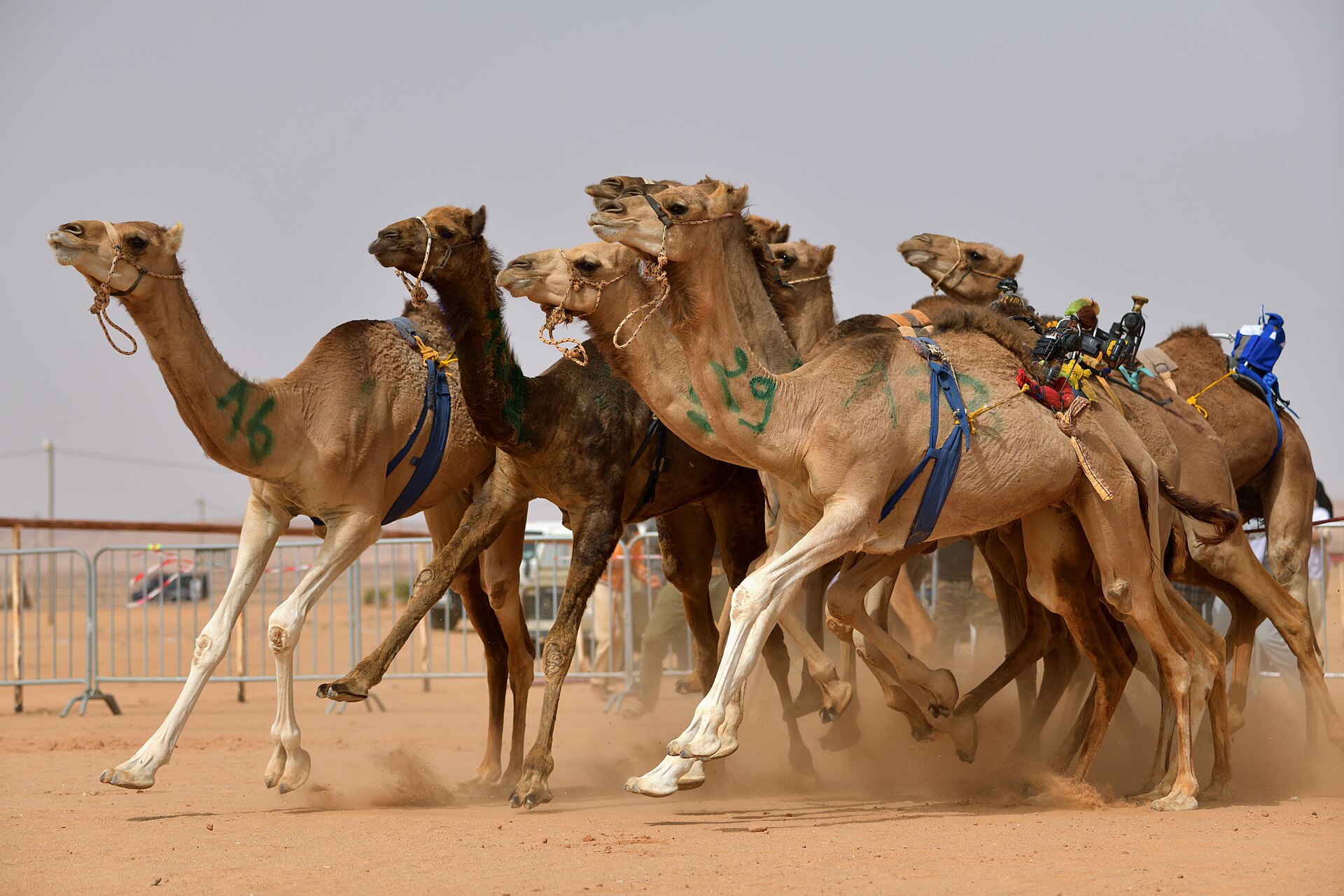
Walking produces no such phase. Neither does standing still. Observers compare this to horses. Both animals share this stride mechanic.
The distinction matters greatly. Camels become airborne through momentum, not intent. They don’t vault deliberately like gazelles or horses clearing fences. Footage confirms this. The “jump” serves propulsion, not purpose. It’s biomechanics at work, how living structures function during movement. Understanding this separates natural gait from chosen action.
| Animal | Fastest gait | All four feet airborne? | Deliberate leap from standing? |
|---|---|---|---|
| Dromedary camel | Gallop | Yes, for a fraction of a second | No |
| Horse | Gallop | Yes | Yes, trained horses clear obstacles on cue |
| White tailed deer | Bound | Yes | Yes, clears fences from a standstill |
| African elephant | Amble | No, one foot always stays down | No |
From the field: having worked field seasons in Oman, where dromedaries are simply part of the everyday landscape, the thing that stays with you is how little vertical movement there is anywhere in the animal. A horse gathers itself before it moves. A camel does not. The head stays level, the back stays level, and the legs swing forward in pairs on each side, which is why a walking camel looks like it is gliding rather than stepping. Everything about the body is organised around not wasting energy going upwards. That is also exactly why the suspension phase is so easy to miss. It is the only moment in the animal’s entire repertoire when the ground is not carrying it.
How Minecraft’s Camel Dash Compares to Real Galloping
Because Minecraft’s dash mechanic differs so sharply from biological reality, players often misunderstand what real camels can do. The game’s saddled camel launches 12 blocks forward and 1 block upward on command, with a 2.75 second cooldown.
Real dromedary camels gallop differently. Their gait creates brief airborne phases with all four feet off the ground, but this emerges from continuous motion, not a standstill leap.
Three distinctions matter:
- Control: Players trigger dashes at will; real camels can’t perform explosive bursts on command.
- Consistency: Minecraft fixes distance at roughly 12 meters; biological airborne length varies by speed and anatomy.
- Purpose: Game mechanics balance traversal and fall protection; nature follows musculoskeletal limits without cooldowns.
| Minecraft camel dash | Real dromedary camel | |
|---|---|---|
| Trigger | Player holds the jump control | Never performed on command |
| Horizontal distance | Up to 12 blocks | No comparable single leap |
| Vertical gain | 1 block | None from a standing start |
| Cooldown | 2.75 seconds | Not applicable |
| Airborne phase | Scripted arc | Brief suspension inside a gallop stride |
The comparison reveals how digital simplification reshapes understanding of living creatures.
Minecraft camel versus real camel: the short version
- The dash is a command. A player triggers it with the jump control. A real camel has no equivalent burst and cannot be asked to produce one.
- The numbers are exact and unreal. Up to 12 blocks forward, 1 block upward, resetting every 2.75 seconds. Nothing in camel locomotion works on a cooldown.
- A real camel only leaves the ground inside a gallop stride, never from standing, and never on cue.
- The game did get one thing right. Minecraft camels pace, swinging both legs on one side together, which is exactly how the real animal walks.
Why Camels Resist Leaping Obstacles
Although their gallop carries them briefly airborne, camels almost never jump on purpose. Their anatomy and gait favor a rolling, long striding gallop rather than explosive vertical takeoffs, so they rarely perform standing jumps. Their large body mass and long curved neck make controlled vertical clearance awkward and energy inefficient.
Traditional herding cultures noticed this reluctance long before anyone measured it. Sayings that use a jumping camel as the image of an impossible task circulate across the region, though the versions in print vary enough that none of them should be treated as a single authoritative proverb.
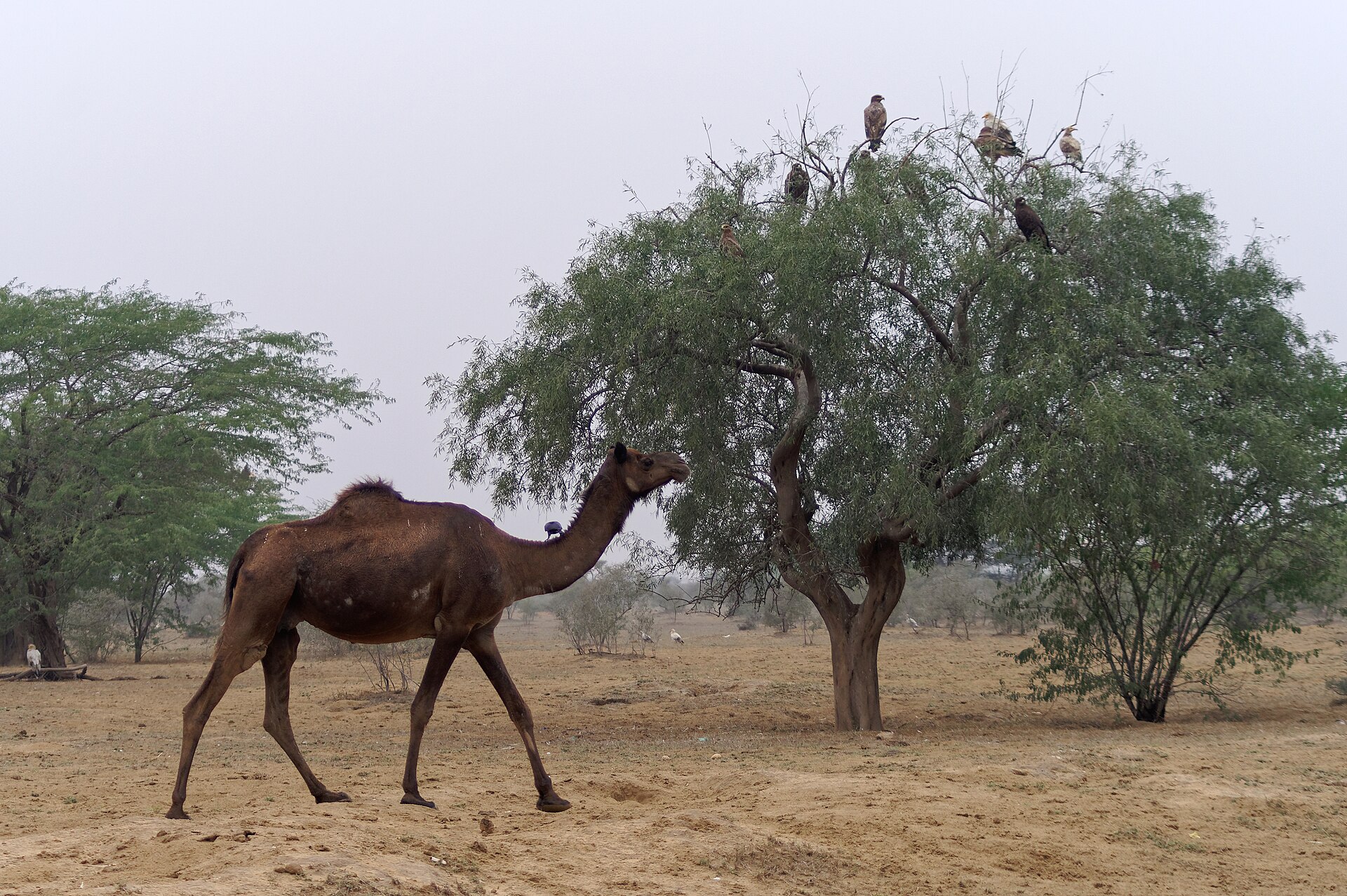
When facing obstacles, camels typically circumvent barriers or step over them using their natural stride. Forced jumping provokes refusal or unpredictable movements, risking injury to handlers and animals through slips or collisions.
This resistance isn’t defiance but biomechanical wisdom. Evolution shaped camels for endurance across open terrain, not acrobatic clearance. Their bodies remember this heritage.
Yemen’s Barefoot Leapers: The Zaraniq Tribe
The Zaraniq tribe of western Yemen has preserved a distinctive athletic tradition for generations. Their competitions occur at social gatherings like weddings and religious festivals, where barefoot runners sprint toward a raised mound of mud and weeds before launching over lines of dromedary camels.
Each successful leap, defined as clearing the animals without contact, adds another camel to the line. Elite jumpers typically manage five or six in sequence before the row becomes too wide to clear.
Tribal Origins
Deep in Tihamah, Yemen’s coastal plain along the Red Sea, the Zaraniq tribe has practiced camel jumping for generations. The sport emerged from a practical dispute. Two tribesmen argued over a camel’s price. They settled it through physical contest. The practice evolved into tradition.
Zaraniq jumpers sprint barefoot across packed mud, launch from a small earth mound, and clear the restrained dromedaries without touching them. The tribe holds these competitions during weddings, Mawlid celebrations and the annual palm festival along the Red Sea coast.
Success brings prestige rather than money. A jumper who clears the line in front of the village at a wedding carries that standing for years, and the best of them are known by name well beyond their own settlement.
Competition Format
A jumper lines up behind the packed mud mound, sprints barefoot toward the row of dromedaries, and launches from the mound, which stands roughly a foot high. The leap counts only if the jumper touches no part of any camel. Each camel cleared stays in the line for the next round, so the row grows wider with every successful attempt.
Competitions occur at weddings, the Mawlid, and the annual palm festival. Prestige serves as the main prize, with modest cash for the winner. Top leapers clear five or six camels. Zaid Omer of Yemen holds the barefoot world record at six camels.
Jumpers wear traditional clothing tucked at the waist, and rely on precise timing and the raised mound rather than on any equipment. A failed landing can injure the athlete and the animal alike. The format tests skill rather than spectacle.
When Weddings and Festivals Host Camel Jumping
Traditional occasions shape this practice markedly. Weddings, the Mawlid (the Prophet Muhammad’s birthday, an Islamic celebration), and the annual palm festival serve as primary venues.
The competition format follows clear structure: competitors run barefoot, launch from a packed mud mound, and clear camels held by reins, with each successful jump adding another animal to the line.
Traditional Occasions
Celebrations among the Zaraniq tribe of Western Yemen have long served as stages for one of the region’s most distinctive athletic displays.
Weddings rank among the most significant traditional occasions for camel jumping. Leapers demonstrate their skill before assembled guests. Success brings prestige within the community. The sport adds ceremony to marital unions.
Mawlid observances marking the Prophet Muhammad’s birthday provide another customary setting. Tribal members gather to witness the leaps. These religious commemorations blend devotion with physical exhibition.
The annual palm festival along the Red Sea coast offers a regular public venue. Crowds assemble specifically to watch competitors attempt record clearing jumps. The event draws spectators from surrounding areas.
These gatherings serve dual purposes. They fulfill social and ritual functions while spotlighting athletic achievement. Prize structures modestly reward victors, though reputation matters more than cash.
The Dromedary as Living Hurdle
The dromedary, a camel with one hump, doesn’t leap in this sport. It stands still. In Zaraniq camel jumping, this animal serves as a passive living hurdle. Competitors jump over it. Handlers hold the camel by reins and tail.
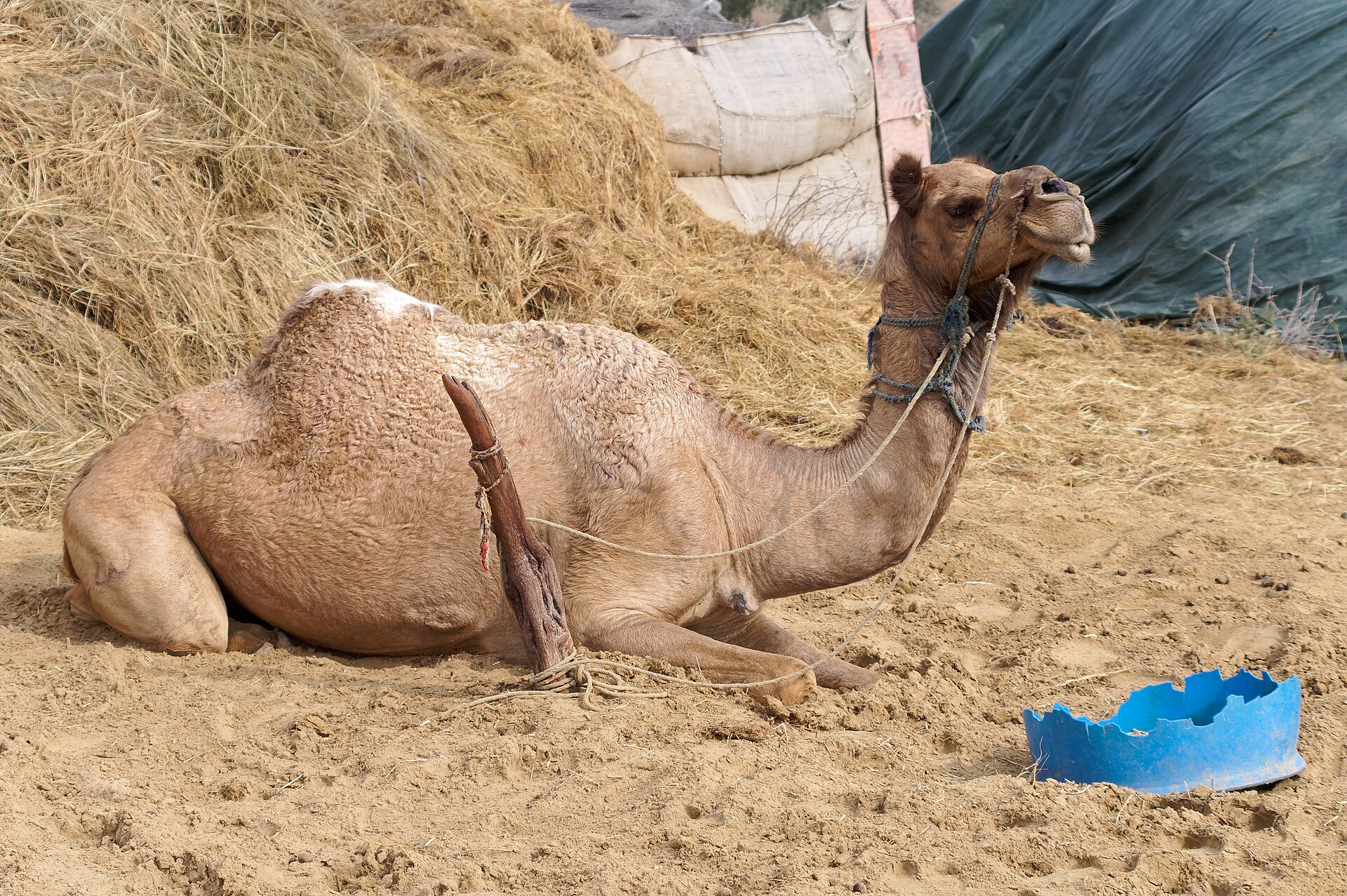
Adult male dromedaries stand roughly 1.8 to 2.0 metres at the shoulder, about 10 cm taller than females, according to the University of Michigan Museum of Zoology Animal Diversity Web. This creates a significant challenge. Jumpers need vertical and horizontal clearance. Success means no contact with the animal. Failure risks injury to the camel’s flank or neck.
The camels stand in rows, and the row grows longer with each successful round. Handlers hold the animals still, which is the part of the sport that carries the most risk for them.
Animal welfare matters here. Improper landings harm these creatures. Handlers must steady and protect them.
Camel Jumping Rules: How to Clear Without Touching
When a competitor steps onto the packed mud mound, they face a precise physical challenge. They sprint barefoot in traditional clothing, launch from the raised platform about one foot high, and must clear the dromedary without touching any part of the camel. A handler holds the camel steady by reins and tail to minimize movement during the approach and vault.
Precise timing and a controlled launch prove critical. A miscalculation risks landing on the camel’s flank or neck, injuring both jumper and animal.
The emotional weight of this sport emerges in three ways:
- The bare feet on packed mud connect the athlete to generations of tradition.
- The handler’s steady grip represents trust between human partners.
- The silent flight above living muscle demands complete presence.
Attempts occur at weddings, Mawlid, and the annual palm festival. Prestige and modest cash reward the victor.
The Record: Six Camels, and Why Nobody Has Ratified It
The most widely cited barefoot record belongs to Zaid Omer of Yemen, credited with clearing six camels. That figure comes from the Mizan Project rather than from any governing body, so treat it as a reported benchmark rather than an adjudicated world record. Top Zaraniq performers typically clear five. Six is the number that separates a good jumper from a famous one.
It is worth being precise about what six camels actually means, because the sport has no federation, no ratification process and no standard animal. A line of six dromedaries is not a fixed distance. It depends on the size of the camels, how tightly the handlers hold them together, and how high the mound is. Compare that with athletics, where the long jump world record of 8.95 metres has stood since 1991 under measured conditions, and the difference is clear: the six camel figure describes an achievement rather than measuring one.
That is not a criticism of the sport. Prestige rather than prize money is what a winner takes home, and the Zaraniq have never needed a tape measure to know who the best jumper in the village is. The distinction only matters if you are trying to compare the feat to anything outside Tihama.
Broken Legs and Bruised Flanks: Dangers to Jumpers and Camels
Landing wrong shatters bone. In Zaraniq camel jumping, mistimed launches send athletes crashing into camel flanks or necks. Broken legs result from awkward landings or poor foot placement. Barefoot competitors sprint from packed mud mounds barely twelve inches high. Slips happen. Fractures follow.
Camels suffer too. A jumper’s full weight striking the flank bruises tissue. Neck collisions strain vertebrae. Each added camel raises the bar, and the stakes. Elite athletes clear five or six; six remains the record. Precision matters more than padding.
Safety rests on technique alone. No helmets protect skulls. No boots stabilize ankles. The leaper’s skill stands between flesh and harm. One miscalculation endures: two species share the risk, neither shielded by equipment, both dependent on split second timing.
Could Camel Jumping Become an Olympic Sport?
Where could such a tradition lead? Olympic inclusion demands more than remarkable barefoot leaps over six camels. The sport lacks standardized rules, international federations, and weight classes. It’s niche, not universal.
- Athletes face broken limbs without regulated safety protocols.
- Camels endure collisions from failed jumps, raising welfare concerns that conflict with Olympic values.
- Prestige and modest cash prizes can’t match global competitive structures.
The International Olympic Committee requires documented worldwide participation across multiple countries. Camel jumping remains rooted in Zaraniq cultural festivals, weddings, and Mawlid ceremonies. Without formal judging, age divisions, and animal welfare standards, the gap appears substantial. Years of demonstration events and protocol development would precede any serious consideration.
One reflects quietly on traditions transformed, and what’s preserved or lost.
Why This Sport Endures in War Torn Yemen
Though Yemen’s conflict has shattered infrastructure across much of the country, camel jumping persists among the Zaraniq tribe through sheer resourcefulness. The sport needs little: dromedary camels, an earthen mound, and barefoot competitors. It avoids the high costs of organized athletics.
Tribal gatherings, weddings, Mawlid celebrations, and the annual palm festival, host these events. They’re community centered spectacles requiring no formal venues.
The rewards matter deeply. Winners gain prestige and social recognition. Honor flows from physical prowess, not wealth. A modest cash prize accompanies this status.
The practice anchors Zaraniq identity. Local custom and a disputed origin story sustain it. Competing through natural strength offers a nonviolent outlet. This matters in a region where weapons dominate other conflicts.
One senses quiet resilience here. Culture adapts, it doesn’t vanish.
Where to See Camel Jumping Today
Travelers seeking authentic camel jumping must head to Yemen’s Red Sea coast. The Zaraniq tribe preserves this practice in Tihama villages, where competitors leap barefoot over dromedary camels during weddings, Mawlid celebrations, and the annual palm festival.
Visitors will witness something rare. The sport remains confined to this region, unchanged by commercial forces.
- Event timing aligns with harvest cycles and religious calendars, not tourist seasons.
- Prize money stays modest; competitors chase community respect, not wealth.
- Conflict hasn’t erased the tradition, local persistence keeps it alive.
Authentic viewings happen in small gatherings, not staged performances. Travelers must connect with local guides or cultural organizations for scheduling and safety updates. Sightings outside Yemen occur only at occasional cultural exhibitions.
From Red Sea Coast to Global Attention: The Sport’s Future
While the Zaraniq tribe’s camel jumping remains rooted in Yemen’s Red Sea coast, the sport hasn’t escaped outside notice entirely. Despite Yemen’s ongoing conflict, the tradition endures at weddings and festivals. Limited international attention has begun to reach this niche practice.
Champion jumpers gain standing across the region rather than beyond it. Without a federation, a ranking system or a filmed archive, reputation travels by word of mouth, which is one reason the sport has never produced a record anyone outside Tihama can check.
Safety concerns limit broader growth. Jumpers risk broken legs. Camels suffer flank or neck injuries. These welfare issues restrict professionalization.
The sport stays culturally specific. It lacks global infrastructure. Animal welfare debates persist. Given these constraints, camel jumping won’t likely reach Olympic status. It remains a small scale tradition. Its future depends on local preservation, not international expansion.
Camel Jumping: Frequently Asked Questions
Can camels jump?
Not in the way a horse or a deer does. A camel cannot spring vertically from a standing position, because its long straight legs and pacing gait are built for covering distance rather than for explosive power. A camel at a full gallop does briefly leave the ground during the suspension phase of the stride, so it becomes airborne without ever jumping on purpose.
How high can a camel jump?
There is no measured vertical jump height for a camel, because camels do not perform standing jumps. The only meaningful airborne moment is the suspension phase of a gallop, which lifts all four feet clear of the ground for a fraction of a second at running speed.
Do camels leave the ground when they run?
Yes. At a walk a camel paces, swinging both legs on the same side together, and at least one foot stays down. At a full gallop the stride includes a suspension phase in which all four feet are off the ground at once.
What is the record for camel jumping in Yemen?
The most widely cited figure is six camels cleared barefoot by Zaid Omer of Yemen, reported by the Mizan Project. Top Zaraniq jumpers typically clear five or six animals. No governing body adjudicates the sport, so the number is a reported benchmark rather than a ratified record.
Is camel jumping a sport where the camel jumps?
No. The camels stand still and the human athlete jumps over them. Zaraniq competitors sprint barefoot across packed mud, launch from a low earth mound, and clear a line of couched or standing dromedaries without touching them.
Why can Minecraft camels dash but real camels cannot?
The Minecraft camel dash is a game mechanic, not a simulation. Players trigger it with the jump control, it carries the mob up to 12 blocks forward and 1 block upward, and it resets after 2.75 seconds. A real camel has no equivalent explosive burst and cannot be asked to produce one.
Final Thoughts
Camels do not jump in the way horses or gazelles leap. Their gallop contains a suspended phase, all four feet briefly airborne, but this is not true jumping. The Zaraniq tribe of Yemen performs a sport where camels sprint across flat ground, their riders guiding them past markers. Biodiversity, the variety of life in a place, does not include athletic camels. The sport survives war and poverty. Observers note its fragility.

Erzsebet Frey (Eli Frey) is an ecologist and online entrepreneur with a Master of Science in Ecology from the University of Belgrade. Originally from Serbia, she has lived in Sri Lanka since 2017. Eli has worked internationally in countries like Oman, Brazil, Germany, and Sri Lanka. In 2018, she expanded into SEO and blogging, completing courses from UC Davis and Edinburgh. Eli has founded multiple websites focused on biology, ecology, environmental science, sustainable and simple living, and outdoor activities. She enjoys creating nature and simple living videos on YouTube and participates in speleology, diving, and hiking.
From the shop
Gifts for people who love the wild
Wildlife themed t-shirts, notebooks, tote bags, bandanas and guides, designed by an ecologist.
Visit the shop