
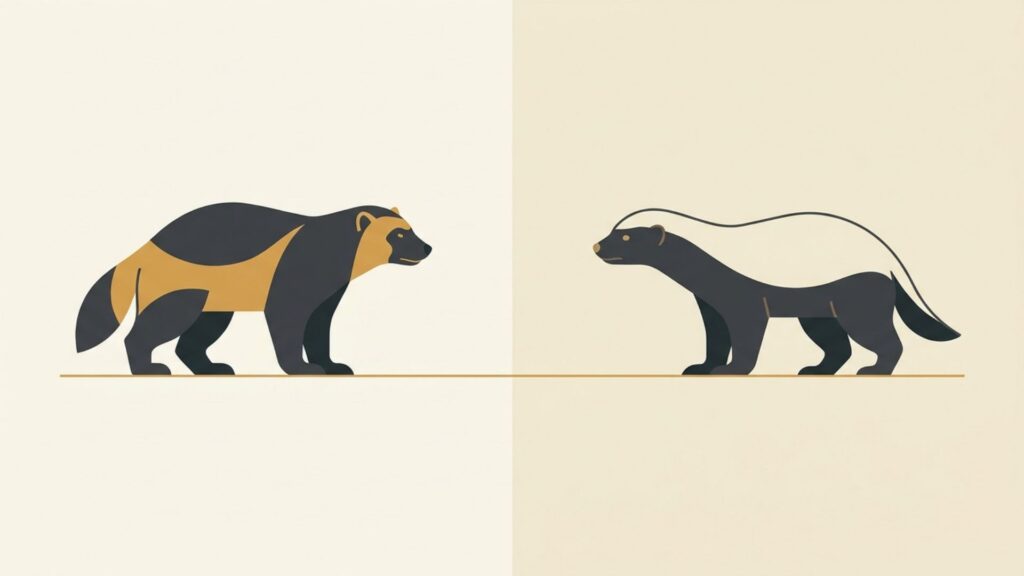
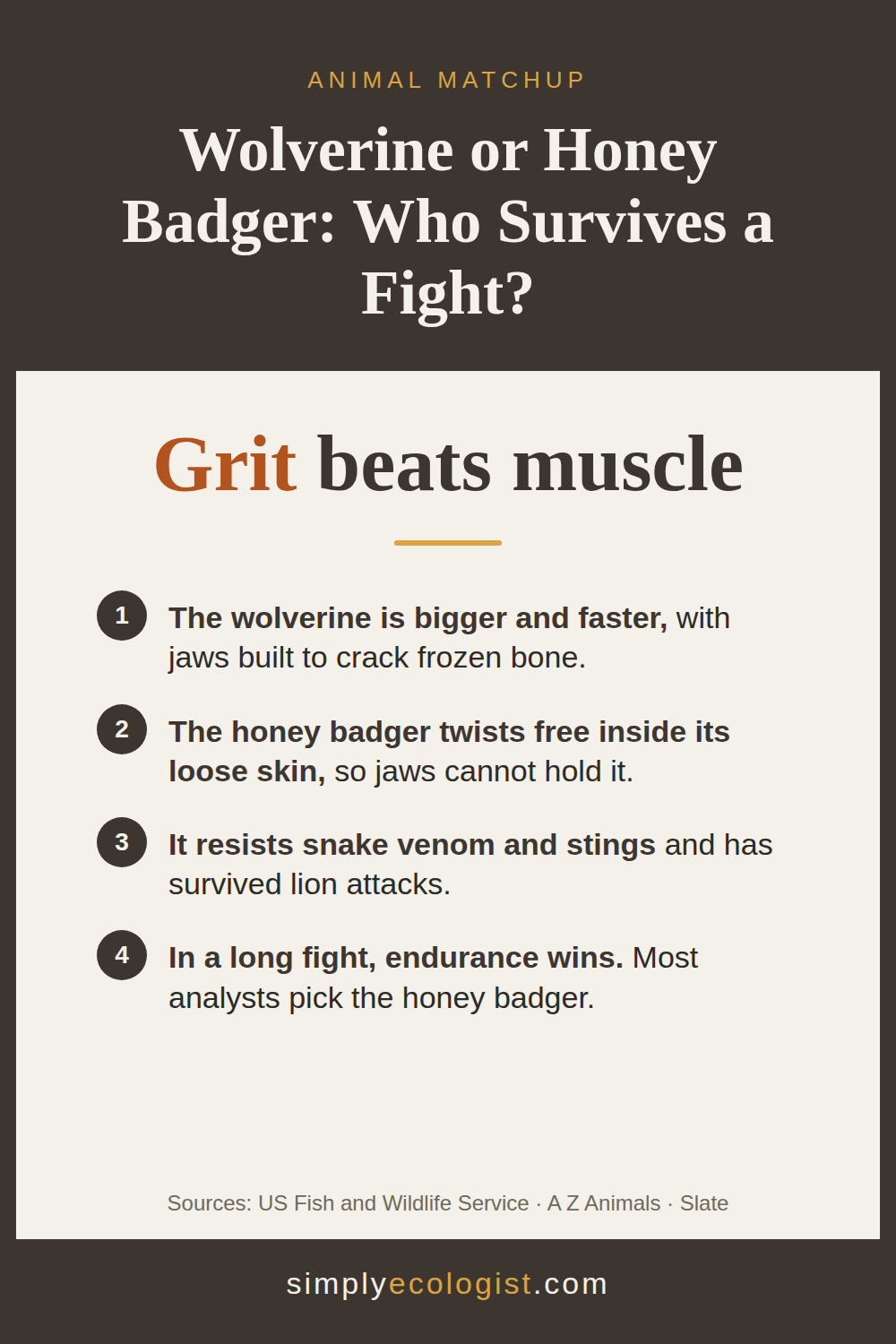
Wolverines typically outweigh honey badgers, with exceptionally large males approaching seventy pounds versus the badger’s forty pound maximum. The wolverine’s speed advantage (roughly thirty miles per hour against nineteen) pairs with bone crushing jaws adapted to crack frozen carcasses. Yet the honey badger’s loose, puncture resistant skin lets it twist free from grips, while its endurance outlasts the wolverine’s thick fur, which traps heat and causes fatigue. Biodiversity, meaning the variety of life forms and their survival strategies, shows two paths to dominance: mass versus resilience. Most analysts favor the honey badger in prolonged combat. The full comparison reveals more.
Part of my complete guide to badgers, which covers American versus European badgers, setts and clans, diet, identification and conservation, with sources.
Key Takeaways
- Wolverines typically outweigh honey badgers by thirty pounds or more, with largest specimens nearly doubling honey badger weights.
- Wolverines reach peak speeds of ~30 mph, outpacing honey badgers at ~19 mph for pursuit and escape.
- Honey badgers possess thick, loose, puncture resistant skin allowing twisting within grips, while wolverines rely on dense insulating fur.
- Wolverines strike hard and fast with bone crushing bites, whereas honey badgers persistently target vulnerable areas like eyes and throat.
- Prolonged combat favors honey badgers due to superior endurance, heat tolerance, and accumulated combat experience against large predators.
Which Is Bigger: Wolverine or Honey Badger?
The wolverine stands as the larger of these two mustelids. Male wolverines typically weigh 24 40 pounds according to the US Fish and Wildlife Service, with exceptionally large males approaching 70 pounds, while honey badgers range from 11 40 pounds. Wolverines measure 2.1 3.5 feet in body length, compared to honey badgers at 1.5 2.5 feet. The largest wolverines nearly double typical honey badger weights.
Honey badgers appear shorter and stockier, with loose, thick skin. Wolverines carry denser mass and longer overall frames. Size ranges do overlap (a small male wolverine and large honey badger may match) but full grown male wolverines usually dominate.
Geographic ranges never intersect. Wolverines occupy northern North America and Eurasia. Honey badgers inhabit Africa, the Middle East, and India. Direct comparisons rely on specimens, not wild encounters. This separation limits ecological competition between them.
Can a Honey Badger Keep up With a Wolverine’s Speed?
Wolverines outpace honey badgers on open ground, reaching an estimated 30 mph against the badger’s estimated 19 mph top speed. The wolverine would use this advantage in flat terrain, where its 24 40 lb mass generates powerful momentum.
A honey badger’s stocky build aids maneuverability in tight spaces. Its lower center of gravity helps in burrows or dense brush. Context shapes outcomes. Speed defines open ground encounters; agility matters elsewhere.
The honey badger digs well. It navigates tricky substrates with ease. These skills reduce speed gaps in complex environments.
Both animals show persistence. Neither retreats readily. The wolverine’s top speed serves best in sustained chases. Yet early strikes matter most. Without them, the badger closes distance, turning pursuit into close combat. Terrain often decides more than raw velocity.
Whose Bite Is Deadlier?
Comparing bite force reveals a stark contrast between these two predators. No reliable bite force measurement has been published for the wolverine, but its skull is built for crushing. Their robust molars crack bone and frozen carcasses with ease. This powerful bite comes from a heavier, more muscular skull.
Honey badgers haven’t been formally tested. Still, their jaws crush tortoise shells and rip flesh. That’s a powerful bite for their size. They weigh just 11 to 40 pounds. Honey badgers compensate with exceptional jaw durability. They target soft tissues like eyes and throats. This maximizes bite effectiveness in close combat.
A wolverine’s bone crushing dentition suggests superior absolute power. Yet the honey badger’s persistence and penetration ability make its bite unusually lethal relative to body size. Both predators prove formidable. Neither relies on thick hide alone to survive encounters.
Who’s Harder to Kill: Thick Fur or Loose Skin?
Both animals wear nature’s armor, but they don’t wear it the same way.
The wolverine’s fur grows several inches thick in winter, and that density blunts glancing bites while trapping air for warmth, yet a determined predator can still bite through to skin.
The honey badger’s skin hangs loose around its neck and shoulders, and that slack lets it twist inside a clamped jaw, making the grip slip where fur would simply compress.
Skin thickness compared shows the honey badger’s hide resists penetration better, while fur versus flexibility favors the badger too, since loose skin moves independent of muscle and defeats the shake and tear method predators rely on.
The wolverine’s stronger bite can’t save it here, because armor that shifts beats armor that only pads.
Skin Thickness Compared
Against a predator’s jaws, loose skin can matter more than thick fur. Honey badger hide (thick, loose, and flexible) lets them twist inside their own skin to bite attackers. This resists penetration from bites and claws that would grip firmer skinned animals. Documented encounters show honey badgers surviving lion and leopard attacks partly through this localized anti grip advantage.
Wolverine hide differs. They possess dense, frost resistant fur and sturdy skin. Their thickness provides insulation and blunt force protection. However, their skin isn’t as loose or puncture resistant. Powerful bites can grip or pierce it.
Wolverine adaptations build mass and winter pelt durability. These suit cold climates. They don’t confer the same evasion of immobilizing holds. Loose, tough skin combined with aggressive defense typically makes an animal harder to kill from close quarters biting than thick fur and mass alone.
Fur Versus Flexibility
The honey badger’s hide and the wolverine’s pelt represent two different answers to the same problem: surviving an attack.
The wolverine wears thick fur, dense insulating underfur with longer guard hairs. This layer cushions shallow bites and shields against cold. It doesn’t stop deep penetration well.
The honey badger carries loose skin, especially around its neck and shoulders. This trait lets it twist inside a predator’s grip and bite back. Teeth struggle to find purchase. The skin resists tearing and clamping.
The wolverine’s bite crushes bone. Against loose skin, this power loses effectiveness. The skin moves, shifts, denies leverage.
Thick fur insulates. Loose skin defends. In prolonged combat, flexibility outlasts padding. The honey badger’s hide proves harder to kill.
How Do Wolverines and Honey Badgers Actually Hunt?
Wolverines and honey badgers don’t hunt the same way. One waits in ambush, crushing bone with powerful jaws, while the other digs into burrows and chases prey across open ground.
These differences reveal how each animal’s body shapes its survival strategy.
Ambush Versus Chase
Although both predators share a reputation for ferocity, wolverines and honey badgers employ fundamentally different hunting strategies shaped by their environments and physical capabilities. Wolverines favor ambush tactics. They use terrain cover, stalk prey windward, then unleash short chase bursts at 30 mph to seize fawns or small mammals. Their approach relies on explosive speed and power. Honey badgers chase more actively. They dig relentlessly, pursue prey at an estimated 19 mph, and extract rodents or reptiles from burrows using curved claws. They don’t wait. They pursue.
- Wolverines blend patience with sudden acceleration, striking before prey detects danger.
- Honey badgers trade stealth for persistence, following prey into spaces where ambush won’t work.
- Each method reflects habitat demands: open terrain favors speed, while dense ground rewards digging.
Both succeed. Neither apologizes.
Bone Crushing Bites
Crushing bone demands more than anger; it requires machinery built for force. Wolverines wield strong jaws and specialized molars, crushing bone to reach marrow inside frozen carcasses. This ability lets them scavenge when hunting fails.
Honey badgers deploy different tactics. Their strong jaws and sharp premolars bite through tortoise shells, accessing protected prey. They target vulnerable areas (head, eyes, throat), delivering disabling bites with tenacity.
Wolverines combine speed, up to 30 mph, with brute force. They ambush, chase, and tear into prey using teeth and claws together.
Honey badgers dig with curved claws to extract burrowed animals. They persist, ripping repeatedly until prey succumbs.
Both species merge biting with clawing. Wolverines emphasize crushing bone for scavenging and larger prey. Honey badgers favor targeted, relentless biting against armored defenses.
Burrow Raids
Digging defines the hunt for both predators. Honey badgers use long, curved foreclaws to raid burrows and termite mounds, extracting ground nesting birds, rodents, and tortoises. Their loose, thick skin lets them enter confined spaces where bites can’t grip.
Wolverines employ strong claws and powerful forelimbs to pry open snow dens and shallow burrows, accessing frozen carrion or trapped mammals. They track scents and excavate carcasses locked in ice, then haul large pieces away. Both species steal from others. Honey badgers target porcupine or tortoise burrows, while wolverines scavenge wolf kills and dig into shallow snow caches.
- Adaptation: Specialized claws shape survival strategy.
- Opportunism: Neither predator digs exclusively; they exploit existing structures.
- Resilience: Thick skin and strength overcome physical barriers.
How Do They Fight When Cornered?
When cornered, a wolverine doesn’t hesitate. It lunges. It uses the wolverine’s greater strength to pin opponents, delivering bone crushing bites while raking with stout claws. The largest males approach 70 pounds and stretch up to 3.5 feet.
A cornered honey badger would twist and counter instead. Its thick, loose skin allows remarkable flexibility. The badger targets vulnerable areas: face, neck, genitals. It bites with force enough to crack tortoise shells.
Both release pungent musk when stressed. This chemical deterrent disorients attackers at close range.
In confined spaces, the honey badger’s loose hide prevents a killing grip. It turns repeatedly. Yet if the wolverine lands an immediate crippling strike (spine or skull), its mass and 30 mph speed end matters quickly. Otherwise, persistence favors the badger.
7 Traits That Decide the Winner
Seven factors tip the scales in this matchup.
The Wolverine carries mass and reach. Adults weigh 24 40 pounds and stretch 2.1 3.5 feet. Honey Badgers top out at 40 pounds and 2.5 feet. Speed favors the Wolverine too. It gallops at an estimated 30 miles per hour. Honey Badgers manage an estimated 19.
Bite mechanics diverge. Wolverines crush bone with heavy, robust molars. Honey Badgers pierce tortoise shells.
Their defenses differ sharply. Honey Badgers wear thick, loose skin. They release musk. These traits absorb punishment. Wolverines lack such armor.
Tactics separate them. Wolverines strike hard and fast. Honey Badgers persist, targeting eyes and throat.
Three elements shape outcomes:
- Physical advantage: mass determines control
- Resilience: durability extends endurance
- Approach: aggression style decides openings
The fight remains uncertain. Each animal embodies different survival strategies. Neither guarantees victory.
Trait Scorecard: Our Verdict
| Trait | Wolverine | Honey badger | Edge |
|---|---|---|---|
| Size and reach | 24 to 40 lbs, up to 3.5 ft | About 20 to 35 lbs, up to 2.5 ft | Wolverine |
| Speed | Estimated 30 mph | Estimated 19 mph | Wolverine |
| Bite | Crushes bone and frozen carcasses | Cracks tortoise shells, targets soft tissue | Wolverine |
| Armor | Dense insulating fur | Loose, puncture resistant skin | Honey badger |
| Endurance and heat tolerance | Overheats in long fights | Keeps fighting | Honey badger |
| Combat experience | Rarely faces larger predators | Survives lions and leopards | Honey badger |
What Happens in the First 60 Seconds
The opening minute reveals how size and strategy collide. A large male wolverine, bursting at an estimated 30 mph, lunges immediately. It clamps its jaws, aiming to pin or crush. The honey badger’s thick skin, loose and rubbery, often deflects this assault. That thick skin, which means hide that shifts under pressure, prevents deep wounds.
By thirty seconds, the honey badger twists free. It exposes throat, eyes, or genitals while spraying overpowering musk. Its claws strike repeatedly. That persistence matters. Wolverines rely on instant dominance. Without it, momentum shifts.
Between forty five and sixty seconds, the question of who Would Win tilts toward resilience. The wolverine either withdraws or bleeds. The honey badger keeps fighting, and that refusal to stop defines the minute’s end.
When Does the Honey Badger Take Over?
Typically, the shift begins within two minutes.
The wolverine’s initial assault fails to crush bone or sever mobility. That’s when momentum would happen to swing. The struggling honey badger twists inside its loose, thick hide. It escapes debilitating holds. Then it counters.
The encounter stretches longer. Pain tolerance matters more than raw power. The badger’s persistence wears down its larger opponent. Close quarters favor the smaller fighter.
Three factors explain this reversal:
- Anatomical defense: The hide’s thickness and looseness absorb trauma that would cripple most mammals, letting the badger absorb bites and keep fighting.
- Targeted offense: Long claws strike eyes, throat, and groin. These wounds accumulate. They disable.
- Experience advantage: Encounters with lions and leopards teach survival. The badger knows protracted combat. It doesn’t panic.
Size disadvantage fades. Resistance wins.
What Weakens the Wolverine in Long Fights?
Often, wolverines enter combat with overwhelming force. Their high energy gallop reaches ~30 mph. This demands substantial aerobic output. They overheat during prolonged struggles. Their thick fur insulates against cold climates. It also impairs heat dissipation. This increases fatigue. They grow tired faster than smaller, more heat efficient species.
Wolverines possess bone crushing jaws. They’ve muscular forelimbs. Their shorter, less flexible skin lacks protection. The honey badger’s loose, puncture resistant hide performs better. Wolverines rely on size and power. They need early crippling blows. Accumulating wounds sap strength. Motor control declines over time.
Extended exposure to intense musk disorients them. Persistent biting and twisting demoralize them. Combat effectiveness drops. One observes nature’s tradeoffs clearly here. Power carries costs. Endurance suffers.
Where Wolverines and Honey Badgers Live (And Why It Matters)
Wolverines occupy cold northern forests and tundra across Alaska, Canada, and Eurasia, while honey badgers roam African savannas and South Asian scrublands thousands of miles away.
Their ranges never touch, so these species evolved under entirely different pressures. This geographic isolation shapes every hypothetical comparison between them, as each animal carries adaptations refined by separate climates and predators they’ll never actually face.
Opposite Hemispheres
Separated by thousands of miles, wolverines and honey badgers carve out lives in worlds that never touch. The Wolverine vs honey badger debate centers on opposite hemispheres. Wolverines roam boreal forests and Arctic tundra across North America and northern Eurasia. Honey badgers occupy savannas and scrublands in sub-Saharan Africa, the Middle East, and South Asia. Their ranges never meet.
- Biodiversity flourishes when species fill different ecological roles.
- Wolverines typically weigh 24 to 40 pounds and endure extreme cold through thick fur and long distance travel.
- Honey badgers evolved venom resistance and loose skin for close combat in warmer climates.
Geographic separation prevents natural encounters. Conservation challenges differ: climate change threatens wolverines, while habitat loss and human conflict endanger honey badgers.
No Natural Overlap
Because their habitats lie on opposite sides of the globe, wolverines and honey badgers never meet in nature. Wolverines inhabit northern boreal forests and tundra across Alaska, Canada, Scandinavia, and Russia. Honey badgers occupy sub-Saharan Africa, the Middle East, and the Indian subcontinent. Their ranges remain entirely separate.
These distributions reflect distinct ecological adaptations. Wolverines thrive as cold adapted scavengers and predators in high latitude ecosystems. Honey badgers exploit warmer savanna, scrub, and arid habitats. No natural opportunity exists for competition or predatory encounters between them.
Conservation concerns differ accordingly. Wolverines face habitat fragmentation and climate change in northern regions. Honey badgers encounter human wildlife conflict and persecution across Africa and Asia. Any behavioral comparison relies on extrapolation from separate studies, not direct observation. The absence of shared habitat makes such analysis inherently speculative.
Who Wins: Wolverine or Honey Badger?
Although size and speed often determine outcomes in predator conflicts, the matchup between a wolverine and a honey badger defies simple categorization. Wolverines typically usually outweigh honey badgers, with the largest males approaching seventy pounds. They run faster too, hitting an estimated thirty miles per hour.
Wolverines possess formidable jaws with bone crushing molars. Their bite allows them to crack frozen carcasses. Yet honey badgers carry advantages. Their skin is thick and loose, resisting bites and stings. They crack tortoise shells with their own strong jaws and slash with long digging claws.
Many analysts conclude the honey badger prevails through defensive resilience and tenacity despite disadvantages.
- Size matters less when defenders won’t quit.
- Biological diversity reveals multiple paths to dominance.
- Adaptability often defeats raw statistics.
Frequently Asked Questions
Do wolverines and honey badgers ever meet in the wild?
No. Wolverines live in cold northern forests and tundra across North America and Eurasia, while honey badgers occupy Africa, the Middle East, and South Asia. Their ranges never overlap, so every matchup is hypothetical.
Yes, distantly. Both belong to the mustelid family, alongside weasels and otters, but they sit in different branches. The wolverine is the largest land mustelid; the honey badger has its own subfamily.
Which is bigger, a wolverine or a honey badger?
The wolverine. Males typically weigh 24 to 40 pounds according to the US Fish and Wildlife Service, with exceptional individuals approaching 70. Honey badgers usually weigh 20 to 35 pounds.
Who would win a fight between them?
Most analysts give a quick fight to the wolverine and a long one to the honey badger. If the wolverine lands an early crippling bite it wins, but the badger’s loose skin, endurance, and experience surviving lions make it the favorite as the fight drags on.
Final Thoughts
Neither animal truly wins. The wolverine dominates in raw power and cold endurance, while the honey badger survives through sheer tenacity and resistance to venom. Their battle would be a war of attrition. The wolverine tires. The honey badger does not. Biodiversity lets both thrive in different worlds. Nature does not crown champions. It rewards persistence. Both animals prove this.

Erzsebet Frey (Eli Frey) is an ecologist and online entrepreneur with a Master of Science in Ecology from the University of Belgrade. Originally from Serbia, she has lived in Sri Lanka since 2017. Eli has worked internationally in countries like Oman, Brazil, Germany, and Sri Lanka. In 2018, she expanded into SEO and blogging, completing courses from UC Davis and Edinburgh. Eli has founded multiple websites focused on biology, ecology, environmental science, sustainable and simple living, and outdoor activities. She enjoys creating nature and simple living videos on YouTube and participates in speleology, diving, and hiking.
🌿 Explore the Wild Side!
Discover eBooks, guides, templates and stylish wildlife-themed T-shirts, notebooks, scrunchies, bandanas, and tote bags. Perfect for nature lovers and wildlife enthusiasts!
Visit My Shop →