
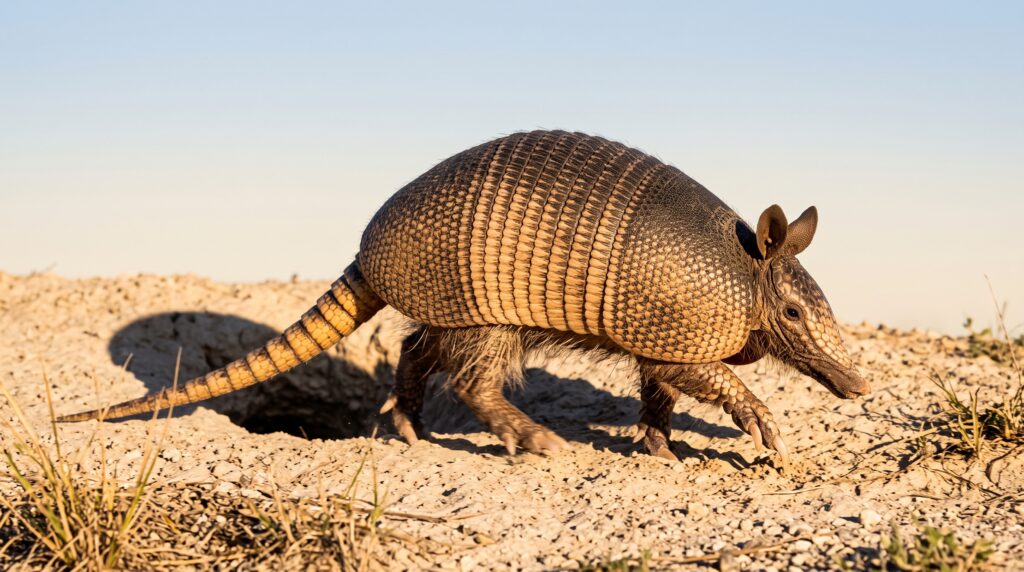
Armadillos are small mammals named from Spanish for “little armored one,” covered in bony plates called osteoderms that evolved independently from reptile armor through convergent evolution roughly 55 million years ago in South America. The nine banded armadillo, now found across the southeastern United States, gives birth to identical quadruplets through polyembryony, a single egg splitting into four embryos. They’re powerful diggers, creating burrows in about fifteen minutes with long curved claws. Their diet centers on ants and termites, though they’ll eat plants and small animals. Armadillos carry *Mycobacterium leprae*, the bacterium causing leprosy, with about 16 percent of wild armadillos in the southeastern states testing positive; handling them poses the main risk to humans. These creatures continue expanding northward about ten miles yearly, aided by warming winters, and what follows reveals even more about their ecological impact.
Key Takeaways
- Armadillos originated in South America 55 million years ago and spread north via land bridges.
- Their armor consists of overlapping bony plates called osteoderms that balance protection with flexibility.
- The nine banded armadillo gives birth to identical quadruplets through a unique process called polyembryony.
- They are the only non human reservoir of leprosy bacteria in the Americas, with about 16 percent of wild armadillos testing positive.
- Armadillos have expanded their range northward about ten miles yearly, now reaching 17 US states
What Is an Armadillo? Species, Origins, and Evolutionary History
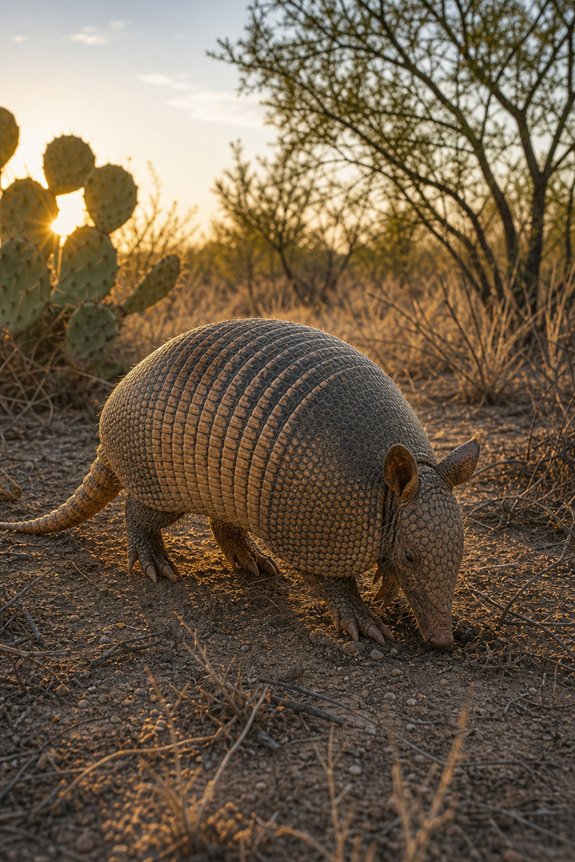
Although many people picture only one type of armadillo, the order Cingulata actually contains twenty one distinct species across nine genera. Biodiversity means variety of life forms within a group. This variety spans from the tiny pink fairy armadillo at five inches to the giant armadillo reaching five feet, a spread of the kind that taxonomy exists to keep track of.
Armadillos originated in South America roughly 55 million years ago. They spread north only three million years ago when land bridges formed. This timeline shows slow, steady adaptation.
The nine banded armadillo bears young in identical litters of four. It’s the only armadillo species found in the United States. Most species remain restricted to Central and South America.
Their evolutionary path shaped unique traits. Scientists find this history worth understanding. It reveals how isolation and time build distinct forms of life.
How Armadillos’ Armor Works: From Scales to Shield
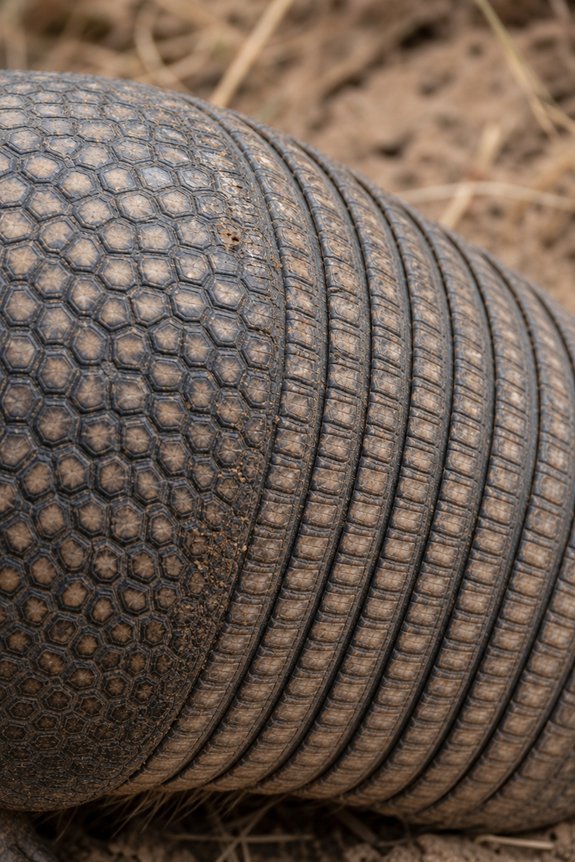
Armadillos carry bony plates called osteoderms. These structures sit under the skin and form a flexible shield.
This armor offers protection without sacrificing movement, a balance shaped over millions of years.
Osteoderm Structure Explained
Beneath the coarse hair and leathery skin lies a remarkable defense system that has protected armadillos for roughly 55 million years. This armor consists of osteoderms, bony plates embedded within the dermis, the thick layer of skin beneath the surface. Each osteoderm contains bone cells, collagen fibers, and blood vessels. The plates overlap like shingles. This arrangement distributes force across multiple points.
Armadillos possess two types of osteoderms. Large hexagonal plates cover the shoulders and hips. Smaller rectangular plates form the bands between. The number of bands varies by species. The nine banded armadillo has exactly nine.
Osteoderms develop before birth. They begin as cartilage. Bone gradually replaces this flexible tissue. The process resembles human skull formation.
This structure offers protection without complete rigidity. The armor remains lighter than a solid shell. Evolution has refined this balance through millennia.
Mobility Versus Protection
Because armor must balance defense with movement, armadillos face a fundamental engineering challenge that evolution has solved through compromise. Their bony plates, called osteoderms, don’t form a solid shell. Instead, they’re arranged in flexible bands across the back. This design allows the animal to bend, run, and dig while maintaining protection.
The three banded armadillo demonstrates this balance perfectly. It can curl into a complete ball when threatened. Its armor covers the head, tail, and body with overlapping plates that lock together. This maneuver takes only seconds.
Other species can’t roll up completely. They’ve developed speed instead. The nine banded armadillo bolts in short bursts when escape proves wiser than confrontation. The 30 miles per hour figure that circulates has no source behind it. Measured foraging speeds are under one mile per hour, and the burst has never been properly timed.
Evolution favors solutions that work, not perfection. Armadillos survive because their armor adapts to specific threats and habitats.
Evolutionary Origins Traced
Armadillo armour did not come down from reptiles. It was built again from scratch.
Osteoderms are an old trick in vertebrate evolution, and a repeatedly reinvented one. They have been lost and re evolved at least nineteen separate times across four legged animals. Crocodiles have them. So did many dinosaurs. Mammals lost them early, and armadillos are the lineage that grew them back.
That makes the armour a case of convergent evolution, where unrelated groups arrive at the same solution because the same problem keeps recurring. It is not inheritance from a shared armoured ancestor.
Until recently armadillos were thought to be the only living mammals with osteoderms. In 2023 researchers found them in spiny mice, which quietly ended a long standing assumption. The trick, it turns out, is still available to mammals that need it.
Why Armadillos Give Birth to Identical Quadruplets
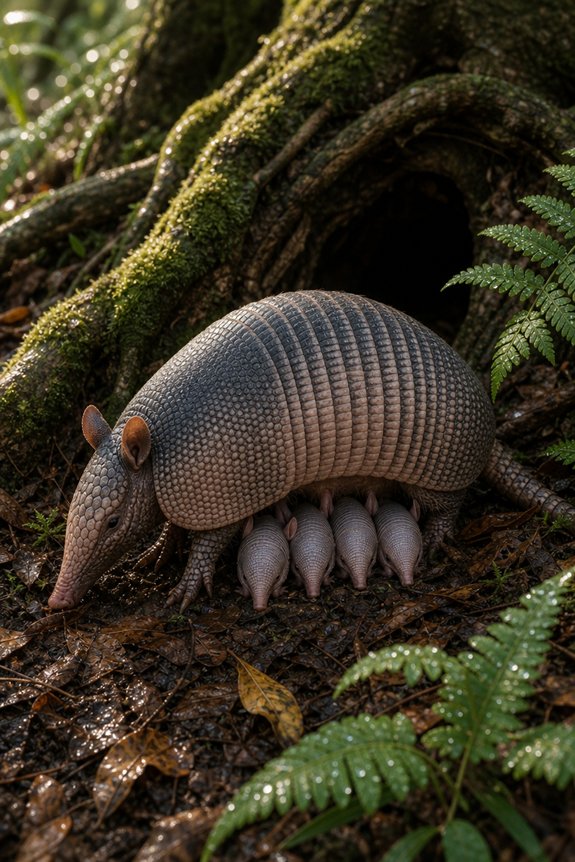
Armadillos produce identical quadruplets because a single fertilized egg splits into four embryos during early development, a reproductive pattern found in no other mammal group. Scientists call this process polyembryony. It guarantees genetic uniformity among offspring.
This reproductive strategy puzzles researchers. Four identical babies emerge from one egg. The mother invests energy equally. Biodiversity, or the variety of life in a species, seems reduced. Yet armadillos thrive across diverse habitats.
Scientists propose several explanations:
- Polyembryony may reduce pregnancy risks for mothers carrying armor plated young.
- Identical siblings share immune profiles, perhaps resisting local parasites together.
- Small litter size conserves energy in unpredictable environments.
- Genetic sameness aids social bonding among nest mates.
The mechanism remains incompletely understood. Researchers continue studying this unique mammalian trait. One wonders what further secrets armadillo reproduction holds.
How Armadillos Dig Burrows in Minutes
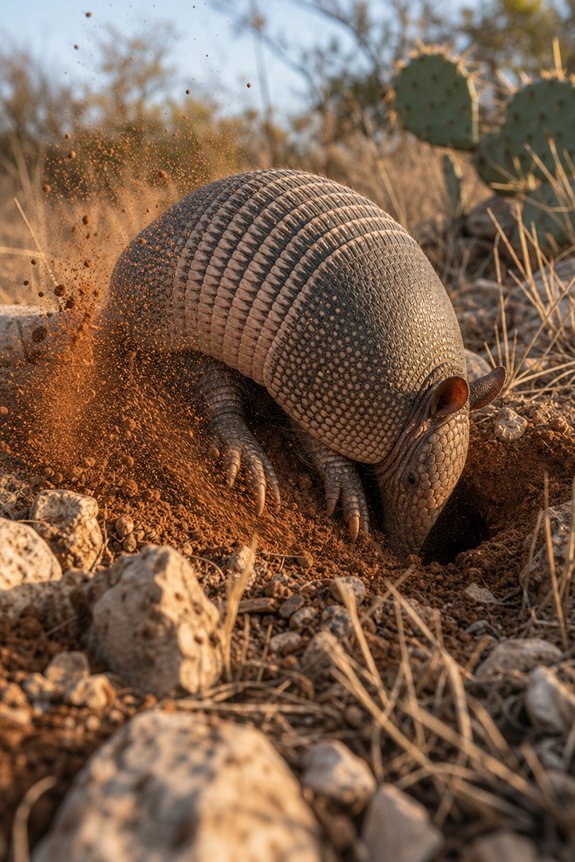
Their reproductive oddities draw study, but armadillos survive through equal measures of engineering prowess. These mammals dig burrows with startling speed. They’ll complete an entrance tunnel in roughly fifteen minutes.
Armadillos possess powerful forelimbs. Each front foot bears three to five curved claws, specialized tools for excavation. The claws are long and heavily curved, and they function like pickaxes. The six inch figure often quoted belongs to the giant armadillo of South America, not the nine banded species.
The digging motion combines rapid scraping with powerful thrusting. Loose soil is kicked out behind them as they work, which is why fresh burrows have a spray of earth at the entrance.
Their low center of gravity aids stability during excavation. The bony armor plates, called scutes, protect against collapsing soil. Burrows run two to twenty five feet long, with the nest chamber usually only about three feet below the surface. They are long rather than deep.
These shelters regulate temperature. They provide escape from predators. The engineering serves immediate survival needs.
One watches this efficiency with quiet respect.
The Armadillo Facts Most Lists Miss
A few things about armadillos are stranger than the leprosy story, and most guides skip them.
- They jump straight up when startled, three to five feet into the air. It works against a coyote. It works catastrophically against a car passing overhead, which is why so many are found dead on roads without being run over in the usual sense.
- They walk along stream bottoms. An armadillo can hold its breath for around six minutes, and small ones simply cross underwater rather than swim. To cross something wider they gulp air to inflate the gut and float across.
- The nine banded armadillo does not reliably have nine bands. Counts run from seven to eleven depending on the individual.
- Only one group can roll into a ball. That is Tolypeutes, the three banded armadillos. Every other species, including the nine banded, cannot do it and relies on running or digging instead.
- They sleep about sixteen hours a day, which is part of why they are seen so rarely for an animal this widespread.
The low body temperature that makes them useful to leprosy researchers is the same trait that limits how far north they can push. Cold is still the thing holding the line.
What Armadillos Eat: Insects, Plants, and Surprising Prey
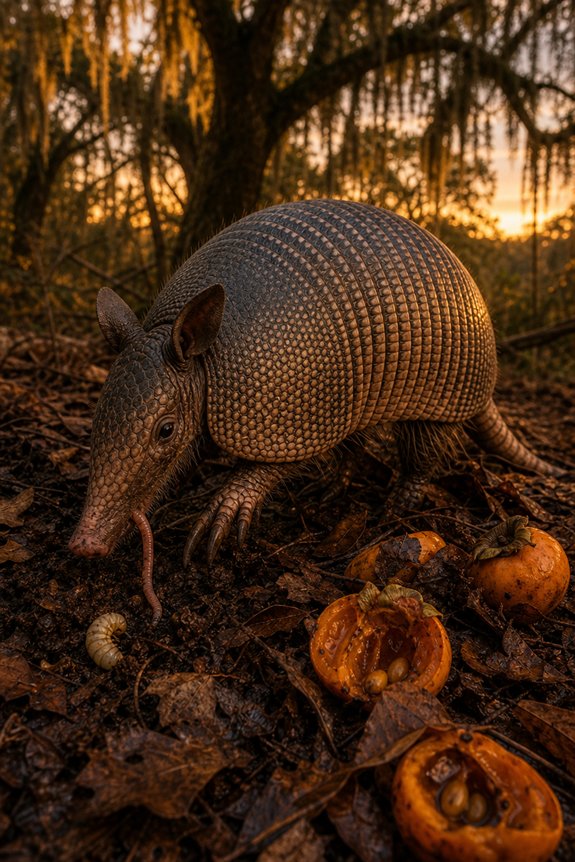
Rooting through leaf litter with their elongated snouts, armadillos spend most waking hours in pursuit of food.
Their diet reveals remarkable adaptability. Most species favor insects, particularly ants and termites. They’ll consume thousands daily. This feeding habit controls pest populations.
It shapes local ecosystems in measurable ways.
Armadillos aren’t strict insectivores. Their menu expands considerably:
- Grubs and beetles high protein staples found in soil
- Carrion opportunistic meals that supplement nutrition
- Fruits and tubers seasonal plant matter aiding digestion
- Small vertebrates frogs, lizards, and bird eggs when available
The nine banded armadillo sometimes eats quail eggs. This surprises researchers.
Such behavior affects ground nesting bird populations. It demonstrates how one species influences the wider community around it.
Understanding these patterns matters. It helps predict ecological shifts as armadillos expand their range.
Where Armadillos Live and Why They’re Spreading North
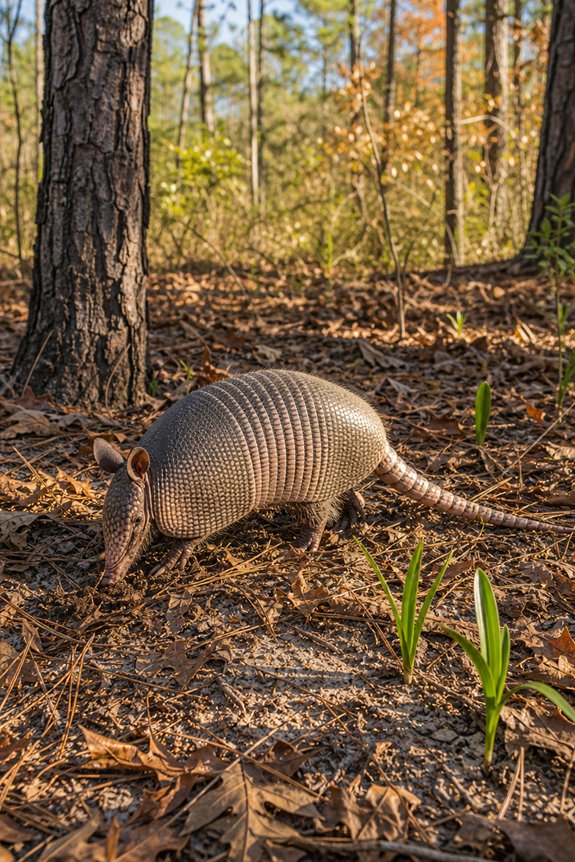
Although they’ve become symbols of the American South, armadillos aren’t native to the United States. They migrated from Central and South America. They crossed the Rio Grande during the late 1800s. They’ve expanded steadily since then.
Armadillos thrive in warm, humid climates. They need loose soil for digging burrows. They eat insects underground. Climate change enables their northern spread. Warmer winters mean they survive farther north. They’ve reached Missouri, Tennessee, and even southern Illinois.
Their range has expanded north at a pace often quoted as ten miles a year, a figure that traces to press coverage rather than a published study. What is documented is the result: they now occupy 17 states. This spread affects local ecosystems. Biodiversity, or the variety of living species in an area, shifts when new animals arrive. Armadillos compete with native wildlife for food and shelter, joining the long list of South American mammals that have pushed north.
Scientists track this movement carefully. It reveals how temperature changes reshape wildlife distribution. One wonders what other creatures will follow.
Do Armadillos Actually Carry Leprosy?
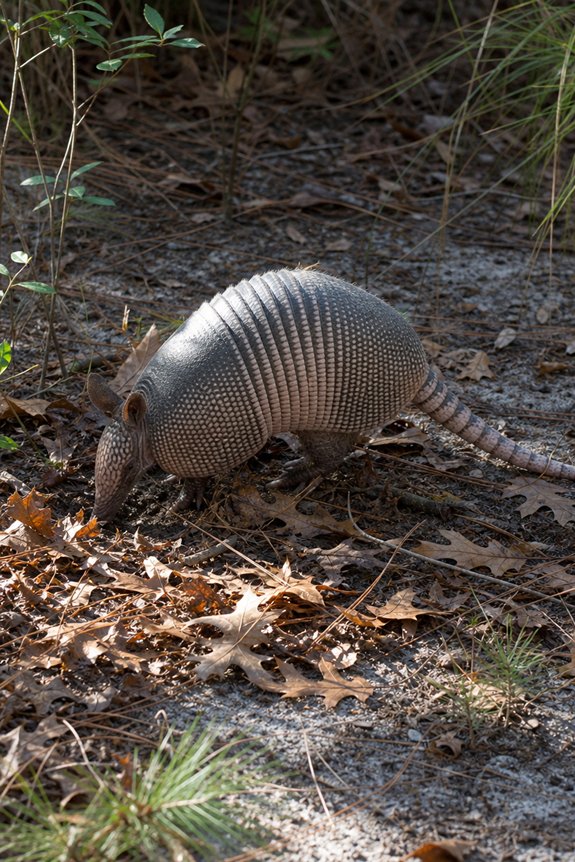
Armadillos carry *Mycobacterium leprae*, the bacterium causing leprosy, a chronic infectious disease affecting skin and nerves.
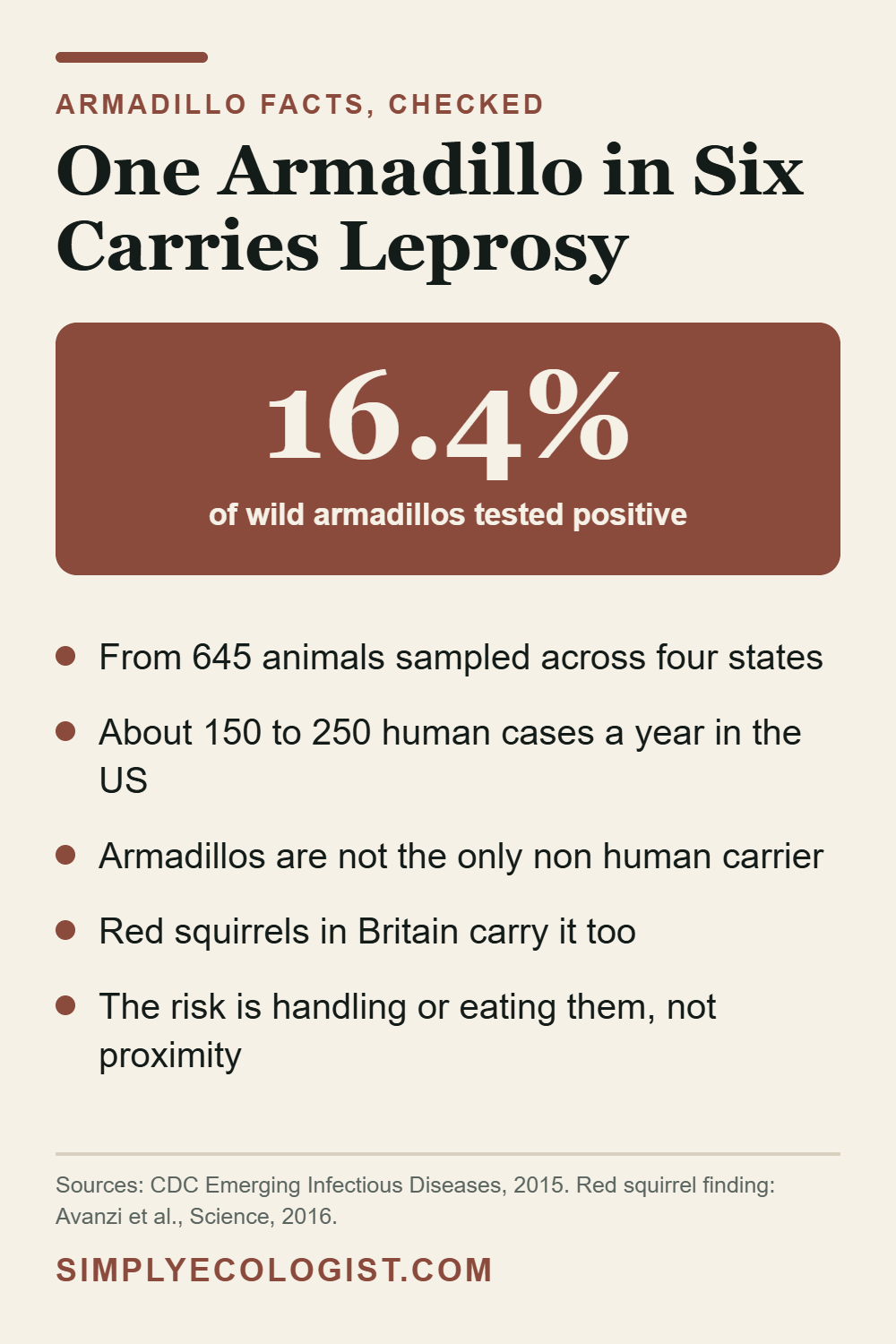
Scientists first confirmed this link in the 1970s, and about 16 percent of wild armadillos in the southeastern United States test positive.
Human infections remain rare, with only about 150 to 250 cases annually in the U.S., but researchers continue monitoring this unusual reservoir species.
Historical Disease Connection
Because leprosy has shadowed human history for millennia, its unexpected link to armadillos deserves careful examination. Scientists discovered this connection in the 1970s. Armadillos became the first non human species known to carry *Mycobacterium leprae*, the bacterium causing leprosy. They are no longer the only one. Eurasian red squirrels in the British Isles were found to carry it in 2016, and wild chimpanzees and sooty mangabeys are hosts too. Armadillos remain the only non human reservoir in the Americas. This finding changed how researchers understood the disease’s ecology, or how it interacts with living things and environments.
Four key historical points emerge:
- Leprosy appeared in humans over 4,000 years ago
- European colonists brought the disease to the Americas in the 1500s
- Armadillos likely acquired the infection from humans centuries later
- The low body temperature of armadillos allows the bacteria to thrive
This shared vulnerability between species reminds us that diseases cross boundaries. Understanding history helps scientists trace how pathogens move through time and populations.
Modern Transmission Risks
The historical link between armadillos and leprosy raises practical questions for today. Researchers confirm that nine banded armadillos in the southern United States carry *Mycobacterium leprae*, the bacterium causing leprosy, also called Hansen’s disease. The best measurement comes from the CDC. Screening 645 armadillos across Mississippi, Alabama, Georgia and Florida between 2003 and 2012, researchers found 106 positives, or 16.4 percent. Louisiana health authorities put local prevalence above 20 percent in some areas.
Human infection remains rare. The CDC reports about 150 to 250 U.S. cases yearly. Most patients have handled armadillos or eaten their meat. The CDC’s guidance is simply to avoid contact. Direct contact poses the main risk. The bacteria can’t survive long in soil or water.
Armadillos’ low body temperature allows the bacterium to thrive. This biological trait makes them unique among mammals. Scientists value this research. It helps them study leprosy treatments. Simple precautions matter. Avoid touching wild armadillos. Wear gloves if handling them becomes necessary.
The Nine Banded Armadillo: America’s Most Successful Invader
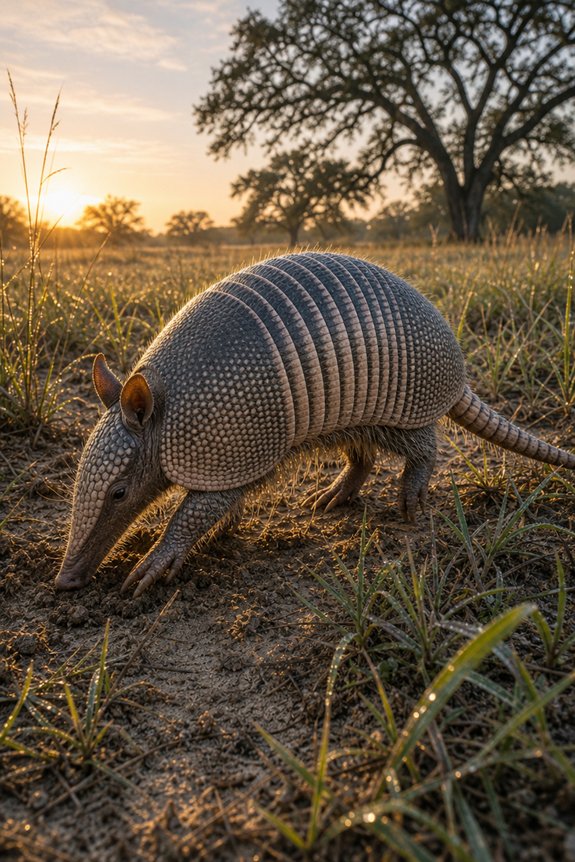
Few mammals have spread so far so fast. The nine banded armadillo, native to Central and South America, now occupies the southeastern United States from Texas to North Carolina.
Biologists first documented established populations in Texas during the 1850s. No agency publishes a reliable total for the United States. Density figures give a better sense of it: roughly one armadillo per four acres in occupied habitat, and up to two per acre where conditions suit them.
Several factors explain this expansion:
- Low body temperature allows survival in varied climates
- Versatile diet includes insects, small vertebrates, and plant matter
- High reproductive rate produces identical quadruplets from single egg divisions
- Few natural predators exist in their new range
Their spread affects ecosystems. Armadillos disturb soil extensively while foraging.
This alters plant communities and reduces insect biodiversity, meaning the variety of living species in an area. They are also the only non human reservoir of leprosy in the Americas.
Scientists continue tracking their northward movement.
Final Thoughts
Armadillos represent millions of years of evolution. Their armor, reproduction, and digging abilities show nature’s ingenuity. These creatures expand northward yearly, adapting to new climates. They carry leprosy, though transmission remains rare. Biodiversity, meaning the variety of life in an area, depends on understanding such species. Armadillos remind us that even odd animals matter. Their survival teaches resilience.

Erzsebet Frey (Eli Frey) is an ecologist and online entrepreneur with a Master of Science in Ecology from the University of Belgrade. Originally from Serbia, she has lived in Sri Lanka since 2017. Eli has worked internationally in countries like Oman, Brazil, Germany, and Sri Lanka. In 2018, she expanded into SEO and blogging, completing courses from UC Davis and Edinburgh. Eli has founded multiple websites focused on biology, ecology, environmental science, sustainable and simple living, and outdoor activities. She enjoys creating nature and simple living videos on YouTube and participates in speleology, diving, and hiking.
🌿 Explore the Wild Side!
Discover eBooks, guides, templates and stylish wildlife-themed T-shirts, notebooks, scrunchies, bandanas, and tote bags. Perfect for nature lovers and wildlife enthusiasts!
Visit My Shop →