
This post contains affiliate links from Amazon and other affiliate networks. As an Amazon Associate I earn from qualifying purchases, at no extra cost to you. I only recommend products I have used or researched.
A nature note
People who spend at least two hours a week in nature report significantly better health and wellbeing, according to a Scientific Reports study of nearly 20,000 people. Nature themed things at home are no substitute, but they keep the reminder in view.
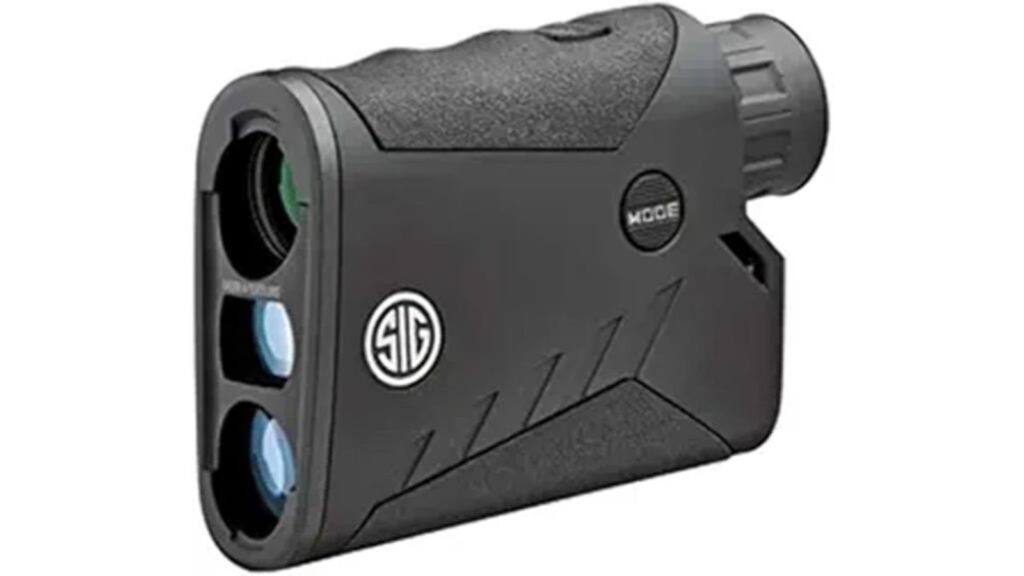
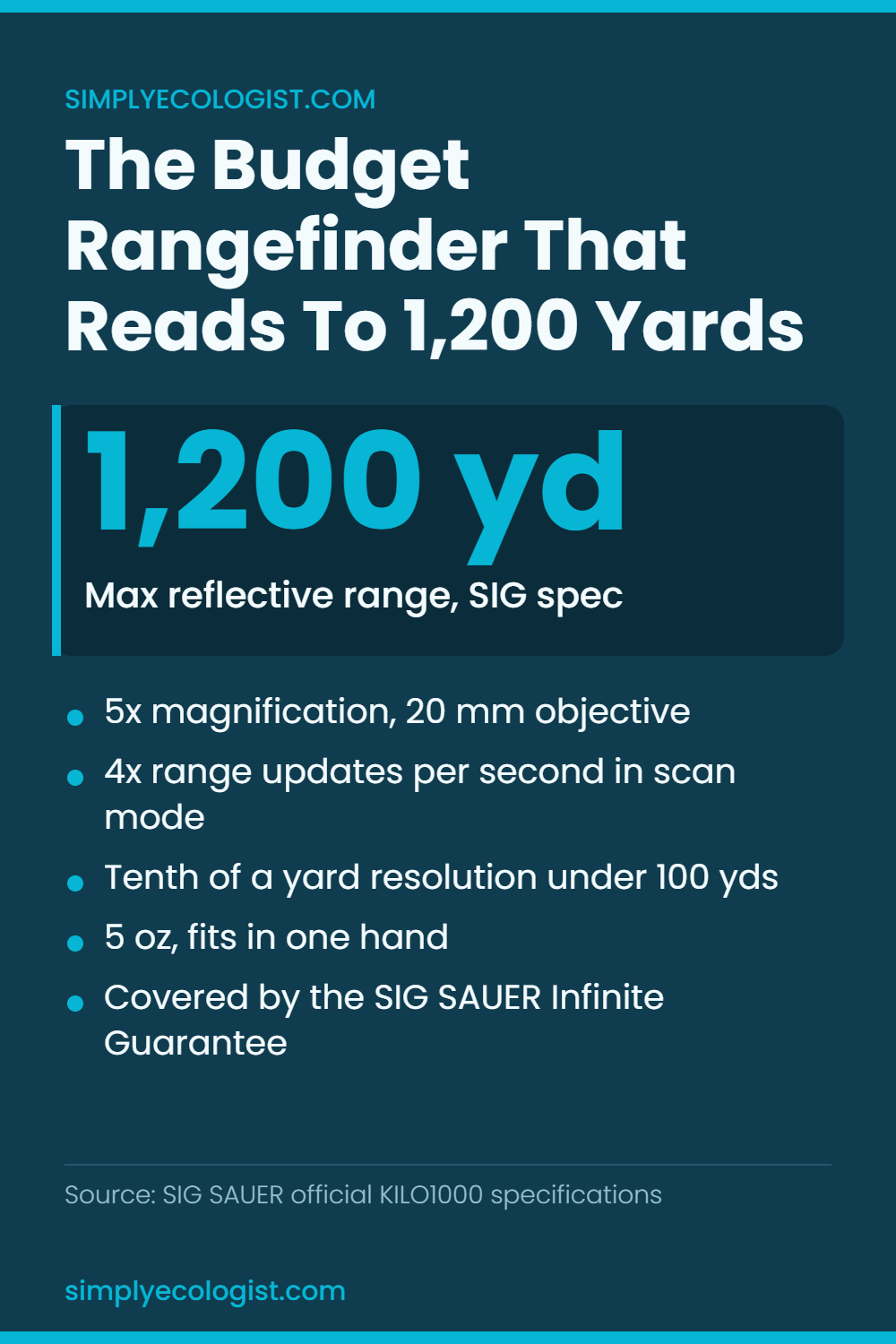
The SIG SAUER KILO1000 ranges to 1,200 yards on a reflective target, 800 yards on trees and 600 yards on deer, and the whole unit weighs 5 oz. Those are SIG SAUER’s own published figures, and they are the numbers most write ups of this rangefinder leave out.
This page puts them in one place, explains what they mean once you are standing in a field rather than reading a spec sheet, and says plainly where the KILO1000 stops being the right tool. It is a 5×20 mm rangefinder monocular built around LightWave DSP signal processing and SpectraCoat anti reflection coatings.
The Short Verdict
Maximum range: up to 1,200 yards on reflective targets, up to 800 yards on trees, up to 600 yards on deer.
Weight: 5 oz, about 140 g.
Best for: golfers and hunters ranging inside 600 yards in reasonable light who want something that lives in a shirt pocket.
Worst for: anyone ranging past 800 yards, or reading numbers at first and last light, because the display carries no illumination.
Price: $211.99 list at sigsauer.com, checked 29 August 2026.
SIG SAUER KILO1000 Specifications
| Magnification and objective | 5x magnification, 20 mm objective |
| Maximum range, reflective target | Up to 1,200 yards |
| Maximum range, trees | Up to 800 yards |
| Maximum range, deer | Up to 600 yards |
| Ranging accuracy | About half a yard out to 500 yards, widening past that |
| Display resolution | Tenth of a yard under 100 yards |
| Scan refresh rate | 4 range updates per second in HyperScan mode |
| Display | Second generation ultra high transmittance LCD, not illuminated |
| Battery | One CR2 primary lithium cell |
| Weight | 5 oz, about 140 g |
| Dimensions | About 4.3 by 3 by 1.4 inches |
| Laser class | Class 1M |
| Warranty | SIG SAUER Infinite Guarantee, no time limit, transferable, no receipt required |
| List price | $211.99 |
Sources: SIG SAUER’s KILO1000 5×20 mm product page for range, optics, weight and price, and the KILO1000BDX owner’s manual for ranging accuracy, battery and laser class. Specifications and price last checked 29 August 2026.
One caveat worth stating: SIG SAUER’s own pages disagree on the cell, listing CR2 in the manual and CR 1/3N elsewhere, so the figure above is the manual’s.
Key Features and Technology
When you’re in the market for a high performance rangefinder monocular, you want features that will actually change what you can do in the field.
The Sig Sauer Kilo1000 monocular delivers with its 5×20 mm design and SpectraCoat anti reflection coatings for superior light transmission.
What is LightWave DSP?
LightWave DSP is SIG SAUER’s name for the digital signal processing engine that reads the returning laser pulse and turns it into a number on the screen. It is the part that makes the fast refresh below possible, and SIG SAUER describes it as the fastest rangefinder engine it builds.
What is HyperScan?
The HyperScan feature is the continuous scan mode. Hold the range button down and the reading refreshes 4 times per second while you sweep, so you can follow a moving animal or find the edge of a treeline instead of pressing the button again and again. RangeLock then reports the last distance measured when you release the button.
What is angle modified range?
The KILO1000 reports either the line of sight distance or the angle modified range. Angle modified range is the equivalent horizontal distance, worked out from the line of sight distance and the incline angle.
It is the number that matters when you are shooting down from a tree stand or up across a valley, because gravity only acts over the horizontal part of the shot.
Performance and Accuracy: How Far and How Precise?
How far can the KILO1000 range?
Up to 1,200 yards on a reflective target, up to 800 yards on trees and up to 600 yards on deer, per SIG SAUER’s product page.
Those three figures are not interchangeable, and the gap between them is the whole story of laser ranging: the more light a target throws back, the further the unit reads.
A road sign is easy. A deer standing in timber is the hard case, and 600 yards is the honest number to plan around.
How precise is it really?
The display resolves to a tenth of a yard under 100 yards, which is a different thing from accuracy. SIG SAUER’s owner’s manual for the KILO1000BDX puts ranging accuracy at roughly half a yard out to 500 yards, widening past that.
So the extra digit on the screen inside 100 yards is genuine resolution, useful on a golf course, and it is not a claim that a 400 yard reading is correct to a tenth of a yard.
You’ll get fast readings whether you’re ranging flagsticks without reflective prisms or ordinary objects with no prism at all.
Reviewers consistently praise the clarity of the optics and the speed of the readings, although those comparisons are not tied to a named competing model or to a measured test.
How does the display hold up in low light?
This needs saying carefully, because the two obvious statements about the display contradict each other and both are half true.
The LCD is a second generation ultra high transmittance panel, which means the glass passes as much light as it can, so the view through the KILO1000 stays usable as the sun drops. The digits are a separate question.
They are a black LCD with no illumination behind them, so you read them against whatever light is left in the scene. In daylight that is effortless. At dusk it is genuinely hard, and it is hardest against a dark background such as timber.
Bright optics, dim numbers. If most of your ranging happens in the last twenty minutes of legal light, that single trait should decide the purchase, and an illuminated display model is worth the extra money.
Five things drive the optical performance in combination: the 5×20 mm lens, the SpectraCoat anti reflection coatings, the high transmittance LCD, the LightWave DSP engine behind the reading, and the 4 updates a second that keep the number live while you move.
Build Quality, Design and Portability
Beyond its performance and accuracy, the Sig Sauer Kilo1000 monocular has a durable design that is built to last.
You’ll appreciate the compact and lightweight construction. At 5 oz and roughly 4.3 by 3 by 1.4 inches it goes in a shirt pocket, on a belt or in the lid of a pack without you thinking about it, and you can work every control with one hand while the other hand holds a rifle, a club or a clipboard.
The device’s rugged build can withstand rough handling, and SIG SAUER covers it under the Infinite Guarantee, which carries no time limit, is fully transferable and needs no receipt. It is not unlimited cover, though, and the difference matters before you drop it in a river.
SIG SAUER excludes intentional damage, misuse, cosmetic damage that does not affect performance, loss, theft and unauthorized repair. Note too that SIG SAUER’s published specifications for this model do not state a water resistance rating, so treat it as weather resistant rather than submersible.
SIG SAUER positions the KILO1000 as a step up on its earlier rangefinders in optics and processing speed. It suits range work and field work equally, and its compact size will not weigh you down.
User Experience and Feedback
From the moment you power on the Sig Sauer Kilo1000 monocular, you’ll appreciate its user friendly design, with reviewers praising its simplicity.
You’ll find the setup process a breeze, with clear instructions that get you up and running quickly. Owner reviews frequently mention the accuracy and the speed, and several compare it favorably with more expensive brands, though those comparisons are not tied to a named model or a measured test.
You’ll also appreciate the lightweight and compact design, making it easy to take with you on the range or in the field.
Limitations and Areas for Improvement
While the Sig Sauer Kilo1000 rangefinder shines in many areas, it’s important to recognize its limitations.
You might find the display challenging to read in low light conditions since it’s not illuminated. Additionally, you’re limited to a single reticle type, which mightn’t suit your preferences.
If you’re looking to capture longer distances, you might wish for higher magnification than 5x, and the 600 yard figure on deer is the ceiling worth planning around rather than the 1,200 yard headline number. On the other hand you’ll appreciate the value at this price point compared to higher end rangefinders.
Pros and Cons
- Reads to 1,200 yards on reflective targets and 600 yards on deer, which covers every golf distance and most hunting ones
- 4 range updates per second in HyperScan, so you can sweep a treeline and watch the number settle
- 5 oz and roughly 4.3 by 3 by 1.4 inches, small enough to live in a shirt pocket
- Angle modified range is built in, which matters from a tree stand or on a slope
- Covered by the SIG SAUER Infinite Guarantee, with no time limit and no receipt required
Cons
- The LCD carries no illumination, so the digits get hard to read exactly when deer move
- One reticle only, with no option to change it
- 5x magnification is modest if you want to pick out a small target near the top of its range
- No water resistance rating appears in SIG SAUER’s published specifications for this model
- List price is $211.99, so check the street price before assuming this is the budget choice
What a Rangefinder Like This Does in Field Ecology Work
Golf and hunting are not the only reasons to own a laser rangefinder, and the survey use case is the one almost nobody writes about. Distance sampling needs a measured perpendicular distance from the transect line to the animal you detected, not an estimate, because the whole method collapses when observers guess.
Point counts need a radius that is genuinely fixed, so that every bird inside 50 meters is counted and every bird outside it is not. Vegetation and nest work needs the distance from a plot centre or a marked tree recorded once and found again next season.
Set the KILO1000’s published numbers against those tasks and most of the fit is good. Six hundred yards on a deer sized target is far beyond any point count radius.
A display that resolves to a tenth of a yard under 100 yards is finer than the tolerance most protocols ask for. Four updates a second helps when the animal is walking away from you while you are still trying to get a reading.
Two things do not fit as neatly. The unit reads in yards or meters and most survey protocols are written in meters, so set the unit once and check it at the start of every field day, because a transect recorded in the wrong unit is a lost transect.
And the display is unlit, which is a real problem for dawn chorus counts and for anything at dusk. If your survey window is the first hour of light, that is the specification to weigh above all the others.
Value for Money Assessment
Your budget friendly investment in the Sig Sauer Kilo1000 monocular yields impressive returns, offering strong performance at a fraction of the cost of high end rangefinders.
You’ll get clear optics, fast results and accurate yardages without breaking the bank. The durable design and the SIG SAUER Infinite Guarantee mean repairs are covered for as long as you own it, within the exclusions listed above.
Although some users find the display challenging in low light, the overall value for money is hard to beat at this price point.
You’ll appreciate the simplicity, effectiveness and portability of this monocular, making it a strong choice for golfers and outdoor enthusiasts. List price is $211.99 at sigsauer.com, checked 29 August 2026, so compare that against the street price wherever you buy.
Frequently Asked Questions
How far can the SIG SAUER KILO1000 range?
Up to 1,200 yards on a reflective target, up to 800 yards on trees and up to 600 yards on deer, according to SIG SAUER’s product page for the KILO1000 5×20 mm. Plan around the 600 yard figure for animals.
How accurate is the KILO1000?
SIG SAUER’s KILO1000BDX owner’s manual states ranging accuracy of about half a yard out to 500 yards, widening beyond that. The tenth of a yard you see on screen under 100 yards is display resolution, not accuracy.
What battery does the KILO1000 use?
One CR2 primary lithium cell, per the owner’s manual. SIG SAUER’s own pages are not consistent here, with CR 1/3N listed elsewhere, so check the cell in the box before you buy spares.
Is the KILO1000 waterproof?
SIG SAUER’s published specifications for the KILO1000 5×20 mm do not state a water resistance or ingress protection rating. Treat it as weather resistant rather than submersible, and if submersion matters to you, ask SIG SAUER before ordering.
Is the KILO1000 good for bowhunting?
Bow ranges sit far inside what this unit can read, and two features help: the display resolves to a tenth of a yard under 100 yards, and angle modified range gives you the horizontal equivalent distance when you are shooting down from a stand.
The limitation is light. The display is not illuminated, so the last twenty minutes of legal shooting light are its weakest moment.
Is the KILO1000 laser eye safe?
The KILO1000BDX owner’s manual designates the unit a Class 1M laser product. Class 1M is the class used for lasers that are safe for the unaided eye but should not be viewed through magnifying optics, so follow the safety notes printed in the manual.
What warranty does the KILO1000 have?
SIG SAUER covers it under the Infinite Guarantee, which has no time limit, is fully transferable and requires no receipt. It excludes intentional damage, misuse, cosmetic damage that does not affect performance, loss, theft and unauthorized repair.
Conclusion
The KILO1000 is the right rangefinder for someone who ranges inside 600 yards, in daylight or decent light, and wants a 5 oz unit that disappears into a pocket. It is the wrong one for anyone who needs readings past 800 yards, and for anyone whose ranging happens at first and last light, because the display is not illuminated. At $211.99 list, checked 29 August 2026, it is not automatically the cheapest way to get a dependable yardage, so if budget is the deciding factor compare it against a cheaper unit before you buy. Within those limits it’s a solid investment for anyone who wants a compact, reliable rangefinder monocular.

Erzsebet Frey (Eli Frey) is an ecologist and online entrepreneur with a Master of Science in Ecology from the University of Belgrade. Originally from Serbia, she has lived in Sri Lanka since 2017. Eli has worked internationally in countries like Oman, Brazil, Germany, and Sri Lanka. In 2018, she expanded into SEO and blogging, completing courses from UC Davis and Edinburgh. Eli has founded multiple websites focused on biology, ecology, environmental science, sustainable and simple living, and outdoor activities. She enjoys creating nature and simple living videos on YouTube and participates in speleology, diving, and hiking.
From the shop
Gifts for people who love the wild
Wildlife themed t-shirts, notebooks, tote bags, bandanas and guides, designed by an ecologist.
Visit the shop