
This post contains affiliate links from Amazon and other affiliate networks. As an Amazon Associate I earn from qualifying purchases, at no extra cost to you. I only recommend products I have used or researched.
A nature note
People who spend at least two hours a week in nature report significantly better health and wellbeing, according to a Scientific Reports study of nearly 20,000 people. Nature themed things at home are no substitute, but they keep the reminder in view.
You’re in the market for a rangefinder, but with so many options available, it’s hard to know where to start. Whether you’re an ecologist doing research or a golfer looking to improve your game, the right rangefinder can make all the difference.
Rangefinders are widely used for hunting in countries where it is legally allowed. Although I am not a hunter, as must admit that hunting, when regulated and managed responsibly, can actually contribute positively to ecological balance in several ways. Therefore you can find hunting in the name of the product.
In 2024, the technology has advanced substantially, offering features you might not have even known you needed. From rechargeable batteries to slope compensation, these devices are more than just distance calculators.
They’re precision tools designed to enhance your performance and give you an edge in the field or on the course. But which one is right for you?
TIDEWE Hunting Rangefinder with Rechargeable Battery (700/1000Y)
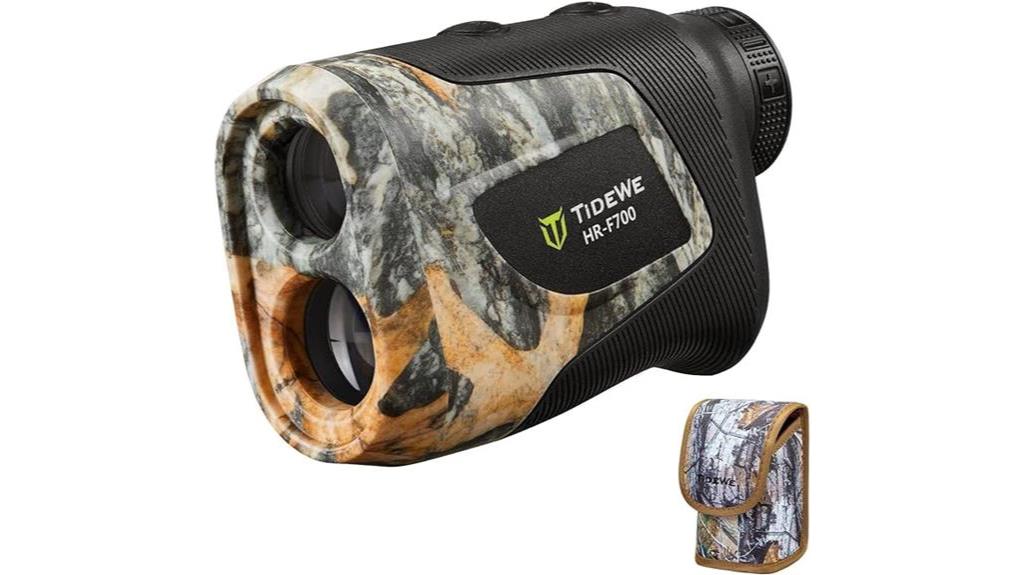
Boasting a rechargeable battery capable of 20,000 measurements on a single charge, the TIDEWE Hunting Rangefinder is ideal for hunters and outdoor enthusiasts who need reliable, long-lasting performance in the field.
This compact device offers 6x magnification and displays straight-line vertical distance, horizontal distance, and speed to target. You’ll appreciate its fast and accurate readings within +/- 1 yard and measuring speed of less than 0.5 seconds.
With its clear LCD display, ergonomic design, and popular camo pattern, the TIDEWE rangefinder is both functional and stylish. It’s built to withstand the elements, featuring a waterproof construction and weather-resistant materials.
At just 0.35 pounds, it won’t weigh you down during long hunts. Customers praise its accuracy, ease of use, and value for money, comparing it favorably to more expensive models in the $150-$200 range.
Pros:- Rechargeable battery with 20,000 measurements per charge
- Accurate readings within +/- 1 yard and fast measuring speed
- Waterproof and weather-resistant construction
- Non-illuminated reticle may be difficult to see in low light conditions
- Some users report focus ring issues at close distances
- Limited to 6x magnification, which may not be sufficient for all users
Callaway Golf 300 Pro Laser Rangefinder
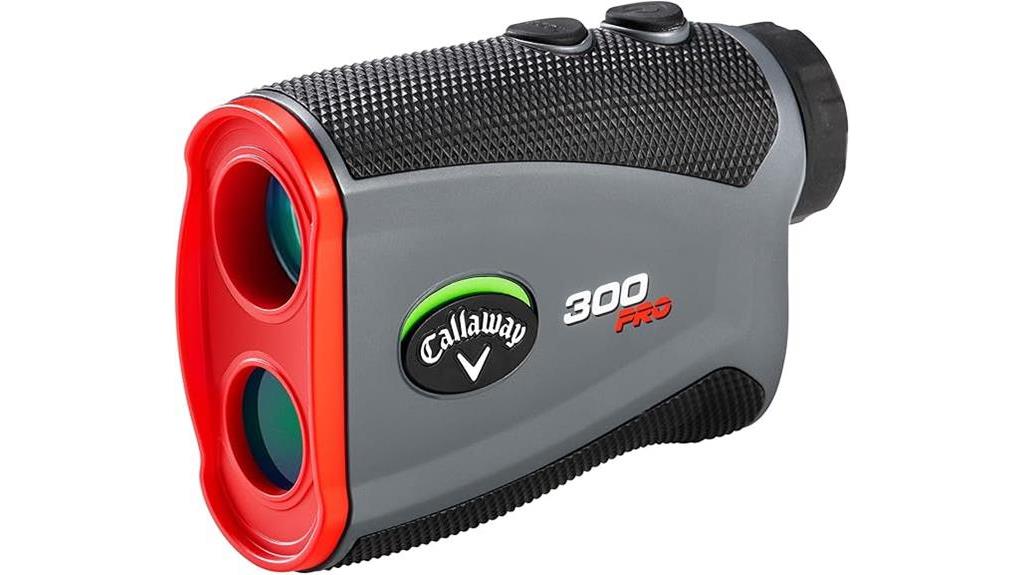
The Callaway Golf 300 Pro Laser Rangefinder stands out with its precise slope measurement feature, making it ideal for golfers who want to improve their game on courses with varying elevations.
You’ll appreciate its 6x magnification and impressive range of 5-1000 yards with +/- 1 yard accuracy. The Pin Acquisition Technology locks onto flags up to 300 yards away, while the Pulse feature confirms distances with a vibration.
You’ll find the external slope on/off switch handy for tournament play, and the Magnahold cart mount keeps your device secure. The compact design (4×2.7×1.4 inches) and water resistance add to its practicality.
With a 4.7-star rating from over 11,000 customers, it’s a popular choice. While some users report issues with slope accuracy and battery life, many praise its ease of use and value compared to pricier alternatives.
Pros:- Precise slope measurement and pin-locking technology for accurate distance calculations
- Compact, water-resistant design with convenient magnetic cart mount
- External slope on/off switch for tournament legality
- Some users report issues with slope measurement accuracy
- Battery life concerns mentioned in some reviews
- Limited information available on warranty and return policy
AOFAR HX-700N Hunting Range Finder 700 Yards
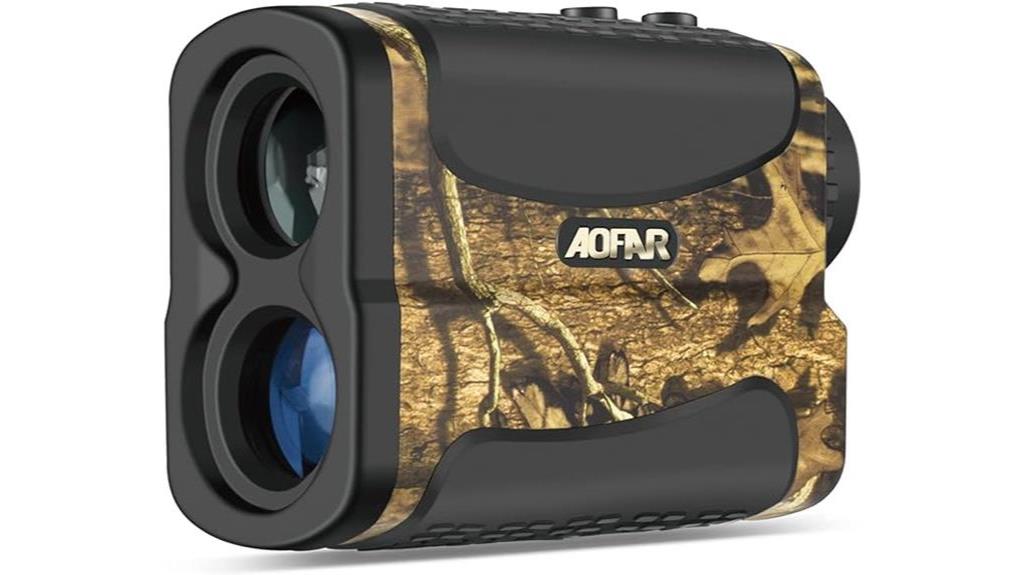
With its advanced pin sensor technology and 700-yard range, the AOFAR HX-700N Hunting Range Finder is ideal for bow hunters seeking precision in harsh environments.
You’ll appreciate its compact size (110x75x45mm) and lightweight design (180g), making it easy to carry in the field. The HX-700N offers two basic modes: Range and Speed, with an accuracy of ±1 yard.
This waterproof rangefinder boasts an IP54 rating, ensuring reliability in various weather conditions. You’ll find it user-friendly, as evidenced by its 4.6-star rating from nearly 10,000 customers. The package includes essential accessories like a carrying pouch, CR2 battery, and cleaning cloth.
With a 6x magnification and a measuring range of 5-700 yards, you’ll have no trouble identifying targets. The 2-year warranty and lifetime customer support provide peace of mind for your investment.
Pros:- Lightweight and portable design with a 700-yard range
- Waterproof construction with IP54 rating for all-weather use
- High accuracy (±1 yard) with advanced pin sensor technology
- Limited to two basic modes (Range and Speed)
- Plastic construction may not be as durable as metal alternatives
- May be overkill for casual or recreational users who don’t need long-range capabilities
Golf Rangefinder with Slope and Pin Lock Vibration (600/1000YDS)
Budget-conscious golfers seeking professional-grade accuracy will find the Golf Rangefinder with Slope and Pin Lock Vibration an impressive choice. This compact device offers a 1000-yard range with ±1 yard accuracy and quick 0.5-second measurements. You’ll appreciate the slope compensation feature, providing recommended hitting distances, and the flagpole lock with vibration for precise targeting.
Despite its affordable price point around $50, this rangefinder delivers performance comparable to more expensive models. You’ll enjoy clear views through the multilayer coated lens, though it may struggle in low light conditions.
The rechargeable Li-ion battery guarantees long-lasting use, and the USB-C charging adds convenience. While the plastic construction feels a bit cheap, the lightweight design and included accessories make it a practical choice for golfers looking to shave strokes off their game without breaking the bank.
Pros:- Offers professional-grade features like slope compensation and pin lock vibration at an affordable price
- Compact, lightweight design with long-lasting rechargeable battery
- Provides accurate readings comparable to more expensive rangefinders
- Struggles with accuracy in low light conditions and shadows
- Plastic construction feels somewhat cheap
- Smaller viewing window compared to some other rangefinders
Sig Sauer Buckmasters 1500 Hunting Laser Rangefinder
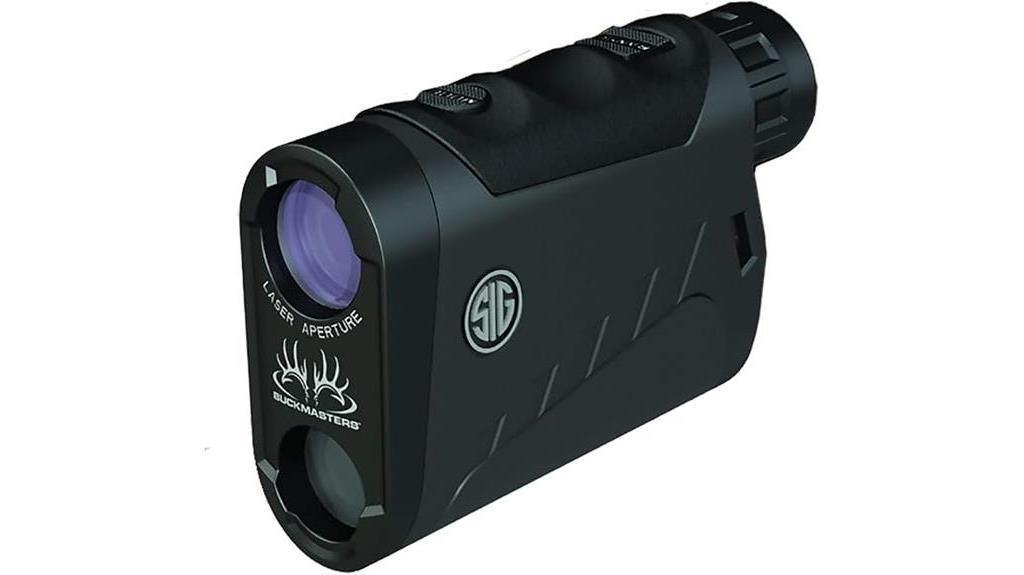
Hunters seeking an affordable yet high-performance rangefinder will find the Sig Sauer Buckmasters 1500 an excellent choice. With a 6x magnification and 22mm objective lens, it offers clear optics and a vivid red illuminated display optimized for low-light conditions. You’ll appreciate its IPX-4 waterproof rating and comfortable grip for outdoor use.
This rangefinder boasts impressive capabilities, ranging deer up to 600 yards, trees to 800 yards, and reflective targets to 1500 yards. It features Buckmasters Mode with 8 onboard ballistic groups and a continuous scan mode for versatile hunting applications. The compact, lightweight design (5.2 oz) easily fits into a rangefinder pouch.
While most users praise its accuracy and value, some have reported issues with dead batteries upon arrival. Despite this, the Sig Sauer Buckmasters 1500 remains a solid choice for hunters seeking performance without breaking the bank.
Pros:- Impressive range capabilities for deer, trees, and reflective targets
- Vivid red illuminated display optimized for low-light hunting
- Lightweight, compact design with comfortable grip and IPX-4 waterproof rating
- Some units reported to arrive with dead batteries
- Quality control issues, with a few customers receiving damaged packaging
- May feel less durable compared to higher-end rangefinders
Gogogo Sport Vpro Green Hunting Rangefinder (1200 Yards)
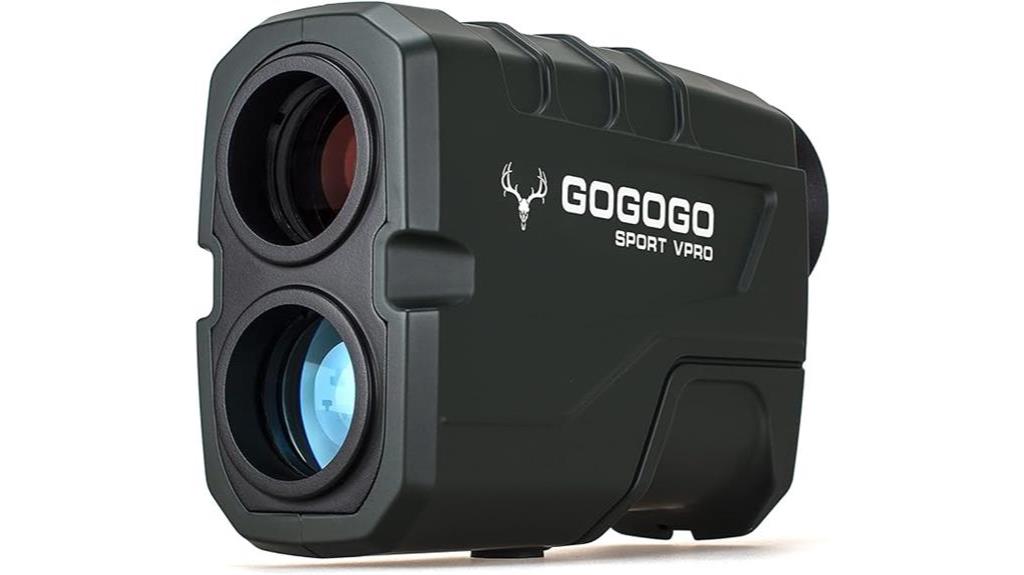
For those who demand versatility in their rangefinder, the Gogogo Sport Vpro Green Hunting Rangefinder stands out. This compact device offers four measurement modes, including Normal, Scan, Golf, and Speed, making it suitable for various outdoor activities.
You’ll appreciate its 6x magnification and LCD digital display, which provide clear visuals up to 1200 yards.
The Gogogo Sport Vpro excels in daylight conditions, consistently ranging objects up to 650 yards. Its golf mode features slope compensation and flag lock, while the speed mode measures target velocity. You’ll find it easy to use, with a rechargeable battery and USB charging.
At just 184g, it’s lightweight and portable. Although it has some limitations in dim lighting, its accuracy, multiple functions, and affordable price point make it a solid choice for hunters, golfers, and target shooters alike.
Pros:- Multiple measurement modes including Normal, Scan, Golf, and Speed
- Compact, lightweight design with rechargeable battery and USB charging
- Accurate readings up to 650 yards consistently
- Limited performance in dim lighting conditions
- May have some limitations in slope measurement accuracy for golf
- Maximum range of 1200 yards may not be consistently achievable
ACPOTEL Range Finder for Shooting and Hunting
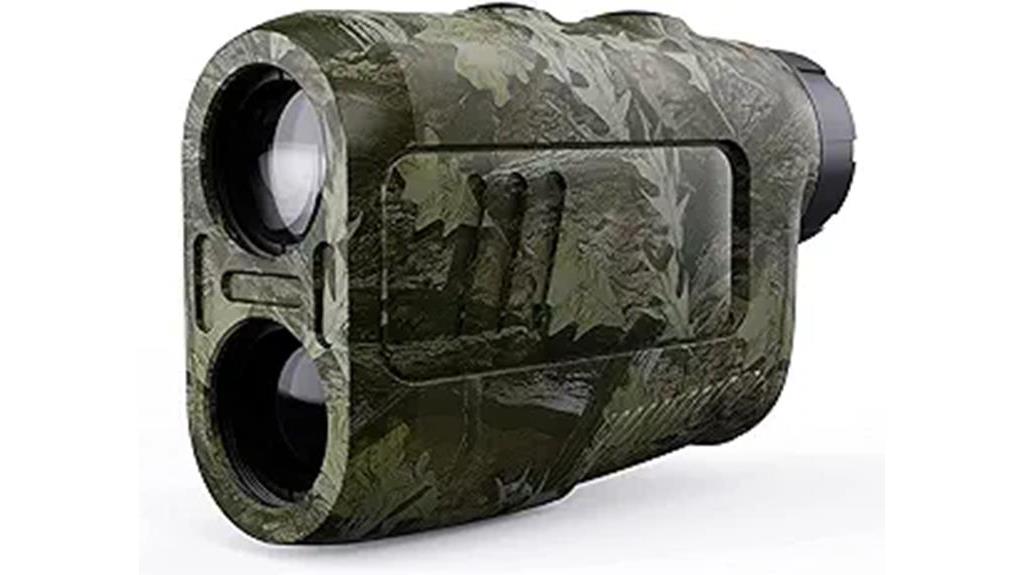
Outdoorsmen seeking a versatile rangefinder will appreciate the ACPOTEL Range Finder’s dual display and high precision. This camo-colored device offers fast measurements up to 1000 yards with ±0.5 yard accuracy. You’ll find its high-sensitivity screen with three LCD display levels useful in various lighting conditions.
The ACPOTEL Range Finder boasts a waterproof design, making it reliable in rain and fog. It’s compact, weighing only 150 grams, and comes with a protective hard case. While it’s accurate enough for photography, archery, and hunting, some users report it feels cheap and may be temperature sensitive.
Despite these drawbacks, many customers find it easy to use and a good value for the price. With a 2-year warranty and a high ranking among laser rangefinders, it’s a solid choice for your outdoor activities.
Pros:- High precision measurements up to 1000 yards with ±0.5 yard accuracy
- Waterproof design for use in rainy and foggy conditions
- Dual display with three LCD levels for clear visibility in various lighting situations
- Some users report it feels cheaply made
- May be sensitive to temperature changes
- Lacks shock protection, potentially affecting durability
AL52 Golf & Hunting Laser Rangefinder with Slope Mode
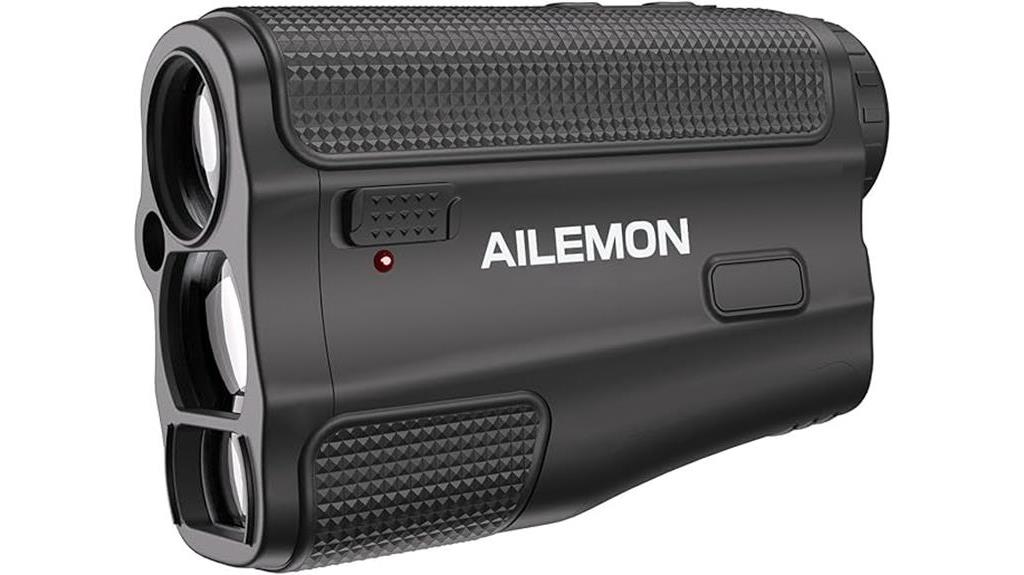
Golf enthusiasts and hunters seeking versatility will find the AILEMON AL52 Laser Rangefinder an excellent choice. With a range of 5-900 yards and +/- 1 yard accuracy, it’s suitable for various objects at short and long distances.
You’ll appreciate its flagpole locking function, effective up to 250 yards, and its slope compensation feature for accurate readings on uneven terrain.
The AL52 boasts a 6x magnification all-glass optical system with fully multi-coated and rain-repellent lenses. It’s lightweight at just 6.08 ounces and has an ergonomic design for easy handling. The device offers continuous scanning and fast measurements, making it ideal for quick, on-the-go use.
With an IP54 rating, it’s water-resistant and durable. Backed by a one-year warranty and lifetime customer service, the AL52 provides reliability and peace of mind for your outdoor adventures.
Pros:- Long-range capability of up to 900 yards with +/- 1 yard accuracy
- 6x magnification with fully multi-coated, rain-repellent lenses for clear viewing
- Lightweight and ergonomic design with multiple measurement modes
- Limited water resistance (IP54 rating) may not be suitable for extreme weather conditions
- Plastic construction might not be as durable as more premium rangefinders
- Maximum flagpole locking distance of 250 yards may be insufficient for some long-range golfers
Gogogo Sport Vpro Laser Rangefinder for Golf & Hunting
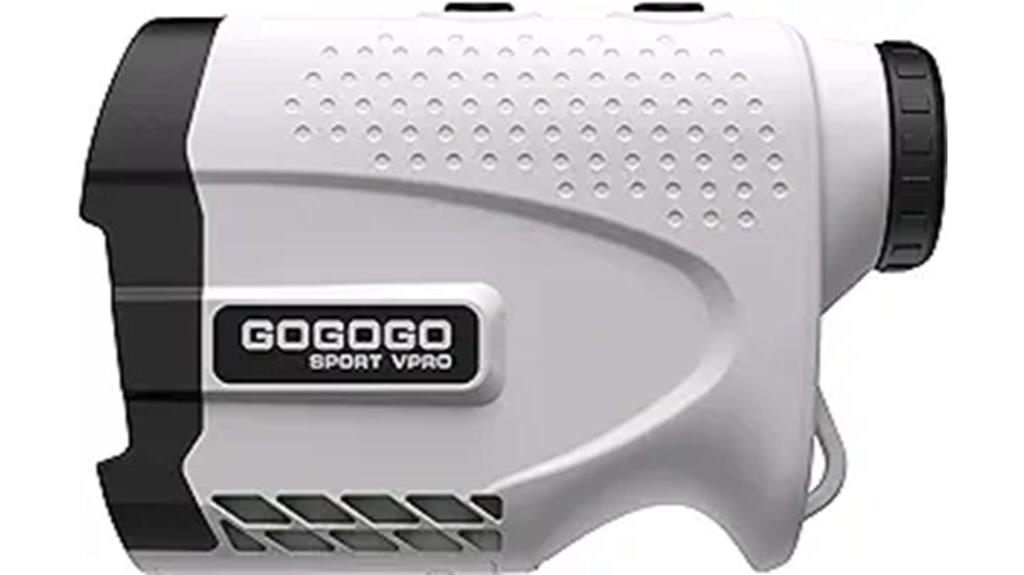
Boasting high-precision distance measurement and versatile functionality, the Gogogo Sport Vpro Laser Rangefinder is an ideal choice for both golf enthusiasts and hunters on a budget. This compact device offers a measuring range of 5-1200 yards with +/- 1m accuracy. You’ll appreciate features like continuous range readings, angle range compensation, and flagpole-locking vibration.
The Gogogo Sport Vpro’s fully multi-coated optics provide clear, bright images, while the adjustable diopter guarantees precise focus. Its slope switch makes it tournament legal, and the water-resistant design adds durability.
With a 4.3-star rating from over 8,500 reviews, it’s a popular choice among users. However, some customers reported inconsistent readings and difficulty locking onto targets. Despite these minor issues, many users found it comparable to more expensive brands with regard to accuracy and functionality.
Pros:- Wide measuring range of 5-1200 yards with high accuracy
- Advanced features like ARC, Pin-Seeking, and Flagpole-Locking Vibration
- Fully multi-coated optics for clear, bright images
- Some users report inconsistent readings and difficulty locking onto targets
- Batteries not included
- Potential durability issues, with one user reporting device failure after 2 years
Hunting Laser Rangefinder with Rechargeable Battery (1000 Yards)
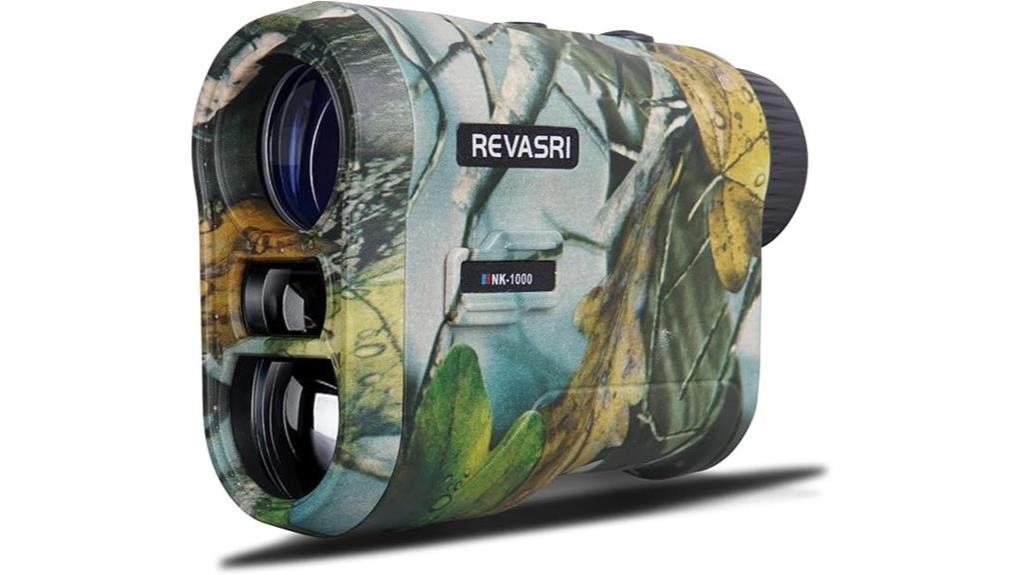
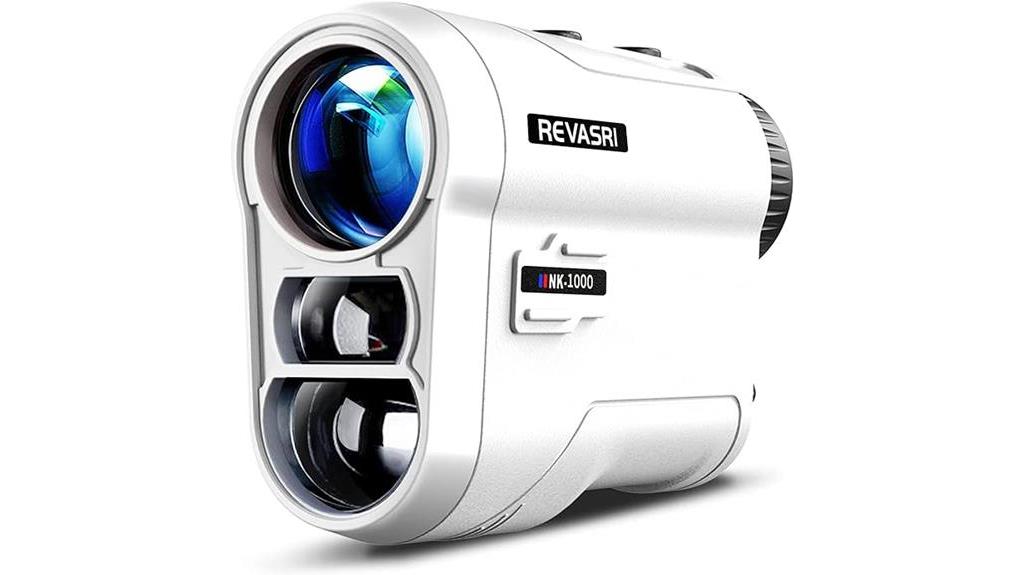
For hunters and outdoor enthusiasts seeking versatility and precision, this REVASRI laser rangefinder offers seven distinct modes to suit various needs. With a 1000-yard range and 6.5X magnification, you’ll get accurate measurements within ±1 yard. The rechargeable lithium battery and compact design make it convenient for extended use in the field.
You’ll appreciate the multilayer coated glass lens and high-end LCD display, ensuring clear visibility in various conditions. The device’s rain-proof construction and lightweight build (just 4.23 ounces) add to its portability.
While some users report difficulty reading the display in certain lighting conditions, many praise its accuracy and ease of use. At #5 in Laser Rangefinders on Amazon, this REVASRI model balances functionality and affordability for those who need reliable distance measurements in hunting, archery, or golf.
Pros:- Multiple measurement modes for various applications (hunting, golfing, archery)
- Accurate range up to 1000 yards with 6.5X magnification
- Compact, lightweight, and rain-proof design for outdoor use
- Some users report difficulty reading the display in certain lighting conditions
- Switching between yards and meters can be complicated for some users
- May require frequent manual focusing adjustments
Vortex Optics Crossfire HD 1400 Laser Rangefinder
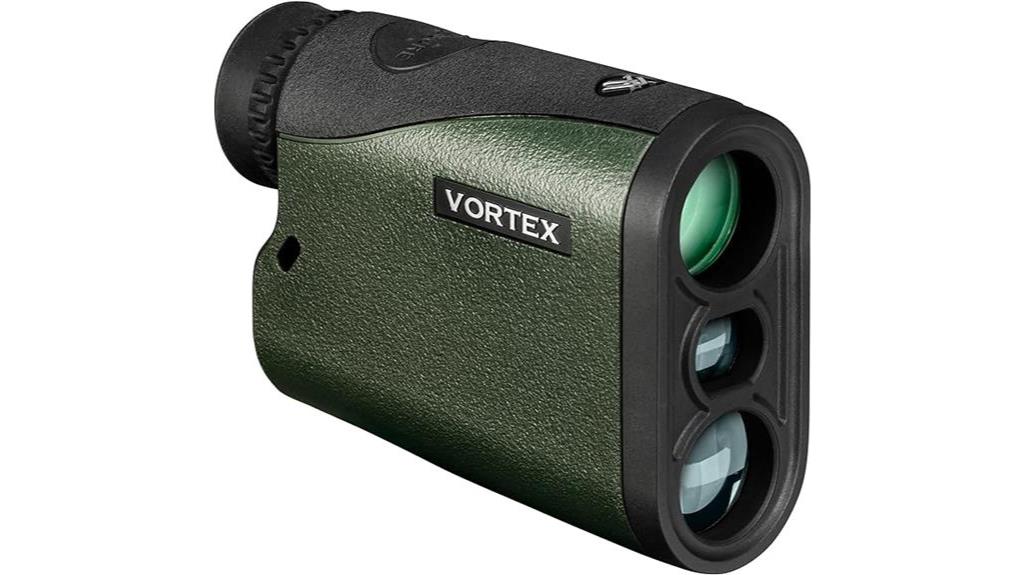
Hunters and long-range shooters will appreciate the Vortex Optics Crossfire HD 1400 Laser Rangefinder’s impressive 1,400-yard maximum range. This compact device weighs just 4.8 ounces, making it easy to carry in the field. You’ll benefit from its 5x magnification and 21mm objective lens, providing clear views of your target.
The Crossfire HD 1400 boasts an HD optical system with XR lens coatings for exceptional resolution and light transmission. Its red TOLED display guarantees clear readouts in any lighting condition. With three target modes and two ranging modes, you can adapt to various situations.
The rangefinder is waterproof, shockproof, and features ArmorTek lens coatings for durability. Vortex backs it with an unlimited, unconditional lifetime warranty, giving you peace of mind. With a 4.8-star rating from 639 reviews, it’s a top choice for precision rangefinding.
Pros:- Impressive 1,400-yard maximum range with 5x magnification
- Lightweight and compact design for easy portability
- High-quality HD optics with multiple modes for versatile use
- Relatively high price point compared to some competitors
- 750-yard range on game may be limiting for some long-range hunters
- Learning curve to master all features and modes
Sig Sauer Kilo1000 Laser Range Finding Monocular
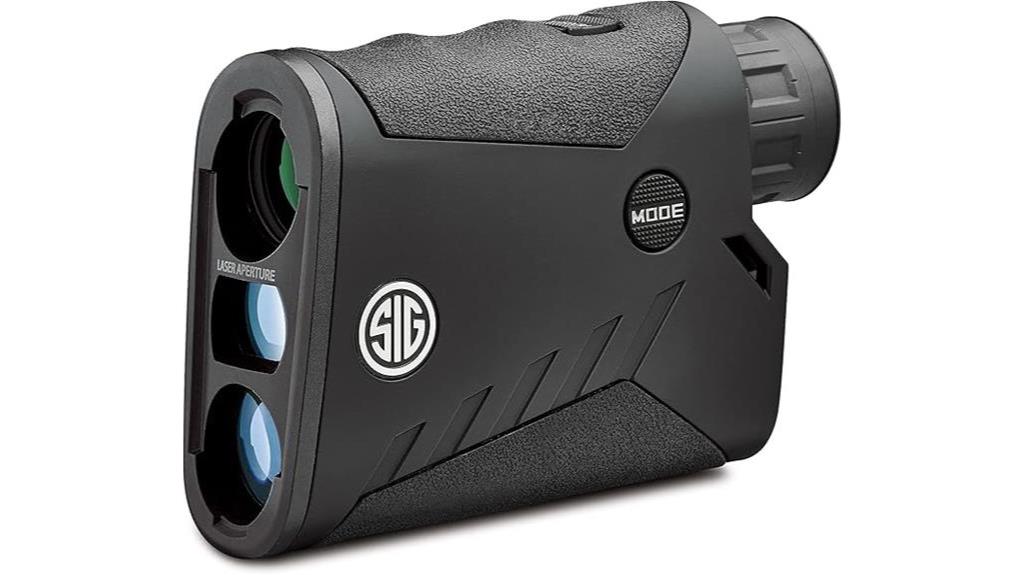
The Sig Sauer Kilo1000 Laser Range Finding Monocular stands out as a top choice for those seeking speed and accuracy in their rangefinder. With its LightwaveTM DSP Technology, you’ll get the fastest and longest distance measurements available. The 5x20mm monocular features SpectraCoatTM anti-reflection coatings, ensuring superior light transmission and optical clarity.
You’ll appreciate the HyperScan feature, providing 4x range updates per second in scan mode, while RangeLock reports the last range result for distant targets. The high transmittance LCD display offers excellent low-light performance. It’s easy to use, compact, and lightweight, making it perfect for carrying in your pocket or bag.
While some users find the 5x magnification sufficient, others suggest a higher magnification option would be beneficial. Overall, the Kilo1000 outperforms many competitors in speed, accuracy, and price, making it a highly recommended choice for rangefinder enthusiasts.
Pros:- Revolutionary LightwaveTM DSP Technology for fastest and longest distance measurements
- HyperScan feature provides 4x range updates per second in scan mode
- Compact, lightweight design with superior optical clarity
- Some users may prefer higher magnification than the 5x offered
- Lack of illuminated numbers for easier reading in low light conditions
- Battery life, while sufficient, may not be as long-lasting as some competitors
AL51 Rangefinder for Hunting and Archery (900 Yards)
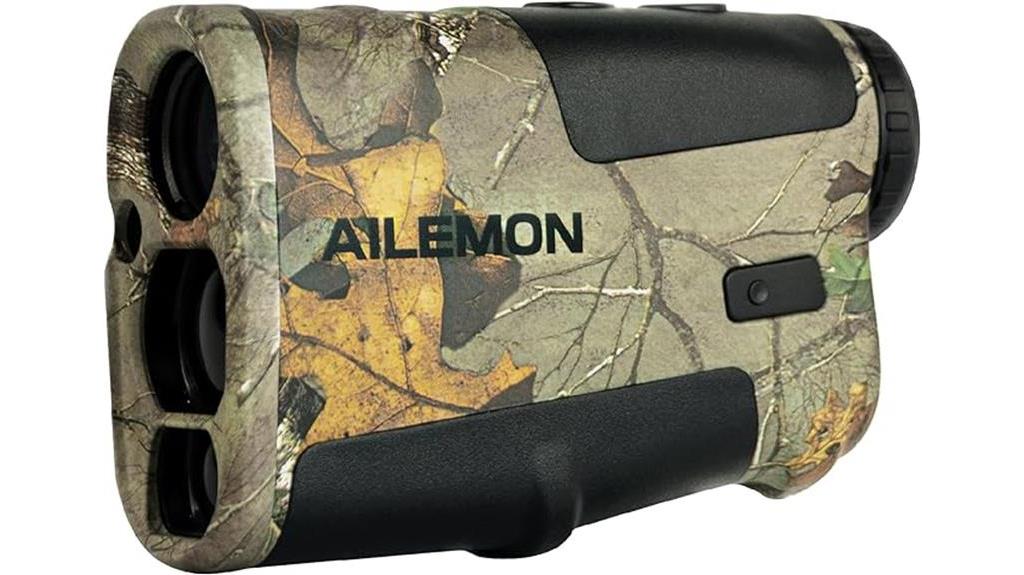
Archers and hunters seeking a versatile, high-performance rangefinder will find the AILEMON AL51 an excellent choice. This multi-functional device measures distances up to 900 yards with impressive accuracy. You’ll appreciate its fast measurement speed and advanced features like ARC technology and speed measuring.
The AL51’s 6x magnification and ultra-clear optics guarantee you’ll have a crisp view of your target. Its camouflage design and durable construction make it ideal for outdoor use, while its waterproof and dust-proof qualities protect it from the elements.
You’ll find it easy to use, with a focus ring for adjustments and a low battery indicator on the screen.
With a 1-year warranty, lifetime technical support, and positive customer reviews, the AL51 offers great value for its performance and features.
Pros:- Multi-functional device with 6x magnification and fast measurement speed
- Durable, waterproof design with camouflage finish for outdoor use
- Impressive 900-yard range with +/- 1 yard accuracy
- Batteries not included, requiring separate purchase
- Some users report minor issues with the product
- May be more complex for users seeking a simple, basic rangefinder
WOSPORTS Hunting Laser Rangefinder (800 Yards)
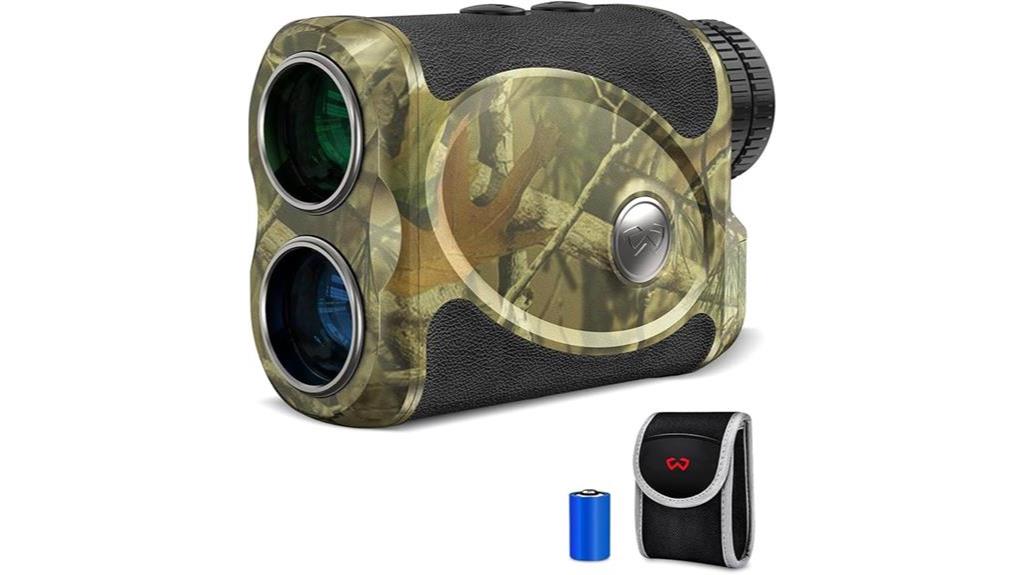
Outdoor enthusiasts seeking an affordable yet reliable rangefinder will find the WOSPORTS Hunting Laser Rangefinder an excellent choice. This compact device offers high accuracy up to 800 yards with a +/- 1 yard margin of error. You’ll appreciate its three mode options: Distance, Target Lock, and Speed, which can measure up to 300km/h.
The rangefinder’s ergonomic design and fast focus eyepiece guarantee clear visibility and easy use. While the optics may be slightly dark and the LCD display can be challenging to read against dark backgrounds, you’ll find it performs well in various lighting conditions.
You’ll get accurate readings from 6 to 150 yards, and the device’s compact size makes it easy to carry. Despite some limitations in foggy or low light conditions, you’ll likely prefer this rangefinder over more expensive models for its value and performance.
Pros:- High accuracy up to 800 yards with +/- 1 yard margin of error
- Three useful modes: Distance, Target Lock, and Speed (up to 300km/h)
- Compact, lightweight design with intuitive interface and fast focus
- Optics can be dark, making it challenging to use in low light conditions
- LCD display may be difficult to read against dark backgrounds
- Performance may be compromised in foggy or dusky conditions
Leupold RX-1400I TBR/W Gen 2 w/Flightpath Rangefinder, Black/Gray
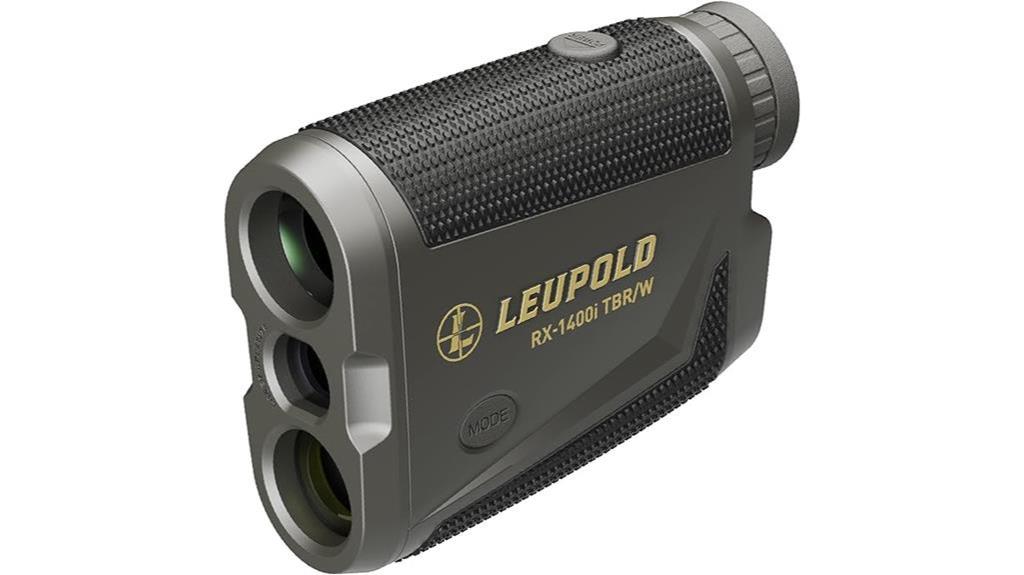
Hunters and long-range shooters will appreciate the Leupold RX-1400I TBR/W Gen 2’s advanced ballistic capabilities. This feature-rich rangefinder provides ballistically calculated ranges for accurate shots at long distances and steep angles. It even generates a hold point for a 10-mph wind at 90 degrees out to 800 yards.
You’ll find the RX-1400I exceptionally versatile, with a ranging distance of 1,400 yards on reflective objects and 1,200 yards on trees. The selectable Bow mode with Flightpath technology is perfect for archers, helping you spot potential arrow obstructions.
With its lightweight aluminum body, weighing just 5.1 ounces, and IP54 rating, it’s built to guarantee the device’s reliability in harsh conditions. The exceptionally bright red TOLED display confirms readability in changing light conditions. Backed by Leupold’s lifetime warranty, this rangefinder offers excellent value for its advanced features.
Pros:- Advanced TBR/W technology for accurate long-range and angled shots
- Versatile with both rifle and bow modes, including Flightpath technology for archers
- Durable, lightweight design with bright TOLED display for various lighting conditions
- Higher price point compared to basic rangefinders
- May have a steeper learning curve for users new to advanced ballistic features
- Limited to 800 yards for wind hold calculations, which might not satisfy extreme long-range shooters
Factors to Consider When Choosing Rangefinders
When you’re in the market for a rangefinder, you’ll want to ponder several key factors. These include the device’s range and accuracy, magnification and optical quality, size and portability, battery life, and its durability and weatherproofing.
Each of these aspects plays a vital role in determining which rangefinder will best suit your specific needs and usage scenarios.
Range and Accuracy
Two of the most crucial factors to ponder when choosing a rangefinder are its range and accuracy.
You’ll want to look for a device with a high maximum range, typically measured in yards, and an accuracy of +/- 1 yard or better. Some rangefinders can measure distances up to 1,400 yards or more, while others have shorter ranges.
Consider the rangefinder’s performance in various environmental conditions, such as fog, rain, or extreme temperatures. Different models may have varying accuracy levels depending on the target, like reflective or non-reflective surfaces. The update rate, or how quickly it provides continuous measurements, can affect its effectiveness in fast-paced situations.
Rangefinders use different technologies, with laser technology offering fast and accurate readings, especially in good lighting. The speed of measurement can vary, with some models providing readings in under 0.5 seconds.
Keep in mind that environmental factors like lighting, weather, and terrain can impact a rangefinder’s accuracy and range. By carefully evaluating these aspects, you’ll be able to choose a rangefinder that meets your specific needs and guarantees reliable measurements in various scenarios.
Magnification and Optics
Beyond range and accuracy, a rangefinder’s magnification and optics play a vital role in its overall performance. When choosing a rangefinder, you’ll want to weigh the magnification power, which typically ranges from 6x to 7x. Higher magnification provides a more detailed view of your target, enhancing precision and target identification.
The objective lens size is another critical factor. Measured in millimeters, larger lenses allow more light to enter, resulting in brighter images. This is particularly important in low-light conditions.
You’ll also need to decide between monocular and binocular designs. Monocular rangefinders are more compact and lightweight, while binocular models offer a more immersive viewing experience.
Pay attention to lens coatings and glass quality. Anti-reflective and hydrophobic coatings can improve light transmission and reduce glare, while HD or ED glass enhances detail resolution and corrects chromatic aberration.
Examine the field of view as well; a wider FOV aids in faster target acquisition but may compromise optical quality. Finally, don’t overlook eye relief, as longer eye relief provides more comfort during extended use.
Size and Portability
Size and portability are essential factors to ponder when choosing a rangefinder. You’ll want a compact device that’s easy to carry and handle in the field.
Look for models with dimensions around 4-5 inches in length, 1-2 inches in width, and 2-3 inches in height. These compact sizes allow for easy storage in your pocket or on a lanyard, reducing the risk of damage or loss.
Weight is equally important. Opt for rangefinders weighing between 5-10 ounces, as they’re considered lightweight and won’t burden you during long treks. This is especially pivotal for archers traversing dense forests or rugged terrain.
Consider the ergonomics of the rangefinder. Choose a model that fits comfortably in your hand and provides a secure grip, even in wet or gloved conditions. This guarantees ease of use and accuracy in various outdoor situations.
Battery life also plays a role in portability. Select a rangefinder that can last for several months on a single set of batteries, minimizing the need for frequent replacements in the field.
Battery Life
Battery life is a crucial factor when selecting a rangefinder, as it directly impacts the device’s reliability and performance in the field.
You’ll want to ponder the type of batteries used, with lithium-ion batteries being a popular choice due to their high energy density and long lifespan. Some rangefinders can offer up to 8,000 measurements on a single set of batteries, while others may require more frequent replacements.
Pay attention to features that help conserve battery life, such as auto-shutoff functions. These can substantially extend the time between battery changes, especially if you’re prone to forgetting to turn off your device.
Keep in mind that usage patterns and environmental conditions can affect battery life. Frequent use in low-light conditions or extreme temperatures may drain batteries more quickly.
When making your decision, look at the manufacturer’s claimed battery life and ponder how it aligns with your intended use. Some models use rechargeable batteries, while others require disposables.
Ultimately, choosing a rangefinder with excellent battery life guarantees you’ll have a reliable tool when you need it most, whether you’re hunting, golfing, or surveying.
Durability and Weatherproofing
When selecting a rangefinder, durability and weatherproofing are often overlooked yet essential elements to ponder. Your device will face various environmental challenges, from rain and snow to extreme temperatures and accidental drops.
To guarantee your rangefinder can withstand these conditions, look for models with IPX7 or higher water resistance ratings, which protect against immersion in water beyond 1 meter for up to 30 minutes.
A rugged, shock-resistant design is pivotal to withstand accidental drops and bumps. Seek out rangefinders with sealed optics, O-rings, and nitrogen-filled chambers to prevent fogging and maintain clear visibility in changing weather. Scratch-resistant coatings on lenses and armor coatings on the body offer additional protection.
Pay attention to the materials used in construction, such as aluminum or polymer, as they impact the device’s durability. Look for models with IP54 ratings or higher for thorough weatherproofing.
Verify the battery compartment and other openings are properly sealed to prevent water ingress. By prioritizing these features, you’ll invest in a rangefinder that can reliably perform in harsh conditions, providing accurate readings regardless of the environment you’re in.
Display and Readability
Moving beyond physical durability, a rangefinder’s display and readability can make or break your experience in the field. You’ll want a clear, bright display that’s easy to read in various lighting conditions. Look for high-quality LCD or OLED screens that provide crisp images, even in low light.
The display should feature large, legible numbers and clear labels for quick information processing. Some rangefinders offer adjustable brightness settings or automatic adjustment, certifying visibility in changing light. You might also find models with red or blue light modes to preserve night vision and reduce eye strain.
For peak performance, consider rangefinders with red TOLED displays or high transmittance LCD screens. These technologies offer superior readability in any lighting condition. Look for devices that provide instant yardages to the tenth of a yard, certifying accuracy even in challenging environments.
A high-contrast display with minimal glare will improve your ability to read measurements in bright sunlight or low-light situations. By prioritizing display quality and readability, you’ll certify that your rangefinder remains a reliable tool in any outdoor scenario, helping you make precise distance calculations quickly and effortlessly.
Additional Features
Beyond the core functionality, modern rangefinders often come packed with additional features that can enhance your experience and improve accuracy. Look for models with slope compensation, which adjusts for elevation changes to provide more precise distance calculations.
This feature is particularly useful for golfers and hunters in hilly terrain. Some rangefinders offer ballistic calculators, helping shooters account for factors like wind and bullet drop.
You’ll find units with multiple reticle options, allowing you to choose the best aiming point for your needs. Built-in image stabilization can be a game-changer, especially for long-range measurements or when using high magnification.
Many advanced rangefinders now incorporate Bluetooth connectivity, enabling you to sync data with smartphone apps for detailed analysis and record-keeping.
Consider models with scan mode, which continuously updates distances as you pan across a landscape. Weather-resistant construction is vital for outdoor use, so check for water and fog-proof designs.
Some rangefinders even feature built-in GPS or compass functions, adding navigation capabilities to your device. By carefully evaluating these additional features, you can select a rangefinder that perfectly suits your specific needs and activities.
Price and Value
In light of the wide price range for rangefinders, it’s crucial to weigh both cost and value when making your selection. With prices spanning from under $100 to over $1,000, you’ll need to set a budget and carefully consider the features and quality you’re getting for your money.
Remember that a higher price doesn’t always guarantee better performance. Some mid-range options may offer similar accuracy and features to more expensive models.
To determine the best value, consider the cost per feature, such as the price per yard of ranging capability. This approach can help you identify which rangefinder offers the most bang for your buck.
While budget-friendly options may lack advanced features, they can still provide accurate readings for casual users. However, be cautious of extremely low prices, as they may indicate poor quality or unreliability. To protect your investment, look for rangefinders with good warranties or return policies.
Ultimately, prioritize your needs and set a realistic budget. By carefully evaluating the price-to-value ratio, you can find a rangefinder that meets your requirements without breaking the bank.

Erzsebet Frey (Eli Frey) is an ecologist and online entrepreneur with a Master of Science in Ecology from the University of Belgrade. Originally from Serbia, she has lived in Sri Lanka since 2017. Eli has worked internationally in countries like Oman, Brazil, Germany, and Sri Lanka. In 2018, she expanded into SEO and blogging, completing courses from UC Davis and Edinburgh. Eli has founded multiple websites focused on biology, ecology, environmental science, sustainable and simple living, and outdoor activities. She enjoys creating nature and simple living videos on YouTube and participates in speleology, diving, and hiking.
From the shop
Gifts for people who love the wild
Wildlife themed t-shirts, notebooks, tote bags, bandanas and guides, designed by an ecologist.
Visit the shop