Stop spending 3 hours on an application that gets rejected. Do it in 20 minutes, and fix the part that was actually broken.
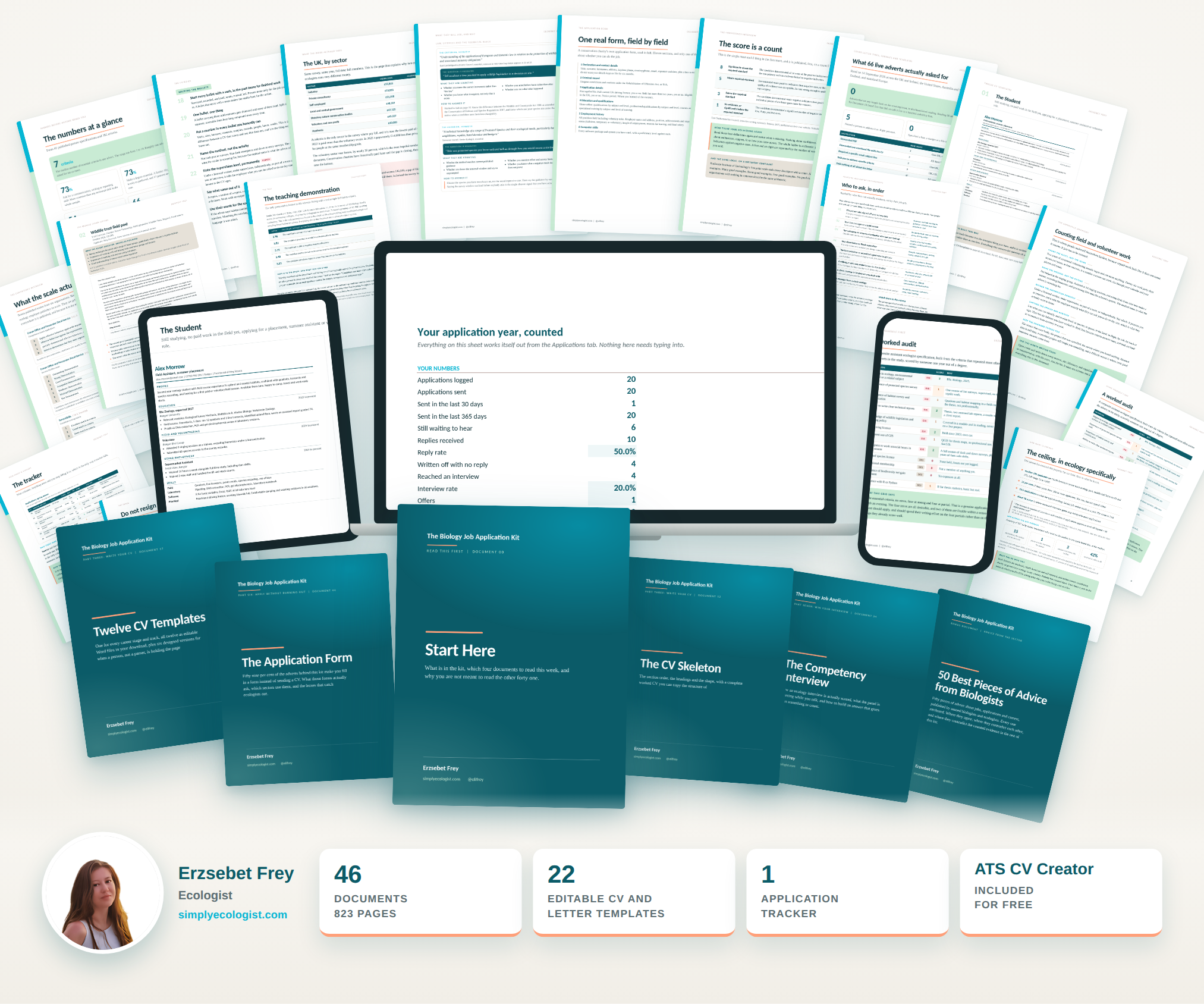
46 guides, 22 editable templates and a tracker that tells you which stage of your applications is failing.
823 pages for biologists, ecologists, zoologists and environmental scientists who are sending applications and hearing nothing back. Built from counted evidence, not from memory: 42 live adverts coded criterion by criterion, 597 job titles harvested from 17 boards, and published interview research with its sample size printed on the page it appears.
46 documents | 823 pages | 22 templates | 1 tracker |
Every month you spend fixing the wrong thing is a season you do not get back
Ecology hires in windows. Miss the spring intake because you spent March rewriting a CV that was never the problem, and the next real chance is a year away.
You get home. The advert closes on Friday. You open the CV you have opened 40 times, and you start moving things around, because moving things around feels like progress.
2 hours later you have swapped 2 bullet points and rewritten the personal statement into something that sounds like everyone else’s. You write a letter about how passionate you have been about wildlife since childhood. You send it at 11 and you feel like you did something.
3 weeks pass. Nothing. Not a rejection, just nothing.
And the worst part is you have no idea which bit went wrong, so next Friday you will do exactly the same thing again.
What is actually in it
- How to find out which stage of your applications is failing, even if you have never tracked a single one
- How to read a person specification in 10 minutes and decide whether to bother, even if every advert looks impossible to you right now
- How to find evidence you already have, even if you think you have no experience at all
- How to write a CV that survives being read by software, even if you have no idea what happens to your file after you press send
- How to fill in the application form that most employers actually use, even if your career is a run of seasonal contracts with a gap every winter
- How to answer a competency interview against a published scoring scale, even if nobody has ever shown you one
- How to give a job talk or a field test, even if presenting in your second language terrifies you
- How to handle an offer, a rejection, and total silence, even if you have never negotiated anything in your life
What it gives back, 3 ways
Hours saved. Document 13 puts tailoring at 20 minutes against the 2 to 3 hours most people spend. Across 30 applications, which is where the research says added volume stops helping, that is roughly 70 hours. At even a minimum wage valuation of your evening, the kit pays for itself on application 4.
Money saved. Conservation Careers gates its applications course inside a subscription at £147 per quarter, about $185, or roughly $740 for a year. This kit is $47 at launch and yours permanently. That is a saving of about $693 in the first year against the nearest equivalent. The ATS CV Creator alone sells at $29, so $18 of the launch price buys the other 823 pages.
Money gained. 1 seasonal assistant ecologist contract in the United Kingdom is roughly £24,000 pro rata. Moving 1 application from rejection to interview is not a guarantee of a job, and nobody can promise you that. What can be said honestly is that the kit costs less than 1 per cent of 1 month of that salary.
The full contents
46 PDFs, 823 pages, in 8 parts plus a bonus. Every one ends with a page naming what its evidence cannot tell you.
Read this first 14 pages
- 00 Start Here 14 pp
Part One: Know Your Market 71 pages
- 01 The Employer Map 16 pp
- 02 Marked Before Anyone Reads You 14 pp
- 03 The Job Title Decoder 13 pp
- 04 The Hiring Calendar 14 pp
- 05 What the Work Actually Pays 14 pp
Part Two: Build Your Evidence 69 pages
- 06 The Experience Inventory 14 pp
- 07 The Evidence Bank 13 pp
- 08 Score Yourself First 13 pp
- 09 Closing the Gaps 13 pp
- 10 Licences, Tickets and Letters After Your Name 16 pp
Part Three: Write Your CV 103 pages
- 11 The CV Rules 17 pp
- 12 The CV Skeleton 13 pp
- 13 Tailoring in Twenty Minutes 12 pp
- 14 The Other Versions 15 pp
- 15 Machine Readable 14 pp
- 16 Three CVs, Three Species 12 pp
- 17 Twelve CV Templates 20 pp
Part Four: Write Your Letters 119 pages
- 18 The Cover Letter Rules 17 pp
- 19 The Four Paragraph System 15 pp
- 20 Ten Worked Cover Letters 17 pp
- 21 The Supporting Statement 17 pp
- 22 Statements for Research Posts 16 pp
- 23 Emails That Get Replies 16 pp
- 24 Cover Letter Types, Formats and Templates 21 pp
Part Five: Line Up Your References 58 pages
- 25 Choosing and Asking Your Referees 14 pp
- 26 The Referee Briefing Pack 14 pp
- 27 Eight Recommendation Letters 16 pp
- 28 When Your References Are a Problem 14 pp
Part Six: Apply Without Burning Out 118 pages
- 29 Should You Apply at All 15 pp
- 30 How Many Is Enough 17 pp
- 31 The Jobs Nobody Advertised 18 pp
- 32 Your Online Presence 32 pp
- 33 What You Are Walking Into 16 pp
- 44 The Application Form 20 pp
Part Seven: Win Your Interview 155 pages
- 34 The Competency Interview 21 pp
- 35 What They Will Ask, and Why 23 pp
- 36 The Field Test 20 pp
- 37 The Talk 33 pp
- 38 What to Ask Them 28 pp
- 39 Getting There 30 pp
Part Eight: After the Answer 97 pages
- 40 The Offer 36 pp
- 41 The Rejection 23 pp
- 42 The Silence 22 pp
- 43 When It Keeps Not Working 16 pp
Bonus document 19 pages
- B 50 Best Pieces of Advice from Biologists 19 pp
And not PDFs
- 12 CV templates, editable Word files, one for each stage and specialism
- 10 cover letter templates, editable Word files, one for each situation
- The Application Tracker, a spreadsheet with a log, a self counting dashboard, a funnel chart and a monthly chart
- A licence for the ATS CV Creator, the paid tool on this site, which sells separately at $29
What you can do with it in the first week
- First hour. Put your last 5 applications into the tracker and read the dashboard. It tells you which stage is failing, which is usually not the one you assumed.
- First hour. Read Document 00, 14 pages, and pick 1 of its 3 routes. You will know which 4 documents to read and which 42 to leave alone.
- First day. Run the ten minute triage from Document 29 on the advert sitting in your browser tab, and find out whether it is worth your evening before you spend it.
- First day. Open the CV template that matches your stage and move your own content into it. The order is already right, so this is cutting and pasting rather than designing.
- First day. Use the 20 minute tailoring method inside to rebuild your CV and cover letter for a specific job, start to finish.
- First week. Build the evidence inventory in Document 06 and the themed bank in Document 07. Every application after this takes a fraction of the time.
- First week. Ask your referees once, properly, using the script in Document 25, before you need them. Forms will not let you submit without two.
- First week. Send one application using Document 44 if it is a form, which it will be 59 times out of 100, or Document 19 if it is a letter.
Instant download. 46 guides, 823 pages and 22 editable templates.
3 things included at no extra cost
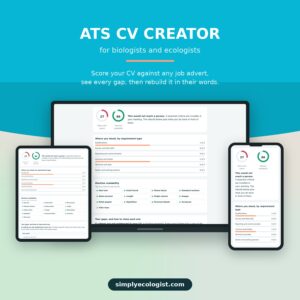
The paid version of the CV tool on this site, which sells on its own at $29. Paste your CV and the advert, and it scores the match, runs the readability checks, lists the criteria you have not covered and rebuilds the CV from your own words. Your key arrives with your order.
A spreadsheet with a dashboard that counts itself. Log what you send, and it compares your year against the counted research in Document 30 and names which stage is failing. Two charts, no setup.
A bonus document of practitioner advice, every line attributed to a real named person with a date, grouped by theme, with a page on where they contradict each other and a page on where they contradict the research in the rest of the kit.
Who this is for, and who it is not for
This is for you if
| This is not for you if
|
Who wrote this
Erzsebet Frey, ecologist and wildlife biologist. BSc Biology, MSc Ecology, University of Belgrade.
I did my degree in Belgrade, which is not one of the universities that opens doors. I had no contacts in the field and no money to do the unpaid season abroad that everyone told me I needed. I applied for 47 things before anybody said yes.
What I did not understand then is that I was fixing the wrong thing. I rewrote my CV until I could not read it any more, and the CV was never the problem. I was applying for posts where I had hard zeros against the essential criteria, and nobody had ever shown me what a panel actually does with a person specification.
Since then I have run multi taxa surveys, worked in the field in three countries, and won positions abroad from a standing start. Friends ask me to read their applications, which is how I know the same three mistakes turn up every time. So I spent three months counting what employers actually write down, instead of remembering what I thought they wanted. That is this kit.
What it replaces
The nearest equivalent training in this field is not sold on its own. It sits inside a subscription at £147 a quarter, roughly $740 a year. This is a one off payment, and it is yours permanently.
Instant download, 1 folder, and nothing in it depends on a link staying alive.
The things people actually ask
I can find all of this online for free
Most of it, yes. That is true of almost every book ever sold. What you cannot find free anywhere is the counting. Nobody has collected 42 live adverts and coded 392 criteria by hand, or harvested 597 job titles from 17 boards. The free advice in this sector is written from memory, which is why so much of it contradicts itself. Document 30 lists 6 numbers you will be told everywhere, including the famous claim that software bins 75 per cent of CVs, and shows that none of them has a source. You are not paying for information. You are paying for somebody having checked.
This looks too basic for me
If you have a job offer in hand, it probably is. If you are reading this because applications keep going nowhere, then the level is not the issue, and Document 43 will tell you within 10 minutes which stage is actually failing. Most people who think the kit is too basic have never seen a scoring scale, and Document 34 prints 4 of them, from 4 different employers, with the wording they give their panels.
This looks too advanced for me
Nothing in it assumes you have worked as an ecologist. Document 06 starts from the position that you have no idea what counts as evidence, and finds 9 places it is hiding in a degree, a volunteering day and a supermarket job. Document 00 gives you a route of 3 documents for your first week so you are never staring at 800 pages.
I do not have time to read 823 pages
You are not meant to. That is written into the first page of the first document. The average person needs 4 documents for the situation they are in this month. Document 00 tells you which 4 in 14 pages, and the emergency route for somebody with a closing date this week takes about 90 minutes.
I am not sure it applies to my country
Be honest with yourself here, because it matters. The counted research leans British, American and Australian, because those are the markets that publish enough to count. Document 14 covers how a CV changes between countries and includes Japan, mainland Europe and the rest of Asia. But if you are applying only within a country the kit does not name, some of the numbers will not be yours. Every document says so on its last page, which is the most useful page in each one.
I work on plants, not animals, or I am in a lab, not the field
The twelve CV templates include a laboratory scientist, a data and GIS specialist, an academic and a consultancy ecologist. The advert sample spans all 9 employer types including biotech, museums and environmental technology. The evidence themes in Document 07 came out of the criteria themselves, not out of one taxon.
$67 is a lot right now
It is, and I know what this sector pays, because Document 05 is 20 pages of exactly that. So here is the honest comparison. The nearest equivalent training in this niche is inside a subscription at £147 a quarter, which is roughly $740 a year. This is $67 once, and the ATS CV Creator inside it sells on its own for $29. If it is still too much this month, use the free CV checker on this site, which is free permanently and always will be.
I have no experience, will this even help me?
This is the question the whole of Part Two exists for. Document 06 is about finding the evidence you already have and do not recognise. Document 09 is 4 routes out of the experience circle, including the one that costs nothing, which is doing a small piece of real work with open data and writing it up properly. What the kit cannot do is invent a field season for you.
Is this just CV templates with extra steps?
The templates are about 1 part in 20. Parts Six, Seven and Eight are 370 pages on the campaign, the interview and what happens after the answer, and none of that is templated. Part Seven alone is 155 pages, because interviews are where the published evidence actually is.
How do I know the research is real?
Every figure carries its sample size and the date it was read, on the page it appears. Where I could not verify something, it says so in the text. There are 2 places where I take a position and then correct it, and the correction is printed rather than edited out. And every document ends with a page titled what this evidence does not say. Read that page first if you are sceptical, because it is where I argue against myself.
Will it be out of date in six months?
Parts of it will. Pay figures and live advert counts are the shortest lived things in there, and each one carries the date it was read so you can see how old it is. The parts that do not age are the structural ones: how scoring works, how a form is built, what a panel is instructed to do.
One last thing
Nobody can promise you a job, and I am not going to. What I can tell you is that most people in this field lose applications on things that are avoidable, and spend months fixing the part that was never broken.
This kit will not make you a better ecologist. You already are one. It will stop you losing on the paperwork.
46 guides, 823 pages and 22 editable templates, yours to download today. Stop losing on the paperwork.
Share this
🌿 Explore the Wild Side!
Discover eBooks, guides, templates and stylish wildlife-themed T-shirts, notebooks, scrunchies, bandanas, and tote bags. Perfect for nature lovers and wildlife enthusiasts!
Visit My Shop →