
Key Facts About Quokka Reproduction
- Gestation: about 27 days. Animal Diversity Web gives 27 days, San Diego Zoo Wildlife Alliance gives 26 to 28 days.
- Pouch life: the joey leaves the pouch between six and seven months, and returns if alarmed or cold. Australian Government Species Profile and Threats Database.
- Weaning: around eight months on average. Animal Diversity Web.
- Young per year: one on Rottnest Island, an average of two on the mainland. Western Australian Department of Biodiversity, Conservation and Attractions.
- Embryonic diapause: the female mates again one day after giving birth and that second embryo stays dormant for up to five months. Australian Government Species Profile and Threats Database.
- Lifetime output: a mainland female can consistently wean two offspring a year and produce up to 17 young in a lifetime. Australian Government Species Profile and Threats Database.
When Is Quokka Breeding Season?
On Rottnest Island and Bald Island quokkas breed once a year. The Western Australian Department of Biodiversity, Conservation and Attractions records young born between February and April, which at a 27 day gestation puts mating in January to March. Phillips, Chambers and Bencini, writing in Hystrix in 2017, found that the timing shifts with habitat inside the island itself: births fell in February and March in the settlement area and in March and April elsewhere on Rottnest. Most births fall between February and April rather than peaking in one single month.January to March is the driest quarter of the Rottnest year, not the start of the wet season. Bureau of Meteorology climate averages for Rottnest Island, station 009193, record mean rainfall of 13.3 mm in January, 10.3 mm in February and 18.0 mm in March, against 103.2 mm in June and 114.1 mm in July. Quokkas on Rottnest mate in the driest quarter of the island year. The rain arrives around May, which is roughly when the pouch young is halfway through its development.Rottnest is the best known stronghold for the species rather than its only home. The Australian Museum gives the Rottnest breeding season as January to August, while mainland quokkas breed throughout the year. Quokkas can have up to two breeding cycles per year, although this is far more common in mainland populations, where the Western Australian Department of Biodiversity, Conservation and Attractions records an average of two young a year. On Rottnest a female typically raises one offspring per year, a limit set by the compressed island breeding season as much as by food and water.Activity and interactions rise across the population once the season opens. Males become more aggressive and competitive as they compete for mating opportunities, and they engage in sparring matches, using their forelimbs to push and grapple with rivals.How Do Quokkas Mate?
Courtship
A male quokka approaches a female with a distinctive gait, standing tall on his hind legs and puffing out his chest. If she shows interest he follows her closely, sometimes for several days, nuzzling and grooming her, and he will block her path and spar lightly with other males nearby. She tests his persistence by moving away repeatedly.Quokka courtship is a physical business rather than a vocal one. San Diego Zoo Wildlife Alliance states that there is nothing in the literature describing quokka vocalisations at all, which means any account of clicks or calls during mating is unsupported.How Females Choose a Mate
Females are selective and prefer larger males. McLean, Cameron, Linklater, Schmitt and Pulskamp, publishing in Behaviour in 2009, found that male quokkas form a dominance hierarchy in which the heaviest males are the most dominant and spend the most time with females. San Diego Zoo Wildlife Alliance states the same result more bluntly: the heaviest male gets more access to females. Body size is the mate choice cue that is actually documented. No source describes facial markings as a mate choice cue in quokkas, and the Western Australian Department of Biodiversity, Conservation and Attractions describes the coat plainly as thick, coarse grey brown fur with a lighter belly.Are Quokkas Monogamous?
No. That same 2009 study recorded females forming consorts with one to three males and males with one to five females, and most liaisons lasted under ten minutes. Animal Diversity Web classifies the mating system as polygynandrous, which means both sexes mate with several partners. The nuance worth keeping is that some consort relationships persisted across at least two breeding seasons, so the pairings are neither exclusive nor random.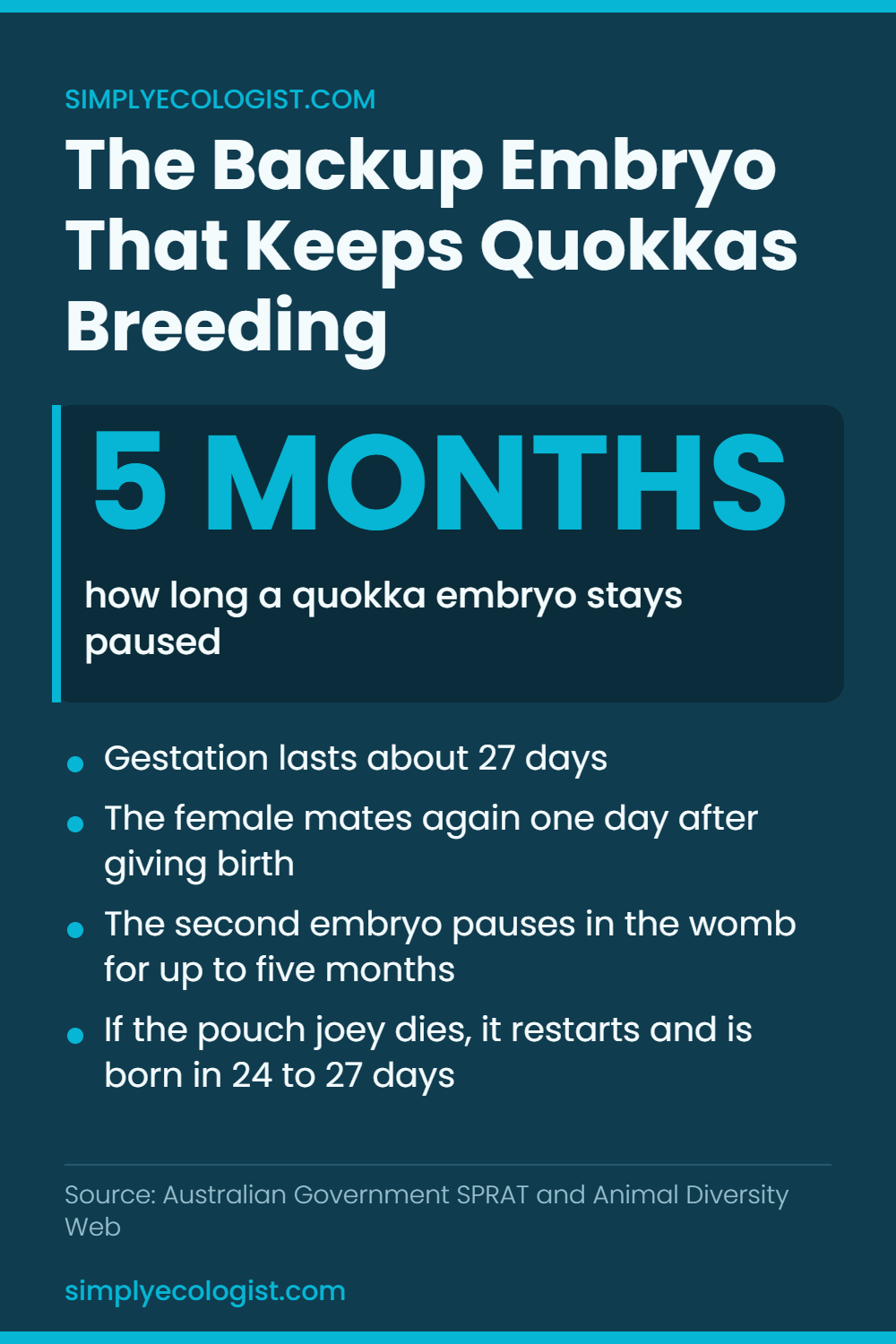
Gestation and Birth
Gestation in quokkas lasts about 27 days. Animal Diversity Web gives 27 days, San Diego Zoo Wildlife Alliance gives 26 to 28 days, and the Australian Government Species Profile and Threats Database gives 24 to 27 days for a birth that follows a resumed diapause. It is one of the shortest gestations of any mammal, and it is short because almost all of the growing happens afterwards, in the pouch.The newborn joey is blind, hairless and tiny, and it crawls unaided to the pouch, attaches to a teat and stays attached for months. Precise figures for its length and weight circulate widely but they trace back to kangaroo neonates rather than to quokkas, so they are not repeated here.What Is Embryonic Diapause and Why Do Quokkas Use It?
Embryonic diapause is a pause button on pregnancy. A fertilised egg divides into a small ball of cells called a blastocyst and then simply stops, sitting dormant in the uterus until a hormonal signal releases it to carry on.Quokkas use it as standard practice. The Australian Government Species Profile and Threats Database sets out the sequence: one day after the young is born, the female mates again and embryonic diapause begins, with the embryo staying dormant inside her. If the pouch young dies within five months, that embryo resumes development and is born 24 to 27 days later. Animal Diversity Web puts the dormant period at approximately five months.That single mechanism explains most of the rest of this page. A female quokka carrying a joey in her pouch is usually also carrying a second, paused embryo. She is not waiting for the next breeding season. She is one lost joey and roughly four weeks away from a replacement.It is also why the mainland and island numbers differ the way they do. The Species Profile and Threats Database records that a mainland female can consistently wean two offspring per year and produce up to 17 young over a lifetime, because mainland quokkas breed year round and the paused embryo can be released as soon as the pouch is free. On Rottnest the breeding season runs January to August according to the Australian Museum, so the second cycle usually has nowhere to go and a female raises one joey a year. The mainland strategy is not a different species trait, it is the same trait with more of the calendar available to it.Diapause is also why quokkas became a laboratory model for marsupial reproduction. Shield and Woolley, in the Australian Journal of Zoology in 1961, built the standard method for ageing quokka pouch young on exactly this behaviour, because removing a pouch young restarts the dormant blastocyst and gives researchers a known conception date. That work is the reason the timing of quokka pouch development can be measured at all.Joey Development Inside the Pouch
The joey stays attached to a teat for months, growing fur and opening its eyes entirely out of sight. Day counts for eye opening and fur growth are repeated all over the internet, but none of them can be traced to a published source for this species. The table below uses the calendar the Rottnest Island Authority gives visitors instead, which has the advantage of being both citable and useful, because it describes what is actually visible in a given month.| Stage | What is happening | Source |
|---|---|---|
| February to April | Births. The newborn crawls to the pouch and attaches to a teat. | WA Department of Biodiversity, Conservation and Attractions; Phillips et al. 2017 |
| June | Pouches look visibly heavier as the joey grows. | Rottnest Island Authority |
| August | Joeys poke their heads out of the pouch. | Rottnest Island Authority |
| September | First hops outside the pouch. | Rottnest Island Authority |
| Six to seven months | The joey leaves the pouch, but returns if alarmed or cold. | Australian Government Species Profile and Threats Database |
| About eight months | Weaning. | Animal Diversity Web |
Do Quokkas Really Throw Their Babies at Predators?
No. The popular version of this claim is wrong in three separate ways at once.Here is what is supported. ABC News reported on the meme in March 2021 and quoted Matthew Hayward, a conservation biologist at the University of Newcastle, who described the mechanism as the mother relaxing her muscular pouch so that the young falls out, after which the youngster flails on the ground and makes noise while the mother gets away. Graeme Coulson, a kangaroo ecologist at the University of Melbourne, framed it in the same report as a female acting in the interest of her own survival and her future reproduction. That is a news report quoting two named academics, not a primary research paper, and the difference is worth stating.Now the three problems. First, there is no throwing. The pouch relaxes and the joey drops. Nothing is aimed and nothing is used as a projectile, which is exactly why the word at, in the phrase throw their babies at predators, is what makes the meme misleading. Second, it is not a quokka speciality. Hayward describes the response as one macropods show generally, so pinning it on quokkas turns a broad marsupial escape reflex into a story about one photogenic animal. Third, it is not callousness. It is reproductive arithmetic.In my reading of the literature, that third point is the one everybody misses, and it is the reason this behaviour belongs on a page about mating rather than on a page about cruelty. A female who escapes is very often already carrying a paused embryo. Losing the pouch joey restarts it, and she can give birth again roughly four weeks later. The dropped joey and the dormant embryo are not two separate quokka curiosities. They are two halves of one strategy.Parental Care
Female quokkas provide almost all of the care. The joey stays in the pouch for about six months and the mother cleans and grooms it throughout. Marsupial milk changes composition as the young develops, so the milk a newly attached joey receives is not the milk a joey receives at pouch emergence.Leaving the pouch is not independence. The mother continues to nurse her young for another two to three months, and that is the stretch that carries the joey to weaning at around eight months.Males play little part in raising young. As the joey becomes more independent, it spends more time away from its mother, although young quokkas often keep a close relationship with her after reaching maturity, sharing foraging areas and resting spots. That prolonged familial bond feeds into the social structure of quokka populations in the wild.Population Dynamics
Quokka numbers rise and fall with the environment, and rainfall is the main lever, because it sets how much food is available and for how long. In drought years fewer females reach the condition needed to carry a joey through to weaning, and numbers fall.Predation is the other lever, and it separates the island from the mainland completely. Quokkas on Rottnest Island have no natural predators, and the Australian Museum records that the island is fox free. On the mainland introduced species like foxes and cats can considerably reduce their numbers. The European Red Fox reached the region in the 1930s and mainland quokka numbers declined severely through the twentieth century, while the Rottnest population, protected by open water, did not.Habitat loss and fragmentation compound both pressures. The Australian Government Species Profile and Threats Database puts the Rottnest population at roughly 8,000 to 12,000 animals and Bald Island at 600 to 1,000, while the population of the northern and central jarrah forest on the mainland may be as few as 150. Populations that small are exposed to local extinction and to loss of genetic diversity, meaning the range of genes a population carries, which is what lets it adapt to whatever comes next. Climate change acts on all of this at once, through temperature and through the rainfall patterns that decide how long a breeding season stays productive.How Habitat Shapes Quokka Mating
Habitat acts on mating indirectly, through food and water. When resources are abundant more females reach the body condition needed to conceive and then to carry a joey through to weaning, and in lean periods survival takes precedence over reproduction. Phillips, Chambers and Bencini showed in Hystrix in 2017 that body condition and birth timing differ between habitats within Rottnest Island itself, with births in the settlement area falling earlier in the season than births elsewhere on the island. That is the clearest published evidence that where a quokka lives changes when it breeds.Cover matters as well, because the dense scrub quokkas move through is also what keeps them out of sight of predators on the mainland, and safe ground allows longer courtship than exposed ground does.Conservation and Breeding Programs
The Australian Government maintains a Species Profile and Threats Database entry for Setonix brachyurus, and that entry is the national reference for the animal’s status and for the pressures on it. The clearest of those pressures is the one already described: fox predation on the mainland, absent on Rottnest.No named quokka captive breeding program or genetic pairing protocol could be located for this article, so none is described here. What can be said with a source behind it is that the mainland decline followed the arrival of the European Red Fox in the 1930s, per the Australian Museum, and that habitat protection and predator control are the levers that address it.Reproduction is where the conservation picture and the biology on this page meet. A mainland female able to wean two joeys a year, and up to 17 across a lifetime, has the reproductive capacity to rebuild a population quickly. What she lacks on the mainland is a landscape without foxes.Frequently Asked Questions
How do quokkas mate?
A male approaches a female with a distinctive upright gait and follows her closely, sometimes for days, nuzzling and grooming her while she tests his persistence. Larger, heavier males are the ones females accept most often, per McLean et al. 2009 in Behaviour. Quokkas are not monogamous: the same study recorded females consorting with one to three males and most liaisons lasting under ten minutes.When is quokka breeding season?
On Rottnest Island and Bald Island quokkas breed once a year, mating from January to March with young born February to April, per the Western Australian Department of Biodiversity, Conservation and Attractions. The Australian Museum gives the wider Rottnest season as January to August. On the mainland quokkas breed throughout the year.How long is a quokka pregnant for?
About 27 days. Animal Diversity Web gives 27 days and San Diego Zoo Wildlife Alliance gives 26 to 28 days. A birth following a resumed diapause takes 24 to 27 days, per the Australian Government Species Profile and Threats Database.What is embryonic diapause in quokkas?
It is a pause in pregnancy. One day after giving birth the female mates again, and that embryo stops developing and stays dormant for up to five months. If the pouch joey dies inside that window, the embryo resumes and is born 24 to 27 days later. Source: Australian Government Species Profile and Threats Database.How many babies do quokkas have?
One joey at a time. A female on Rottnest Island raises one a year, while a mainland female averages two a year and can produce up to 17 over a lifetime, per the Western Australian Department of Biodiversity, Conservation and Attractions and the Australian Government Species Profile and Threats Database.Do quokkas throw their babies at predators?
No. A threatened female relaxes her pouch and the joey falls out, which is not the same as throwing it and is not unique to quokkas. Conservation biologist Matthew Hayward described the mechanism to ABC News in March 2021 and noted that macropods in general do it.How long do quokka joeys stay in the pouch?
Six to seven months, and they return to it if alarmed or cold, per the Australian Government Species Profile and Threats Database. Suckling continues for roughly two more months, with weaning at around eight months on average, per Animal Diversity Web.Sources
Animal Diversity Web, University of Michigan Museum of Zoology, Setonix brachyurusSan Diego Zoo Wildlife Alliance, QuokkaABC News, quokkas throw their babies at predators and other Australian animal myths, March 2021Australian Museum, QuokkaAustralian Government Species Profile and Threats Database, Setonix brachyurusRelated reading: 15 best gifts for wildlife lovers
Erzsebet Frey (Eli Frey) is an ecologist and online entrepreneur with a Master of Science in Ecology from the University of Belgrade. Originally from Serbia, she has lived in Sri Lanka since 2017. Eli has worked internationally in countries like Oman, Brazil, Germany, and Sri Lanka. In 2018, she expanded into SEO and blogging, completing courses from UC Davis and Edinburgh. Eli has founded multiple websites focused on biology, ecology, environmental science, sustainable and simple living, and outdoor activities. She enjoys creating nature and simple living videos on YouTube and participates in speleology, diving, and hiking.
From the shop
Gifts for people who love the wild
Wildlife themed t-shirts, notebooks, tote bags, bandanas and guides, designed by an ecologist.
Visit the shop