
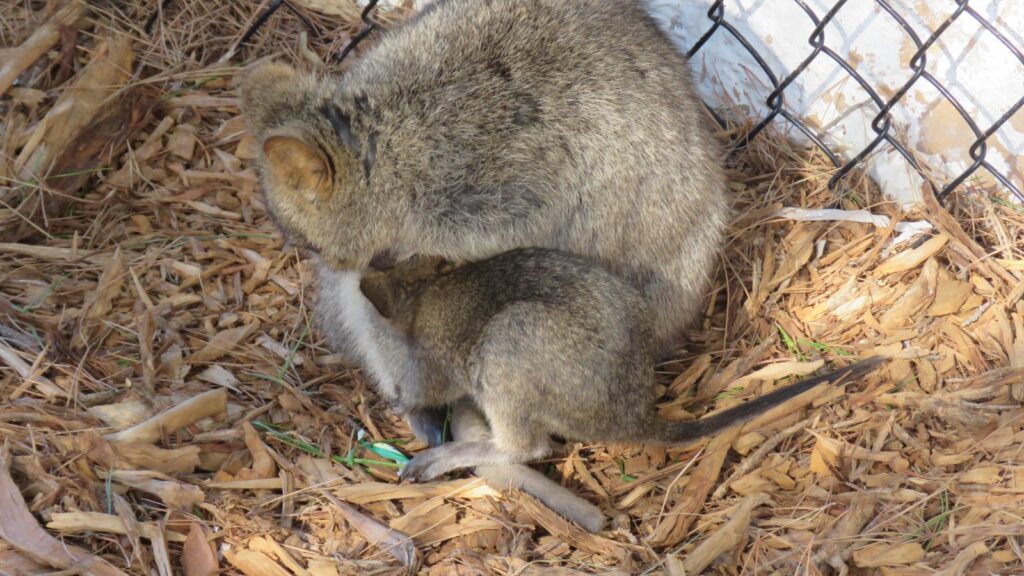
The quokka life cycle runs from a newborn the size of a jellybean to an independent animal in under a year. Quokka babies, called joeys, are born after a pregnancy of about 27 days, blind, hairless and weighing less than a gram. A female quokka, Setonix brachyurus, carries one joey at a time, not a litter. The newborn crawls unaided to its mother's pouch and stays there for six to seven months, first showing its head at 150 to 180 days old, and it is weaned by about eight months. Quokkas live on Rottnest Island and in scattered pockets of southwest Western Australia, and the species is listed as Vulnerable, which is why what happens in that first year matters.
Quick answer. A quokka is pregnant for about 27 days and gives birth to a single joey weighing less than a gram. The joey attaches to one of four teats inside the pouch, stays there for six to seven months, first puts its head out at 150 to 180 days old, and is weaned by about eight months. Sexual maturity follows at about 18 months. In the Northern Jarrah Forests of Western Australia, fewer than half of pouch young survive to independence, according to the Australian Government species profile for Setonix brachyurus. Last updated August 2026.
Quokka life cycle stages at a glance
| Stage | Age from birth in days | Age in months | What happens |
|---|---|---|---|
| Gestation | 27 days before birth | under 1 | Pregnancy lasts about 27 days, among the shortest of any mammal |
| Birth and the crawl to the pouch | Day 0 | 0 | The joey is born blind, hairless and under a gram, and climbs to the pouch unaided |
| Attached inside the pouch | 0 to 150 | 0 to 5 | The joey stays fixed to one of four teats, grows fur and opens its eyes |
| First peek outside | 150 to 180 | 5 to 6 | The head appears at the pouch opening and the joey starts watching the world |
| Out of the pouch | 180 to 210 | 6 to 7 | Short trips outside, returning to the pouch to feed and to hide |
| Weaned | about 240 | about 8 | Milk gives way to vegetation and the young quokka feeds itself |
| Sexual maturity | about 540 | about 18 | Breeding begins, though captive bred animals can mature sooner |
Sources: the Australian Government species profile for Setonix brachyurus, the Australian Museum and Animal Diversity Web. Where those sources disagree, the table gives the range rather than one invented number.
How breeding fits into the quokka life cycle
Quokkas are polygynandrous, meaning both males and females mate with multiple partners during a breeding season, and Animal Diversity Web records a litter size of one, so a female raises a single joey at a time rather than a litter. Courtship, the breeding season and the competition among males are covered in the companion guide to quokka mating habits, so this article picks up the story at conception and follows one joey through to adulthood.
How long is a quokka pregnant?
A quokka's gestation period is particularly short, lasting only about 26 to 28 days. This brief pregnancy allows quokkas to reproduce quickly, which is essential for their survival in the wild. During this time, the embryo develops rapidly within the mother's uterus.
The quokka's gestation period is one of the shortest among marsupials. It's an adaptation that enables them to produce offspring more frequently, especially when environmental conditions are favorable. The brevity of this period also means that the joey is born in an extremely underdeveloped state.
At birth the joey is tiny, weighing less than a gram. It's hairless, blind, and barely formed. Immediately after birth, it must crawl from the birth canal to the mother's pouch, where it will continue its development. This journey is a vital moment in the joey's life, as it's entirely dependent on its own instincts to reach the safety of the pouch.
Once in the pouch, the joey will attach to a teat and begin nursing, starting the next phase of its development outside the womb.
What is embryonic diapause in quokkas?
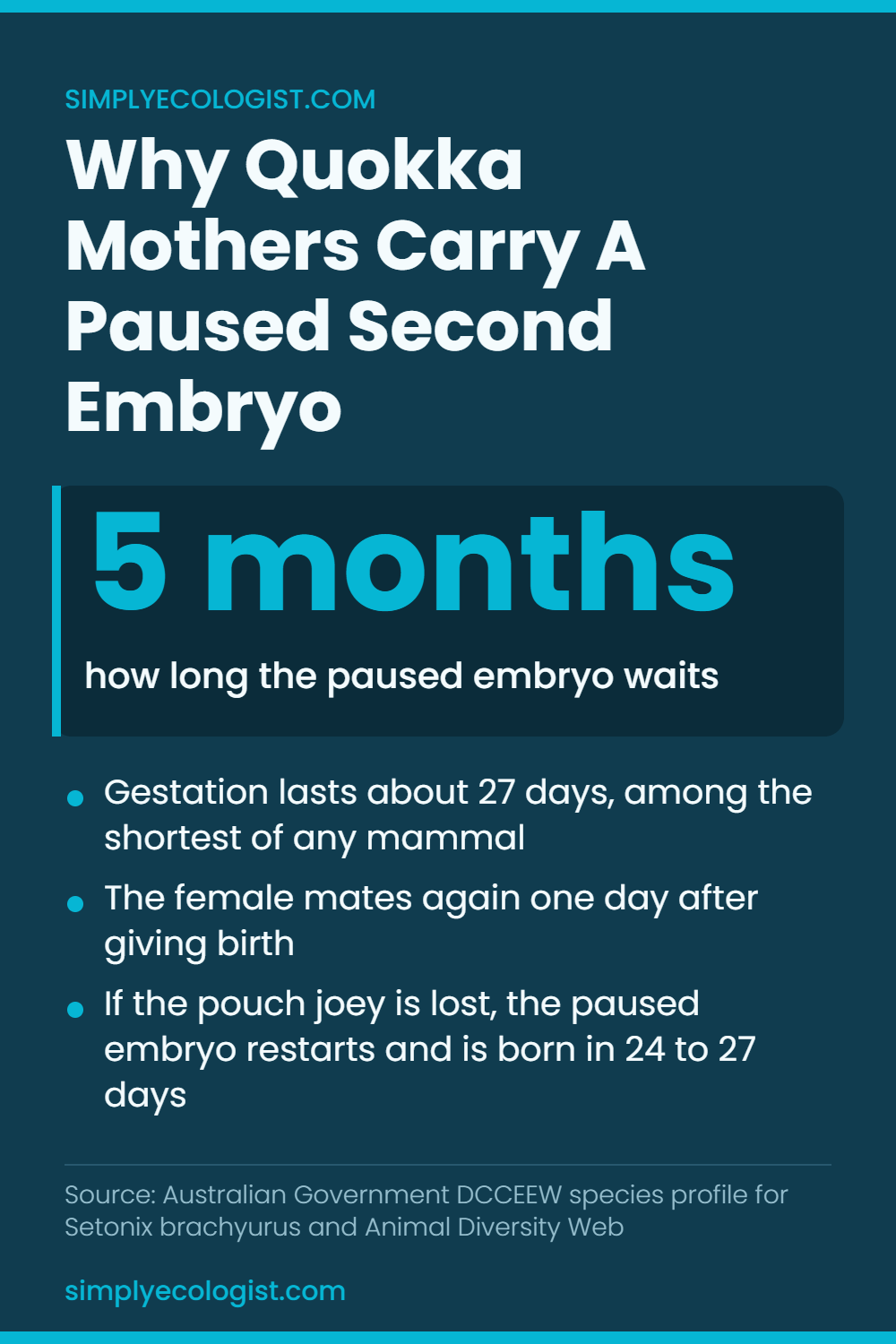
Embryonic diapause is a pause button on pregnancy, and it is the strangest thing about quokka reproduction. One day after a female gives birth, she mates again, and the new embryo stops developing and sits dormant instead of growing. The Australian Government species profile for Setonix brachyurus records that if the joey in the pouch dies within five months, that dormant embryo restarts and is born 24 to 27 days later.
The effect is a spare joey held in reserve. A female who loses her pouch young partway through a hard summer does not have to find a mate and wait out a full breeding cycle, because the replacement is already waiting. Animal Diversity Web puts the dormant period at roughly five months. It is also the reason the quokka life cycle can look faster than it is, since one pregnancy can follow another with no gap at all.
How big is a newborn quokka?
Right after birth, the tiny quokka joey sets out on an essential journey from out of the birth canal to into the mother's pouch. This newborn is incredibly small, weighing less than a gram. It's blind, hairless, and its limbs are barely developed. Using its strong forelimbs, the joey crawls up its mother's fur and into her pouch.
Once inside the pouch, the joey attaches to one of the four teats, where it'll remain for the next six months. During this time the joey develops rapidly. It'll start to develop fur, open its eyes, and its limbs will become more defined. The joey begins to peek out of the pouch at around 150 to 180 days old.
At about 6 months, the joey will venture out of the pouch for short periods. It'll return to the pouch for feeding and safety. This gradual exploration continues until the joey is fully weaned at around 8 months old.
Journey to the Pouch
Immediately after birth, the quokka joey faces its first vital challenge: reaching the mother's pouch. This tiny, underdeveloped newborn, weighing less than a gram, instinctively knows what to do. The newborn uses its strong forelimbs to pull itself through its mother's fur, following the scent of her milk.
This journey is no easy feat. The joey, born blind and hairless, must navigate across its mother's body, relying solely on its sense of smell and touch. It's a race against time, as the vulnerable newborn needs to reach the safety of the pouch quickly to avoid predators and dehydration.
Once the joey reaches the pouch opening, it'll use its mouth to latch onto one of the four teats inside. The mother's pouch provides a warm, protected environment where the joey can continue its development. This journey, though brief, is vital for the quokka's survival. It's a reflection of nature's design, ensuring that even the tiniest, most helpless creatures have a fighting chance at life.
Life Inside the Pouch
Once safely inside the pouch, the quokka joey begins a remarkable phase of growth and development. These tiny creatures progress rapidly. Initially blind and hairless, the joey attaches firmly to one of its mother's teats, where it'll remain for several months.
The pouch expands to accommodate the growing joey. Inside, the baby is nourished by its mother's milk, which changes composition to meet its evolving nutritional needs. The joey's eyes open while it is still attached inside the pouch, and fur starts to grow soon after.
During this time, the joey's limbs and tail develop, preparing it for life outside the pouch. By four months the joey is already experimenting with solid food. The mother will sometimes clean out the pouch, ensuring a healthy environment for her offspring.
At around 150 to 180 days old the joey peeks out of the pouch, curious about the world beyond. This marks the beginning of its shift to pouch emergence, a critical stage in quokka development.
When do quokka joeys leave the pouch?
A quokka joey first ventures beyond the safety of its mother's pouch at around 150 to 180 days old, and leaves the pouch for good at six to seven months. At first only the head appears, observing the surrounding world with wide eyed wonder.
The joey's initial forays outside the pouch are brief and cautious. It gradually spends more time exploring, though it retreats to the pouch at any sign of danger. These excursions are essential for the joey's development, allowing it to strengthen its muscles and improve coordination.
During this phase the joey makes its first attempts at hopping and foraging. It'll mimic its mother's behavior, learning critical survival skills. The joey will also start to nibble on vegetation, supplementing its milk diet.
As the joey gains confidence it ventures further from its mother, though always staying close. This period of exploration is significant for the young quokka's social development, as it begins to interact with other members of the colony.
When are quokkas fully weaned?
A quokka joey is fully weaned by about eight months old, and the weaning process begins at around six months. During this time the joey gradually shifts from its mother's milk to solid foods. They'll start nibbling on leaves and grass, mimicking their mother's eating habits. This period is vital for the joey's development, as they learn essential foraging skills.
As weaning progresses the joey spends more time outside the pouch. They'll become increasingly independent, exploring their surroundings and interacting with other quokkas. However, they'll still return to their mother for milk and security.
By about eight months the joey is fully weaned and independent. At this stage it maneuvers its environment confidently and forages for food on its own. They'll have developed the necessary skills to survive without constant maternal care.
It's important to note that even after weaning, young quokkas may maintain a close relationship with their mothers for several months. You might observe them sharing territory and engaging in social behaviors together as the young quokka continues to learn and grow.
Growth to Adulthood
After weaning, quokkas enter a phase of rapid growth and development. Young quokkas grow quickly through their first year. Their distinctive rounded ears and short, blunt snouts become more pronounced during this time.
As they mature their behaviour changes. They become more independent, exploring their environment with increasing confidence. Their agility improves, allowing them to hop and climb with greater ease. They perfect their foraging skills, learning to identify and consume a wider variety of plant matter.
Sexual maturity is reached at about 18 months in the wild, according to the Australian Museum and the Australian Government species profile. Animal Diversity Web puts it more precisely at 252 days for females and 389 days for males, and the government profile notes that captive bred quokkas can mature at 8 to 9 months. At this point physical changes related to reproductive readiness appear. Females develop a pouch, while males exhibit more muscular features and may engage in territorial behaviors.
Quokka Parenting Behaviors
Quokkas' parenting behaviors are both fascinating and essential for their offspring's survival. Female quokkas are primarily responsible for caring for their young. After giving birth, the mother will immediately clean her joey and guide it to her pouch. She'll nurse the joey for about six months, providing it with all the nutrients it needs to grow.
As the joey gets older the mother becomes more protective. She'll keep a watchful eye on her young as it begins to venture out of the pouch. When threatened, she'll quickly usher her joey back into the safety of her pouch. Quokka mothers are patient, allowing their young to explore and learn about their environment under close supervision.
Male quokkas play a minimal role in parenting. They don't typically assist in caring for the joey or protecting it from predators. However, they may indirectly contribute by defending their territory, which can provide a safer environment for the mother and joey.
Why so few quokka joeys reach adulthood
The life cycle above reads like an efficient machine. A pregnancy of under a month, a spare embryo on hold, a joey independent inside a year. The survival figures tell a harder story. The Australian Government species profile for Setonix brachyurus records that in the Northern Jarrah Forests of southwest Western Australia, less than one in two pouch young survived to independence.
That is the context for the conservation listing. The quokka is listed as Vulnerable under the Environment Protection and Biodiversity Conservation Act, under Western Australian wildlife legislation, and by the IUCN. On Rottnest Island the animals are numerous and famously easy to photograph, which hides how thin the mainland populations have become. Fast breeding is not the same as a secure population. For quokkas the difference sits almost entirely in whether a pouch young survives the months after it first climbs out.
Quokka life cycle questions
How long is a quokka pregnant?
A quokka is pregnant for about 27 days, one of the shortest gestation periods of any mammal. The Australian Government species profile for Setonix brachyurus gives 24 to 27 days for a birth that follows embryonic diapause.
How many babies does a quokka have at once?
One. A quokka gives birth to a single joey per pregnancy. Animal Diversity Web records the litter size as one, so quokkas do not raise litters and a joey cannot have more than one father.
How big is a newborn quokka?
A newborn quokka weighs less than a gram and is born blind, hairless and barely formed. It crawls unaided from the birth canal to the pouch and attaches to one of the four teats inside.
When do quokka joeys leave the pouch?
A quokka joey first puts its head out of the pouch at around 150 to 180 days old, then leaves the pouch for good at six to seven months, returning at first to feed and to hide.
When are quokkas fully weaned?
Quokka joeys are fully weaned by about eight months old. Weaning starts at around six months, when the joey begins feeding on vegetation alongside its mother's milk.
Erzsebet Frey (Eli Frey) is an ecologist and online entrepreneur with a Master of Science in Ecology from the University of Belgrade. Originally from Serbia, she has lived in Sri Lanka since 2017. Eli has worked internationally in countries like Oman, Brazil, Germany, and Sri Lanka. In 2018, she expanded into SEO and blogging, completing courses from UC Davis and Edinburgh. Eli has founded multiple websites focused on biology, ecology, environmental science, sustainable and simple living, and outdoor activities. She enjoys creating nature and simple living videos on YouTube and participates in speleology, diving, and hiking.
From the shop
Gifts for people who love the wild
Wildlife themed t-shirts, notebooks, tote bags, bandanas and guides, designed by an ecologist.
Visit the shop