Python for biologists starts with one honest truth: you do not need to be a programmer to learn it. You need a reason, a little patience and lessons that speak your language. This free course gives you all three, with examples from the field instead of examples from an office.
I wrote these 16 lessons for biologists, ecologists and biology students who have never written a line of code. They follow the order of the beginner Python course I took myself, rewritten in plain English with species counts, survey sites and specimen labels in place of shop sales and customers.
Why Should Biologists Learn Python?
Biology now produces more data than any spreadsheet can comfortably hold. Camera traps, acoustic recorders, GPS collars, eDNA samples and open databases such as GBIF all hand you thousands of rows. Python now sits beside binoculars and GPS units among the tools ecologists use every week, because it turns that pile into answers you can trust and repeat.
- It saves time. A task you repeat every week, such as totalling counts from field sheets, becomes a script you run in seconds.
- It reduces errors. Code does the same thing every time. Copying and pasting by hand does not.
- It makes your work repeatable. Anyone can rerun your script and get the same result, which is exactly what good science needs.
- It opens doors. Many ecology jobs, internships and wildlife biology graduate programs now list Python or R as a skill they want.
How This Python Course for Biologists Works
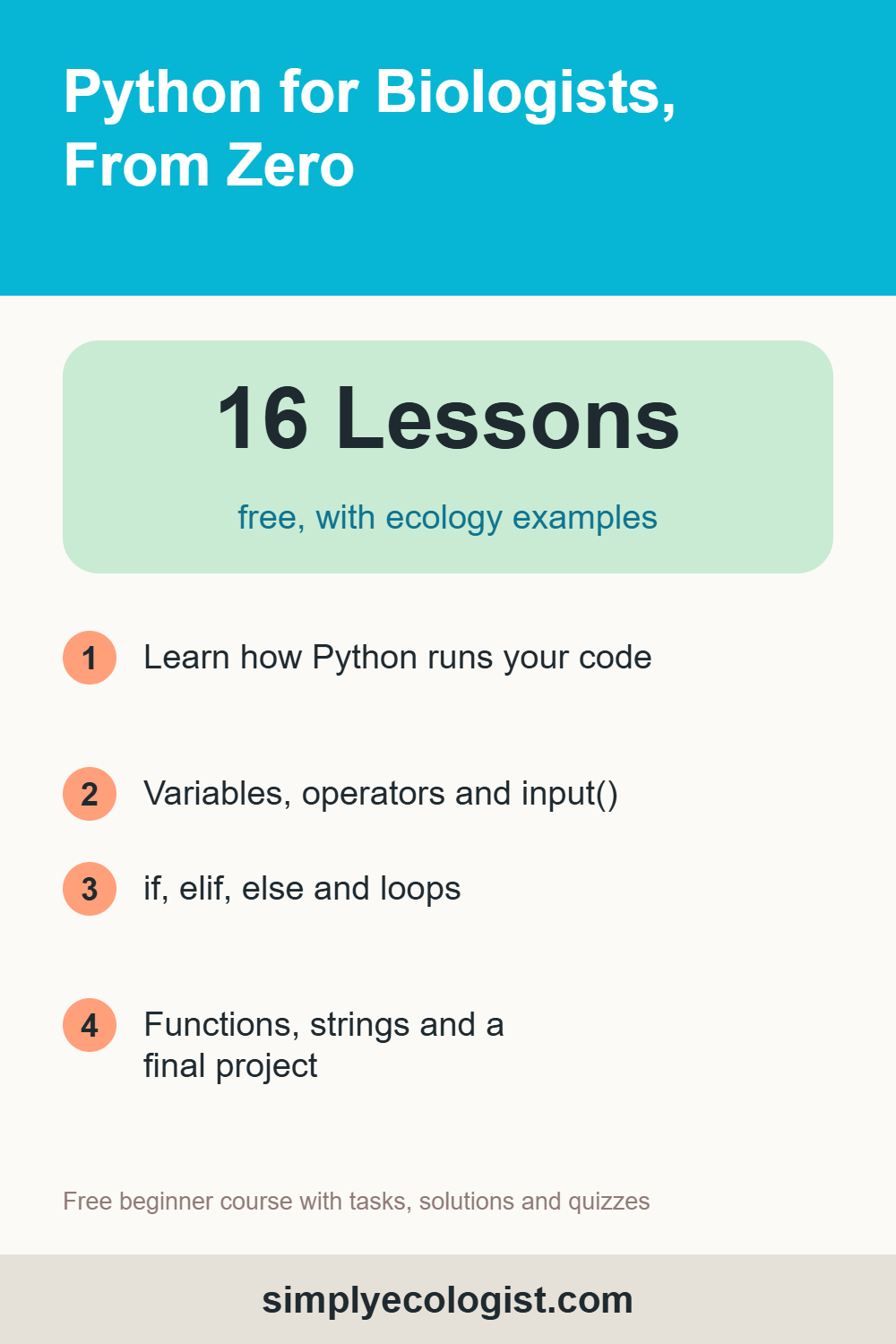
Each lesson is one blog post. You can read them in any order, but they build on each other, so starting at lesson 1 is the easiest path.
- A real lesson. Every post teaches one topic from the ground up, with code you can copy and run.
- Ecology examples. Bird counts, nest sites, sampling plots and species names replace the usual business examples.
- Practice tasks with solutions. Each lesson ends with tasks. The solutions are hidden until you click, so you can try first.
- A short quiz. A few questions at the end show you what stuck and what needs another read.
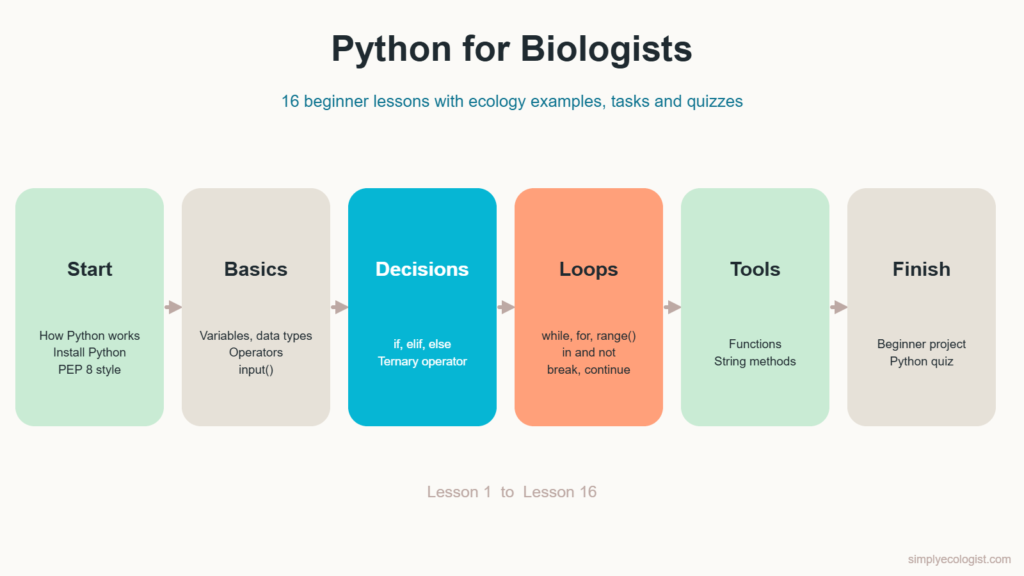
All 16 Lessons
Stage 1: Getting Started
- Is Python Compiled or Interpreted? How Python Runs Your Code and What Python File Extensions Mean: what programming is, why Python, and what happens when you press Run.
- How to Install Python on Windows and Write Your First Program in VS Code: set up your computer and run your first script.
- PEP 8 Python Style Guide for Beginners: indentation, line length, naming and comments that keep your code readable.
Stage 2: The Basics
- Python Variables and Data Types: store counts, measurements and species names, and convert between types.
- Python Operators Explained: calculate, compare and combine conditions on your data.
- Python input() Function: let a user type in field data and turn it into numbers.
Stage 3: Decisions
- Python if Statement: if, else, elif and nested if, so your code can sort records into groups.
- Python Ternary Operator: write a short if else decision in one line.
Stage 4: Loops
- Python while Loop: repeat a task until a condition changes.
- Python for Loop With range(): go through every site, sample or species in a list.
- Python in and not Operators: check whether a value is in a list or a string.
- Break and Continue in Python: stop a loop early or skip a bad record.
Stage 5: Your Own Tools
- Python Functions for Beginners: def, parameters, return and docstrings, so you can package your code into reusable tools.
- Python String Methods Cheat Sheet: clean and reshape text such as species names and site codes.
Stage 6: Finish Line
- Beginner Python Project: build a complete program that uses everything from the course.
- Python Quiz for Beginners: test yourself on every topic in one place.
Do I Need Any Coding Experience?
No. Lesson 1 starts with what programming actually is, and lesson 2 walks you through installing Python. If you can use a spreadsheet, you can follow this course.
What Do I Need to Start?
A computer with Windows, macOS or Linux, an internet connection to download Python, and about an hour per lesson. Python, which you download from python.org, and the code editor used in this course, Visual Studio Code, are both free.
Is Python or R Better for Biologists?
Both are used widely in biology. R has deep roots in statistics and ecology, while Python is strong in data handling, automation and machine learning. Many biologists end up using both. This course teaches Python because its plain syntax makes it a gentle first language.
Ready? Start with lesson 1: Is Python Compiled or Interpreted?
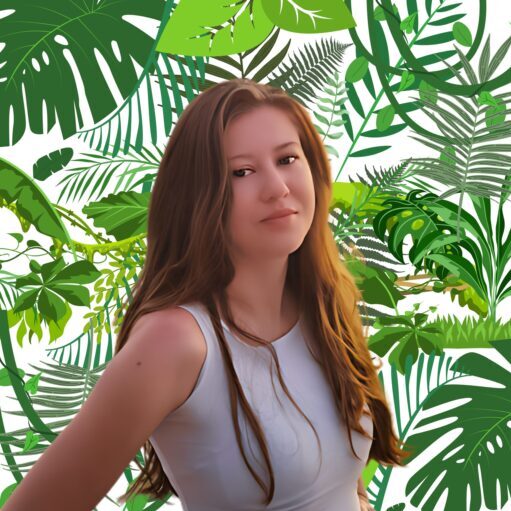
Erzsebet Frey (Eli Frey) is an ecologist and online entrepreneur with a Master of Science in Ecology from the University of Belgrade. Originally from Serbia, she has lived in Sri Lanka since 2017. Eli has worked internationally in countries like Oman, Brazil, Germany, and Sri Lanka. In 2018, she expanded into SEO and blogging, completing courses from UC Davis and Edinburgh. Eli has founded multiple websites focused on biology, ecology, environmental science, sustainable and simple living, and outdoor activities. She enjoys creating nature and simple living videos on YouTube and participates in speleology, diving, and hiking.
From the shop
Gifts for people who love the wild
Wildlife themed t-shirts, notebooks, tote bags, bandanas and guides, designed by an ecologist.
Visit the shop