
Almost everything you have been told about hippos is a little bit wrong, and the truth underneath is better. A hippo cannot swim, despite spending most of its life in water. Its skin is not bulletproof. Its sweat is not blood. And in 2024, after decades of assuming otherwise, researchers showed that a two tonne hippo at full speed leaves the ground completely, which nothing else of that size does.
I am a wildlife biologist with an MSc in ecology, and hippos are one of those animals where the field data reads like a set of clues that do not fit the picture everyone has in their head. Every number below comes from a published study or a conservation assessment. Where the popular figure has no traceable source, I tell you that instead of repeating it.
Hippos at a glance
| Species | Two: common hippo (Hippopotamus amphibius) and pygmy hippo (Choeropsis liberiensis) |
| Closest living relatives | Whales and dolphins, not pigs |
| Weight | Common hippo males 1,500 to 3,200 kg, females smaller. Pygmy hippo 180 to 275 kg |
| Top speed on land | About 30 km per hour, with a brief airborne phase |
| Swimming | They do not. They walk and trot along the bottom |
| Diet | Grass, around 40 kg a night, grazed on land |
| Gestation | About 8 months, one calf |
| Lifespan | Around 40 to 50 years |
| Population | 115,000 to 130,000 common hippos; perhaps 2,000 to 3,000 pygmy hippos |
| IUCN status | Common hippo Vulnerable (2016), pygmy hippo Endangered (2015) |
A hippo is a whale that changed its mind
The single most surprising fact about hippos is their family tree. They look like pigs, and for a long time they were classified near them. Molecular work put that to rest: the closest living relatives of hippos are the cetaceans, the whales and dolphins. Hippos and whales share a common ancestor that no pig shares, roughly 55 million years ago.
Once you know that, a lot of hippo anatomy stops looking odd. The nostrils that close, the ears that fold shut, the almost hairless skin, the eyes and ears set on top of the skull so the animal can lie submerged and still see and hear, the ability to nurse underwater, the way sound carries between individuals below the surface. These are not pig features adapted to water. They are the shared inheritance of a lineage that went into the water and, in the whale branch, never came out.
Hippos cannot swim
This sounds like a trick statement and it is not. A hippo is denser than water. It does not float, and it does not paddle. What it does is walk, trot and push off the bottom, moving through water the same way it moves on land, with the buoyancy taking enough weight that the strides become long and slow and look, from above, like swimming.
In deep water a hippo pushes off the bottom in a series of bounds and surfaces to breathe. It cannot cross water too deep to touch. This is why hippo distribution follows rivers and shallow lakes rather than open water, and why a hippo in a steep sided pool with no exit is in genuine trouble.
Adults surface to breathe roughly every three to five minutes and do it automatically while asleep, without waking.
Speed, and the airborne question
For decades nobody knew whether a hippo at speed ever leaves the ground. It was assumed not, because very large animals generally cannot: elephants at full speed keep at least one foot down at all times.
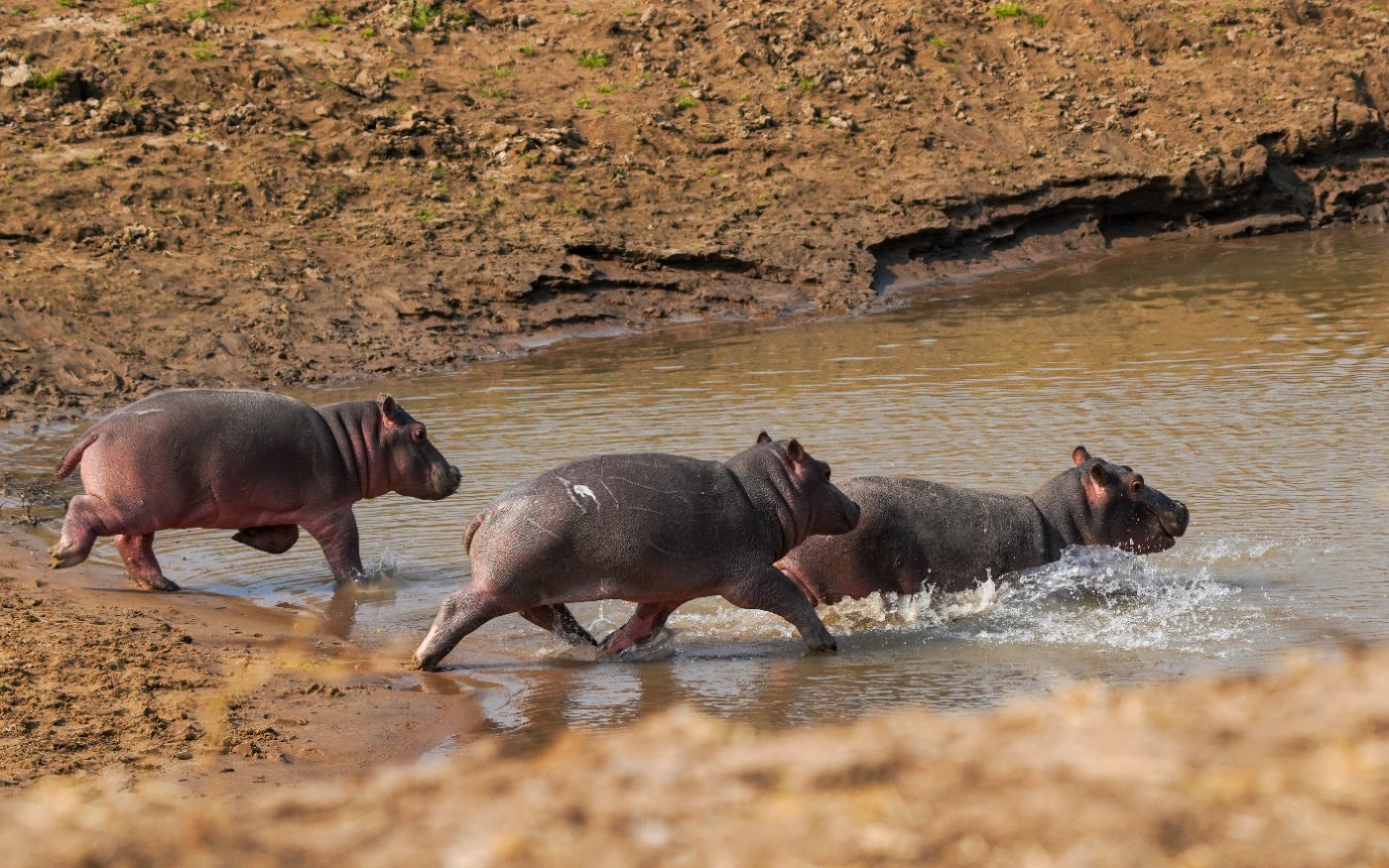
Hutchinson and Pringle settled it in PeerJ in 2024 by analysing 169 strides from 32 hippos. What they found:
- Hippos at speed trot, and essentially only trot. They do not gallop, which makes them one of very few four legged animals with a single high speed gait.
- At full speed all four feet leave the ground at once, for roughly 0.3 seconds per stride, around 15 percent of the time.
- Top speed is around 30 km per hour.
So a hippo becomes briefly airborne and an elephant never does, despite the elephant being the better known runner of the two. That airborne phase is why hippos are dangerous on land in a way their shape does not suggest: 30 km per hour is faster than almost any person can run, and a hippo can hold it long enough to matter. The detail is in how fast can a hippo run and can hippos jump.
Skin, and the bulletproof myth
Hippo skin is genuinely remarkable and it is not bulletproof. It reaches around 6 cm thick over the back and flanks, which is enough to blunt the tusks of a rival in a fight and enough to have been used for shields and whips historically. It is not enough to stop a rifle bullet, and hippos have been shot in very large numbers precisely because they cannot be. The myth seems to have grown out of a real observation, that the hide is extraordinarily tough, stretched one step too far.
What the skin does do is stranger than being bulletproof. It is almost hairless and has no sweat glands in the ordinary sense, which for an animal that grazes at night and bakes by day is a problem. The solution is a secretion produced by subdermal glands, and it is where the blood sweat story comes from.
Hippos do not sweat blood
The red secretion is neither blood nor sweat. Hashimoto, Saikawa and Nakata characterised it in Pure and Applied Chemistry in 2007. It contains two pigments:
- Hipposudoric acid, red, formed by the oxidative dimerisation of homogentisic acid.
- Norhipposudoric acid, orange.
Both absorb ultraviolet light, so the secretion works as a sunscreen, and both are antibacterial, which matters for an animal that carries open fight wounds while lying in water full of its own dung. It is colourless when first secreted and turns red within minutes as it polymerises, then brown. A hippo generates its own sunblock and antiseptic in one fluid, which is a better fact than the myth it replaced.
The related question of what colour a hippo actually is, under all that, is in what colour is a hippo, and the bulletproof claim is taken apart in are hippos bulletproof.
Teeth, tusks and bite
A hippo’s canines and incisors grow continuously throughout life. The lower canines, the tusks, reach around 40 to 50 cm in a large male and are kept sharp by grinding against the uppers every time the animal closes its mouth. They are not feeding teeth at all. A hippo eats grass, and it crops it with hardened lips, not with the tusks. The tusks are weapons, used exclusively against other hippos, crocodiles and anything that will not move.
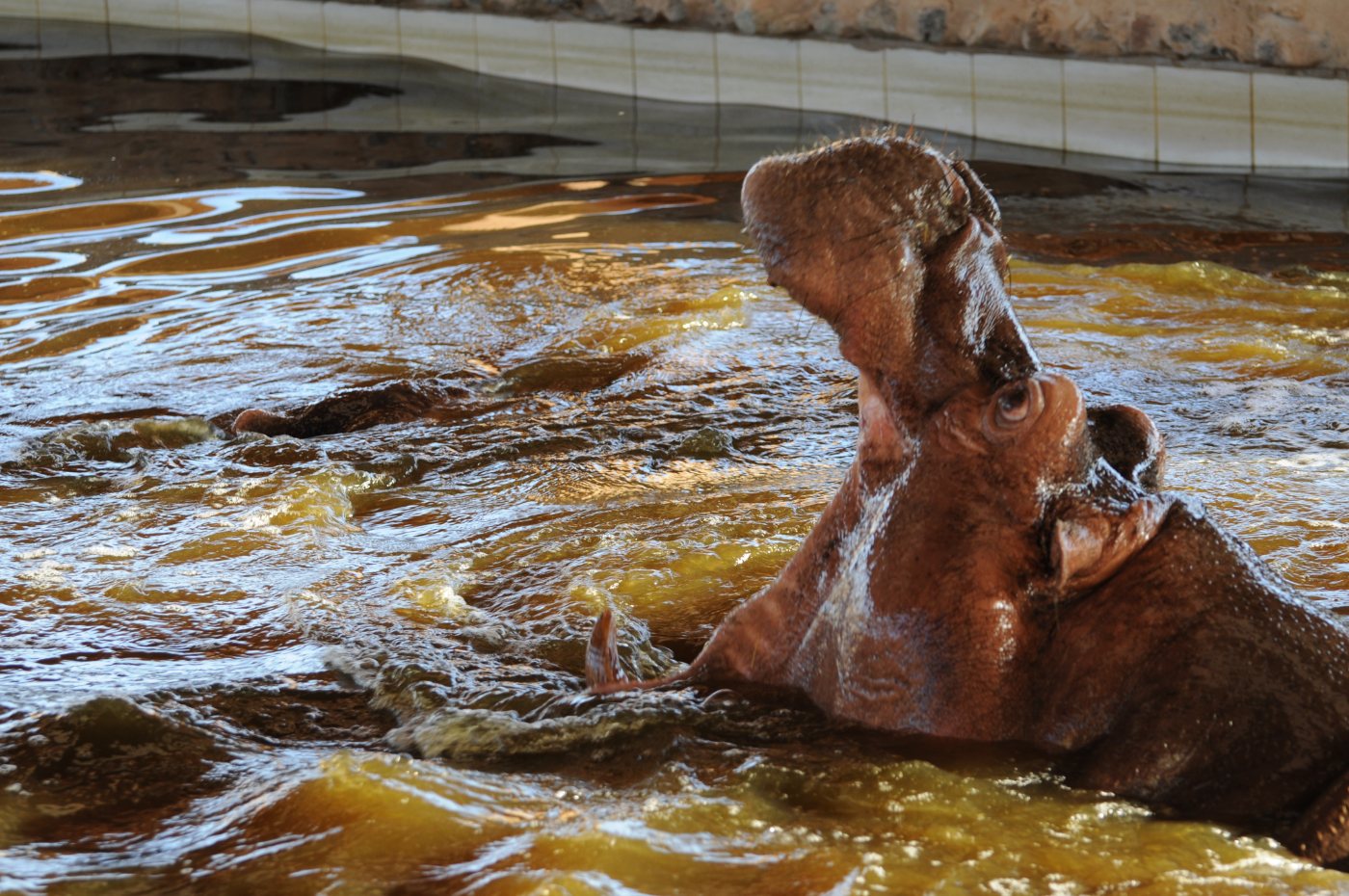
The gape is the display. A hippo opening its mouth to nearly 150 degrees is not yawning, it is showing an opponent the size of its weapons, and it is the clearest warning signal the animal gives.
On bite force, a caution. The figure repeated everywhere is 1,800 psi, and it traces back to a single televised measurement rather than a peer reviewed study, so I would treat it as an order of magnitude rather than a measurement. What is not in doubt is that the jaw is enormous, the muscles that close it are correspondingly huge, and a hippo bite kills large animals routinely. The number is soft; the outcome is not. My working through of what is and is not known is in what is a hippo’s bite force, and the teeth themselves in size of hippo teeth.
Why hippos look fat, and are not
A hippo’s shape is not fat in the way people assume. The barrel is mostly a very large digestive system: hippos are grazers running a fermentation chamber, with a complex multi chambered stomach that they use to extract energy from grass. They are not ruminants and do not chew cud, but they solve the same problem the same way, with volume and time.
Two things follow. First, hippos eat surprisingly little for their size, around 40 kg of grass a night, roughly one to one and a half percent of body weight, where a cow takes two and a half percent or more. Lying in water all day means spending almost nothing on thermoregulation or on carrying their own weight, so the energy budget is small. Second, the fat they do carry sits low and helps ballast them on the riverbed, which for an animal that walks underwater is useful rather than a burden.
The full explanation is in why are hippos so fat.
The night shift
A hippo’s day is split cleanly in two, and once you see the pattern the whole animal makes sense.
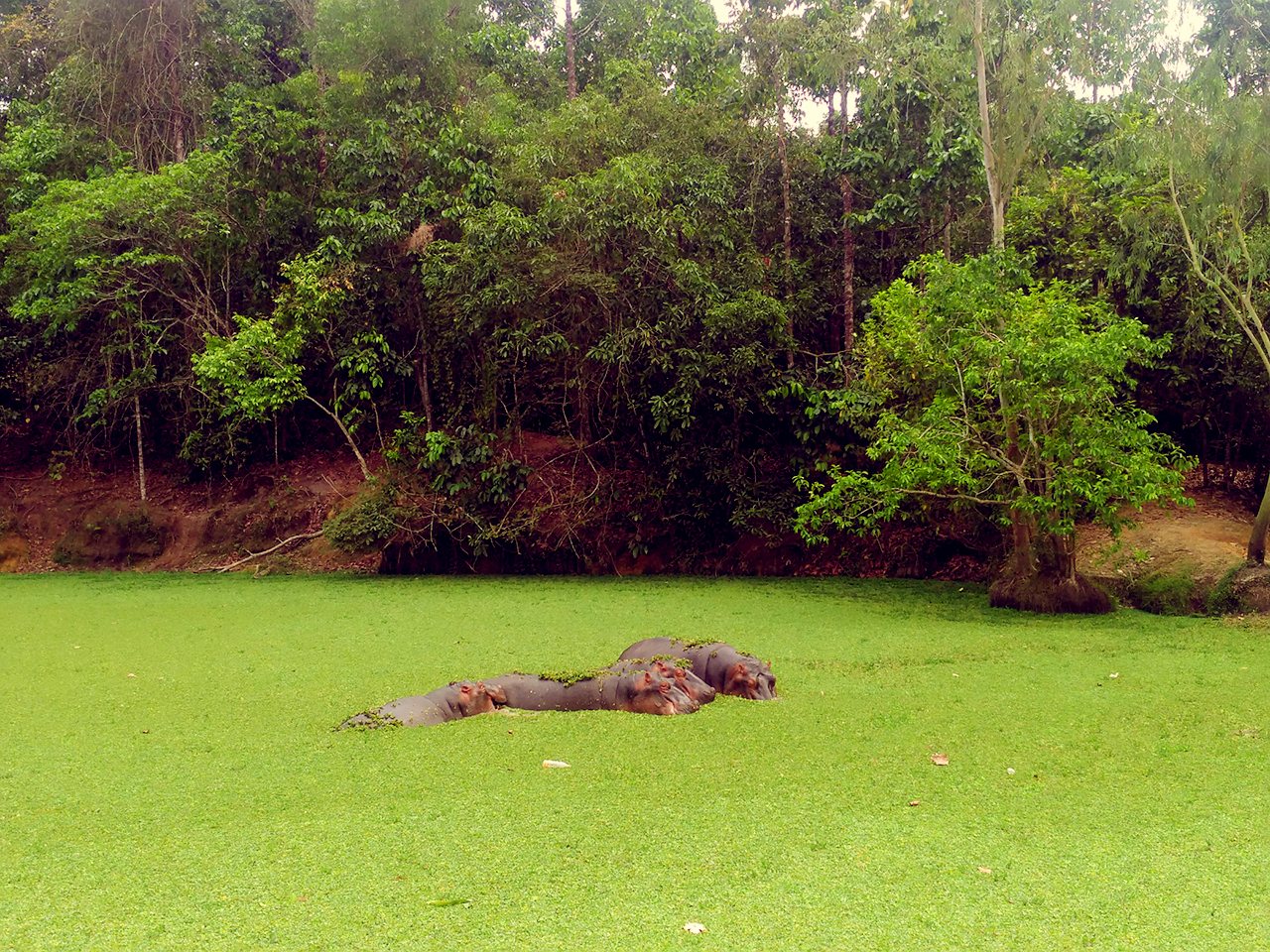
Through the daylight hours it lies in water, in a pod of ten to thirty animals, doing almost nothing. Water takes its weight, keeps it cool and hides it. Then, after dark, it hauls out and walks. Hippos follow the same paths night after night until those paths become deep grooves worn into the bank, and they graze several kilometres inland before returning before dawn.
Two consequences follow from that routine, and both are larger than they look.
- Hippos move nutrients from land into water. They eat grass on land and deposit dung in the river, night after night, on a scale that shapes the whole system. Hippo dung feeds the invertebrates that feed the fish that feed the people living along those rivers. In places where hippos have been lost, the fisheries have followed them down.
- Their paths become channels. Those worn trails carry water when the river rises, spreading floodwater across floodplains and keeping side channels open. A hippo population is slowly engineering the shape of its own river.
Almost nobody thinks of hippos as ecosystem engineers. They belong in that category with beavers and elephants, and the fact that most of their work happens in the dark, underwater, is the only reason it goes unnoticed.
Calves and family life
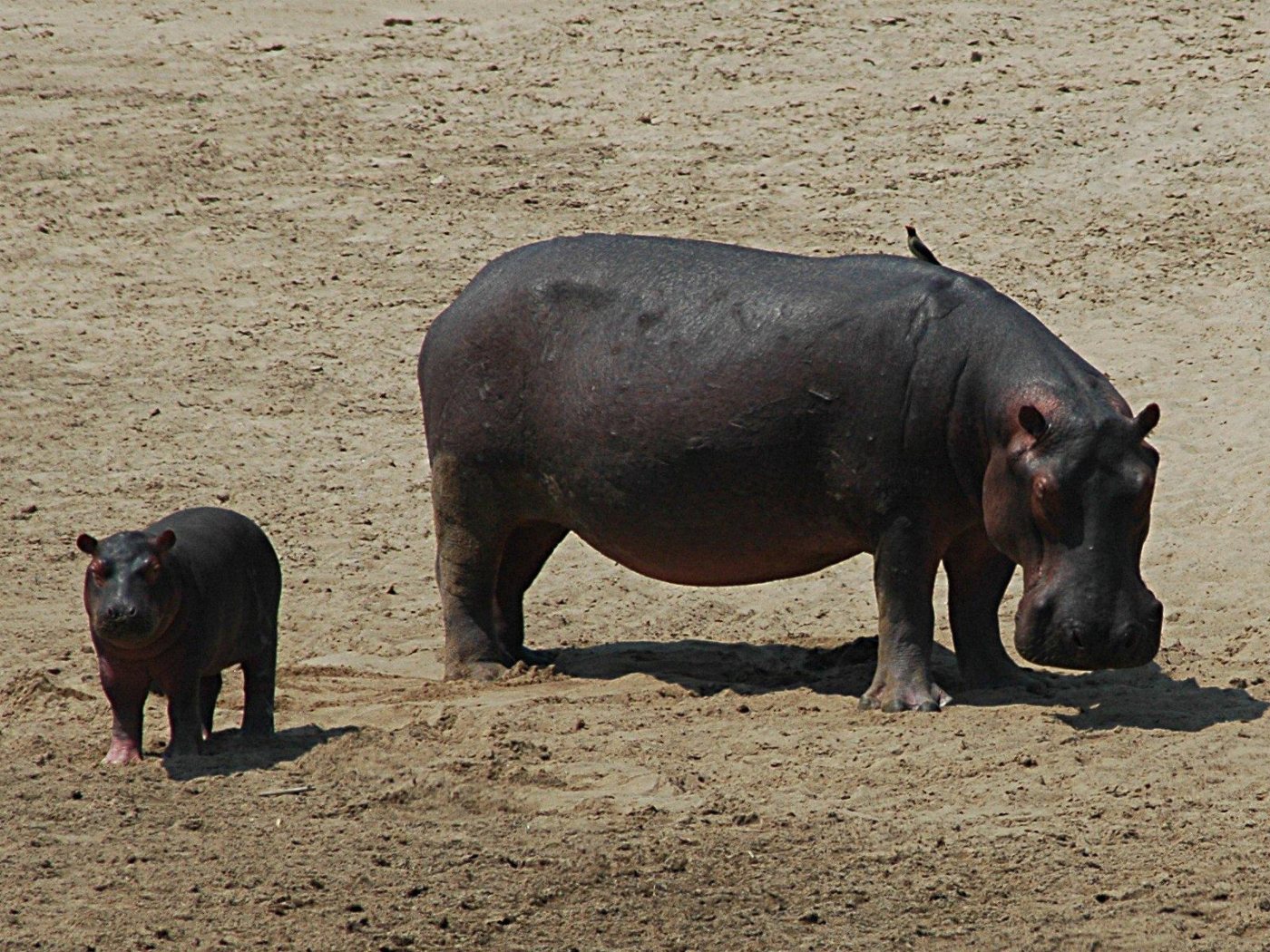
A hippo is pregnant for about eight months and gives birth to a single calf weighing 25 to 50 kg. Birth often happens in shallow water, and a newborn can hold its breath and surface on its own within moments of arriving.
- Calves nurse underwater, closing nostrils and ears and latching between breaths.
- They rest on their mother’s back in deep water, which is where most of the endearing photographs come from and which is also purely practical: a calf cannot walk on the bottom where an adult can.
- Mothers keep calves apart from the pod for the first days or weeks, then rejoin. Females in a pod will collectively watch calves.
- Crocodiles are the main predator of calves, and lions and hyenas take them occasionally. Adults have essentially no predators.
A cow with a calf is the single most dangerous configuration a hippo comes in, and the reason is not temperament. It is that she cannot outrun a threat while a calf is with her, so the only strategy available is to remove the threat. More on the timing and biology in how long a hippo pregnancy lasts.
How dangerous hippos really are
You will read that hippos kill around 500 people a year in Africa, and that they are the continent’s deadliest large animal. It is worth being careful here, because the honest version is both less certain and more useful.
The 500 figure appears in National Geographic, the BBC and the Smithsonian, and Africa Check reviewed it and found it consistent with what those sources report. What none of them provides is the underlying survey. There is no continent wide system counting deaths by species, so the number rests on citation rather than on measurement, and it should be read as a widely accepted estimate rather than a count.
What is solid, and what actually matters if you are ever near one:
- Hippos are territorial in water, and a bull defends a stretch of river against other bulls. A boat is read as an intruder.
- The dangerous position is between a hippo and deep water. Most incidents on land happen when someone unknowingly stands on the route back to the river at night.
- They are fast, and faster than they look. Thirty kilometres per hour with an airborne phase, from a standing start, in an animal shaped like a barrel.
- The warning is the gape. An open mouth is a threat display and it means leave, not that the animal is relaxed.
None of this makes hippos malicious. They are large, short sighted, territorial grazers with no way to escape upward or outward, and the behaviour that reads as aggression is a defence that has worked for millions of years. My fuller treatment is in the truth about hippo aggression.
The other hippo
There is a second species, and hardly anyone knows it exists. The pygmy hippo lives in the rainforests of Liberia, Sierra Leone, Guinea and Ivory Coast, weighs around 180 to 275 kg, and behaves almost nothing like its famous relative.
| Common hippo | Pygmy hippo | |
|---|---|---|
| Weight | 1,500 to 3,200 kg | 180 to 275 kg |
| Habitat | Rivers and lakes, open country | Rainforest swamps and streams |
| Social life | Pods of 10 to 30 | Solitary or in pairs |
| Eyes and nostrils | High on the skull for lying submerged | Set lower, less aquatic |
| Population | 115,000 to 130,000 | Perhaps 2,000 to 3,000 |
| IUCN status | Vulnerable | Endangered |
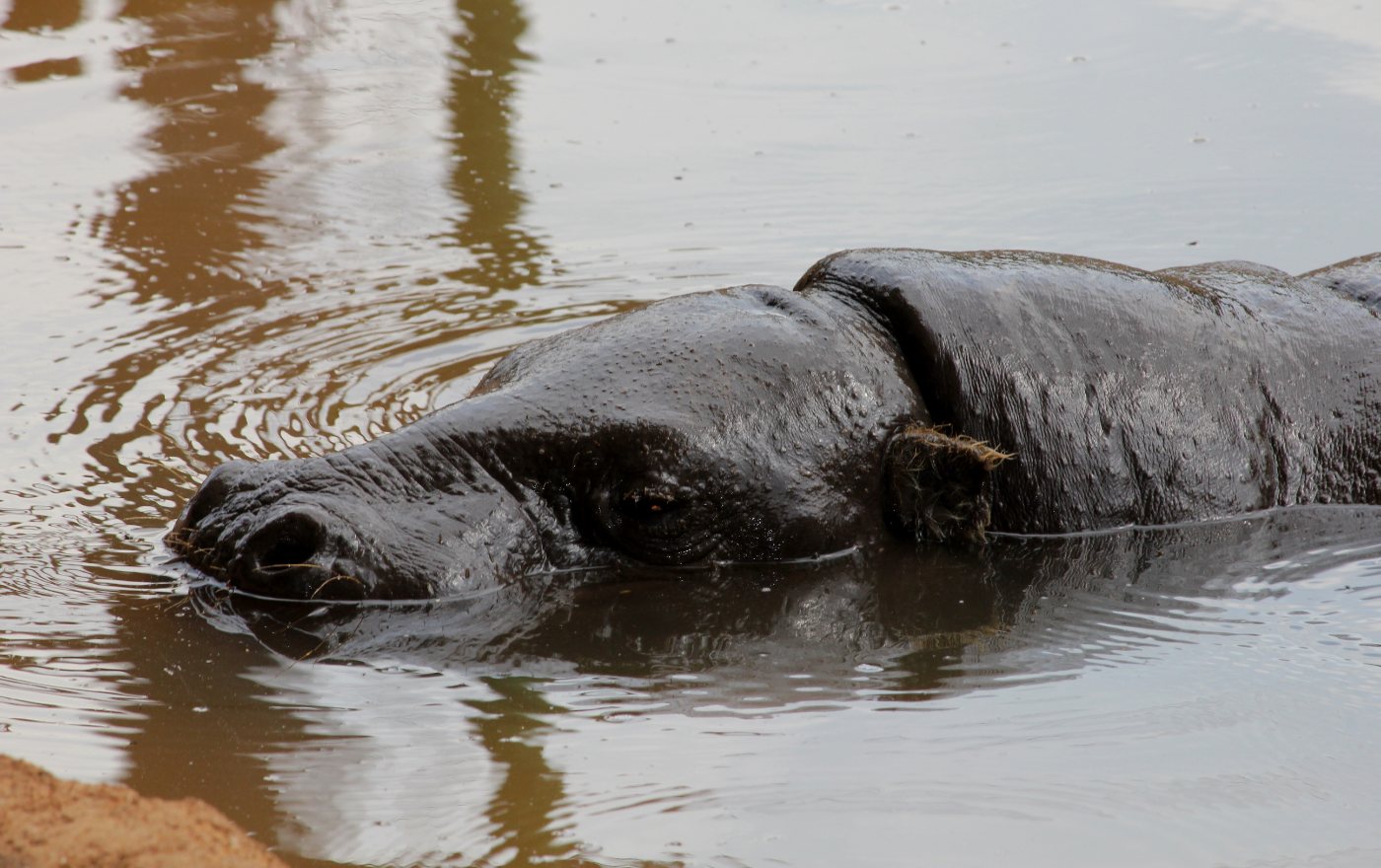
The pygmy hippo is nocturnal, secretive, and spends far more of its life on land than in it. It was so rarely seen that it was treated as a legend in European accounts until the twentieth century, and camera traps still record it only occasionally. Its whole world is a few blocks of West African forest, and logging opens those blocks to hunters as it removes them.
Both species carry the same underlying problem in different forms: an animal that needs water and needs land, in places where people need both as well.
Where hippos stand
The common hippo was assessed as Vulnerable in 2016, with a population of 115,000 to 130,000 and a decline of 7 to 20 percent between 1990 and 2010. Some West African populations are down to fewer than fifty animals. The pygmy hippo has been Endangered since 2015.
What is pushing them down:
- Loss of water. Rivers drawn down for irrigation, wetlands drained, dry seasons lengthening. A hippo without deep water in the dry season has nowhere to be.
- Loss of grazing. The land within a few kilometres of the river is exactly the land people farm, and that overlap is where conflict starts.
- Retaliation. Hippos raid crops and kill fishermen, and are killed in return.
- Ivory. This is the one most people miss. Hippo canines are ivory, and demand for them rose after the elephant ivory bans tightened. It is legal to trade under CITES Appendix II with permits, which makes illegal ivory easy to launder into the legal flow.
- Instability. Hippo populations collapse fast during conflict, because they are large, predictable, and found in the same place every day.
That last point deserves a sentence of its own. A hippo is an animal that cannot hide. It cannot run far, it needs one specific stretch of water, and it is there every single day. Everything that has protected it from predators for millions of years, its size, its refusal to leave the river, its willingness to stand and fight, works against it the moment the threat carries a rifle.
Common questions about hippos
Can hippos swim?
No. They are denser than water and do not float or paddle. They walk, trot and push off along the bottom, and surface to breathe every few minutes.
How fast can a hippo run?
About 30 km per hour. A 2024 study of 169 strides from 32 hippos found they trot rather than gallop, and that all four feet leave the ground for roughly 0.3 seconds per stride at speed.
Are hippos bulletproof?
No. The hide reaches about 6 cm thick and resists tusks in a fight, but it does not stop a bullet.
Do hippos sweat blood?
No. The red secretion contains hipposudoric and norhipposudoric acids, characterised in 2007. It works as a sunscreen and an antibacterial, and it turns red only after it leaves the skin.
What is a hippo’s closest relative?
Whales and dolphins. Not pigs, despite the resemblance.
Do hippos really kill 500 people a year?
That is the widely quoted estimate and it is repeated by reputable outlets, but no underlying survey exists. Treat it as an accepted estimate rather than a measured figure. Hippos are genuinely among Africa’s most dangerous large animals either way.
How long do hippos live?
Around 40 to 50 years in the wild, longer in captivity.
Everything on this site about hippos
- How fast can a hippo run
- Can hippos jump
- Are hippos bulletproof
- What is a hippo’s bite force
- Size of hippo teeth
- Why are hippos so fat
- What colour is a hippo
- How long does a hippo pregnancy last
- The truth about hippo aggression
Hippos share their rivers and floodplains with animals covered elsewhere on this site. For the wider picture, start from mammals, or read the guide to elephants, the other great water shaping giant of the African landscape.
Sources
- Hutchinson, J. R. and Pringle, E. V. (2024). Footfall patterns and stride parameters of common hippopotamus. PeerJ 12: e17675.
- Hashimoto, K., Saikawa, Y. and Nakata, M. (2007). Studies on the red sweat of the Hippopotamus amphibius. Pure and Applied Chemistry 79: 507 to 517.
- IUCN Red List assessment for Hippopotamus amphibius (2016), Vulnerable.
- IUCN Red List assessment for Choeropsis liberiensis (2015), Endangered.
- San Diego Zoo Wildlife Alliance, hippopotamus population fact sheet.
- Africa Check, review of the claim that hippos kill around 500 people a year in Africa.
From the shop
Gifts for people who love the wild
Wildlife themed t-shirts, notebooks, tote bags, bandanas and guides, designed by an ecologist.
Visit the shop