
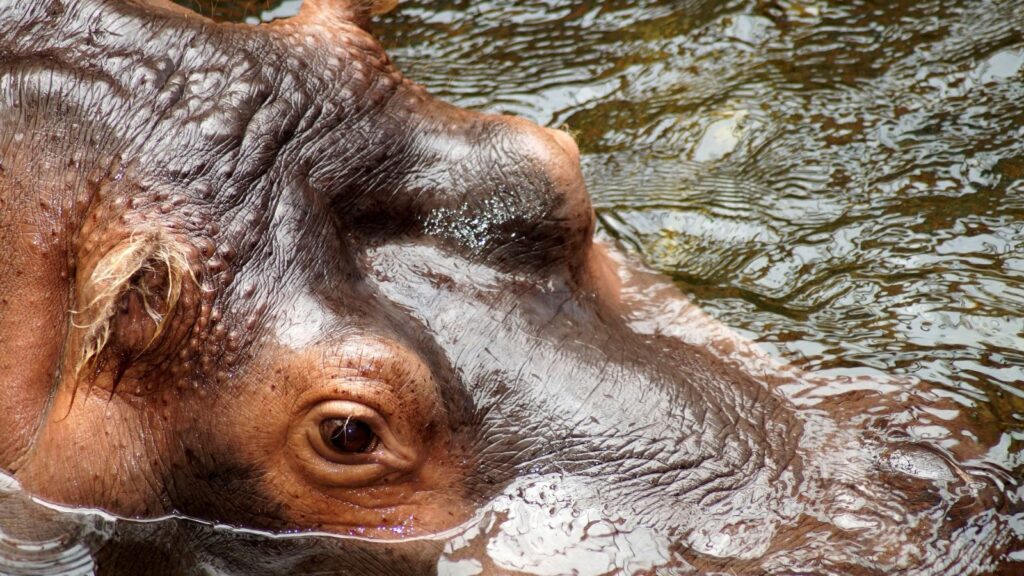
No. Hippos are not bulletproof, and the animals themselves are the reason the myth is so easy to believe. A hippo carries some of the thickest skin of any land mammal, but that thickness is not spread evenly, and it never evolved to stop anything moving at the speed of a bullet.
Part of my complete guide to hippos, which covers both species, how hippos move in water and on land, teeth, skin, calves and how dangerous they really are, with sources.
The interesting part of this question is not the answer. It is the anatomy behind it, because hippo hide turns out to be armour in one place and almost nothing in another.
How Thick Is Hippo Skin, Really?
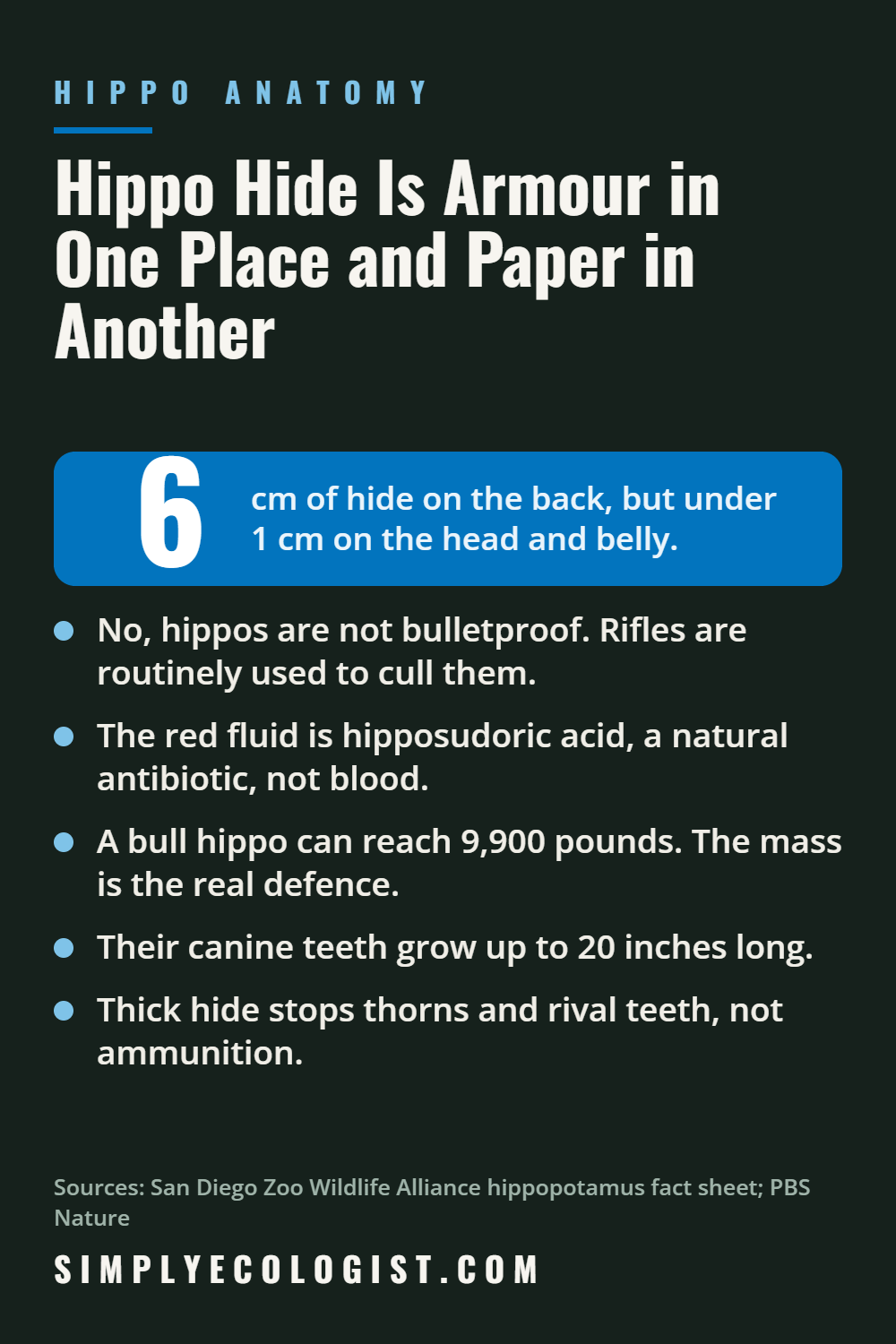
Most articles give a single number, usually two inches, and leave it there. That number is only true for part of the animal. According to the San Diego Zoo Wildlife Alliance, the hippo dermis varies from 5 to 6 cm on the back and rump to under 1 cm on the head and belly, with a thin outer epidermis across the whole body.
That is a tenfold difference between the top of a hippo and its underside. A single average hides the one fact that actually explains the animal.
| Body region | Dermis thickness | What that thickness is for |
|---|---|---|
| Back and rump | 5 to 6 cm | Absorbing bites and tusk strikes from rival hippos |
| Flanks | Intermediate | Partial protection during side on fights |
| Head | Under 1 cm | Almost none. The skull does the work |
| Belly | Under 1 cm | Almost none. Kept underwater and out of reach |
What Hippo Hide Is Actually Built to Stop
Reading armour is one of the more useful habits to bring from survey work into a question like this one. Whatever is thickest on an animal tells you what has been trying to get through it, and the map is usually specific enough to name the threat. Spines face the direction attacks come from. Shell thickens where the jaw closes. On a hippo the thickest hide sits across the back and rump, which is exactly where the canines of another hippo land, and it thins to almost nothing on the head and belly, which are the parts a rival cannot reach and the water keeps hidden.
Read the thickness map again and the evolutionary logic is obvious. The armour sits exactly where another hippo would bite.
Hippos fight each other constantly. Males compete for stretches of river, and they do it with canine teeth that reach up to 20 inches long, on an animal that can weigh close to 10,000 pounds. Those fights leave long open gashes across the back and shoulders. The thick dorsal hide is what keeps those wounds from being fatal.
The skin has a second trick that goes with it. Hippos secrete a thick reddish fluid that people still call blood sweat. It is neither blood nor sweat. It contains hipposudoric acid, which acts as a sunscreen and as an antibiotic, and it is why animals covered in fresh bite wounds, sitting in water full of their own dung, do not routinely die of infection.
So hippo hide is real armour. It is armour against teeth.
So Can a Bullet Kill a Hippo?
Yes, straightforwardly. Hippos have been hunted and culled with ordinary large game rifles for as long as those rifles have existed, and poachers take them with far less. Nothing about 5 cm of collagen stops a centrefire rifle round, and the head, where a hippo is most often shot, is the thinnest skinned part of the whole animal.
You will find claims online that regular bullets bounce off a hippo, or that it takes six rounds of machine gun fire to bring one down. I can find no source for either. They read like campfire stories that got repeated until they sounded like data, and this article used to repeat them too.
What is true is that a hippo is very hard to stop, and that has nothing to do with skin. It is mass. An animal approaching five tonnes carries enormous momentum, its vital organs sit deep behind a huge body, and an adrenalised hippo can keep moving through injuries that would drop a smaller animal instantly. Toughness here is a question of size, not armour.
How Hippo Hide Compares With Other Tough Animals
Hippos are not unusual in this. Almost every famously armoured animal is armoured against a specific biological threat, not against human weapons.
- White rhino: skin roughly 4 to 5 cm over the shoulders and flanks, built to absorb horn strikes from other rhinos.
- African elephant: skin up to about 3 cm in places, but riddled with fine cracks that hold water for cooling. It is a thermoregulation organ first. Their real defence is the same as a hippo’s, which is sheer size and strength.
- Armadillo: genuinely bony armour made of osteoderms. There are real news reports of small calibre rounds ricocheting off armadillos and injuring the shooter, but these are freak incidents, not a defensive capability. The plates evolved against claws and teeth.
- Pangolin: overlapping keratin scales that work well against lion jaws and not at all against a person with a sack.
The pattern holds across all of them. Armour tracks the predator or rival that shaped it. No animal has ever been under selection pressure from ammunition.
Where the Bulletproof Myth Came From
Three things fed it. Hippo hide genuinely is remarkable, and anyone who has touched a dried hippo skin understands why people assume it stops anything. Hippos are also astonishingly aggressive, and animals that will charge a boat acquire a reputation for invulnerability whether or not they deserve one.
The third reason is historical. Nineteenth century hunting accounts are full of shots that failed to stop a charging hippo, which says more about the rifles and the shot placement of the period than about the animal. The stories outlived the guns.
Why the Answer Matters
Hippos are among the most dangerous large animals in Africa for people who live alongside them, and they are also declining. Habitat loss, drought and hunting for meat and for the ivory in those canine teeth have pushed the common hippo onto the IUCN Red List.
Believing an animal is bulletproof makes it sound indestructible. It is the opposite. A hippo is a slow breeding, water dependent, heavily hunted animal with thick skin over its back and paper over its face. If you want more on the animal itself, including the truth about that famous red secretion, see what colour a hippo actually is.
How thick is a hippo skin?
The dermis runs 5 to 6 cm on the back and rump but under 1 cm on the head and belly, so a single average is misleading.
Can a bullet kill a hippo?
Yes. Hippos are routinely culled and hunted with ordinary large game rifles. They are tough because of their mass, not because their skin stops ammunition.
Why do people think hippos are bulletproof?
Their hide really is exceptionally thick over the back, they are famously aggressive, and old hunting accounts of shots that failed to stop a charge kept the story alive.
What is hippo skin actually protecting them from?
Other hippos. Males fight with canine teeth up to 20 inches long, and the thick hide sits exactly where those bites land.
Is the red fluid on a hippo blood?
No. It contains hipposudoric acid and works as both a sunscreen and an antibiotic, which helps open bite wounds heal in dirty water.

Erzsebet Frey (Eli Frey) is an ecologist and online entrepreneur with a Master of Science in Ecology from the University of Belgrade. Originally from Serbia, she has lived in Sri Lanka since 2017. Eli has worked internationally in countries like Oman, Brazil, Germany, and Sri Lanka. In 2018, she expanded into SEO and blogging, completing courses from UC Davis and Edinburgh. Eli has founded multiple websites focused on biology, ecology, environmental science, sustainable and simple living, and outdoor activities. She enjoys creating nature and simple living videos on YouTube and participates in speleology, diving, and hiking.
From the shop
Gifts for people who love the wild
Wildlife themed t-shirts, notebooks, tote bags, bandanas and guides, designed by an ecologist.
Visit the shop