
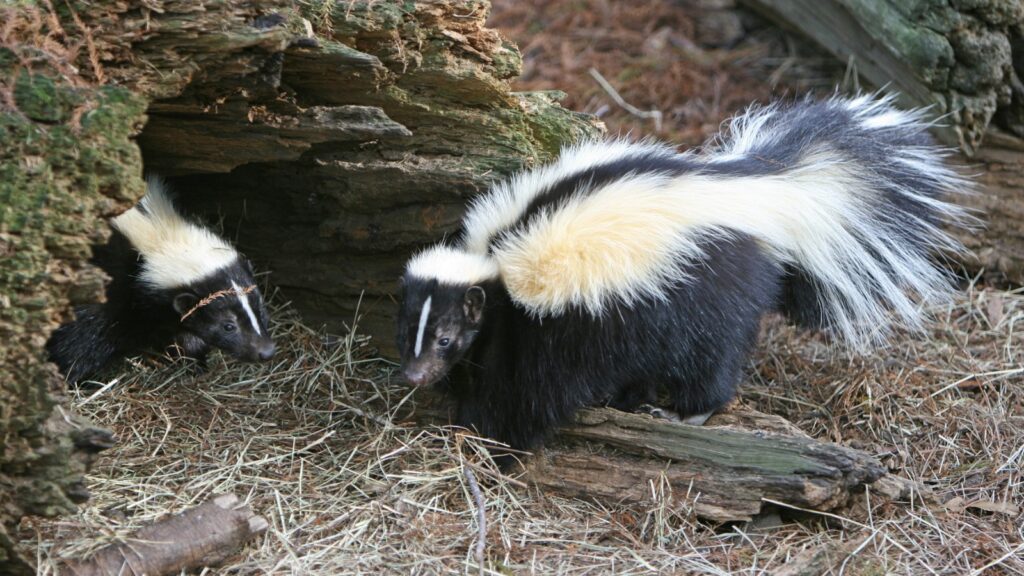
Badgers and skunks share nocturnal habits and warning coloration, visual signals that advertise chemical defenses, yet differ markedly in size and defense. Badgers run about 29 to 31 inches in total length and weigh 9 to 22 pounds, averaging around 15, while most skunks reach 12 to 17 inches and 1 to 10 pounds. Badgers display muted browns and grays with short tails kept low; skunks sport bold black and white dorsal stripes and raise bushy, white tipped tails as warnings. Skunks spray accurately up to 15 feet; badgers rely on claws and close combat, having no aimed spray of any kind. Observers should note build, tail posture, and stripe placement for identification, and more distinctions await those curious enough to explore further.
Part of my complete guide to badgers, which covers American versus European badgers, setts and clans, diet, identification and conservation, with sources.
Key Takeaways
- Badgers have stocky, low bodies with short tails kept down; skunks are lankier with large, bushy tails held upright as warning.
- Skunks display bold black and white dorsal stripes; badgers show muted browns and grays with white facial stripes only.
- Skunks spray pungent fluid accurately up to 15 feet; badgers rely on biting and clawing, and although they have anal scent glands they cannot aim or project the secretion.
- Badgers average around 15 pounds and dig powerfully; most skunks weigh 1 to 10 pounds with lighter builds.
- Skunks raise tails and stomp before spraying; badgers growl and dig when cornered without long range chemical defense.
| Feature | Badger | Skunk |
|---|---|---|
| Body shape | Low, wide, flattened, close to the ground | Rounder, stands higher, arched back |
| Total length | About 29 to 31 in | Striped 22 to 31 in, hog nosed about 21 to 23 in, hooded about 26 to 28 in |
| Weight | 9 to 22 lb, averaging about 15 | Striped 2 to 12 lb, hog nosed 2.5 to 6 lb, hooded under 2 lb |
| White marking | One stripe over the crown, dark cheek patches | Two stripes down the back, or one broad white back in hog nosed |
| Tail | Short and plain | Long and plumed, raised as a warning |
| Front claws | Very long, built for excavation | Large in hog nosed, modest in striped |
| Defence | Digs in, bites, claws. Cannot spray | Sprays accurately to about 15 ft |
| Sign it leaves | Wide cone shaped excavation at a rodent burrow | Shallow divots, or plowed looking rooted patches in hog nosed |
Badger and skunk measurements from the Mammals of Texas accounts held by the Texas Tech Natural Science Research Laboratory. Spray range from the Internet Center for Wildlife Damage Management.
The confusion is not really about size, and as an ecologist that is the part worth correcting first. Almost every article on this compares a badger to a striped skunk, which nobody mixes up. The animal that actually causes the confusion, in Arizona and across the Southwest, is the hog nosed skunk, and not because it is heavy. It weighs about 2.5 to 6 pounds against a badger’s 15. What it shares with a badger is the look and the behaviour: a broad unbroken white back rather than two narrow stripes, oversized front claws, and a habit of rooting up the ground that the Mammals of Texas account describes as leaving characteristically plowed looking patches. At dusk, that reads as badger sign.
Start Here: 3 Questions to Identify Badger or Skunk
How does one reliably tell these two mammals apart when they appear so similar at first glance? Badger vs Skunk identification starts with three practical questions.
First, what’s the overall size? Badgers measure roughly 29 to 31 inches in total length and weigh 9 to 22 pounds, averaging about 15. Skunks run smaller at 12 to 17 inches and 1.1 to 14 pounds depending on species.
Second, examine the coloration and tail. Skunks display bold black and white stripes or spots with a large bushy tail they raise as a warning. Badgers show varied colors, black, brown, gray, tan, with distinct facial striping and short stocky tails.
Third, consider the defense method. Skunks spray accurate musk up to 10 to 15 feet with effects lasting weeks. Badgers rely on digging, growling, and shorter lived glandular secretions. These differences matter for safe wildlife observation.
Arizona and the Southwest: Where Confusion Happens Most
Geographic overlap in Arizona and the Southwest, meaning several species share the same living space, creates frequent misidentifications between American badgers and local skunks.
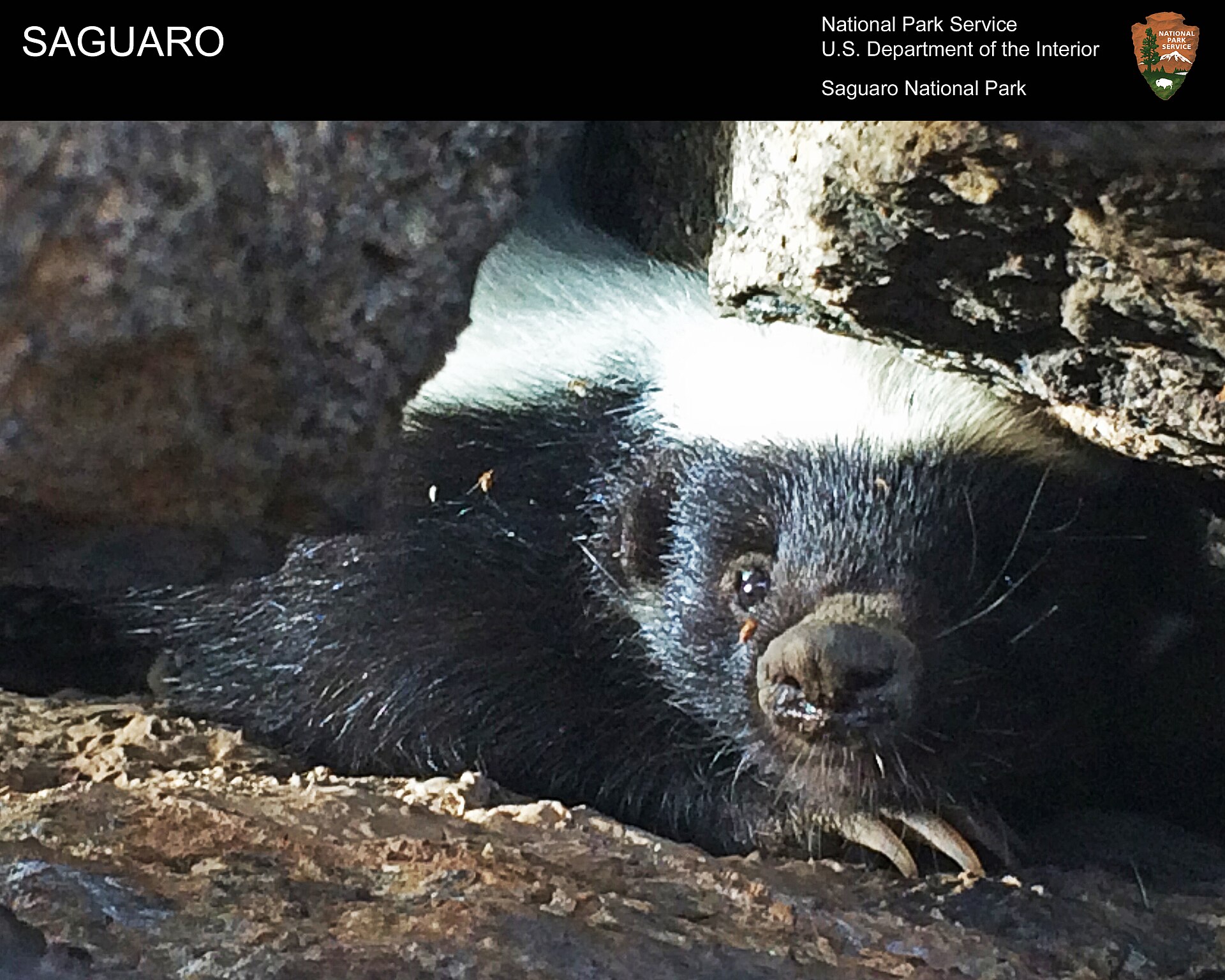
Size confusion happens often, since hog nosed skunks grow larger than other skunk species and can appear badger like to casual observers, though badgers still outweigh them by roughly 15 to 20 pounds on average.
Striped pattern misidentification compounds the problem, as bold dorsal markings on some skunks mimic the badger’s facial coloration from a distance.
Similar Size Confusion
Because the American Southwest hosts some of North America’s largest skunk species, observers in Arizona and neighboring states frequently mistake these animals for badgers at a distance. The common hog nosed skunk averages about 23 inches in total length for males and 21 for females, weighing 1.1 to 2.7 kg, roughly 2.5 to 6 pounds, and rarely to 10. Hooded skunks are smaller than they look: about 28 inches total length for males and 26 for females, but weighing only 800 to 900 g for males and 400 to 700 g for females, which is under 2 pounds. These dimensions approach smaller badgers in length.
American badgers measure roughly 29 to 31 inches but carry that length low and wide, at 9 to 22 pounds. They’re stockier. Their bodies sit low and broad, built for digging. Skunks appear lankier. Weight and shape help separate them.
Tail posture offers another clue. Skunks raise large, bushy tails as warnings. Badgers keep short, stubby tails down.
Close observation matters. Size alone deceives. Field identification demands attention to build and behavior, not just length.
Striped Pattern Misidentification
Size confusion isn’t the only source of mistaken identity in the Southwest. Striped patterns create frequent mix ups between species.
The striped skunk displays bold black and white dorsal stripes running from head to tail. Badgers wear broad white facial stripes or caps against darker fur. These markings look similar at dusk. Observers often misjudge which animal they’re seeing.
The striped skunk’s stripes extend along its back. Badger markings concentrate on the face. This distinction matters for safety. Skunks raise tails before spraying. Badgers don’t use tails as warnings. Pattern recognition helps avoid unpleasant encounters. Careful observation separates the two. Stripes differ in placement and purpose. Knowing these details prevents mistakes.
Regional Species Overlap
Where the desert meets the grassland, Arizona and the broader Southwest host an unusual concentration of look alike mammals. American badgers and multiple skunk species overlap here, so misidentification runs high.
Size offers immediate separation. Badgers run roughly 29 to 31 inches and weigh 9 to 22 pounds. Skunks stretch 13.5 to 36 inches but typically hit just 1 to 10 pounds.
Pattern matters too. Badgers wear brown gray bodies with crisp white and black face stripes. Skunks favor black and white dorsal stripes or spots. The hog nosed skunk carries a long nose and stubby tail.
Behavior diverges sharply. Skunks raise bushy tails, sometimes handstand, and spray. Badgers dig, lunge, and keep tails short.
Habitat seals identification. Badgers leave large burrows in open grassland. Skunks prefer edges, woodlands, and shallow diggings.
Arizona’s “Big Skunk”: Why Hog Nosed Skunks Look Like Badgers
Hog nosed skunks lumber across Arizona’s desert scrub with a heft that catches hikers off guard. These animals average about 23 inches in total length for males and 21 for females, and weigh 1.1 to 2.7 kg, roughly 2.5 to 6 pounds, rarely reaching 10. That mass makes them one of the largest skunk species in North America.
Their pig like snout stands out. It’s long and fleshy, built for rooting up insects and grubs. Their tail is shorter and less bushy than other skunks. Together, these traits create a robust, low slung silhouette. From a distance, the shape reads as badger like.
Their coloration reinforces the confusion. A broad, blunt white stripe runs down their back. It’s wider than the narrow stripes of hooded skunks. At twilight, this pattern can look like badger markings.
Hog nosed skunks also frequent open desert and grassland. They dig constantly. These habits mirror where Americans expect to find badgers, so misidentification happens often. Yet they’re mephitids, not mustelids. They spray, not bite.
Size Comparison: How Badgers Dwarf Most Skunks
While hog nosed skunks look the part, they don’t match badgers in bulk. Badgers typically weigh 9 to 22 pounds, averaging about 15, and measure roughly 29 to 31 inches in total length. This makes them substantially larger than most skunks. The figures come from the Mammals of Texas account held by the Texas Tech Natural Science Research Laboratory, which gives adult badgers 4 to 10 kg, averaging about 7, at a total length of 730 to 788 mm.
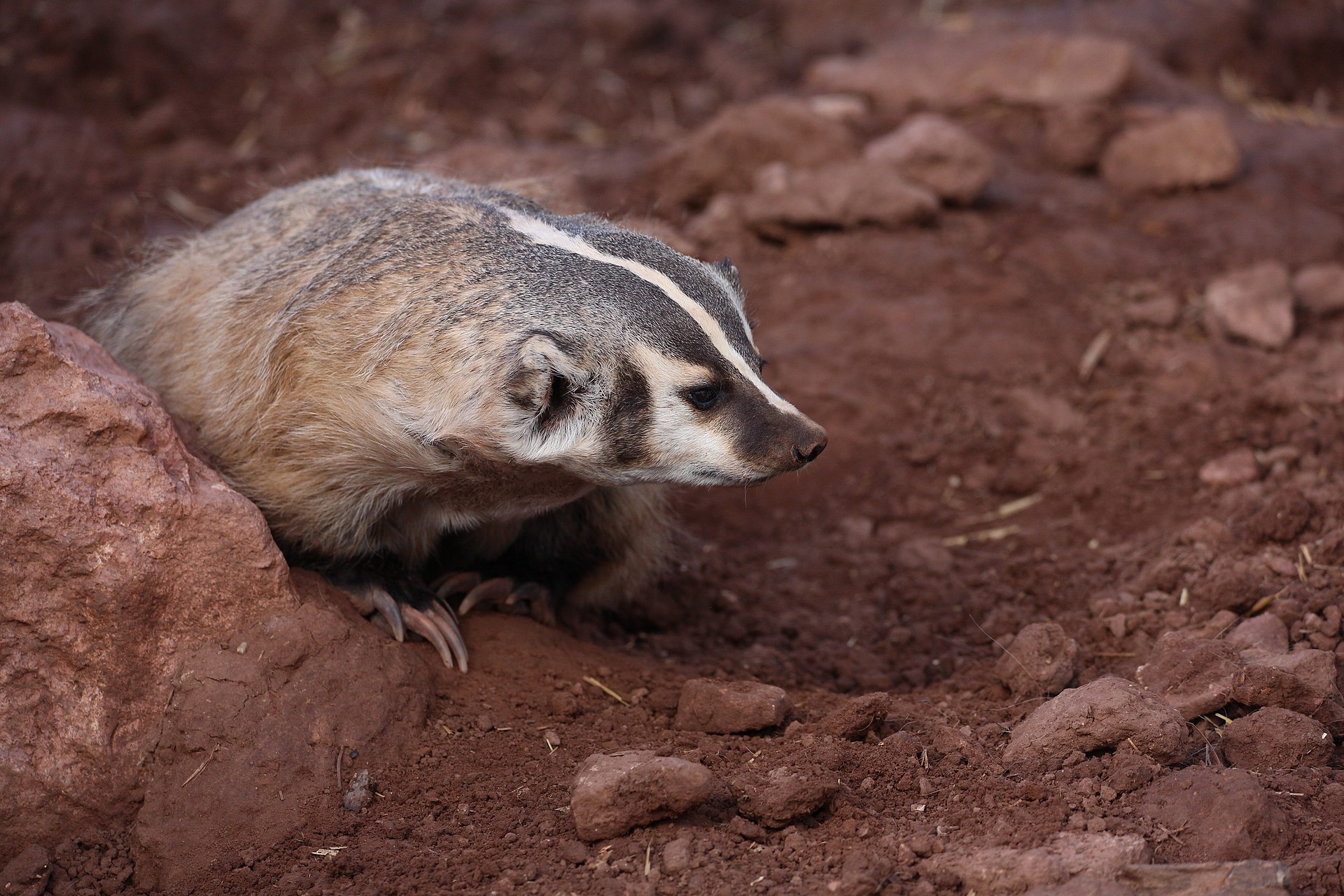
Skunk species vary widely. Western spotted skunks weigh merely 1 to 1.5 pounds. Larger American hog nosed and striped skunks reach 5 to 14 pounds. Even the biggest skunks, at roughly 6 to 12 pounds for a large striped skunk, weigh well under an average badger.
These size differences shape behavior. Badgers are robust diggers. They tackle larger prey. Smaller skunks forage insects and small vertebrates instead.
Where ranges overlap in North America, body size offers a reliable field clue. A particularly heavy, stocky animal substantially larger than typical skunk dimensions is more likely one of the badgers.
Stripe Patterns That Identify Badger or Skunk
Observers distinguish badgers from skunks by examining color pattern variations, facial marking differences, and body stripe contrast.
Badgers display muted body tones with broad white facial stripes running from nose to crown, while skunks present stark black and white longitudinal stripes or spotted patterns with bushy white tails.
These differences aren’t merely aesthetic; they aid wildlife identification, supporting biodiversity, the variety of life forms in a given area.
Color Pattern Variations
Skunks almost always display stark black and white coloration that serves as a warning to predators. This aposematic pattern, bright contrasting colors that signal danger, appears as longitudinal white dorsal stripes in striped and hog nosed species, or as spots and broken stripes in spotted skunks.
Hog nosed skunks carry one broad white stripe down the back with a relatively short tail. Hooded skunks develop a white dorsal “hood” extending into side stripes, paired with a bushy tail used in warning displays. Spotted skunks show broken white patterns across smaller bodies.
Badgers present more muted combinations. Their coloration tends toward cryptic browns, grays, tans, and blacks suited for camouflage. Some species like honey badgers display white backs with black undersides, while others blend earth tones. Unlike skunks’ body centered warnings, badger patterns don’t rely on bold black and white contrast.
Facial Marking Differences
Because facial markings offer immediate visual cues for identification, they serve as practical tools for distinguishing badgers from skunks in the field.
Badgers display broad white facial markings running from the nose across the head. Dark patches frame their cheeks and eyes, creating a mask like effect. These stripes sit lower and spread wider on a stockier head.
Skunks present sharper, more defined facial markings limited to bold contrasting lines. Their patterns appear on elongated snouts without distinctive cheek patches.
Hog nosed and hooded skunks develop dorsal markings extending toward the head, forming a white “hood.”
Spotted and dwarf skunks carry broken spots or short stripes on the face and flanks.
Observers note these differences in stripe placement, width, and integration with head shape. Such details provide reliable field identification tools.
Body Stripe Contrast
Body stripe contrast offers one of the most reliable methods for distinguishing these two mammals. Skunks display bold black and white patterns that serve as aposematic signals, warning predators of their chemical defenses. Badgers show more mixed coloration with subtler contrasts.
- Skunk stripes dominate the back. Striped and hog nosed skunks carry wide dorsal bands running lengthwise. These markings cover much of the body.
- Badger stripes stay facial. The American badger has a white stripe from nose to crown. Darker cheeks frame this marking.
- Spotted skunks break the pattern. Their white markings form distinct spots and broken stripes. This differs from continuous bands.
- Tails amplify the signal. Skunks possess bushy white tipped tails. Badgers have short, inconspicuous tails with muted coloration.
Tail Talk: Digging Tool vs Warning Signal
Anatomical differences often reveal how species adapt to distinct survival challenges. The BADGER carries a short, stout tail. This appendage hardly signals visually. Instead, it stabilizes the body during powerful digging. Heavy musculature and this compact tail assist the American badger in excavating burrows. They flip soil while hunting fossorial prey, animals living underground.
Skunks present a striking contrast. Their large, bushy tails serve warning functions. Striped and hog nosed species hold these tails upright before spraying. The high contrast black and white fur enhances aposematic signaling, color patterns that warn predators of danger. This visual threat reduces actual chemical discharge.
Functionally, these tails diverge completely. The badger’s tail enables subterranean life and digging mechanics. The skunk’s tail operates as behavioral deterrent. Both structures reflect evolutionary solutions to distinct pressures.
Spray Range: How Skunks Outshoot Badgers
Skunks propel their defensive musk up to fifteen feet with precision, while badgers can’t project their secretions beyond a few inches. Spray biology and the warning sequence that precedes it are set out by the Internet Center for Wildlife Damage Management, the USDA and university run reference on nuisance wildlife.
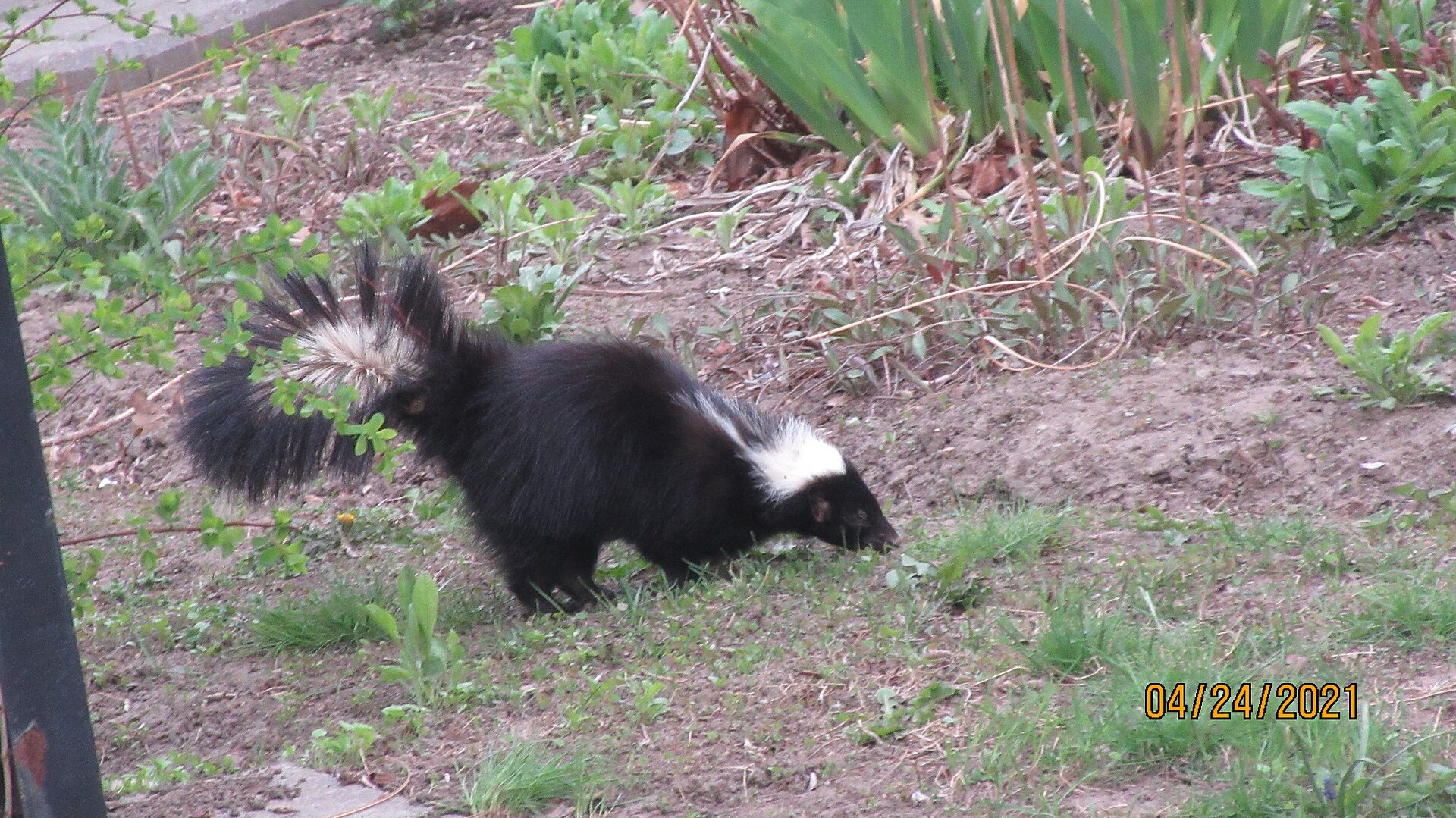
This contrast defines their survival strategies: skunks neutralize threats from a distance, and badgers must rely on close quarters confrontation.
The comparison reveals how evolution shapes distinct chemical arsenals for similar ecological challenges.
Skunk Spray Distance
When threatened, a skunk can let loose a stream of musk from its anal glands reaching 10 to 15 feet, with some species managing only 6 to 10. That’s biodiversity, the variety of life forms, here affecting defense strategies.
Skunks deliver multiple aimed discharges, commonly five or six, before reserves deplete. Badgers lack this precision. Skunk spray forms a focused, high pressure jet. It carries potent sulfur compounds. The odor persists days to months. Badger secretions disperse poorly and fade fast.
Larger skunks achieve greater range and volume. Smaller species substitute distance with warning behaviors like handstands.
- Range varies by species anatomy
- Multiple shots extend deterrence
- Chemical potency increases effectiveness
- Physical size correlates with defensive capability
This measured superiority defines survival.
Badger Musk Limits
Badgers defend themselves with musk, but their glands don’t match skunk engineering. Their secretions mark territory and warn predators, yet they lack the range and potency that skunks spray with precision.
Skunks shoot fluid ten to fifteen feet. Badgers can’t do this. Their musk drifts rather than jets, dispersing quickly without direction. It’s close range defense, not long distance deterrence.
A skunk fires five or six bursts before emptying reserves. Badgers exhaust faster and can’t repeat. Their glands aren’t built for sustained chemical warfare.
Skunk odor persists for months on fur and surfaces. Badger musk fades sooner, less invasive, less memorable. The difference lies in anatomy, specialized skunk glands versus badger’s simpler equipment.
Evolution favors what each creature needs. Skunks perfected distance. Badgers rely elsewhere.
Defense Comparison Analysis
Though badgers carry their own chemical defenses, they’ve never developed the artillery that skunks command. Skunks possess specialized anal musk glands that accurately spray pungent fluid 10 to 15 feet, often directly at a predator’s face. Badgers use general glandular secretions for marking and short range defense. These dissipate quickly. The ability to spray repeatedly matters: skunks deliver five or six successive discharges before depletion. Badgers lack this mechanism entirely.
Skunks display clear warning behaviors, raised tails, stomping, before deploying their limited reserves. Badgers rely on intimidation and physical confrontation instead. Skunk spray lingers for days to months. Badger secretions fade fast.
- Range: Skunks reach 10 to 15 feet; badgers manage mere inches.
- Accuracy: Skunks target faces precisely.
- Capacity: Skunks spray multiple times; badgers cannot.
- Persistence: Skunk musk endures; badger scent vanishes.
This contrast reveals how evolution shapes survival tools differently.
Can Badgers Spray? No, and Here Is Why
Surprisingly, both animals can emit foul odors. Skunks possess specialized anal musk glands. These glands spray a pungent special fluid accurately up to 10 to 15 feet. They can fire multiple times.
Badgers carry scent glands too. They produce glandular secretions mainly for territorial marking. These secretions prove less targeted than skunk spray. The odor fades faster. It serves close range deterrence, not long range defense.
Some “stink badgers” exist. They’re classified with skunks, not true badgers. This shows spraying ability follows taxonomy, not common names.
North American badgers rely on biting and digging. They use musky secretions as backup. Skunks warn first. They raise tails, stamp, or hop. Their spray lingers for days or months. Badger odor remains milder. The distinction matters for anyone encountering wildlife.
Hooded Skunks: Long Tailed, and Lighter Than They Look
What distinguishes a large skunk from a badger at dusk? Hooded skunks are relatively large and capable of spraying powerful musk from specialized glands, yet observers often confuse them with badgers.
These skunks reach about 26 to 28 inches in total length, much of it tail, but weigh only 400 to 900 g, which is under 2 pounds. They inhabit southern Arizona, barely crossing from Mexico. Two color phases exist: white backed and dark with side stripes. Their tails are longer than hog nosed skunks.
Sightings near human areas (e.g., golf courses) can be mistaken for other large mustelids or badgers.
Their diet spans carrion, eggs, insects, and fruit.
Biodiversity, the variety of life in an area, benefits from such adaptable species.
- Size creates confusion among nocturnal observers.
- Color variation complicates quick identification.
- Human development brings wildlife into view.
- Adaptability guarantees survival at habitat edges.
Who Dug That Hole? Burrow Clues That Solve the Mystery
Evidence settles arguments. Badgers release their power through excavation. Their burrows measure six to ten inches high, with tunnels stretching three to six feet deep. Multiple chambers and broad spoil heaps mark their work. If the hole is the only evidence you have, our guide to identifying animal burrows and holes works through the shape and spoil clues species by species.
| Clue | Badger excavation | Skunk grub divot | Hog nosed rooting |
|---|---|---|---|
| Shape | Wide, cone shaped, sloping in | Small, neat, cone shaped divot | Shallow, rooted, plowed looking patches |
| Size | Entrance often 8 to 12 in across, elliptical | 2 to 4 in across | Irregular, spread over a patch of ground |
| Spoil | A fan of soil thrown well behind the hole | Little to none | Turned over soil across the area |
| Depth | Deep. A real tunnel system | A few inches. Not a burrow | Surface only |
| Why | Hunting a burrowing rodent, or denning | Digging out grubs | Rooting for invertebrates |
| Who | American badger | Striped skunk | Hog nosed skunk |
Badger burrow dimensions vary widely with soil and purpose. The rooting description follows the Mammals of Texas account of the hog nosed skunk.
Skunks dig differently. They create small cone shaped pits, just two to four inches deep, while hunting insects or bulbs. No extensive tunnels follow.
Check the soil. Badger digs show overturned mounds with claw marks and packed rims. Skunk foraging scatters loose, shallow dirt with peck like holes.
Location matters too. Badgers choose open grasslands or desert flats for long term setts. Skunks prefer garden beds, fence lines, or rock piles.
Tracks confirm identity. Badger paws span 2.5 to 3.5 inches with deep claw imprints. Skunk tracks measure one to 1.5 inches. Scat seals the case, bone and fur versus insect remains.
After Dark: Why Both Come Out at Night
Both badgers and skunks routinely emerge after sunset. They’re primarily nocturnal, meaning active at night. Peak activity hits during the first hours after dark and just before dawn. Temperatures drop then. Prey moves. Insects and rodents surface. Timing matters as much as darkness. Sightings of both animals cluster in late summer and early autumn, when the year’s young disperse and inexperienced animals turn up in places adults would avoid, and again in late winter during the breeding season. If you are suddenly seeing something you have never seen before, it is usually one of those two windows rather than a new resident.
Badgers dig. They excavate burrows in grasslands and deserts using powerful forelimbs. Skunks root with sensitive snouts. Both find food in darkness.
Night reduces encounters with diurnal predators, those active by day. It limits human contact too. Badgers navigate by smell and hearing. Skunks use smell and touch.
Seasonality shifts their patterns. Skunks stay active year round in mild areas. Badgers adjust for breeding or scarce food.
Nocturnal life carries risk. Road collisions increase after dark.
- Cooler temperatures reduce heat stress during foraging.
- Prey availability peaks when insects and rodents emerge.
- Darkness provides cover from daytime hunters.
- Keen senses replace sight for successful navigation.
Encountered One? Safety Steps and When to Back Away
Because most encounters happen unexpectedly, knowing how to respond matters. Observers should maintain 15 to 20 feet of distance. Skunks spray up to 10 to 15 feet, and many raise their tails as warning. These defense mechanisms protect them from threats. Back away slowly. Sudden movements or loud noises provoke stress. Both species are nocturnal. They prefer escape over confrontation.
Never corner an animal. Badgers dig powerfully and slash with sharp claws. Skunks deliver multiple accurate sprays. The odor persists for days. If sprayed, ventilate the space immediately. Wash skin and clothes with degreasing soap and a baking soda peroxide solution. Avoid eyes and mouth. Seek medical help if spray contacts eyes.
Do not handle young or injured animals. Contact wildlife authorities instead. Daytime lethargy or disorientation signals possible illness. Keep pets and people away.
Why Evolution Made Badgers and Skunks Look Like Twins
Although badgers and skunks belong to entirely different mammal families, they’ve arrived at remarkably similar appearances through a process called convergent evolution, when unrelated species independently develop matching traits because they face comparable challenges. Both evolved bold black and white stripes as aposematic coloration, visual warnings advertising their chemical defenses to predators. Aposematic colouring like this is a textbook case of the key concepts in ecology that shape how animals advertise themselves.
Short, stocky builds and strong limbs suit their ground dwelling lives. Overlapping North American ranges and nocturnal habits reinforced these parallels.
- Warning signals reduce deadly encounters for both species.
- Digging adaptations serve similar omnivorous diets.
- Scent glands represent independent solutions to predation pressure.
- Divergent details, skunks spray precisely, badgers fight, show appearance deceives.
Convergent evolution therefore masks different survival strategies beneath matching coats.
Badger or Skunk: Common Questions
How do you tell a badger from a skunk?
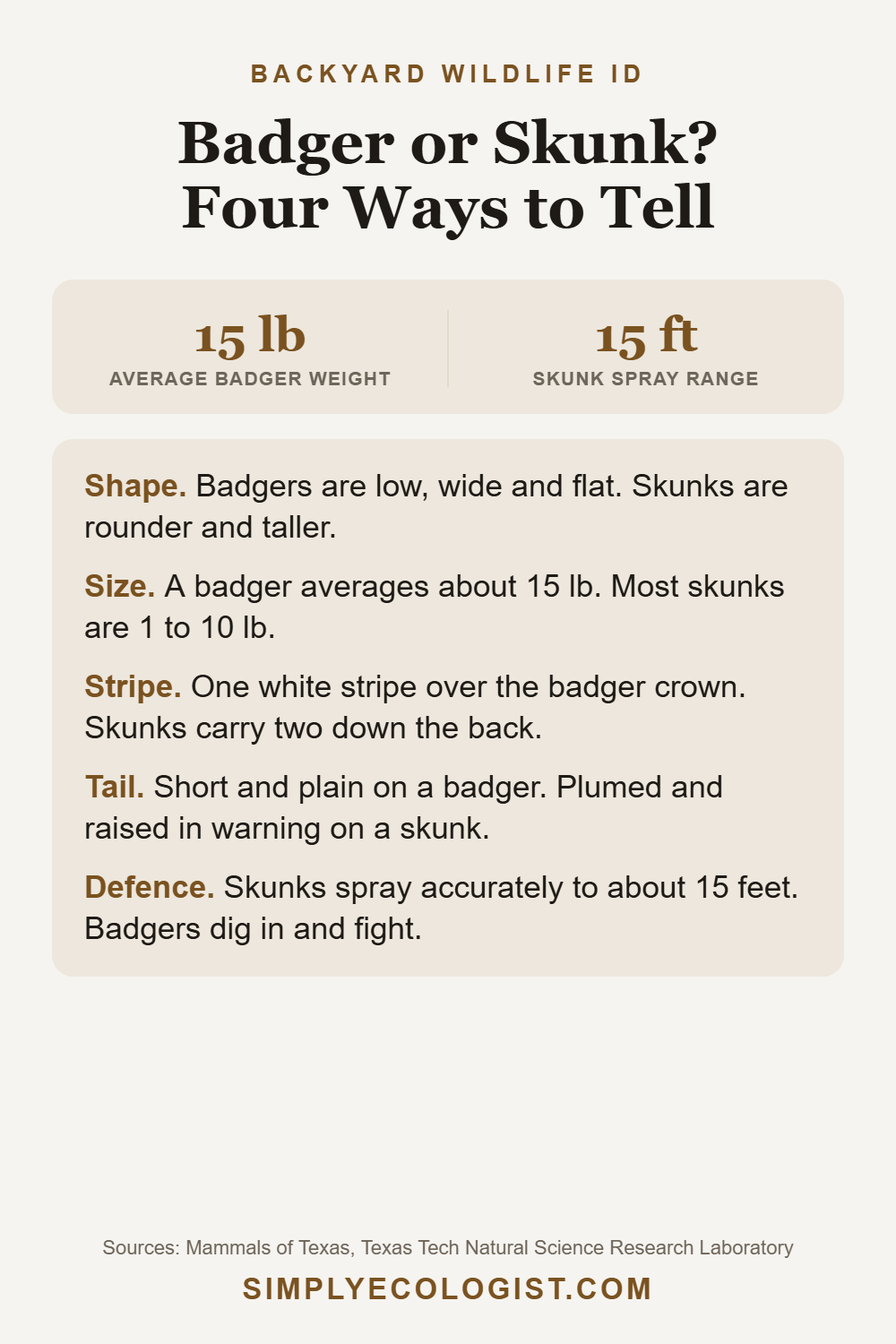
Shape first. A badger is low, wide and flattened, carried close to the ground. A skunk is rounder and stands higher. Then the stripe: badgers wear one white line over the crown, skunks carry two down the back. Then the tail: short and plain versus plumed and raised.
How big is an American badger?
Roughly 29 to 31 inches in total length, weighing 9 to 22 pounds and averaging about 15. That is heavier than almost any skunk but not the 30 pound animal it is often described as.
Why do people confuse badgers and skunks in Arizona?
Because of the hog nosed skunk. It is much larger than the familiar striped skunk, it has a broad white back rather than two narrow stripes, and it digs. At dusk, at a distance, that reads as a badger.
Can badgers spray like skunks?
No. Badgers have anal scent glands and can release a musk, but they cannot aim it and cannot project it. A skunk sprays accurately to around 15 feet. A badger that feels cornered digs in and fights instead.
How far can a skunk spray?
Accurately to about 10 to 15 feet, with the smell carrying much further and lingering for weeks on fabric and fur. The raised tail is the warning that precedes it.
Which digs the hole in my yard?
Badgers dig wide cone shaped excavations with a fan of soil thrown behind, usually at a rodent burrow. Skunks make small, shallow, cone shaped divots a few inches across while hunting grubs in turf.
Are badgers or skunks dangerous?
Neither wants a confrontation. A skunk will warn you with a raised tail and stamping before it sprays. A badger will back into a hole and hiss. Give either one room to leave and both problems solve themselves.
Why do badgers and skunks look alike at all?
Both advertise. Bold black and white patterning is aposematic, a visual warning that the animal is not worth attacking, and it has evolved separately in animals that stand their ground rather than outrun a predator.
Final Thoughts
Badgers and skunks stand as living symbols of nature’s parallel paths. They’re biodiversity, varied life forms in one ecosystem, demonstrating how different species solve similar problems. The badger’s strength and the skunk’s warning show survival’s range. Both matter. Their coexistence reminds observers that ecosystems function through unexpected kinship, not competition alone.

Erzsebet Frey (Eli Frey) is an ecologist and online entrepreneur with a Master of Science in Ecology from the University of Belgrade. Originally from Serbia, she has lived in Sri Lanka since 2017. Eli has worked internationally in countries like Oman, Brazil, Germany, and Sri Lanka. In 2018, she expanded into SEO and blogging, completing courses from UC Davis and Edinburgh. Eli has founded multiple websites focused on biology, ecology, environmental science, sustainable and simple living, and outdoor activities. She enjoys creating nature and simple living videos on YouTube and participates in speleology, diving, and hiking.
From the shop
Gifts for people who love the wild
Wildlife themed t-shirts, notebooks, tote bags, bandanas and guides, designed by an ecologist.
Visit the shop