
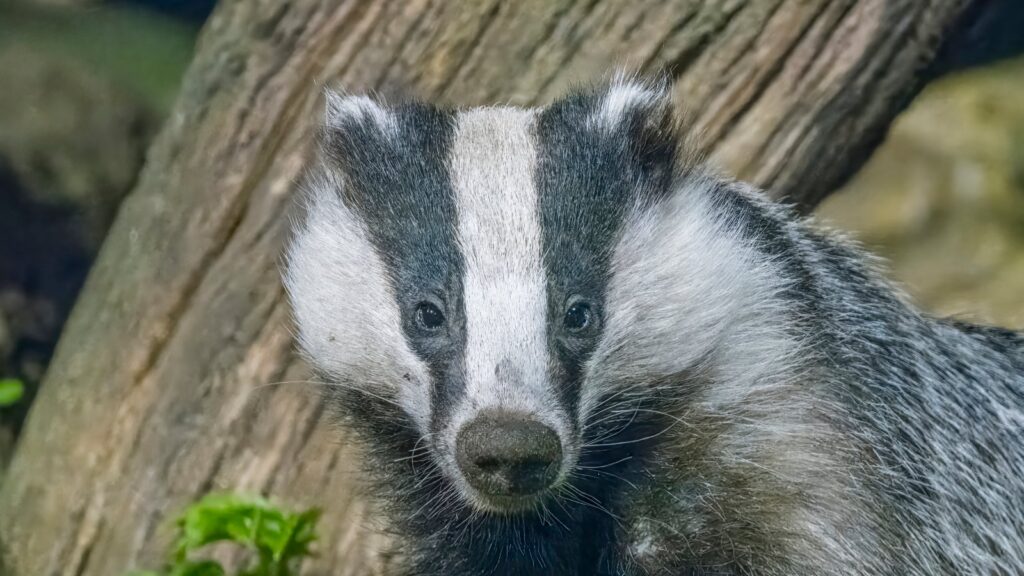
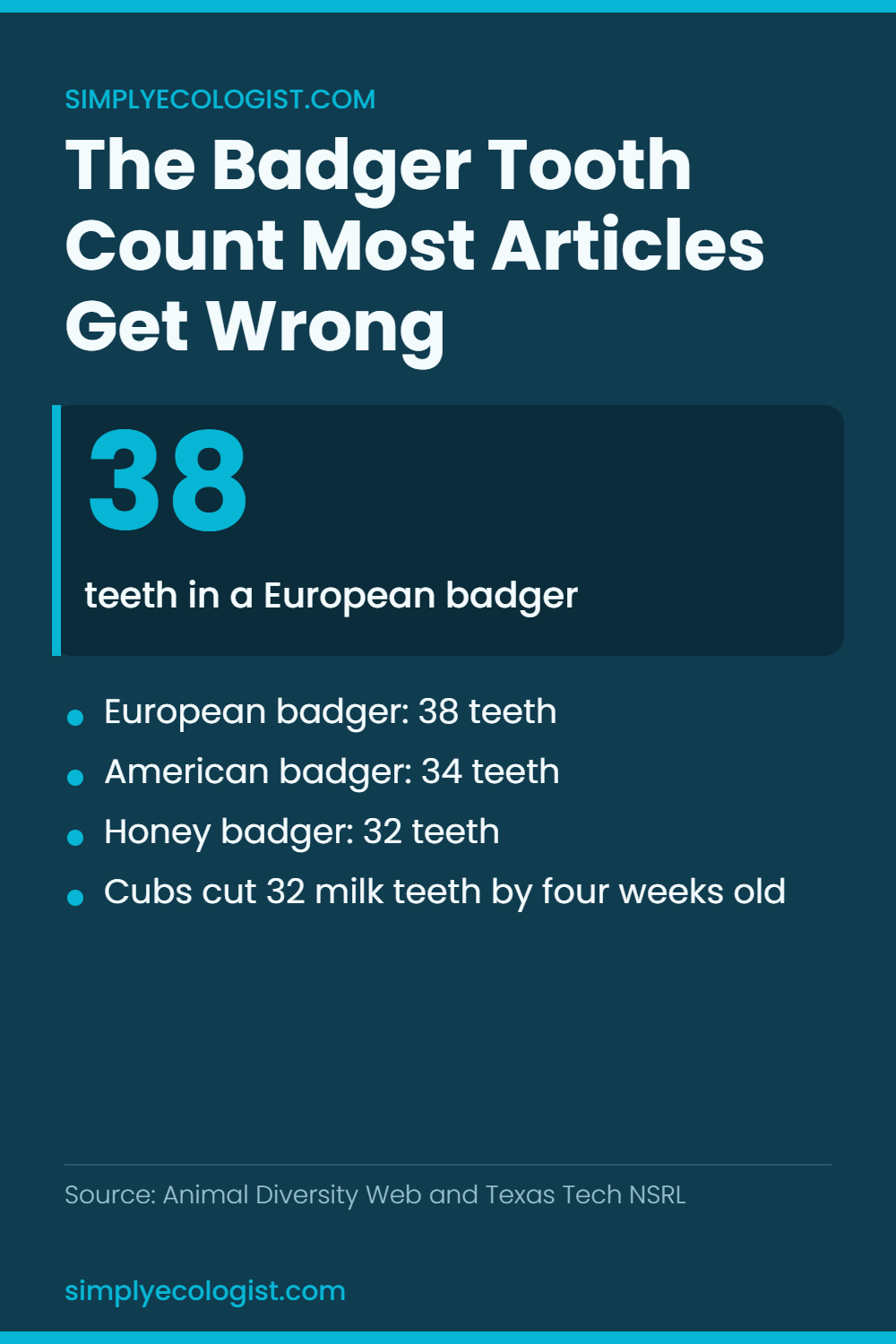
A European badger (Meles meles) has 38 teeth, an American badger (Taxidea taxus) has 34, and a honey badger (Mellivora capensis) has 32. There is no single badger tooth count, because the animals we call badgers sit in three different branches of the weasel family and their mouths are built for three different jobs.
Part of my complete guide to badgers, which covers American versus European badgers, setts and clans, diet, identification and conservation, with sources.
The number repeated most often online is 34. That is the American badger figure, published as a dental formula by the Natural Science Research Laboratory at Texas Tech University, and it is wrong for the other two species. If you have read that badgers have 34 teeth, you have read a fact about one badger presented as a fact about all of them.
Below are the counts and dental formulas for all three, when cubs cut their milk teeth, which teeth do the actual cutting, why a badger skull keeps hold of its lower jaw when most carnivore skulls do not, and how researchers read a badger’s age off the wear on its teeth. Every figure names the source it came from.
Written by Erzsebet Frey, ecologist. Reviewed and rewritten against primary species accounts in August 2026.
Key Takeaways
- Tooth counts differ by species: 38 in the European badger, 34 in the American badger, 32 in the honey badger.
- Badger teeth are rooted and stop growing once they are formed. They do not grow continuously, and a worn permanent tooth is never replaced.
- Cubs cut 32 milk teeth from about four weeks old and carry the full permanent set of 38 by about four months.
- Because worn teeth are never replaced, wear accumulates in one direction for life, which is what lets researchers estimate a wild badger’s age from its teeth.
How Many Teeth Does a Badger Have?
It depends on which badger. A dental formula is shorthand for one half of the mouth: the number of incisors, canines, premolars and molars in the upper jaw, written over the number in the lower jaw. Count one side, double it, and you have the whole animal.
How many teeth does a European badger have?
38. Animal Diversity Web, published by the University of Michigan Museum of Zoology, gives the formula for Meles meles as I 3/3, C 1/1, P 4/4, M 1/2 = 38. That is nine teeth in each upper half and ten in each lower half, so 19 a side.
How many teeth does an American badger have?
34. The Natural Science Research Laboratory at Texas Tech University gives Taxidea taxus as I 3/3, C 1/1, P 3/3, M 1/2, doubled to 34. The American badger carries one premolar fewer than the European badger in each half of each jaw, and that is where the missing four teeth go.
How many teeth does a honey badger have?
32. The Mammalian Species account for Mellivora capensis, published by the American Society of Mammalogists, gives I 3/3, C 1/1, P 3/3, M 1/1, total 32. The honey badger has the same premolar count as the American badger but usually lacks the second lower molar, which accounts for the last two teeth of the difference. The same account records one specimen that kept a small second lower molar on the left side only, so the species is not entirely consistent about it.
Dental Adaptations for Badger Diet
The three species eat differently and their dentition follows. Here is the same information as a reference table, with the source for every row.
| Badger Species | Scientific Name | Dental Formula | Total Teeth | Primary Diet | Source |
|---|---|---|---|---|---|
| European Badger | Meles meles | I 3/3, C 1/1, P 4/4, M 1/2 | 38 | Omnivorous | Animal Diversity Web |
| American Badger | Taxidea taxus | I 3/3, C 1/1, P 3/3, M 1/2 | 34 | Carnivorous | Texas Tech NSRL |
| Honey Badger | Mellivora capensis | I 3/3, C 1/1, P 3/3, M 1/1 | 32 | Primarily carnivorous | Mammalian Species No. 721 |
Reading the table across, European badgers have dentition Animal Diversity Web calls well suited to an omnivorous diet: flattened molars for crushing and grinding, small incisors and prominent canines. Earthworms make up much of what they eat. American badgers are carnivores living largely on ground squirrels, pocket gophers, kangaroo rats and cottontails, which they catch by digging out the burrow and cornering the animal at the far end of it. Honey badgers are described by Animal Diversity Web as having a primarily carnivorous diet of eggs, small rodents, snakes, birds and frogs, with fruit, roots and bulbs as a supplement. That last row is a correction worth making. The honey badger is routinely labelled omnivorous, and its plant food is real but secondary.
Structure and Function of Badger Teeth
A badger mouth carries the four standard mammal tooth types, and in the European badger they are not shaped the way most articles claim. Animal Diversity Web describes Meles meles as having flattened molars, small incisors and prominent canines. The incisors are small, not large. They are a row of little pegs at the front, useful for nibbling and grooming rather than for cutting through prey.
The canines are the prominent teeth, long and curved, and they do the gripping and puncturing. Behind them the cheek teeth change job along the row: the premolars stay simple and pointed, and the molars broaden and flatten for crushing. That flattened rear molar is the giveaway for an omnivore. A pure meat eater has no use for a grinding surface that size.
Different species of badgers arrange the same set of tooth types differently. The American badger, which hunts burrowing rodents, carries one premolar fewer in each half jaw than the European badger does. The honey badger drops the second lower molar as well, and the Mammalian Species account records a specimen that kept a small one on the left side only, which tells you the species is less fixed about its back teeth than most carnivores are.
Growth and Replacement of Badger Teeth
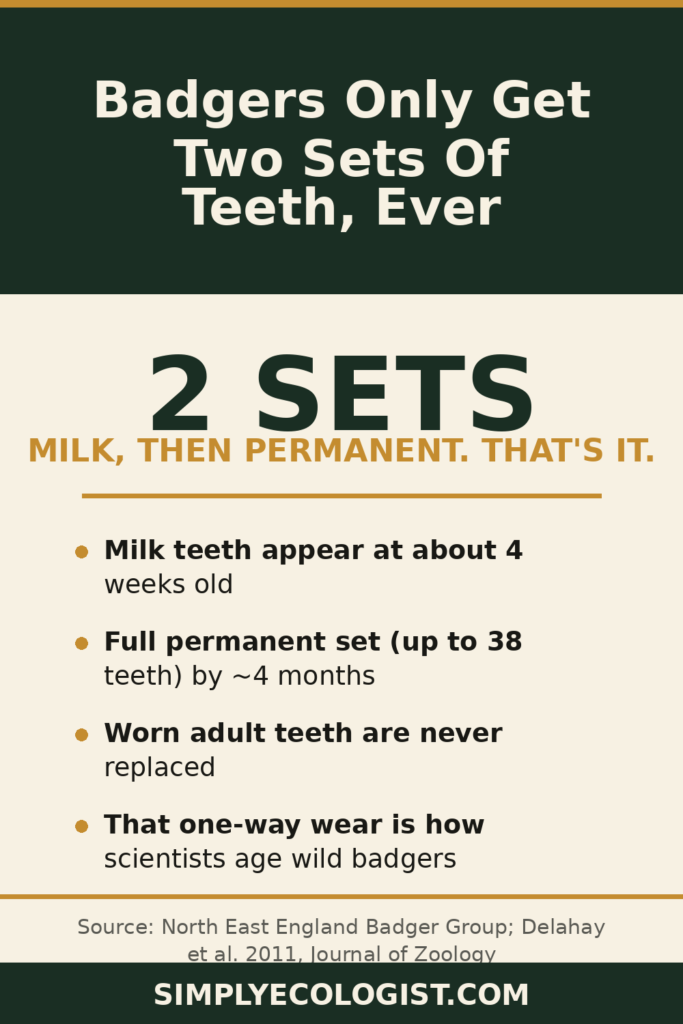
Badgers do not have continuously growing teeth. This is the most repeated error about badger dentition and it is worth stating plainly: a badger gets two sets of teeth and no more.
Two words cover it. Badgers are diphyodont, meaning they grow one set of milk teeth and one set of permanent teeth and that is the end of it. They are also brachydont, meaning the crowns are low and the roots close off once the tooth is formed, so the tooth stops growing. Ever growing teeth, the kind that keep erupting from an open root for the whole of an animal’s life, are called hypselodont. A review in Frontiers in Physiology of ever growing teeth in mammals places that trait in rodents, elephants, walrus, babirusa, sloths and, among the marsupials, wombats. The order Carnivora is not on the list, and badgers are carnivorans.
So when a badger’s permanent teeth wear down, nothing replaces them. The animal has to live with what it has left. That is a real constraint for the badger and, as it turns out, a useful gift to anyone studying one.
Milk Teeth and When They Erupt
Badger cubs are born toothless. The North East England Badger Group records that milk teeth first appear at about four weeks old and build up to 32 in number, and that a cub normally has its full adult set of 38 by around four months old.
So the sequence is 32 milk teeth from four weeks, then the permanent set pushing them out, complete at 38 by roughly four months. The milk set is smaller than the adult set, which is normal for carnivores. The extra teeth in the adult mouth are cheek teeth with no milk predecessor, and they simply erupt into place rather than replacing anything.
Baby teeth are replaced. Adult teeth are not. Those two statements get muddled together into a claim that badger teeth continuously replace themselves, and they are not the same thing at all.
The Carnassial Pair That Does the Cutting
Every member of the order Carnivora has one pair of teeth on each side modified into a shearing blade: the last upper premolar working against the first lower molar. These are the carnassials. They pass each other like scissor blades rather than meeting face to face, and they are the teeth a badger uses to cut through skin and sinew.
Carnassials tell you a great deal about diet. The more meat a carnivoran eats, the more blade like they become, and the more it eats everything else, the more the teeth behind them spread out into grinding surfaces. In the European badger the carnassials are present and functional, but the tooth immediately behind the upper carnassial is the large flattened molar Animal Diversity Web describes, and that tooth is doing crushing work rather than cutting work. A working blade in front of a broad grinding platform is what an omnivore’s cheek row looks like.
Why a Badger Skull Keeps Its Lower Jaw
On most carnivore skulls the lower jaw lifts straight off once the soft tissue is gone. On a badger skull it usually does not, and that is anatomy rather than accident.
The badger’s jaw hinge is a long cylinder of bone sitting in a socket that wraps almost the whole way around it, so the joint opens and closes freely but cannot slide sideways or be pulled free. The North East England Badger Group states the consequence directly: it is impossible to dislocate the jaw without fracture. Put that together with the muscle mass a badger carries on its skull and you have a jaw built to hold on to whatever it has closed on.
The other feature to look for on an adult badger skull is the sagittal crest, a blade of bone running front to back along the midline that anchors the jaw muscles. Animal Diversity Web calls the crest on Meles meles prominent. It is not there at birth. The North East England Badger Group notes that the temporal ridges begin to converge at around eight weeks and the crest is not fully formed until roughly a year old, which makes it a rough age marker in its own right.
Ageing a Badger by Tooth Wear
Because a badger never replaces a worn permanent tooth, wear only ever runs one way, and that turns a badger’s teeth into a clock. Researchers score how far the cusps have flattened on particular teeth and convert the score into an age estimate.
The method has been tested properly. Delahay and colleagues published a paper titled “Using lifetime tooth wear scores to predict age in wild Eurasian badgers: performance of a predictive model” in the Journal of Zoology in 2011, working from a study population in which many badgers had known true ages because they had been caught and marked as cubs. The finding was that repeated wear scores taken across an individual’s life predict age better than a single score does, and that estimates become less reliable as animals get older.
This is the practical reason the continuous growth myth matters. If badger teeth really did keep growing and replacing themselves, ageing by tooth wear could not work at all, and a substantial body of badger population research would go with it.
How Badger Teeth Compare With Other Mustelids
Badgers belong to the weasel family, Mustelidae, and the family is not consistent about tooth counts. Every formula below comes from a published species account, and I have normalised the notation to I, C, P and M so the rows can be read against each other.
| Mustelid | Scientific Name | Dental Formula | Total Teeth | Source |
|---|---|---|---|---|
| European Badger | Meles meles | I 3/3, C 1/1, P 4/4, M 1/2 | 38 | Animal Diversity Web |
| Wolverine | Gulo gulo | I 3/3, C 1/1, P 4/4, M 1/2 | 38 | The Wolverine Foundation |
| Pine Marten | Martes martes | I 3/3, C 1/1, P 4/4, M 1/2 | 38 | Mammalian Species 54(1022) |
| Eurasian Otter | Lutra lutra | I 3/3, C 1/1, P 4/3, M 1/2 | 36 | Mammalian Species 48(940) |
| American Badger | Taxidea taxus | I 3/3, C 1/1, P 3/3, M 1/2 | 34 | Texas Tech NSRL |
| Honey Badger | Mellivora capensis | I 3/3, C 1/1, P 3/3, M 1/1 | 32 | Mammalian Species No. 721 |
Three things stand out. 38 is the ordinary mustelid number, shared by the European badger, the wolverine and the pine marten. The Eurasian otter sits at 36, having lost one lower premolar a side. The American badger and the honey badger are the reduced ones, dropping a premolar from each half jaw and, in the honey badger’s case, a lower molar on top of that. So the 34 that circulates as the badger tooth count is not even the family norm.
Teeth as Tools in Badger Behavior
Badgers do use their teeth for more than eating, but two claims about that circulate widely and both are wrong.
Badgers do not dig with their teeth. Digging is forelimb work. The Natural Science Research Laboratory at Texas Tech University describes the American badger as having large front feet with claws 25 mm or more in length, and short powerful front legs that, in its words, can move earth with amazing speed. The same account describes badgers catching prey by digging out burrows and forcing the animal to the far end. A tooth may sever a root that gets in the way, but the excavation apparatus is the forelimb and the claw, not the mouth.
Badgers also do not scent mark with their mouths. European badgers mark with the subcaudal gland, a pouch between the base of the tail and the anus, and they carry paired anal glands as well as interdigital glands between the toes. That is what the badger literature describes, including work by Davies published in the Journal of Zoology in 1988. No mouth associated scent gland has been described in badgers, and biting or chewing an object does not deposit a scent mark.
What badgers genuinely do with their teeth beyond feeding is fight and threaten. Bite wounds from disputes over territory and status are a recognised feature of badger social life, and the tooth chattering sound badgers make in aggressive encounters is a real vocalisation. That is a narrower and more accurate claim than tooth communication, which is not a term the literature uses.
Frequently Asked Questions
So Is There One Badger Tooth Count?
It depends on the species. The European badger has 38, the American badger has 34 and the honey badger has 32. The figure of 34 that circulates as the badger tooth count is correct only for the American badger.
How Do Badgers Use Their Teeth to Communicate With Each Other?
Mostly by chattering them. Badgers produce a tooth chattering sound in aggressive and defensive encounters, alongside growls and other calls, and they bite in serious disputes. There is no evidence for a wider system of tooth communication built on specific tooth movements, and the term itself does not appear in the badger literature.
Are There Any Differences in the Teeth Structure and Function Between Male and Female Badgers?
Yes, and this is a place where the usual answer online is wrong. Tooth size sexual dimorphism in the European badger has its own published study, “Tooth size in the European badger (Meles meles) with special reference to sexual dimorphism, diet and intraspecific aggression”, in Acta Theriologica, and there is a separate study of craniological sexual dimorphism in Meles in Zoologischer Anzeiger. Neither full text was available to me, so no figure is quoted here. But the honest answer to the question is that a measured difference exists, not that there is none.
What Are Some Common Dental Diseases or Conditions That Affect Badgers?
This is far less well documented for wild badgers than the confident lists of badger tooth decay and gum disease online suggest, and those lists do not trace back to a study. What is genuinely documented is tooth wear, and wear is not a disease. It is the ordinary consequence of a rooted permanent set that never gets replaced, and because it is never replaced, the wear is permanent and cumulative.
Do Badgers Ever Lose Their Teeth Completely, and if So, How Do They Adapt to That?
Badgers lose their milk teeth on schedule and replace them with the permanent set by about four months old, according to the North East England Badger Group. Permanent teeth lost after that are gone for good, because badgers are diphyodont and get no third set. Their dentition is also distinct from that of other burrowing animals such as rodents, whose incisors really do grow continuously throughout life. That difference is the source of much of the confusion about badger teeth.
Can Badgers Use Their Teeth to Break Through Hard Surfaces, Such as Rocks or Tree Bark?
They can chew and tear at bark and roots, and their crushing molars handle hard shelled invertebrates such as beetles. Rock, no. It is also worth saying that no measured bite force value for the European badger, the American badger or the honey badger appears to have been published. Bite force numbers for badgers do circulate online, but they do not lead back to a study, so treat them with suspicion.
Conclusion
The first thing to take away is that badger is a name three different animals share, and their mouths are not the same: 38 teeth in the European badger, 34 in the American badger, 32 in the honey badger, each figure taken from a published species account rather than from another article.
The second is that badger teeth are ordinary rooted carnivoran teeth. Two sets, milk then permanent, and nothing after that. They do not grow continuously, they do not push forward from the base, and worn ones are not replaced. That limitation is exactly what makes tooth wear a workable way to age a wild badger, which is a better piece of science than the myth it replaces.
The third is that a badger’s teeth are only half the story of a badger’s mouth. The jaw that will not dislocate, the crest that grows in over the first year, the flattened rear molar of an omnivore: those are the things a skull tells you that a tooth count on its own never will.

Erzsebet Frey (Eli Frey) is an ecologist and online entrepreneur with a Master of Science in Ecology from the University of Belgrade. Originally from Serbia, she has lived in Sri Lanka since 2017. Eli has worked internationally in countries like Oman, Brazil, Germany, and Sri Lanka. In 2018, she expanded into SEO and blogging, completing courses from UC Davis and Edinburgh. Eli has founded multiple websites focused on biology, ecology, environmental science, sustainable and simple living, and outdoor activities. She enjoys creating nature and simple living videos on YouTube and participates in speleology, diving, and hiking.
From the shop
Gifts for people who love the wild
Wildlife themed t-shirts, notebooks, tote bags, bandanas and guides, designed by an ecologist.
Visit the shop