
Conservation context
More than one in five reptile species are threatened with extinction, according to the first global reptile assessment, which makes understanding them matter more than ever.
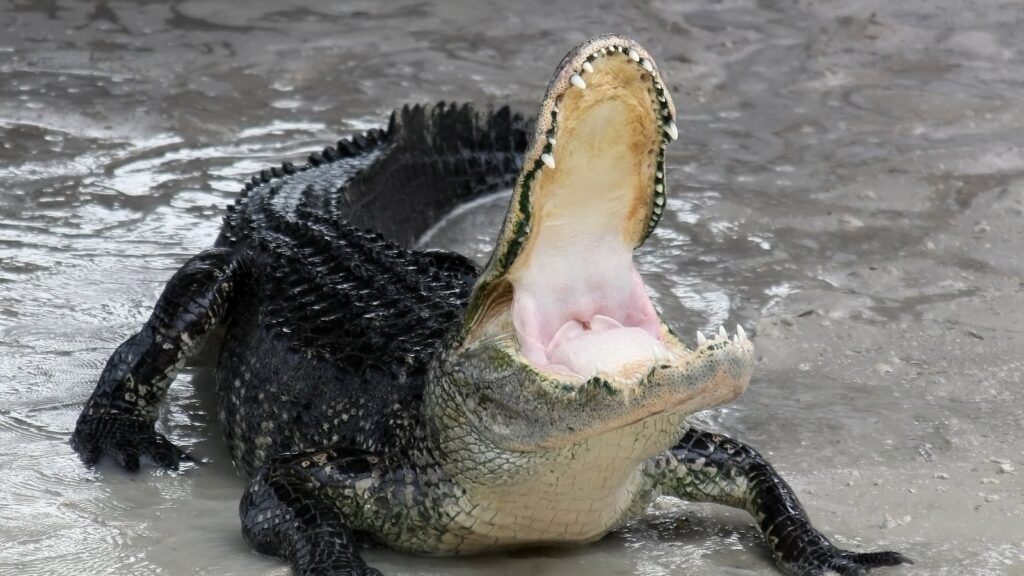
You’re comparing two massive reptiles with some serious differences. Alligators have a broad, U-shaped snout, darker skin, and a distinctive overbite that hides their lower teeth, while crocodiles have a narrow, V-shaped snout and lighter skin.
Size matters, too – alligators reach 4.5 meters and 450 kg, while crocodiles can grow up to 7 meters and 1,000 kg.
These physical differences are just the start; their habitats, behaviors, and biological characteristics are also distinct. Want to get to know these incredible creatures better and uncover what really sets them apart from one another?
Physical Characteristics
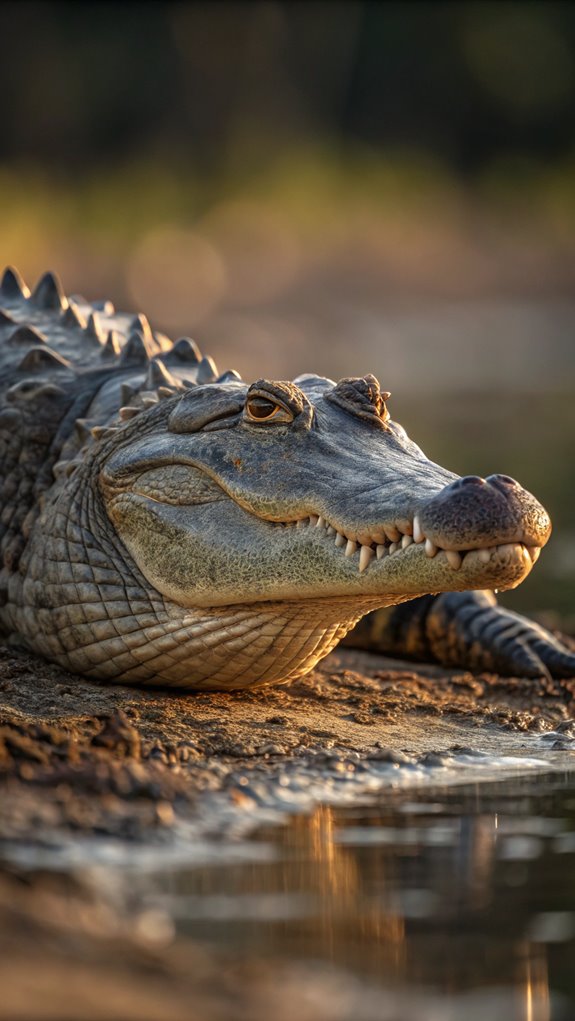
When examining the physical characteristics of alligators and crocodiles, you’ll notice several distinct differences. One of the most noticeable differences is the snout shape; alligators have a U-shaped snout, while crocodiles have a V-shaped snout.
This difference affects their dietary adaptations, with alligators suited for crushing hard-shelled prey like turtles and crocodiles being more versatile for catching various prey including fish and mammals.
You’ll also notice a difference in jaw alignment, with alligators having an overbite that conceals the bottom row of teeth when the mouth is closed, whereas crocodiles have jaws that are roughly the same size, with teeth visible even when the mouth is closed. Alligators have 80 teeth, while crocodiles have 66 teeth.
Another key difference is their size; the largest alligator species can grow up to 4.5 meters in length, while the largest crocodile species can grow up to 7 meters.
Saltwater crocodiles can weigh up to 1,000 kg, while American alligators can weigh up to 450 kg. Female alligators are generally smaller than the males of the same species.
Their skin and coloration also differ, with alligators typically having dark black, green, or grey skin, while crocodiles have lighter, more mottled skin. Both have tough, scaly skin, but crocodiles have more mottled skin patterns compared to alligators.
Additionally, crocodiles have integumentary sense organs all over their bodies, while alligators have these only on the head and around the jaw. These physical differences can help you distinguish between an alligator and a crocodile.
Both alligators and crocodiles can be found in semi-aquatic environments; however, they inhabit different geographical ranges, with crocodiles being more tolerant of saltwater environments.
Geographical Distribution
Numerous geographical differences exist between alligators and crocodiles. You find alligators along the Atlantic Coast of North America, from Florida through coastal North Carolina, and along the Gulf Coast into Texas.
Their range includes the southeastern United States, covering states such as North Carolina, South Carolina, Georgia, Florida, Louisiana, Alabama, Mississippi, Arkansas, Oklahoma, and Texas.
Alligators tend to inhabit swampy areas, rivers, streams, lakes, ponds, and seasonal wetlands like Carolina Bays. In Georgia, for instance, you can spot them in the Savannah River and its swamp and tributaries.
In contrast, the global distribution of crocodiles spans across the Americas, Africa, Asia, and Australia. While American crocodiles are found in the southeastern United States, particularly in Florida, their habitat preference is skewed towards saltwater environments.
You don’t often find crocodiles and alligators in the same specific regions, except in Florida. The difference in salt tolerance and habitat preferences is quite evident in their distribution patterns.
You can find alligators in various wetland habitats in Georgia and other southeastern states, but crocodiles are mostly restricted to Florida’s saltwater environments.
While alligators are happy in freshwater habitats like marshes, swamps, rivers, and lakes, occasionally venturing into brackish water, crocodiles are more tolerant of saltwater and can thrive in both freshwater and saltwater environments.
These geographical differences fundamentally stem from the distinct habitat preferences and salt tolerance of alligators and crocodiles. Their distribution across different regions is influenced by factors like water depth, vegetation, and salt levels.
Alligators rely on external heat sources for temperature regulation. Additionally, the International Union for Conservation of Nature IUCN Red List offers data on the conservation status of these species.
Behavioral Traits
Behavioral differences are a key distinction between alligators and crocodiles. You’ll notice that alligators are less aggressive, only becoming defensive when provoked or protecting their young. On the other hand, crocodiles are more aggressive and likely to attack without being provoked.
This is reflected in the relatively rare attacks on humans by alligators compared to crocodiles. Crocodiles tend to view humans as potential prey, especially in areas where they frequently interact with people.
When it comes to feeding behaviors, both alligators and crocodiles are skilled hunters with a diverse diet. They prefer to swallow their prey whole rather than chewing it.
However, alligators are opportunistic feeders and won’t chase down humans unless they feel threatened. Crocodiles, with their broader diet, may include humans as prey. Both species use sensory pits along their jaws to detect and capture prey.
You’ll also observe differences in their social behavior. Alligators are less social and spend most of their time alone or in small groups. They tend to dig holes to protect themselves from extreme temperatures. In contrast, crocodiles are more active in the water.
The average lifespan for both species can vary, but research indicates both species benefit from a practically Unlimited tooth supply. Both alligators and crocodiles are capable of holding their breath for up to an hour, which aids in their underwater hunting.
Both species have excellent night vision and above-water vision, making them effective hunters. Alligators are generally more docile, often basking or swimming, which makes them easier to spot in the Everglades.
These behavioral traits highlight the distinct characteristics of each species, setting them apart from one another. By understanding these differences, you can better appreciate the unique nature of alligators and crocodiles.
Biological Differences
Explore the fascinating world of biological differences between alligators and crocodiles, and you’ll discover some astonishing distinctions. When you examine their musculoskeletal systems, you notice that alligators have a shorter humerus bone in their forelimbs and shorter femurs in their hindlimbs compared to crocodiles.
On the other hand, they share a lizard-like body and tough, scaly skin. Both have small limbs in comparison to their overall bodies and webbed toes, which propel them through the water. Their powerful tails also play a significant role in swimming, with alligators sporting a broader and flatter tail.
Another notable difference lies in their snout characteristics. As you study their snouts, you see that alligators have a U-shaped, rounded snout, while crocodiles have a longer, pointed V-shaped snout. This variation affects their hunting strategies and prey preferences.
Alligators can crush hard-shelled prey with their strong, rounded snouts, while crocodiles’ narrower snouts allow them to capture fish and other smaller animals. You’ll also notice that alligators’ upper teeth are visible when their mouth is closed, whereas both upper and lower teeth are visible in crocodiles.
Both alligators and crocodiles have sensory organs that detect pressure changes in the water, excellent night vision, and sensitive hearing. Additionally, they’ve tiny black specks called integumentary sense organs (ISOs) on their heads that aid in detecting prey.
However, the distribution of ISOs differs between the two, with crocodiles having them on almost every scale on their body. Both alligator and crocodile species face threats due to habitat loss.
The conservation status of alligators differs significantly from that of many other reptiles, with alligators now being considered a notable conservation success story.
Environmental Adaptations
The natural world has its own way of adapting to changing environments, and the unique adaptations of alligators and crocodiles are a prime example.
You’ll find alligators thriving in swamps, streams, rivers, ponds, and lakes, particularly in freshwater habitats like wetland prairies and shallow open water. While they prefer freshwater, they can wander into brackish water, showcasing their generalist tendencies.
In the United States, alligators are native to the Southeastern region, with Louisiana hosting the largest American alligator population in the Southeastern U.S..
On the other hand, crocodiles are limited to specific habitat types like mangrove swamps, coastal areas, and inland freshwater bodies accessed through canals. They’re found in southern Florida and Puerto Rico within the United States and are adapted to both saltwater and freshwater settings.
However, climate change poses significant threats to these adaptations. Rising sea levels, changing temperature, and altered water chemistry can impact alligator habitats, leading to direct mortality and changes in sex ratios. Despite this, alligators’ generalist tendencies and adaptability enable them to adjust their behavior and nesting strategies.
Crocodiles, however, face more severe threats, including a potential 30-98% loss of habitat due to sea level rise. Developed areas and roads create barriers to their northward migration, while changes in water chemistry and salinity can negatively impact their habitat. Habitat disruption can lead to decreased populations due to loss of essential habitats.
Temperature-dependent sex determination also makes them vulnerable to altered sex ratios, highlighting the need for conservation efforts to protect these incredible creatures. By understanding their unique adaptations and environmental challenges, you can appreciate the intricate balance of their ecosystems and the importance of preserving their habitats.
Comparative Statistics
Beyond just environmental adaptations, alligators and crocodiles exhibit a range of fascinating differences when you explore their statistics.
You’ll notice that alligators tend to be smaller than crocodiles. The American alligator reaches lengths of up to 4.5 meters and weighs up to 450kg, whereas the saltwater crocodile can grow up to 7 meters long and weigh up to 1,000kg.
You’ll also find that these two species have distinct physical characteristics. Alligators have a U-shaped snout, darker skin, and an overbite that conceals their lower teeth. They also have shorter legs and 80 teeth.
In contrast, crocodiles have a V-shaped snout, lighter skin, aligned jaws with visible lower teeth, and 66 teeth. The varying snout shape is also reflected in the webbed feet of alligators, which lacks the jagged fringes seen on the hind legs of crocodiles.
When you compare the lifespan of these two species, you’ll see that alligators typically live from 30 to 50 years, while crocodiles can live from 70 to 100 years. Crocodiles are commonly found in saltwater habitats.
Additionally, crocodiles tend to be more aggressive and territorial than alligators. They also have a stronger bite force, with the saltwater crocodile exerting a bite force of up to 3,700 psi compared to the alligator’s 2,125 psi.
Despite these differences, both alligators and crocodiles are apex predators with similar diets.
However, their hunting strategies and abilities vary. Alligators use their broad snout to crush hard-shelled prey, while crocodiles use their V-shaped snout for grasping and tearing prey.
These statistical differences highlight the unique characteristics of each species.
Habitat Preferences
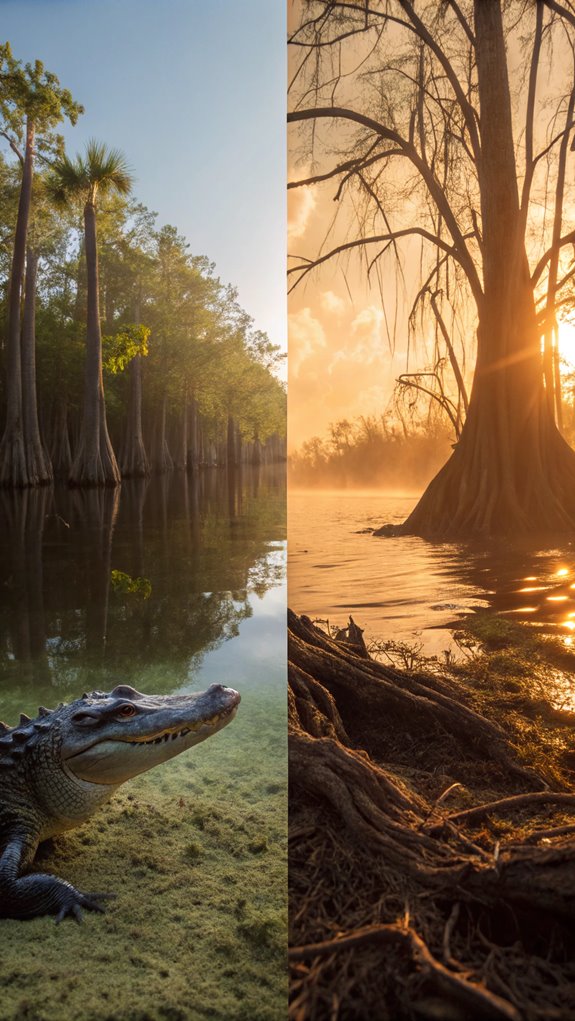
Delving into the world of alligators and crocodiles reveals that their habitats play a significant role in shaping their behavior, physiology, and overall survival. You’ll find alligators thriving in freshwater habitats, such as rivers, streams, lakes, ponds, and wetlands.
They also inhabit wetland ecosystems like swamps, marshes, and estuaries, which provide dense vegetation for hiding and basking. Although less tolerant of saltwater, alligators can inhabit brackish environments, especially in coastal areas.
As you explore their habitat distribution, you’ll notice that alligators are primarily concentrated in the southeastern United States, specifically in coastal areas from North Carolina to Texas. Florida and Louisiana have the highest densities due to abundant wetland habitats.
Smaller populations are scattered throughout Georgia, Alabama, Mississippi, and South Carolina in freshwater habitats. Alligators require warm temperatures to regulate their body heat and survive, typically in subtropical to tropical climates.
The presence of water sources nearby is also crucial, as alligators generally do not venture far from water, usually staying within 170 feet of a water body.
To survive, alligators need habitats with specific requirements, including aquatic vegetation for camouflage and supporting diverse ecosystems of prey species. They also require basking sites like logs, rocks, and shorelines exposed to sunlight for thermoregulation. The American alligator is considered a keystone species due to its crucial role in maintaining ecosystem balance.
Water depth and flow are essential, as they prefer slow-moving waters with sufficient depth for immersion and ambush tactics. Females need areas with debris, leaves, mud, and vegetation to build nests. The presence of both aquatic vegetation and suitable basking sites determines habitat quality.
Species Variations
Numerous species variations exist between alligators and crocodiles, many of which are evident in their physical characteristics, behaviors, and habitats. You can easily distinguish between these two large reptiles by looking at their snout shapes.
Alligators have a broad, rounded snout that’s U-shaped and appears rounded at the edges, while crocodiles have a narrow, tapered, triangular snout that’s pointed and V-shaped. This key distinguishing feature is just one way to tell these species apart.
You can also examine their dental structure for differences. Alligators have teeth that fit into sockets, including the fourth tooth in the lower jaw that fits into an internal socket in the upper jaw, making it invisible when the mouth is closed.
Crocodiles, on the other hand, have the fourth tooth in the lower jaw exposed. Alligators replace their teeth continuously, going through as many as 3,000 teeth in a lifetime.
Another notable physical characteristic of alligators is their armored body, which features embedded bony plates called osteoderms or scutes.
Behavioral traits also set alligators apart from crocodiles. You’ll hear alligators making barking sounds as juveniles and producing bellows, grunts, or hisses as adults. Their breeding habits are unique, too, with females building nests and males occupying larger territories.
During peak breeding season from March to May, females lay approximately 35 eggs, which incubate for about 2 months. After hatching, females remain protective of their young for about 2 years.
Males are generally larger than females across all crocodilian species, with some saltwater crocodiles reaching lengths of over 6 meters. They display territorial tendencies, especially males, through vocalizations used for communication during breeding.
Size and Strength
Now that you’ve learned about the distinct species variations between alligators and crocodiles, let’s examine the notable differences in their size and strength.
When comparing these two massive reptiles, size plays a key role. You’ll notice that crocodiles can grow up to 23 feet long, while alligators typically reach up to 19 feet. That’s about a 4-foot difference. On average, crocodiles are about 3 feet longer than alligators.
Weight also greatly differs between the two. Crocodiles can weigh up to 2,000 pounds, while alligators weigh up to 1,000 pounds. That’s twice the weight.
This disparity can be attributed to the larger bones in crocodiles, particularly the humerus and femur. Additionally, their muscle mass is greater, supporting their stronger bite force. This advantage translates to a substantial edge in combat against alligators.
Bite force is another area where crocodiles surpass alligators. They’ve a bite force of up to 3,700 psi, significantly stronger than alligators’ 2,125 psi. Their jaw power is also unparalleled in the animal kingdom.
This difference in size and strength points to distinct adaptations to their environments. Crocodiles are better adapted to living in various aquatic environments, which likely contributed to their larger size and strength.
The color of their skin is also different, with alligators displaying darker coloration. These distinct adaptations result in varying geographical distributions, with Nile crocodiles found mostly in Africa.
Distinctive Features
Distinctive features set alligators and crocodiles apart, making it easier to identify these large reptiles. When you look at their snouts, you’ll notice that alligators have broad, U-shaped snouts, while crocodiles have narrow, V-shaped snouts. This difference in snout shape affects their jaw alignment and tooth visibility.
Alligators have wider upper jaws that hide their lower teeth when their mouth is closed, whereas crocodiles have equal-sized jaws that make their lower teeth visible, even when their mouth is closed.
You can also identify these reptiles by their snout function and dental alignment. Alligators’ broad snouts are perfect for crushing hard-shelled prey like turtles, while crocodiles’ snouts are adapted for capturing fish and other smaller, fast-moving prey.
The fourth tooth on either side of an alligator’s lower jaw fits into an upper jaw socket, hidden when the mouth is closed. In crocodiles, this tooth is exposed. Additionally, alligators have webbed feet, while crocodiles have separated toes. These physical differences reflect their unique adaptations to their environments and prey preferences.
When observing these reptiles, you’ll also notice differences in their coloration and jaw skin. Alligators are darker, with gray and black colors, and have a more uniform snout color.
Crocodiles are lighter, with tans and brown colors, and often have a mottled snout. Crocodiles also have a jagged fringe on their jaw skin, which alligators lack. By paying attention to these distinctive features, you can easily tell alligators and crocodiles apart.
The behavior between the two species also highlights the difference: While alligators tend to only attack when they’re provoked, crocodiles are generally more aggressive.

Erzsebet Frey (Eli Frey) is an ecologist and online entrepreneur with a Master of Science in Ecology from the University of Belgrade. Originally from Serbia, she has lived in Sri Lanka since 2017. Eli has worked internationally in countries like Oman, Brazil, Germany, and Sri Lanka. In 2018, she expanded into SEO and blogging, completing courses from UC Davis and Edinburgh. Eli has founded multiple websites focused on biology, ecology, environmental science, sustainable and simple living, and outdoor activities. She enjoys creating nature and simple living videos on YouTube and participates in speleology, diving, and hiking.
From the shop
Gifts for people who love the wild
Wildlife themed t-shirts, notebooks, tote bags, bandanas and guides, designed by an ecologist.
Visit the shop