
The jaguar is the cat that solved a different problem. Lions cooperate, cheetahs run, leopards climb. The jaguar built a head strong enough to bite through bone, and then went into the water after animals that bite back. It is the only big cat that routinely kills by punching its canines through the skull of its prey, and one of very few predators anywhere that treats a caiman as food rather than as a rival.
I am a wildlife biologist with an MSc in ecology. Every figure below comes from a published study or a conservation assessment, and where a familiar claim turns out to be shakier than it sounds, I say so rather than pass it along.
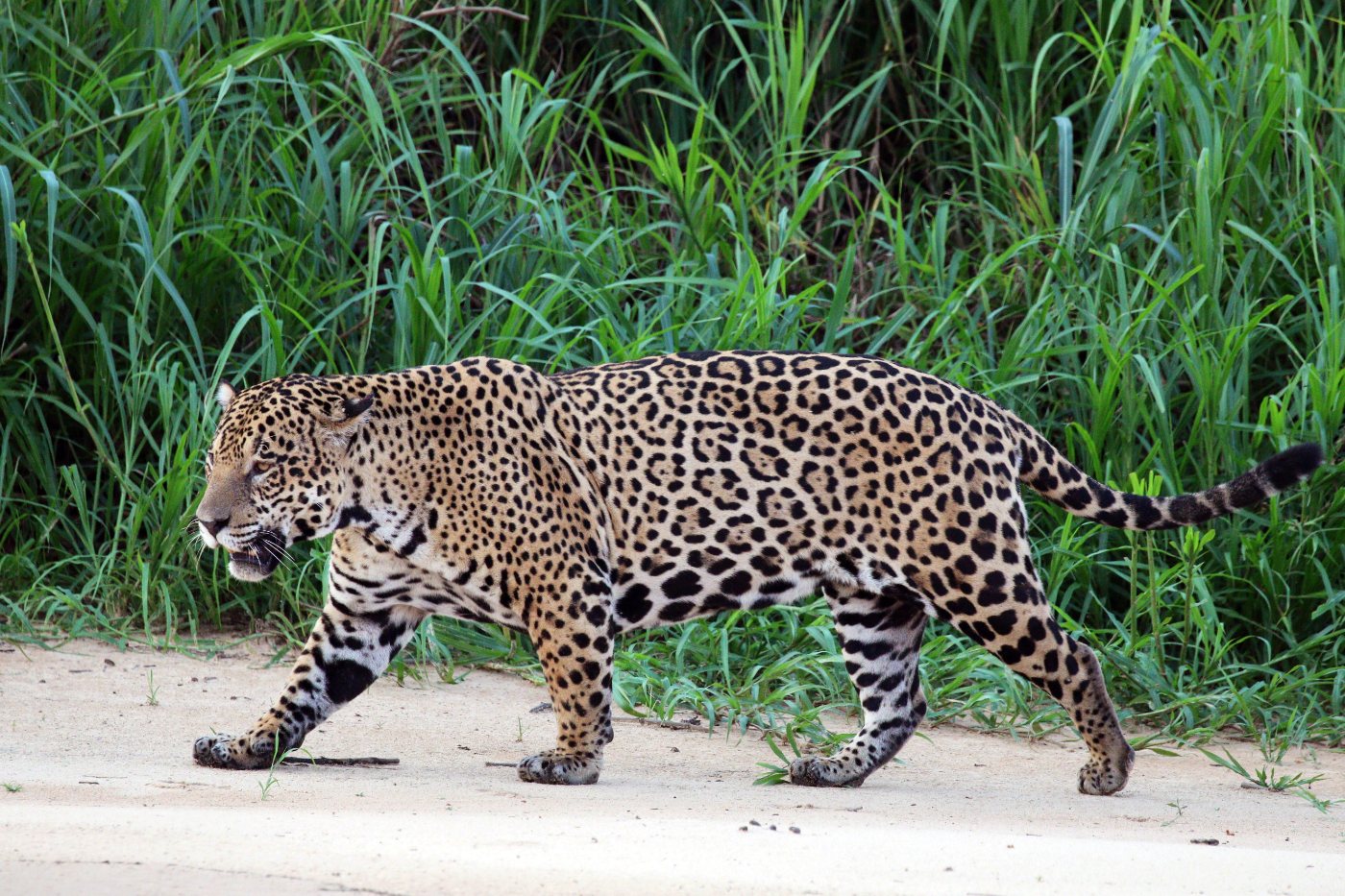
Jaguars at a glance
| Scientific name | Panthera onca |
| Family | Felidae, genus Panthera |
| Size rank | Largest cat in the Americas, third largest in the world after tigers and lions |
| Weight | 36 to 148 kg, with Pantanal animals at the top of that range |
| Body length | 110 to 170 cm, plus a tail of 44 to 80 cm |
| Range | Southern Arizona to northern Argentina, across 34 recognised subpopulations |
| Range remaining | 51 percent of the historic range |
| Amazon population | 57,000 to 64,000, which is 89 percent of all jaguars |
| Melanism | Around 10 percent are black, and the trait is dominant |
| Killing method | A bite through the skull, unique among the big cats |
| IUCN status | Near Threatened |
The bite, and what the numbers actually say
You will read constantly that the jaguar has the strongest bite of any big cat. That is true and false at the same time, and the distinction is worth getting right because almost nobody makes it.
- In absolute force, the jaguar loses. Christiansen and Wroe modelled canine bite force across large carnivores and put the tiger at about 1,472 newtons, the lion at about 1,315, and the jaguar at about 887. A tiger simply has a bigger head.
- Relative to body size, the jaguar wins. Correct for mass and the jaguar comes out at the top of the big cats. Kilogram for kilogram nothing else in the genus bites harder.
So the honest sentence is: pound for pound the jaguar has the most powerful bite of any big cat. Drop the qualifier and the claim becomes wrong. The figure of 1,500 psi that circulates online has no traceable measurement behind it and I would not repeat it.
The anatomy behind the ratio is well described. The jaguar’s skull is short and broad, which shortens the lever arm between the jaw joint and the canines, and the temporalis and masseter muscles have a larger cross sectional area than in comparable cats. It is the difference between a long spanner and a short one. The jaguar traded reach for torque.
What that buys is covered in how strong are jaguars.
The skull bite
Almost every big cat kills the same way. A lion, a tiger or a leopard takes the throat and holds until the animal suffocates, or bites the nape and separates the vertebrae. It is a method that works on hoofed prey with long, vulnerable necks.
The jaguar frequently does something else. It bites the head, driving its canines through the temporal bones of the skull directly into the brain. Death is immediate rather than gradual. No other big cat does this as a matter of routine.
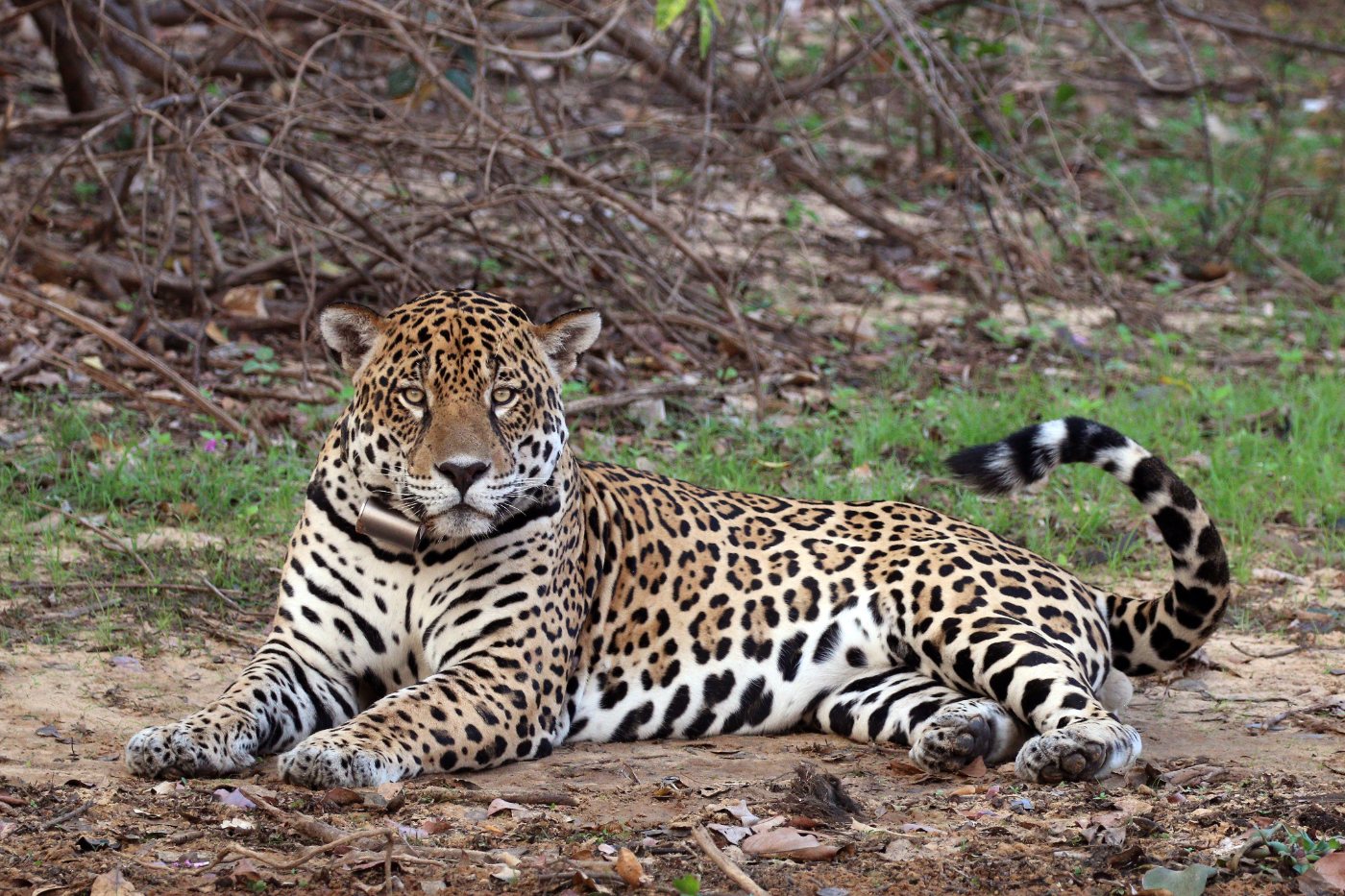
Why it evolved becomes obvious once you look at what a jaguar eats. Much of its prey is armoured, or short necked, or capable of fighting back at close range:
- Caiman. A throat bite on a caiman puts a cat’s head directly in front of the one weapon it must avoid. A skull bite from above and behind does not.
- Turtles. A jaguar can bite through the shell of a river turtle, which almost nothing else on the continent can do.
- Armadillos and peccaries. Short necked, armoured, or aggressive in groups.
- Anacondas. Documented, and a throat hold on a constrictor is a poor idea.
The pattern is consistent. A jaguar hunts things that punish a slow kill, so it evolved a fast one, and the head it needed to do that is the same head that produces the bite force statistic everyone quotes. The technique and the stalk are covered in jaguar hunting explained and the reptile question specifically in do jaguars eat crocodiles.
Jaguar or leopard
These two get confused constantly, and they live on different continents, so a photograph is usually all you need once you know what to look at.
| Jaguar | Leopard | |
|---|---|---|
| Rosettes | Larger, fewer, with spots inside them | Smaller, denser, empty inside |
| Build | Stocky, deep chested, short legged | Longer, lighter, more slender |
| Head | Broad and heavy, powerful jaw | Smaller and rounder in proportion |
| Tail | Shorter | Longer, used for balance in trees |
| Where | The Americas | Africa and Asia |
| Kill method | Often a skull bite | Throat bite, then hauls the kill into a tree |
The spots inside the rosettes are the single reliable field mark. Everything else varies by individual.
Black jaguars, and why they are not a species
There is no such animal as a black panther. The name describes a colour, not a species, and it is applied to two different cats: melanistic jaguars in the Americas and melanistic leopards in Africa and Asia.
About 10 percent of jaguars are melanistic, and the genetics are one of the more elegant stories in cat biology, because the two species arrived at the same appearance by different routes.
- In jaguars melanism comes from a 15 base pair deletion in MC1R, and the trait is dominant. One copy is enough. A black jaguar can have spotted parents only if one of them carries it.
- In leopards it comes from a recessive form of a completely different gene, ASIP. Two copies are needed, so two spotted leopards can produce a black cub.
Same look, different gene, opposite inheritance. That is convergent evolution operating at the level of a single trait, in two cats that separated millions of years ago.
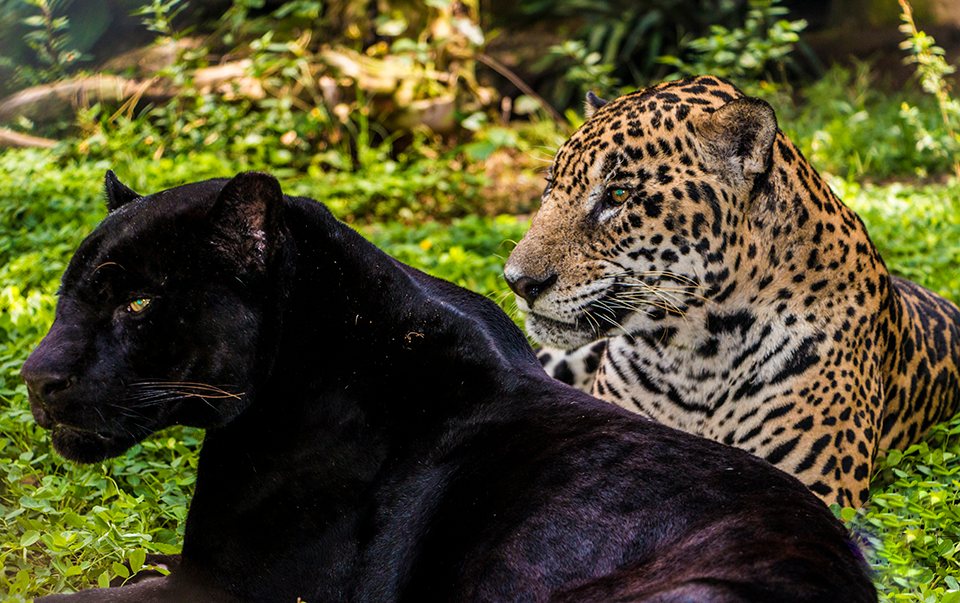
Two things worth knowing about black jaguars. The rosettes are still there. In direct light or at the right angle you can see the pattern as a darker black against black, which is why camera trap operators can still identify individuals. And melanism is not evenly distributed: it is concentrated in dense, moist forest rather than open or temperate habitat, which suggests it is being selected for rather than simply tolerated. Whether the advantage is camouflage, thermoregulation or something tied to immune function is still open.
Water, and why the jungle
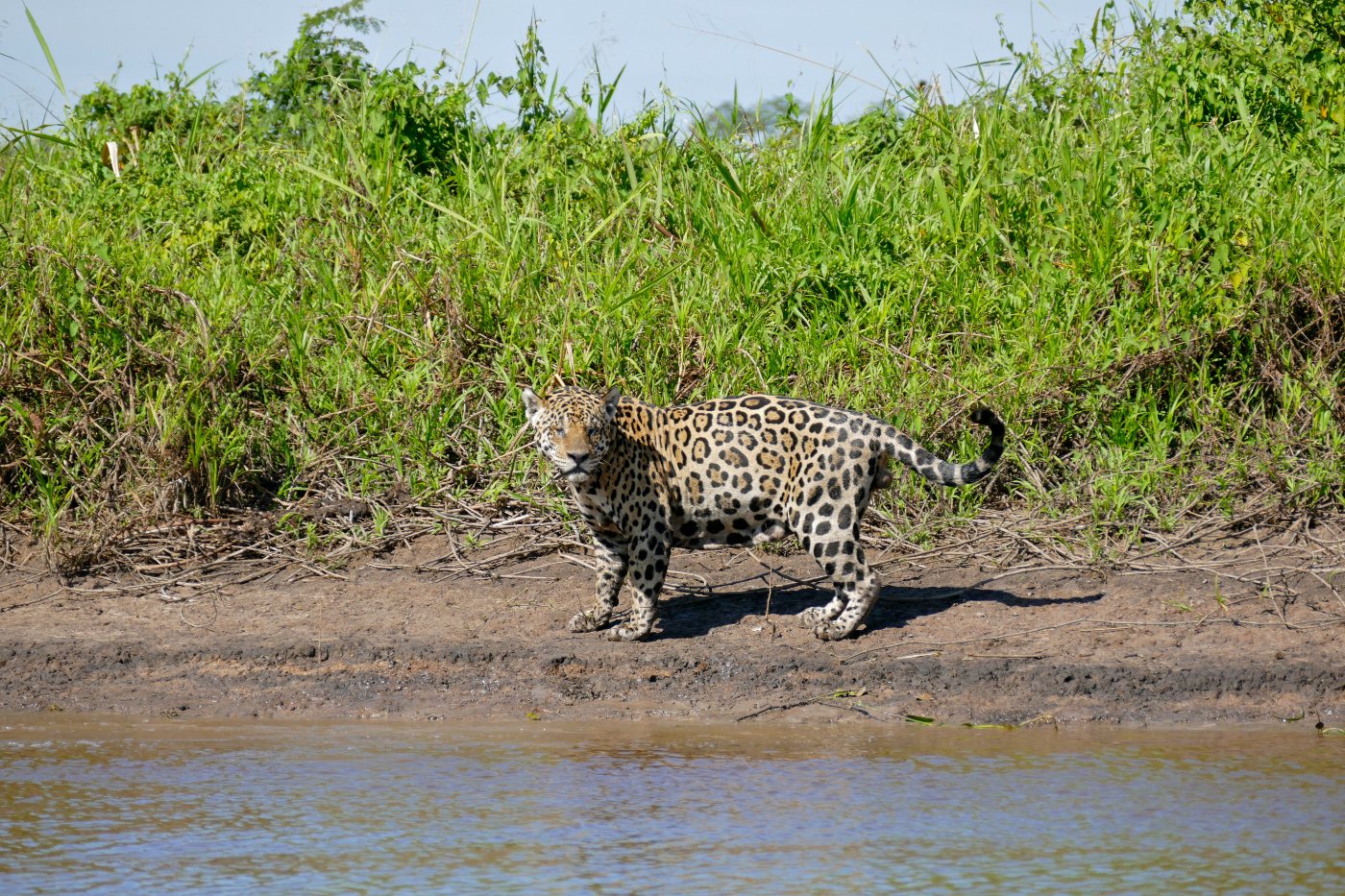
Jaguars are the most water associated of the big cats after tigers. They swim readily, cross rivers without hesitation, hunt from riverbanks, and take fish, turtles and caiman. In the Pantanal, jaguars are often found by boat, along water, because that is where they live.
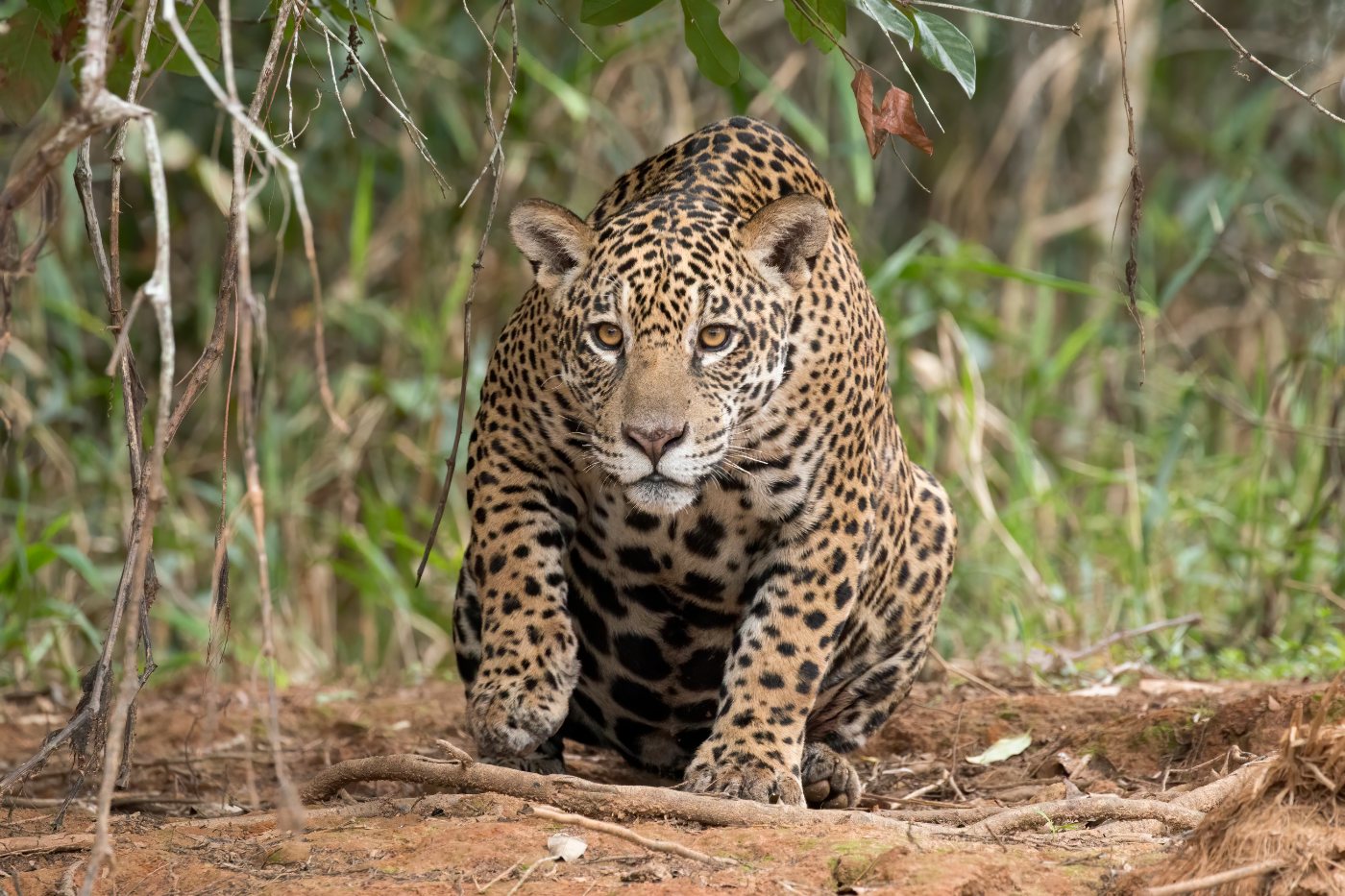
The reason for the rainforest association is not that jaguars need jungle. It is that jungle is what is left. Jaguars did well in dry scrub, grassland and wetland too, and much of that has been converted to farmland faster than forest has. The Amazon now holds 57,000 to 64,000 jaguars, which is 89 percent of the world population. That is not a preference. It is a last refuge.
What the forest genuinely does provide is cover for an ambush predator, water, and dense prey. A jaguar hunts by getting close, and closed habitat is where that works. My longer answer is in why do jaguars live in the jungle and the wider picture in the ecology of jaguars.
Speed, and a number to be careful with
Jaguar speed is one of those figures that has drifted upward through repetition. You will see 80 km per hour quoted. There is no measurement behind it.
What the anatomy says is more useful than a disputed number. A jaguar is built like a wrestler, not a sprinter: heavy, deep chested, short in the leg, with a low centre of mass. That build is superb for grappling, climbing, swimming and short explosive charges, and poor for sustained speed. Realistic estimates put a jaguar in the region of 50 to 65 km per hour over a very short distance, below a leopard and far below a cheetah.
It barely matters, because a jaguar does not chase. It closes to within a few metres under cover and ends the hunt in one or two bounds. Speed is not the tool it is using. The full treatment is in how fast can a jaguar run.
What a jaguar eats
The jaguar has one of the broadest diets of any large cat. More than eighty prey species have been recorded across its range, and the list reads less like a menu than an inventory of whatever is available.
- Peccaries and capybara, the mainstays across much of the range. A capybara is the largest rodent on earth and a very convenient size for a jaguar.
- Deer, mainly brocket and marsh deer.
- Caiman, taken often enough in the Pantanal to be a significant part of the diet there.
- Turtles, including river turtles whose shells the jaguar simply bites through.
- Armadillos, agoutis, coatis, birds, fish and anacondas.
- Cattle, wherever ranching has replaced wild prey, which is the root of most conflict with people.
That flexibility is why jaguars have held on across so much of Latin America while more specialised predators have not. It is also why they end up on ranches. A cat that can adapt to eighty prey species will adapt to the eighty first if you put it in front of them.
Territory and solitude
Jaguars are solitary outside of mating and mother with cubs. Males hold ranges that overlap those of several females and defend them against other males. Range sizes vary enormously with prey density: a jaguar in the rich Pantanal needs a fraction of the area a jaguar in dry Chaco scrub does.
- Gestation is about 100 days, and litters are usually one to four cubs, most often two.
- Cubs stay with the mother for roughly one and a half to two years.
- Females breed from around three years old, males a little later.
- Communication is by scent marking, scrapes, and a call that is not a lion style roar but a series of deep rasping coughs, the sound often written as saw like.
Jaguars do have the anatomy to roar, being members of Panthera, but the sound is structurally different from a lion’s and carries less far.
Where jaguars are losing ground
The jaguar is listed as Near Threatened, which sits between Least Concern and the threatened categories, and that listing hides a very uneven picture. The species as a whole is not on the brink. Large parts of its former range are already empty.
- 51 percent of the historic range is gone. The jaguar has lost about half of everywhere it used to be.
- It is extinct in Uruguay and El Salvador, and effectively gone from the United States apart from occasional males wandering into Arizona from Mexico.
- 89 percent of the world population is in Amazonia. Everything outside that is a set of small, fragmented, vulnerable subpopulations.
The pressures, in order:
- Habitat loss and fragmentation. Deforestation for cattle and soy, and roads that cut populations into pieces too small to hold their own genetic diversity.
- Prey depletion. Hunting removes peccary and capybara, and a forest with no prey holds no jaguars regardless of how many trees are standing.
- Retaliation for livestock. The direct killing that follows when wild prey runs out and cattle do not. This is the single biggest source of jaguar deaths in ranching country.
- The fang and body part trade. Newer and growing. Jaguar teeth, skulls and paste have started appearing in trafficking seizures in Bolivia, Peru and Suriname, moving along the same routes as tiger parts and often filling the same demand.
That last one deserves attention precisely because it is recent. Tiger populations are small enough and protected enough that supply is constrained. The jaguar is the substitute, and it is being drawn into a market it had no part in a decade ago.
What is working
The jaguar has one advantage most threatened big cats do not: a continuous corridor is still physically possible. The species’ range runs unbroken in principle from Mexico to Argentina, and the Jaguar Corridor initiative is built on exactly that, protecting and reconnecting the links between core populations rather than treating each park as an island. It is one of the few genuinely continental scale carnivore plans anywhere, and it exists because the jaguar has not yet been fragmented past the point where it would be pointless.
Alongside that, the same unglamorous things that work everywhere: compensation for livestock losses, predator proof enclosures, keeping prey populations intact, and enforcement against trafficking.
Common questions about jaguars
Do jaguars have the strongest bite of any big cat?
Relative to body size, yes. In absolute force, no: the tiger bites hardest at about 1,472 newtons against the jaguar’s roughly 887. The qualifier is the whole claim.
What is a black panther?
Not a species. It is either a melanistic jaguar or a melanistic leopard. About 10 percent of jaguars are black, from a dominant mutation in MC1R, and the rosettes are still visible in the right light.
How do you tell a jaguar from a leopard?
Look inside the rosettes. Jaguar rosettes have spots in the middle, leopard rosettes are empty. Jaguars are also stockier, with heavier heads and shorter tails, and they live in the Americas.
Do jaguars really kill caiman?
Yes, routinely in some areas such as the Pantanal. The skull bite is what makes it survivable: attacking the head from above avoids the one part of a caiman that can kill a cat.
How many jaguars are left?
The Amazon holds 57,000 to 64,000, about 89 percent of the total. The species occupies 51 percent of its historic range and is listed as Near Threatened.
Are jaguars dangerous to people?
Very rarely. Attacks on humans are unusual and almost always involve a cornered, wounded or captive animal. A jaguar’s default response to a person is to leave.
Can jaguars climb and swim?
Both, well. They climb to rest and to ambush, and they swim by choice rather than necessity, which is unusual in cats.
Everything on this site about jaguars
- Adaptations of a jaguar
- How fast can a jaguar run
- How strong are jaguars
- Jaguar hunting explained
- Do jaguars eat crocodiles
- Why do jaguars live in the jungle
- The ecology of jaguars
Jaguars are one of the big cats. The two they are most often compared with are covered in full at tigers and lions, and for the rest of the animal guides on this site, start from mammals.
Sources
- IUCN Cat Specialist Group, species account for Panthera onca, including range, population and body measurements.
- Christiansen, P. and Wroe, S. (2007). Bite forces and evolutionary adaptations to feeding ecology in carnivores. Ecology 88: 347 to 358.
- Eizirik, E. et al. Molecular genetics and evolution of melanism in the cat family, including the MC1R deletion in jaguars.
- Panthera, jaguar species profile and the Jaguar Corridor Initiative.
- IUCN Red List assessment for Panthera onca, Near Threatened.
From the shop
Gifts for people who love the wild
Wildlife themed t-shirts, notebooks, tote bags, bandanas and guides, designed by an ecologist.
Visit the shop