
The tiger is the largest cat that has ever been weighed alive, and the only big cat whose coat is patterned in stripes rather than spots or plain colour. It is also one of the most studied animals on earth, and one of the least understood by the people who write about it. Almost every popular tiger page repeats the same handful of numbers, most of them uncited and several of them wrong.
This page is my attempt at the opposite. I am a wildlife biologist with an MSc in ecology, and everything below is either a measured figure from a published study or clearly labelled as an estimate. Where the science disagrees with itself, and on tigers it often does, I say so instead of picking the tidier answer.
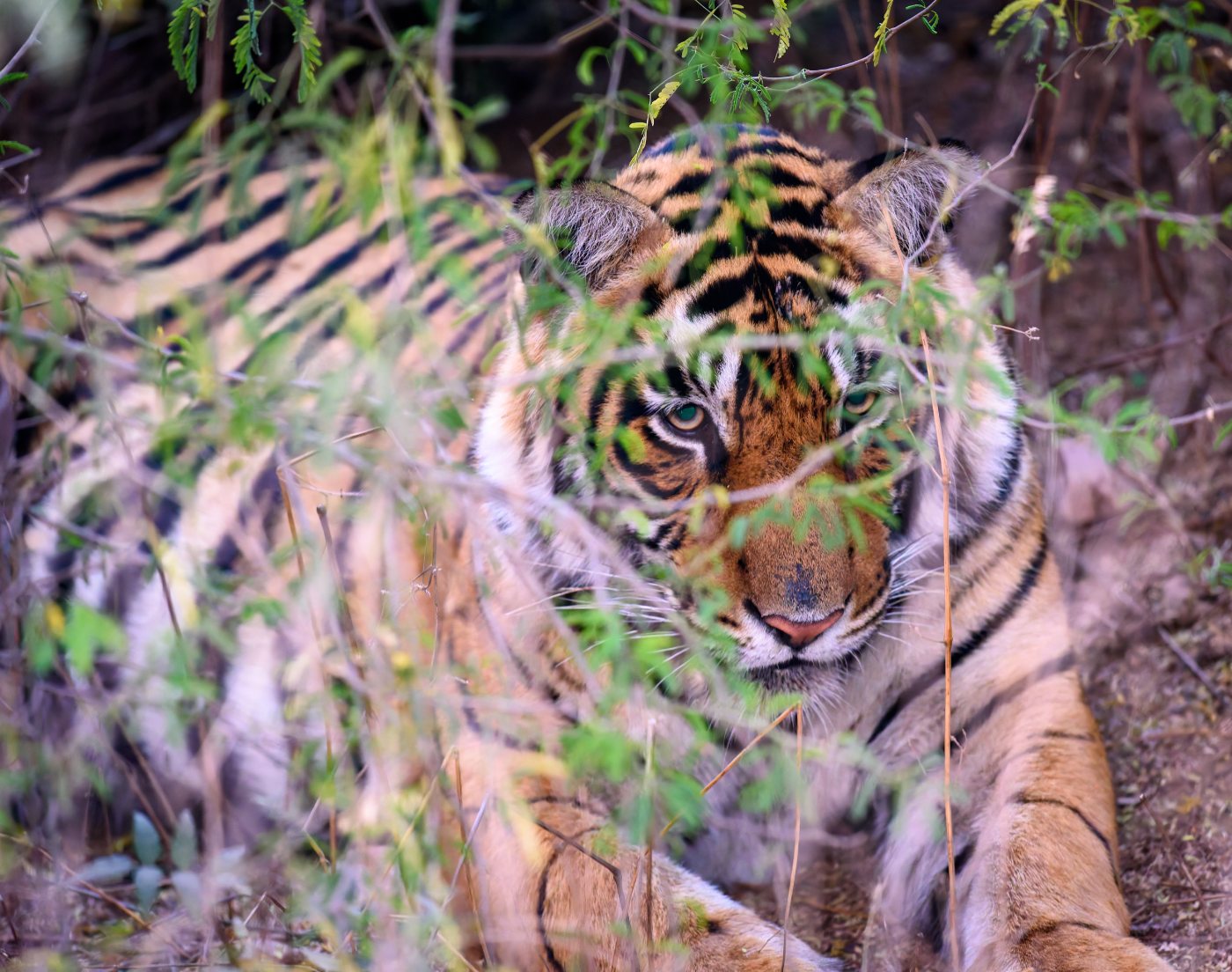
Tiger at a glance
| Scientific name | Panthera tigris (Linnaeus, 1758) |
| Family | Felidae, genus Panthera |
| Living subspecies | Two or six, depending on which framework you follow (explained below) |
| Body length | 150 to 230 cm head and body, plus a tail of 90 to 110 cm |
| Weight | 75 to 325 kg across the whole species |
| Lifespan | Roughly 12 to 15 years in the wild, up to about 19 in captivity |
| Diet | Obligate carnivore, mostly large ungulates averaging around 91 kg |
| Kill rate | One large prey animal roughly every 6.5 days |
| Social structure | Solitary and territorial, apart from mothers with cubs |
| IUCN Red List | Endangered |
| Wild population | About 5,574 (Global Tiger Forum estimate, 2023) |
| Range remaining | Less than 7 percent of the historical range |
| Countries with wild tigers | Ten to thirteen, depending on how breeding populations are counted |
How many kinds of tiger are there?
This is the single most confused topic in popular tiger writing, and the confusion is honest, because the experts genuinely disagree.
The traditional list has nine subspecies: six alive and three extinct. In 2017 the Cat Classification Task Force of the IUCN Cat Specialist Group carried out a full revision of cat taxonomy and cut the tiger down to two subspecies, Panthera tigris tigris for all mainland tigers and Panthera tigris sondaica for the Sunda island tigers of Sumatra, Java and Bali. Their argument was that mainland tigers show weak and clinal differences rather than clean breaks.
Then in 2018 a team led by Yue-Chen Liu published whole genome sequences from 32 tigers in Current Biology and found the opposite. Six living groups came out as distinct evolutionary units with very little gene flow between them, all descended from a common ancestor roughly 110,000 years ago. The study also found 14 genes under natural selection, the strongest signal being ADH7 in Sumatran tigers, a gene tied to body size. The likely reading is that island tigers shrank because smaller bodies need less food when the available prey is small.
So the honest answer is: two subspecies if you are following the 2017 morphological revision, six if you are following the 2018 genomic evidence. Conservation practice has mostly stayed with six, because managing Amur tigers and Sumatran tigers as one unit would be a disaster in practice. I use the six group names on this site for that reason.
The six living tigers
| Tiger | Scientific name | Where it lives | Rough wild numbers |
|---|---|---|---|
| Bengal tiger | P. t. tigris | India, Nepal, Bhutan, Bangladesh | Around 4,000, the great majority of all wild tigers |
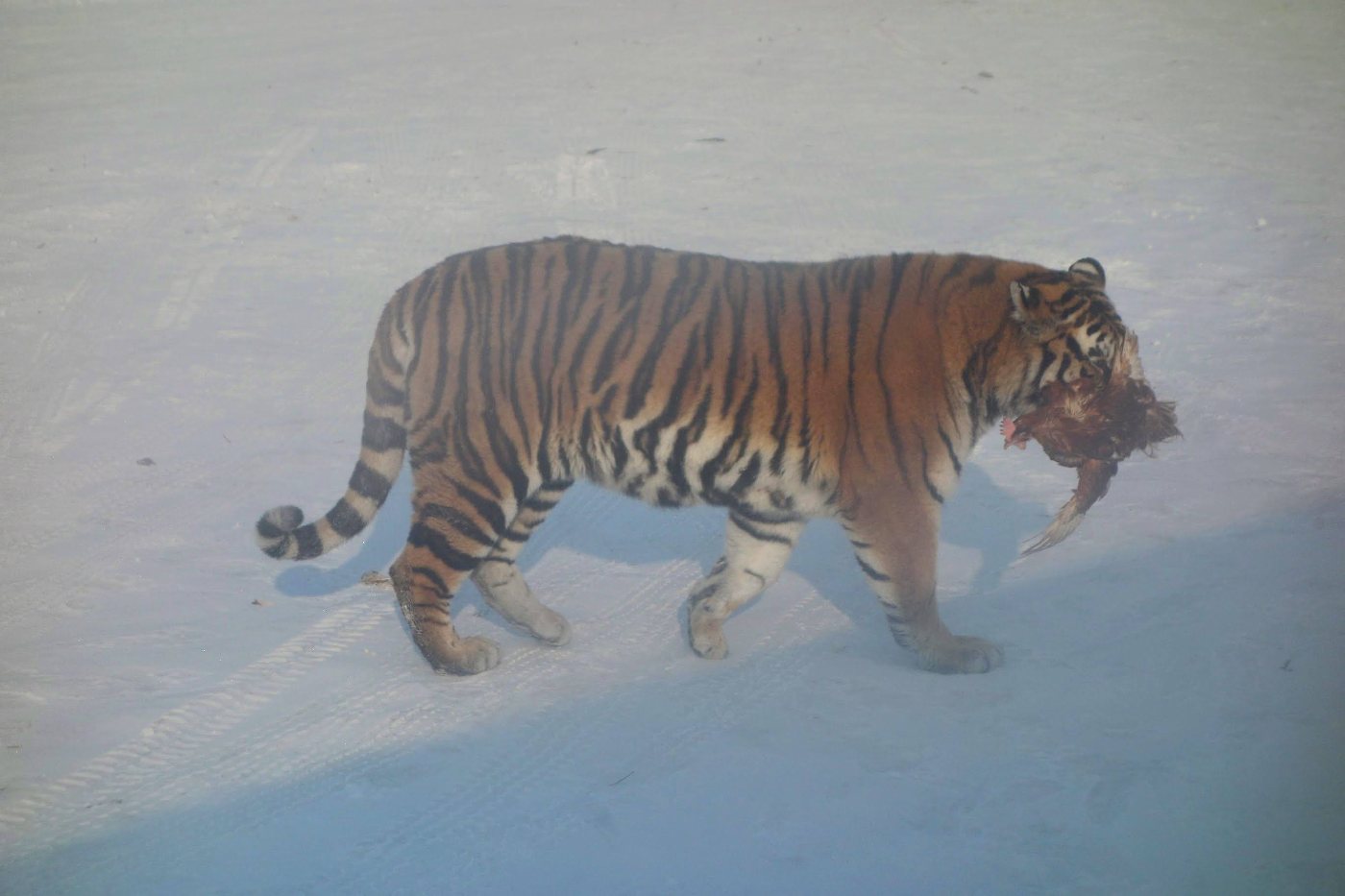
| Amur or Siberian tiger | P. t. altaica | Russian Far East, north east China | 265 to 486 in Russia (IUCN, 2022), plus a small number in China |
| Indochinese tiger | P. t. corbetti | Thailand, Myanmar, Laos | A few hundred at most, and falling |
| Malayan tiger | P. t. jacksoni | Peninsular Malaysia | Fewer than 150, critically endangered |
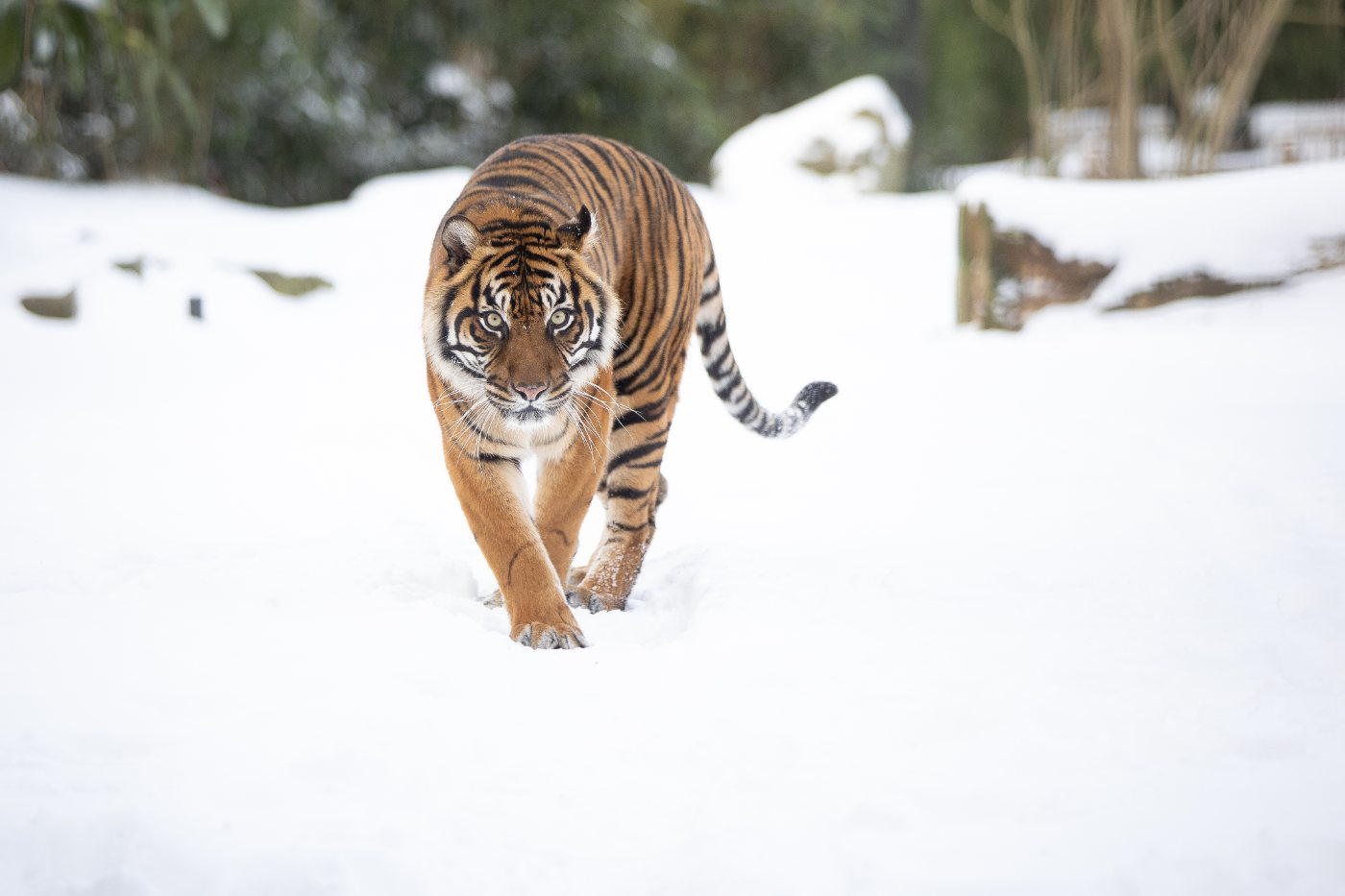
| Sumatran tiger | P. t. sumatrae | Sumatra, Indonesia | Roughly 400 to 600 |
| South China tiger | P. t. amoyensis | Formerly central and southern China | None confirmed in the wild since the 1970s |
The three that are gone
- Caspian tiger (P. t. virgata), from Turkey through Iran and Central Asia, last records in the 1970s. Genetically it was almost identical to the Amur tiger, which is why reintroduction of Amur tigers to Kazakhstan is now being attempted.
- Javan tiger (P. t. sondaica), last confirmed in the 1970s in Meru Betiri. Occasional claimed sightings continue and one 2019 hair sample caused a stir, but there is no accepted evidence of a surviving population.
- Bali tiger (P. t. balica), the smallest tiger ever recorded, gone by the 1940s. It is the only big cat known to have been driven extinct on a single island within living memory.
If you want the two most different tigers side by side, I have a full comparison of the Siberian tiger and the Bengal tiger, which are separated by about 4,000 km, 30 degrees of latitude and roughly 60 kg of body mass.
How big are tigers really?
Across the whole species the IUCN Cat Specialist Group gives a range of 75 to 325 kg, with a head and body length of 150 to 230 cm and a tail of 90 to 110 cm. That range is enormous because it spans a Sumatran female and an Amur male, animals that differ more in size than a coyote differs from a wolf.
| Tiger | Male weight | Female weight |
|---|---|---|
| Bengal | 200 to 260 kg | 100 to 160 kg |
| Amur | 160 to 190 kg average | 110 to 130 kg average |
| Sumatran | 100 to 140 kg | 75 to 110 kg |
Two things in that table surprise people. The first is that wild Amur tigers average less than wild Bengal tigers. The Amur tiger has the reputation of being the giant of the species, and the very heaviest individuals ever recorded were Amur males, but the modern wild population lives on thin prey in a hard climate and is not, on average, heavier than a well fed Bengal tiger in central India. Zoo Amur tigers, which are fed generously and move little, are where the enormous published weights usually come from.
The second is how large the sex difference is. Male tigers commonly weigh 60 to 70 percent more than females of the same population. That is a bigger gap than in lions and it shapes everything about tiger society, from territory size to how long a mother can defend cubs from a strange male.
Strength, bite and jaws
Tiger strength is where popular writing goes furthest off the rails, so here is what has actually been measured.
- Bite force. Christiansen and Wroe (2007) modelled canine bite force in large carnivores from skull anatomy and put the tiger at about 1,472 newtons, ahead of the lion at 1,315 N and well ahead of the jaguar at 887 N. Note that this is the opposite of the popular claim that jaguars outbite tigers. Jaguars have the highest bite force relative to their size, which is a different statement.
- Bite force quotient. Correcting for body mass, Wroe and colleagues gave the tiger a BFQ of about 139, the lion 128 and the leopard 98. So the tiger is strong both in absolute terms and for its size.
- Canines. 6.4 to 7.6 cm of exposed crown, the longest of any living cat. They are oval in cross section, which resists bending when a struggling animal twists.
- Dragging. There are repeated field reports of tigers moving carcasses heavier than themselves, including gaur weighing several hundred kilograms, usually by short pulls rather than one continuous haul. Exact figures are rarely measured, so treat any precise number you see with suspicion.
The functional point is that a tiger is built for grappling, not for a long chase. The forelimbs are heavily muscled and the shoulder blades are large and mobile, which is what lets a tiger hold a struggling ungulate still enough to place a killing bite. I go into the anatomy in more detail in how strong are tigers.
Speed, jumping and swimming
Running
A tiger can reach roughly 56 km per hour, but only in a short burst over a few dozen metres. It has no distance speed at all. This is why the hunt is built around cover and a close approach rather than pursuit, and why sambar and chital, which are slower over one second but far better over one minute, escape so often. There is more on the mechanics in how fast a tiger can run.
Jumping
No one has measured a maximum tiger jump under controlled conditions, and anyone quoting a precise figure is guessing. What we do have is better than a guess: the standards zoos are required to build to, and the cases where those standards failed.
- The Association of Zoos and Aquariums recommends a barrier of at least 5 m (16.4 ft) for tigers, a figure its spokesman described as based on the opinions of a group of experts rather than on measurement.
- In 2007 a tiger left its enclosure at San Francisco Zoo over a wall of 3.8 m (12.5 ft), well below the AZA minimum. So 3.8 m is demonstrably not enough.
- A Bengal tigress in Nepal in 1974 was recorded getting onto a limb about 4.6 m (15 ft) up while defending cubs.
- Horizontal leaps of around 10 m are widely reported in the field literature, which is easier than it sounds because a running long jump uses momentum a standing vertical jump cannot.
What animals normally do, and what they can do, are often very different things.
Dale Miquelle, Wildlife Conservation Society
That is the sentence to keep in mind whenever you read a tiger performance statistic. A motivated tiger and a bored tiger are not the same animal. My full breakdown, including how tigers use claws to convert a jump into a climb, is in how high can tigers jump.
Swimming
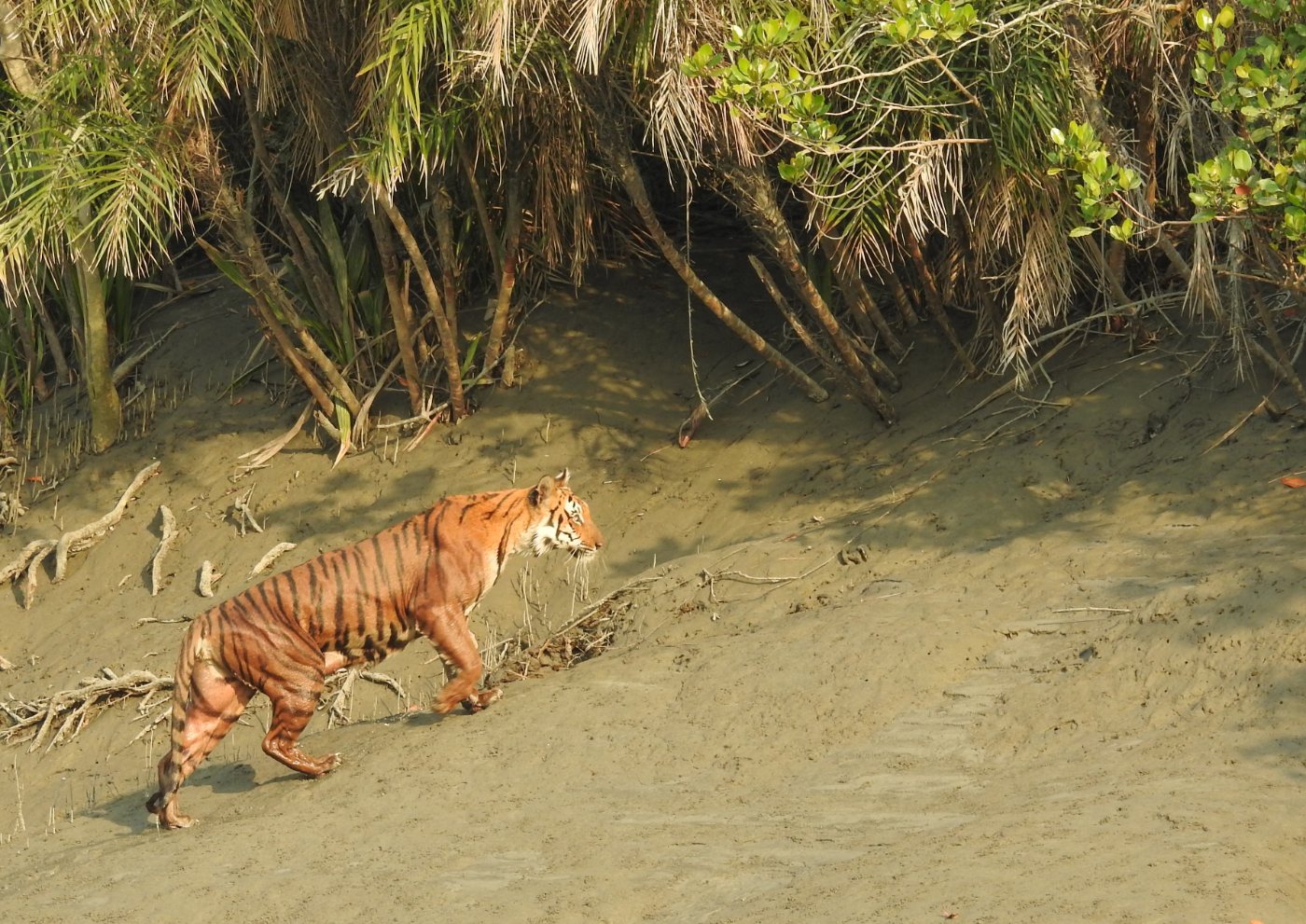
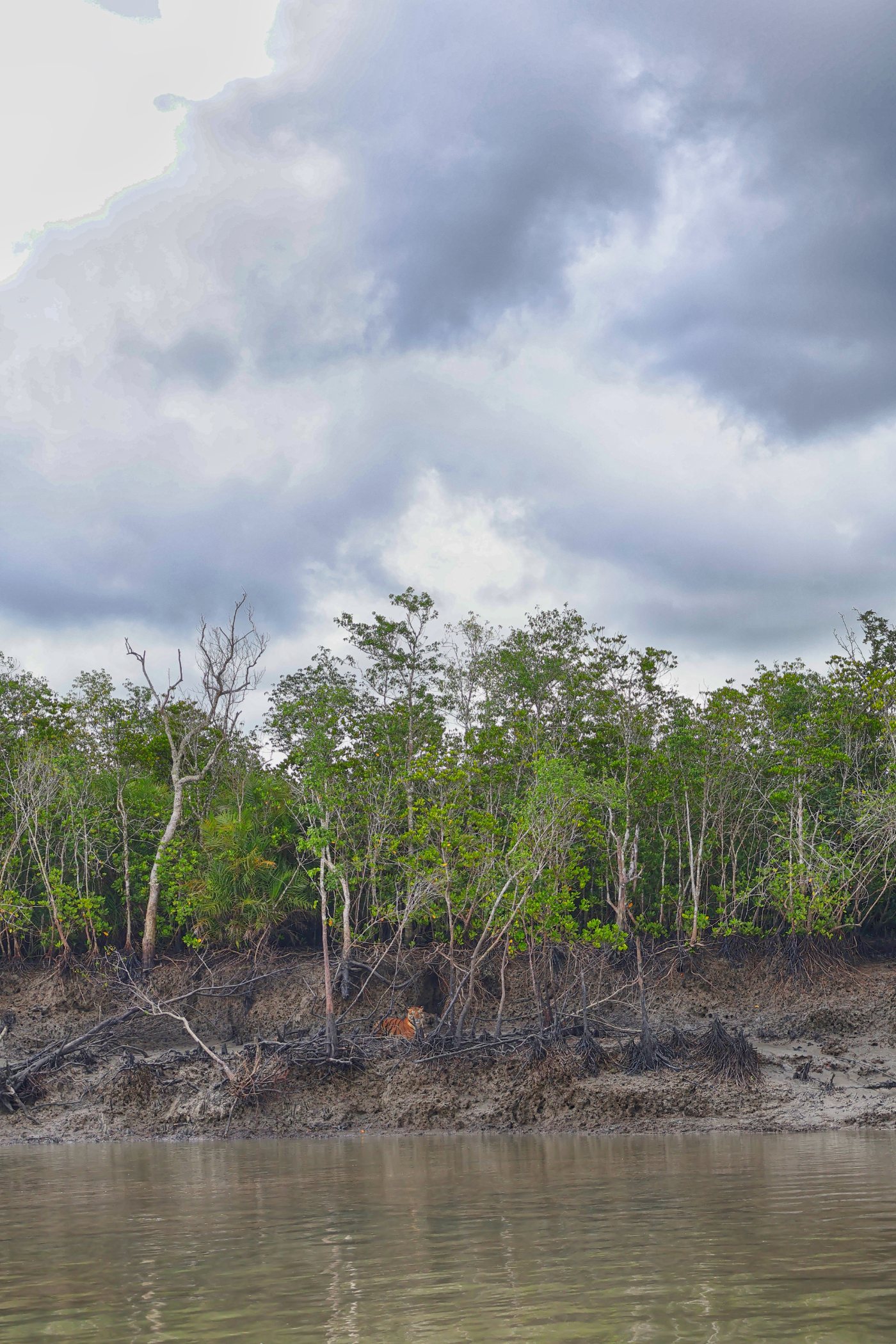
Tigers are the strongest swimmers of any big cat. They cross rivers as a matter of routine and have been recorded swimming channels up to about 8 km wide. In the Sundarbans, the mangrove delta shared by India and Bangladesh, swimming is not a curiosity but the normal way of moving through the range, because the forest is cut into islands by tidal creeks that fill and empty twice a day. Tigers there also drink brackish water, hunt in mud that would exhaust a lion, and have the highest rate of attacks on people anywhere in the tiger’s range.
Stripes: what they are for and why no two tigers match
Every tiger carries a stripe pattern that is unique to that individual, in the same way a human fingerprint is. This is not a poetic comparison, it is a working research tool. Camera trap surveys across India, Nepal, Thailand and Russia identify individual tigers from flank photographs, which is how national population estimates are produced at all. Without unique stripes we would have no reliable idea how many tigers exist.
Some further points that popular pages usually get wrong:
- The stripes are in the skin, not only the fur. Shave a tiger and the pattern is still there. The pigment pattern is set in the skin and the hair follicles simply follow it.
- They are mostly vertical on the body and horizontal on the limbs and forehead, which matches the direction of the grass and shadow a stalking tiger moves through.
- Orange is not a camouflage failure. Deer, wild boar and cattle are dichromats. They lack the cone type that lets primates separate red from green, so to a sambar a tiger in dry grass is not orange on green, it is a broken grey shape in grey vegetation. Tiger colour is tuned to the eyes of the animals being hunted, not to ours.
- The pattern is developmental, not learned. Cubs are born with it fully formed.
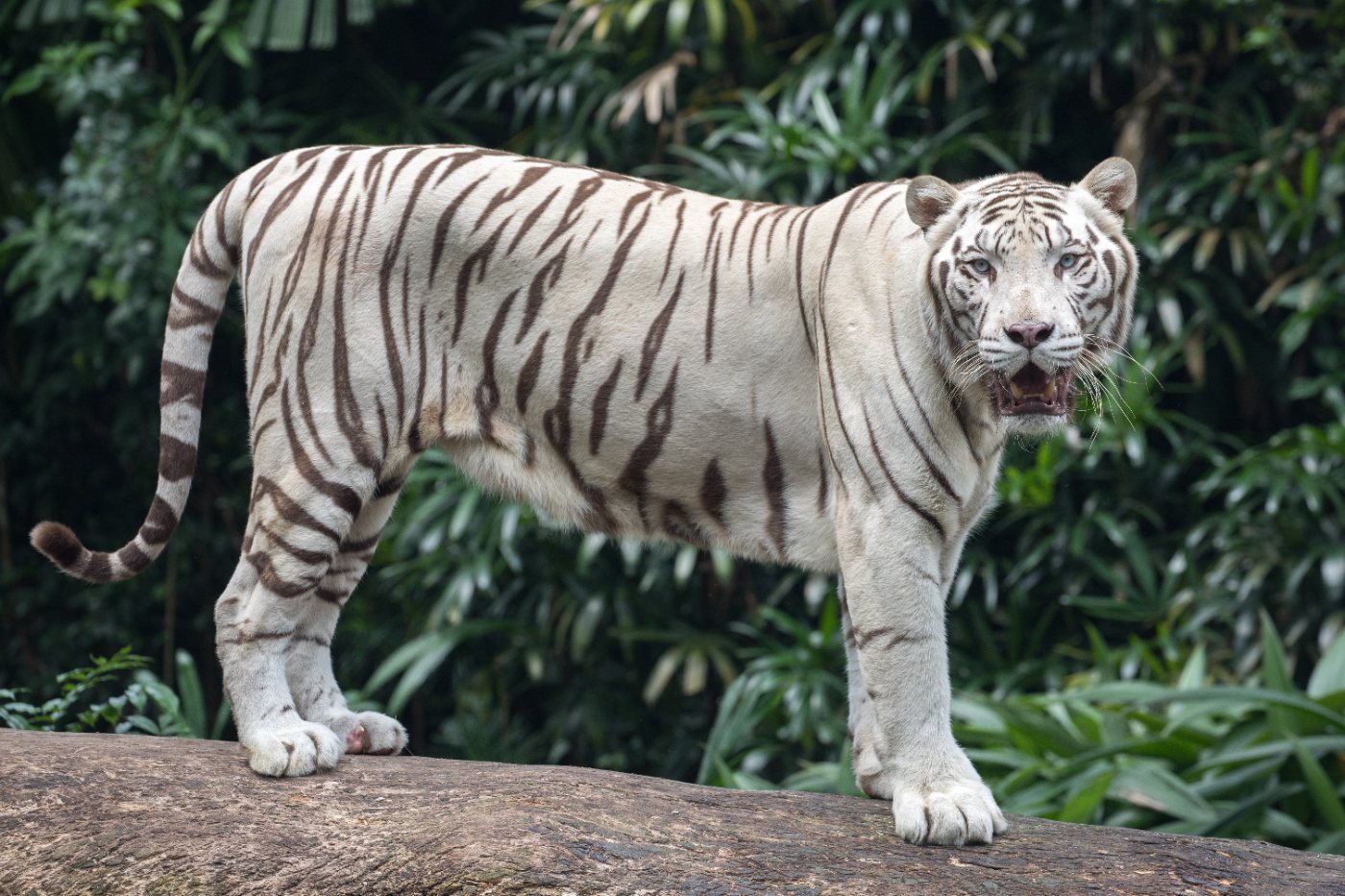
White tigers, golden tigers and black tigers
All three are colour variants of ordinary tigers, not separate species or subspecies, and each one is now traced to a specific gene.
- White tigers carry a single change in the pigment gene SLC45A2, identified by Xu and colleagues in Current Biology in 2013 from a family of 16 tigers with three full genomes sequenced. The variant blocks red and yellow pigment while leaving black almost untouched, which is exactly why a white tiger still has dark stripes. It is not albinism: albinos have no pigment at all and pink eyes, white tigers have blue eyes and full black striping. Historical records of white tigers in India go back to the 1500s and the last wild one was shot in 1958.
- Golden or strawberry tigers show a paler, more diffuse pattern from a separate recessive variant. Every known individual traces back to captive Bengal lines.
- Black or pseudo melanistic tigers have stripes so broad they merge. Sagar and colleagues showed in PNAS in 2021 that a single base change in the Taqpep gene is responsible, and that the variant sits at a frequency of about 0.58 in the tigers of Similipal in Odisha. The reason is not that black is useful there. Similipal’s tigers are isolated by roughly 500 km from the nearest population, founded by very few animals, and the variant simply drifted upward. It is one of the clearest examples anywhere of what genetic isolation does to a small population.
The conservation footnote matters. Captive white tigers are produced by mating close relatives, because the variant is recessive and rare. The health problems associated with them come from that inbreeding rather than from the colour gene itself. I cover the biology and the welfare argument in white tiger adaptations.
Hunting and diet
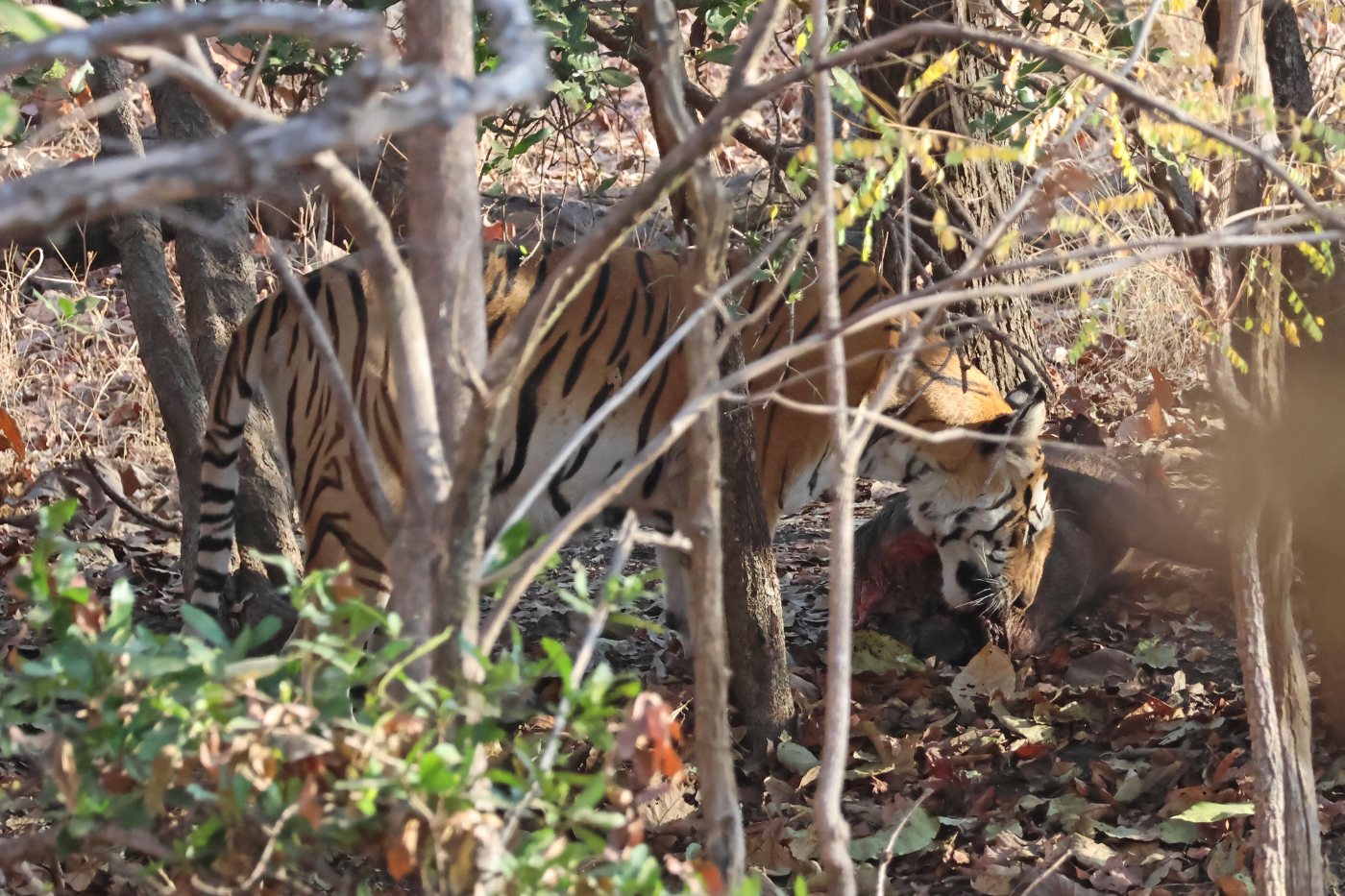
A tiger hunts by stalking to within about 30 m and then closing in a few seconds. Reported success rates run from around 5 percent to as high as 50 percent depending on the site, the prey and the individual, which tells you how much the terrain matters. Most attempts fail.
The best hard numbers on how much a tiger actually eats come from Miller and colleagues (2013), who fitted GPS collars to Amur tigers in the Russian Far East and physically searched 378 location clusters, finding 111 kills. Their results:
- One kill every 6.54 days, which is close to 56 large prey animals a year.
- An estimated 8.93 kg of meat per tiger per day averaged across the year.
- Individual variation from 6.1 to 11.2 kg per day.
Averaged across the day is not how a tiger eats, though. It gorges, taking as much as 50 kg in one sitting, then covers the carcass and returns to it for days. Mean prey weight for tigers has been put at about 91.5 kg, compared with about 37.6 kg for leopards, and that difference is the main reason the two cats coexist across much of Asia.
What is on the menu depends entirely on where the tiger lives. In central India it is chital, sambar and wild boar. In the Russian Far East it is red deer, sika deer and wild boar, with badgers and raccoon dogs in summer, and bears making up roughly 3 percent of the diet. In Sumatra and the Malay peninsula it is smaller: muntjac, pigs, and sun bear cubs. I look at the rainforest end of the range in what Bengal tigers eat in the tropical rainforest and at the habitat question itself in do Bengal tigers live in the rainforest.
One consequence is worth stating plainly, because it drives conservation policy. A single tiger needs roughly 50 large ungulates a year. A breeding population of 20 tigers therefore needs a prey base of thousands of animals. Forests that look intact on satellite images but have been emptied of deer by snaring cannot hold tigers, and across Southeast Asia that empty forest problem has cost more tigers than deforestation has.
Territory and social life
Tigers are solitary and territorial. A resident male holds a range that overlaps the ranges of several females, defends it against other males, and has no part in raising cubs. Females hold smaller exclusive ranges and often settle next to or partly inside their mother’s.
The size of those ranges varies more than in almost any other big cat, and the reason is prey density:
| Site | Female range | Male range |
|---|---|---|
| Chitwan, Nepal (rich lowland grassland and forest) | Up to about 43 km² | About 10 to 66 km² |
| Sikhote Alin, Russian Far East (cold, thin prey) | 248 to 520 km² | 847 to 1,923 km² |
A male Amur tiger may need forty times the area of a male Bengal tiger in Chitwan to make a living. That single fact explains why Russia can hold only a few hundred tigers across an enormous landscape while India holds thousands in a fraction of the space, and why any road, farm or mine that fragments Russian forest costs more tigers than the same development would in India.
Territories are advertised rather than patrolled. Tigers spray a mix of urine and anal gland secretion onto trees at nose height, scrape the ground with the hind feet, rake bark with the claws, and leave faeces at trail junctions. A visiting tiger reads from those marks who the resident is, what sex, and roughly how long ago it passed. Most encounters between adults are avoided this way, which is exactly the point: fighting is expensive for an animal that has no group to fall back on if it is injured.
How tigers communicate
- Roar. Audible up to about 3 km. Tigers, like lions, leopards and jaguars, have a flexible ligament in the hyoid apparatus that allows a full roar. The small cats, and cheetahs, do not.
- Moan. A quieter, lower version of the roar, carrying about 400 m, used at closer range.
- Chuff or prusten. A soft blowing sound made through the nostrils with the mouth closed. It is a friendly signal, used between a mother and cubs and between courting adults, and it is the only tiger sound that is unambiguously non hostile.
- Growl, hiss and snarl. Threat displays, close range.
- Low frequency components. Tiger roars contain energy below the range of human hearing, which is part of why a roar at close range is felt as much as heard.
Breeding and cubs
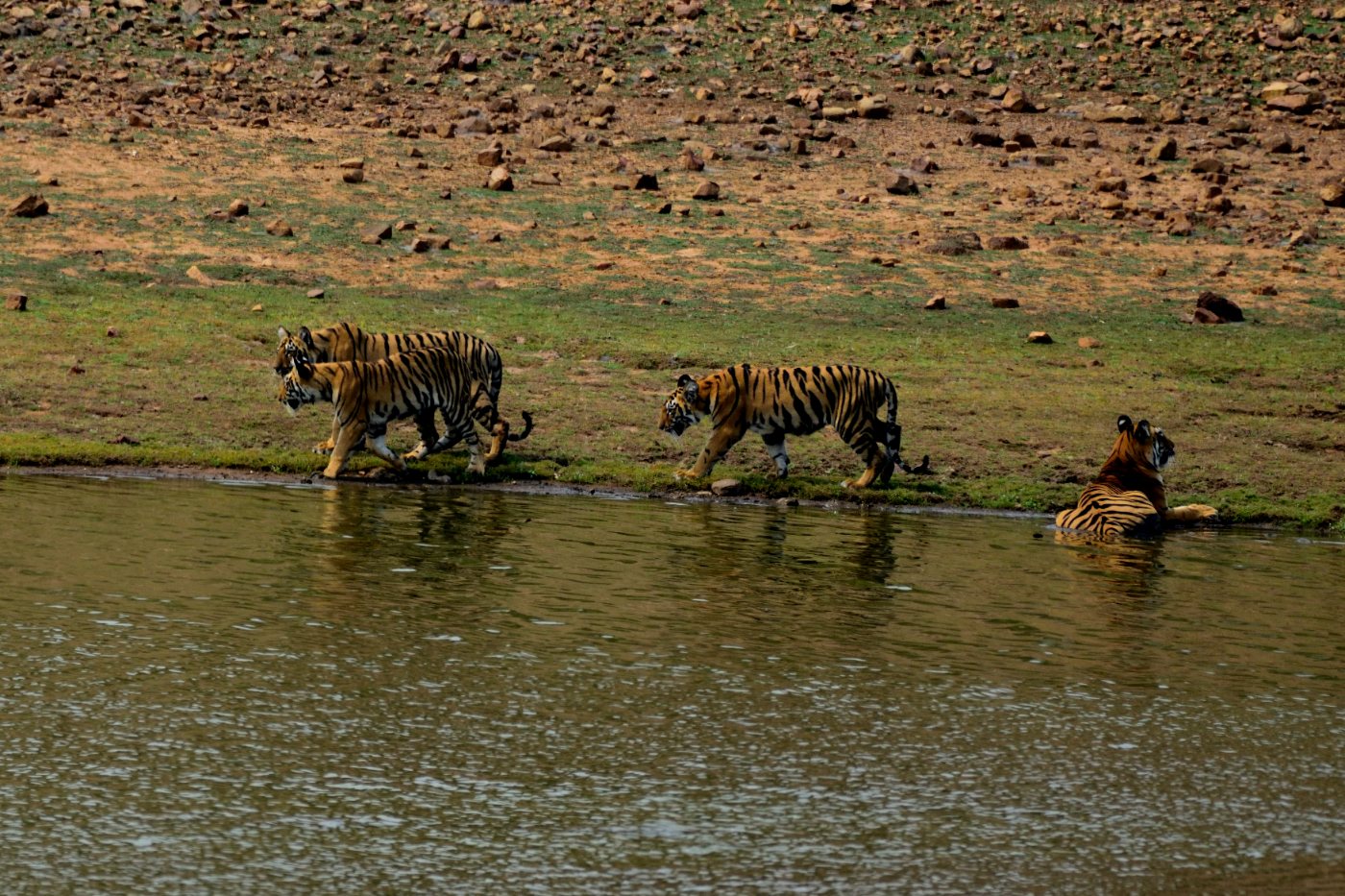
Tigers have no fixed breeding season across most of the range. A female comes into oestrus roughly every three to nine weeks if she has no cubs, and signals it by scent marking more often and calling.
- Gestation: a little over three months.
- Litter size: up to seven has been recorded, but two or three is normal.
- Birth weight: 785 to 1,610 g. A newborn tiger weighs about as much as a bag of sugar.
- Eyes open: between three and 14 days.
- Leaving the den: around two months, which is also when cubs start on meat.
- Independence: 18 to 24 months, one of the longest dependencies of any cat.
- Sexual maturity: three to four years for females, four to five for males.
Cub survival varies enormously between sites. In well protected reserves annual survival of around 85 percent has been recorded, and one long study lost only one of 21 cubs across more than eight years. In fragmented or poached landscapes it collapses. The commonest cause of cub death after starvation is infanticide by an incoming male, which brings the female back into oestrus. A tigress therefore has to hold her range against strange males for two full years to get one litter to independence, which is why male turnover in a reserve is one of the numbers managers watch most closely.
On terminology, since it is one of the most searched tiger questions: an adult female is a tigress, an adult male is simply a tiger, and a young one is a cub. There is no separate word for a male, and no group noun that is used in the field, though an ambush or streak of tigers turns up in dictionaries. The detail is in what a female tiger is called.
Where tigers live now
Tigers once ranged from eastern Turkey to the Russian Pacific coast and south to Bali. Today less than 7 percent of that range remains occupied, and the range has contracted by more than half within the last three tiger generations alone.
The most widely used current figure is 5,574 wild tigers, announced by the Global Tiger Forum in September 2023. That is roughly a 74 percent increase on the 2010 estimate of about 3,200, with growth reported in Bhutan, China, India, Nepal and Russia. The IUCN Cat Specialist Group’s own 2021 assessment gives a range of 3,726 to 5,578 individuals excluding cubs, with about 3,140 mature individuals.
Two cautions on that headline number, because you will not find them on most tiger pages. First, part of the increase is better counting rather than more tigers: camera trap grids and genetic capture recapture have replaced pugmark censuses, and they find animals the old methods missed. Second, the gains are concentrated. India, Nepal, Bhutan and Russia are up. Southeast Asia is in freefall. Cambodia, Vietnam and Laos have lost their breeding tigers entirely within the last two decades.
| Country | Status |
|---|---|
| India | 3,682 in the 2022 national estimate, around three quarters of all wild tigers. The sixth national census began in late 2025 with the report due in July 2027, and officials expect a rise of 10 to 15 percent, most of it outside reserve cores. |
| Russia | 265 to 486 Amur tigers in the 2022 IUCN assessment, concentrated in Primorye and Khabarovsk. |
| Nepal | Roughly tripled since 2009 and now around 350, one of the clearest conservation successes anywhere. |
| Bhutan | Around 130, including tigers recorded above 4,000 m, the highest altitude tigers known. |
| Bangladesh | A little over 100, almost all in the Sundarbans. |
| Indonesia | Sumatran tigers only, roughly 400 to 600 and declining with forest loss. |
| Thailand | Around 150 to 200, the last stronghold in mainland Southeast Asia, centred on the Western Forest Complex. |
| Malaysia | Fewer than 150 Malayan tigers, critically endangered. |
| China | A small but growing Amur tiger population in the north east, plus a handful of Bengal and Indochinese tigers on the southern borders. |
| Myanmar, Laos, Cambodia, Vietnam | Myanmar retains a small number. The other three have no confirmed breeding population left. |
Country figures come from different years and different methods, so they do not add neatly to the global total. Treat them as the best available picture rather than a ledger.
Why tigers are endangered
Four pressures, in roughly this order of severity:
- Poaching for trade. Skins, bones and teeth feed a market that has never been closed. In the Russian Far East, human caused mortality accounts for 75 to 85 percent of all tiger deaths, with an estimated 30 tigers killed each year in a population of a few hundred.
- Prey depletion. Industrial scale snaring for bushmeat empties forests of deer and pigs. A forest with no prey cannot hold tigers no matter how well the trees are protected. This is the main reason mainland Southeast Asia lost its tigers.
- Habitat loss and fragmentation. Not just clearance but severance. Roads, canals and plantations cut populations into units too small to survive the loss of a few breeding females, and dispersing young tigers die trying to cross them.
- Conflict with people. Tigers that kill livestock, or people, are killed in return. As populations recover into buffer zones and farmland this becomes the growth limiting factor rather than poaching. India recorded more than 70 attacks in 2024.
What has actually worked
Tiger conservation has a real track record, which is unusual among large carnivores, and it is worth being specific about what produced the recovery rather than vague about it.
- Protecting a core with enough prey, and enforcing it. Every recovering population sits around a well staffed protected core. Nepal’s tripling came with a large increase in patrol effort and army involvement in Chitwan and Bardia.
- Counting properly. Camera trap grids with individual stripe identification, and genetic sampling from scat, turned tiger numbers from a political argument into data. You cannot manage what you are guessing at.
- Corridors. India’s next challenge is not reserve cores, which are close to saturated, but the land between them. The 2026 census is explicitly focused on where tigers can go next rather than only on how many there are.
- Paying for coexistence. Compensation for lost livestock, insurance schemes and predator proof corrals reduce retaliatory killing more reliably than enforcement alone.
- The Tx2 commitment. The 2010 pledge by 13 range countries to double wild tiger numbers by 2022 was not met globally, but it did what targets are supposed to do: it moved money and political attention, and several countries met it individually.
The captive tiger question
You will read everywhere that there are more tigers in American back gardens than in the wild, usually with a figure of 5,000 or even 20,000. That claim deserves more scepticism than it gets. Registration data under the United States Big Cat Public Safety Act, passed in 2022, accounted for roughly 100 big cats in 2024. The PETA Foundation’s own estimate of all captive big cats in the country, including unregistered animals, is around 3,200, and a peer reviewed count found 4,103 federally regulated big cats of all species. The often repeated 20,000 has no traceable source. As one researcher put it plainly, the number is not real.
The problem with captive tigers is genuine and does not need inflating: unregulated breeding produces animals of unknown and mixed ancestry that have no conservation value, and parts from captive animals can launder into the illegal trade. But a conservation argument built on a number nobody can source is a weak argument, and it gets used against the people making it.
Tiger versus lion
The question will not go away, so here is what can honestly be said. On size, the tiger wins: the largest tigers outweigh the largest lions, and a Bengal or Amur male is on average heavier and longer in the body than an African lion of the same age. On bite force at the canines the tiger also leads, about 1,472 N against about 1,315 N. Tigers are more muscular in the forelimbs and use them more in killing.
What that does not settle is a fight, because lions do not fight alone and tigers do not fight in groups. A lion male is shaped by a life of fighting other coalitions, carries a mane that protects the throat, and has the experience a solitary ambush hunter usually lacks. The historical accounts people cite from Roman arenas and Indian princely collections are not evidence of anything except what happens when two starved captive animals are pushed together.
The ecologically interesting fact is that the two barely met. Asiatic lions and Bengal tigers overlapped in northern and central India until the nineteenth century, and the surviving Asiatic lions in Gir are the last remnant of that. Even then they largely used different habitat, lions in open scrub and tigers in denser forest. The full measurements are in tiger versus lion size comparison.
Common questions about tigers
How many tigers are left in the world?
About 5,574 in the wild according to the Global Tiger Forum estimate released in 2023. The IUCN Cat Specialist Group’s 2021 figure is 3,726 to 5,578 excluding cubs. India holds roughly three quarters of them.
Are tigers bigger than lions?
On average yes, in both mass and body length, though the two overlap considerably and a large lion outweighs a small tiger easily.
Do tigers actually like water?
Yes, and unusually so for a cat. They bathe to cool down, cross rivers routinely, and in the Sundarbans hunt in and around water. Swims of up to 8 km have been recorded.
Is a white tiger a separate species?
No. It is a Bengal tiger carrying a recessive variant of the pigment gene SLC45A2. It is not albino, and there are none in the wild today.
How much does a tiger eat?
GPS collar work on Amur tigers gives an average of about 8.9 kg of meat a day, taken as one large kill roughly every 6.5 days rather than daily meals. A tiger can eat as much as 50 kg at a single carcass.
Do tigers hunt humans?
Almost never by preference. The great majority of attacks involve people entering tiger habitat to collect wood, honey or fish, or surprising a tiger at a kill. Habitual man eating is rare and is usually traced to injury, old age or the loss of normal prey. The Sundarbans is the one place with a persistent pattern, and even there the rate is a handful of deaths a year in a landscape used daily by tens of thousands of people.
Can tigers purr?
No. Tigers roar, and the anatomy that allows a roar rules out the continuous purr of a domestic cat. Their friendly sound is the chuff, a soft blow through the nose.
How long do tigers live?
Around 12 to 15 years in the wild, and up to about 19 in captivity. Wild males often have much shorter effective lives because holding a territory against younger rivals is brutal.
Everything on this site about tigers
- Interesting tiger facts
- How strong are tigers, and the strength facts behind the claims
- How high can tigers jump
- How fast can a tiger run
- Siberian tiger versus Bengal tiger
- Tiger versus lion size comparison
- White tiger adaptations
- What is a female tiger called
- What Bengal tigers eat in the tropical rainforest
- Do Bengal tigers live in the rainforest
Tigers are one branch of the cat family. For the wider picture, and for the other animal guides on this site, start from mammals.
Sources
- IUCN Cat Specialist Group, species account for Panthera tigris, including the 2017 Cat Classification Task Force revision and the 2021 population assessment.
- Liu, Y. C. et al. (2018). Genome wide evolutionary analysis of natural history and adaptation in the world’s tigers. Current Biology 28: 3840 to 3849.
- Xu, X. et al. (2013). The genetic basis of white tigers. Current Biology 23: 1031 to 1035.
- Sagar, V. et al. (2021). High frequency of an otherwise rare phenotype in a small and isolated tiger population. PNAS 118.
- Miller, C. S. et al. (2013). Estimating Amur tiger kill rates and potential consumption rates using GPS collars. Journal of Mammalogy 94: 845 to 855.
- Christiansen, P. and Wroe, S. (2007). Bite forces and evolutionary adaptations to feeding ecology in carnivores. Ecology 88: 347 to 358.
- Wroe, S., McHenry, C. and Thomason, J. (2005). Bite club: comparative bite force in big biting mammals. Proceedings of the Royal Society B 272: 619 to 625.
- Global Tiger Forum and WWF (2023). Revised global wild tiger population estimate of 5,574.
- National Tiger Conservation Authority (2023). Status of Tigers in India 2022.
- WildCats Conservation Alliance, Amur tiger species factsheet.
From the shop
Gifts for people who love the wild
Wildlife themed t-shirts, notebooks, tote bags, bandanas and guides, designed by an ecologist.
Visit the shop