
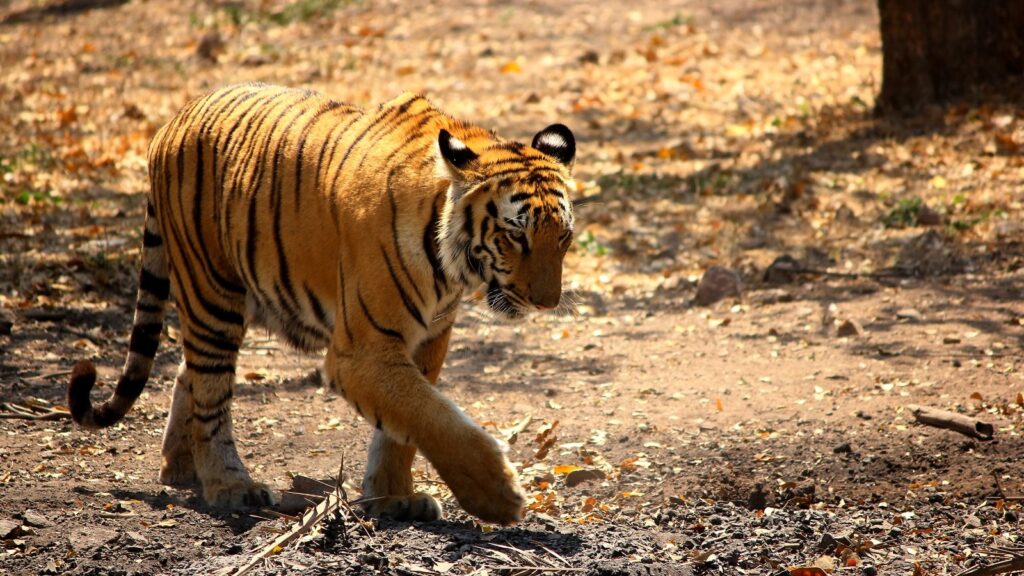
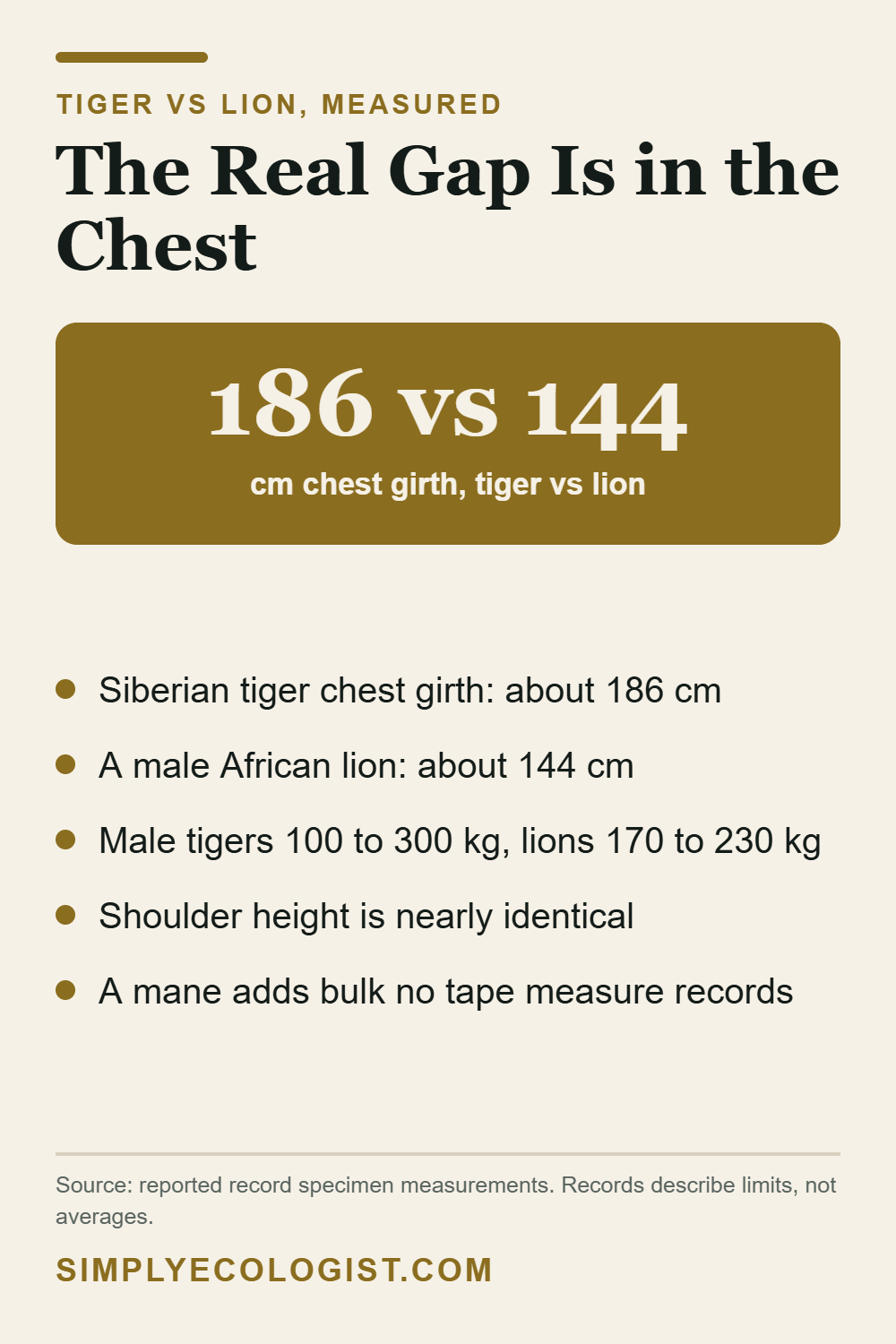
Tigers average larger than lions. Male tigers weigh 100 to 300 kg (220 to 660 lb), while male African lions typically reach 170 to 230 kg (370 to 500 lb). Bengal tigers, at 160 to 230 kg, overlap with big lions, but Siberian tigers stretch to 4 m and 300 kg. Chest girth shows the gap clearly: about 186 cm in Siberian tigers versus 144 cm in lions. Shoulder heights don’t differ much. The sections below explain measurements, records, and bite force in more detail.
Part of my complete guide to tigers, which covers tiger subspecies, size and strength, hunting, territory, breeding and current populations, with sources.
Key Takeaways
- Tigers average larger than lions overall, with Siberian males reaching ~300 kg (660 lb) versus 170 to 230 kg for African lion males.
- Bengal tigers (160 to 230 kg) overlap heavily with big lions, so weight alone doesn’t always separate the two.
- Shoulder height is close: Siberian tigers ~3.9 to 4.2 ft, African lions ~3.9 ft, Bengal tigers ~3.5 ft.
- Chest girth favors tigers strongly, up to ~186 cm in Siberians versus ~144 cm in a typical male lion.
- A lion’s mane inflates perceived bulk, so measured girth, shoulder height, and weight give fairer comparisons.
Tiger vs Lion Size: The Quick Verdict
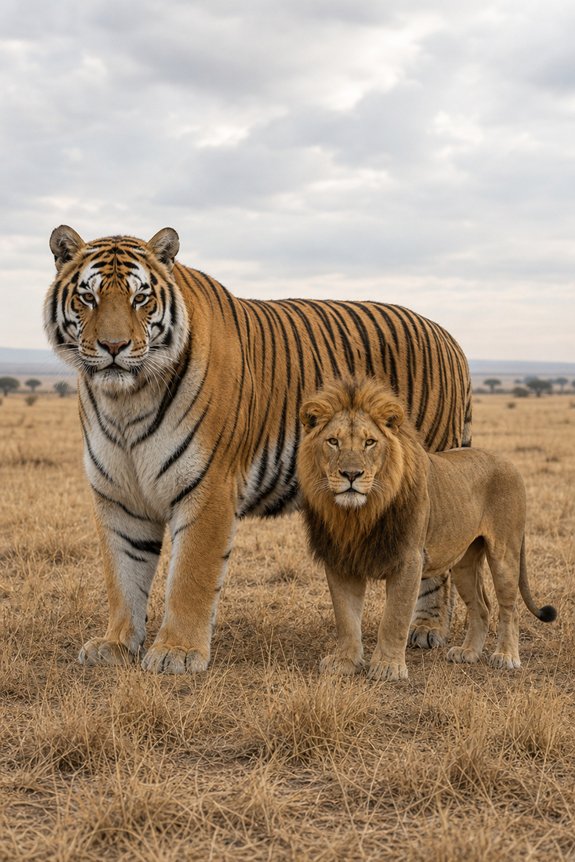
Two big cats dominate this debate, and one of them is consistently bigger. Tigers win on size. Male tigers average 220 to 660 lb (100 to 299 kg), while male African lions weigh 370 to 500 lb (170 to 230 kg). Siberian tigers, also called Amur tigers, hold the records, though record specimens are not typical animals. They reach about 4 m (13 ft) long and stand 3.9 to 4.2 ft at the shoulder.
Lions measure 1.8 to 2.1 m (6 to 7 ft) long, excluding the tail, and reach about 3.9 ft tall.
Girth tells the same story. The largest Siberian tiger chest girth, meaning the measurement around the ribs, was about 186 cm, compared with 144 cm in African lions. Bengal tigers are the exception; at 350 to 500 lb, they match large lions closely. The gap is real, though narrower than many people assume.
| Measurement | Siberian tiger | Bengal tiger | African lion | Asiatic lion |
|---|---|---|---|---|
| Male weight | 160 to 190 kg typical, 300 kg on record | 160 to 230 kg | 170 to 230 kg | 160 to 190 kg |
| Female weight | 100 to 160 kg | 100 to 160 kg | 110 to 150 kg | 110 to 120 kg |
| Total length, male | up to 4.2 m (13.8 ft) on record | 2.7 to 3.0 m | 2.5 to 3.0 m | 2.5 to 2.9 m |
| Shoulder height, male | 3.9 to 4.2 ft | about 3.2 ft | about 3.9 ft | 3.5 to 3.9 ft |
| Chest girth, male | about 186 cm on record | about 125 cm | about 144 cm | not well recorded |
How Tiger and Lion Size Is Measured
Size claims depend on the method used.
Researchers record total length, meaning nose to tail tip, or head body length, which stops at the base of the tail, so a tiger listed at 4 metres isn’t 4 metres of body.
Weight comes from scales or from estimates based on chest girth, the distance around the body just behind the front legs, and it’s worth remembering that record animals such as a 300 kg Siberian tiger sit well above the typical 170 to 230 kg male African lion.
Standard Measurement Methods
Researchers rely on four standard measurements when they size up a big cat: total length, head and body length, shoulder height, and weight. Each one answers a different question.
- Total length runs from nose to tail tip, and Siberian tigers have reached about 4 m.
- Head and body length stops at the tail’s base, so it doesn’t count the tail.
- Shoulder height measures the ground to the top of the scapula, the shoulder blade; Siberian males reach 1.2 to 1.3 m, lions about 1.0 to 1.2 m.
- Weight comes from a sedated animal on a calibrated, checked scale.
Chest girth, the circumference behind the forelimbs, adds bulk data: 186 cm for tigers, 144 cm for lions. Careful notes on sex and subspecies matter more than records. I find that discipline reassuring.
Typical Versus Maximum Records
Because record specimens grab attention, they often overshadow the numbers that actually describe a species. An outlier is a single animal far from the average. Siberian tigers show this clearly, with rare males reaching about 13 feet and 660 pounds. Most tigers stay well below that.
Bengal males usually weigh 350 to 500 pounds, and Asiatic lion males fall near 350 to 420 pounds. African lion males average roughly 370 to 500 pounds. Researchers prefer these typical ranges.
Conservation planning depends on what the average animal needs, not what one exceptional hunter once shot and measured. Records still matter for documenting biological limits. They just describe possibility, not the ordinary. Reading old record claims, one notices how easily a single number becomes a species’ reputation.
Male Tiger vs Male Lion Weight Compared
Most adult male tigers outweigh most adult male lions, though the margin varies by subspecies. A subspecies is a regional population with slightly different traits. Weight ranges tell the story clearly.
- Male tigers overall: about 100 to 300 kg (220 to 660 lb).
- Bengal males: commonly 160 to 230 kg (350 to 500 lb).
- Siberian, or Amur, males: up to roughly 300 kg (660 lb).
- African lion males: about 150 to 230 kg (330 to 510 lb), typically 170 to 230 kg.
Heaviest recorded wild Siberian tigers approach 300 kg, above the usual lion maximum on record, near 230 to 250 kg. The overlap matters. A large lion can match or beat a small tiger, so averages don’t decide individual matchups. Age, nutrition and region all shift the numbers.
Studying these figures, one notices how much geography shapes body size.
Body Length: Nose to Tail Tip Compared
While weight measures bulk, length measures reach. Male Siberian tigers, also called Amur tigers, stretch up to 13 to 13.8 feet, about 4 to 4.2 meters, nose to tail tip. They’re the longest of the big cats.
Typical male Bengal tigers and large African male lions both average near 10 feet, or 3 meters, though exceptional individuals grow longer. Females don’t reach those lengths. Siberian tigresses average roughly 9.2 feet, about 2.8 meters, slightly longer than many lionesses.
African lionesses and Bengal tigresses average close to 9 feet, or 2.7 meters. Subspecies matter here, since a subspecies is a distinct population within one species. Comparing Siberian tigers to African lions tells more than comparing tigers to lions generally. That distinction is easy to overlook.
Shoulder Height: Which Cat Stands Taller?
Shoulder height tells a clearer story. Male Siberian tigers stand about 3.9 to 4.2 feet at the shoulder, while adult male African lions usually top out near 3.9 feet.
Bengal males stand shorter, around 3.2 feet, which actually puts them below the Siberian tigresses and African lionesses that reach about 3.5 feet, a narrow overlap worth keeping in mind.
Male Shoulder Height Rankings
Both cats stand tall, but they don’t stand equally tall. Shoulder height measures from the ground to the top of the shoulder blade, the highest point of the back when the animal stands.
Among wild male Panthera cats, the big cat genus that includes tigers and lions, the ranking looks like this:
- Siberian (Amur) tigers reach about 3.9 feet, or 1.2 meters, with reports up to 4.2 feet.
- African lions typically top out near 3.9 feet, matching all but the largest Siberian males.
- Asiatic lions measure roughly 3.5 to 3.9 feet.
- Bengal tigers stand shortest, around 3.2 feet, or 0.97 meters.
The gaps are small. A few inches separate first from last, which surprises many people expecting one clear winner. That margin deserves attention.
Female Height Comparisons
Because females run smaller than males across both species, the numbers shift downward, but the pattern stays much the same.
Female Siberian tigresses reach shoulder heights near 3.5 ft, or about 1.07 m. Shoulder height means the distance from the ground to the top of the shoulder, not the head.
African lionesses measure roughly 3.0 to 3.5 ft, so 3.5 ft serves as a common maximum for both.
Asiatic lionesses, found mainly in India, fall in that same range.
Bengal tigresses stand slightly shorter, topping out around 3.2 ft, or 0.97 m.
Bengal Tigers Stand Shorter
Bengal tigers sit at the shorter end of the range. Males stand about 3.2 feet, or 0.97 meters, at the shoulder. That’s the highest point of the back, just above the front legs. Male lions often reach 3.5 to 3.9 feet, roughly 1.07 to 1.2 meters.
- Bengal male tiger: about 3.2 ft (0.97 m).
- Bengal tigress: roughly 3.0 to 3.2 ft.
- Male lion: up to 3.5 to 3.9 ft (1.07 to 1.2 m).
- Siberian tiger: up to 3.9 to 4.2 ft, equaling or exceeding lions.
Chest Girth: Tiger Bulk vs Lion Bulk
Chest girth tells us a lot about raw bulk. Chest girth means the distance around an animal’s rib cage, measured just behind the front legs. Siberian tigers, also called Amur tigers, lead all wild big cats here, with recorded girths reaching about 186 centimeters. African lions measure far less.
A typical male lion shows a chest girth near 144 centimeters, roughly 40 centimeters below the largest tigers. Bengal tigers fall lower still, though some specimens reach around 125 centimeters.
These numbers reflect real differences in build. Siberian tigers look barrel chested and heavily muscled, while most lions and smaller tiger subspecies carry less mass through the torso. Girth tracks body weight closely, so bigger tigers often outweigh lions. That simple fact still surprises many people.
Does a Lion’s Mane Make Him Look Bigger?
Measurements tell one story, but appearances tell another. A male lion’s mane adds several inches of visible bulk around the neck and head. That extra fur makes him look larger than his shoulder height or body mass suggests.
Tigers have no mane, so a lion’s silhouette looks wider even when both cats weigh about the same.
The mane also carries information about the animal itself.
- Mane color ranges from blonde to black, and darker manes signal older, healthier males.
- Fuller manes correlate with higher testosterone levels.
- The mane shields the neck and throat during fights, giving a real defensive benefit.
- Males in cooler regions grow thicker manes, since heat limits mane growth.
Siberian Tiger: The Biggest Cat of All
The Siberian tiger, also called the Amur tiger, is the largest cat alive today. Record males have reached about 300 kg, or 660 pounds, while wild Amur males today average closer to 160 to 190 kg. Total length, including the tail, sometimes stretches to roughly 4 metres, nearly 13 feet. Typical males measure less. Most run 3 to 3.3 metres long and stand 1.1 to 1.2 metres at the shoulder. Record animals have shown chest girths near 186 cm. That’s the broadest chest of any wild big cat.
Their coats are paler and thicker in winter, and their bodies are heavier, which helps them hold heat and hide in snowy taiga forests. Taiga means the cold northern forest belt. Big prey there favored big hunters. They usually outweigh most lions, and that fact still surprises many people.
Bengal Tiger Size vs African Lion Size
How do Bengal tigers stack up against African lions? They overlap closely in mass. Adult males of both species fall within a similar weight range, though tigers usually carry a longer body.
- Male Bengal tigers weigh 160 to 230 kg (350 to 500 lb) and stretch 2.7 to 3.0 m including the tail.
- Male African lions weigh 170 to 230 kg (370 to 500 lb), with body length near 1.8 to 2.1 m excluding the tail.
- Lions reach 2.5 to 3.0 m in total length, so large tigers can match or slightly exceed them.
- Females differ more sharply. Tigresses average 100 to 160 kg, while lionesses commonly reach 110 to 150 kg.
Chest girth and muscle distribution explain the rest. Tigers look longer and more heavily muscled, while a lion’s mane creates a compact, blockier outline. Size is not the whole comparison either, since a tiger’s sprint speed over short distances works to a very different set of limits.
That contrast strikes me as remarkable.
Asiatic Lion: The Smaller Lion Subspecies
Asiatic lions run smaller than their African relatives. Adult males weigh 160 to 190 kg and stand about 1.07 to 1.2 m at the shoulder, while females average 110 to 120 kg.
Their manes are thinner and darker, leaving the ears visible, and the entire wild population, 891 animals at the 2025 census, lives in Gujarat, and a majority now range outside the Gir Protected Area itself, a spread narrow enough to give researchers pause.
Size And Physical Measurements
Measure an Asiatic lion beside its African cousin, and the difference shows up quickly. The gap is modest but consistent. Adult males carry less bulk, and females follow the same pattern across recorded surveys.
- Males weigh 160 to 190 kg (350 to 420 lb).
- Males stand 1.07 to 1.2 m (3.5 to 3.9 ft) at the shoulder.
- Females weigh about 110 to 120 kg (240 to 265 lb).
- Females reach 0.8 to 1.07 m (2.6 to 3.5 ft) at the shoulder.
Shoulder height means the distance from the ground to the top of the front legs. That measure matters more than length, since tails vary.
Males also show thinner, darker manes that leave the ears visible, plus a fold of skin along the belly.
Numbers like these help keep comparisons honest, rather than dramatic. Such details still deserve careful attention.
Distinctive Features And Range
Beyond weight and shoulder height, a few physical traits set this subspecies apart. The mane is thinner and darker, so the ears stay visible. A fold of skin runs lengthwise along the belly. Coat color ranges from reddish tawny to silvery gray, sometimes flecked with black.
Their range has shrunk. Lions once roamed from Turkey to India, but wild Asiatic lions now live only in the Indian state of Gujarat, centred on the Gir Protected Area. Careful protection has worked. Counts rose from 177 in 1968 to 674 in 2020, and the 2025 census recorded 891. The population is also spreading out: 497 of those lions, about 56 percent, now range outside the Gir protected areas altogether. A single state still means one disease or fire could threaten everything.
Males usually pair into coalitions of two, while related females form prides. In Gir they hunt chital, antelope, wild boar, and water buffalo. That single foothold deserves attention.
Did Tigers and Lions Ever Meet in the Wild?
They did, which is why the comparison is not purely hypothetical.
Asiatic lions and Bengal tigers overlapped across northern and central India within historical memory, and lions ranged alongside Caspian tigers in Iran and central Asia. Both cats used the same dry forest and scrub in places, and both hunted the same deer and wild pig.
What is missing is any reliable account of them fighting. The overlap thinned as lions were pushed back toward Gujarat and tigers toward forest, and by the time anyone was recording wildlife carefully, the two had largely stopped meeting. Today Asiatic lions occupy one Indian state and tigers occupy reserves elsewhere.
So the encounter that everyone wants to settle is one that ecology arranged and history closed. That seems worth knowing before staking anything on the answer.
Why Tiger Subspecies Vary So Much in Size
Because tigers spread across such different climates, they didn’t stay one size. Isolated populations gradually diverged genetically, meaning their gene pools drifted apart over thousands of years. Prey and cold did the rest.
- Climate: Siberian tigers reach ~300 kg (660 lb) and 4 m (13 ft), with thick fur for taiga winters.
- Prey size: tigers hunting large ungulates alone, like Bengals at 160 to 230 kg (350 to 500 lb), evolved heavier builds.
- Isolation: island and Asiatic subspecies, such as some Sumatran tigers, trend smaller than continental relatives.
- Bottlenecks: population crashes shrink genetic diversity, the variety of genes in a group, and reduce prey, lowering average size.
That size range is striking. A single species can hold both extremes, which is worth remembering before comparing tigers with lions.
Tigress vs Lioness: Female Size Compared
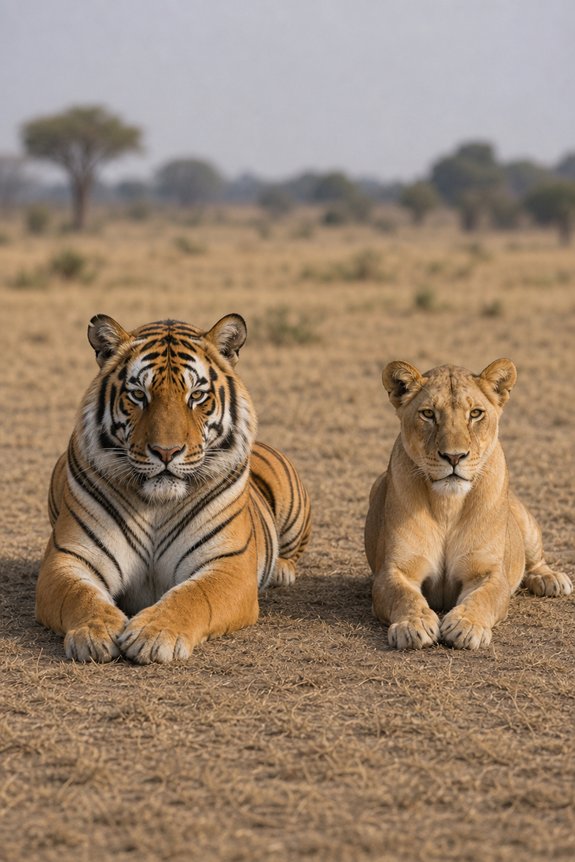
That same subspecies variation shapes the female comparison too. Female Siberian tigers usually rank as the largest cats among females. They average about 9.2 feet in total length and stand up to 3.5 feet at the shoulder.
African lionesses measure close to 9 feet and reach a similar 3.5 feet shoulder height. Bengal tigresses match that length, but their shoulders often sit lower, near 3.2 feet.
Weight tells a similar story. Bengal tigresses range from 100 to 160 kilograms, or 220 to 350 pounds, while lionesses weigh 110 to 150 kilograms. Siberian tigresses sit at the top of that range, and their chest girth (the distance around the ribcage) often exceeds a lioness’s.
Still, overlap is common. One tigress may match the lioness beside her.
How Prey Size Drives Tiger and Lion Bulk
When a tiger hunts, it hunts alone. That shapes its body. A tiger must knock down wild boar, deer, or gaur without help, so natural selection favors mass and muscle. Siberian tigers reach 300 kg, or 660 pounds, with chest girths reported near 186 cm.
Lions face different pressures. Prides share the work of killing wildebeest and zebra, so individual males average 170 to 230 kg.
Four factors link prey to bulk:
- Solitary kills demand brute force, including bite pressure above 1,000 psi.
- Cooperative hunting spreads risk, lowering each lion’s size requirement.
- Cold habitats hold bigger ungulates, hoofed grazing mammals, so Amur tigers grow larger.
- Bengal tigers, at 160 to 230 kg, match large lions because their prey does too.
It’s a quiet reminder that diet writes anatomy.
Why Solitary Hunting Made Tigers Bigger
Tigers hunt alone, without backup. That’s why a single cat needs enough mass to pin large prey like gaur or wild boar, and why its bite ranks among the strongest of any cat. Popular figures put it near 1,000 pounds per square inch against roughly 650 for a lion, about half again rather than double, and no peer reviewed measurement of a live big cat bite exists at all. Comparisons that correct for body size, such as the bite force quotient work of Wroe and colleagues, put the two cats far closer together than the popular numbers suggest.
Lions face less of that pressure, since a pride spreads the risk across several hunters, which helps explain why males average 170 to 230 kg while Siberian tigers can reach roughly 300 kg.
Alone Against Large Prey
Because a tiger hunts alone, its body has to do the work of an entire hunting party.
There’s no pride to surround the prey. A tiger must knock down animals like adult gaur and water buffalo by itself, and that pressure favored heavier, stronger cats over generations.
Four traits show how that pressure shaped the animal:
- Body mass: Siberian males reach about 300 kg (660 lb), with total lengths near 4 m (13 ft).
- Bite force: reports exceed 1,000 psi, enough to hold a struggling buffalo.
- Chest girth: one Siberian tiger measured roughly 186 cm around the chest.
- Hindquarters: thick muscle powers the ambush launch and the takedown.
Lions manage with less, commonly 170 to 230 kg, because teamwork replaces raw size.
That tradeoff still strikes me as elegant.
Ambush Power Over Numbers
Ambush hunting boils down to a single moment. A tiger stalks close, then launches from cover and must end the fight in seconds. That deadline shapes the body. Explosive power comes from strong hindquarters and a wide chest, and large Siberian tigers show chest girths near 186 centimeters.
Bite force matters too. A tiger’s bite is usually quoted near 1,000 pounds per square inch against roughly 650 for a lion, about half again rather than double, which means one animal can dispatch a large ungulate (a hoofed grazer like deer or wild boar) without help. Lions split that work. Cooperative hunts lower the pressure on any single body, so males usually weigh 170 to 230 kilograms. Tigers can reach 300. The difference seems less about strength than about who shows up for the kill.
Prides Reduce Size Demands
When lionesses hunt together, no single cat has to carry the whole weight of the kill. The group shares the risk. That sharing lowers the selective pressure (natural selection, meaning the process where useful traits become more common) for extreme body mass. Male African lions usually weigh 370 to 500 pounds, or 170 to 230 kilograms. Tigers range from 220 to 660 pounds, and Siberian males reach 300 kilograms.
- Coordinated lionesses can bring down prey one cat might lose.
- Shared effort reduces the need for individual gigantism.
- Tigers hunt alone, so strength must come from one body.
- A Siberian tiger’s chest measures about 186 cm, versus 144 cm in lions.
Teamwork solves a problem that size solves for tigers. This trade off is worth noting.
How Pride Life Shapes Lion Body Size
Lions don’t hunt alone, and that single fact shapes their bodies.
A pride is a family group of related females, their cubs, and a few adult males. When several lionesses hunt together, they can bring down a buffalo that one cat couldn’t handle. That teamwork lowers the pressure to grow massive. Selection favors endurance, agility, and coordination instead of sheer bulk.
Males follow a different path. They spend energy on manes, which can weigh several kilograms and shield the neck during fights, and on defending territory. Adult males average 170 to 230 kilograms, roughly 370 to 500 pounds. Solitary tigers, which kill without help, evolved heavier frames.
Sharing risk changes what a body needs. That trade off is easy to overlook, but it explains much.
How Climate Shapes Tiger and Lion Size
Social structure isn’t the only force shaping these cats. Climate matters too. Biologists point to Bergmann’s rule, the pattern that animals in colder regions tend to grow larger bodies. A bigger body has less surface area for its volume, so it loses heat slowly.
- Siberian tigers reach about 300 kg and stand 3.9 to 4.2 feet at the shoulder.
- Bengal tigers average 160 to 230 kg, with leaner frames suited to humid forests and wetlands.
- African lions fall between, at roughly 170 to 230 kg and 3.5 to 3.9 feet tall.
- Cold climate tigers add dense, pale winter fur and chest girth near 186 cm.
Temperature gradients track these differences. Lions in savannas gain little from extra bulk, since cooperative hunting spreads the work. It’s a reminder that size reflects place, not strength.
Bite Force: Does Bigger Mean Stronger?
Size shows up in the jaws too. Tigers have been measured above 1,000 pounds per square inch, or psi, the pressure their jaws apply to each square inch of prey.
Lions are usually quoted nearer 650 psi, and their contests lean on mass, claws, and pride numbers, which makes that gap less surprising than it first appears.
Tiger’s 1,000 Pound Bite
Clamping down on a struggling buffalo, a large tiger can generate a bite force estimated at more than 1,000 pounds per square inch, psi, or the pressure packed into each small area of tooth contact. That is roughly half again above most estimates for lions, not the doubling often claimed. Several features explain the gap.
- Skull size: tigers average larger skulls, giving jaw muscles more leverage.
- Jaw musculature: heavier, more robust muscles close the jaws harder.
- Hunting style: tigers hunt alone, so one bite must crush a skull or vertebrae.
- Social pressure: lions grapple necks and fight in groups, which lowers the need for a maximum bite.
Numbers vary by study and by animal, and Siberian tigers sit at the top of the range. Treating reported psi figures as approximations seems wisest.
Mane Versus Muscle Advantage
Bite force tells only part of the story. A lion’s mane works like armor. The thick hair around the neck and head absorbs bites and swipes, which reduces damage during fights and partly offsets a weaker jaw.
Tigers hold the edge in size. Large male Siberian tigers reach about 660 pounds, while most male lions weigh 370 to 500 pounds. That extra mass feeds powerful forelimbs built for grappling, meaning wrestling with an opponent for control.
Fighting styles differ too. Lions rely on displays, group pressure, and body weight for leverage. Tigers strike alone with precise blows and a crushing bite above 1,000 psi.
Neither trait decides a contest by itself. Age, health, and experience matter too, a reminder that averages rarely predict individuals.
The Biggest Tiger and Lion on Record
Records help settle the argument that averages can’t. The largest recorded Siberian tiger, also called the Amur tiger, stretched about 13.8 feet, or 4.2 meters, in total length. It weighed roughly 660 pounds, near 300 kilograms. No lion on record matches that.
- Largest Siberian tiger: 13.8 ft long, up to 660 lb.
- Largest Bengal tigers: 10 to 11 ft long, 350 to 500 lb.
- Largest African lion: about 12 ft long, up to 500 lb.
- Chest girth: 186 cm for the tiger, 144 cm for the lion.
Girth means the distance around the chest. That gap is wide, nearly 42 centimeters. The biggest individuals favor tigers in length, weight, and bulk. Reading these numbers, one starts to see the Siberian tiger as the largest big cat yet documented.
Why Captive Cats Weigh More Than Wild Ones
Nearly every record figure in this post comes from a captive animal or an old hunting record, and that is worth flagging before the numbers travel.
Captive tigers and lions are fed reliably, expend little energy, and often carry weight a wild animal never would. The heaviest tigers ever recorded were captive, and several famous figures come from shot animals measured by hunters with an interest in the number being large.
Wild animals sit lower and vary more. A wild Amur male averages 160 to 190 kg against the 300 kg figure that circulates for the subspecies. A wild lion in a poor season can drop well below its typical range.
The practical rule is to compare like with like. Wild averages against wild averages tells you about the animals. Records against records tells you about the extremes, and about who was doing the measuring.
Ligers and Tigons, Bigger Than Either Parent
There is a complication to the whole comparison, and it is worth meeting head on. The largest cat alive is neither a tiger nor a lion.
A liger is the offspring of a male lion and a female tiger. Males reach 3 to 3.6 metres in length and can approach 500 kg, above any pure tiger or lion in captivity. Hercules, a liger in the United States, holds the Guinness record for largest living cat at 418 kg, or 922 pounds. One animal called Nook reportedly exceeded 550 kg, though that figure was never certified. A tigon, from a male tiger and a female lion, runs smaller and is far rarer.
Three things keep this from undermining the comparison:
- Ligers exist only in captivity. Lions and tigers overlapped historically in India and in Iran, but no wild liger has ever been confirmed.
- Male ligers are sterile. Female ligers are sometimes fertile, and one produced a liliger in 2012.
- The size comes at a cost. Ligers carry elevated rates of organ failure, neurological problems, cancer and arthritis, which is why the breeding is widely criticised on welfare grounds.
So a liger outweighs every tiger on record without telling us anything about which wild cat is larger. It is a captive artefact, and an unhappy one.
Would the Bigger Cat Win a Fight?
Although size matters in a fight, it doesn’t decide one. A Siberian tiger can reach 300 kg and 4 m in total length, while most male lions weigh 170 to 230 kg. That gap gives tigers more muscle mass, a wider chest girth, and a bite force reported above 1,000 pounds per square inch.
Tigers also hunt alone, so they routinely tackle large prey without help. Lions bring different advantages. A male’s mane, the thick hair around his neck and shoulders, shields the throat during fights. Males also battle rivals often over territory and pride control, which builds combat experience.
Wild encounters are extremely rare, and staged fights prove little. For a cat that went the other way entirely, trading all of that bulk for speed, see how dangerous cheetahs actually are. Age, health, and individual size likely settle the matter. Honestly, no reliable answer exists.
Final Thoughts
Tigers edge out lions in most measurements, though not in all of them. Male tigers span 100 to 300 kg against 170 to 230 kg for African lions, and the largest recorded Siberian tiger reached 13.8 feet nose to tail, ahead of the largest recorded lion at about 12 feet. Shoulder height is where the two cats nearly meet: Siberian males stand 3.9 to 4.2 feet, African lions about 3.9, and Bengal tigers around 3.2. The clearest gap is chest girth, roughly 186 cm in a record Siberian against 144 cm in a male lion.
Keep in mind that every one of those largest figures describes a record specimen rather than an ordinary animal. A wild Amur male today averages closer to 160 to 190 kg. Numbers like these are worth remembering, and worth reading carefully. They describe animals most people will never see up close.

Erzsebet Frey (Eli Frey) is an ecologist and online entrepreneur with a Master of Science in Ecology from the University of Belgrade. Originally from Serbia, she has lived in Sri Lanka since 2017. Eli has worked internationally in countries like Oman, Brazil, Germany, and Sri Lanka. In 2018, she expanded into SEO and blogging, completing courses from UC Davis and Edinburgh. Eli has founded multiple websites focused on biology, ecology, environmental science, sustainable and simple living, and outdoor activities. She enjoys creating nature and simple living videos on YouTube and participates in speleology, diving, and hiking.
🌿 Explore the Wild Side!
Discover eBooks, guides, templates and stylish wildlife-themed T-shirts, notebooks, scrunchies, bandanas, and tote bags. Perfect for nature lovers and wildlife enthusiasts!
Visit My Shop →