
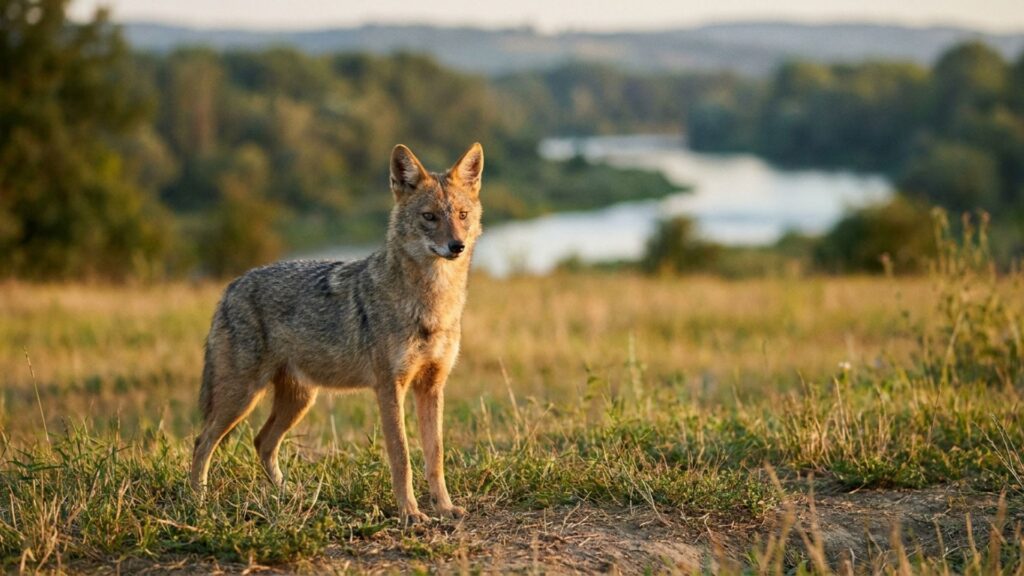
Nature never ceases to surprise us. One of the most extraordinary wildlife stories of the year comes from the Balkans, where a golden jackal named Vasa has completed a journey many experts thought a single animal would never attempt.
Fitted with a GPS tracking collar by researchers near Donji Tovarnik in Serbia in the spring of 2026, Vasa set off on a trek that has reshaped what scientists know about how far golden jackals disperse. Over the following months he traveled more than 1,000 kilometers (about 620 miles; some reports put it closer to 1,200 km, or roughly 750 miles), crossing several European countries on his way from Serbia to Germany’s Rhön region, as covered by PIRSCH and Spektrum.
Key Takeaways
- A GPS-collared golden jackal named Vasa dispersed from Serbia to Germany’s Rhön region in 2026.
- He covered more than 1,000 km / 620 miles (reported around 1,200 km, or about 750 miles), crossing the Balkans and the eastern edge of the Alps.
- It is one of the longest journeys ever documented for a golden jackal with a GPS collar.
- Golden jackals are expanding rapidly across Europe and are now recorded in about nine German federal states.
- His near-straight route shows how little rivers, mountains, and borders slow this adaptable predator.
Who Is Vasa, and Where Did He Start?
Vasa is a young golden jackal (Canis aureus) that researchers collared near Donji Tovarnik, a village in northern Serbia, as part of a movement monitoring project. Golden jackals are close relatives of the wolves and are built for long distance travel, but even so, what the collar recorded next surprised the team following his signal.
The Route: Across the Balkans, the Alps, and Major Rivers
Researchers watched Vasa move almost in a straight line toward northwestern Europe. He swam major rivers, the Sava (twice), the Drava, and the Danube, and skirted the eastern edge of the Alps before arriving in the Rhön, a highland region on the border of Hesse, Bavaria, and Thuringia.
Unlike many animals that pause to hold temporary territories, Vasa kept moving with unusual speed and purpose, rarely resting for long. Rivers, mountains, farmland, forests, and international borders barely slowed him down.
| Detail | Vasa’s journey |
|---|---|
| Species | Golden jackal (Canis aureus) |
| Start | Near Donji Tovarnik, Serbia |
| Finish | Rhön region (Hesse), Germany |
| Distance | More than 1,000 km / 620 miles (reported ~1,200 km / ~750 miles) |
| Collared | Spring 2026 (late March) |
| Barriers crossed | Sava (twice), Drava, Danube; eastern Alps |
| Significance | Among the longest GPS-tracked jackal dispersals |
One of the Longest Journeys Ever Tracked
Researchers believe this is the longest dispersal ever recorded for a GPS-tracked golden jackal, a journey that rivals distances usually associated with wolves. Some individual jackals may have moved even farther, but those movements were inferred from genetics rather than directly tracked, which is exactly what makes Vasa’s collar data so valuable.
Golden Jackals Are Quietly Conquering Europe
Vasa’s trek fits a much bigger pattern. Once largely confined to southeastern Europe, golden jackals have spread steadily north and west, and are now recorded in about nine German federal states, from Bavaria to Schleswig-Holstein (Spektrum, waldwissen.net). Their intelligence, adaptability, and ease in human shaped landscapes, traits they share with the wolf and coyote, have made them one of the continent’s great wildlife success stories.
Why Did Vasa Leave? What Scientists Still Do Not Know
The most fascinating question is still open. Scientists do not know what triggered his journey. It may have been the search for new territory, the drive to find a mate, competition with other jackals, or some combination of natural pressures. Whatever the cause, his travels have challenged long-held assumptions about the species and opened new questions for research on wildlife movement and habitat connectivity.
A Personal Note From Serbia
As an ecologist who grew up in Serbia and studied at the University of Belgrade, I find Vasa’s journey especially moving. A single animal from my home region quietly crossed a continent, guided only by instinct, while the rest of us cross borders with passports and maps. It is a reminder that some of the greatest journeys on Earth are still happening out of sight, beneath our notice.
Frequently Asked Questions
How far can a golden jackal travel?
Golden jackals are exceptional dispersers. Vasa’s GPS-tracked journey from Serbia to Germany covered more than 1,000 kilometers (about 620 miles), and genetic studies suggest some individuals move even farther.
Are there golden jackals in Germany?
Yes. Golden jackals have expanded rapidly and have now been recorded in about nine German federal states, from Bavaria to Schleswig-Holstein.
Why do golden jackals travel so far?
Young jackals disperse to find their own territory and a mate. The exact triggers vary, and in Vasa’s case scientists still do not know precisely why he left.
Is a golden jackal the same as a wolf?
No. The golden jackal is a smaller relative of the wolf and coyote. All are wild canids, but jackals are lighter and better adapted to landscapes shaped by people.
This account is based on 2026 reporting on Vasa’s GPS-tracked journey (PIRSCH, Spektrum, waldwissen.net) and statements from the researchers following his movements.
Erzsebet Frey (Eli Frey) is an ecologist and online entrepreneur with a Master of Science in Ecology from the University of Belgrade. Originally from Serbia, she has lived in Sri Lanka since 2017. Eli has worked internationally in countries like Oman, Brazil, Germany, and Sri Lanka. In 2018, she expanded into SEO and blogging, completing courses from UC Davis and Edinburgh. Eli has founded multiple websites focused on biology, ecology, environmental science, sustainable and simple living, and outdoor activities. She enjoys creating nature and simple living videos on YouTube and participates in speleology, diving, and hiking.
From the shop
Gifts for people who love the wild
Wildlife themed t-shirts, notebooks, tote bags, bandanas and guides, designed by an ecologist.
Visit the shop