
Key Takeaways
- Elicit, ResearchRabbit, and Consensus streamline literature discovery, citation mapping, and evidence extraction for ecology and biology research.
- AlphaFold predicts protein structures with confidence scores, while DeepCell segments and tracks cells using deep learning.
- NotebookLM and SciSpace Copilot turn PDFs into searchable, source-grounded assistants for protocols and summaries.
- Always validate AI outputs, confirm AlphaFold models with lab assays and verify literature claims against primary sources.
- Disclose AI tool names, versions, and prompts used, following journal transparency and citation guidelines.
AI Tools for Ecology and Biology at a Glance
Here is a quick map of the main tools in this guide, what each is best for, and what it costs. Full walkthroughs follow below.
| Tool | Best for | Cost | Free tier |
|---|---|---|---|
| Elicit | Literature search & data extraction | Plus ~$12/mo, Pro ~$42/mo | Yes (5,000 credits/mo) |
| ResearchRabbit | Citation mapping & discovery | Premium ~$10/mo | Yes (core free) |
| Scite | Citation context (supporting vs contrasting) | Freemium | Limited |
| Consensus | Evidence-based Q&A from papers | Freemium | Yes |
| NotebookLM | Grounded Q&A over your own PDFs | Free | Yes |
| AlphaFold | Protein structure prediction | Free database; cloud GPU ~$0.50-3/hr | Yes |
| DeepCell | Single-cell image segmentation | Free / open source | Yes |
| MegaDetector | Camera-trap image filtering | Free / open source | Yes |
| iNaturalist / Seek | Species ID from photos | Free | Yes |
| BenevolentAI | Drug-target discovery | Enterprise | No |
| ASCEND (BenchSci) | Antibody & reagent selection | Institutional | Varies |
| Napkin | Turning notes into diagrams | Freemium | Yes |
What Makes a Great AI Tool for Biology Research?
Before you trust any AI tool with your data, ask whether you can reproduce what it did. Great tools build reproducible pipelines. These let you rerun an analysis and get the same result, using exported weights, seeds, and notebooks. They also ingest common formats like FASTA, PDB, GEO, and SRA directly, keeping metadata like sample IDs intact.Look for uncertainty quantification too. This means the tool tells you how confident it is, not just what it predicts. Provenance tracking matters just as much, since it links outputs back to source papers or training data, so you can check reliability.Trustworthy tools also follow interoperability standards, like APIs and ontologies such as Darwin Core, and they publish benchmark validation against datasets like CASP. Without that, claims stay unverified.Map Scientific Literature Faster With ResearchRabbit
Once you know what makes an AI tool trustworthy, the next step is finding one that helps you work faster.ResearchRabbit does this by turning a single paper or author into a full citation map. You see co-author networks and clusters instantly, revealing which labs drive a subfield. These visualization workflows save hours of manual searching.The tool also offers timeline analytics, showing when interest in a topic grew, like eDNA research or climate-driven species range shifts.Discovery alerts flag new papers as they publish, so you rarely miss relevant work.You can build collaborative libraries, sharing curated collections with colleagues for reviews or grants.Metadata export lets you send citations directly into reference managers, keeping your workflow smooth and organized.Turn Research Questions Into Evidence With Elicit
In place of hours spent skimming abstracts, Elicit turns a plain language question into a ranked list of relevant papers pulled from databases like PubMed and Semantic Scholar.This automated screening extracts key fields, population, intervention, outcome, sample size, and study design, so you see evidence at a glance.For ecology work, it builds tables showing species, location, sampling methods, and effect sizes across studies.Ecosystem filters let you narrow results to specific habitats, taxa, or time periods, sharpening relevance.Iterative search means you refine criteria step by step, adding conditions until results match your question.Citation links support transparency reporting, letting you trace claims back to source text.Still, data validation matters: extraction accuracy varies, so verify before citing in a meta analysis.Check How Studies Support Each Other With Scite
Elicit shows you which papers matter. Scite shows you whether they hold up. It offers citation transparency by labeling each citing statement as supporting, contrasting, or mentioning.You get the exact sentence, with a linked DOI, for context verification. That means you can check if a claim about species range shifts is backed or challenged, not just cited.Scite also supports evidence tracking through retraction alerts, flagging papers with expression of concern notices before you build on shaky findings. For ongoing work, alert customization lets you save searches on topics like biodiversity loss (the decline of variety in plant and animal life) or phenology shifts.New evidence appears automatically. It’s a practical way to keep your research grounded in what’s actually been verified.Get Evidence-Based Answers With Consensus
When you need a quick, sourced answer rather than a full citation map, Consensus searches across peer-reviewed papers and returns a synthesized response alongside the studies it drew from. It works like a search engine that pulls only from published research.
For ecology questions, you can ask whether a management intervention works or how a species responds to warming, and Consensus surfaces the supporting studies with citations. A free tier covers occasional use, with paid plans for heavier workloads. As always, follow the links back to the primary papers before you cite.
Get Grounded Answers From Your Papers With NotebookLM
Load up a stack of PDFs, and NotebookLM turns them into a searchable, source-bound assistant. It answers only from your uploaded files. This keeps PDF provenance clear, so every claim traces back to a specific paper. You can ask it to compare sample sizes, sites, and findings across five studies at once. It handles figure explanations too, breaking down charts and graphs in plain English. Method walkthroughs help you understand unfamiliar lab techniques step by step.The tool also supports citation mapping, showing which sources back a given point, and dataset linking across multiple papers. For ecology work, where studies often span different species or regions, this traceability matters. It builds trust in your synthesis, one grounded answer at a time.Predict Protein Structures in Minutes With AlphaFold
Feed AlphaFold an amino-acid sequence, and it hands back a folded 3D structure in minutes to hours. DeepMind built it, and its predictions often match crystallography for well-behaved proteins. The AlphaFold DB stores over 214 million structures across species, giving you a shortcut through sequence diversity without running new lab experiments.For structure validation, check the pLDDT score, a per residue confidence measure, alongside PAE maps that show where predictions stay reliable. This confidence interpretation matters before you design mutants or study functional sites. AlphaFold Multimer handles complex prediction, modeling protein-protein interactions relevant to symbiosis or host-pathogen studies.Running it needs a GPU, but Colab notebooks simplify setup. Treat outputs as hypotheses, experimental integration through targeted lab work still confirms what the model suggests.Automate Single-Cell Image Analysis With DeepCell
At the heart of single cell microscopy work, tedious manual segmentation costs researchers days of labor. DeepCell fixes this. It uses deep convolutional neural networks to detect cell boundaries with precision that beats old thresholding methods, especially in messy, mixed tissues.The platform also handles label‑free phenotyping, which means it classifies cell types by shape and texture alone, no fluorescent markers needed. For time‑lapse studies, it tracks cells frame by frame, supporting lineage reconstruction, mapping which cells divided from which parents.Because DeepCell relies on GPU‑accelerated workflows and cloud deployment, large datasets process in hours, not days. Transfer‑learning best practices matter here too: fine-tune pretrained models on just a few dozen annotated images, and you’ll get reliable results on entirely new cell types.Turn Research Notes Into Diagrams With Napkin
Turning scattered field notes into a clear diagram used to eat up an afternoon. Napkin changes that. You type in plain text, like a description of a food web or nutrient cycle, and it builds a visual summarization in seconds. Layout automation handles the hard part, arranging boxes and arrows with consistent styling, so you skip the manual work in Illustrator or PowerPoint.The real value shows up in iterative drafting. Each time you revise your notes, a new diagram appears, exposing gaps in your methods or hypotheses. When you’re ready to publish, export workflows support PNG and SVG files, ready for posters or manuscripts. You can also repurpose these visuals as outreach graphics, sharing biodiversity trends, meaning the variety of species in an ecosystem, with non specialist audiences.Prioritize Drug Targets With BenevolentAI
Sifting through millions of papers to find a promising drug target takes researchers weeks, sometimes months.BenevolentAI speeds this up by building a knowledge graph, a web connecting genes, diseases, pathways, and chemicals drawn from scientific literature and databases.This structure enables target prioritization, ranking candidates by evidence weighting, which combines genetic data, pathway relevance, and expression levels into a single score.The platform also performs tractability assessment, checking whether a target has known ligands (molecules that bind it) and predicting safety risks early.Mechanistic linking traces how a gene or protein connects to a disease process, grounding each hypothesis in biology.Researchers get exportable rationales, citation-backed summaries that hand off cleanly to lab teams for testing.Streamline Experimental Design With ASCEND
Picking the wrong antibody or cell line can derail weeks of lab work. ASCEND by BenchSci tackles this problem directly. It mines biomedical literature and reagent databases to guide reagent selection for your experiments. The platform builds project specific navigator pages, showing validated antibodies and cell lines through evidence ranking, which counts supporting publications and assay types. This helps you spot the most reliable option quickly.ASCEND also runs off target screening, flagging cross reactivity risks before you commit resources. For protocol optimization, it suggests concentrations and incubation times pulled from aggregated published methods. That’s useful for pilot planning, when early missteps cost the most time.Identify Species From Photos Using AI Tools
Sort Camera Trap Images With AI Software
With thousands of images piling up on a single memory card, wildlife researchers need software that can tell an empty frame from one holding an actual animal. MegaDetector handles this first pass. It’s an open source PyTorch model that flags animals, humans, and vehicles with roughly 90-95% precision, giving you automated image curation before species labels even enter the picture.Platforms like Timelapse2 and Wildlife Insights build on this, integrating detection with metadata export and cutting review time by over 80% in field trials.Some setups now run models via edge deployment, processing images on the camera itself, which supports privacy preserving filtering and camera health monitoring. For rare species, active learning review keeps a human checking uncertain cases before they’re logged.Apply Machine Learning to Ecological Data Sets
Turn a spreadsheet of species counts, soil samples, or GPS pings into a working prediction, and you’re doing applied ecological machine learning. Start with scikit-learn for baseline models like random forests, since it handles tabular data well and pairs easily with pandas for cleanup.Good feature engineering matters most: turning raw dates or coordinates into useful variables like season or distance to water. Watch for imbalanced labeling, where rare species get too few examples to learn from.Ecological data also carries temporal autocorrelation, meaning nearby time points influence each other, so use spatial cross-validation to test models fairly across regions. Finally, favor explainable predictions. Knowing why a model flags a wetland as high risk matters as much as the forecast itself.Model Population Trends With AI-Driven Statistics
Once your model can flag a wetland or forest patch, the next step is tracking how species numbers shift there over time. Bayesian smoothing separates real population change from observation noise, giving you credible intervals around each yearly estimate. Integrated models go further, merging counts, capture-recapture data, and breeding records into one framework, which reduces bias and sharpens precision compared to single-source methods.For short-term forecasts, machine learning forecasting tools like gradient boosting or LSTM networks use climate and land-use data to predict trajectories, often beating simple guesswork by 10-30% accuracy. Spatial autocorrelation matters too: nearby sites often shift together, so spatial models map decline hotspots across unsampled areas. Automated pipelines tie this together, pulling data from Earth Engine and citizen-science platforms into reproducible workflows.Map Habitats With AI-Powered Remote Sensing and GIS
Beyond tracking population numbers, mapping the physical spaces where species live matters just as much. You can now use satellite imagery paired with neural networks to classify land cover with over 85% accuracy. Google Earth Engine gives you planetary scale data and AI tools, cutting analysis time from weeks to hours. LiDAR reveals canopy structure, the layered heights and gaps within a forest, at sub meter detail. Object detection models like YOLOv8 spot individual trees or animal burrows on drone imagery with strong precision. Satellite phenology, the study of seasonal vegetation cycles, combined with temporal change detection tracks wetland inundation and fire recovery over years. Together, these tools turn raw pixels into living maps of habitat change.Sequence Genomes Faster With AI Bioinformatics Platforms
Genome sequencing produces raw reads, short fragments of DNA code that need assembly into a complete picture. AI now speeds every step of that process.ONT’s Bonito basecaller performs real time basecalling, converting electrical signals into DNA letters as sequencing happens, not after.Cloud assembly pipelines then stitch millions of reads together using shared computing power, cutting processing time from weeks to hours.For mixed samples, metagenomic binning sorts DNA fragments by organism, useful when studying whole ecosystems from a single soil or water sample.Tools like DeepVariant handle variant phasing, identifying which gene mutations travel together on the same chromosome.Finally, dedicated annotation tools such as eggNOG-mapper and InterProScan link new sequences to known gene functions through curated databases. Together, these tools turn raw code into biological understanding.Ask Life Science Questions With AI Chatbots
After the sequence data gets assembled, you still need to understand what it means. AI chatbots can help you interpret results and generate hypotheses. Use Elicit to search literature automatically, pulling study populations, sample sizes, and outcomes from published research. Ask Consensus for quick, evidence-based answers about species responses or ecological interventions, drawn only from peer-reviewed studies. Upload PDFs to NotebookLM to ask questions grounded in your own sources, reducing hallucination risk.Still, treat every answer carefully. Check model transparency and data provenance before trusting a claim. Demand uncertainty communication, not false confidence. Consider ethical implications, especially with sensitive biodiversity data, meaning the variety of species in an ecosystem. Human oversight remains essential; verify every number against primary literature.Draft Research Papers With AI Writing Assistants
Once your analysis produces results, you still need to write them up clearly. Use ChatGPT or Gemini to draft sections like your abstract or methods. Prompt with your study design, sample sizes, and p-values, then verify every claim yourself. Upload literature to NotebookLM for concise syntheses, but check citations against original sources to avoid training bias, where AI models repeat patterns from flawed or narrow data.Track every draft with version control, so you and collaborators can see what changed and why. Peer collaboration matters here: share drafts early for feedback. Practice writing transparency and ethical disclosure by noting AI assistance in your methods, since most journals now require it.Cite AI Tools Correctly in Academic Papers
Because AI can shape your results, you owe your readers a clear account of how you used it. Follow COPE guidance: AI tools can’t be authors. This is authorship transparency, giving credit only to people who take responsibility for the work.Include version disclosure, naming the tool, its version, and the date you used it. Add prompt documentation, the exact inputs you gave the tool, especially for figures, code, or literature searches through Elicit or Scite. Store this material in a supplementary repository so others can check your work.Use the citation format your style guide requires; APA, for example, lists ChatGPT as a large language model with a date and URL. Verify every output against primary sources before you publish.Avoid Common Mistakes When Relying on AI Tools
Since AI tools can produce confident sounding answers that are wrong, you need a habit of checking before you trust. Always verify sources when a tool like Elicit summarizes a study. Check sample sizes and methods sections yourself. Quantify uncertainty too. A confidence interval tells you how precise an estimate is; ignoring it can mislead your conclusions.Validate models before treating predictions as fact. AlphaFold’s structures need lab confirmation through binding assays or X-ray methods, especially for unusual protein complexes. Inspect outputs from image tools like DeepCell manually, measuring precision and recall against labeled samples.Finally, track provenance. Record which tool, version, and prompt you used. This isn’t just bureaucracy, it’s how science stays honest, reproducible, and open to scrutiny.Manage Lab Protocols and Notes With AI Tools

Compare Costs Across Popular AI Research Tools
Once your protocols and notes live in a searchable system, the next question is what all this software actually costs. Subscription comparisons matter here. Elicit runs free to start, with a Plus plan around $12 and a Pro plan around $42 monthly. ResearchRabbit stays free for basic use, charging around $10 for premium features. Consensus and Perplexity follow similar patterns, free access with paid tiers around $10-$30.Total costing gets more complex with AlphaFold. The database itself is free, but running models locally means compute expenses, often $0.50-$3 per hour on cloud GPUs. Institutional discounts can lower many of these prices markedly. Weigh feature tradeoffs carefully: free tiers often limit query volume or export options. Match each tool’s cost to your actual research needs, not its full feature list.Find Free AI Tools Worth Trying as a Student
Before you spend a single dollar, dig into the free tools already built for student budgets.Elicit’s free tier scans thousands of papers and pulls out sample sizes, methods, and outcomes, saving hours on literature reviews.ResearchRabbit maps citation networks for free, showing which ecology papers shaped a field.NotebookLM lets you upload PDFs and ask direct questions about dense methods sections.For image work, open source alternatives like DeepCell and Napari plugins handle microscopy analysis without licensing fees.Many of these platforms include accessibility features like screen-reader support and skill building workshops through tutorials.Before uploading data, review privacy considerations, check where files are stored.Student case studies show real gains: faster reviews, clearer summaries, less guesswork.Build a Research Workflow With Multiple AI Tools
Free tools give you a starting point, but real progress comes from chaining several platforms into one workflow. Start with Elicit or ResearchRabbit to build a literature set, then move to NotebookLM for close reading. Feed results into AlphaFold or DeepCell for structural or image data. Run models through scikit-learn or Orange, checking claims with scite and Consensus before drawing conclusions.Think about field deployment early. If you collect samples outdoors, you may need offline processing, since remote sites often lack steady internet. Consider data sovereignty too, who owns the data you gather matters, especially in biosurveillance ethics work involving wildlife or disease tracking. Real community engagement, meaning honest collaboration with local stakeholders, keeps your workflow grounded and accountable.Pick the Right AI Toolkit for Your Field Study
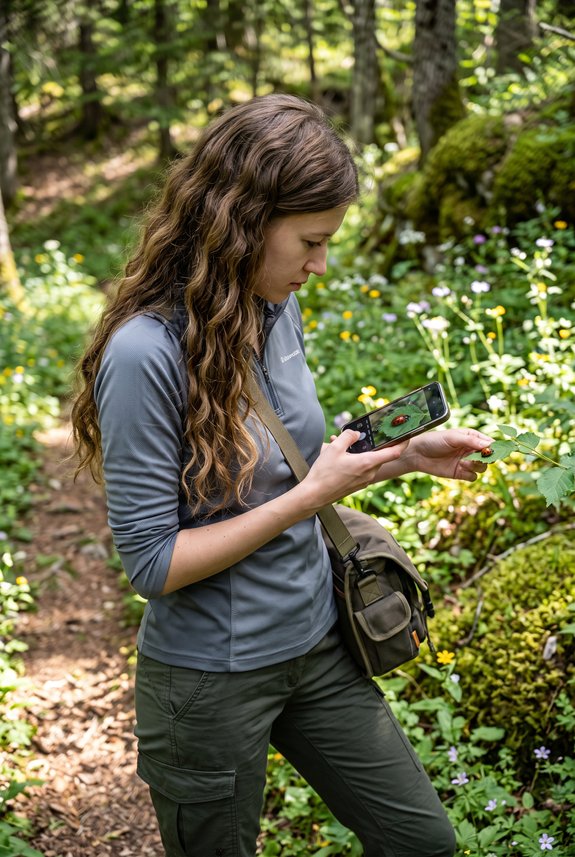
With the right tools in hand, you can match your AI toolkit to the specific questions your field study asks. If you’re tracking species presence, use iNaturalist for photo identification; it reaches 80-90% accuracy on common taxa. For acoustic surveys, BirdNET or DeepSqueak process audio and flag calls with over 85% precision.Success depends on practical choices too. Sensor placement determines what data you actually capture. Battery management keeps equipment running during long deployments. Data labeling, tagging raw observations with correct categories, improves model accuracy over time. Team training guarantees everyone uses tools consistently across sites. Don’t overlook ethical considerations: protecting sensitive location data for endangered species matters as much as the science itself. Biodiversity, the variety of life in an ecosystem, depends on careful, responsible measurement.Frequently Asked Questions
Which AI Tool Is Best for Biology Research?
There is no single best tool; the right choice depends on your task. For literature search and data extraction, Elicit and ResearchRabbit lead. For protein structure prediction, AlphaFold is the standout. For identifying species from photos, use iNaturalist, and for sorting camera-trap images, MegaDetector. Match the tool to your research question rather than expecting one tool to do everything.What Is the Most Reliable AI Tool for Research?
You’ll find Elicit most reliable, it prioritizes data provenance, offers model interpretability, meets reproducibility standards, follows solid ethics frameworks, and adapts well across domains. You’re getting trustworthy synthesis without sacrificing transparency or accuracy in your biology research.How Can AI Be Used in Ecology?
You use AI for remote sensing to track habitat change, species identification via camera traps, behavioral monitoring through bioacoustics, ecosystem modeling with machine learning, and invasive detection, helping you spot threats faster and make smarter conservation decisions.What AI Is Better Than Chatgpt?
You’ll find domain specific models like Elicit, Scite, and AlphaFold outperform ChatGPT. They’re ethical alternatives offering privacy preserving analysis, real time reasoning, and open source assistants that ground answers in verifiable, field-specific evidence rather than generic text.
Erzsebet Frey (Eli Frey) is an ecologist and online entrepreneur with a Master of Science in Ecology from the University of Belgrade. Originally from Serbia, she has lived in Sri Lanka since 2017. Eli has worked internationally in countries like Oman, Brazil, Germany, and Sri Lanka. In 2018, she expanded into SEO and blogging, completing courses from UC Davis and Edinburgh. Eli has founded multiple websites focused on biology, ecology, environmental science, sustainable and simple living, and outdoor activities. She enjoys creating nature and simple living videos on YouTube and participates in speleology, diving, and hiking.
From the shop
Gifts for people who love the wild
Wildlife themed t-shirts, notebooks, tote bags, bandanas and guides, designed by an ecologist.
Visit the shop