
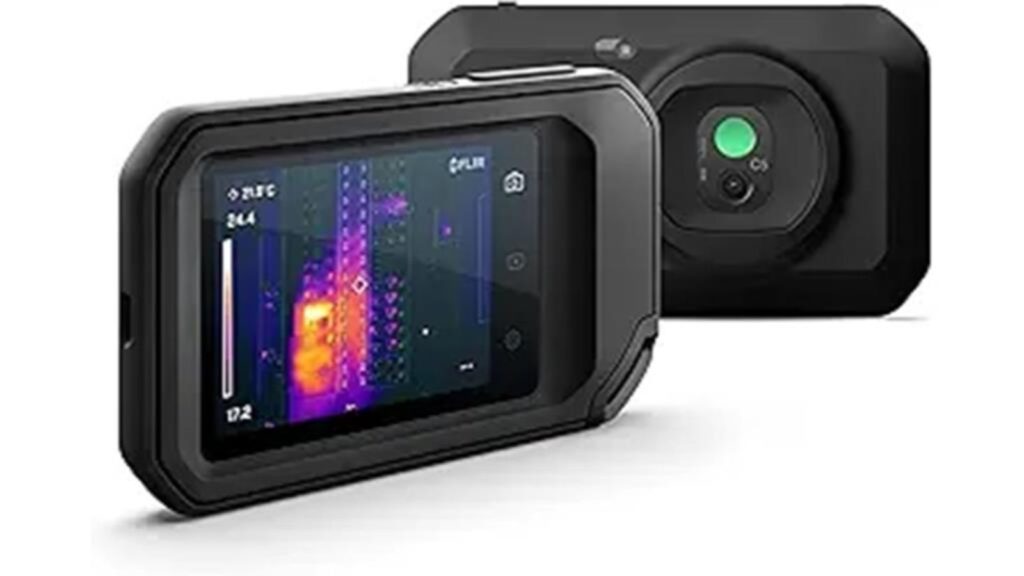
This post contains affiliate links from Amazon and other affiliate networks. As an Amazon Associate I earn from qualifying purchases, at no extra cost to you. I only recommend products I have used or researched.
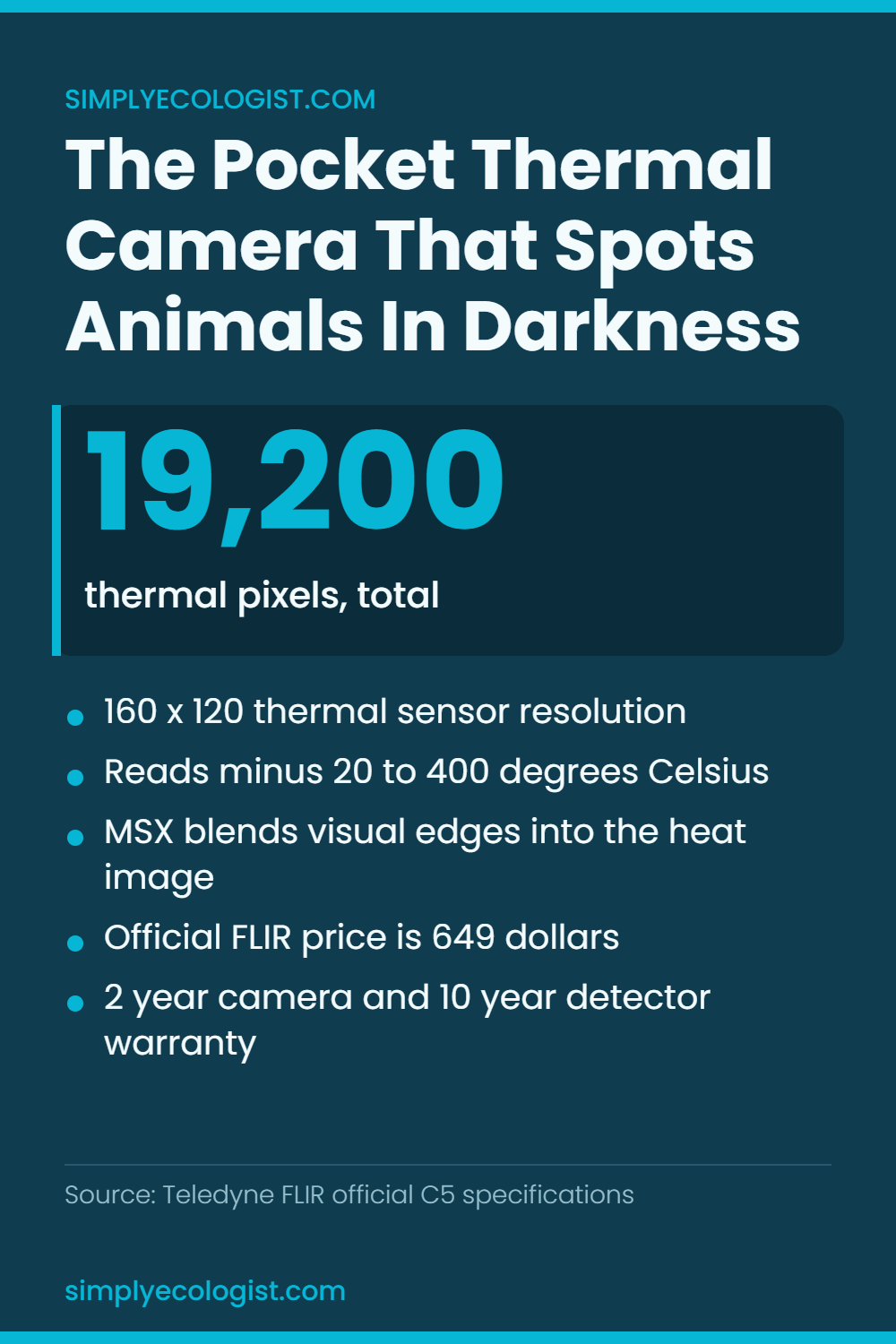
Short answer: the FLIR C5 is worth it if you need occasional thermal inspection at close range and can live with an entry level sensor. Teledyne FLIR lists it at 649 dollars as of 29 August 2026, and its 160 x 120 detector gives you 19,200 thermal pixels in total, enough to find a warm patch on a wall, not enough to identify an animal fifty meters away.
A nature note
People who spend at least two hours a week in nature report significantly better health and wellbeing, according to a Scientific Reports study of nearly 20,000 people. Nature themed things at home are no substitute, but they keep the reminder in view.
As you consider investing in a thermal imaging camera, the FLIR C5 is likely on your radar. With its impressive temperature detection range and rugged design, it seems like a solid choice. But is it really worth the investment? You’re probably wondering if the C5’s features, such as MSX technology and portability, make it a reliable tool for your specific needs. Can it hold up to daily use, and are there any potential drawbacks to be aware of? Let’s take a closer look at the C5’s performance, user feedback, and value to determine if it’s the right fit for you.
Handheld Thermal Imaging Power
Step into the world of handheld thermal imaging power with the FLIR C5, a device that puts the ability to detect temperatures from -20 to 400°C (-4 to 752°F) right in your hands.
You’ll be able to identify temperature anomalies with ease, making it perfect for a wide range of applications.
Whether you’re inspecting electrical systems, detecting energy leaks, or tracking animals in the dark, the FLIR C5 provides the portability and flexibility you need.
Its compact design and lightweight construction make it easy to carry around, allowing you to take thermal imaging capabilities wherever you go.
With the FLIR C5, you’ll have the power to uncover hidden problems and make data driven decisions like a pro.
Key Features and Technical Specs
You’re now holding a powerful tool that packs a punch with its advanced features and technical specifications.
The FLIR C5 boasts MSX technology, which combines visual details with thermal imaging for clearer pictures. With a resolution of 160 x 120 and 19,200 pixels, you’ll get crisp images.
This handheld IR camera measures temperatures from -20 to 400°C (-4 to 752°F), making it suitable for various applications.
The device comes with a 2 year warranty on parts and labor, and a 10 year warranty on the essential detector component.
Those terms are not automatic. FLIR requires you to register the camera within 60 days of purchase to activate the warranty, so do it the week it arrives rather than the week something goes wrong.
You’ll appreciate the rugged design and good battery life, making it a reliable companion for your thermal imaging needs.
FLIR C5 Specifications, As Published by FLIR
Every figure in this table comes from the official Teledyne FLIR C5 product and support pages. None of them are measurements I made, and the warranty row carries a condition that most reviews leave out.
| Thermal resolution | 160 x 120, which is 19,200 thermal pixels in total |
| Thermal sensitivity | Below 70 mK, so under 0.07 degrees Celsius of difference |
| Object temperature range | Minus 20 to 400 degrees Celsius (minus 4 to 752 degrees Fahrenheit) |
| Visual camera | 5 MP, used mainly to feed the MSX overlay |
| Housing rating | IP54, so dust protected and splash resistant, not submersible |
| Drop rating | 2 meters |
| Battery life | About 4 hours |
| Image transfer | Direct upload to the FLIR Ignite cloud, plus a USB cable in the box |
| Warranty | 2 years on parts and labor, 10 years on the detector, conditional on registering within 60 days |
| Price | 649 dollars on the Teledyne FLIR site as of 29 August 2026, matched by TruTech Tools at 649 dollars |
Real World Applications and Uses
The FLIR C5’s thermal imaging capabilities make it an ideal tool for various real world applications.
You’ll find it’s perfect for home energy evaluations, helping you detect issues like roof leaks and insulation problems, which can save you significant costs. It’s also useful for inspections in electrical, mechanical, building, and HVAC applications.
If you’re an outdoorsy person, you’ll appreciate its ability to locate animals in the dark, quickly identifying livestock in fenced areas using thermal imaging.
Whether you’re a professional or a DIY enthusiast, the FLIR C5’s versatility and ease of use make it a valuable addition to your toolkit.
Can the FLIR C5 Spot Wildlife at Night?
This is the question a wildlife audience actually has about thermal cameras, and it is the one no tool review site is going to answer for you, so here it is properly.
Thermal cameras do not amplify light. They read emitted heat, which means a warm bodied animal shows against a cooler background whether there is moonlight or none at all. That is genuinely useful in field ecology. A deer in a hedge line, a fox crossing stubble, livestock scattered across a paddock at two in the morning: all of them glow. So the question is not whether the FLIR C5 sees them. It is whether it sees enough of them to be worth carrying.
Start with the number that decides everything else. The C5 detector is 160 x 120, which is 19,200 thermal pixels in total, and Teledyne FLIR publishes that figure on its own product page. Every one of those pixels has to cover a slice of the scene in front of you, so the further away your subject sits, the fewer pixels land on it. Up close that is invisible. At range it is the whole story.
Here is roughly how it plays out. At a few meters an animal fills a large part of the frame and you get a recognizable shape. At twenty or thirty meters the same animal is a warm blob a handful of pixels across: you can tell something warm is there, and roughly how big, and often nothing more. Past fifty meters detection and identification separate completely. You will know a heat source exists. You will not know whether it is a fox, a hare or a neighborhood cat, and you will certainly not be counting a group or reading behavior.
So the honest framing is this. The FLIR C5 is an identification tool at short range and a presence detector at medium range. It is not a survey instrument. If your work is counting animals across a field, identifying species at distance, or recording anything that has to stand up in a dataset, this is not the tool, and MSX will not rescue it. MSX borrows edges from the 5 MP visual camera, and visual edges need light. In full darkness the feature that makes C5 images so readable indoors is doing very little for you.
Where it does earn a place in a field kit:
- Roost and refuge checks. Finding a warm animal in a bat box, a nest box, a hedge base or under a shed, at arm reach to a few meters, where the sensor has pixels to spare.
- Livestock and welfare checks at close range, which is a job the camera is genuinely built for.
- Confirming occupancy before you disturb anything. Knowing a burrow entrance or a loft space is warm before you put your head in it is a welfare gain and a safety one.
- Following up a sign. You have tracks, scat or a camera trap hit, and you want to know whether the animal is still there right now.
What it will not replace is a dedicated thermal spotting monocular, which gives up the C5 measurement features in exchange for a sensor and a field of view built for scanning a landscape. If scanning is your job, buy for that job instead.
One practical caution that has nothing to do with the camera. Thermal contrast is not constant. On a cold clear night a mammal stands out beautifully against the ground. After a warm day, when the soil and the stone have soaked up heat and are radiating it back, that contrast collapses and animals become much harder to pick out of the background. Plan your night around the weather, not around the specification.
And the boring but important part: FLIR rates the battery at about 4 hours, and every lithium cell gives you less than its rating in the cold. Carry a power bank and the USB cable that comes in the box.
Balancing Performance and Price
As you explore the FLIR C5’s capabilities, it’s clear that its performance and price are closely tied.
Here is the number, dated so you can check it rather than trust it. Teledyne FLIR lists the C5 at 649 dollars on its official product page, and the retailer TruTech Tools lists the same 649 dollars, both confirmed on 29 August 2026. Thermal camera pricing moves, so treat that as a checkpoint and not a promise, and confirm the current figure before you buy.
You’ll find that it offers a good balance between the two, making it an attractive option for those who need a reliable thermal camera without breaking the bank. The C5’s 160 x 120 resolution and 19,200 pixels provide decent image quality, and its MSX technology guarantees clearer pictures.
Considering its features and price point, you’ll likely find that the C5 is a worthwhile investment for your thermal imaging needs.
User Feedback and Reliability Insights
Reliability is the hardest thing to check from a specification sheet. There is no aggregate rating for the C5 that I can point you at with a sample size attached, so instead of telling you what most users think, here is what FLIR commits to in writing: an IP54 housing, a 2 meter drop rating and a ten year warranty on the detector itself. A manufacturer that warrants a detector for ten years is making a statement about how long it expects that detector to last.
The camera is straightforward to operate and the supplied instructions will get you started quickly. You will also find mentions of screen niggles and slow charging in retailer reviews, and none of them arrive with a sample size, so read them as anecdotes rather than as a pattern you can rely on.
The camera’s performance is generally consistent, making it suitable for its intended applications. You might find the resolution limitations a drawback, especially if you’re a professional user.
However, for its price, the FLIR C5 offers a good balance of performance and reliability. It’s a solid choice for those who need a dependable thermal imaging camera for everyday use.
Connectivity Options and Software
How easily can you transfer and analyze your thermal images with the FLIR C5? You’ll appreciate the convenience of cloud connectivity via FLIR Ignite, which enables effortless photo uploads and quick report generation.
A USB cable is also included for file transfers, giving you ownership of your images and allowing for on device photo editing.
Additionally, you’ll get a trial of FLIR Thermal Studio, which offers advanced thermal analysis features. This means you can dive deeper into your thermal data and extract valuable insights.
With these connectivity options and software features, you can seamlessly integrate the FLIR C5 into your workflow and make the most of your thermal imaging capabilities.
Using the FLIR C5 Effectively
To access the full potential of your FLIR C5, it’s vital to understand the best practices for using this handheld IR camera effectively.
You’ll want to start by familiarizing yourself with the camera’s settings and modes to guarantee you’re capturing the most accurate thermal data. When taking images, hold the camera steady and avoid sudden movements to minimize blur.
It’s also important to maintain a consistent distance from your target to ensure accurate temperature readings. Additionally, make sure to calibrate the camera regularly to guarantee peak performance.
FLIR C5 Pros and Cons
Weighed against what FLIR publishes, not against a wish list.
Pros
- MSX lays edges from the visual camera over the heat image, which is what turns a low resolution thermal picture into something you can actually read.
- An IP54 housing and a 2 meter drop rating mean it travels in a work bag rather than a padded case.
- A working range of minus 20 to 400 degrees Celsius covers almost every building, electrical and livestock job a non specialist will ever meet.
- Images upload straight to FLIR Ignite, so you are not hunting for a cable at the end of a site visit.
- Ten years of detector warranty, if you register inside 60 days, is a long commitment for a manufacturer to make.
Cons
- 19,200 thermal pixels is the entire picture. That is the ceiling on everything the camera can resolve, and no software feature raises it.
- Anything small or far away lands on a handful of pixels, so the C5 detects at distance without identifying at distance.
- About 4 hours of battery on the figure FLIR publishes, which makes it a half day tool and less than that in cold weather.
- MSX depends on the visual camera, so its main advantage fades in darkness, which is exactly when a lot of wildlife work happens.
- At 649 dollars it is a real purchase, and the case for it rests on how often you will genuinely reach for it.
FLIR C3 vs C5: What Actually Differs
One thing to clear up first. The original FLIR C3 has been discontinued, and the model that sits below the C5 in the current range is the C3-X. So if you are comparing a C3 against a C5 today, you are really comparing the C3-X against the C5. Both sets of figures below are taken from the Teledyne FLIR product pages for the two cameras, checked on 29 August 2026.
| Specification | FLIR C3-X | FLIR C5 |
|---|---|---|
| Thermal resolution | 128 x 96, or 12,288 pixels | 160 x 120, or 19,200 pixels |
| Thermal sensitivity | Below 70 mK | Below 70 mK |
| Object temperature range | Minus 20 to 300 degrees Celsius | Minus 20 to 400 degrees Celsius |
| Visual camera | 5 MP | 5 MP |
| Battery operating time | 4 hours | 4 hours |
| Housing and drop rating | IP54, 2 meters | IP54, 2 meters |
| Listed price on 29 August 2026 | 499 dollars, reduced from 569 dollars | 649 dollars |
Read down that table and the picture is unusually clear. Sensitivity, visual camera, battery, housing and drop rating are identical. Two things separate the cameras. The C5 gives you 19,200 thermal pixels against 12,288, which is 56 percent more of the only thing that limits what a thermal image can resolve. And the C5 reads to 400 degrees Celsius rather than 300, which matters if you are looking at exhausts, flues or industrial plant, and not at all if you are looking at walls, windows and animals.
So the decision is simple. If your subjects are close and cool, the extra money buys you resolution you may never use. If you want the most thermal pixels FLIR will sell you in a pocket body, that is the C5, and the gap between the two prices on the day I checked was 150 dollars.
Is the Investment Worth It?
Your thermal imaging needs are unique, and the FLIR C5’s capabilities have likely piqued your interest, but the question remains: is this investment worth the cost?
Consider your specific use cases and the benefits the FLIR C5 provides. If you’re a homeowner looking to detect energy leaks or a professional conducting routine inspections, the C5’s features and price point might be an excellent fit.
While it may not offer the highest resolution or refresh rate, it balances performance and affordability well.
Weigh the pros and cons, and if the FLIR C5 meets your needs, it’s likely a worthwhile investment.
Conclusion
You’ve weighed the pros and cons, and it’s time to decide: is the FLIR C5 worth the investment? If you need a reliable, portable thermal imaging camera for electrical inspections, home energy evaluations, or any other applications, the answer is resounding yes. With its rugged design, MSX technology, and temperature detection range, it’s a solid choice. While minor charging issues exist, the C5’s performance and affordability make it a worthwhile tool for professionals and DIY enthusiasts alike.
What is the FLIR C5 used for?
It is a compact thermal imaging camera used for building inspections, electrical checks, and spotting heat or moisture problems.
Does the FLIR C5 have MSX technology?
Yes. MSX overlays visual detail onto the thermal image to make readings easier to interpret.
Is the FLIR C5 good for beginners?
Its point and shoot design and automatic settings make it approachable for first time thermal camera users.

Erzsebet Frey (Eli Frey) is an ecologist and online entrepreneur with a Master of Science in Ecology from the University of Belgrade. Originally from Serbia, she has lived in Sri Lanka since 2017. Eli has worked internationally in countries like Oman, Brazil, Germany, and Sri Lanka. In 2018, she expanded into SEO and blogging, completing courses from UC Davis and Edinburgh. Eli has founded multiple websites focused on biology, ecology, environmental science, sustainable and simple living, and outdoor activities. She enjoys creating nature and simple living videos on YouTube and participates in speleology, diving, and hiking.
🌿 Explore the Wild Side!
Discover eBooks, guides, templates and stylish wildlife-themed T-shirts, notebooks, scrunchies, bandanas, and tote bags. Perfect for nature lovers and wildlife enthusiasts!
Visit My Shop →