
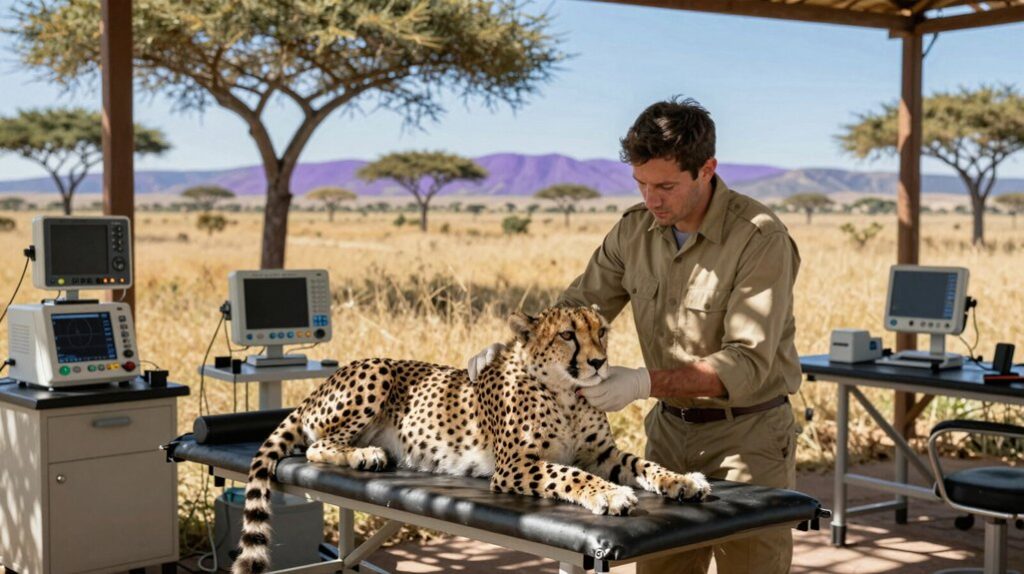
Volunteers aged 18 to 85 work directly with endangered wildlife cheetahs and rhinoceroses at a private game reserve near Hoedspruit, preparing specialized diets, cleaning enclosures under supervision, and recording behavioral data that informs captive-breeding programs designed to counter poaching losses and genetic bottlenecks.
Staff teach practical research methods—identifying individual cheetahs by spot patterns, collecting spoor and scat for analysis, assisting with health checks—while maintaining strict minimal-contact protocols during rehabilitation to preserve wild instincts before release.
Who Can Volunteer: Age and Eligibility Requirements?
Who might wonder whether they’re the right fit for this kind of work, and what does the program actually require?
The age range spans from 18 to 85 years—a broad window that welcomes both young adults and older participants who share a genuine passion for conservation.
All applicants pass through a vetting process before their trip begins, ensuring that each volunteer meets the eligibility standards and possesses the right temperament for their assigned placement.
It’s worth noting that accommodation follows a twin-share arrangement, which means volunteers will room with another participant throughout their stay. This shared living situation calls for flexibility and a collaborative spirit, qualities that serve well in conservation work where teamwork often proves essential to daily tasks and long-term success.
How the Pre-Trip Volunteer Vetting Process Works
Once eligibility requirements are understood, the formal vetting process itself begins to take shape—a series of steps designed to match each applicant with the right role at the endangered species centre in Hoedspruit.
The review examines details including age, relevant experience, and personal motivations, ensuring alignment with cheetah and rhino conservation programs.
A Trip Coordinator then manages pre-trip requirements: visa paperwork, placement confirmation, and logistical support tailored to each volunteer’s circumstances.
Safety and supervision criteria receive careful attention, with health, fitness, and conduct expectations verified to protect both volunteers and vulnerable wildlife.
This operational framework, refined since 2008 across tens of thousands of travelers, includes local team oversight and emergency contact procedures—safeguards that activate once acceptance is confirmed, creating a foundation of accountability throughout the placement.
What Daily Tasks Look Like at the Conservation Centre
Working directly with endangered animals transforms vague conservation ideals into a sequence of concrete, repeatable actions—tasks that collectively sustain the physical and psychological well-being of cheetahs, rhinos, and other vulnerable species housed at the Hoedspruit centre.
Volunteers prepare specialized diets, clean enclosures, and assist with basic medical treatments under staff supervision, ensuring each animal’s immediate needs are met.
They record behavioral observations and health indicators that feed into breeding programs and research databases, turning daily notes into actionable conservation intelligence.
Enrichment work involves designing stimulating activities and supporting orphan rehabilitation—efforts that maintain natural instincts while minimizing stress.
Beyond direct animal care, volunteers inspect perimeter fences, restore habitats, and maintain water points across the reserve, reducing poaching vulnerability and improving conditions for reintroduction candidates.
Endangered Cheetahs and Rhinos You’ll Work With
At the Hoedspruit centre, cheetahs and rhinoceroses form the core of volunteer engagement—two species whose survival hinges not only on protecting habitat but on rebuilding populations depleted by decades of poaching and fragmentation.
The breeding programmes here focus deliberately on genetic diversity, pairing individuals to strengthen inherited traits and avoid the weaknesses that arise when populations become too small.
Volunteers observe these animals up close: cheetahs recovering from injury, rhino calves orphaned by poachers, adults participating in carefully monitored reproduction. Staff limit human contact during rehabilitation to preserve instincts—hunting reflexes in cheetahs, defensive behaviour in rhinos—that determine whether an animal can eventually return to protected reserves.
Each task volunteers undertake supports research data collection, health monitoring, and public education that together address the threats both species face.
How Cheetah Breeding Programs Combat Extinction
Among the animals volunteers support at Hoedspruit, cheetahs present a particularly urgent conservation challenge, one that breeding programs address through meticulous genetic planning rather than simple reproduction.
With roughly 7,100 adult and adolescent cheetahs remaining in the wild according to IUCN estimates, captive breeding offers both insurance populations and reintroduction candidates—but cheetahs carry exceptionally low genetic diversity, meaning every pairing must be carefully screened using studbooks to maximize heterozygosity, the presence of different gene variants that strengthen resilience.
Before release, cubs undergo conditioning in predator avoidance and hunting live prey, improving survival rates once they rejoin wild landscapes.
South Africa’s metapopulation management even transfers individuals between fenced reserves to maintain gene flow across regions, reducing inbreeding and sustaining long-term viability while generating research data that guides broader conservation strategies.
Rhino Rehabilitation and Anti-Poaching Protection Work
Because rhinoceros populations face perhaps the most acute poaching crisis of any African megafauna—with over 1,000 individuals killed annually across the continent at the height of the crisis—rehabilitation centers in Hoedspruit shoulder dual responsibilities:
healing individual animals while fortifying the species’ long-term survival.
Volunteers participate in carefully structured programs that treat orphaned and injured rhinos, providing medical care and nutritional support while deliberately minimizing human contact to preserve wild instincts essential for post-release survival.
The work extends beyond individual rehabilitation: staff monitor breeding programs and genetics to maintain population diversity, coordinate anti-poaching patrols with local rangers, install protective bomas—secure enclosures—and track individual animals across reserves.
Community education initiatives address poaching drivers and demand reduction, recognizing that lasting protection requires both immediate intervention and sustained cultural shifts that value living rhinos over illegal trade.
Minimizing Human Contact During Animal Rehabilitation
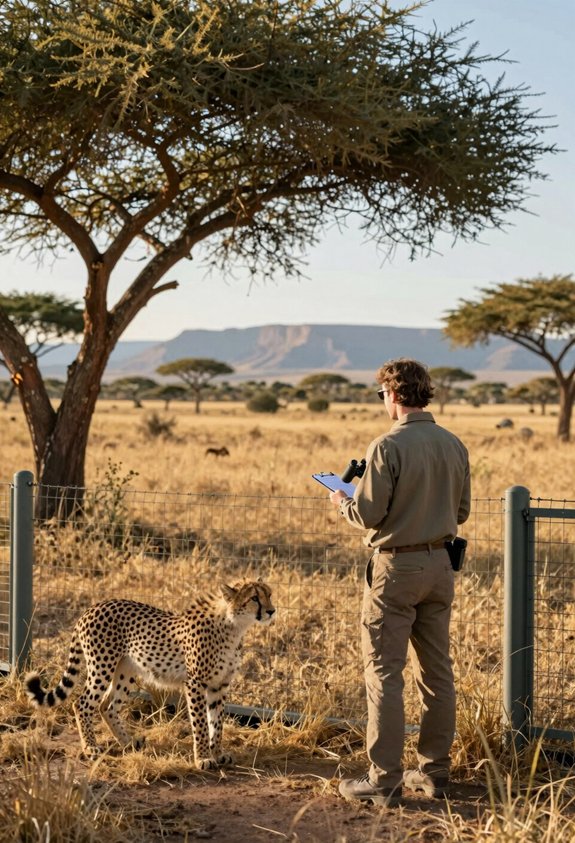
Successful rehabilitation requires a paradox: volunteers must invest time and care into animals they’re simultaneously working to distance from human presence. At the sanctuary, protocols guarantee orphaned cheetahs and rhinos interact minimally with people, preserving the wild behaviours essential for reintroduction.
A small, trained core team handles routine care while volunteers assist with supervised, non-contact tasks—preparing food from a distance, maintaining facilities, observing from hides. Feeding happens without close human presence whenever possible.
Strict hygiene measures, including gloves and equipment disinfection, protect vulnerable animals from disease transmission. Quarantine procedures isolate new arrivals until health assessments confirm they pose no risk.
Public education emphasizes that these careful boundaries, though they limit tactile connection, directly support long-term conservation outcomes by giving rehabilitated animals their best chance at survival.
Learning From Expert Wildlife Conservationists on Site
Within the sanctuary’s fieldwork routines, volunteers encounter a calibre of mentorship that rarely exists outside university research stations—daily collaboration with conservationists who’ve dedicated years to understanding the biology, behaviour, and recovery needs of Africa’s most imperiled species.
These professionals supervise hands-on tasks in animal husbandry (the daily care and feeding of captive animals) and teach practical research methods: identifying individual cheetahs by spot patterns, collecting behavioural data during rhinoceros health checks, recording GPS coordinates during habitat surveys.
The learning isn’t confined to wildlife alone—conservationists lead public-outreach workshops where volunteers design education materials aimed at reducing poaching and habitat destruction in surrounding communities.
Over trips lasting two to twelve weeks, this continuous supervision guarantees that every task, from rehabilitation protocols to field data collection, follows best-practice ethical standards and safety guidelines established through rigorous professional experience.
Animal Tracking, Data Collection, and Research Skills You’ll Develop
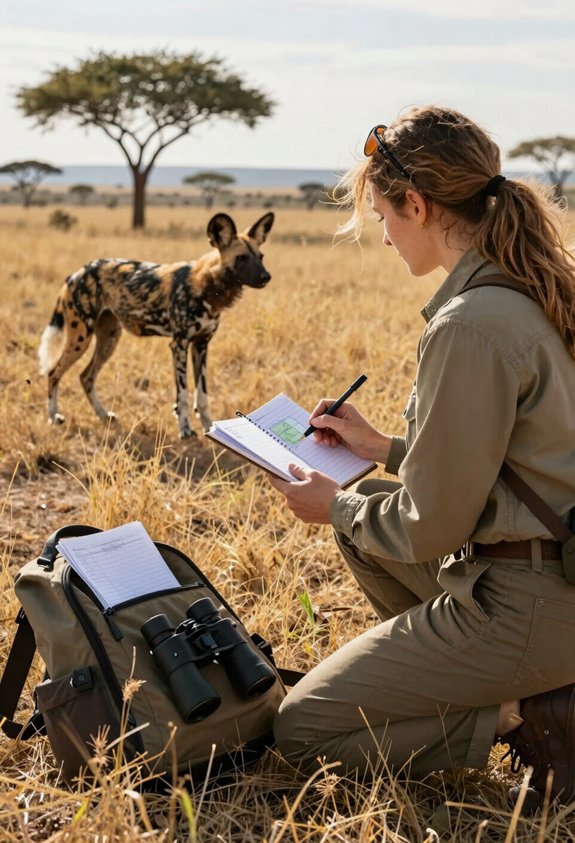
As volunteers move beyond daily care routines into the sanctuary’s research program, they gain technical skills that professional field biologists use to answer critical conservation questions—how many animals live in a region, where they travel, what they eat, and whether populations are growing or declining.
They’ll learn to deploy GPS collars that record location fixes every 30–240 minutes, creating maps of individual home ranges and movement corridors.
Camera-trap grids checked every few weeks yield photos for population estimates through capture–recapture methods.
Spoor tracking—reading tracks and signs left by animals—teaches identification by measuring dimensions and stride length on standardized datasheets.
Collecting scat and hair samples for genetic and diet analyses, then entering field data into Excel, ArcGIS, and R software, transforms observations into repeatable results that inform real conservation decisions.
Choosing Between 2-Week and 12-Week Volunteer Placements
One of the first decisions prospective volunteers face is how many weeks they can realistically commit—and whether a brief two-week stay or a full twelve-week immersion better matches their goals, schedule, and budget.
A two-week placement serves travelers seeking a hands-on introduction to cheetah and rhino care, bush walks, and education activities—a meaningful “taster” experience, though one with limited depth in project work.
By contrast, a twelve-week placement enables sustained involvement in breeding, rehabilitation, and research efforts: the continuity required for monitoring animal health, collecting longitudinal data, and supporting potential reintroduction programs. Longer stays also cultivate stronger relationships with staff and animals, opening up more advanced responsibilities and noticeably greater practical skills.
While accommodation and excursions remain consistent across durations, volunteers should weigh logistics carefully—shorter bookings demand less planning, whereas exended commitments require flexibility and forethought.
Thatched Hut Accommodation on a Private Game Reserve
Once a volunteer has settled on a placement length and prepared for the journey, the question of daily life naturally arises—where they’ll sleep, how they’ll share space with others, and what comforts await after long days alongside cheetahs and rhinos.
The answer lies in traditional thatched huts positioned on a private game reserve, where twin-share rooms pair volunteers together in comfortable, secure surroundings. Camp facilities extend beyond sleeping quarters: a communal kitchen, outdoor entertainment area, and relaxation spaces sit adjacent to the huts, creating a hub for shared meals and evening conversation.
Phone reception proves limited in this remote setting, though free Wi‑Fi at the project site keeps volunteers connected when needed. Breakfast and lunch follow a self-serve model, while staff prepare dinners—all served from the central camp facilities.
What Three Daily Meals and Camp Amenities Include
Each day, volunteers gather around the communal kitchen table three times, finding nourishment in meals that blend practicality with the cultural flavors of southern Africa.
Breakfast and lunch operate on a self-serve basis, allowing participants to fuel up according to their own schedules and preferences.
Dinners arrive differently—prepared by onsite staff who rotate between African and Western dishes, offering tastes that range from familiar comfort foods to regional specialties.
Between meals, the camp provides spaces designed for connection: an outdoor entertainment area where volunteers can unwind, relaxation zones that invite quiet reflection, and the communal kitchen itself, which becomes a natural gathering point.
The site also maintains free WiFi and limited phone service, ensuring that staying connected to the wider world remains possible even while immersed in wilderness work.
WiFi Availability and Limited Phone Service at the Reserve
While the camp provides comfortable spaces for volunteers to gather and recharge, staying connected to life beyond the reserve requires adjusting expectations about technology access.
Mobile phone service throughout the reserve remains limited—signals can be intermittent or weak in most areas, making cellular communication unreliable.
However, free WiFi is available in common areas at the project site, allowing volunteers to check email and send messages when they’re near these shared spaces.
The thatched huts where volunteers sleep may not receive strong WiFi signals inside every room, so using the kitchen or outdoor entertainment areas provides better connectivity. Despite these technological limitations, the local support team maintains a 24/5 emergency line, providing immediate assistance whenever volunteers truly need help during their stay.
You’ll get $100 off automatically, and by adding the additional code ELI100 at checkout, you can save an extra $100, for a total of $200 off your Global Work & Travel wildlife internship adventure.
Ready to volunteer or intern abroad? Enter code ELI100 at checkout and get $100 OFF any internship or volunteer project worldwide.
Explore ProjectsBush Walks and Game Drives Included in Your Program
Venturing beyond the daily rhythm of animal care and habitat maintenance, volunteers join guided bush walks and game drives that deepen their understanding of the reserve’s broader ecosystem and the species they’ve come to protect. Conservation staff and wildlife experts lead these supervised outings, teaching participants to track movement patterns, interpret animal behaviour, and recognize the subtle signs that reveal how cheetahs, rhinoceroses, and other endangered species navigate their surroundings.
Each excursion follows strict safety protocols and conservation best practices, ensuring close encounters remain educational without causing disturbance. These activities aren’t simply breaks from work—they’re practical extensions of the volunteer experience, offering real-world context for research, monitoring, and the public education efforts that sustain long-term protection. The reserve becomes a living classroom where observation sharpens understanding.
Traditional Village Visits and Cultural Immersion Activities
Beyond the fence lines and acacia-studded grasslands where volunteers track endangered species, the program extends into nearby communities where cultural exchange becomes another layer of the conservation story. Guided visits to traditional villages offer hands-on experiences—cooking demonstrations, craft-making workshops, storytelling sessions led by local elders—that reveal how human communities and wildlife reserves coexist.
These excursions, scheduled alongside bush walks and game drives, provide direct financial support to village economies while creating meaningful dialogue between visitors and hosts.
The camp’s limited phone service and free Wi‑Fi encourage volunteers to engage fully, listening with respect and learning how conservation efforts ripple outward to support education initiatives and sustainable livelihoods.
Cultural immersion, in this setting, isn’t separate from wildlife work—it’s foundational to it.
Why Hoedspruit Is Central to South Africa’s Conservation Efforts
A glance at any conservation map of South Africa reveals Hoedspruit not as an isolated dot but as a nerve center where protected wilderness, private reserves, and community land converge along the western boundary of the Greater Kruger ecosystem.
This positioning creates essential corridors—pathways that allow lions, elephants, and leopards to move freely between territories, exchanging genes and maintaining healthy populations.
The town hosts specialized breeding centers for cheetahs and rhinos, coordinates anti-poaching patrols across multiple properties, and supports a dense network of research projects that track migration patterns and disease outbreaks. International volunteers and conservation NGOs sustain long-term monitoring, education, and habitat restoration work, turning geographic advantage into measurable progress for species teetering on the edge of extinction.
How Your Volunteer Work Directly Impacts Species Survival
When volunteers arrive at Hoedspruit’s endangered species centre each morning to prepare meals, clean enclosures, and observe the cheetahs and rhinos in their care, they’re not simply helping to keep the facility running—they’re performing tasks that translate directly into higher survival rates for animals whose wild populations are plummeting.
Daily husbandry work maintains the health of individual animals, while data collection on behavior and breeding patterns informs captive-breeding programs that increase reproductive success. Volunteers also support rehabilitation protocols for orphaned or injured animals, following structured guidelines that minimize human contact—a critical factor in preparing candidates for reintroduction to wild habitats.
Beyond hands-on care, volunteer-led education initiatives reach visitors and local communities, building the public support necessary to combat poaching and habitat loss at their source.
Safety Protocols for Working Near Dangerous Wildlife
Working alongside cheetahs, rhinos, and other species capable of inflicting serious injury requires layered safety protocols that protect both volunteers and animals—systems designed not to eliminate risk entirely, which would be impossible, but to reduce it to manageable levels through preparation, supervision, and strict adherence to tested procedures.
Every participant completes mandatory on-site safety induction and practical training with experienced staff before any close work begins, and unsupervised handling is never permitted.
Personal protective equipment—gloves, boots, eye protection, and when necessary bite-resistant guards—is required for feedings, medical procedures, and enclosure maintenance.
Health precautions include up-to-date tetanus vaccination, recommended rabies pre-exposure vaccination for high-risk roles, and immediate wound-care protocols.
Emergency systems provide constant supervision, radio communication with a 24/5 support line, veterinary access, and established containment procedures.
Airport Transfers and First-Day Volunteer Orientation
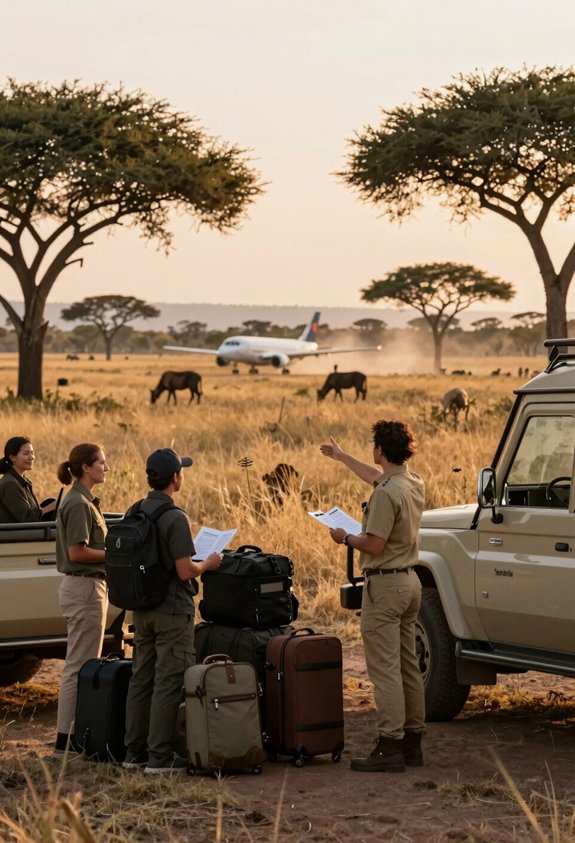
From the moment a volunteer’s flight touches down at the nearest major airport, the program’s local team coordinates every detail of the arrival process—arranging secure transfers to the private game reserve, ensuring clear communication about pick-up locations and timing, and handling the logistics that might otherwise overwhelm someone arriving in unfamiliar territory after a long international journey.
Upon reaching the sanctuary, first-day orientation begins with project supervisors outlining safety protocols, daily schedules, and the minimal-contact policy that guides all interactions with rehabilitating animals.
The tour includes thatched-hut accommodation, communal kitchens where volunteers prepare breakfast and lunch while staff handle dinner, and relaxation areas.
Volunteers meet their twin-share roommates, learn about limited phone service paired with free WiFi, and receive emergency contacts—including the 24/5 support line available throughout placements ranging from two to twelve weeks.
What the 24/5 Emergency Support Line Covers
Though volunteers spend much of their placement focused on daily tasks—feeding schedules, enclosure maintenance, behavioral observations—the 24/5 emergency support line exists as a safety net for those rare moments when something goes wrong and immediate guidance becomes essential.
Available five days each week, the line coordinates medical or security responses through local teams, liaising directly with project supervisors to guarantee rapid intervention when safety concerns arise.
It addresses critical travel disruptions: missed transfers, accommodation emergencies, or situations requiring urgent contact with the Trip Coordinator.
Volunteers can also access pre-departure guidance or request help with time-sensitive trip changes—cancellations, transfers, placements on hold—all managed according to program policies, guaranteeing that unexpected circumstances receive prompt, organized support from experienced staff
How to Book Your Spot With a Flexible Deposit
Once a volunteer understands the safety measures in place—emergency lines, local coordination, rapid response protocols—the next practical step involves locking in a departure date and confirming participation, and that’s where the “Book Now, Decide Later” feature becomes especially useful.
A small deposit secures the spot while the volunteer finalizes travel dates, and it offers genuine flexibility: dates can be changed or transferred, or the entire booking can be placed on hold rather than cancelled outright.
A Trip Coordinator handles visa paperwork and applies the deposit toward the final balance, while an optional Personal Travel Concierge arranges flights, insurance, and add-ons.
If cancellation becomes necessary with 84 days’ notice, a 50% fee applies—an important detail worth noting early.
Cancellation Policies and Destination Transfer Options
Life rarely unfolds according to plan, and volunteer programs that recognize this reality tend to build policies around second chances rather than outright endings—a principle that shows up clearly in the way cancellation and transfer options work. Instead of cancelling completely, travelers can place trips on hold or transfer their booking to a different destination, preserving momentum while accommodating shifts in circumstance.
If outright cancellation becomes necessary, an 84-day notice period carries a 50% fee—a structure that balances flexibility with program planning needs.
Throughout these changes, a Personal Travel Concierge and Trip Coordinator assist with rebooking logistics, visa adjustments, and paperwork changes, while ongoing local support and a 24/5 emergency line remain available to navigate last-minute modifications, ensuring assistance extends well beyond initial booking.
What Your Trip Coordinator Handles Before Departure
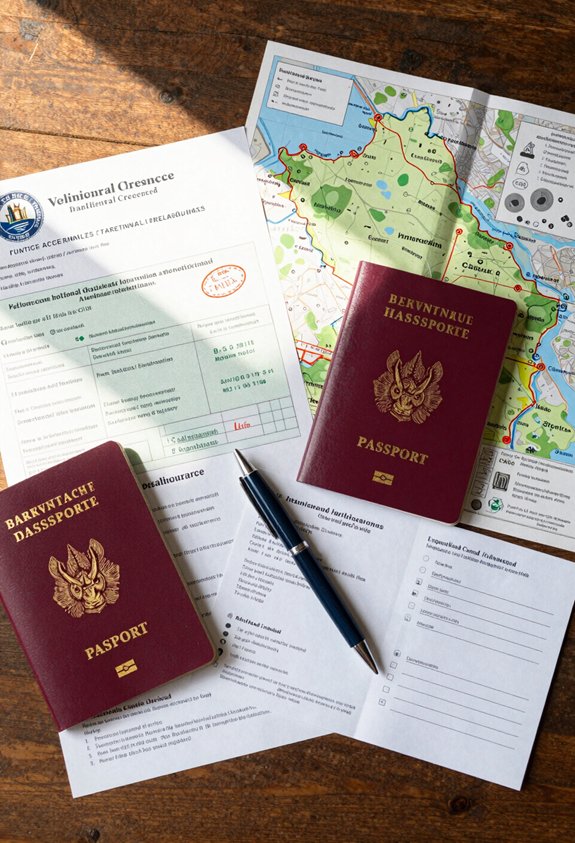
Behind every flexible policy sits a person who actually implements it, and that’s where the Trip Coordinator steps in—someone who doesn’t just field inquiries but actively builds the scaffolding that holds a volunteer journey together from first question to final boarding pass.
This coordinator guides the entire arc: vetting the endangered species centre placement, managing visa paperwork and pre-departure documents so entry requirements are met, arranging secure airport transfers, and confirming twin-share thatched-hut accommodation on the private game reserve.
Questions find answers through one steady contact.
Meanwhile, a linked Personal Travel Concierge handles flights, insurance, and optional add-ons, managing bookings and explaining deposit structures—like “Book Now, Decide Later”—alongside cancellation terms, ensuring travelers understand the framework before committing.
Visa Paperwork and Personal Travel Concierge Services
While the Trip Coordinator builds the volunteer placement itself—securing your role with the endangered wildlife cntre and confirming your spot on the private reserve—the visa paperwork demands equal attention, and that’s where the coordinator’s step-by-step guidance becomes essential, walking travelers through South Africa’s entry requirements with document checklists, application timelines, and review sessions that catch missing signatures or outdated passport dates before they become problems.
Meanwhile, the Personal Travel Concierge operates in parallel: booking flights that align with visa approval dates, arranging travel insurance tailored to volunteer work, and adding extras like airport transfers or weekend excursions to nearby parks.
The Book Now, Decide Later option holds your spot with a small deposit, giving both coordinator and concierge time to finalize visa timing and adjust travel details right up to departure.
Connecting With a Global Community of Conservation Volunteers
Joining a wildlife conservation placement means stepping into a living, worldwide community of individuals who share a commitment to protecting vulnerable species and their habitats.
Volunteers become part of an inner circle exceeding one million travelers, creating connections that extend well beyond their placement dates.
The program welcomes ages eighteen through eighty-five, forming multigenerational teams where varied life experiences deepen understanding and foster lasting friendships.
Most participants stay three to four weeks—a duration that allows meaningful bonds to form through shared daily responsibilities, game drives, and cultural outings.
All volunteers undergo vetting before arrival, ensuring everyone brings genuine dedication to conservation and ethical animal care.
Beyond active placements, a broader network of over ninety thousand past travelers offers peer-generated advice, mentorship, and trusted recommendations backed by more than ten thousand four- and five-star reviews.
Real Volunteer Reviews and Experiences From Past Participants
What does it truly mean to work with endangered wildlife, and can a volunteer placement deliver the depth of experience many travelers hope for? Past participants offer reassuring testimony: the program holds an average rating of 4.8 out of 5, supported by more than 10,000 recorded four- and five-star reviews.
Volunteers who stayed the typical three-to-four-week period consistently praise hands-on rehabilitation work with cheetahs and rhinoceroses at Hoedspruit’s endangered species centre.
They also note comfortable twin-share thatched accommodation, three daily meals, and included bush walks.
Many emphasize the quality of supervision—vetted project staff, secure airport transfers, and round-the-clock emergency support—as reasons they felt confident volunteering abroad.
Reviewers report gaining practical conservation skills, deep emotional reward from rehabilitation work, and lasting friendships with fellow volunteers and local staff.
Ready to volunteer or intern abroad? Enter code ELI100 at checkout and get $100 OFF any internship or volunteer project worldwide.
Explore ProjectsIf you’re exploring hands-on experience in ecology or wildlife biology, don’t miss my complete guide to wildlife conservation internships with global work and travel, where I break down what’s worth your time, money, and long-term career goals.

Erzsebet Frey (Eli Frey) is an ecologist and online entrepreneur with a Master of Science in Ecology from the University of Belgrade. Originally from Serbia, she has lived in Sri Lanka since 2017. Eli has worked internationally in countries like Oman, Brazil, Germany, and Sri Lanka. In 2018, she expanded into SEO and blogging, completing courses from UC Davis and Edinburgh. Eli has founded multiple websites focused on biology, ecology, environmental science, sustainable and simple living, and outdoor activities. She enjoys creating nature and simple living videos on YouTube and participates in speleology, diving, and hiking.
🌿 Explore the Wild Side!
Discover eBooks, guides, templates and stylish wildlife-themed T-shirts, notebooks, scrunchies, bandanas, and tote bags. Perfect for nature lovers and wildlife enthusiasts!
Visit My Shop →