
I have spent a lot of field time around canids, and wolves are the animal people get most confidently wrong. Almost everything in the popular story, the alpha male, the howling at the moon, the wolves that changed the rivers, is either an artefact of studying captive animals or a piece of science that has been reassessed and never re-reported. This page is the version I would give a student: what is actually known, what is contested, and where the evidence runs out.
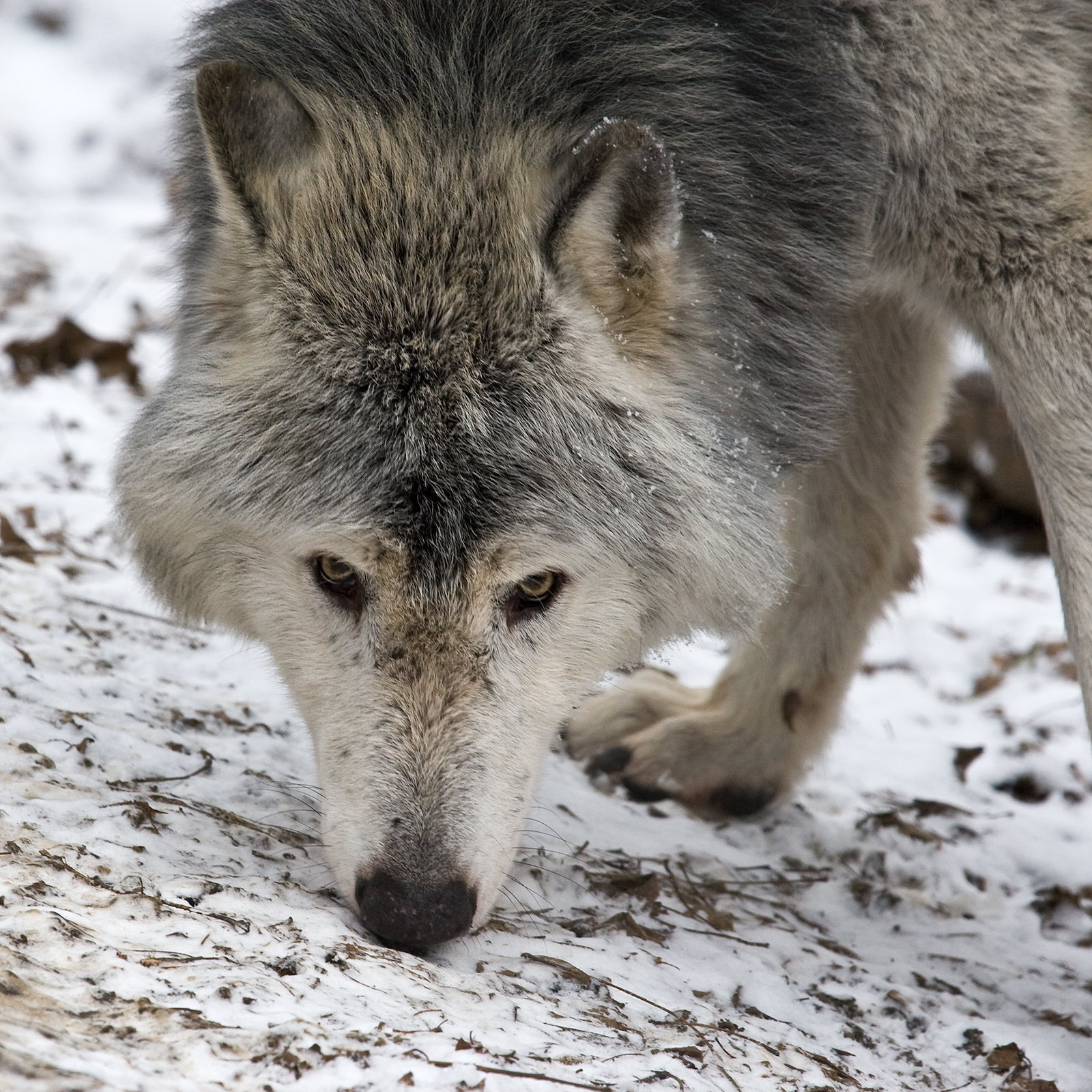
How many wolf species are there?
Four living species are generally recognised, and one of the four is genuinely disputed. The IUCN Canid Specialist Group taxonomy workshop held at CIBIO in Portugal in 2019 is the reference point most researchers now use.
| Species | Common name | Status | How settled |
|---|---|---|---|
| Canis lupus | Grey wolf | Least Concern | Settled |
| Canis simensis | Ethiopian wolf | Endangered | Settled, never seriously disputed |
| Canis lupaster | African wolf | Not yet assessed separately | Split from golden jackal in 2015, naming still unsettled |
| Canis rufus | Red wolf | Critically Endangered | Species status upheld, origin contested |
| Canis sp. cf. lycaon | Eastern or Algonquin wolf | Threatened in Canada | Not a grey wolf subspecies; rank unresolved |
The subspecies number you see everywhere is wrong
You will read that there are 38 subspecies of grey wolf. That figure comes from Mammal Species of the World, third edition, in 2005, and it includes the domestic dog and the dingo. Strip those out, and note that the eastern wolf and red wolf are now treated as separate species rather than subspecies, and the number stops being a fact and becomes a matter of which authority you follow. There is no agreed subspecies count. Anyone who gives you one without saying whose list they are using is repeating rather than checking.
If you want the range of forms rather than a number, my species of wolves list and types of wolves and their characteristics walk through the living wolves, and types of wolves and where they live maps them geographically.
The dire wolf was never a wolf, and the ones in the news are not dire wolves
Two things worth separating. First, the palaeontology: Perri and colleagues, writing in Nature in January 2021, sequenced dire wolf genomes and found the lineage split from living canids around 5.7 million years ago with no evidence of gene flow with grey wolves or coyotes. Grey wolves, coyotes and dholes evolved in Eurasia; the dire wolf was an old New World animal that happened to look similar. The result supports putting it in its own genus, Aenocyon, rather than Canis. A 2026 follow up in Cell Genomics using two much older genomes suggests the dire wolf was itself of hybrid origin, which refines the picture without putting it back in Canis.
Second, the animals announced by Colossal Biosciences in April 2025 are grey wolves carrying about twenty edits across fourteen genes, only fifteen of them derived from dire wolf sequence, with no ancient DNA inserted. Colossal’s own lead scientist described them as grey wolves with twenty edits. The IUCN Canid Specialist Group stated that the animals are neither dire wolves nor proxies for them and that the project does not contribute to conservation. If a headline told you the dire wolf is back, it was wrong.
There is no alpha wolf
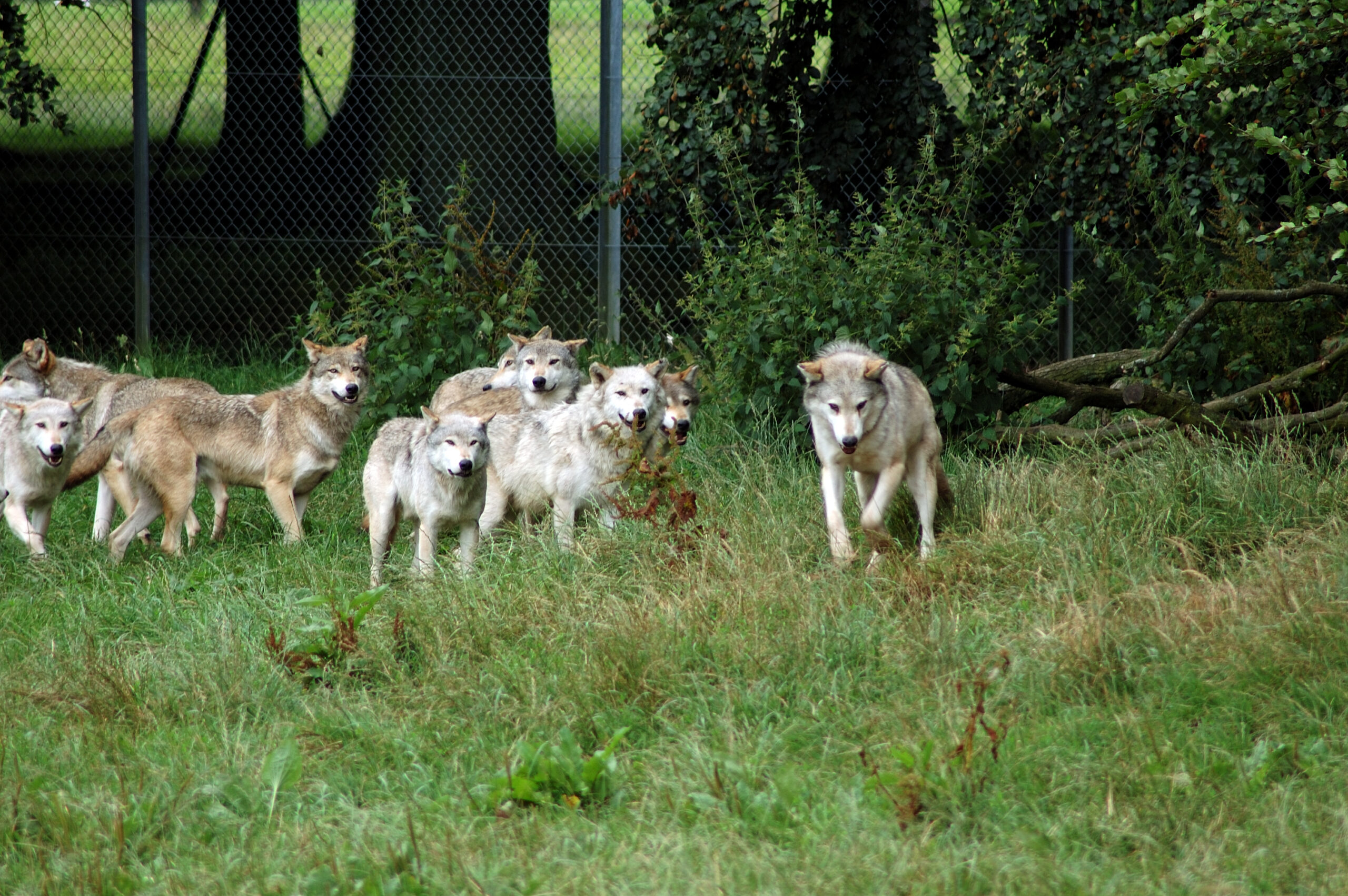
This is the correction that matters most, because the alpha model is still taught, still sold in dog training courses, and still repeated in nature documentaries.
It began with Rudolph Schenkel’s 1947 study, Expression Studies on Wolves, carried out on unrelated captive wolves at Basel Zoo. Put a group of unrelated adult wolves in an enclosure and they do form a dominance hierarchy, with animals competing for rank. That is a real observation. It is also an observation about captivity.
The model reached the public through L. David Mech’s 1970 book The Wolf. Mech then spent thirteen summers watching wild wolves on Ellesmere Island and published the correction himself, in Alpha status, dominance, and division of labor in wolf packs, Canadian Journal of Zoology 77, 1999. His conclusion, in his own words:
I conclude that the typical wolf pack is a family, with the adult parents guiding the activities of the group in a division-of-labor system in which the female predominates primarily in such activities as pup care and defense and the male primarily during foraging and food-provisioning and the travels associated with them.
L. David Mech, 1999
And on the vocabulary itself: Why not refer to an alpha female as the female parent, the breeding female, the matriarch, or simply the mother?
So a wild pack is a breeding pair and their offspring, usually one to three years old, dispersing as they mature. The parents lead because they are the parents. Nobody fought their way to the top. On his own site Mech is blunt that his 1970 book is the reason the idea spread, which is a rare and honest thing for a scientist to say about his own work.
I have written about what pack structure actually looks like in wolf pack ranks, roles and order and leader of the pack, and about reading wolf body language in how do you know if a wolf is angry.
What sounds do wolves make, and can a wolf purr?
No. Wolves cannot purr, and the usual explanation you will find online is also wrong, so it is worth doing properly.
The common answer is that cats purr because of a rigid hyoid bone. That explains why small cats purr and big cats roar. It does not explain cats against dogs, and the snow leopard breaks it anyway, since it has an incompletely ossified hyoid and still purrs. The better supported mechanism is laryngeal. Herbst and colleagues, Current Biology 2023, took excised domestic cat larynges and got self sustaining oscillation at 20 to 30 hertz with no neural input and no muscle contraction at all. The structure that allows it is a pad of connective tissue embedded in the vocal folds, which is a felid feature. Wolves do not have it.
Being straight about the evidence: I could find no study that has anatomically tested a wolf larynx for purring capacity. The conclusion rests on the absence of the felid vocal fold pad and on purring being absent from every published wolf vocal repertoire. That is strong inference, not a direct experiment, and you should treat it as such.
What wolves do produce was measured properly by Sadhukhan, Hennelly and Habib in PLOS ONE, 2019, on Indian wolves:
| Call | Mean fundamental frequency | Typical duration |
|---|---|---|
| Howl | 422 Hz | 5.2 seconds |
| Social squeak, the “talking” sound | 461 Hz | short |
| Whine | 906 Hz | 1.2 seconds |
| Whimper | 1708 Hz | 0.4 seconds |
Growls, barks and huffs are added to that as non harmonic calls. No purr anywhere in the repertoire. The rumbling, contented noise people describe and interpret as purring is almost always a low whine or a soft growl, which is why the question comes up so often. I have taken that apart in detail in can wolves purr, and what that rumbling sound really is, with a shorter version in do wolves purr.
Every wolf howl is individually identifiable
Howls carry individual identity in their frequency and amplitude structure, which is now being used for monitoring. A 2026 study in Ecologies classified two free ranging wolves from forty adult howls with 92 per cent accuracy using fundamental frequency features. Adult howls span roughly 150 to 780 hertz and pup howls sit significantly higher. The authors are careful to say that inferring whole pack composition acoustically still needs validation, which is the right caution.
Across species, Kershenbaum and colleagues, 2016, analysed 2,000 howls from thirteen canid species and found 21 distinct howl types. Species differ not by having unique sounds but by how often they use each type, which is where the popular idea of howling dialects comes from.
Do wolves howl at the moon?
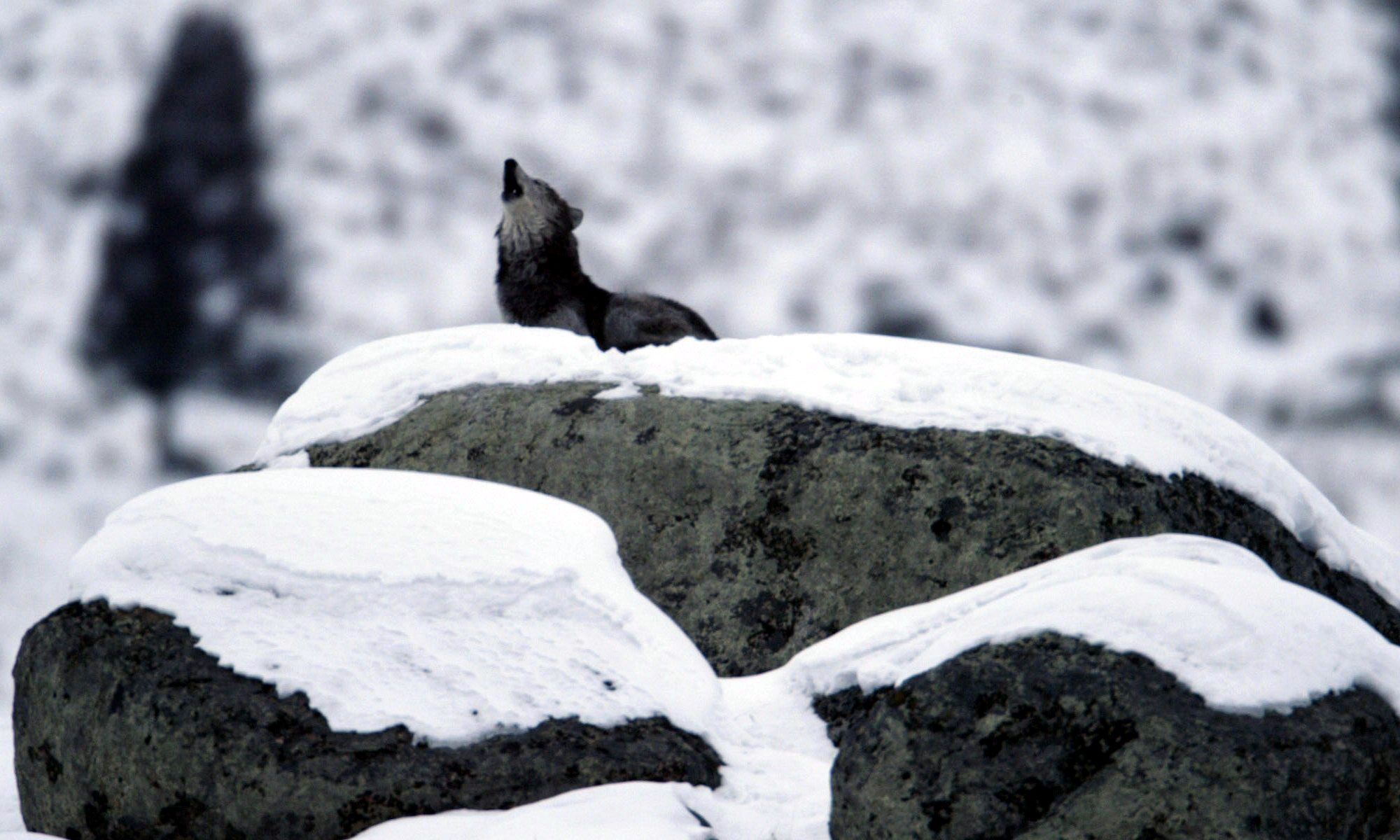
No. And here is a piece of honesty you will not get elsewhere: I could not find a single peer reviewed study that tested howling rate against lunar phase. Every debunk I found is institutional or popular rather than experimental. So the correct statement is not “a study disproved it”. The correct statement is that no mechanism links howling to the moon, and everything that does predict howling has been measured.
Harrington and Mech, 1979, measured five factors, and the numbers are specific:
- Pack size. Larger packs replied to a howl in 66.9 per cent of sessions, against 40.7 per cent for a small pack.
- Food. A 72.7 per cent reply rate at kill sites against 34.8 per cent elsewhere, falling as the carcass was eaten. Wolves answer most when they have something to defend.
- Pups. Response peaked at 77.1 per cent in August at rendezvous sites.
- Breeding season. Replies from groups with breeders rose from 7.1 to 40.0 per cent across February and March.
- Social role. Breeding males answer most; lone subordinates rarely answer at all.
Wolves responded to howls from at least 9 km, and can hear them at roughly 9 to 11 km in good conditions. Crucially, they approached the source in under 3 per cent of sessions. The authors concluded that advertisement, not confrontation, is the day to day mechanism of territory maintenance. Howling keeps packs apart rather than bringing them together.
There is also a social dimension. Mazzini and colleagues, 2013, found that wolves howled more when the pack mate who had left was a preferred partner or higher ranking, and that cortisol did not correlate with howling. Howling is a flexible social tool, not an involuntary stress response.
So why the moon? Wolves are crepuscular and nocturnal, they lift the head to howl so the sound carries further, and they howl most in the breeding season, which in the northern hemisphere means long dark winter nights. The correlation is with darkness and season. The moon is just what happens to be in the sky. The longer version is in why are wolves howling at the moon.
Wolf eye colour, and why a blue eyed wolf is usually a wolfdog
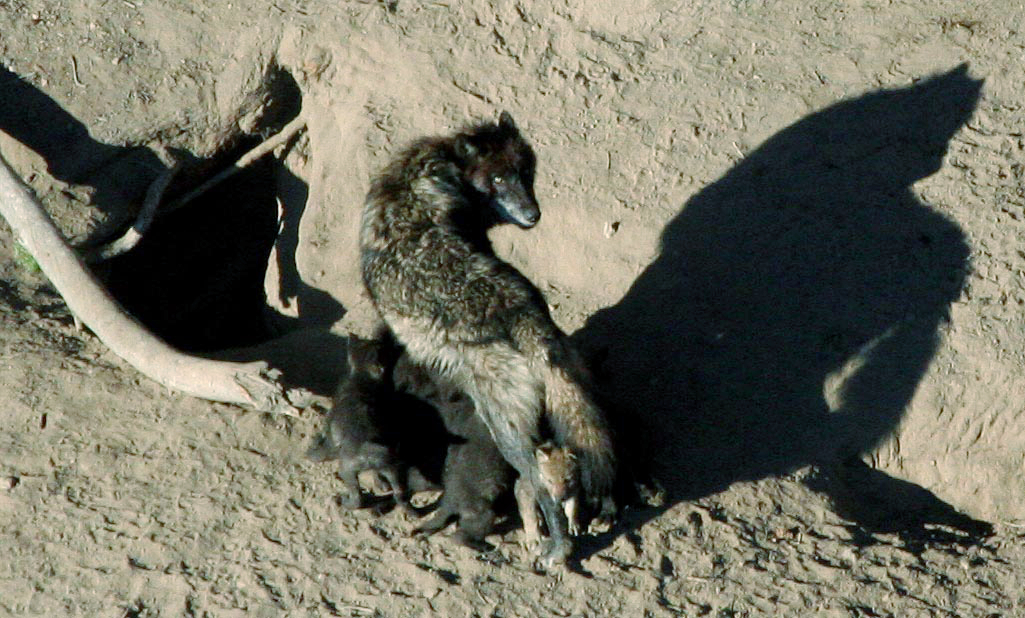
Wolf pups are born with their eyes shut. The eyes open somewhere between 11 and 15 days and they are blue, which is not pigment at all but a structural effect: light scattering through an iris that has not yet accumulated melanin. The same thing happens in many mammals, humans included. Between roughly eight and sixteen weeks the blue gives way to yellow gold as melanin builds up.
Adult wild wolves have amber, yellow or gold irises. That is not just an impression. Konno and colleagues, Royal Society Open Science, December 2023, compared 22 grey wolves against 81 dogs from 35 breeds and found dogs’ irises significantly darker and redder than wolves’. When they asked people to rate the faces, dark eyed dogs were judged friendlier and more immature, which the authors suggest is a domestication signal: we may have selected for the darker eye without ever meaning to.
Blue eyed adult dogs are common. Blue eyed adult wild wolves essentially do not occur. In dogs the genetics is known: a 98.6 kilobase duplication upstream of the ALX4 gene on chromosome 18, identified by Deane-Coe and colleagues in PLOS Genetics, 2018 across more than 6,000 dogs, plus two other routes through merle and piebald.
Now the part almost every page on this subject gets wrong. That study did not test wolves. There is, as far as I can find, no published work on wolf iris pigmentation genetics at all, and nothing establishing whether the ALX4 duplication exists in wild wolf populations. So the honest position is this: the known blue eye variants are documented in domestic dogs and are not documented in wild wolves, which is the best available explanation for why blue eyed adult wolves are absent from the wild. It is an inference from an evidence gap, not a finding. In practice, a blue eyed adult animal being sold to you as a wolf is a strong indicator of dog ancestry.
More on the range of iris and coat colours in wolf eye colors and common and rare wolf colours.
Yellowstone: what wolves actually did, and what they did not
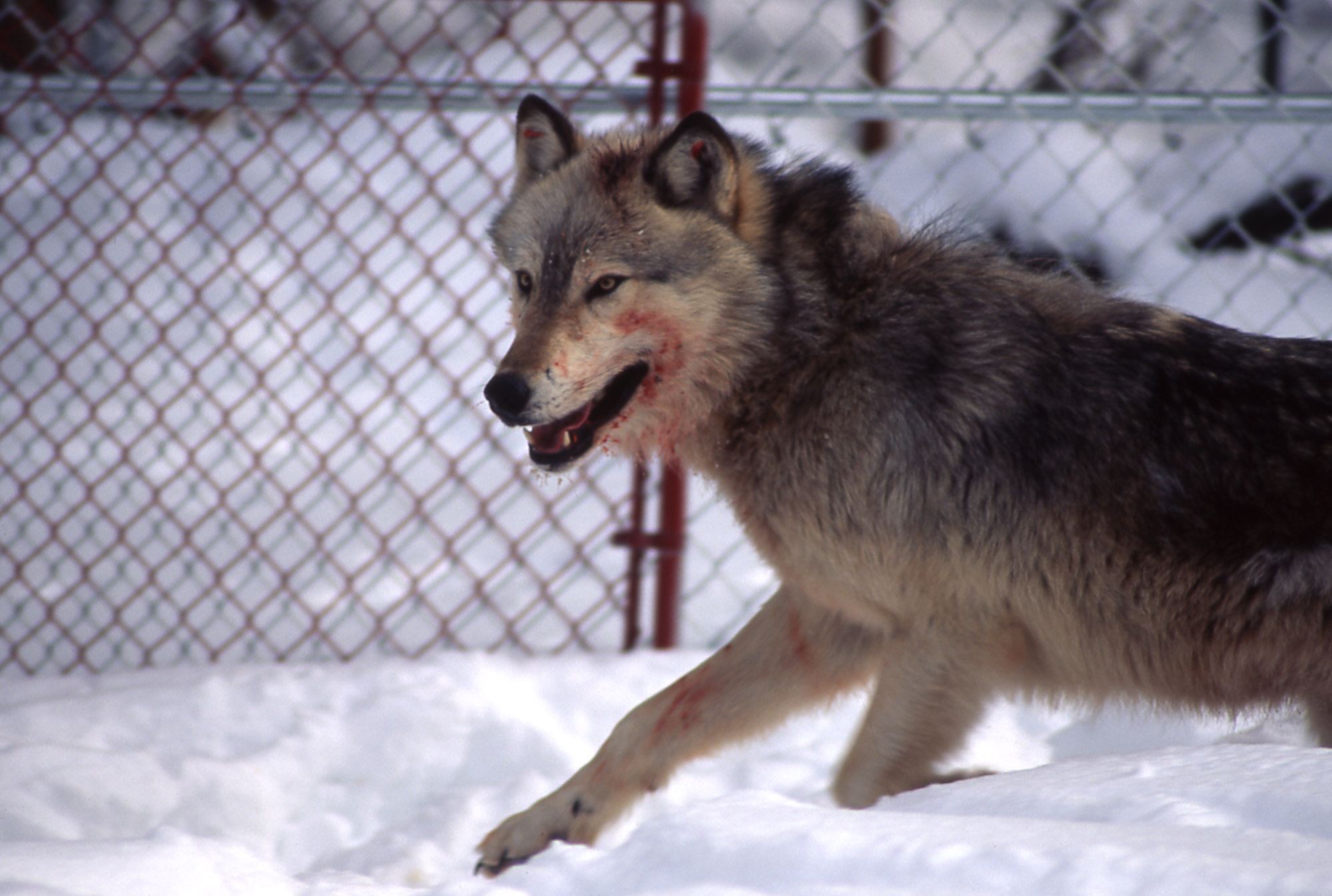
The facts of the reintroduction are not in dispute. Fourteen wolves in three packs were released between 21 and 27 March 1995, brought from near Hinton in Alberta. Seventeen more in four packs followed between 2 and 14 April 1996, from east of Williston Lake in British Columbia. Thirty one animals, seven packs, held in acclimation pens for around ten weeks first. At the end of 2024 the park held 108 wolves in nine packs with seven breeding pairs, and the northern range elk count stood at 5,597.
What is in dispute is the story built on top of that, and this is where I part company with most of what is published.
The popular version comes from a 2014 video narrated by George Monbiot: wolves frightened elk away from valley bottoms, willow and aspen recovered, beavers returned, riverbanks stabilised, the wolves changed the rivers. The scientific basis was Ripple and Beschta, 2012, which documented real changes: aspen leader browsing fell from 100 per cent in 1998 to under 25 per cent by 2010, cottonwood recruitment went from zero between 2001 and 2003 to 156 trees by 2010, beaver colonies rose from one in 1996 to twelve in 2009. Note what that paper actually said about rivers, though. It said recovering vegetation can provide hydraulic roughness and root strength and that eroding channels are likely to stabilise. The certainty in the video is not in the paper.
Since then the reassessment has been substantial:
- Hobbs, Cooper and colleagues, 2024, ran a twenty year manipulative experiment with fenced exclosures and simulated beaver dams. Willows grew more than three times taller where browsing was excluded and the water table was raised. Excluding browsing on its own was not enough. Groundwater is co-limiting, and the northern range now sits in an alternative stable state.
- Brice, MacNulty, Larsen and Stahler used nineteen years of aspen data and found that the driver was the reduction in elk numbers, not the landscape of fear, and that the reduction came from wolves, bears, cougars and human hunters together. Daniel Stahler, the Yellowstone Wolf Project biologist, said it refines a story that has erroneously claimed elk’s fear of wolves drove the aspen regeneration. That specifically kills the mechanism the video is built on.
- Ripple and colleagues answered in 2025 with a claimed 1500 per cent increase in willow crown volume. MacNulty and colleagues replied that the model was circular, crown volume having been computed from height and then height regressed against that volume, and that only 3 of 22 plots sampled in 2020 had matching 2001 measurements.
The National Park Service’s own position is that this is unresolved and multi causal, with water availability, climate, beaver loss and the recovery of cougars and bears all contributing. Their summary line is worth keeping: surely, we have made progress, but we are not there yet.
My reading: wolves had real and measurable effects in Yellowstone. The specific claim that wolves changed the rivers through a behavioural fear cascade is not supported by the current weight of evidence, and the strongest quantitative argument for it has been shown to rest on a circular model. That is a more interesting story than the myth, not a less interesting one. I have written the restoration up in the wolves in Yellowstone, and the general principle in habitat in ecology.
Where wolves live now, and how many are left
A warning before the numbers. The global figure of 200,000 to 250,000 grey wolves, attributed to the IUCN assessment, is repeated everywhere including by me. There is no rigorous global census behind it. It is a compilation of national estimates of very uneven quality and different vintages. Treat it as an order of magnitude, not a count.
Europe: recovering, and protection just weakened
The best data anywhere comes from Di Bernardi and colleagues, February 2025: over 21,500 wolves in Europe by 2022, a 58 per cent increase in a decade, around 19,000 of them in the EU, present in 34 countries. Seven countries hold more than a thousand wolves each: Bulgaria, Greece, Germany, Italy, Poland, Spain and Romania. Germany went from one pack in 2000 to 184 packs and 47 pairs by 2022.
The cost side is real and worth stating plainly, because conservation arguments that ignore it do not survive contact with farmers. Around 56,000 domestic animals are killed by wolves in the EU each year, with about 17 million euros paid in compensation. Sheep and goats are roughly two thirds of losses.
Protection has now been reduced. Under the Bern Convention the wolf moved from Appendix II, strictly protected, to Appendix III, protected, following a vote on 6 December 2024, in force from 7 March 2025. One detail that is almost always left out: the Czech Republic, Monaco and the United Kingdom formally objected, so the change does not apply to them. The EU followed, with the Council giving final approval on 5 June 2025 to move the wolf from strictly protected to protected under the Habitats Directive. Member states may still keep stricter national protection and must maintain favourable conservation status. The Council’s own figures show EU wolves rising from about 11,193 in 2012 to about 20,300 in 2023.
If you want to see wild wolves in Europe, I have written up where to see wolves in Italy.
United States: contested, and moving fast
Legal status has changed repeatedly and is changing again as I write this in September 2026. The Fish and Wildlife Service delisted grey wolves across the lower 48 in late 2020. A federal court in the Northern District of California vacated that rule on 10 February 2022, restoring protection everywhere except the Northern Rockies, which Congress had delisted separately through a 2011 rider. On 5 August 2025 a federal court in Montana overturned the agency’s refusal to relist Northern Rockies wolves, finding it had failed to consider historical range and had not assessed whether Idaho and Montana regulations were adequate. The House passed a bill to delist wolves by statute on 18 December 2025, which then went to the Senate.
Most recently, an executive order signed on 4 September 2026 directs the Secretary of the Interior, within 90 days, to determine whether grey and Mexican wolves meet delisting or downlisting criteria, to send the President a legislative recommendation to delist or downlist, and to revise the criteria authorising lethal removal. That 90 day deadline falls in early December 2026. Anything you read about US wolf status that is not dated is not usable.
| Population | Count | As of |
|---|---|---|
| Alaska | 7,700 to 11,200 | 2017 |
| Minnesota | 2,919 | winter 2022 to 23 |
| Wisconsin | about 1,200 | 2024 to 25 |
| Idaho | about 1,129 | 2025 |
| Michigan | 762 | 2023 |
| Montana | 725 | 2025 |
| Washington | 270 in 49 packs | April 2026 |
| Wyoming | 253 | 31 December 2025 |
| Oregon | 230 | April 2026 |
| Mexican wolf, US | 319 | end of 2025 |
| California | about 55 | May 2026 |
| Colorado | at least 32 | 31 March 2026 |
| Yellowstone National Park | 108 in 9 packs | 31 December 2024 |
| Red wolf, wild | about 22 adults plus 14 to 15 pups | August 2026 |
| Ethiopian wolf | about 450 in 99 packs | 2024 |
Colorado is the one to watch. Ten wolves from Oregon were released in December 2023 and fifteen from British Columbia in January 2025. The population roughly doubled to at least 32 by March 2026, in four packs. But ten wolves died in the twelve months to March 2026, giving 61 per cent survival against the 70 per cent threshold the state had set, and Colorado failed to secure a third source population for winter 2026. Depredation ran to 19 cattle, 23 sheep and one working dog across 43 confirmed incidents, with more than 753,000 dollars paid out.
The two wolves that could actually disappear
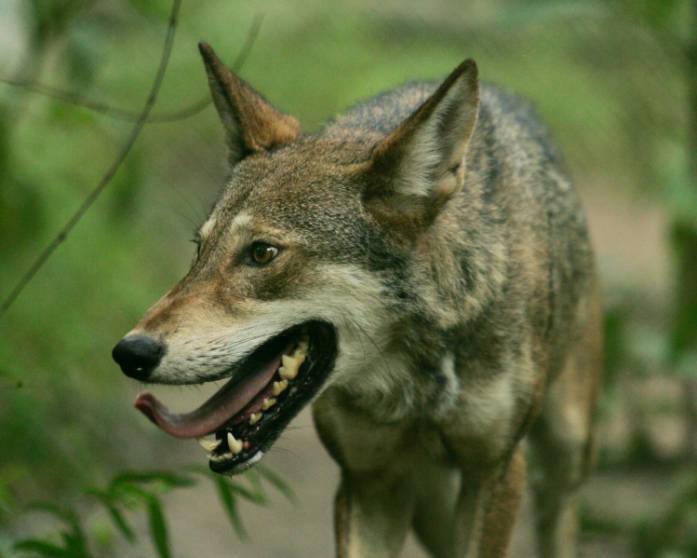
The red wolf exists in the wild in five counties on the Albemarle Peninsula in North Carolina and nowhere else. About 22 adults and subadults, plus 14 to 15 pups from four litters in 2026, against roughly 295 animals in captivity. Its taxonomy has been fought over for a decade. VonHoldt and colleagues, 2016, concluded from whole genomes that red wolves are about 76 per cent coyote and 24 per cent grey wolf, with admixture 287 to 430 years ago. Hohenlohe and colleagues published a formal rebuttal in 2017 arguing the timing was never actually tested. The National Academies reviewed the whole question in 2019 and concluded that evidence available at present supports species status for the extant red wolf. What is settled is that it is a distinct lineage worth conserving. What is not settled is whether it is an ancient species or an ancient hybrid lineage, and honestly, for conservation purposes that matters less than it sounds. My piece on red wolves covers the animal itself.
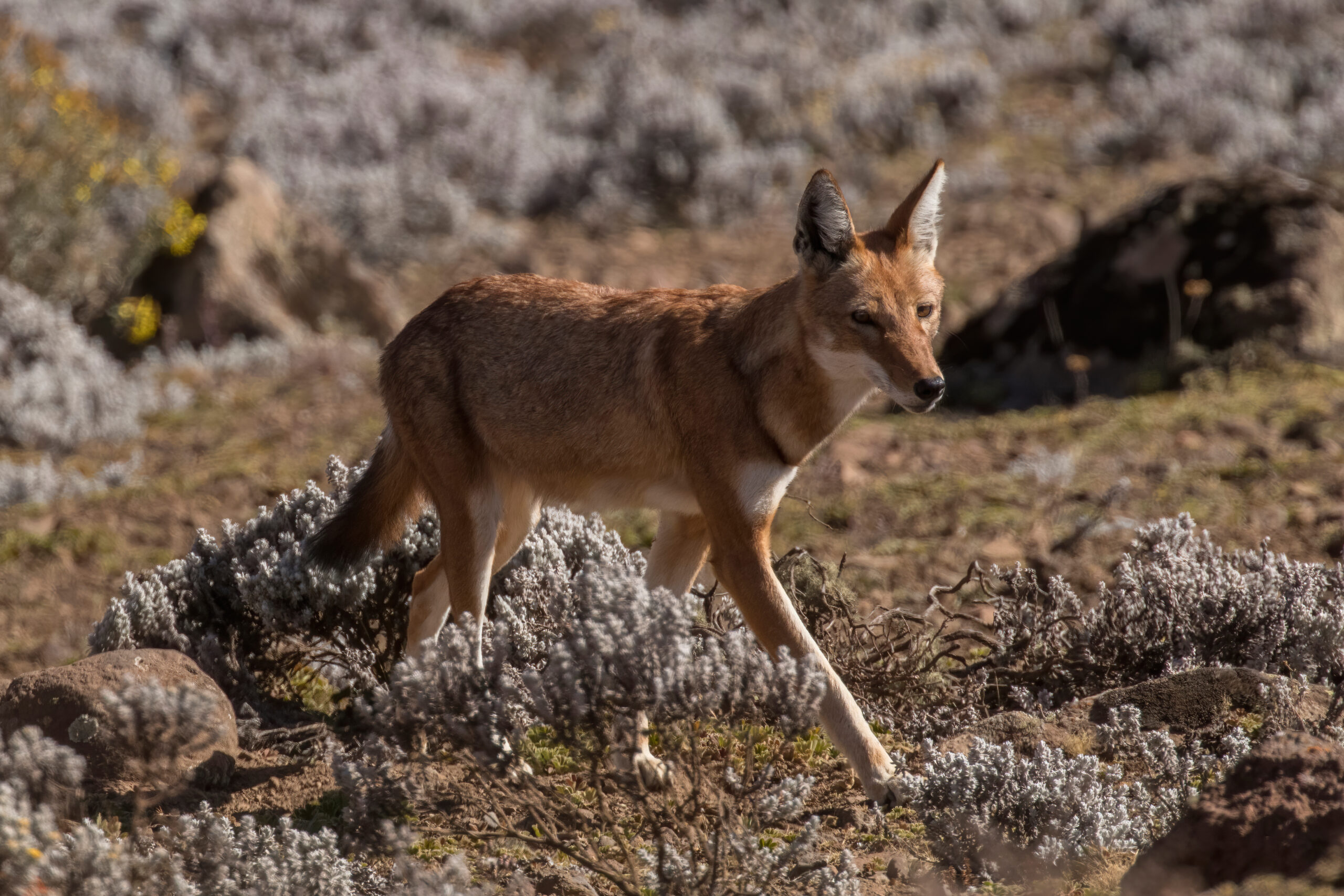
The Ethiopian wolf is the rarest canid on Earth and Africa’s most endangered carnivore: roughly 450 animals in 99 packs across six isolated mountain ranges, more than half of them in the Bale Mountains, with some ranges holding fewer than 25 adults. It is already extinct at Mount Guna and Gosh Meda. Its species status has never been disputed. The threat is not persecution but disease from domestic dogs. Rabies outbreaks in 1991 and again in 2008 to 2009 each killed or disappeared around 75 per cent of the known animals in affected populations, which is why emergency vaccination campaigns now exist. A specialist of high altitude Afroalpine grassland with a diet built largely around giant molerats, it has nowhere else to go as the climate warms.
Are wolves dangerous to people?
Rarely, and far less than almost any other large carnivore you could name, but the honest answer is not “never”. Healthy wild wolves avoid people. The cases that do occur cluster around habituation through food, around rabies, and around wolves that have learned to associate humans with an easy meal. That is a management problem rather than a wolf problem, and it is the reason feeding wildlife matters. I go through the actual record in how dangerous are wolves to humans and is the grey wolf dangerous.
Telling wolves apart from the animals they get confused with
Wolves, coyotes and foxes are all canids, which is why the confusion is reasonable rather than silly. Size, leg length, muzzle depth and track shape separate them in the field. Start with coyote versus wolf versus fox, then fox versus wolf for the two extremes of the family. For the size question specifically, largest wolves in the world and what species of wolf is the largest deal with the records, and do bears eat wolves covers what happens where wolf and bear ranges overlap.
Every wolf article on this site
Species, types and identification
- Species of wolves list
- Types of wolves and their characteristics
- Types of wolves and where they live
- Largest wolves in the world
- What species of wolf is the largest
- Can red wolves swim
Appearance
Behaviour and communication
- Can wolves purr, and what that rumbling sound really is
- Do wolves purr
- Why are wolves howling at the moon
- Wolf pack ranks, roles and order
- Leader of the pack
- How do you know if a wolf is angry
Wolves and people
- How dangerous are wolves to humans
- Is the grey wolf dangerous
- The wolves in Yellowstone: a story of ecological restoration
- Where to see wolves in Italy
- Wolf gifts for people who actually like wolves
Comparisons
Sources
Everything above is traceable. These are the primary sources, in the order they appear.
- IUCN SSC Canid Specialist Group (2019). Old World Canis Taxonomy Workshop, CIBIO, Vaírão, Portugal.
- Perri, A.R. et al. (2021). Dire wolves were the last of an ancient New World canid lineage. Nature 591: 87 to 91.
- Mech, L.D. (1999). Alpha status, dominance, and division of labor in wolf packs. Canadian Journal of Zoology 77: 1196 to 1203.
- Schenkel, R. (1947). Expression Studies on Wolves. English translation.
- Herbst, C.T. et al. (2023). Domestic cat larynges can produce purring frequencies without neural input. Current Biology.
- Sadhukhan, S., Hennelly, L. and Habib, B. (2019). Characterising the harmonic vocal repertoire of the Indian wolf. PLOS ONE.
- Harrington, F.H. and Mech, L.D. (1979). Wolf howling and its role in territory maintenance. Behaviour 68: 207 to 249.
- Mazzini, F. et al. (2013). Wolf howling is mediated by relationship quality rather than underlying emotional stress. Current Biology 23.
- Orlando, P. et al. (2026). Beyond the Howl: an acoustic framework for wolf monitoring. Ecologies 7(2): 39.
- Konno, A. et al. (2023). Are dark-eyed dogs favoured by humans? Royal Society Open Science 10(12).
- Deane-Coe, P.E. et al. (2018). 98.6-kb duplication associated with blue eyes and heterochromia in Siberian Huskies. PLOS Genetics 14(10).
- Ripple, W.J. and Beschta, R.L. (2012). Trophic cascades in Yellowstone: the first 15 years after wolf reintroduction. Biological Conservation 145.
- Hobbs, N.T. et al. (2024). Does restoring apex predators to food webs restore ecosystems? Ecological Monographs 94.
- Brice, E. et al. The primacy of density-mediated indirect effects in a community of wolves, elk, and aspen. Ecological Monographs.
- MacNulty, D.R. et al. (2025). Flawed analysis invalidates claim of a strong Yellowstone trophic cascade. Global Ecology and Conservation 63.
- Di Bernardi, C. et al. (2025). Continuing recovery of wolves in Europe. PLOS Sustainability and Transformation.
- vonHoldt, B.M. et al. (2016). Whole-genome sequence analysis shows two endemic species of North American wolf are admixtures. Science Advances 2(7).
- National Academies of Sciences, Engineering, and Medicine (2019). Evaluating the Taxonomic Status of the Mexican Gray Wolf and the Red Wolf.
Population figures come from the National Park Service Yellowstone wolf reports, Colorado Parks and Wildlife, Arizona Game and Fish, the USFWS Red Wolf Recovery Program, WildCRU’s Ethiopian Wolf Conservation Programme and the Wolf Conservation Center compilation, all dated in the table above.
If a term here is unfamiliar, the glossary of ecology terms covers more than 1,500 of them. Wolves sit inside a wider set of ideas about predators and ecosystems that I cover in the ecology section.
Written by Erzsebet Frey, MSc Ecology, University of Belgrade. Last reviewed September 2026. If something here goes out of date, particularly the US legal status, tell me and I will fix it.
From the shop
Gifts for people who love the wild
Wildlife themed t-shirts, notebooks, tote bags, bandanas and guides, designed by an ecologist.
Visit the shop