
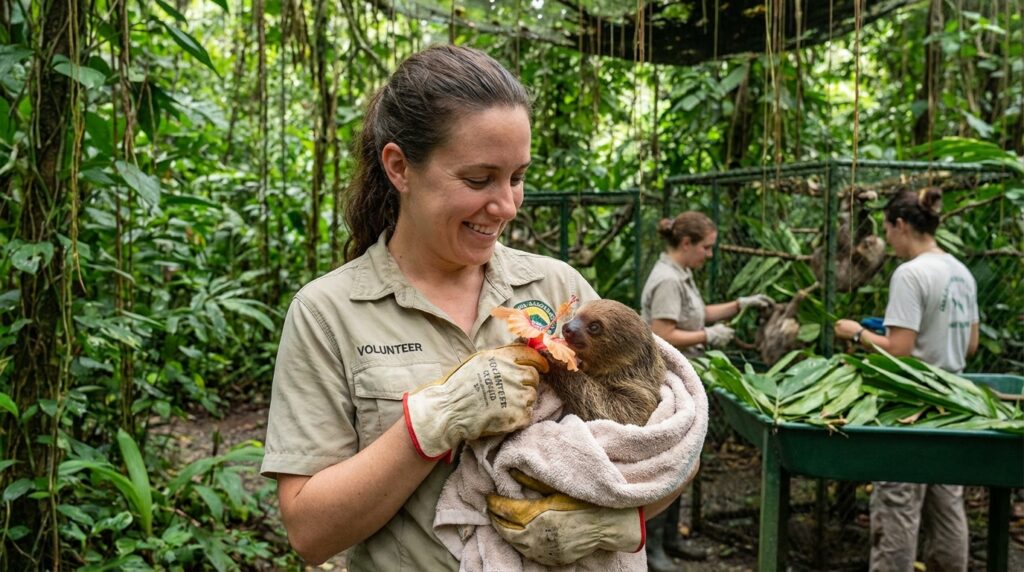
Volunteers in Costa Rica work directly with injured and orphaned sloths at sanctuaries where rehabilitation prepares these animals for their eventual return to protected forests. The country’s extensive network of national parks—covering roughly 30% of its land—creates a steady need for hands-on care that includes feeding, enclosure maintenance, physical therapy assistance, and enrichment activities. No prior wildlife experience is required, though the work demands patience and a methodical approach as volunteers contribute to both animal recovery and broader environmental education efforts that strengthen local conservation awareness throughout this recognized hotspot for sloth populations.
Why Volunteer With Sloths in Costa Rica?

Why would someone travel thousands of miles to care for an animal that moves at a fraction of human speed and spends most of its day asleep in the canopy?
The answer lies in Costa Rica’s unique position as a sloth conservation hotspot, where roughly 30% of the country enjoys protected status as national parks and reserves.
This abundance of habitat supports thriving populations while also generating rescue cases—injured or orphaned individuals that need hands-on rehabilitation.
Volunteers feed these animals, clean enclosures, assist with physical therapy, and help create enrichment activities that prepare sloths for release.
Beyond animal care, participants contribute to environmental education and outreach efforts that strengthen local conservation awareness.
The work is quiet, methodical, and profoundly meaningful for those who value species recovery over spectacle.
What You’ll Actually Do at a Sloth Sanctuary
Working alongside sloths means stepping into a rhythm dictated entirely by the animals’ needs—early mornings begin with preparing fresh browse, a mix of leaves and shoots selected to match each individual’s natural diet, followed by methodical rounds through enclosures where volunteers record which foods each sloth accepts or ignores.
The work extends beyond feeding: volunteers repair climbing structures, clean habitats, and design enrichment activities that encourage sloths to forage and climb as they’d in the wild.
Gentle handling during rehabilitation sessions allows volunteers to observe behaviour closely, noting changes in mood or movement that might signal health concerns.
Under supervision, they assist with basic medical tasks—administering medications, supporting wound care, helping during veterinary examinations—while also contributing to education programs and documenting daily life through photos that help the sanctuary communicate its conservation mission.
Who Can Volunteer With Sloths in Costa Rica?
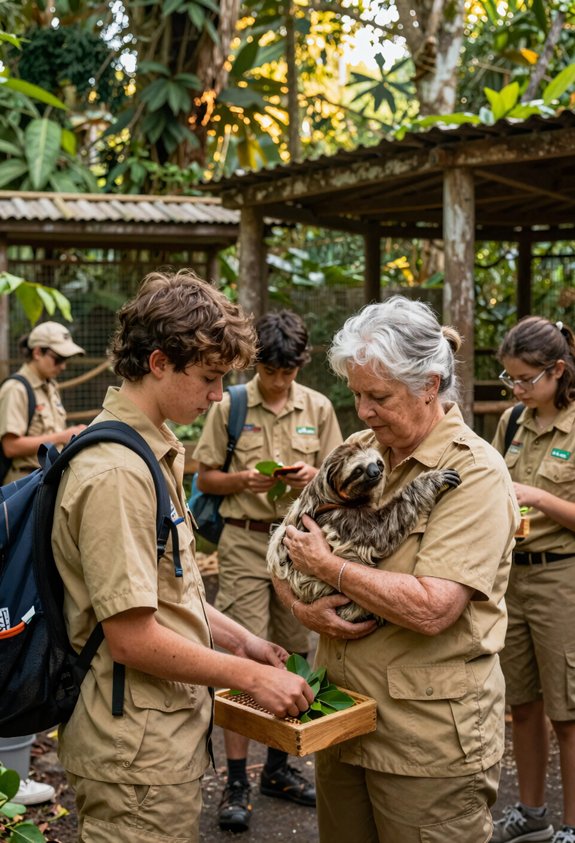
Sloth volunteering in Costa Rica welcomes a remarkably wide range of people—anyone eighteen or older can apply, and the program regularly hosts participants from gap-year students fresh out of school to retirees in their eighties, all united by a willingness to work at the animals’ unhurried pace.
Most volunteers commit to stays of three to four weeks, though placements accept shorter two-week terms or longer twelve-week assignments depending on individual schedules.
The work itself demands reasonable physical fitness: participants feed animals, clean enclosures, perform light repairs, and provide enrichment activities—all under direct supervision from trained staff.
Before departure, volunteers typically complete a criminal background check, update vaccinations, secure travel insurance, and handle visa documentation, with guidance from a dedicated Trip Coordinator who makes certain each person arrives prepared and confident.
Do You Need Wildlife Experience to Apply?
One question arises again and again among prospective participants: whether a background in biology, veterinary science, or animal care becomes necessary before stepping into a Costa Rican sloth sanctuary. The answer offers reassurance—no prior wildlife experience stands as a requirement for application.
On-site training, orientation, and ongoing supervision provide the foundation volunteers need to learn safe sloth handling, feeding protocols, enrichment activities, and rehabilitation techniques. Trip Coordinators vet applicants before departure to confirm suitability for animal-focused work, while experienced staff supervise placements throughout.
Practical requirements include criminal background checks and adherence to safety protocols, yet hands-on skills develop upon arrival through structured instruction.
How Long Should You Volunteer at a Sloth Sanctuary?
Once a volunteer confirms eligibility and secures a place at the sanctuary, the next question naturally becomes how many weeks to commit—a decision that shapes both the depth of the experience and the value contributed to the animals.
Minimum placements run two weeks, suitable for a short experience but often too brief for deep involvement in sloth rehabilitation.
The typical and recommended stay spans three to four weeks, which usually allows time for orientation, skill-building, and meaningful contribution to sloth care and enrichment.
Longer placements extend up to ten weeks—sometimes twelve—ideal for seeing animals through full rehabilitation cycles and gaining advanced hands-on experience. Since on-site training occupies initial days and weekday schedules include one rest day weekly, volunteers should consider how placement length affects actual time spent performing independent care tasks.
Two-Week Placements vs. Three-Month Stays
Two weeks at a sloth sanctuary feels like opening a book and reading just the first chapter—enough to meet the characters and sense the story’s arc, but not nearly enough to witness transformation or resolution.
Both placements include identical daily support: on-site training, supervision, airport transfers, shared dormitories, three meals, and weekdays on duty with one day off.
The difference lies in depth. A two-week volunteer completes orientation, basic feeding, enclosure cleaning, and enrichment—foundational tasks that introduce the rhythm of sanctuary work.
A three-month stay builds continuity: volunteers progress into advanced rehabilitation, bond meaningfully with individual animals, and contribute measurably to welfare outcomes. Longer placements align better with typical cohort lengths and allow participation in education outreach and enrichment projects that require sustained commitment.
You’ll get $100 off automatically, and by adding the additional code ELI100 at checkout, you can save an extra $100, for a total of $200 off your Global Work & Travel wildlife internship adventure.
What the Trip Fee Covers and What It Doesn’t
When a volunteer considers the financial commitment required for sloth sanctuary work, clarity about what’s included—and what isn’t—proves essential for realistic planning.
The trip fee covers pre-departure support, on-site training and orientation, dedicated project supervision, and most in-country logistics including secure airport transfer to the Turrucares placement.
Accommodation in shared dorms, three daily meals prepared by the on-site cook, and weekday structured volunteer duties with one day off per week are included.
Local excursions and gWorld trip support—Trip Coordinator, Travel Concierge, and 24/5 emergency assistance—often come with the package, though specific inclusions are confirmed at booking.
The fee doesn’t cover international flights, travel insurance, vaccinations, criminal background checks, visa fees, or personal spending like souvenirs.
Ready to volunteer or intern abroad? Enter code ELI100 at checkout and get $100 OFF any internship or volunteer project worldwide.
Explore ProjectsHow Much Shuld You Budget for Flights and Insurance?
Most travellers book six to twelve months in advance, searching fares early to secure better prices and convenient arrival dates that align with their placement.
Insurance isn’t included either, though the Travel Concierge will help tailor policies covering medical evacuation—emergency transport to proper facilities—trip cancellation, and the duration of a two-to-twelve-plus-week stay.
Budget estimates become clearer after booking, when dedicated coordinators provide specific flight options, recommended coverages, and timing advice for finalising out-of-pocket costs like background checks, visas, and vaccinations.
Do You Need a Visa to Volunteer in Costa Rica?
Whether a volunteer needs a visa to enter Costa Rica—and if so, which type—depends entirely on nationality, since each country holds a different passport agreement with Costa Rican immigration authorities.
A dedicated Trip Coordinator will review each traveler’s citizenship and advise on the correct entry permit or visa for stays ranging from two weeks to three months or longer.
Pre-departure support includes assistance with paperwork, so documents can be checked and confirmed well before departure. Volunteers should book six to twelve months in advance to allow time for any necessary applications, or they can choose the “Book Now, Decide Later” option to secure their placement while sorting immigration requirements.
The approved visa must cover both the arrival date and the full duration of the volunteer placement.
Daily Tasks Caring for Injured Sloths
Caring for injured sloths at the Turrucares sanctuary means stepping into a routine shaped by each animal’s recovery timeline, dietary needs, and behavioral patterns—work that begins with supervised feeding sessions and extends through enclosure maintenance, gentle socialization, and health monitoring.
Volunteers follow species-specific diets during scheduled mealtimes, sometimes hand-feeding individuals who need extra support.
Daily tasks include cleaning enclosures, repairing structures, and building enrichment setups with branches and ropes that encourage natural climbing and mobility.
Gentle handling helps reduce stress while volunteers track weight, observe movement patterns, and record behavioral changes for rehabilitation files.
Under staff guidance, they may assist with basic medications, prepare sloths for veterinary checks, or support pre-release conditioning—all anchored by on-site training and structured weekday supervision that guarantees every task serves recovery.
Feeding Schedules and Nutritional Needs for Sloths
Because sloths evolved to extract nutrition from leaves that most mammals can’t digest, their feeding schedules and dietary requirements differ sharply from the routines volunteers may know from other wildlife work.
Three-toed sloths subsist almost entirely on high-fiber foliage—Cecropia and hibiscus leaves especially—while two-toed sloths accept a broader menu that includes occasional fruits and flowers.
Their extremely slow metabolisms and multi-chambered, fermentative stomachs mean digestion can stretch across weeks, so caregivers offer small, frequent portions of fresh browse daily rather than large meals.
Fruit appears only as a rare treat to prevent obesity and digestive upset.
Orphaned infants need species-appropriate milk formulas every two to six hours, weaning gradually onto leaves over months. Hydration comes primarily from fresh foliage, though clean water and veterinarian-recommended vitamin supplements support sloths recovering from injury or malnutrition.
Why Sloths Need Human Interaction During Recovery
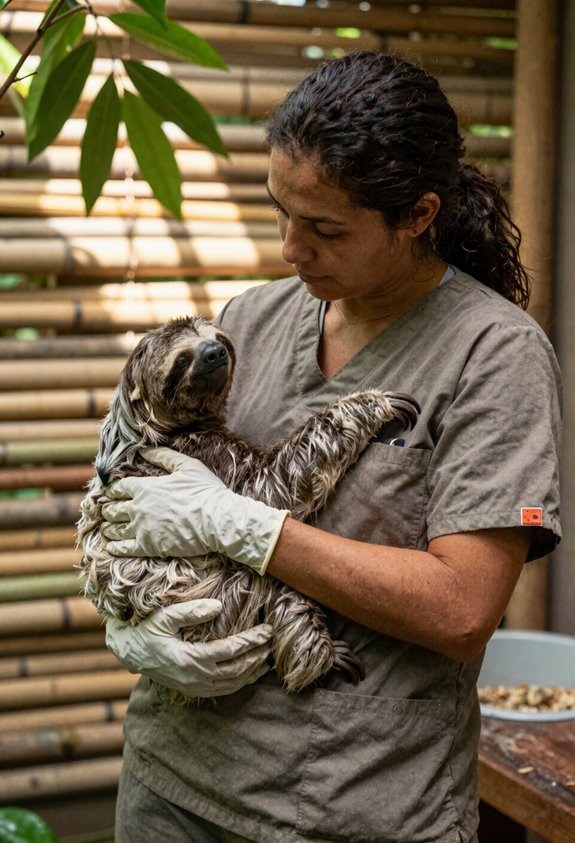
Rescuing a sloth from the rainforest floor or a roadside verge marks only the beginning of a recovery process that can span several months, and during that time human caregivers become indispensable partners in the animal’s survival.
Trained volunteers provide precise rehydration and nutrient-rich meals tailored to the sloth’s exceptionally slow metabolism—its body temperature hovers around 30–34°C, and digestion unfolds at a glacial pace.
Veterinarians and handlers clean wounds, administer antibiotics, and guide physical rehabilitation: assisted climbing exercises rebuild the specific limb strength patterns essential for canopy life.
Throughout weeks of monitoring, caregivers track weight gain, stool consistency, and thermoregulation, all while limiting handling to reduce stress and prevent imprinting.
This structured interaction prepares each sloth for successful reintroduction to the wild.
What Enclosure Maintenance Involves for Volunteers
Maintaining the physical spaces where recovering sloths eat, climb, and rest forms a daily cornerstone of volunteer work at rehabilitation sanctuaries—a rhythm of cleaning, repairing, and enriching that directly supports each animal’s health and preparation for release.
Volunteers regularly remove waste, soiled bedding, and food debris from enclosures and platforms, disinfecting surfaces to reduce disease risk for these arboreal species.
They repair climbing structures, ropes, and wooden platforms using local materials, ensuring safe pathways during rehabilitation.
Building enrichment items—hanging foliage bundles, puzzle feeders, elevated resting spots—encourages natural foraging and motor skills.
Volunteers also maintain surrounding gardens that supply fresh browse and shade, creating stress-reducing environments.
All enclosure maintenance is supervised and taught during on-site orientation at the Turrucares sanctuary, forming part of structured weekday duties for volunteers.
Building Enrichment Structures for Sloth Habitats
Beyond cleaning and repairing the spaces themselves, volunteers learn to construct enrichment structures—purpose-built pathways, platforms, and feeding stations—that encourage recovering sloths to practice the arboreal behaviors they’ll rely on after release.
They weave arboreal pathways using natural hardwood branches and UV-stable ropes, creating continuous routes with gaps no wider than one meter to match sloths’ slow, deliberate movement. Each attachment point must support at least ten to fifteen kilograms, accounting for adult weight and dynamic loads.
Volunteers install resting platforms at varied heights to mimic canopy layers, ensuring slight drainage and overhead shade. They also prepare feeding enrichments—suspended browse bundles and hidden food stations—that encourage natural foraging postures.
Weekly inspections and monthly maintenance checks keep structures safe, with ropes replaced every six to twelve months or whenever fraying appears.
Other Animals You’ll Help Alongside Sloths
Within most sloth rescue centers, the work extends far beyond sloths alone—volunteers quickly discover they’re stepping into a broader ecosystem of care that includes toucans, howler monkeys, kinkajous, and a rotating cast of parrots, coatis, and other native species brought in after injuries, displacement, or human conflict.
Tasks span preparing fruit-based feeds for toucans, assisting with wing checks, and cleaning aviaries while adding enrichment that stimulates natural behavior.
Howler monkeys require socializing routines, strict feeding schedules, and rebuilt climbing structures that encourage movement through vertical space. Kinkajous—nocturnal by nature—receive daytime care: diet prep, enclosure cleaning, enrichment designed for arboreal life.
Across species, volunteers document healing with photos, repair habitats, and support preparations for release, witnessing how rehabilitation unfolds across an entire community of Costa Rican wildlife.
From Toucans to Kinkajous: Species at the Sanctuary

The range of species sheltered within these sanctuaries reflects the complex pressures facing Costa Rica’s forest ecosystems, where human expansion, habitat fragmentation, and accidental injuries bring a steady stream of wildlife through rehabilitation doors.
Toucans arrive as striking yet vulnerable birds, their large bills and bright plumage concealing delicate constitutions that demand careful monitoring during recovery.
Sloths require patience and long-term commitment, as their slow metabolisms and specialized diets mean weeks or months of species-specific attention before release becomes viable.
Howler monkeys present social challenges—rehabilitators must address both physical wounds and behavioral needs, ensuring these primates maintain the group dynamics essential for survival in the wild.
Kinkajous add nocturnal complexity to daily routines, their nighttime activity patterns requiring adjusted care schedules that accommodate both diurnal and nocturnal species under one sanctuary roof.
Ready to volunteer or intern abroad? Enter code ELI100 at checkout and get $100 OFF any internship or volunteer project worldwide.
Explore ProjectsTeaching Local Kids About Sloth Conservation
How do children learn to care about animals they rarely see moving through the forest canopy? Volunteers help local students distinguish two- and three-toed sloths through clear visuals and short demonstrations that explain diet, slow metabolism, and arboreal lifestyle—tree-dwelling habits that keep these mammals hidden overhead.
Age-appropriate activities include storytelling, coloring sheets, puppet shows, and simple citizen-science tasks that make conservation concepts tangible.
Short field visits to nearby botanical gardens or sanctuaries reinforce classroom lessons with real-world context.
Participants aged eighteen to eighty-five prepare lesson plans, deliver interactive sessions, and document outreach through photos for follow-up campaigns.
Behind-the-scenes videos reveal how rescued sloths are fed, rehabilitated, and prepared for release—strict no-contact welfare rules mean handlers use footage rather than live animals, protecting both children and wildlife throughout the educational process.
Taking Photos for the Sanctuary’s Social Media

Beyond the classroom, where lesson plans and puppet shows spark curiosity about arboreal life, volunteers turn their attention to a different kind of storytelling—one that unfolds through cameras and smartphone screens. Taking photos for the sanctuary’s social media becomes a purposeful task: capturing clear, respectful images of sloths, toucans, howler monkeys, and kinkajous to promote rehabilitation stories and support fundraising efforts.
Volunteers work under the supervision of the on-site team, following welfare guidelines introduced during orientation—they photograph enrichment activities, feeding routines, or natural behaviours without causing stress. The sanctuary’s free WiFi allows immediate uploads or scheduled posts, though anyone editing or posting on behalf of the project coordinates with the Trip Coordinator, who manages branding and social channels.
Each image serves environmental education sessions and donor communications, transforming fleeting moments into lasting advocacy.
How Many Hours Per Day Will You Work?
What determines the length of a volunteer’s workday isn’t a fixed number printed in advance, but rather the rhythm of animal care itself—sloths and other residents set the pace, and daily schedules adapt to meet their feeding times, medical needs, and behavioral routines.
Exact hours vary by placement and project needs, confirmed during on-site orientation when supervisors outline expectations based on current circumstances.
Tasks like feeding, socializing, enclosure maintenance, enrichment activities, and environmental education are scheduled to meet animal care requirements, so shift lengths depend on those daily demands.
Longer stays—typically three to four weeks, with a minimum of two weeks—often yield more predictable routines as volunteers settle into regular shifts, though flexibility remains central to effective animal stewardship throughout the experience.
Weekend Adventures and Free Time From Turrucares

Beyond the structured routines of sloth care and habitat maintenance, volunteers discover that their free evenings and weekend hours—especially the full day off granted each week—offer meaningful opportunities to connect with Costa Rica’s landscapes, communities, and cultural rhythms at their own pace.
Turrucares sits roughly one hour from San José Airport, positioning participants within easy reach of Central Valley attractions: botanical gardens, local markets, and forested trails leading to waterfalls.
Many volunteers join organized group excursions arranged through the project or coordinate weekend trips with fellow participants, exploring coastal regions, Nicaragua, Panama, or the Caribbean. These outings—whether brief afternoon visits to nearby towns or multi-day journeys planned after placement ends—expand understanding of regional ecosystems and cultural diversity while reinforcing the conservation principles practiced daily.
Turrucares: Your Base for Wildlife Rehabilitation
Nestled within Costa Rica’s Central Valley, Turrucares serves as the operational heart of this wildlife rehabilitation placement—a purpose-built centre where injured and orphaned forest animals receive the specialised care they need before returning to their natural habitats. Located roughly one hour from San José Airport, the facility sits surrounded by protected forest areas that provide both context and eventual release sites for recovering animals.
Volunteers here work directly with species common to the region: sloths learning to climb again, toucans regaining flight strength, howler monkeys rebuilding social bonds, and kinkajous—nocturnal relatives of raccoons—adjusting to enclosure life before wilderness return.
How Far Is Turrucares From San José Airport?
How does one measure distance when the journey itself becomes part of the arrival experience? Turrucares sits approximately one hour from Juan Santamaría International Airport, though traffic patterns—the flow and rhythm of vehicles along Costa Rica’s roads—can shift this timing.
What matters more than exact kilometers is that volunteers won’t navigate this route alone: an airport transfer comes included with the placement, ensuring a driver meets arrivals directly at the terminal.
The Trip Coordinator and local team confirm all pick-up details beforehand, communicating estimated arrival times so volunteers can anticipate their schedule. This arrangement transforms what could be a stressful arrival into a smooth passage, allowing new participants to settle into the experience while someone familiar with local roads handles the practical journey from airport to wildlife center.
Each day begins and ends within the shared dorm at the sanctuary, a simple on-site space designed to keep volunteers close to the sloths they’re there to support—close enough that the walk from bed to enclosure takes only moments, allowing participants to step directly into their responsibilities without the friction of commute or distance.
The dorm itself fosters a communal atmosphere, where volunteers share rooms and stories, building connections that often extend beyond the placement.
Free WiFi allows participants can stay connected with home, while three daily meals prepared by an on-site cook provide consistent nourishment throughout the week.
Evenings and weekends remain open for rest or exploration, and all accommodation details are confirmed before departure, offering clarity and security as volunteers prepare for their time at Turrucares.
What Do Three Daily Meals Look Like in Costa Rica?
Living and working at the sanctuary means more than shared rooms and early mornings—it also means sitting down to meals that reflect the flavors and rhythms of Costa Rican daily life, prepared fresh by an on-site cook who understands both the local palate and the energy volunteers need throughout their days.
Breakfast typically starts with gallo pinto, a traditional mix of rice and beans served alongside eggs, fresh tropical fruit, and strong Costa Rican coffee.
Lunch is the day’s main meal: a casado plate featuring rice, beans, salad, fried plantain, and protein such as chicken, fish, or beef.
Dinner tends toward lighter fare—soups, grilled proteins, salads, or sandwiches with more seasonal fruit. Each meal emphasizes fresh local ingredients and simple preparation, providing balanced nutrition throughout the volunteer experience.
Is There WiFi at the Volunteer Accommodation?
Whether volunteers plan to video call loved ones back home, share photo updates from their day with the sloths, or simply check email between shifts, connectivity isn’t something they’ll need to worry about at the Turrucares sanctuary—free WiFi is available throughout the shared dormitory and common areas where participants live during their placement.
This internet access comes included alongside other essential amenities like meals, training, and supervision, ensuring volunteers can maintain contact with the outside world without additional cost.
While the connection supports basic online activities—messaging, browsing, uploading photos—volunteers should remember they’re in a rural setting where bandwidth may not match urban standards. Still, the on-site WiFi provides reliable enough service for staying connected during downtime, allowing participants to balance their immersive wildlife experience with necessary digital communication.
What Orientation and Training Cover on Arrival
Once volunteers step off the transport in Turrucares, they’re welcomed into a structured orientation that transforms nervous anticipation into practical understanding—a process designed to replace uncertainty with clear expectations before any animal interaction begins.
The first hours introduce the sanctuary layout, shared dormitory arrangements, meal times, the daily schedule, and the single weekly day off.
Training then shifts to hands-on instruction: local care teams demonstrate species-specific handling techniques, sloth-safe feeding routines, enrichment activities—objects and tasks that stimulate natural behaviors—and socialization methods for injured forest animals.
Volunteers also learn enclosure maintenance procedures, including cleaning protocols, repair tasks, and garden upkeep.
Health briefings cover hygiene standards, PPE (personal protective equipment) use, quarantine protocols, and animal welfare guidelines.
Emergency contacts, supervision structure, and social media photography guidelines complete the preparation.
Who Supervises Your Daily Work at the Sanctuary?
A clear chain of responsibility waits at every feeding station, enclosure gate, and enrichment table—because working with vulnerable wildlife demands consistent guidance from people who understand both the animals’ needs and the risks of improvisation.
The sanctuary’s trained local staff and animal-care team supervise daily tasks on-site, offering hands-on direction as volunteers prepare meals, clean habitats, and assist with rehabilitation protocols.
These supervisors have been screened and vetted by the organizing body, ensuring they follow established animal-welfare and safety standards rather than personal preference.
On the first day, project supervisors deliver an on-site orientation and practical training session covering proper handling, feeding techniques, and rehabilitation procedures—so volunteers begin work with clarity, not guesswork, shaping their contributions from the start.
Best Time of Year to Volunteer in Costa Rica
When should you pack your bags for a sloth sanctuary in Costa Rica? The dry season—December through April—draws most volunteers because reliable weather makes outdoor rehabilitation, enclosure repairs, and excursions smoother and more predictable.
The green season from May to November brings lush forests, fewer tourists, and lower prices, though heavier afternoon rains can interrupt daily duties and turn roads near Turrucares into muddy, slower routes.
Shoulder months like late April through May and November into early December often strike a comfortable balance: you’ll encounter fewer crowds than peak season yet drier conditions than midsummer’s heaviest downpours.
Because dry-season intakes fill quickly, booking six to twelve months ahead—or securing flexible deposit options—ensures you claim your preferred dates.
Costa Rica’s Dry Season vs. Rainy Season for Wildlife Work
Costa Rica’s two distinct seasons—dry and rainy—shape nearly every aspect of wildlife rehabilitation work, from the number of animals arriving at the sanctuary to the daily routines volunteers follow once they’re on-site.
The dry months (November through April) bring easier travel on unpaved roads and allow staff to schedule construction projects, enclosure repairs, and infrastructure upgrades that can’t wait until next year.
Conversely, the rainy season (May through October) often sees more rescues—storms and flooding displace wildlife, and slick roads increase vehicle strikes—which means volunteers spend more time providing direct animal care, administering medications, and sheltering vulnerable residents from downpours.
Mosquitoes and parasites also proliferate during wetter months, so biosecurity protocols, repellents, and preventive health measures become even more critical for everyone’s safety.
How Costa Rica Protects 30% of Its Land as Parkland
Roughly three out of every ten acres in Costa Rica now fall under some form of official protection—a proportion that places this small Central American nation among the world’s leaders in land conservation and offers critical habitat for the sloths, monkeys, toucans, and countless other species that volunteers come here to help.
This network spans roughly 30 national parks plus dozens of biological reserves, wildlife refuges, and private conservation lands, all coordinated through SINAC—the National System of Conservation Areas—which organizes protection across twelve regional zones.
A market-style Payment for Environmental Services program, launched in the 1990s, pays thousands of landowners to maintain or restore forests, while park entrance fees and ecotourism revenue provide funding that keeps the system running and expanding year after year.
How This Sanctuary Releases Rehabilitated Sloths to the Wild
At the heart of successful sloth rehabilitation lies a careful, step-by-step process that prepares each animal—whether orphaned, injured, or displaced—to return to the wild with the skills it needs to survive on its own.
Veterinarians at the sanctuary near Turrucares provide medical treatment, while staff guarantee regular feeding and opportunities for socialisation with other sloths.
Volunteers contribute by rebuilding enclosures, enriching habitats with natural materials, and helping animals practise foraging behaviours they’ll rely on after release.
Once the team determines a sloth can survive independently, trained local staff coordinate its release into suitable habitat—often within Costa Rica’s protected areas, which cover roughly 30% of the nation. Site selection and animal welfare remain top priorities throughout this final, vital stage.
Booking Your Sloth Volunteer Trip 6–12 Months Ahead
Because sloth sanctuaries operate with tight capacity limits and volunteers often arrive from dozens of countries competing for the same care placements, securing a spot requires forethought—most participants book six to twelve months before their intended start date. Early booking guarantees preferred seasonal windows and locks in availability, particularly during peak travel months when rescue centers fill quickly.
Those uncertain about exact timing can reserve with a small deposit under the “Book Now, Decide Later” framework, which allows up to one year to finalize dates while the Lifetime Deposit Guarantee protects the investment through swaps or transfers.
After confirmation, a dedicated Trip Coordinator tailors program length—typically two to twelve weeks—and guides visa preparation, ensuring each volunteer’s arrival aligns seamlessly with the sanctuary’s rehabilitation schedule and operational rhythm.
Using Book Now, Decide Later for Flexible Planning
When a traveler feels drawn to sloth conservation but can’t yet pin down departure dates—whether due to work commitments, academic calendars, or simply the need to coordinate with travel companions—the “Book Now, Decide Later” option offers a practical middle ground. It allows participants to secure a spot with a small deposit, then take up to one year to confirm exact travel dates.
Since most volunteers book six to twelve months in advance and spaces remain limited, this feature holds a place while calendars align. The deposit sits under a Lifetime Deposit Guarantee, meaning it can be swapped to another trip, gifted to friends or family, or saved for future booking if circumstances shift—ensuring that initial commitment doesn’t become a penalty when life inevitably complicates planning.
Even with careful planning and genuine intention, circumstances sometimes force a volunteer to step back from a confirmed sloth-conservation trip—whether because of unexpected work obligations, family emergencies, health concerns, or financial shifts that weren’t visible months earlier when the booking felt secure.
Canceling with 84 days’ notice results in a 50% fee, and refunds appear as store credit—valid for two years—rather than cash returns.
However, volunteers aren’t locked into absolute loss: many can place trips on hold, transfer bookings to different dates or destinations, or pass reservations to friends and family depending on organizational policies.
Those who used “Book Now, Decide Later” deposits gain additional flexibility to swap dates, gift their spot, or save funds for future bookings, creating pathways forward even when original plans collapse.
Can You Transfer Your Placement to a Friend?
Life rarely unfolds in perfectly straight lines, and the volunteer who secures a sloth-conservation placement in January may discover by summer that a new job, an unexpected move, or a shift in personal priorities makes the trip impossible—but that doesn’t mean the opportunity has to vanish entirely. The programme permits transfers to friends or family members, provided the organisation’s procedures are followed and space remains available.
Early notification proves essential, as most travellers book six to twelve months ahead and partner capacity stays limited. The incoming volunteer must complete identical vetting requirements—Trip Coordinator review, visa documentation, and any necessary criminal background checks—before assuming the placement.
Transfers benefit from both the Lifetime Deposit Guarantee and the “Book Now, Decide Later” feature, ensuring flexibility when circumstances shift unexpectedly.
Booking a placement marks the beginning rather than the conclusion of the journey, and the arrival of a dedicated Trip Coordinator signals that personalised support has begun in earnest.
This individual reviews the volunteer’s interests, skills, preferred location, and intended impact—the specific difference one hopes to make—then matches them with the most suitable wildlife rehabilitation placement.
The coordinator confirms accommodation and meal arrangements before departure, ensuring nothing remains uncertain. They also provide personalised advice on visa requirements and necessary paperwork, guiding volunteers through each administrative step.
If a different project would better align with the volunteer’s goals, the coordinator can arrange a swap or alternative placement. Additionally, they oversee the pre-departure vetting process, ensuring all participants suit the programme’s demands.
How Volunteer Placements Are Vetted for Safety
Once the logistics of arrival are confirmed, attention naturally shifts to the environment waiting at the other end—an environment where volunteers will work closely with animals that depend on structured care, and where safety for both people and wildlife forms the foundation of every interaction.
The organisation screens and audits each project partner before listing, confirming animal-welfare standards and on-site safety protocols meet established criteria.
A Trip Coordinator then assesses individual interests, skills, and desired impact to match volunteers with suitable placements—a process designed to reduce risk by aligning capabilities with responsibilities.
Pre-departure requirements include visa assistance and a criminal background check, protecting staff, visitors, and vulnerable animals alike. Upon arrival, on-site training, orientation, and ongoing supervision guarantee volunteers practice safe handling and rehabilitation techniques consistently.
What 24/5 Emergency Support Covers in Costa Rica
While training and orientation build competence in daily tasks, emergencies—ranging from missed transfers to medical incidents—require immediate access to experienced coordinators who understand both the local context and the volunteer’s individual needs.
The 24/5 emergency line operates on stand-by Monday through Friday, connecting volunteers directly to trained staff who collaborate with the in-country partner responsible for arrival logistics and on-the-ground assistance.
This support addresses placement concerns, safety incidents, and coordination breakdowns that can’t wait for regular business hours.
The service draws on a safety framework refined since 2008, backed by international offices that maintain continuity across time zones.
Emergency teams work alongside Trip Coordinators and local staff, ensuring volunteers aren’t managing crises alone—even when challenges arise outside standard planning protocols.
How the gWorld App Connects You With Other Volunteers
How do volunteers find travel companions when they’re preparing for a placement halfway around the world, often without personal contacts in the destination country? The gWorld app addresses this challenge by linking participants headed to the same region, making it possible to coordinate arrival logistics, accommodation, and shared activities before departure.
Through in-app social networking and messaging, volunteers can introduce themselves, share travel plans, and arrange to travel together—whether with friends or new contacts. The platform also enables users to join Global Getaways and community groups for meet-ups, side trips, and local excursions.
Trip details and document storage allow group members to share itineraries, meeting points, and important paperwork, while Marketplace deals, Academy resources, and referral rewards encourage collaboration and help volunteers pool savings and knowledge.
Exploring Central Markets and Waterfalls Near Turrucares
After coordinating arrivals and connecting with fellow volunteers through the gWorld app, participants often look forward to exploring the area around Turrucares during their weekly day off—and two of the most rewarding options are the region’s central markets and nearby waterfalls.
The markets, reachable within an hour from San José Airport, offer fresh Costa Rican produce and simple local fare that isn’t available on-site: tropical fruits, savory snacks, and authentic street food that provide genuine cultural immersion.
Meanwhile, several waterfalls make excellent half-day or full-day excursions, often organized as group adventures by the project itself. When visiting these natural sites, volunteers should pack swimwear, a towel, sturdy footwear, and some cash—since entrance fees and local vendors may not accept cards, requiring small bills for smooth transactions.
Post-Placement Travel to Nicaragua and Panama
Once the volunteer placement in Turrucares comes to a close—typically after two or four weeks of hands-on work with sloths and other wildlife—many participants choose to extend their Central American adventure by traveling north to Nicaragua or south to Panama, both of which offer distinct landscapes, cultural experiences, and natural wonders that complement the conservation work they’ve just completed.
The program’s Personal Travel Concierge can arrange onward flights and logistics to either destination once participants register, though international flights, travel insurance, and visa requirements remain the traveler’s responsibility and should be confirmed well in advance.
Nicaragua’s volcanic lakes and colonial architecture contrast with Panama’s canal-zone history and Caribbean beaches, giving volunteers a chance to reflect on their service while discovering how conservation priorities shift across borders and ecosystems.
What Past Sloth Volunteers Say About This Program
Consistently, past sloth volunteers describe the program as deeply hands-on, recounting daily routines in which they fed injured sloths from bottles, cleaned enclosures, and sat quietly alongside rehabilitating animals to help them grow accustomed to gentle human presence—a process known as socialization, which prepares rescued wildlife for eventual release or long-term care.
Experienced staff provide clear orientations and close supervision throughout typical three-to-four-week stays, ensuring volunteers understand each task before performing it independently.
Participants also emphasize the strong sense of community that develops in shared on-site accommodation, where daily proximity to fellow volunteers creates lasting bonds.
The program’s overall 4.8-out-of-5 rating reflects numerous four-and-five-star testimonials, with reviewers praising practical inclusions like airport transfers, three daily meals, and one weekly day off—logistics that allow volunteers to focus fully on sloth rehabilitation work.
Ready to volunteer or intern abroad? Enter code ELI100 at checkout and get $100 OFF any internship or volunteer project worldwide.
Explore ProjectsIf you’re exploring hands-on experience in ecology or wildlife biology, don’t miss my complete guide to wildlife conservation internships with global work and travel, where I break down what’s worth your time, money, and long-term career goals.

Erzsebet Frey (Eli Frey) is an ecologist and online entrepreneur with a Master of Science in Ecology from the University of Belgrade. Originally from Serbia, she has lived in Sri Lanka since 2017. Eli has worked internationally in countries like Oman, Brazil, Germany, and Sri Lanka. In 2018, she expanded into SEO and blogging, completing courses from UC Davis and Edinburgh. Eli has founded multiple websites focused on biology, ecology, environmental science, sustainable and simple living, and outdoor activities. She enjoys creating nature and simple living videos on YouTube and participates in speleology, diving, and hiking.
🌿 Explore the Wild Side!
Discover eBooks, guides, templates and stylish wildlife-themed T-shirts, notebooks, scrunchies, bandanas, and tote bags. Perfect for nature lovers and wildlife enthusiasts!
Visit My Shop →