
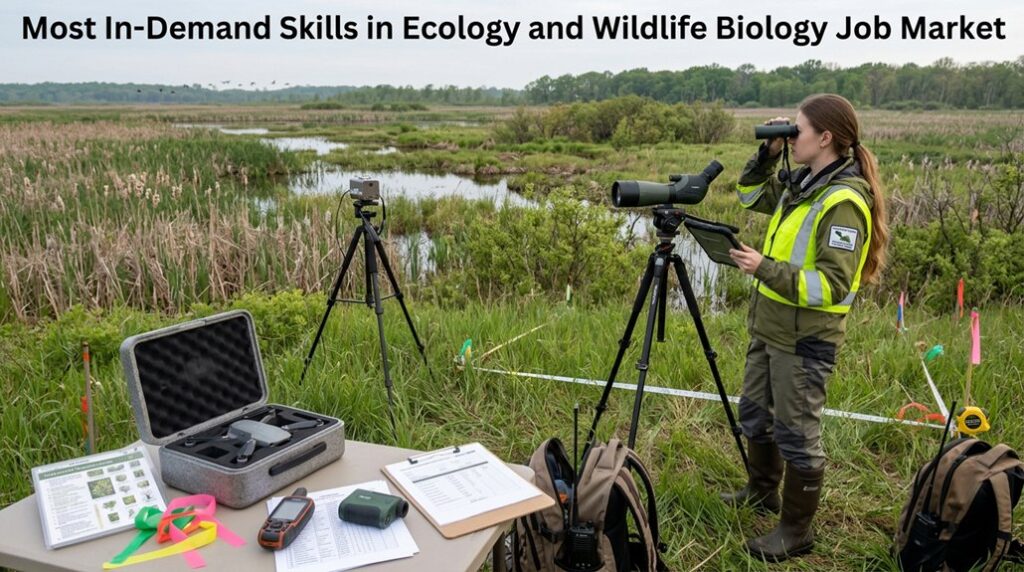
Employer data from ecology job boards, environmental consultancies, and the U.S. Bureau of Labor Statistics show that the most in-demand skills in ecology and wildlife biology combine field expertise with quantitative and spatial analysis. Analyses of job postings on ecology recruitment sites consistently highlight GIS and spatial analysis (ArcGIS/QGIS), statistical programming (especially R and Python), ecological data analysis, and remote sensing as among the most frequently required technical skills.
Employers also strongly value field survey techniques (wildlife monitoring, vegetation surveys, camera trapping, mark–recapture), species identification—particularly plant identification, and experience with environmental impact assessment (EIA) used in environmental consulting.
According to BLS occupational data for zoologists and wildlife biologists, the field has about 18,200 jobs in the U.S. with ~1,400 openings annually and a median salary of about $72,860, and job descriptions commonly emphasize the ability to collect and analyze biological data, use spatial tools, and write technical reports for conservation or policy decisions, showing that modern employers prioritize ecologists who combine ecology knowledge, quantitative analysis, GIS, and strong scientific communication.
Core Ecology and Wildlife Biology Skills Employers Want
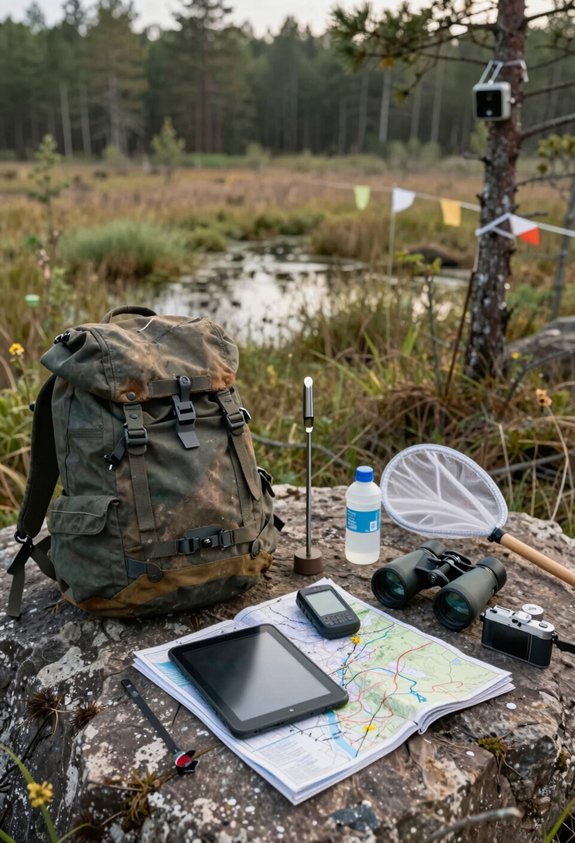
Because ecology and wildlife biology jobs sit at the crossroads of fieldwork and data driven decision making, you’ll stand out when you can move smoothly between collecting evidence outdoors and turning it into clear, usable results.
Employers often expect GIS, such as ArcGIS or QGIS, so you can map habitat, estimate where animals live, and test landscape connectivity, how well places link for movement. You’ll also rely on R, a programming tool for statistics, so you can model populations and run occupancy analysis, which estimates presence even when you don’t always detect an animal.
In many roles, you’ll use standard survey methods, like camera traps, point counts, and telemetry tagging, and you’ll work safely with gear, navigation, and wildlife handling.
A Simple Skills Map: Field, Lab, Data, Communication
Often, the quickest way to make sense of ecology and wildlife biology careers is to picture your skills as a simple map with four regions: field, lab, data, and communication, so you can see where you’re strong, where you’re still growing, and how the pieces connect.
In the field region, field skills like GPS navigation, ATV or boat operation, diving, climbing, and safe wildlife handling help you work on remote projects that can run for weeks or months.
In the lab region, you build comfort with specimen collection, histology (studying tissues), PCR (copying DNA), and basic sample processing for disease, genetics, or rehab work.
In the data region, data skills like R for statistics, GIS for mapping, and modeling tools turn observations into decisions.
In communication, you practice reports, grants, and outreach that keeps work funded and trusted.
If all of this is giving you a headache and you feel that the field requires a multitude of skills, I agree, it’s a lot. But you’ll find plenty of resources on Simply Ecologist to help you build and learn those skills. So, no worries.
Skills That Most Boost Entry-Level Hiring Odds
Build your entry-level odds by stacking a few practical skills that hiring teams can see and trust, even in a short interview or a half-day field test.
Start with Geographic information systems (GIS), meaning software like ArcGIS or QGIS that lets you map data and do basic spatial analysis, because many entry roles ask for clear maps and simple layers.
Add R, a coding tool you use to clean messy data, run tests like t-tests and GLMs (models that compare groups or predict outcomes), and make repeatable graphs.
What “Field Ready” Means on Wildlife Job Postings
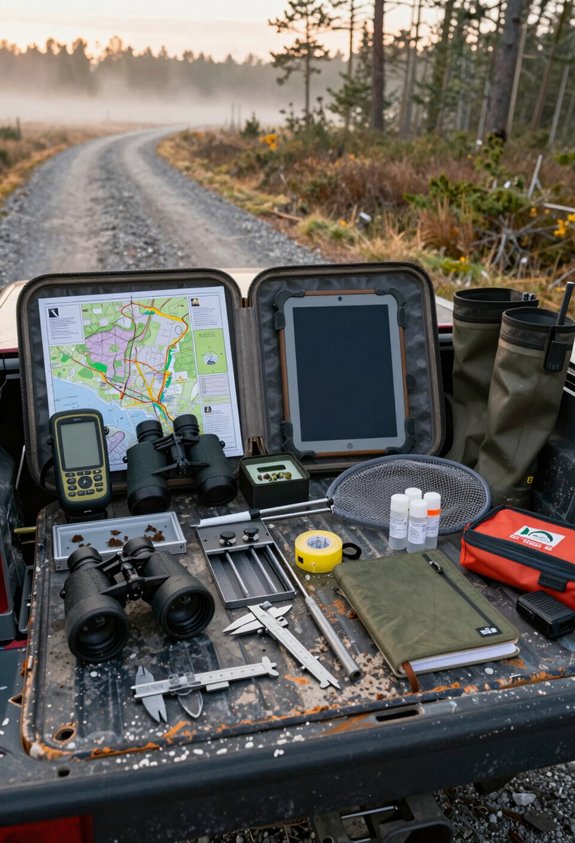
Look past the buzzword and you’ll see that “field ready” is a practical promise: you can step into a remote project with little ramp up, carry a 20–40 lb pack, move safely over rough ground, and stay steady through 10–12+ hour shifts in heat, cold, or night conditions.
Employers also want navigation you can trust, so you’ll use a handheld GPS, read a topo map (a map showing elevation lines), and follow compass bearings, while recording WGS84 coordinates and clear waypoint names.
You may need to run an ATV or boat, handle generators and power tools, and operate sampling gear mist nets, PIT tag readers, camera traps, or yagi antennas.
Ariver’s license, WFA/WFR training, and careful biosecurity, animal handling, and clean data entry are important.
What “Quantitative Skills” Means in Ecology Roles
Step into most ecology jobs today and you’ll find that “quantitative skills” means you can turn messy field notes into trustworthy evidence, using statistics (the math of patterns and uncertainty) and practical coding in tools like R or Python to test ideas, estimate population change, and report results with clear limits.
You’ll run data analysis with models such as generalized linear or mixed models, methods that link predictors to outcomes while accounting for randomness, and you may use survival, occupancy, or capture recapture models to estimate births, deaths, and detection.
You’ll also map patterns with GIS and spatial statistics, building habitat suitability or resource selection models.
Skills That Matter Most in Nonprofits and Advocacy
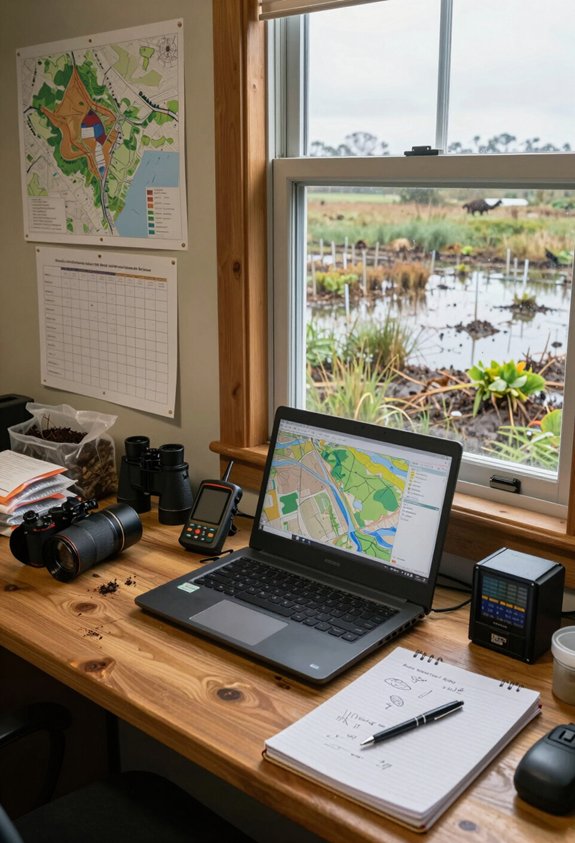
Because nonprofit and advocacy work runs on trust as much as it runs on science, you’ll need skills that help you turn good evidence into steady support, clear decisions, and lasting community buy in. You’ll often work with tight budgets, so grant writing and fundraising matter, and you must show results in plain language that donors and neighbors can feel.
- Fundraising and grant writing: you’ll craft strong goals, budgets, and reports that match a funder’s priorities.
- Policy analysis: you’ll turn research into short briefs and testimony, meaning clear, usable guidance for laws and land-use choices.
- Community engagement: you’ll teach, listen, and organize volunteers, building trust through consistent outreach.
- Monitoring and data management: you’ll use GIS—map-based data—to track progress and support campaigns.
Wildlife Surveys: Transects, Points, and Plot Methods
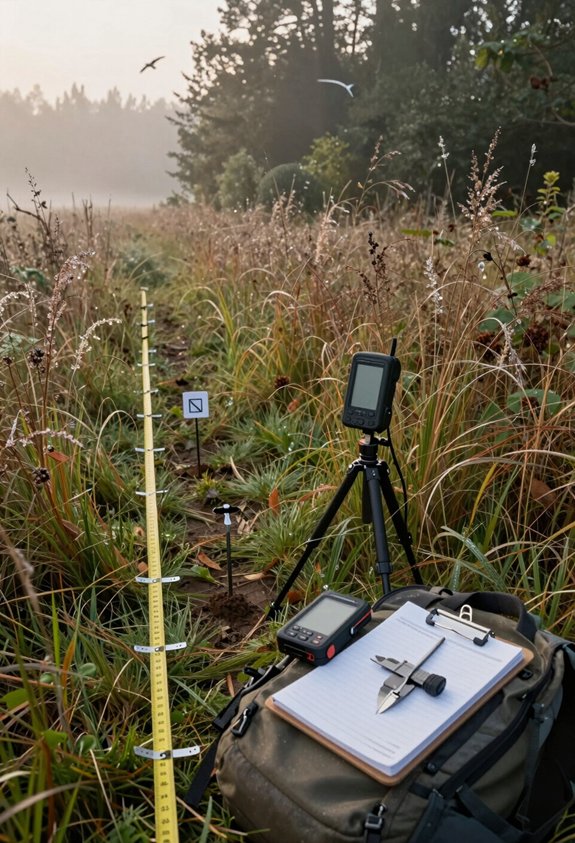
Step into the field with a simple goal, count what’s there in a way that stays fair and repeatable, and you’ll quickly see why ecologists lean on a few core survey designs: transects, points, and plots.
With line transects, you walk a measured line, record each detection and its perpendicular distance, then use distance-sampling tools like Distance to correct for animals you missed and estimate density.
With point counts, often for birds, you stand still 3–10 minutes, note detections by time and distance, and support removal (accounting for late detections) or distance analyses.
With plots, you search a defined area and count everything, best when detectability stays high.
- Set consistent lengths, durations, and seasons
- Record observer, weather, and habitat notes
- Match method to movement and scale
- Keep data clean and comparable
Monitoring Design: Choosing Indicators and Effort
In the quiet space between a question and a field season, monitoring is designed to tell the truth actually needed: indicators are chosen—measures that stand in for ecosystem health, such as population growth rate (λ, “lambda,” indicating whether a population is growing or shrinking), occupancy (the share of sites a species uses), adult survival for long‑lived animals, or simpler community signals like species richness and abundance indices—and they are tied directly to the management goal.
Effort is set with power analysis, a planning test for how many surveys are required; to detect a 20 % abundance change with 80 % power at α = 0.05, 30 + replicates or repeats are often needed.
When monitoring animal populations, timing is matched to life history and threats: annual surveys for slow change, weekly surveys for outbreaks.
Detection‑corrected models are used so that detectability does not mislead. Monitoring is one of the most important skills you should learn.
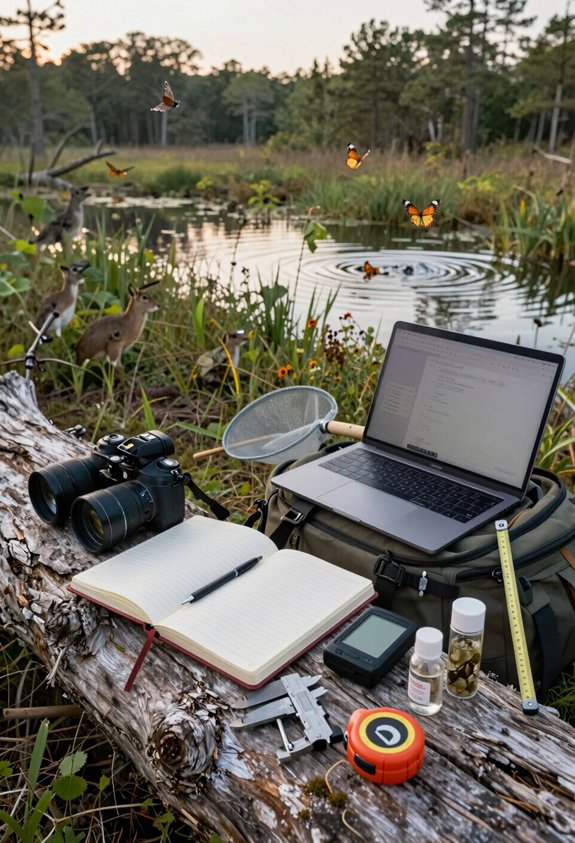
Species ID: Birds, Mammals, Amphibians, Reptiles, Fish, Insects
Good monitoring only works when you can name what you’re seeing, because your indicators, like occupancy (how many sites a species uses) or λ, “lambda,” the population growth rate, depend on correct species calls in the field. Hiring managers notice solid species id and field identification across taxa,
- Practice multi cue ID, marks, songs, tracks, fins, life stages.
- Aim for ≥85% accuracy, then document it carefully.
- Use tools, like guides, keys, Merlin/eBird, cameras, and keep notes.
- Build regional depth by learning species of concern in your area.
Habitat Assessments: Vegetation, Water, and Disturbance
Read a habitat the way you’d read a story, by noticing what grows there, how water behaves, and what signs of change keep repeating, because those clues often explain why a species shows up, or why it doesn’t.
For habitat assessments, you’ll start with vegetation: run a 100‑m transect and use line‑intercept or point‑quadrat methods, meaning you record what a tape crosses or what points hit, to estimate percent cover and species mix in 30–90 minutes.
Then check water in place—temperature, pH, dissolved oxygen, conductivity, turbidity, and take samples for lab tests of nutrients or contaminants under EPA-style rules.
Finally, map disturbance with GPS and GIS, tracking roads, logging, grazing, invasives, fire, or flood by frequency, extent, and severity, then link all metrics to habitat suitability indices and occupancy models, using solid QA/QC and archived, georeferenced notes.
Camera Traps: Setup, Spacing, and Metadata Standards
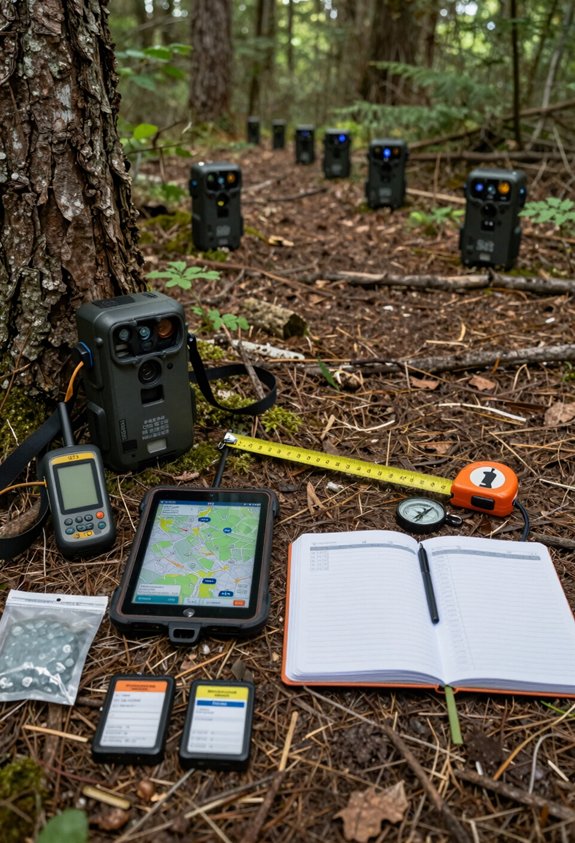
Placing a camera trap feels like setting a careful question into the landscape, because where you point it, how high you mount it, and how far you space it from the next unit all shape what the animals can “answer” with their movements.
Set camera traps on trails, water, edges, or game paths, and mount them 30–50 cm for small mammals, 70–120 cm for larger ones, so bodies fill the frame.
Choose spacing by home range, meaning the area an animal uses: 50–150 m for fine-scale work, 250–500 m for medium mammals, and >1 km for wide carnivores.
Keep settings consistent, then follow metadata standards, so every image stays usable and comparable.
- Record siteID/cameraID, WGS84 GPS, ISO 8601 dates
- Log orientation, height, nearest-camera distance, habitat
- Note bait use, battery %, SD space
- Use CTDS/Darwin Core, checksum backups
Bioacoustics: Recorders, Call ID, and Validation
After you’ve learned to let a camera “watch” a place with consistent setup and clean metadata, you can also let the landscape speak through sound, capturing voices that never cross a lens. You’ll often deploy autonomous acoustic recorders, like Song Meter SM4 or AudioMoth, and because batteries can last up to six months, you can gather thousands of hours if you choose the right sample rate, often 16–48 kHz depending on your target species.
Next, you can scan files with automated call identification tools, Kaleidoscope, Raven Pro classifiers, or BirdNET, which use machine learning, meaning software trained on examples, to flag likely calls, sometimes topping 80% accuracy. Still, you’ll validate by hand-checking 5–20% to estimate errors, then adjust occupancy or abundance, while keeping clear time, GPS, settings, and habitat notes.
Telemetry: VHF Tracking and Triangulation Basics
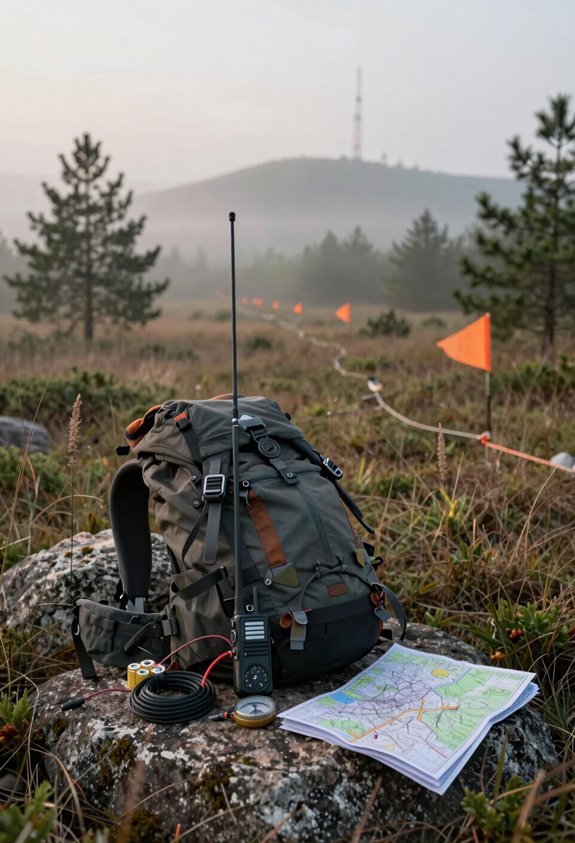
Tune your attention to the faint, steady pulse of a VHF tag, VHF means “very high frequency,” a band of radio waves often used in wildlife collars and small transmitters, and you’ll start to see how tracking can feel like careful listening with your hands.
In VHF telemetry, you sweep a Yagi antenna, a directional frame that “points” the signal, and you note the strongest peak as a bearing, or compass direction.
Then triangulation, which means crossing bearings from two, ideally three, known spots, helps you estimate where the animal is, and wide angles, over 60° apart, tighten the fit.
- Correct for magnetic declination before you plot lines.
- Take several bearings quickly, animals move.
- Record to the nearest degree, aim for clean signal to noise.
- Report an error estimate, in meters, with each point.
GPS Collars and Satellite Tags: Deployment Planning
Before you ever buckle a GPS collar or satellite tag onto an animal, you’ll want a careful plan that ties your study goals to what the device can realistically deliver, because GPS collars, units that calculate location from satellites overhead. and satellite tags, units that also send those locations through a network like Argos, GSM (cell service), or Iridium, ask you to balance data detail, battery life, cost, and animal welfare in the same decision.
Start with objectives: sample size, fix schedule (how often locations record), and expected movement, while keeping tag mass under about 3–5% of body weight. Choose networks thoughtfully. GPS only. saves power, Argos or GSM can report sooner, and Iridium reaches everywhere but costs more.
Run bench tests, then mock trials, and budget for subscriptions, data cleaning, and 10–30% failures.
Capture Methods: Traps, Nets, and Safe Extraction
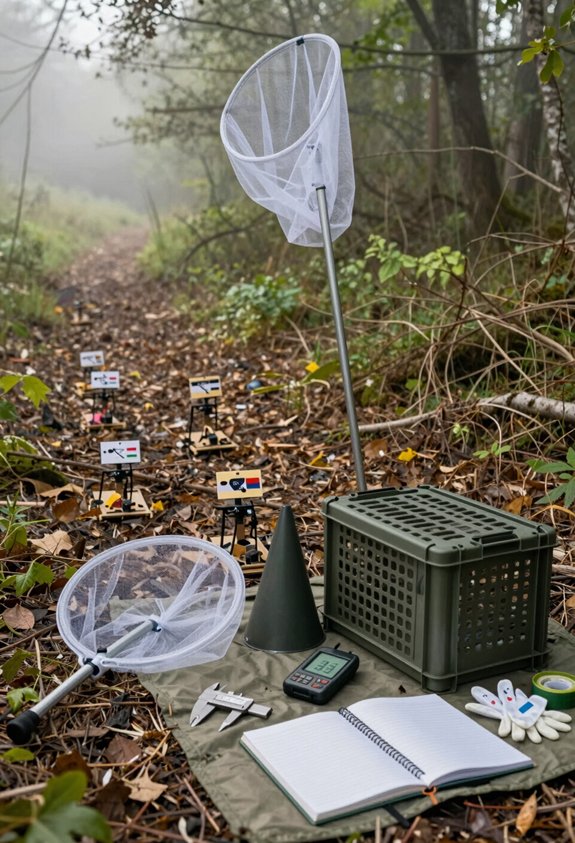
Because every capture is a brief interruption in an animal’s life, you’ll do best when you treat traps, nets, and extraction as one careful system, choose the right tool for the species, set it in a way that matches natural movement, and plan your handling steps so stress stays low and data stays trustworthy.
You’ll pick live traps by body size, Sherman for 10–120 g rodents, Tomahawk for 1–10+ kg mammals, and place them on runways with bait that fits the diet. With mist nets, you’ll match mesh (12–38 mm) and height to birds or bats, then check every 10–30 minutes.
For herps and invertebrates, drift fences guide them into pitfall arrays.
- Carry PPE, always.
- Use two-person extraction for risky animals.
- Keep reversal drugs ready if immobilizing.
- Log GPS, time, sex, weight immediately.
Animal Handling: Restraint, Stress Reduction, Release
Handling a wild animal well means holding power with restraint, and you’ll do it best when you treat restraint, stress reduction, and release as one continuous promise: keep the animal safe, keep your team safe, and gather only the data you truly need.
In animal handling, you match technique to taxon, meaning the animal group, soft cloths or rabbit snares for small mammals, towel wraps or one handed banding holds for birds, and chemical immobilization only under veterinarian oversight for large mammals.
You move quietly, use low light, and work fast, because stress hormones like cortisol often spike less when you finish within 5–10 minutes.
Record methods, time, drugs, and odd signs, as a wildlife rehabilitator would.
Then observe 15–60 minutes, and release at the capture site, in similar weather and time of day.
Field Safety: PPE, Bite Protocols, Heat/Cold Risk
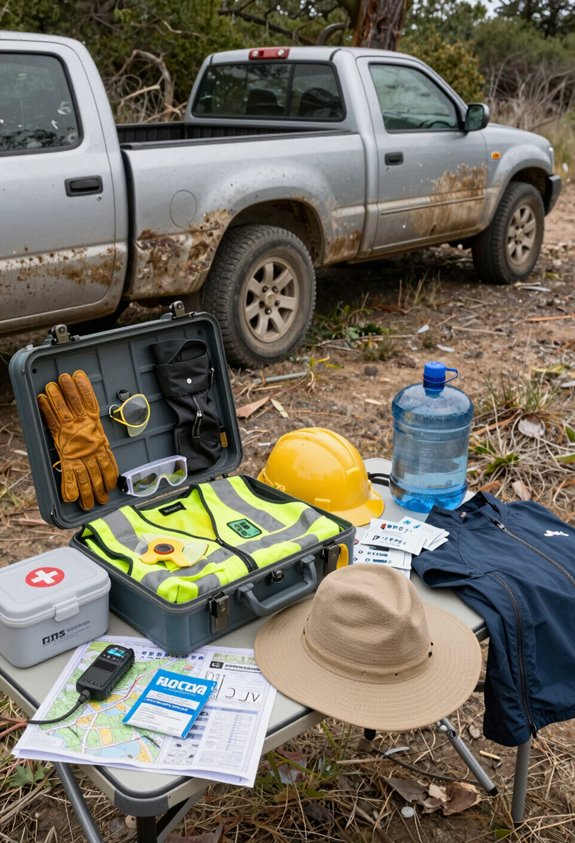
Often, the difference between a smooth field day and a preventable emergency comes down to the quiet habits you practice every time you step outside: you wear the right PPE (personal protective equipment, meaning the gear that shields your body from injury and contamination), you follow a clear bite and wound plan, and you treat heat and cold as real hazards, not background conditions.
Build steady routines that protect you and your data, since consistent use can cut injury and contamination by over 30%.
- Pack a PPE kit—nitrile gloves, goggles, hi-vis vest, durable boots, waterproof first aid.
- Use bite protocols: if safe, immobilize, irrigate 5 minutes, apply pressure, get rabies/tetanus evaluation within 24 hours.
- Track heat with WBGT (a heat-risk index): stop hard work above 28°C, rest/water in shade at 26–28°C.
- Control cold below -10°C with insulated layers, windproof shells, warm-up breaks.
Remote Field Ops: Camp Logistics, Comms, Vehicles
Good PPE and solid bite, heat, and cold routines keep you safe in the moment, but remote fieldwork asks for a wider kind of readiness, one that keeps your whole team steady for days or weeks at a time.
You build that steadiness through camp logistics, planning 2–4 weeks of food per person, treating water with UV or filters that clean 20+ liters a day, budgeting generator fuel, and locking up samples and PPE.
Communications skills and equipment use is needed such Iridium or Starlink for long range calls, VHF/UHF radios for team check-ins, and SPOT/PLB beacons for rescue within 1–6 hours.
Finally, knowledge about vehicles: check oil, coolant, tires, and batteries, then fix belts and punctures.
Sampling Design: Random, Stratified, Adaptive
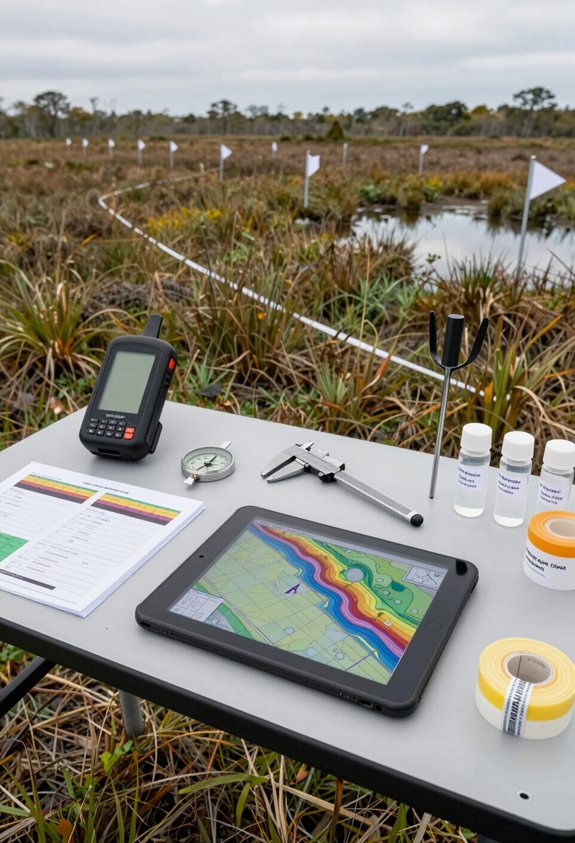
Why does the way you choose your sampling sites matter so much when you’re trying to describe a whole landscape or population from a handful of observations? Your design shapes bias (systematic error) and variance (how spread out your estimates are), and it can change how many samples you’ll need.
- Use random sampling when you want fairness by chance, every unit has a known shot, so you can compute standard errors for abundance or occupancy.
- Choose stratified sampling when habitats differ, you split the area into similar groups, then sample within each one, boosting precision and catching rare patches.
- Try adaptive sampling for clustered targets, you sample more around detections, making effort count.
- Match analysis to design, using weights or Horvitz–Thompson estimators, so estimates stay unbiased.
Building Field Protocols and Data Sheets That Work
Start by treating your field protocol like a promise you’re making to your future self and to everyone else who might use your data: you’ll collect the same kind of evidence, in the same way, every time, so a handful of notes can honestly speak for a whole landscape.
Build protocols around clear, testable objectives, then define sampling units, transect length, plot size, or rules for individual IDs, so results stay comparable across observers and years.
On data sheets, add standard metadata, like date, time, GPS to ±5–10 m, observer ID, weather, equipment, and protocol version, because reproducibility means others can retrace your steps.
Keep entries constrained with codes, fixed decimals, and a key, since pilots often cut errors by over 50%.
Add redundancy and calibration notes, then pilot a season, revise.
Population Estimation: Counts, Distance Sampling
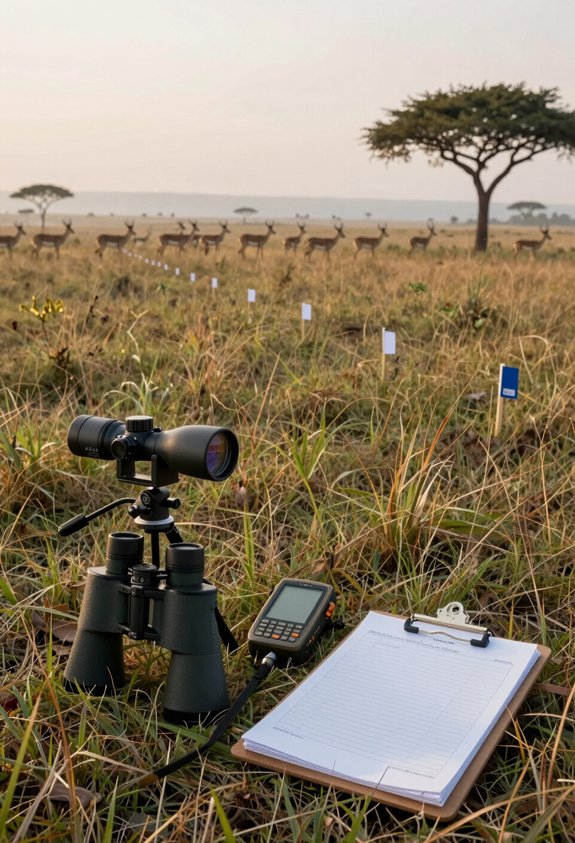
Often, the hardest part of estimating a population isn’t finding animals, it’s admitting, honestly and on paper, that you didn’t detect all of them, and then choosing a method that deals with that gap instead of pretending it away.
You can start with counts, meaning raw tallies or indices, but you’ll standardize routes, time, and training so trends don’t just reflect effort. With distance sampling, you walk a line or watch from a point, record how far each animal is from the transect, and model “detection probability,” or the chance you saw it, to correct density, often in Distance. Aim for 60–80 detections to steady your confidence intervals, and add covariates like habitat or weather to cut bias.
- Fix effort
- Measure distance
- Fit detection
- Map density
Mark–Recapture: Assumptions and Common Pitfalls
Because you rarely get to count every animal you care about, mark–recapture gives you a practical workaround: you capture some individuals, mark them in a way you can recognize later, release them, then capture again and use the fraction of “recaptures” to estimate how many are out there.
To use it well, you keep the assumptions in view, because each one can quietly bend your estimate.
Key techniques include the single‑mark Lincoln‑Petersen index for closed populations, and multiple sample methods such as Schnabel or Schumacher-Eschmeyer for long term studies.
Occupancy Models: Handling Imperfect Detection
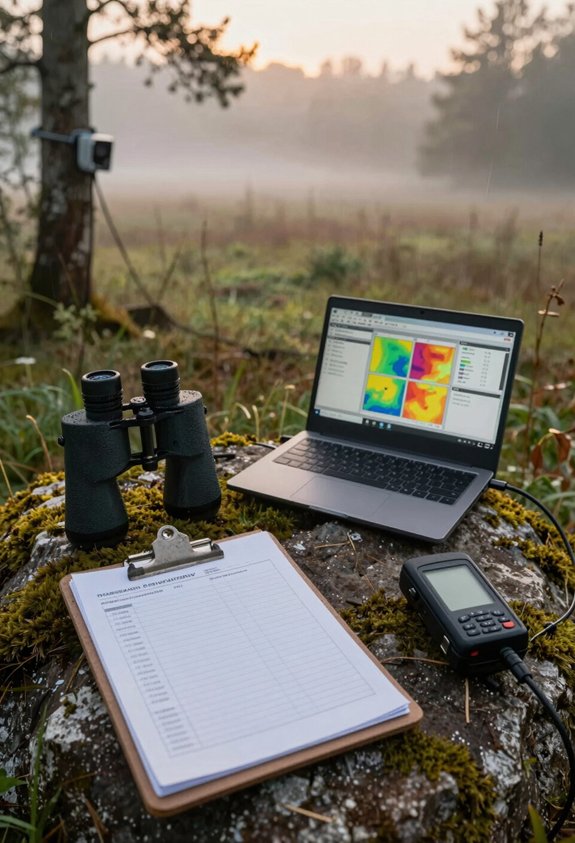
Mark–recapture shows how missed animals can bend your estimates, and occupancy models tackle the same problem when you care less about how many individuals exist and more about whether a species uses a place at all.
You separate ψ, the chance a site is occupied, from p, the detection probability, meaning the chance you notice the species when it’s there, and you estimate both with repeated visits and detection histories like 0101.
You can model p with logistic regression, a method that links covariates to probabilities, so observer, weather, or time of day don’t quietly bias your results.
When p is modest, you often gain more by adding visits than a few extra sites.
- Plan K repeats per site
- Record covariates carefully
- Fit ψ and p together
- Consider dynamic extensions
Movement and Habitat Selection: Basic Modeling
With GPS track data in hand, you can start asking a more grounded question than “where did the animal go?”, you can ask what it chose, and what the landscape made easier or harder.
You’ll usually begin with GPS tracks made of frequent fixes, then pair them with map layers like landcover, elevation, or distance to water, matched to what the animal can sense at about 10–100 meters.
From there, you can fit resource-selection functions (RSFs), which compare used locations to available ones, or step selection functions (SSFs), which compare each real step to 10-20 random “available” steps.
You’ll describe movement with step lengths and turning angles, then use conditional logistic regression to link choices to covariates.
Finally, you’ll test trustworthiness with k-fold checks and simple simulations of space use patterns.
Invasive Species Monitoring: Early Detection Workflows
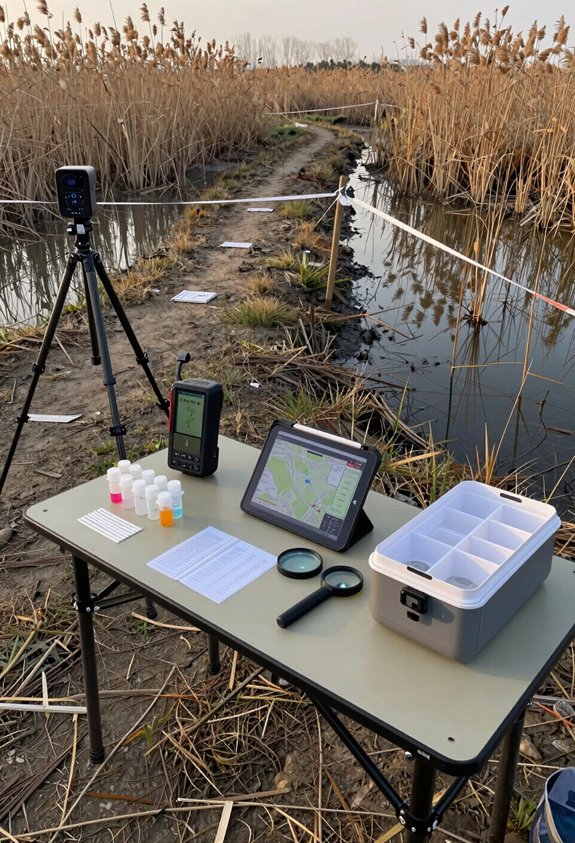
In the early days of an invasion, before a new plant, insect, or pathogen becomes obvious, you can set up an early detection workflow that treats surveillance as a steady habit, not a one time hunt.
Pair stratified surveys, meaning repeat transects or quadrats on a schedule, with targeted eDNA sampling, meaning you test water or soil for genetic traces that appear before you see the organism.
- Score sites with a risk matrix—pathway × establishment × impact—so ports and disturbed areas get more visits.
- Standardize proof: GPS points, timestamped photos, and repeatable counts or percent cover.
- Use drones or satellites plus change-detection, then ground-truth alerts within 7–14 days.
- Report within 24–72 hours, update iNaturalist or EDDMapS, and trigger containment fast.
Climate and Habitat Risk: Exposure, Sensitivity, Refugia
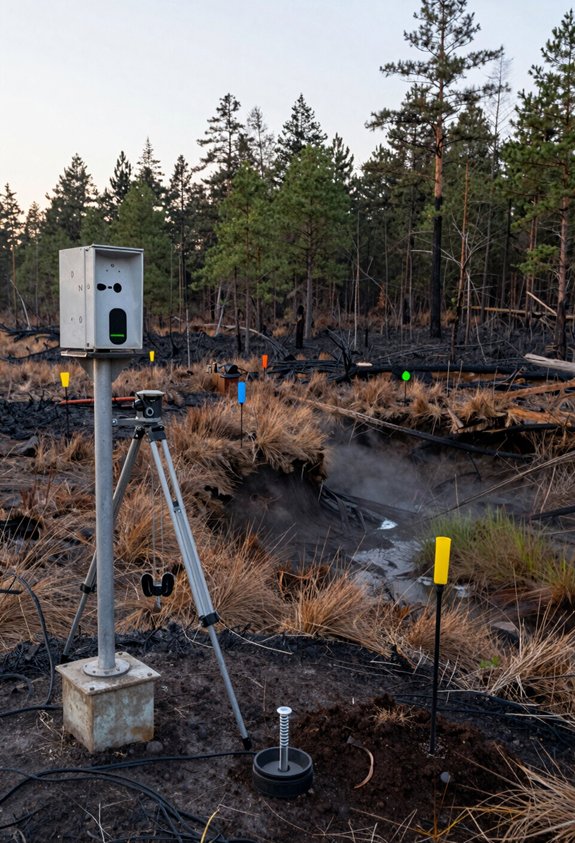
Although climate change can feel like a huge, distant force, you can assess its impact on wildlife in a steady, practical way by breaking “climate and habitat risk” into three parts, exposure, sensitivity, and refugia.
You start with exposure, meaning what climate pressures a population will face, and you can map it with species distribution models (SDMs, tools that link sightings to climate) plus CMIP6 scenarios to see shifts in heat, rain, and extremes by 2050–2100.
Then you judge sensitivity, meaning how easily a species is harmed, using traits like narrow heat limits, low fecundity, specialized diets, or low mobility.
Finally, you look for refugia—stable, buffered places found with downscaled models and fine-scale GIS.
- Run SDMs with future climate grids
- Summarize range-wide exposure change
- Score trait-based sensitivity
- Map microrefugia like north slopes, valleys
Conservation Planning: Goals, Actions, and Tradeoffs
In conservation planning, you set goals that you can measure, like boosting a focal population by 20% in five years or securing 500 hectares, and you defend those targets with population viability analysis, modeling a species’ odds of persistence, and threat assessments that rank pressures.
Then you choose actions, often mixing habitat protection or restoration, invasive control, captive breeding and reintroduction, plus policy or community steps, while you estimate costs and timelines with GIS-based prioritization and budgets.
You also face tradeoffs, so you use MCDA, scoring options across values to balance biodiversity, services, livelihoods, and limited funding, and you document stakeholder agreements so follow-through stays likely.
Restoration Monitoring: Metrics, Baselines, Timelines
Tracking a restoration site over time turns hope into evidence, because you’re not just asking “does it look better?”—you’re measuring recovery with clear metrics, or repeatable numbers that describe how an ecosystem is changing. In restoration monitoring, you’ll track percent native species cover, plant density (plants per m²), vegetation structure like canopy height, soil organic matter (%), and wildlife indices such as birds per point count.
- Set a baseline using pre-work data or a nearby reference site, sampled the same way, example 10×10 m plots, 30 m transects, soil cores to 10 cm.
- Build a timeline: sample yearly for 3–5 years, then every 2–5 years up to 10–20, and run seasonal fauna surveys.
- Use thresholds—≥60% native cover by year 5—to trigger actions.
- Plan power (≥80%) so change isn’t guesswork.
Wildlife Breeding Programs: Genetics and Husbandry
Build a breeding program the way you’d build a strong bridge, here is what you should know. Start with genetics and daily care working together, because “genetics” means the inherited traits in a population and husbandry means the hands-on routine of feeding, housing, and managing animals so they can thrive and reproduce.
You’ll plan matings to keep mean kinship low, which helps avoid inbreeding, and you’ll aim for an effective population size, Ne, above 50 now and 500+ over time so the group can adapt.
Use pedigrees, microsatellites, or SNP genomics—DNA-wide markers—to guide mate choice, protect heterozygosity, and retain allelic richness.
In husbandry logs, track pairing dates, estrus timing, nutrition, enrichment, and neonatal care.
When needed, add assisted reproduction and cryobanking under IUCN/EEP standards, then measure births, survival, recruitment, and inbreeding F.
Sample Collection: Labeling, Preservation, Transport
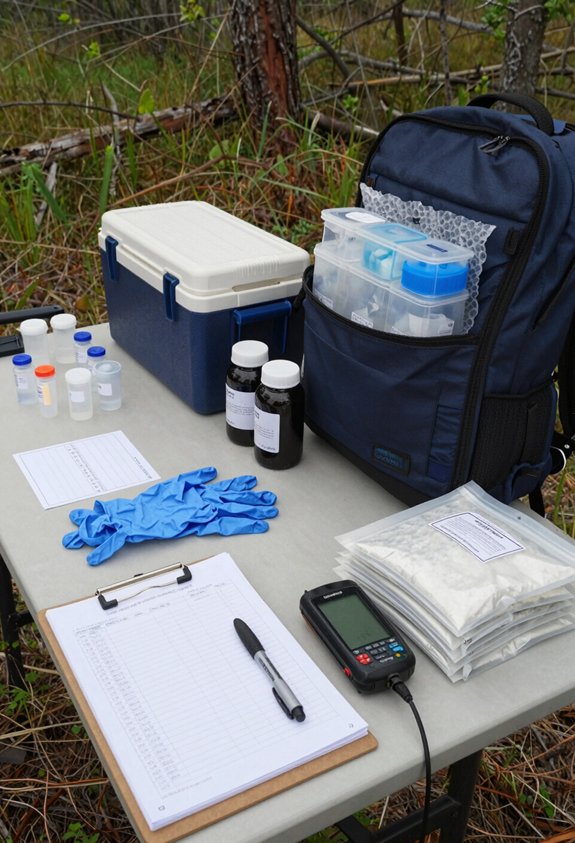
Treat every sample like a small promise to your future self: if you label it clearly, preserve it quickly, and move it carefully, you won’t lose the story it can tell.
In sample collection, you’ll rely on a unique sample ID, like project, site, date, number, written on waterproof labels and echoed in your notes, so each vial stays understandable later.
When you preserve tissue or blood, cool it on ice at 4°C for short holds, or snap freeze in liquid nitrogen, then store at -80°C for long-term DNA work.
For fecal, soil, or eDNA, use sterile single use tools, add 95% ethanol or DNA buffer, and avoid freeze–thaw cycles.
- Label with ID + metadata
- Chill or snap-freeze fast
- Seal, cushion, contain leaks
- Ship cold with manifest, permits
Chain of Custody and QA/QC for Field Samples
Good labels and careful preservation keep a sample usable, but you also need proof that it stayed trustworthy from your hands to the lab bench, and that’s where chain of custody and QA/QC come in.
You build a chain of custody by logging every handoff, who, when, where, and why, using COC forms or barcoded labels tied to a unique sample ID, so traceability, meaning you can track it end to end, never breaks.
You start QA/QC, meaning quality checks and error control, at collection: use sterile containers, take field blanks, and collect duplicates (often 10%) to spot problems.
Record temperature and preservatives with timestamps, add GPS tagged photos and notes, and document any deviation from EPA, CITES, or permit protocols.
Genetics Basics: DNA, eDNA, Contamination Control
Listening for DNA in the landscape can feel almost like learning a new language, because genetics lets you read tiny biological clues that animals and plants leave behind. With environmental DNA (eDNA), you can detect presence from trace DNA in water or soil—sometimes just a few picograms per liter, using qPCR (a DNA counting test) or metabarcoding (a mixed-species DNA scan).
Learn mtDNA, which is abundant and helps with species ID, and nuclear DNA markers like SNPs, which reveal relatedness and population structure. Because false positives can creep in, steady contamination control matters: use blanks, single-use tools, and separate pre- and post-PCR spaces.
Preserve samples fast—filter, freeze, or buffer them—and interpret results with limits, inhibition checks, and replication.
- Choose mtDNA vs nuclear markers
- Plan blanks and spatial separation
- Preserve, then document storage
- Interpret with context and repeats
Necropsy and Pathology: What Field Biologists Should Know
Opening a body to learn its story can feel weighty, yet in field ecology it’s also a practical skill you can approach with steady care and clear steps. Start with necropsy basics, meaning you follow a standard order every time—external exam, measurements, sexing, then open cavities in sequence (chest/coelom, abdomen, skull), and record gross lesions, or visible changes, using a checklist and clear photos for disease surveillance.
Work clean and safe: wear gloves, N95, eye protection, and coveralls, and decontaminate tools and boots with 1:10 bleach to protect you and the site. Keep a diagnostic chain-of-custody, which tracks labels, handlers, metadata, and cold-chain, and call specialists when findings seem new, widespread, or reportable.
Health Sampling: Blood, Swabs, Parasites, Body Condition
Blood is drawn using sterile vacutainers or syringes, selecting EDTA for blood‑cell counts and heparin for plasma, and species‑specific restraint is applied to prevent hemolysis or cell rupture.
Oral, nasal, cloacal, or skin swabs are collected with synthetic tips, placed in transport medium, and kept cold to preserve DNA/RNA.
Parasites are examined via fecal egg counts, reported as eggs per gram, and PCR DNA testing is employed when permitted. Body condition is scored using a 1–5 or 1–9 scale, supplemented by mass:length ratios or fat‑depth measurements.
This is just a small portion of the things that are good to know.
Microscopy and Specimen Preparation Fundamentals
Step up to the microscope with the same steady patience used in the field, because clear images don’t happen by luck, they come from how the specimen is prepared.
Begin with fixation, “locking” cells in place: use 10 % neutral buffered formalin for tissues, or ethanol when DNA preservation is needed, and match fixation time to tissue type so autolysis does not blur detail.
Process and embed with care, graded ethanols dehydrate, xylene clears, and paraffin supports, allowing 4–10 µm sections to be cut without chatter artifacts. Stain with controlled timing: H&E for morphology, Giemsa for blood and parasites, Gram or silver stains for microbes.
Work sterile, label relentlessly, and employ brightfield, phase‑contrast, and oil‑immersion techniques to reach ~0.2 µm resolution. These are some of the basics to know.
Permits and Compliance: What You Need Before Fieldwork
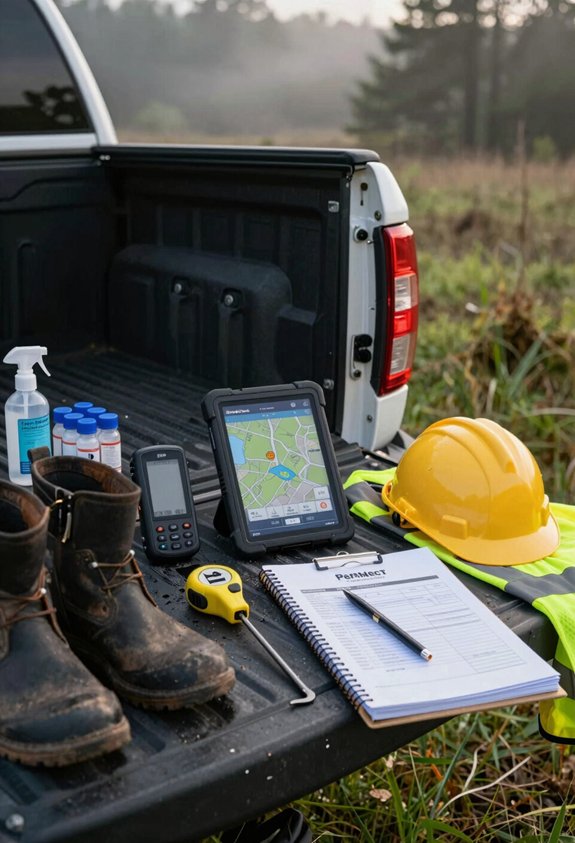
Because good field science depends as much on trust as it does on technique, you can’t head out with nets, traps, or sample vials until you’ve lined up the permits and approvals that prove your work is legal, ethical, and responsibly planned.
In the U.S., you may need federal permits like USFWS Section 10(a)(1)(A) or MBTA coverage, plus NOAA/NMFS authorization for marine species, and you’ll almost always need state licenses for capture, handling, transport, or rehab.
If your work could affect a listed species or its critical habitat, the Endangered Species Act may require an incidental take permit or a biological opinion, violations can bring serious penalties.
Start early, since timelines range from weeks to 3–12+ months.
- Confirm species and activities
- Map jurisdictions and land access
- Gather qualifications, protocols, mitigation
- Track deadlines, renewals
Ethics and Animal Welfare: IACUC and Best Practices
Permits may open the door to fieldwork, but ethics and animal welfare guide how you move once you’re there, shaping each capture, sample, and release into work you can stand behind.
In the U.S., an IACUC, an oversight committee required at NIH- or USDA-funded institutions, reviews every vertebrate protocol, inspects facilities twice a year, and checks that you follow the Animal Welfare Act and PHS humane care policy. It is important to learn how to write clear justifications for any invasive step, keep handling time short, choose species appropriate capture and restraint, and document training so everyone uses humane techniques.
Biosafety: Zoonoses, Sharps, Decontamination
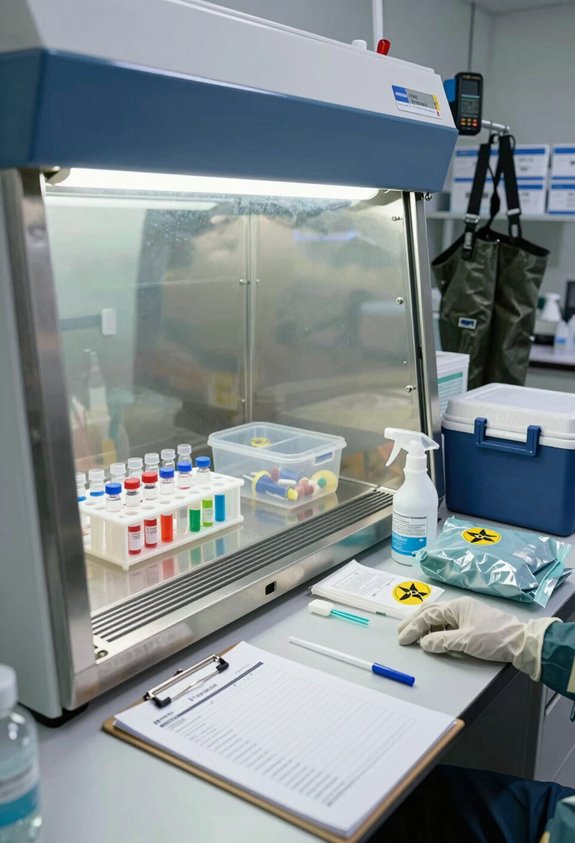
Treat biosafety like a quiet promise you keep in the field, protect the animals, protect your team, and protect the communities that live near your sites. It is important to know about Zoonoses, meaning diseases that pass between animals and people, so you learn likely threats, leptospirosis, hantavirus, rabies, tularemia, brucellosis, how to prevent, how they spread, how long symptoms may take, and what to do after exposure.
Practice sharps safety, choosing safety needles, never recapping, and reporting injuries right away, as OSHA expects, knowing to handle dangerous chemicals and what to do in case of contamination is of major importance.
Learn to;
- Match PPE to risk, don, doff carefully
- Label, segregate, transport samples by rules
- Use puncture-resistant sharps containers
- Follow a written exposure-response plan
GIS Foundations: Projections, Layers, Map Outputs
GIS proficiency for ecologists hinges on spatial data acquisition and management, including the ability to import, clean, and integrate raster and vector datasets from sources such as satellite imagery, LiDAR, and field GPS tracks.
Mastery of spatial analysis tools, buffering, overlay, intersect, and terrain modeling, enables habitat suitability mapping, species distribution modeling, and landscape connectivity assessments.
Competence with coordinate reference systems and projection transformations is essential to ensure accurate distance and area calculations across study regions.
Skills in geoprocessing automation via scripting (e.g., Python with ArcPy or GeoPandas) allow reproducible workflows and large‑scale batch processing.
Finally, effective visualization and cartographic design, coupled with the capacity to export results for statistical analysis or web‑based GIS platforms, complete the toolkit needed for rigorous ecological research and decision‑making.
GPS Workflows: Collecting Points, Tracks, Accuracy
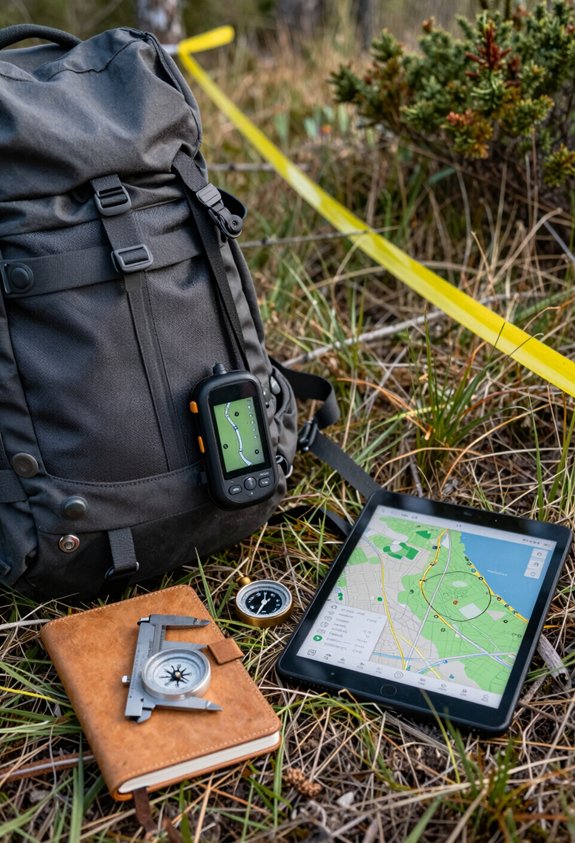
Often, the most useful GPS data comes from a steady routine rather than a fancy device, so when you collect point locations and tracks with a handheld GPS or GNSS receiver (a satellite-based tool that estimates your position), you’ll want to slow down and make each record clear and repeatable.
Keep WGS84 set, enable WAAS/EGNOS/GLONASS when available, and save waypoints with an ID, UTC time, and estimated horizontal accuracy in meters.
For tracks, choose a 1–5 second or 5–10 meter interval, then start and stop with metadata, and back up right away.
Check accuracy by noting HDOP/PDOP (satellite geometry) and repeating key points 3–5 times.
- Log satellites, canopy, weather
- Use RTK/PPK when needed
- Tie to benchmarks
- Document transforms
Remote Sensing: Land Cover, Change Detection Basics
Good GPS points and tracks tell you what you saw on the ground, but remote sensing helps you see the whole landscape at once, using sensors on satellites or aircraft that record reflected light across several bands, separate “colors” your eyes can’t fully distinguish.
You’ll often start with multispectral imagery from Landsat 8 (30 m pixels) or Sentinel-2 (10–20 m), then classify land cover—vegetation, water, urban areas, bare ground—by matching pixel patterns to known places.
For change detection, you compare images across time: you might difference bands, compare two classified maps, or track NDVI, a simple greenness index, to reveal habitat loss or wetland shifts.
Before you trust change, you preprocess, calibrate, correct the atmosphere, align images, mask clouds with tools like Fmask.
You’ll check accuracy with a confusion matrix, aiming for >85%.
Statistics Essentials for Ecology Jobs
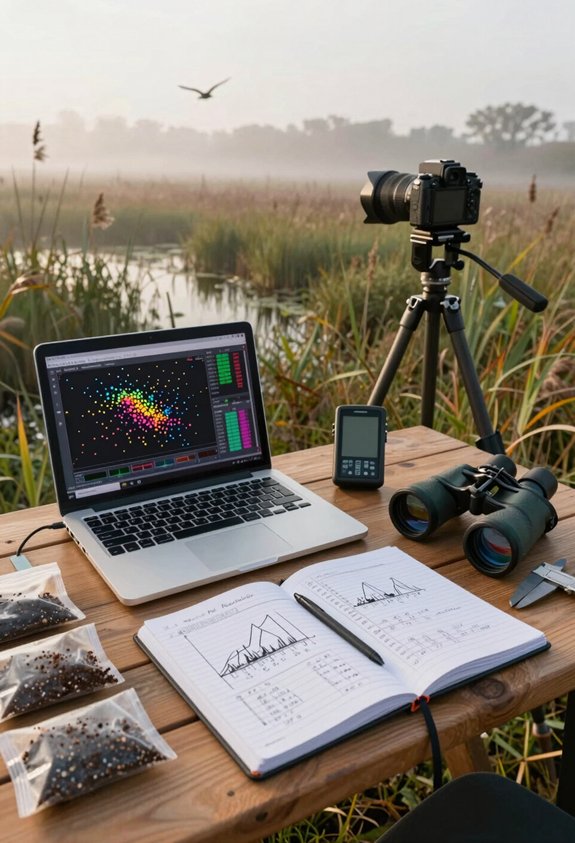
In ecology jobs, you’ll almost always lean on statistics to turn messy field notes and sensor data into clear, defensible answers, and that means getting comfortable with R, an open source program for cleaning data, making graphs, and fitting models, since most employers now expect it.
R and Python Basics for Analysis and Reproducible Code
Because ecology data rarely arrives neat, field sheets have gaps, sensors drift, and datasets come from many sources, you’ll want a coding habit that lets you retrace every step, and that’s where R and Python shine as languages you use to clean, analyze, and explain data in a repeatable way.
Data Management: Databases, Tidy Data, Documentation
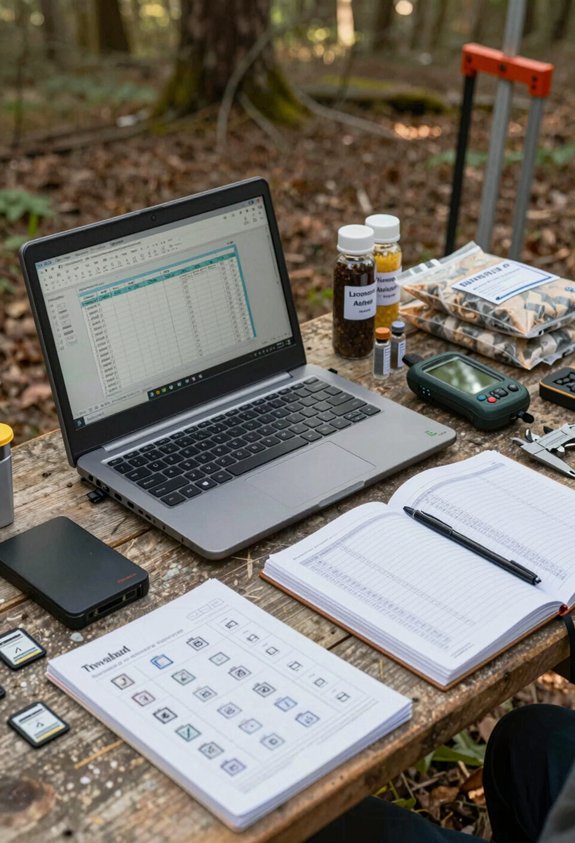
Keeping data organized is a skill you build on purpose, and it pays off every time you return to a project months later and still understand what you did.
When you work with big biodiversity tables, you’ll often rely on databases, structured systems like PostgreSQL or SQLite, and you’ll use SQL, a query language, to filter records and run spatial joins with GIS layers.
You’ll also gain speed by shaping tidy data, meaning each variable is a column and each observation is a row, which fits naturally in R’s tidyverse or Python’s pandas.
Documentation matters, too: clear data dictionaries, README files, and metadata standards like Darwin Core or EML keep reuse value high.
- Design tables for joins
- Validate data early
- Track changes with Git/DVC
- Write metadata before uploading
Technical Writing and Stakeholder Communication That Lands Offers
Write like your work will be read by someone who must decide what happens next, because strong technical writing and stakeholder communication often tip the scale in hiring, about 70% of conservation and research hiring managers rank publication‑quality reports and grant narratives as essential for wildlife biologists and ecologists.
Shape each message to your audience: give policymakers a tight executive summary and cost‑benefit framing, but give technical reviewers clear methods, uncertainty (how sure you are), and links to raw data.
Quantify impacts so choices feel real, population trends, percent habitat loss, or recovery timelines, using numbers that fit cleanly into graphs.
Practice two formats employers ask for, an 8–15 page report with GIS maps, and a 1‑page brief or short slide deck.
Cite primary sources, and share R scripts or GIS layers so others can reproduce your results.
Conclusion
You’ve seen the skills map, and now you can choose what to practice first: field methods, safe, consistent sampling outdoors, lab methods, data basics, like statistics, which means using numbers to test patterns, and coding in R or Python, which helps you repeat analyses reliably, software like GIS and Distance.
These are the skills in ecology that employers value the most. Yes, it involves a lot of statistics, chemistry, geography, and geology, not just biology. After all, ecology is a complex science.
If you’re wondering how to turn your coursework and volunteer work into a real opportunity, read my step-by-step guide on how to get a paid biology internship or job with no experience.

Erzsebet Frey (Eli Frey) is an ecologist and online entrepreneur with a Master of Science in Ecology from the University of Belgrade. Originally from Serbia, she has lived in Sri Lanka since 2017. Eli has worked internationally in countries like Oman, Brazil, Germany, and Sri Lanka. In 2018, she expanded into SEO and blogging, completing courses from UC Davis and Edinburgh. Eli has founded multiple websites focused on biology, ecology, environmental science, sustainable and simple living, and outdoor activities. She enjoys creating nature and simple living videos on YouTube and participates in speleology, diving, and hiking.
🌿 Explore the Wild Side!
Discover eBooks, guides, templates and stylish wildlife-themed T-shirts, notebooks, scrunchies, bandanas, and tote bags. Perfect for nature lovers and wildlife enthusiasts!
Visit My Shop →