
A population in ecology comprises individuals of the same species living in a specific area at a particular time. It functions as a fundamental ecological unit characterized by size, density, distribution, age structure, and growth rate. Populations shape and respond to environmental conditions through birth, death, immigration, and emigration processes. These dynamics influence competition, predation, resource availability, and ecosystem health. Understanding population patterns reveals broader ecological relationships and evolutionary mechanisms at work in natural systems.
Definition of Population in Ecology

A population in ecology represents a group of organisms of the same species that occupy a specific area at a given time and can potentially interbreed. This functional unit serves as the fundamental level at which many ecological and evolutionary processes occur.
Populations possess distinct characteristics including size, density, distribution pattern, age structure, and growth rate.
Population density refers to the number of individuals per unit area or volume, which can influence resource competition, predator-prey dynamics, and disease transmission. This metric helps ecologists assess habitat quality and carrying capacity.
Population growth describes how the number of individuals changes over time, governed by four primary processes: birth, death, immigration, and emigration.
Growth patterns may be exponential under ideal conditions or logistic when constrained by environmental factors. Understanding these patterns enables predictions about future population trends and helps identify species at risk of decline or those experiencing unsustainable expansion.
Ecological significance
Populations occupy a central position in ecological systems, serving as the critical link between individual organisms and broader community interactions. As functional units within ecosystems, populations influence and respond to environmental changes, resource availability, and interspecific relationships.
Population density directly affects ecological interactions such as competition, predation, and mutualism. When populations reach high densities, competition for limited resources intensifies, potentially leading to regulatory mechanisms that stabilize ecosystems. Conversely, low population densities may trigger conservation concerns or indicate environmental disturbance.
The dynamics of populations—their growth, decline, and spatial distribution—drive ecosystem processes including energy flow, nutrient cycling, and community succession.
Populations also serve as indicators of ecosystem health, with changes in abundance or structure often signaling broader environmental shifts. Additionally, populations represent the level at which evolutionary forces operate, making them fundamental to understanding both ecological and evolutionary processes across temporal and spatial scales.
Real World Examples
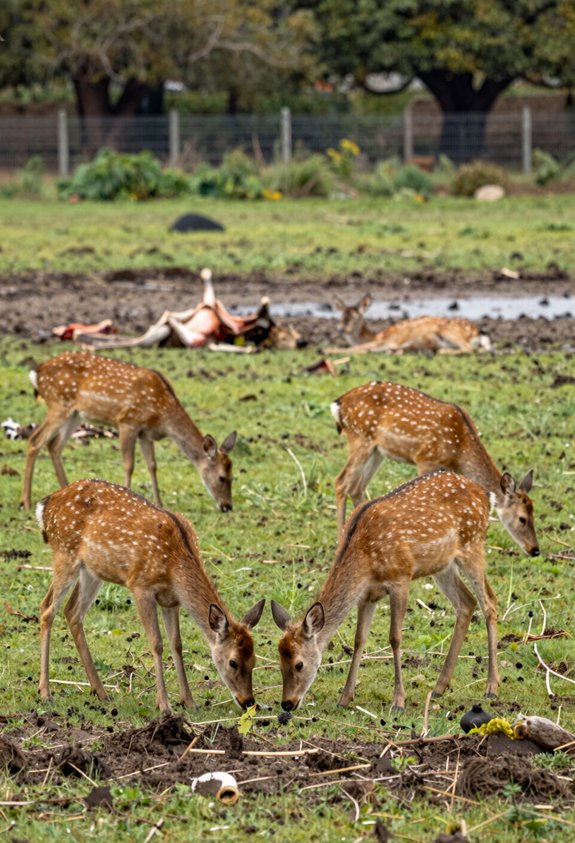
Population ecology offers numerous observable examples in the natural world, revealing complex biological relationships and survival patterns.
These instances range from the cyclical fluctuations between predator and prey populations, vibrant coral reef ecosystems, and wildlife adaptations in urban environments to isolated species on islands.
Examining these real-world examples provides valuable insights into ecological principles that govern population dynamics and biodiversity.
Throughout natural ecosystems, ecologists observe numerous fascinating examples of population dynamics that illustrate fundamental principles of ecology.
The reintroduction of wolves to Yellowstone National Park demonstrates trophic cascades, as predator populations altered elk behavior, subsequently affecting vegetation patterns and ecological niches of numerous species.
Studies of island biogeography in the Galápagos reveal how isolation influences population density and speciation rates.
The population cycles of snowshoe hares and lynx in boreal forests exemplify predator-prey relationships, with characteristic boom-bust patterns occurring approximately every decade.
Coral reef communities showcase how multiple species coexist through niche partitioning, with population densities responding to both abiotic factors like ocean temperature and biotic interactions.
These examples highlight how populations respond to environmental constraints, competition, and predation in predictable yet complex ways.
Predator-Prey Cycle Dynamics
While evidence of predator-prey relationships exists across ecosystems globally, several real-world examples particularly illuminate the cyclic nature of these population dynamics.
The classic case of Canadian lynx and snowshoe hare populations demonstrates clear 10-year oscillation patterns, where predator populations lag behind prey fluctuations.
In Yellowstone National Park, wolf reintroduction triggered cascading effects through elk population control, highlighting predator adaptation to hunting strategies.
Marine environments showcase similar patterns with Atlantic cod and capelin fish relationships in the North Atlantic.
Prey resilience manifests through evolutionary adaptations like the increased reproductive rates of voles when faced with weasel predation in northern Europe.
The Serengeti’s lion and wildebeest interactions represent another compelling example where seasonal migration serves as a prey resilience mechanism against predation pressure.
Coral Reef Biodiversity
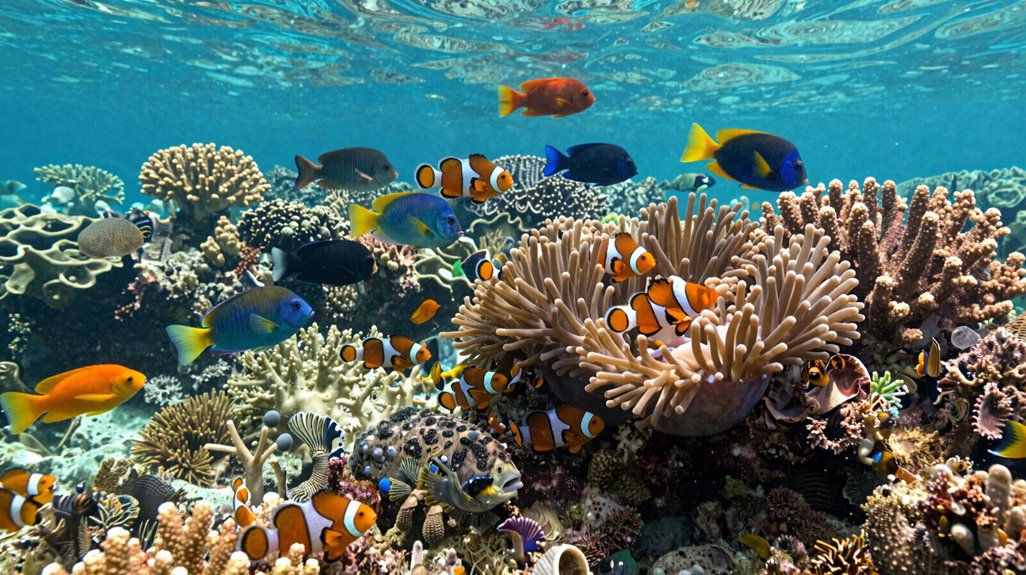
Coral reefs represent some of Earth’s most densely populated ecosystems, providing habitats for approximately 25% of all marine species despite covering less than 1% of the ocean floor. This remarkable biodiversity exemplifies complex population dynamics, with intricate symbiotic relationships between corals, zooxanthellae algae, fish, and invertebrates.
Within coral ecosystems, population densities fluctuate based on resource availability, predation pressure, and environmental conditions. Climate change threatens these delicate balances through coral bleaching and ocean acidification, which can dramatically alter species composition and abundance.
Reef conservation efforts focus on maintaining genetic diversity and population resilience by establishing marine protected areas and reducing anthropogenic stressors. Understanding population structures within reef systems is vital for predicting ecological responses to environmental change and implementing effective conservation strategies to preserve these biodiversity hotspots.
Urban Wildlife Adaptation
As urban landscapes continue to expand worldwide, wildlife populations demonstrate remarkable adaptability to human-dominated environments. Species like raccoons, coyotes, and peregrine falcons have developed specialized behaviors that capitalize on urban resources while avoiding human contact.
This urban adaptation includes nocturnal foraging patterns, modified diets, and utilization of anthropogenic structures for nesting.
Conservation biologists increasingly recognize the importance of wildlife corridors connecting fragmented urban habitats. These pathways allow populations to maintain genetic diversity through migration between isolated green spaces.
Cities like Singapore and Vancouver have incorporated such corridors into urban planning, creating greenbelts and underpasses that facilitate animal movement.
Research indicates that successful adaptation depends on species’ behavioral plasticity and the availability of these essential ecological connections throughout metropolitan areas.
Island Species Isolation
Islands serve as natural laboratories for studying population ecology, offering clear examples of species isolation and its evolutionary consequences. The Galapagos finches represent a classic case where geographic isolation led to remarkable species diversification, with distinct beak morphologies evolving to exploit different food resources.
Similarly, Hawaii’s honeycreepers demonstrate how isolation drives adaptive radiation when populations occupy varied ecological niches.
Modern habitat fragmentation creates “island effects” in terrestrial environments, where once-continuous populations become isolated. Madagascar’s lemurs illustrate long-term isolation consequences, evolving into numerous endemic species found nowhere else.
The island of Mauritius, home to the extinct dodo, shows how isolated populations often lack defenses against introduced predators, making them vulnerable to extinction.
These island populations provide valuable insights into evolutionary processes, speciation, and conservation challenges.
Wildfire Recovery Patterns
Wildfire recovery demonstrates dynamic population ecology principles through distinct regeneration phases. After severe burns, ecosystems follow predictable succession patterns, beginning with pioneering species adapted to nutrient-rich ash substrates. These initial colonizers typically exhibit r-selected traits: rapid growth, abundant reproduction, and short lifespans.
Fire ecology research reveals how species employ different recovery strategies. Some plants, like lodgepole pines, utilize serotinous cones that release seeds only under intense heat, while others regenerate from fire-resistant root systems.
Animal populations respond variably—some species flourish in post-fire landscapes rich with new growth, while others require mature forest structures.
Human intervention in natural recovery cycles through prescribed burns or suppression policies can greatly alter succession trajectories, highlighting the importance of understanding these patterns for effective conservation and forest management practices.
Invasive Species Impacts
Invasive species represent one of the most profound anthropogenic influences on population dynamics in modern ecological systems. When non-native organisms establish in new environments, they often lack natural predators and competitors, allowing explosive population growth. The zebra mussel in North American waterways demonstrates this pattern, with densities reaching 700,000 individuals per square meter in some locations.
These population explosions drive ecosystem disruption through multiple pathways. Invasive species may outcompete natives for resources, alter habitat structure, or disrupt existing predator-prey relationships.
The introduction of Nile perch to Lake Victoria decimated over 200 endemic cichlid species, while kudzu in the southeastern United States smothers native vegetation. Such invasions frequently trigger trophic cascades that fundamentally restructure ecological communities, highlighting how population-level changes can transform entire ecosystems.
Related concepts
In ecological studies, several concepts closely relate to population dynamics and provide deeper insight into how species interact with their environment. Population density, the number of individuals per unit area, fundamentally shapes ecological interactions through competition, predation, and resource availability.
Age structure analysis reveals population stability and growth potential by examining the distribution of different age groups.
Other related concepts include metapopulation theory, which examines spatially separated populations connected through migration, and source-sink dynamics, where some habitats produce population surpluses while others experience net population loss.
Carrying capacity defines the maximum population size an environment can sustain indefinitely, while minimum viable population represents the threshold below which extinction becomes likely.
Trophic cascades illustrate how population changes at one level affect multiple ecosystem levels.
Together, these concepts form an integrated framework for understanding the complex interplay between populations and their ecosystems, essential for effective conservation and management strategies.
If you want to strengthen your ecology foundation, start with the Ecology Basics to understand core concepts step by step. Dive deeper with 25 Key Concepts in Ecology with Real-World Examples to see how theory applies in nature. If you prefer to learn ecology fast and simply, the Ecology Flashcards are perfect for quick, focused learning. For a complete reference, explore the Glossary of Ecology Terms with 1,500+ terms explained in simple language, available as a PDF for use on any device.
🌿 Explore the Wild Side!
Discover eBooks, guides, templates and stylish wildlife-themed T-shirts, notebooks, scrunchies, bandanas, and tote bags. Perfect for nature lovers and wildlife enthusiasts!
Visit My Shop →