
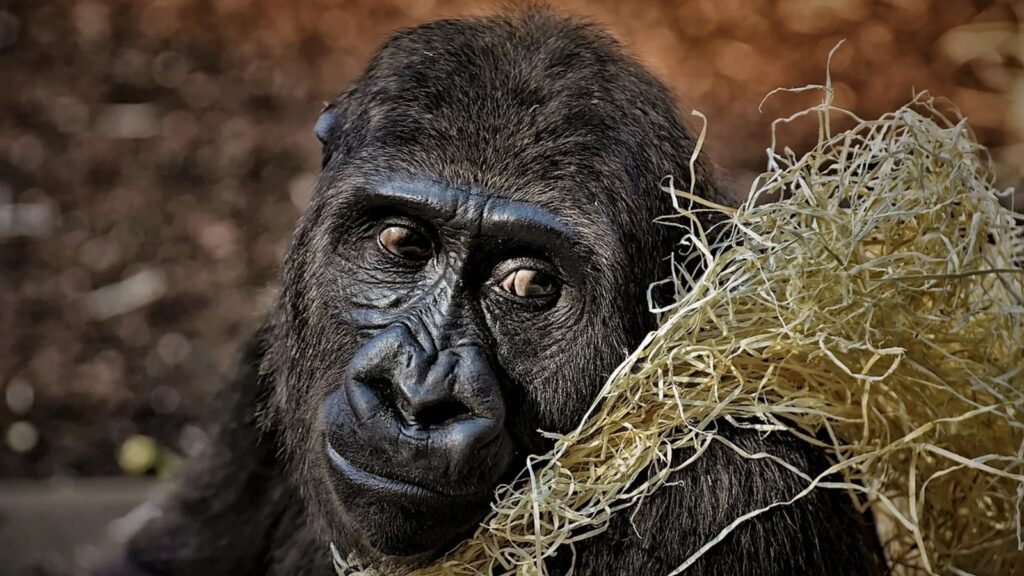
A gorilla can leave the ground, but not by much. The figure repeated everywhere is about four feet, slightly less than a silverback’s standing height, and it is worth saying plainly at the start that nobody has ever measured it properly. No gorilla has been put on a force plate or filmed against a calibrated jump board. Four feet is an estimate, and this article will treat it as one.
What we can say with confidence is why the number is low, and it has almost nothing to do with weakness.
How High Can a Gorilla Jump?
Roughly four feet, on the available estimates. A silverback weighs somewhere between 300 and 430 pounds in the wild, and jump height scales badly with body mass. Doubling an animal’s weight does not double the force its legs can produce, so large animals almost always jump poorly relative to their size. An elephant cannot leave the ground at all.
Gorillas also carry their muscle in the wrong place for jumping. The bulk sits in the shoulders, chest and arms, which is what you would expect from an animal whose ancestors solved the vertical problem by climbing rather than leaping.
How Far Across Can a Gorilla Jump?
This half of the question almost never gets answered, so here is the honest position. There is no published measurement of gorilla horizontal jump distance either.
What field observers do report is that gorillas cross gaps rather than leap them. Adults will reach across, bridge with an arm, or climb down and around. Juveniles, which weigh a fraction of an adult and are far more arboreal, do launch themselves between branches and swing from lower limbs, and that behaviour drops away sharply as they put on weight. If you have seen footage of a gorilla making a genuine leap, it was almost certainly a young one.
For a real comparison, a red kangaroo covers about 25 feet in a single bound and clears roughly 6 feet in height, on legs built as elastic springs. That is the animal whose whole body plan is a jumping machine. A gorilla’s is not.
Built to Climb, Not to Jump
Gorillas are knuckle walkers on the ground and vertical climbers in trees. They grip a trunk with hands and feet and haul themselves up, using arm and shoulder strength rather than leg drive.
One correction worth making, because this page used to get it wrong: gorillas do not brachiate. Brachiation is arm swinging locomotion underneath branches, and it belongs to gibbons and siamangs, animals weighing 15 to 30 pounds. An adult gorilla is roughly twenty times heavier and no branch would hold it. Juveniles do some suspensory play, which is as close as the family gets.
Young gorillas also spend a great deal of time in trees building day nests, which is where most of the climbing behaviour people describe actually comes from. It is worth reading alongside how a gorilla group is organised, because who nests where says a lot about the group.
The Gorilla Strength Myth
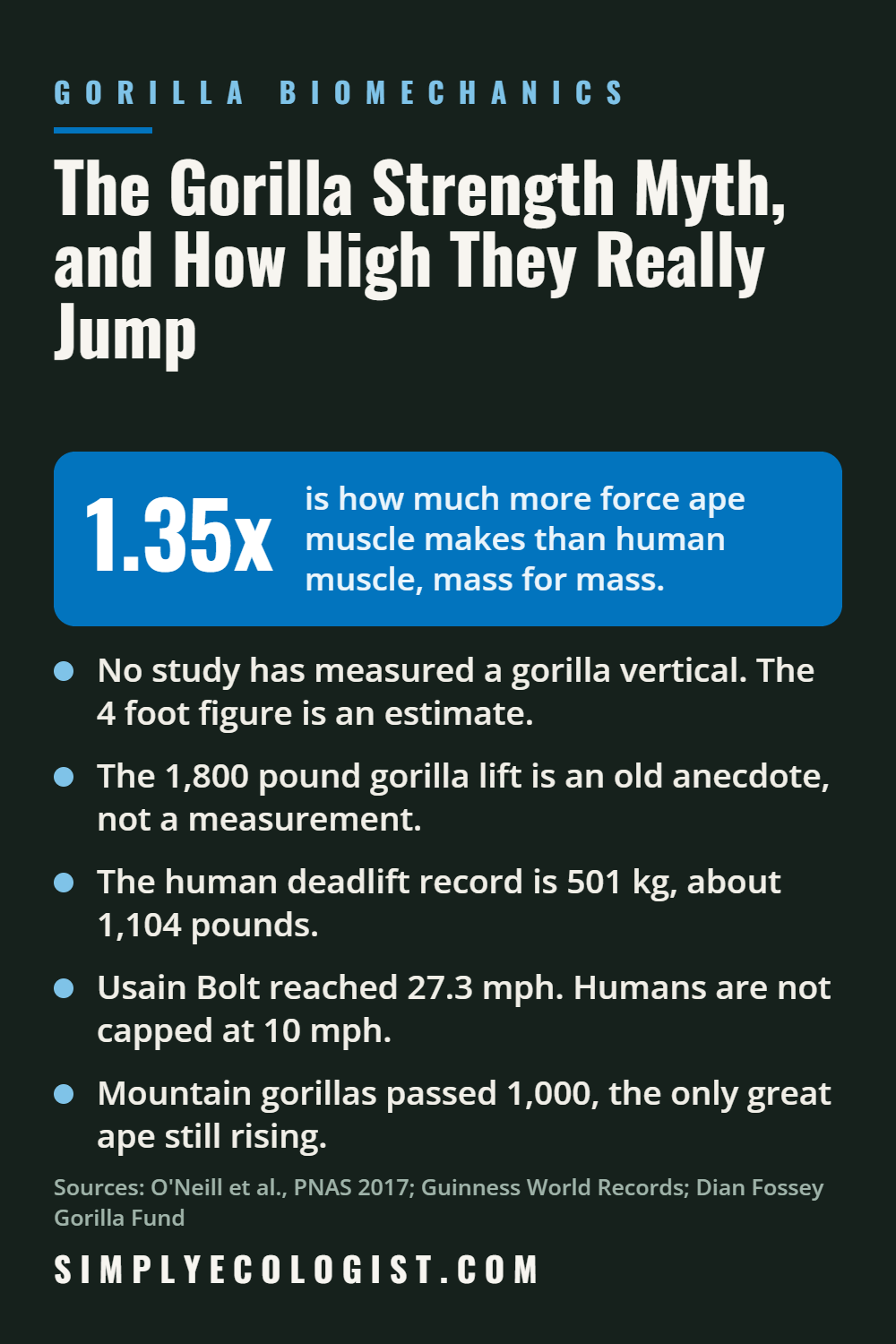
One thing that becomes obvious once you have spent seasons taking measurements is how few numbers about wild animals are actually measurements. Body mass gets weighed. Bite force occasionally gets rigged with a transducer. The vertical jump of a 200 kilogram ape does not get recorded, because nobody can persuade one to jump on cue over a marked board, and no ethics committee would sign off on making it. So when you meet a figure like 1,796.77 pounds, the decimal places are the tell. Real measurements arrive with a range and a method attached. Invented ones arrive with false precision.
You will have seen the claim that a gorilla can lift around 1,800 pounds and is roughly twenty times stronger than a human. Both figures used to appear on this page, and both should go.
No gorilla lift has ever been measured under controlled conditions. The 1,800 pound figure traces to an old anecdotal record rather than an experiment, and versions of it circulate with decimal places attached, which is a reliable sign that a number has been copied rather than measured.
The best evidence available comes from muscle itself. O’Neill and colleagues published a study in PNAS in 2017 comparing chimpanzee and human skeletal muscle directly, and found that ape muscle produces about 1.35 times the maximum force and power of human muscle per unit of mass. The authors call that difference modest, and describe their result as a correction to a century of super strength assumptions dating back to the 1920s.
So apes are stronger than us, but mainly because they carry more muscle and have limb proportions built for pulling, not because their muscle fibre is some other order of thing. A silverback would still win comfortably. It just would not win by a factor of twenty.
The human side of the comparison was wrong here too. This page previously said a well trained human can lift only 880 pounds. The heaviest deadlift on record is 501 kg, about 1,104 pounds, and that has since been exceeded.
How Fast Can a Gorilla Run?
The figure repeated across safari and zoo sites is 20 to 25 miles per hour in a charge, which is 32 to 40 kilometres per hour. Treat it as an estimate. I have not found a primary measurement of gorilla running speed anywhere in the literature, and the wide spread of numbers online suggests the range has been converted between units more than once along the way.
The comparison with humans also needs correcting. This page used to claim that even trained athletes do not exceed 10 miles per hour. That is wrong by a wide margin. Usain Bolt’s 9.58 second world record averaged 23.35 miles per hour and peaked at 27.33 miles per hour, and elite marathon runners hold around 13 miles per hour for two hours straight.
A charging gorilla and a sprinting human are therefore in roughly the same speed bracket. The difference is that the gorilla does it over a few metres, on four limbs, weighing three times as much, and does not usually intend to make contact. Most charges are display.
Mountain Gorillas Are the One Great Ape Going Up
Mountain gorillas passed 1,000 individuals in the most recent range wide census, reported by the Dian Fossey Gorilla Fund, making them the only great ape whose numbers are rising.
That recovery was bought with intensive daily protection, veterinary intervention and tourism revenue, in two small volcanic ranges, over decades. It is the single most encouraging number in great ape conservation, and it is fragile.
Where to See Gorillas, and What It Costs
If reading about them makes you want to see one, mountain gorilla trekking is tightly regulated and permits are limited on purpose. Current prices for foreign non residents:
- Rwanda, Volcanoes National Park: about 1,500 US dollars per person, issued by the Rwanda Development Board. A deliberate high value, low volume model.
- Uganda, Bwindi Impenetrable and Mgahinga: about 800 US dollars per person through the Uganda Wildlife Authority, dropping to around 600 in the low season months of April, May and November. A longer habituation experience costs more.
- Democratic Republic of Congo, Virunga: historically the cheapest at around 400 US dollars, but the park has been closed to visitors since 2020 on security grounds.
Confirm prices with the issuing authority before you plan around them, because they change. A permit buys one hour with a habituated group, and the fee is the mechanism that pays the rangers keeping the population climbing. Dry season, roughly June to September and December to February, books out months ahead.
How high can a gorilla jump?
Roughly four feet on the available estimates, slightly less than a silverback’s standing height. No controlled measurement of a gorilla vertical jump has ever been published.
How far across can a gorilla jump?
There is no published figure. Adults tend to bridge or climb around gaps rather than leap them. Juveniles, being much lighter, do leap between branches.
Are gorillas twenty times stronger than humans?
No. A 2017 PNAS study found ape muscle produces about 1.35 times the force of human muscle per unit mass. Gorillas are far stronger overall because they carry much more muscle, not because their muscle is many times better.
How much can a gorilla lift?
Nobody knows. No gorilla lift has been measured under controlled conditions, and the widely quoted 1,800 pound figure comes from an old anecdote rather than an experiment.
How fast can a gorilla run?
Commonly given as 20 to 25 miles per hour in a charge, though this is an estimate rather than a measurement. For comparison, Usain Bolt peaked at 27.33 miles per hour.
Why do gorillas climb instead of jumping?
Jump height scales badly with body mass, and gorilla muscle is concentrated in the shoulders and arms. Climbing with four gripping limbs is simply the cheaper solution for an animal that size.

Erzsebet Frey (Eli Frey) is an ecologist and online entrepreneur with a Master of Science in Ecology from the University of Belgrade. Originally from Serbia, she has lived in Sri Lanka since 2017. Eli has worked internationally in countries like Oman, Brazil, Germany, and Sri Lanka. In 2018, she expanded into SEO and blogging, completing courses from UC Davis and Edinburgh. Eli has founded multiple websites focused on biology, ecology, environmental science, sustainable and simple living, and outdoor activities. She enjoys creating nature and simple living videos on YouTube and participates in speleology, diving, and hiking.
From the shop
Gifts for people who love the wild
Wildlife themed t-shirts, notebooks, tote bags, bandanas and guides, designed by an ecologist.
Visit the shop