
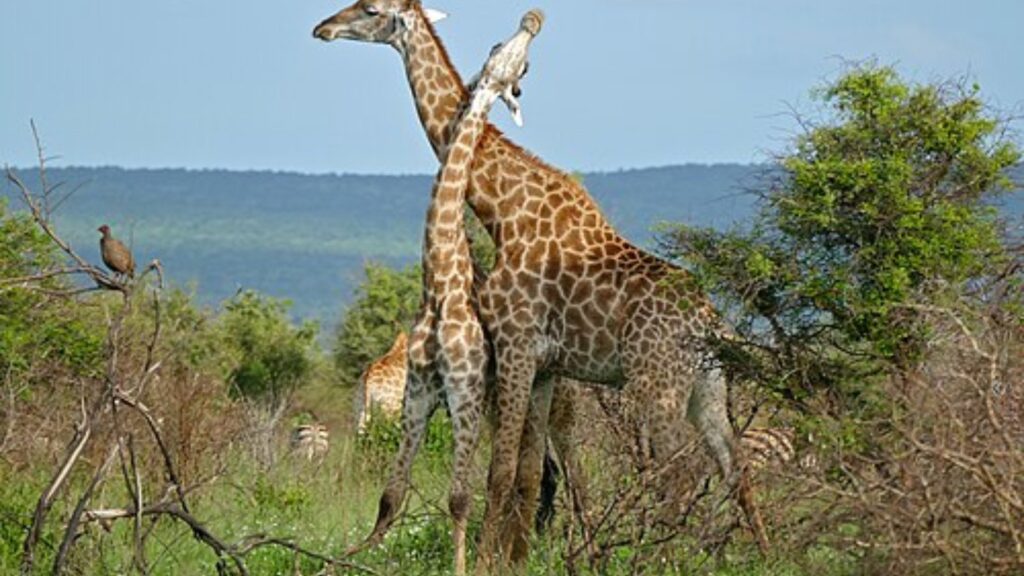
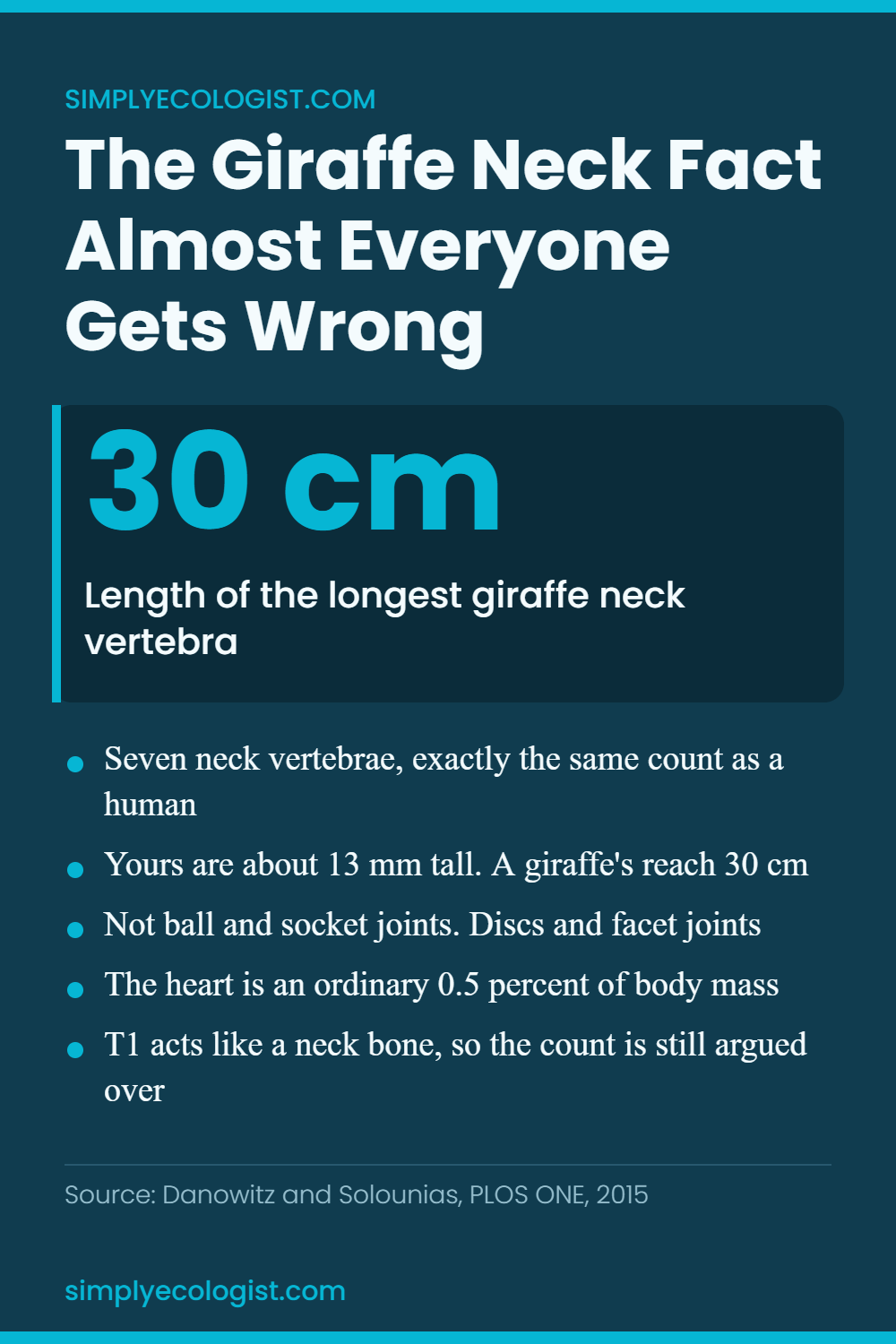
In short: a giraffe has seven neck vertebrae, the same count as you, but the longest of them reach about 30 cm each, and they meet at facet joints rather than ball and socket joints.
Giraffe necks are marvels of evolutionary engineering. Like most mammals, they have seven cervical vertebrae, but the longest of those bones reach roughly 30 cm, about 12 inches, in the adult skeletons measured by Danowitz and Solounias in 2015. The tallest vertebra in your own neck is about 14 mm. Those giraffe bones are not joined by ball and socket joints, whatever you have read elsewhere. They meet across intervertebral discs, with paired facet joints between the bony processes behind them. Strong ligaments and muscles support the weight of their heads and necks, and a set of specialized adaptations manages blood flow and pressure when the head goes up and down. That anatomy is what lets a giraffe reach high branches for feeding and keep watch over open country at the same time.
Written by Erzsebet Frey, ecologist. Every measurement in this article is linked to the peer reviewed research it comes from.
Key takeaways
- A giraffe has seven cervical vertebrae, exactly the same count as a human. Mammals are held to seven by developmental constraint, with only two exceptions: sloths and sirenians.
- The longest of those bones, C2 to C4, measure about 30 cm, close to 12 inches. The tallest vertebral body in your own neck is roughly 14 mm.
- They are not ball and socket joints. Adjacent vertebral bodies meet across an intervertebral disc, and the articular processes meet at paired facet joints.
- The giraffe heart is not exceptionally large. Measured hearts average 2.68 kg, about 0.53 percent of body mass, the same proportion as any other mammal. The pressure comes from a ventricle wall around 3 cm thick.
Are giraffe neck vertebrae really ball and socket joints?
No. Giraffe cervical vertebrae are joined by intervertebral discs between the vertebral bodies and by paired facet joints between the articular processes, not by ball and socket joints. There is no spheroidal joint anywhere in a mammalian neck, giraffe or otherwise.
What the joints actually are
Two structures hold one neck vertebra to the next. The vertebral bodies, the thick barrels that carry the load, meet across a pad of cartilage, the intervertebral disc. That is a symphysis. It has no capsule and no fluid filled cavity, so it is not a synovial joint at all. Behind them, small bony processes on each vertebra overlap and meet at the zygapophyseal joints, usually called facet joints. Those are synovial, but they are flat sliding surfaces. Neither structure resembles the hip or the shoulder, which are the genuine ball and socket joints in a mammal body.
Where the claim probably came from
The two papers that describe giraffe neck bones in the most detail, Danowitz and Solounias in PLOS ONE in 2015 and Solounias in the Journal of Zoology in 1999, never once use the phrase. What Danowitz and Solounias do describe is a vertebral body with a domed cranial end meeting a concave caudal end. A dome pressed into a dish looks a little like a ball in a socket if you are describing a photograph rather than a dissection, and that wording appears to have travelled from there into general reference writing and then into almost every popular article on the subject, including earlier versions of this one.
Why the difference matters
A ball and socket joint rotates freely in every direction. Discs and facet joints do not. They allow a limited bend at each level, constrained in direction, and a giraffe gets its range of motion by stacking seven of those limited bends across a neck more than two metres long rather than by having freer joints than you do. That is the more interesting answer, and it is the one the measurements support.
How many vertebrae does a giraffe have in its neck, and how long is each one?
A giraffe has seven cervical vertebrae, the same number as a human, a mouse or a whale. What is different is the size of each bone.
Seven bones, roughly 30 cm each
In the adult specimens measured by Danowitz and Solounias, the vertebral centrum lengths run C2 at 298 to 314 mm, C3 at 295 to 310 mm, C4 at 297 to 310 mm, C5 at 292 to 297 mm, C6 at 280 to 292 mm and C7 at 252 to 272 mm. So the longest single neck vertebra in a giraffe is close to 31 cm, a shade over 12 inches. Those seven bones, with the discs between them, carry a neck that reaches about 2.4 m, near 8 feet, in a large bull, the figure Taylor and Wedel give for adult males.
For scale, mean human cervical vertebral body heights measured on the anterior surface run 13.3 mm at C3, 12.4 mm at C4, 11.6 mm at C5, 12.4 mm at C6 and 14.1 mm at C7. Your longest neck bone is about the height of a thumbnail. A giraffe’s is about the length of your forearm. Same count, roughly twenty times the size.
What holds the neck up
The vertebrae are reinforced with strong ligaments and muscles to support the weight of the head and neck. There is a great deal to hold. Williams reported in 2016 that a giraffe neck can itself weigh over 100 kilograms, and that males spar with a head weighing up to forty kilograms on the end of it.
A giraffe neck also carries a circulatory system built to cope with a head that swings through two metres of height. Vessels and valves regulate blood pressure as the animal raises and lowers its head, which is what stops blood rushing to the brain when a giraffe bends down to drink. That story has its own section below.
The anatomy of giraffe neck vertebrae is a reflection of nature’s ingenuity, allowing these animals to thrive in a unique ecological niche while keeping exactly the same number of vertebrae as every other mammal around them.
How did the giraffe neck get so long?
By lengthening the same seven bones, in two separate stages, over millions of years. The elongation did not happen all at once and it did not happen evenly along the neck.
Two stages, the front of each bone first
Danowitz and colleagues traced the sequence through the fossil giraffids Canthumeryx, Samotherium, Palaeotragus, Bohlinia and Giraffa sivalensis, and found that cranial lengthening is the first stage of elongation seen in the family, followed by caudal lengthening. In plain terms, the front end of each vertebra stretched first, around 7.5 million years ago, and the back end stretched afterwards. It is that second stage that produced the extreme modern neck.
Longer bones, not extra bones
While most mammals, including humans, have seven neck vertebrae, giraffes have the same number but each one is considerably larger than those of other mammals. The elongation supplies the length without departing from the basic mammalian body plan, which is a far tighter constraint than it sounds: adding a neck bone is not something a mammal lineage gets to do.
The five metre nerve
One consequence of that stretch is a piece of wiring that only makes sense as history. The recurrent laryngeal nerve leaves the brainstem, runs the whole length of the neck down into the chest, loops around a vessel near the heart, and runs the whole length of the neck back up to the larynx, which sits a few centimetres from where it started. Wedel put the total brainstem to larynx pathway in the largest giraffes at close to five metres. The neck did not simply get longer. Everything routed through it got longer too.
What the neck is actually for
The rete mirabile, a complex network of blood vessels, adapted alongside the bones to regulate blood flow to the brain and prevent sudden pressure changes when the giraffe lowers or raises its head. As for why the neck itself evolved, the high browsing explanation everyone knows is not settled. Williams argued in 2016 that reaching high leaves is not on its own sufficient, that the sexual selection case is weak because male and female necks do not differ much once you scale for body size, and that vigilance may fit the evidence better.
How does a giraffe bend a neck that long?
With seven limited bends rather than a few free ones. Each joint in a giraffe neck moves less than you would expect, and the reach comes from the length of the segments being moved.
Strength and flexibility in the same bone
The cervical vertebrae of a giraffe are larger and more robust than those of other mammals, and they are still mobile. Each vertebra meets its neighbour across an intervertebral disc, with paired facet joints behind, and the domed cranial end of one body sits against the concave caudal end of the next, the shape Danowitz and Solounias describe. That geometry lets giraffes bend their necks in several directions, which matters for feeding and for vigilance.
Why the neck is not filled with air
A giraffe neck is heavy, and there is no anatomical trick that makes it light. Mammal vertebrae are solid bone. Air filled vertebrae are a bird, pterosaur and saurischian dinosaur feature, and Taylor and Wedel list the fact that giraffes lack an air sac system and pneumatic bones among the reasons no mammal neck ever reached sauropod lengths. A giraffe has to carry every gram of solid bone in its neck, and that is one of the limits on how long a mammal neck can get.
Necking is combat, not defence
The ligaments and muscles supporting the neck are strong and elastic, and giraffes do swing their necks as weapons. It is worth being precise about when. Necking is male to male combat over access to mates, not an anti predator defence. Williams describes it as sparring with a head weighing up to forty kilograms, on a neck that can itself weigh over 100 kilograms.
How does a giraffe pump blood up a neck two metres long?
With very high pressure, a thick walled left ventricle, valves in the jugular veins and a vascular net at the base of the brain. Not, as is very often claimed, with an enormous heart.
The heart is an ordinary size
This is the part most articles about giraffes get wrong. Smerup and colleagues weighed the hearts of eight giraffes of 330 to 654 kg and found a mean heart mass of 2.68 kg, which is 0.53 percent of body mass. That is the same relative cardiac mass as any other mammal, a group that sits between roughly 0.5 and 0.6 percent. Scaled up to a 1,200 kg bull it comes to about 6 kg, near 13 pounds. The giraffe heart is not exceptionally large, and the twenty five pound figure that circulates widely, including in earlier versions of this article, is not supported by direct measurement.
What is unusual is the wall. The left ventricular wall measures about 2.9 to 3.6 cm thick, and it is that thickness rather than bulk that generates the force. The heart pumps blood at high pressure, with mean arterial pressure measured at 224 mmHg and left ventricular systolic pressure at 234 mmHg, roughly twice the human figure.
Valves, and what they do not do
The jugular veins of a giraffe carry a series of one way valves that resist blood flowing backward up the neck under gravity when the animal lowers its head. Two clarifications are worth making. The valves sit in the veins, not in the arteries, so it is wrong to say the blood vessels of the neck generally are valved. And they do not solve the problem completely: published work reports that blood still pools in the jugulars when the head goes down, so the simple no backflow story is an approximation rather than a full mechanism.
The rete mirabile
Giraffes also have thick walled arteries and a complex network of blood vessels called the rete mirabile at the base of the brain. The rostral epidural rete sits in the cavernous venous sinus above the brain plate, and its turns and bends increase the length of artery blood must travel before entering the brain, exerting resistance to blood racing to the brain when the head is lowered to the ground. That is what keeps the pressure surge off the brain when a giraffe bends down to drink.
Standing tall without pooling blood
Blood also has to be kept from pooling in the legs. The mechanism described in the physiology literature is not a set of elastic ligaments but a covering: tight skin and dense fascia around the lower limb working like a compression suit, together with thick walled arteries in the distal leg, maintaining proper circulation throughout a very tall body.
How do giraffe neck bones compare with other mammals?
Same count, wildly different size. Almost every mammal has seven cervical vertebrae. The giraffe simply built each one about twenty times taller than yours.
Why seven, and why it is not Williston’s Law
The seven vertebra constant is a developmental constraint, and it is usually credited to the wrong principle. Williston’s law is the generalisation that serially repeated body parts tend to reduce in number and become more specialised over evolutionary time, and it was applied classically to the bones of the tetrapod skull. It is not the explanation for seven neck bones. That constancy is tied to Hox gene patterning during development and to the costs of disturbing it, the argument Galis set out in 1999 in a paper asking why almost all mammals have seven cervical vertebrae. The only mammals that break the rule are sloths and sirenians.
Cervical vertebrae compared
| Species | Cervical vertebrae | Longest cervical vertebra | Source |
|---|---|---|---|
| Giraffe | 7 | About 30 to 31 cm (C2 up to 314 mm) | Danowitz and Solounias, PLOS ONE, 2015 |
| Human | 7 | About 14 mm (C7 body height 14.1 mm) | Journal of Clinical and Diagnostic Research, 2022 |
| Okapi | 7 | Measured in the same PLOS ONE study and a small fraction of the giraffe figure. Exact value not quoted here | Danowitz and Solounias, PLOS ONE, 2015 |
| Camel | 7 | Not quoted here | Taylor and Wedel, PeerJ, 2013 |
| Two toed sloth | Not seven. Sloths are one of only two mammal groups that vary | Not quoted here | Taylor and Wedel, PeerJ, 2013 |
| Manatee | Fewer than seven. Sirenians are the other group that varies | Not quoted here | Taylor and Wedel, PeerJ, 2013 |
Camels, llamas and manatees
Compared with other long necked mammals such as camels and llamas, giraffe vertebrae show stronger ligament attachments and a more robust bone structure to carry the neck’s weight. Manatees went the other way and reduced the count. Giraffes kept the standard seven and increased the size dramatically, which is the whole evolutionary strategy in one line: the mammalian body plan was not rewritten, it was stretched.
Does a giraffe have seven neck vertebrae or eight?
Seven, by the standard skeletal count. But the argument over it is genuine, and it is the most interesting unresolved question about the giraffe neck.
The case for eight
Solounias argued in 1999 that the giraffe has in a subtle way escaped our scrutiny and actually has eight cervical vertebrae. His evidence was the shape of the eighth vertebra in the series, the one normally counted as the first thoracic: a long vertebral body, a highly convex anterior articular facet, and posterior facets built in the cervical style rather than the thoracic one.
Where the argument stands now
Gunji and Endo revisited it in 2016 and concluded that those modifications allow the first thoracic vertebra to adopt the kinematic function of a cervical vertebra in giraffes, while the count itself stays at seven. T1 behaves like a neck bone without being one. Danowitz and Solounias add a related oddity: the giraffe is the only known mammal in which the transitional vertebra, the point where the spine switches from cervical to thoracic mechanics, is T2 rather than T1.
So if you meet the claim that a giraffe has eight neck bones, it is not simply wrong. It is a functional definition rather than a skeletal one. The developmental count is seven.
Giraffe neck vertebrae: frequently asked questions
How many vertebrae does a giraffe have in its neck?
Seven. A giraffe has exactly the same number of cervical vertebrae as a human. Mammals are limited to seven by developmental constraint, and the only groups that vary are sloths and sirenians.
Do giraffes have bones in their neck?
Yes. Seven large cervical vertebrae, plus the intervertebral discs between them, plus the ligaments and muscles that hold the whole column up. The neck alone can weigh over 100 kilograms.
What type of joint is in a giraffe’s neck?
Two types. Intervertebral discs join the vertebral bodies, forming a cartilaginous symphysis with no joint cavity. Paired facet joints, which are flat synovial joints, connect the articular processes behind them.
Are giraffe cervical vertebrae ball and socket joints?
No. That claim is widespread but no peer reviewed osteology paper supports it. The vertebral bodies have a domed front end meeting a concave back end across a disc, which is not a spheroidal joint.
How long is one giraffe neck vertebra?
The longest reach about 30 to 31 cm, a little over 12 inches. Measured centrum lengths run from 252 mm at C7 to 314 mm at C2 (Danowitz and Solounias, PLOS ONE, 2015).
How long is a giraffe’s neck?
About 2.4 metres, near 8 feet, in a large adult bull. Six feet is closer to an average than a maximum.
How big is a giraffe’s heart?
About 2.68 kg on average in measured animals, which is 0.53 percent of body mass, the same proportion as any other mammal. It is not exceptionally large. Its power comes from a ventricle wall around 3 cm thick.
Sources
- Danowitz M and Solounias N, 2015. The cervical osteology of Okapia johnstoni and Giraffa camelopardalis. PLOS ONE 10.1371/journal.pone.0136552.
- Taylor MP and Wedel MJ, 2013. Why sauropods had long necks, and why giraffes have short necks. PeerJ 10.7717/peerj.36.
- Smerup M and colleagues, 2016. The thick left ventricular wall of the giraffe heart. Journal of Experimental Biology 10.1242/jeb.132753.
- Solounias N, 1999. The remarkable anatomy of the giraffe neck. Journal of Zoology.
- Gunji M and Endo H, 2016. Functional cervicothoracic boundary modified by anatomical shifts in the neck of giraffes. Royal Society Open Science 10.1098/rsos.150604.
- Danowitz M and colleagues, 2015. Fossil evidence and stages of elongation of the Giraffa camelopardalis neck. Royal Society Open Science 10.1098/rsos.150393.
- Galis F, 1999. Why do almost all mammals have seven cervical vertebrae? Developmental constraints, Hox genes, and cancer. Journal of Experimental Zoology.
- Williams EM, 2016. Giraffe stature and neck elongation. Biology 10.3390/biology5030035.
- Wedel MJ, 2012. A monument of inefficiency: the presumed course of the recurrent laryngeal nerve in sauropod dinosaurs. Acta Palaeontologica Polonica 10.4202/app.2011.0019.

Erzsebet Frey (Eli Frey) is an ecologist and online entrepreneur with a Master of Science in Ecology from the University of Belgrade. Originally from Serbia, she has lived in Sri Lanka since 2017. Eli has worked internationally in countries like Oman, Brazil, Germany, and Sri Lanka. In 2018, she expanded into SEO and blogging, completing courses from UC Davis and Edinburgh. Eli has founded multiple websites focused on biology, ecology, environmental science, sustainable and simple living, and outdoor activities. She enjoys creating nature and simple living videos on YouTube and participates in speleology, diving, and hiking.
From the shop
Gifts for people who love the wild
Wildlife themed t-shirts, notebooks, tote bags, bandanas and guides, designed by an ecologist.
Visit the shop