

Producers are organisms—primarily plants, algae, and certain bacteria—that convert solar energy into chemical energy through photosynthesis, creating the foundation upon which all ecosystems depend. They absorb carbon dioxide and release oxygen, shaping Earth’s atmosphere while generating organic compounds that fuel food webs from the smallest herbivore to the largest predator. Whether they’re towering forest trees, ocean phytoplankton, or cultivated crops like wheat and corn, producers demonstrate remarkable adaptations to their environments, and understanding their diverse roles reveals how energy flows through the natural world.
Definition
At the foundation of every ecosystem lies a simple yet profound truth: energy must enter the system from somewhere, and in nearly all cases, that somewhere is the sun.
Producers—organisms that create their own food from inorganic materials—capture this solar energy and convert it into chemical energy through photosynthesis, the process by which light transforms carbon dioxide and water into glucose and oxygen.
These organisms, primarily plants, algae, and certain bacteria, serve as the entry point for energy that’ll eventually flow through entire food webs. Their ecological roles extend beyond mere energy conversion: they generate the organic compounds that all other life depends upon, release oxygen into the atmosphere, and form the structural foundation of habitats.
Understanding the various producer types, from towering forest trees to microscopic phytoplankton drifting in oceans, reveals how life sustains itself across vastly different environments, each adapted to harness sunlight in its own particular way.
Ecological significance
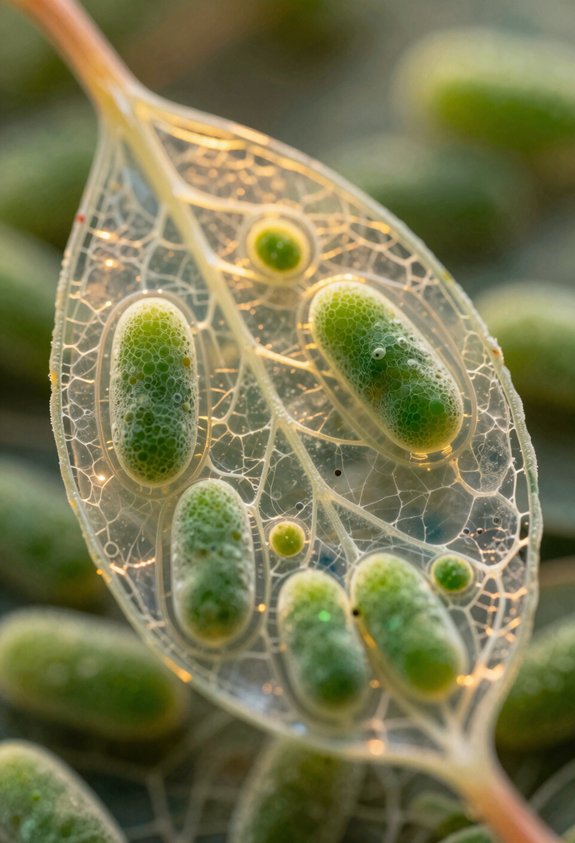
Without producers, ecosystems wouldn’t simply struggle—they’d cease to exist altogether, because these organisms alone possess the biochemical machinery to transform the sun’s radiant energy into the stored chemical energy that powers all higher trophic levels, those successive feeding positions in a food chain.
Their role extends far beyond mere energy capture: producers establish ecosystem balance by regulating atmospheric gases, releasing oxygen while absorbing carbon dioxide through photosynthesis. They anchor every food web, providing the foundational resources that herbivores consume and that carnivores indirectly depend upon.
When producer populations fluctuate—whether through drought, disease, or human interference—the effects ripple outward, destabilizing entire communities.
Consider how a forest’s trees support not only deer and insects but also the predators that hunt them, the decomposers that recycle nutrients, and the countless organisms inhabiting soil and canopy.
Producers don’t simply participate in ecosystems; they create the very conditions that make complex biological communities possible.
Real World Examples
Observing producers in their natural settings reveals how these foundational organisms—the living things that create their own food through photosynthesis—sustain ecosystems across diverse environments.
From the towering oak trees in temperate forests to the microscopic phytoplankton drifting in ocean currents, producers demonstrate remarkable adaptations to their specific habitats, each converting sunlight into energy that flows through food webs.
Agricultural systems, where crops like corn and wheat dominate vast landscapes, offer particularly clear examples of how human societies depend on these photosynthetic organisms for survival and economic stability.
Terrestrial Plant Producer Examples
When someone steps into a grassy meadow or walks beneath towering oak trees, they’re encountering some of Earth’s most essential producers—the terrestrial plants that convert sunlight into the chemical energy supporting entire food webs.
In forest ecosystems, maples and pines dominate the canopy, capturing sunlight through their broad leaves or needle clusters while creating habitat layers where countless organisms thrive.
Meanwhile, grassland species like bluestem and buffalo grass blanket prairies with dense root systems, holding soil in place as they photosynthesize and provide sustenance for grazing herbivores.
These producers share a common role: they transform solar energy into glucose through photosynthesis, making that energy available to primary consumers—the herbivores that feed upon them—and subsequently to all higher trophic levels in terrestrial environments.
Aquatic Photosynthetic Organisms
Beneath the surface of oceans, lakes, and rivers, a vast community of photosynthetic organisms generates much of Earth’s oxygen while forming the foundation of aquatic food webs—a community often invisible to casual observers but critical to planetary health.
Marine phytoplankton, microscopic drifting organisms that capture sunlight in saltwater environments, produce approximately half of the oxygen we breathe while supporting everything from tiny zooplankton to massive whales.
Freshwater algae perform similar roles in ponds, streams, and lakes, converting dissolved carbon dioxide and nutrients into energy-rich compounds through photosynthesis.
These aquatic producers include cyanobacteria (once called blue-green algae), diatoms with their intricate silica shells, and green algae that coat submerged rocks.
Together, they sustain entire ecosystems, demonstrating that producers don’t require roots or soil to power life’s essential processes.
Agricultural Crop Producers
Across millions of acres worldwide, agricultural crop producers—familiar plants like wheat, corn, rice, and soybeans—serve dual roles as both ecological producers and humanity’s primary food sources, converting sunlight into the carbohydrates, proteins, and fats that sustain roughly eight billion people.
These cultivated plants perform photosynthesis just as their wild relatives do, capturing solar energy and transforming carbon dioxide into organic compounds that form the foundation of our food systems.
Modern crop management—the deliberate planning of planting, irrigation, fertilization, and harvesting—maximizes their productivity while balancing ecological health.
Increasingly, farmers adopt sustainable practices: techniques that maintain soil fertility, reduce chemical inputs, and protect surrounding ecosystems, ensuring these essential producers continue functioning efficiently across generations without depleting the natural resources upon which all life depends.
Related concepts

Understanding producers requires seeing how they connect to several other fundamental concepts in ecology, each one clarifying a different aspect of how energy and matter move through living systems.
Producer interactions shape the foundation of food webs—the interconnected feeding relationships that link all organisms in an ecosystem. These interactions determine energy flow, the one-way transfer of usable energy from sunlight through producers and onward to consumers at higher levels.
Because energy transforms and dissipates as heat with each transfer, producers must constantly capture new solar energy to sustain the entire system.
Producers also participate in biogeochemical cycles, which are the circular pathways that elements like carbon, nitrogen, and phosphorus follow through living and nonliving components of ecosystems.
Through photosynthesis, producers pull carbon dioxide from the atmosphere, temporarily storing carbon in their tissues before it cycles back through respiration, decomposition, and other processes. This cycling connects producers to every other organism and to Earth’s physical environment.
If you want to strengthen your ecology foundation, start with the Ecology Basics to understand core concepts step by step. Dive deeper with 25 Key Concepts in Ecology with Real-World Examples to see how theory applies in nature. If you prefer to learn ecology fast and simply, the Ecology Flashcards are perfect for quick, focused learning. For a complete reference, explore the Glossary of Ecology Terms with 1,500+ terms explained in simple language, available as a PDF for use on any device.
🌿 Explore the Wild Side!
Discover eBooks, guides, templates and stylish wildlife-themed T-shirts, notebooks, scrunchies, bandanas, and tote bags. Perfect for nature lovers and wildlife enthusiasts!
Visit My Shop →