
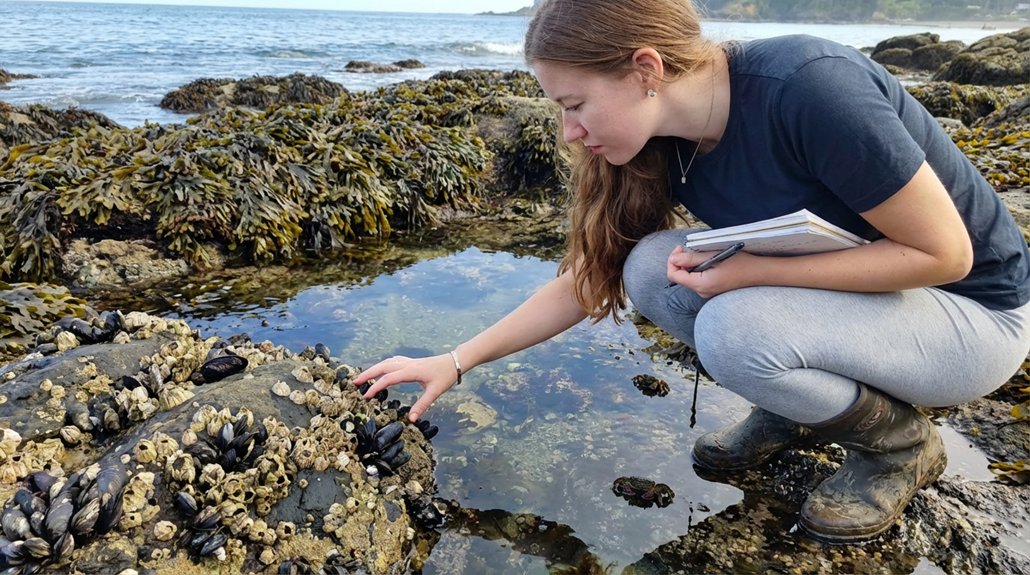
A niche represents the complete role an organism plays within its ecosystem—not just where it lives, but how it feeds, reproduces, and interacts with both living and nonliving elements around it. This concept proves essential because niche differentiation, or the division of resources among species, allows competitors to coexist without depleting what they need to survive. Darwin’s finches illustrate this beautifully: thirteen species share the Galápagos Islands, yet each has developed distinct beak shapes suited to specific food sources, reducing direct competition through specialization. The patterns observed in nature confirm that understanding niches reveals much about ecological balance and diversity.
Definition
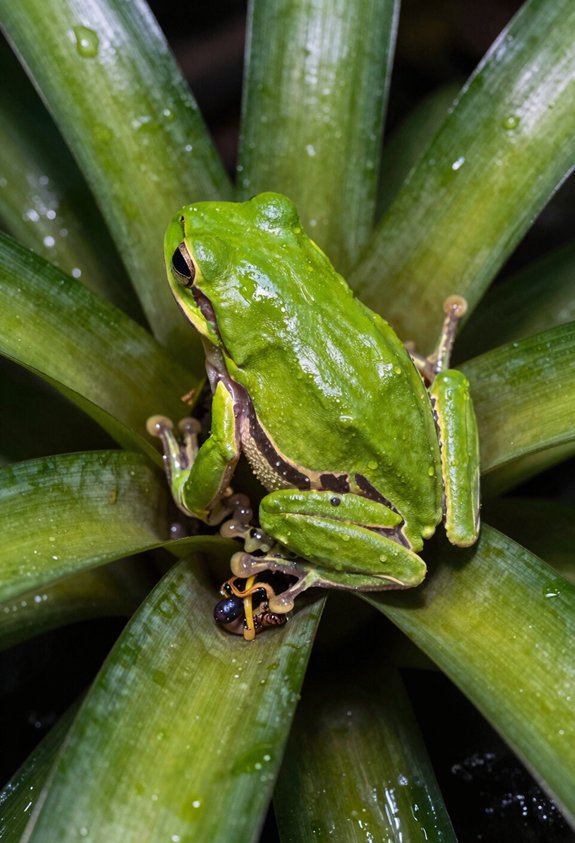
A niche, in ecological terms, represents the complete role an organism plays within its ecosystem—not merely where it lives, but how it lives, what it eats, when it’s active, and how it interacts with both living and nonliving elements around it.
This concept extends beyond physical location to encompass the full spectrum of an organism’s ecological roles: its feeding habits, reproductive patterns, temperature preferences, and relationships with other species.
When we consider niche differentiation—the process by which competing species use the environment differently—we begin to understand how multiple organisms coexist without depleting the same resources simultaneously.
A warbler feeding on insects at treetop level occupies a different niche than another warbler species hunting the same insects near the trunk, even when both inhabit identical forests.
This separation allows related species to reduce direct competition, thereby maintaining biodiversity and ecological balance within shared habitats.
Ecological significance
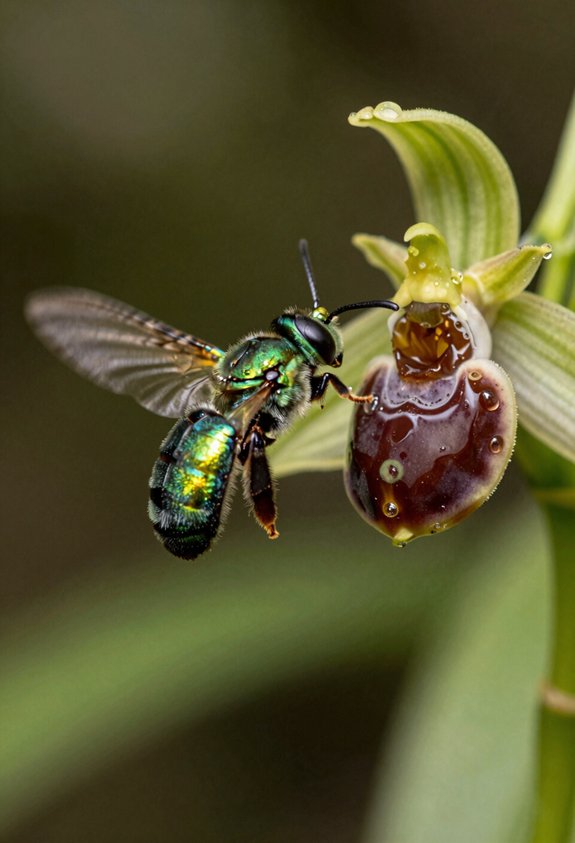
Understanding how organisms carve out distinct roles within their environments leads naturally to recognizing why these roles matter for entire ecosystems.
Niche differentiation—the process by which species develop distinct ways of living to reduce competition—strengthens ecosystem stability, meaning the system’s ability to maintain its functions despite disturbances. When multiple species occupy different niches, they create a web of interdependence: pollinators serve flowering plants, predators control prey populations, and decomposers recycle nutrients back into the soil.
This diversity of roles guarantees that if one species declines, others can partially compensate, preventing total collapse. Communities with high niche diversity typically recover faster from fires, floods, or disease outbreaks because their functional redundancy—having multiple species performing similar roles—provides backup systems.
The ecological significance of niches extends beyond individual survival; it fundamentally shapes how resilient, productive, and balanced natural communities remain across generations.
Real World Examples
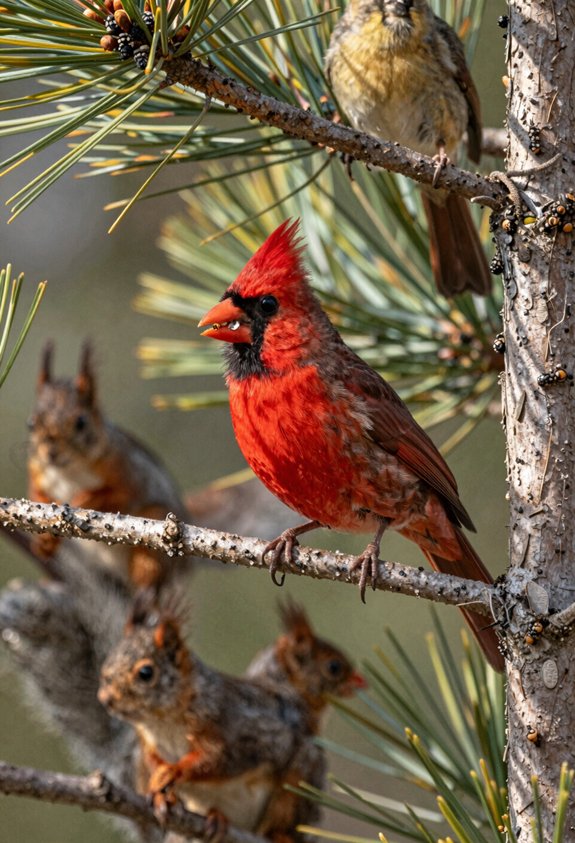
Observing how species actually use their niches in nature—the specific roles and resources each organism requires to survive—reveals patterns that confirm what ecological theory predicts.
Darwin’s finches on the Galápagos Islands demonstrate niche specialization through their varied beak shapes, each adapted to different food sources like seeds, insects, or nectar, which allows multiple species to coexist without competing directly.
Similarly, the African savanna supports lions, leopards, cheetahs, and wild dogs in the same landscape because each predator hunts different prey or employs distinct hunting strategies, while coral reefs host hundreds of fish species that partition their environment by depth, feeding time, and preferred algae or coral formations.
Galapagos Finches Beak Specialization
When Charles Darwin visited the Galápagos Islands in 1835, he encountered thirteen species of finches that would eventually transform our understanding of ecological niches and adaptation.
These remarkable birds demonstrate adaptive radiation—the process by which one ancestral species evolves into multiple forms to exploit different resources.
Each finch species occupies a distinct niche, and their beak variation reflects the specific food sources they’ve come to depend upon: large, powerful beaks for cracking tough seeds, slender beaks for catching insects, or sharp beaks for grasping cactus flowers.
This specialization reduces competition among species, allowing them to coexist on the same islands.
The finches show us how environmental pressures shape organisms over time, creating diversity from common ancestry through the elegant mechanism of natural selection.
African Savanna Predator Partitioning
Across the golden grasslands of East Africa, multiple predator species hunt the same prey populations yet manage to coexist without driving one another to extinction—a phenomenon ecologists call resource partitioning.
Lions typically hunt at night in open plains, targeting large prey like zebras and wildebeest. Leopards, meanwhile, prefer dawn and dusk hunts in areas with trees, dragging smaller kills into branches for safekeeping.
Cheetahs rely on daytime vision across flat terrain, pursuing swift gazelles when other predators rest. Wild dogs hunt cooperatively during morning hours in woodland edges.
This predator competition resolves through differences in habitat utilization—each species claiming distinct times, places, and hunting methods. Such partitioning demonstrates how ecological niches divide available resources, allowing diverse carnivores to thrive together without exhausting their shared ecosystem.
Coral Reef Fish Microhabitats
Beneath the surface of tropical oceans, coral reefs offer not one habitat but hundreds—a three-dimensional maze of crevices, branches, and sandy patches where fish species divide space with remarkable precision.
This microhabitat diversity allows dozens of species to coexist in relatively small areas without exhausting shared resources. Damselfish, for instance, defend tiny territories among branching corals, while gobies shelter in abandoned worm tubes and parrotfish graze exposed coral surfaces.
Each species occupies a distinct layer or structural niche—some preferring the reef’s upper ridges where light penetrates strongly, others inhabiting darker caverns below.
These spatial divisions reduce direct species interactions that might otherwise lead to competitive exclusion, demonstrating how physical complexity in an ecosystem creates opportunities for specialization and supports extraordinary biodiversity within confined spaces.
Related concepts
Several concepts orbit closely around the idea of an ecological niche, each one illuminating a different facet of how organisms relate to their environments and to one another.
Niche differentiation—the process by which competing species divide up resources to reduce direct competition—stands as perhaps the most important of these related ideas, allowing multiple species to coexist where resource availability might otherwise support only one.
When two birds feed on insects from the same tree, for example, one might forage on the trunk while another searches the outer branches, each carving out a slightly different role.
Competitive exclusion, another key concept, suggests that species occupying identical niches can’t coexist indefinitely: one will eventually outcompete the other.
Character displacement describes how species evolve different traits when living together compared to when they’re apart, further reducing niche overlap and fostering diversity in communities where organisms continuously adjust to one another’s presence.
If you want to strengthen your ecology foundation, start with the Ecology Basics to understand core concepts step by step. Dive deeper with 25 Key Concepts in Ecology with Real-World Examples to see how theory applies in nature. If you prefer to learn ecology fast and simply, the Ecology Flashcards are perfect for quick, focused learning. For a complete reference, explore the Glossary of Ecology Terms with 1,500+ terms explained in simple language, available as a PDF for use on any device.
🌿 Explore the Wild Side!
Discover eBooks, guides, templates and stylish wildlife-themed T-shirts, notebooks, scrunchies, bandanas, and tote bags. Perfect for nature lovers and wildlife enthusiasts!
Visit My Shop →