
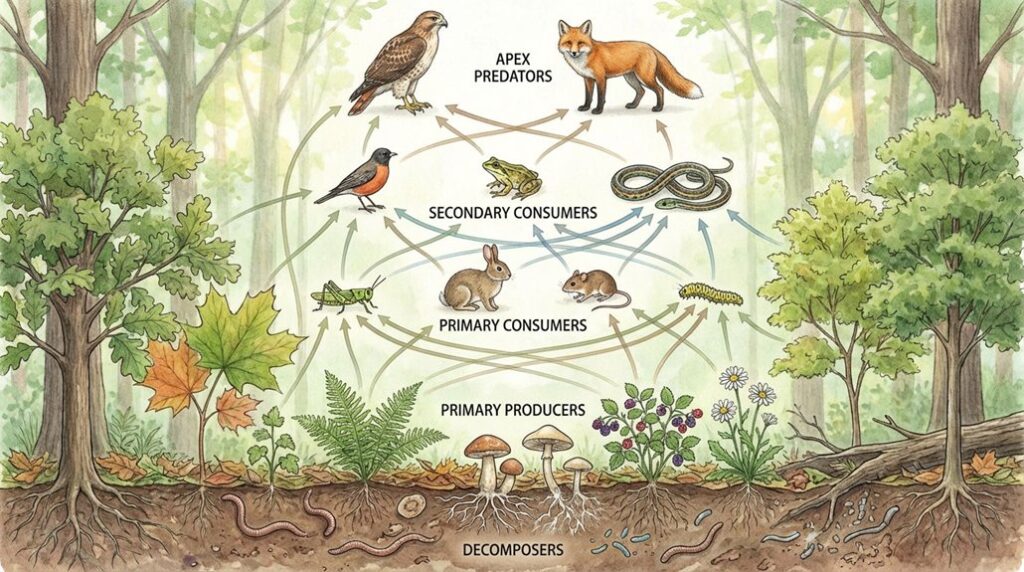
A food web represents the interconnected feeding relationships within an ecosystem, mapping how energy and nutrients flow through multiple pathways rather than along a single chain. Organisms occupy different trophic levels—feeding positions that determine their role—while approximately 90% of energy dissipates at each transfer, creating the pyramid structure observed in nature. This complexity matters deeply: diverse webs absorb disturbances without collapsing, whereas simplified systems become fragile, risking cascading failures when key species disappear. The wolf reintroduction at Yellowstone demonstrates this principle vividly, as predators restored balance by controlling elk populations, which allowed vegetation to recover and biodiversity to flourish. The mechanisms behind these transformations reveal essential patterns.
Definition
A food web represents the intricate network of feeding relationships that connect different organisms within an ecosystem, showing how energy and nutrients flow from one living thing to another through multiple, overlapping pathways.
Unlike a simple food chain that traces a single line from producer to consumer, a food web illustrates the complex reality of nature—where organisms often feed on multiple species and serve as food for several predators.
Within this network, scientists organize organisms into trophic levels, which are fundamentally feeding positions that indicate an organism’s role in energy transfer.
Energy flow moves through these levels as organisms consume one another, though it’s important to recognize that each transfer results in energy loss, typically around ninety percent.
This decreasing energy availability explains why ecosystems support fewer organisms at higher trophic levels, creating the familiar pyramid structure.
Ecological significance
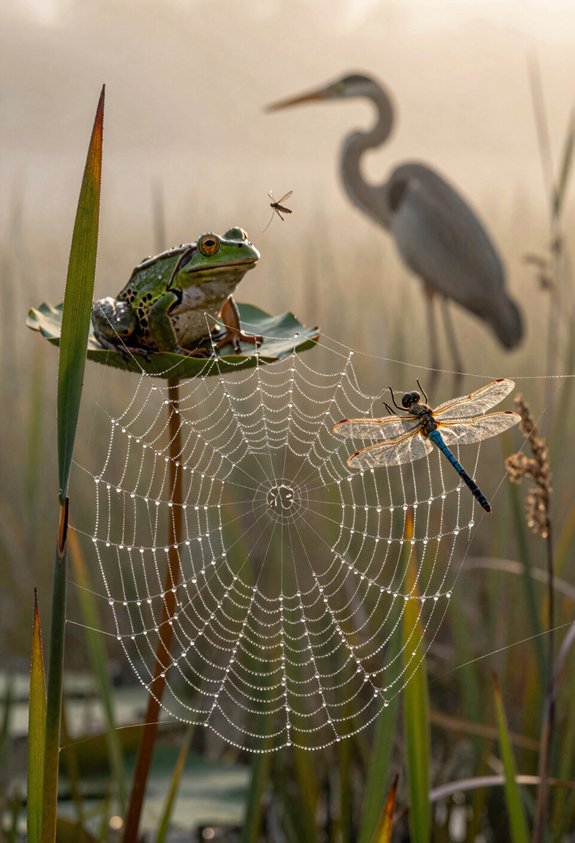
Food webs reveal something fundamental about ecosystem stability—they show us why biodiversity matters in practical, measurable ways. When scientists examine these networks, they’re observing how energy transfer occurs across trophic levels, meaning the hierarchical positions organisms occupy based on what they consume.
A diverse web with many interconnected pathways can absorb shocks—if one species declines, predators often have alternative prey, and this flexibility prevents collapse. In contrast, simplified webs with few connections become fragile: losing a single species can trigger cascading failures throughout the system.
The ecological significance extends beyond stability, though. Food webs also regulate nutrient cycling, control population sizes, and maintain the delicate balance between production and decomposition.
Understanding these patterns helps ecologists predict how human activities—habitat destruction, species introductions, climate shifts—will ripple through natural communities, offering vital insights for conservation efforts and ecosystem management.
Real World Examples
Real-world ecosystems reveal how food webs operate beyond theoretical models, showing the intricate connections that sustain life across diverse habitats.
When wolves returned to Yellowstone National Park after decades of absence, their presence triggered a trophic cascade—a series of effects that rippled through multiple levels of the food web, from elk populations to riverside vegetation.
Similar patterns emerge in coral reefs, where predator-prey relationships maintain delicate balances, and in the Amazon rainforest, where the removal or addition of key species can transform entire communities through interconnected feeding relationships.
Yellowstone Wolf Reintroduction Impact
When wolves returned to Yellowstone National Park in 1995 after a seventy-year absence, ecologists gained one of the most compelling demonstrations of how a top predator—an animal at the highest level of the food chain—can reshape an entire ecosystem through what scientists call a trophic cascade, a series of changes that ripple down through different feeding levels.
The wolf population began controlling elk herds, which had grown too large and overgrazed young trees along riverbanks. As elk changed their grazing patterns to avoid predation, willows and aspens recovered, bringing back beavers that build dams and create wetland habitats.
This restoration of ecosystem balance extended even further: birds returned, stream erosion decreased, and the entire landscape transformed—all because one keystone species reclaimed its ecological role.
Coral Reef Predator-Prey Dynamics
Beneath the surface of tropical oceans, coral reefs host some of the planet’s most intricate predator-prey relationships, where the balance between hunters and hunted maintains the spectacular diversity that makes these ecosystems thrive.
Groupers patrol the reef structures, controlling populations of herbivorous fish that would otherwise overconsume algae-eating organisms—a dynamic that directly supports coral symbiosis, the mutually beneficial partnership between corals and their photosynthetic algae.
When apex predators like sharks decline due to overfishing, mid-level predators increase unchecked, disrupting these carefully balanced interactions and threatening reef resilience, which refers to the ecosystem’s ability to recover from disturbances.
Scientists have documented how removing even a single predator species can trigger cascading effects throughout the food web, ultimately compromising the coral communities themselves.
Amazon Rainforest Trophic Cascades
In the Amazon rainforest, jaguars demonstrate how a single apex predator—an animal at the top of the food chain with no natural predators—can shape entire ecological communities through what scientists call trophic cascades, a phenomenon where effects ripple down through multiple levels of the food web.
When jaguars hunt herbivores like capybaras and peccaries, they prevent these animals from overgrazing vegetation, which maintains biodiversity and supports nutrient cycling throughout different trophic levels.
However, habitat destruction threatens these delicate species interactions: when jaguars disappear, herbivore populations explode, vegetation suffers, and ecosystem stability collapses.
This cascade reveals how removing just one predator can trigger biodiversity loss across the entire food chain, disrupting the ecological balance that countless organisms depend upon for survival.
Related concepts
Food webs don’t exist in isolation from other ecological concepts, and understanding how they connect to related ideas deepens one’s grasp of ecosystem function.
Trophic levels—the hierarchical positions organisms occupy in feeding relationships—provide the framework upon which food webs are built, showing how energy flow moves from producers through various consumers. These webs illustrate species interactions beyond simple predation: competition, mutualism, and parasitism all influence who eats whom.
Ecosystem stability depends partly on the complexity of these connections, as biodiversity loss can destabilize entire networks by removing key species. While a food chain represents a single linear pathway, food webs reveal the interconnected reality of nature.
Both biotic factors—living components like plants and animals—and abiotic factors—nonliving elements such as water, temperature, and nutrients—shape these networks. Together, these concepts form an integrated understanding of how ecosystems maintain themselves through countless, delicate relationships.
If you want to strengthen your ecology foundation, start with the Ecology Basics to understand core concepts step by step. Dive deeper with 25 Key Concepts in Ecology with Real-World Examples to see how theory applies in nature. If you prefer to learn ecology fast and simply, the Ecology Flashcards are perfect for quick, focused learning. For a complete reference, explore the Glossary of Ecology Terms with 1,500+ terms explained in simple language, available as a PDF for use on any device.
🌿 Explore the Wild Side!
Discover eBooks, guides, templates and stylish wildlife-themed T-shirts, notebooks, scrunchies, bandanas, and tote bags. Perfect for nature lovers and wildlife enthusiasts!
Visit My Shop →