
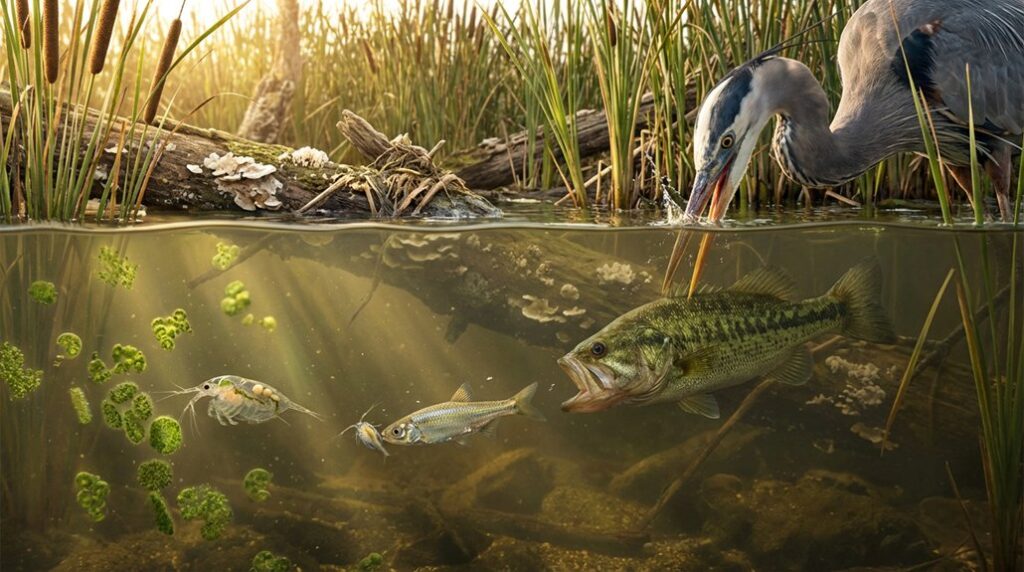
A food chain traces the linear pathway of energy transfer through an ecosystem, beginning with producers—plants and phytoplankton that convert sunlight into usable energy—and moving through successive trophic levels, or feeding positions, as herbivores consume plants and carnivores hunt other animals.
Each transfer loses approximately ninety percent of energy to heat and metabolic processes, which explains why ecosystems support fewer predators than prey.
This interconnected sequence reveals how organisms depend on one another for survival, and exploring specific examples across different habitats illuminates these essential relationships further.
Definition
When ecologists speak of a food chain, they’re referring to a linear sequence that shows how energy and nutrients move from one organism to another through feeding relationships—essentially, who eats whom in a particular ecosystem.
This concept helps us understand how life sustains itself through interconnected patterns of consumption.
Each position in the chain represents a trophic level, which is simply a feeding step or rank in the hierarchy of eating—from the grass that captures sunlight to the hawk that hunts smaller birds.
The movement between these levels involves energy transfer, where usable energy passes from prey to predator, though not all of it makes the journey successfully.
In fact, roughly ten percent of energy moves upward with each step, while the rest dissipates as heat or supports the organism’s own life processes.
Ecological significance
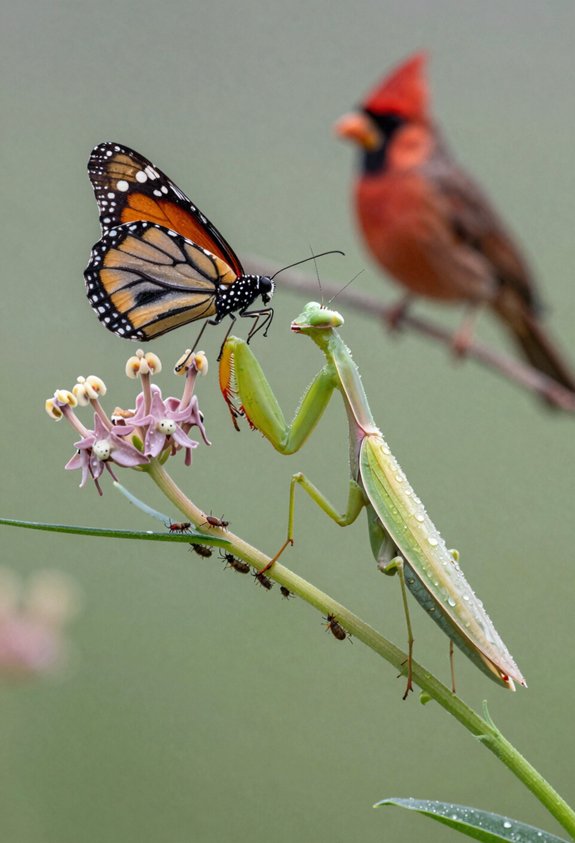
Because food chains map the pathways through which energy flows and nutrients cycle, they’ve become essential tools for understanding how ecosystems maintain stability and respond to disturbance. Each link represents a trophic level—a position in the feeding hierarchy where organisms share similar roles as producers, consumers, or decomposers.
Energy transfer between these levels follows predictable patterns: roughly ten percent of the energy stored in one level moves up to the next, while the remaining ninety percent dissipates as heat or supports metabolic processes.
This inefficiency explains why ecosystems support fewer top predators than herbivores, creating the characteristic pyramid shape ecologists observe in nature.
Understanding these relationships helps researchers predict how removing a single species might cascade through an entire system, altering population sizes and resource availability at multiple trophic levels.
Food chains consequently reveal the interdependence that binds communities together, showing that every organism plays a role in maintaining ecological balance.
Real World Examples
Observing food chains in actual ecosystems—rather than only in diagrams—reveals how energy flows through living communities in patterns that are both predictable and remarkably complex.
Ocean waters, forest floors, and open grasslands each demonstrate distinct versions of the producer-consumer-decomposer cycle, where organisms occupy specific feeding roles, or trophic levels, that determine their place in the transfer of nutrients.
These real-world examples show that while the basic principles remain consistent across habitats, the particular species involved and the challenges they face create food webs that are uniquely adapted to their environments.
Ocean Food Chain Example
How does energy actually move through the vast expanse of the ocean, connecting microscopic organisms to the largest animals on Earth?
The ocean food chain begins with phytoplankton—tiny floating plants that capture sunlight and create their own food through photosynthesis. These microscopic producers support ocean biodiversity by feeding zooplankton, which are consumed by small fish like sardines and anchovies.
Medium-sized fish then prey on these smaller species, and marine predators such as sharks, dolphins, and orcas occupy the top positions. Even giant blue whales, despite their enormous size, feed primarily on krill: small shrimp-like creatures that eat phytoplankton.
This interconnected system demonstrates how energy transfers from one level to the next, with each organism playing a crucial role in maintaining the ocean’s ecological balance.
Forest Ecosystem Food Chain
Towering trees, thick underbrush, and layers of decomposing leaves create a forest environment where energy flows through a complex network of producers, consumers, and decomposers.
Forest food webs begin with oak trees and berry bushes converting sunlight into stored energy through photosynthesis—the process plants use to make their own nutrition.
Deer and squirrels consume these plants, transferring energy upward as primary consumers. Wildlife interactions become more intricate when foxes hunt rabbits, or when owls swoop down to catch mice scurrying across the forest floor.
These carnivores occupy the secondary and tertiary consumer levels, each transfer losing some energy as heat.
Eventually, fungi and beetles break down fallen logs and dead animals, returning essential nutrients to the soil where trees can absorb them again, completing the cycle.
Grassland Predator-Prey Relationships
Wide-open plains stretch across continents where grasses dominate the landscape and predator-prey relationships unfold with particular clarity, offering some of the most observable examples of energy transfer in terrestrial ecosystems.
In African savannas, lions fulfill critical predator roles by hunting zebras and wildebeest—large herbivores that convert grass into muscle tissue. This interaction demonstrates herbivore dynamics: when predator populations decline, herbivore numbers surge until overgrazing degrades the grassland itself.
North American prairies showcase similar patterns, where coyotes regulate rabbit and ground squirrel populations. The relationship works both ways—predator survival depends entirely on herbivore availability, creating cyclical population fluctuations that ecologists can measure across seasons.
These observable patterns help scientists understand how energy moves through trophic levels, the feeding positions organisms occupy within food chains.
Related concepts
When examining food chains in greater depth, it’s helpful to recognize that several related concepts extend and refine our understanding of how energy and nutrients move through ecosystems.
Trophic levels—the hierarchical positions organisms occupy based on their feeding relationships—form the structural framework that organizes every food chain, with producers at the base, herbivores above them, and carnivores higher still.
Energy transfer between these levels follows a predictable pattern: roughly ten percent of the energy at one level becomes available to the next, while the rest dissipates as heat or supports metabolic processes.
Food webs expand upon simple chains by acknowledging that most organisms consume multiple food sources and serve as prey for various predators, creating interconnected networks rather than linear sequences.
Biomass pyramids illustrate how the total mass of living material decreases at successive trophic levels, reflecting these energy losses and explaining why ecosystems typically support fewer top predators than primary consumers.
If you want to strengthen your ecology foundation, start with the Ecology Basics to understand core concepts step by step. Dive deeper with 25 Key Concepts in Ecology with Real-World Examples to see how theory applies in nature. If you prefer to learn ecology fast and simply, the Ecology Flashcards are perfect for quick, focused learning. For a complete reference, explore the Glossary of Ecology Terms with 1,500+ terms explained in simple language, available as a PDF for use on any device.
🌿 Explore the Wild Side!
Discover eBooks, guides, templates and stylish wildlife-themed T-shirts, notebooks, scrunchies, bandanas, and tote bags. Perfect for nature lovers and wildlife enthusiasts!
Visit My Shop →