

The biosphere in ecology refers to Earth’s entire zone of life—a thin, fragile shell extending from deep ocean floors to the upper atmosphere where all living things exist. It’s not a single ecosystem but rather the sum of every ecosystem working together, integrating organisms with water, air, and rock. This interconnected web regulates climate, cycles nutrients, and sustains biodiversity across diverse environments like rainforests and coral reefs. Understanding these connections reveals how Earth truly functions as one living system.
Definition
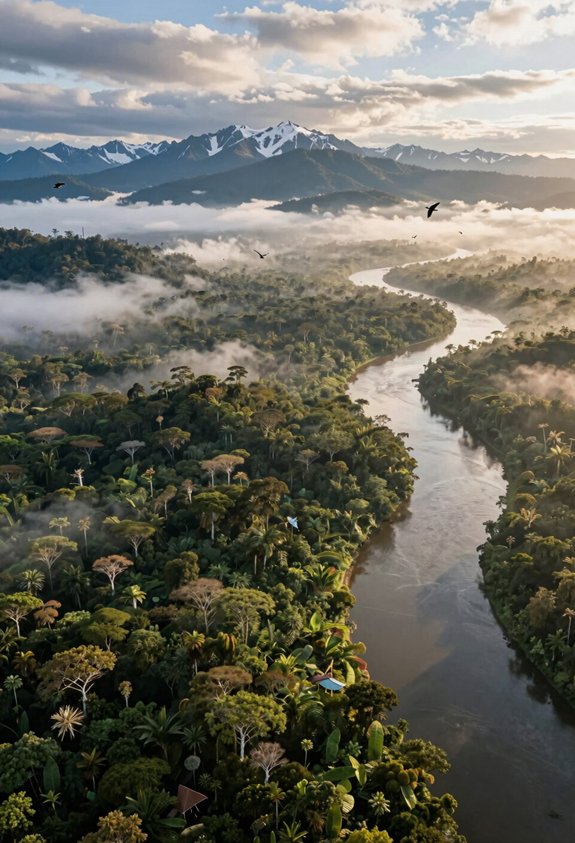
The biosphere represents the sum total of all ecosystems on Earth—a thin, fragile shell extending from the deepest ocean trenches to the upper reaches of the atmosphere where life can persist.
This concept requires careful linguistic framing to grasp fully, as it encompasses every living organism and the physical environments they inhabit.
The term itself derives from Greek roots: “bios” meaning life and “sphaira” meaning sphere.
Understanding the biosphere demands semantic precision—the careful selection of words that capture exact meanings.
Scientists define it as the global ecological system integrating all living beings and their relationships, including interactions with the lithosphere, hydrosphere, and atmosphere.
One shouldn’t confuse the biosphere with individual ecosystems, which represent smaller, localized communities.
Instead, it functions as the interconnected web where energy flows and matter cycles continuously, supporting the remarkable diversity of life that characterizes our planet.
Ecological significance

Why does the biosphere matter so deeply to every living thing on Earth?
The biosphere functions as a life-support system—regulating climate, cycling nutrients, and maintaining the atmospheric balance that allows organisms to thrive.
Every breath you take connects you to this planetary web of interdependence.
Scientists use valuation frameworks, which are methods for measuring nature’s worth in economic and ecological terms, to help communities understand what healthy ecosystems provide.
These assessments reveal services often taken for granted: clean water filtration, soil formation, and pollination of crops.
Understanding the biosphere’s ecological significance also shapes policy implications, meaning the ways scientific knowledge influences laws and environmental decisions.
When policymakers recognize how interconnected life systems truly are, they can craft protections that consider whole ecosystems rather than isolated species.
The biosphere reminds us that human well-being remains inseparable from the health of every forest, ocean, and grassland we share.
Real World Examples
The biosphere’s complexity becomes clearer when one examines specific ecosystems that illustrate its remarkable diversity. From the Amazon Rainforest’s layered canopy—home to an estimated ten percent of all species on Earth—to the Great Barrier Reef’s intricate coral communities, these environments demonstrate how living organisms shape and are shaped by their surroundings.
The African savanna’s seasonal rhythms, Yellowstone’s geothermal communities thriving in extreme heat, and the Arctic tundra’s resilient life forms each offer distinct windows into the biosphere’s adaptive capacity.
Amazon Rainforest Ecosystem
Spanning across nine South American countries, the Amazon Rainforest stands as one of Earth’s most complex and essential ecosystems—a living laboratory where the principles of ecology unfold on a breathtaking scale.
This vast region demonstrates how interconnected relationships sustain life, from the canopy’s towering trees to the soil microbiome—the community of bacteria, fungi, and microscopic organisms that cycle nutrients through the forest floor.
Indigenous governance plays a critical role in maintaining this ecological balance, as native communities have developed sustainable practices over thousands of years that protect biodiversity while meeting human needs.
Their traditional knowledge systems recognize what modern science confirms: the rainforest functions as an integrated whole, where each species contributes to the health of the larger system that sustains them all.
Great Barrier Reef
Australia’s Great Barrier Reef offers another compelling example of ecology’s core principles at work, stretching more than 2,300 kilometers along the northeastern coastline as the world’s largest coral reef system.
This underwater ecosystem supports thousands of species—from microscopic algae to sea turtles and sharks—each playing essential roles in maintaining balance.
Rising ocean temperatures have triggered coral bleaching, a stress response where corals expel the symbiotic algae living in their tissues and turn white.
Without these algae, corals lose their primary food source and often die.
To protect this fragile system, scientists and policymakers have implemented reef zoning, a management approach that designates specific areas for different uses—some open for recreation, others strictly protected.
These zones help reduce human impact while allowing the reef time to recover.
African Savanna Biodiversity
While coral reefs showcase biodiversity beneath the waves, Africa’s savanna grasslands reveal equally complex ecological relationships unfolding across vast open landscapes.
The savanna functions as a dynamic system where grazer dynamics—the interactions between herbivores and the plants they consume—shape the entire ecosystem.
Wildebeest, zebras, and gazelles rotate through different grass species, preventing any single plant from dominating and allowing diverse vegetation to thrive.
Fire regimes, meaning the patterns of natural and human-set burns that sweep across these grasslands, play an equally essential role.
These periodic fires clear dead plant material, return nutrients to the soil, and create open spaces where new growth emerges.
Many savanna species have adapted to depend on these cycles: certain seeds germinate only after exposure to smoke, and predators use freshly burned areas to hunt more effectively.
Yellowstone Geothermal Communities
Yellowstone’s bubbling hot springs and steaming vents host some of Earth’s most remarkable life forms—organisms that thrive in conditions once thought impossible for living things.
These geothermal features support vibrant microbial mats, which are layered communities of bacteria and archaea that carpet the edges of hot pools in brilliant oranges, yellows, and greens.
Each color band represents different species adapted to specific temperatures.
Thermophile adaptation—the ability of organisms to flourish in extreme heat—allows these microbes to survive in waters reaching 70°C or higher.
Scientists study these communities because they reveal how life might exist on other planets with similar conditions.
The organisms produce heat-resistant enzymes that researchers now use in medicine and biotechnology, demonstrating how understanding extreme ecosystems benefits human society in unexpected ways.
Arctic Tundra Life
At the opposite extreme of Earth’s temperature spectrum, the Arctic tundra presents a frozen landscape where life persists through remarkable cold-weather adaptations rather than heat tolerance.
Caribou, musk oxen, and lemmings engage in tundra herbivory—the grazing and browsing that shapes plant communities across these treeless plains.
Their feeding patterns influence which vegetation thrives, creating a dynamic relationship between animals and the sparse but resilient flora.
Beneath the surface lies permafrost, permanently frozen ground that stores vast amounts of carbon.
As global temperatures rise, permafrost feedback occurs: thawing ground releases stored greenhouse gases, which then accelerate further warming in a self-reinforcing cycle.
Arctic foxes, snowy owls, and countless migratory birds depend on this delicate ecosystem, where even small temperature shifts can transform the entire biological community.
Galápagos Islands Evolution
How did a small cluster of volcanic islands become one of the most important natural laboratories for understanding life’s diversity?
The Galápagos Islands, isolated in the Pacific Ocean, showcase adaptive radiation—the process where one ancestral species evolves into many different forms to fill various ecological roles.
Darwin’s finches illustrate this beautifully: a single finch ancestor arrived and diversified into thirteen distinct species, each with beaks shaped for different food sources.
The islands’ small, separated populations also demonstrate genetic drift, the random changes in gene frequency that occur more dramatically in limited groups.
Giant tortoises evolved shell shapes matching their specific island environments, while marine iguanas developed unique abilities to feed underwater.
These living examples continue teaching scientists how isolation and time generate remarkable biological diversity.
Coral Triangle Marine Diversity
While the Galápagos Islands demonstrate how isolation creates diversity through separation, the Coral Triangle reveals how rich conditions can generate extraordinary variety through abundance and interconnection.
This region—spanning waters between Indonesia, Malaysia, the Philippines, Papua New Guinea, Timor-Leste, and the Solomon Islands—contains over 75 percent of all known coral species and supports more than 3,000 fish species.
The area’s remarkable reef resilience, meaning the ability of coral ecosystems to recover from disturbances, stems partly from its sheer biological variety.
Marine symbiosis plays a central role here: corals depend on tiny algae living within their tissues for nutrition, while countless fish species rely on coral structures for shelter and breeding grounds. This web of mutual dependence creates stability, where each organism’s survival strengthens the whole system’s capacity to endure environmental stress.
Related concepts
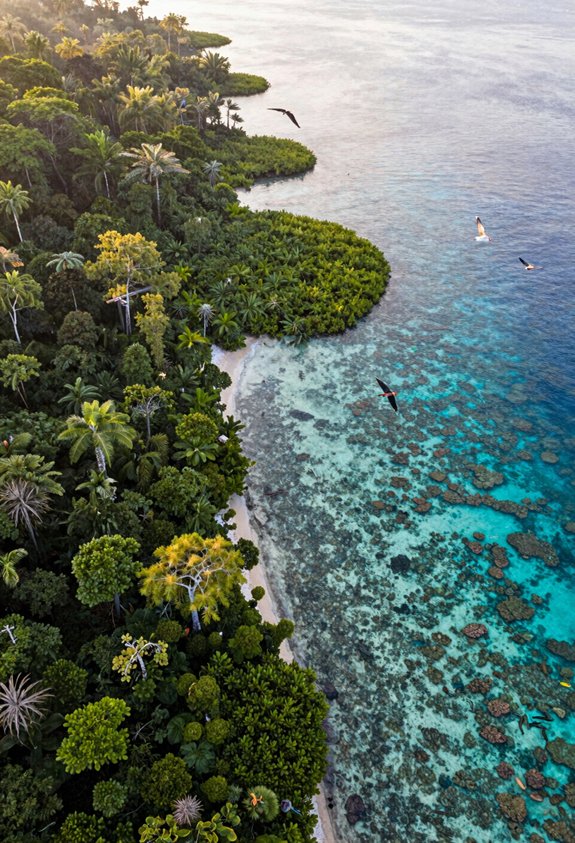
Understanding how the biosphere connects to other ecological ideas helps reveal the larger framework scientists use when studying life on Earth.
Two fundamental processes link all living systems: nutrient cycling—the continuous movement of essential elements like carbon and nitrogen through organisms and their environments—and energy flow, which traces sunlight’s transformation into usable fuel as it passes from producers to consumers.
These processes operate at every scale, from a single pond to the entire planet.
The biosphere also relates closely to concepts like ecosystems, which focus on specific communities and their physical surroundings, and biomes, which group regions by climate and dominant life forms.
Scientists sometimes use the term ecosphere to emphasize how living and nonliving components interact as one system.
Each concept offers a different lens: the biosphere reminds us that Earth’s life forms, despite their diversity, share a single interconnected home.
If you want to strengthen your ecology foundation, start with the Ecology Basics to understand core concepts step by step. Dive deeper with 25 Key Concepts in Ecology with Real-World Examples to see how theory applies in nature. If you prefer to learn ecology fast and simply, the Ecology Flashcards are perfect for quick, focused learning. For a complete reference, explore the Glossary of Ecology Terms with 1,500+ terms explained in simple language, available as a PDF for use on any device.
🌿 Explore the Wild Side!
Discover eBooks, guides, templates and stylish wildlife-themed T-shirts, notebooks, scrunchies, bandanas, and tote bags. Perfect for nature lovers and wildlife enthusiasts!
Visit My Shop →