
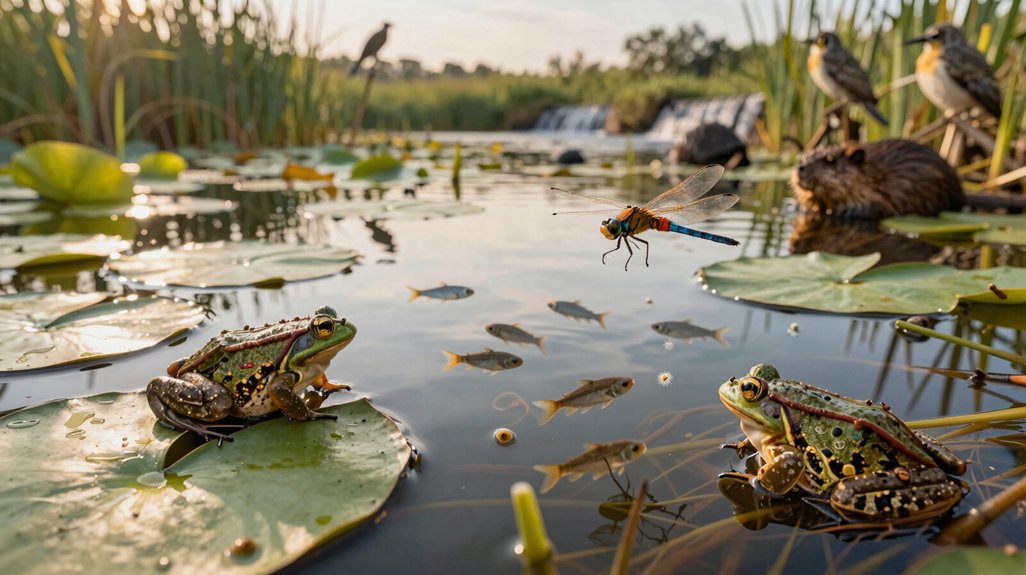
A community in ecology refers to assemblages of different species populations living and interacting within the same geographical area. These interactions create frameworks for energy flow and nutrient cycling that maintain ecosystem health. Communities exist at various spatial scales from microhabitats to extensive ecosystems, with examples including coral reefs, temperate forests, and tide pools. Through predation, competition, and mutualism, these biological networks form the foundation for biodiversity conservation and ecological succession. Understanding these dynamics reveals nature’s intricate balance.
Definition of Community in Ecology
Within the field of ecology, a community refers to the assemblage of populations of different species occupying the same geographical area at a particular time. This ecological concept encompasses all interacting organisms in a defined area, regardless of taxonomic classification.
Communities can exist at various spatial scales, from microhabitats like a fallen log to extensive ecosystems such as an entire forest.
Ecologists analyze community structure by examining species composition, abundance patterns, trophic relationships, and functional roles within the system. These assessments reveal how different organisms coexist and influence each other through competition, predation, mutualism, and other ecological interactions.
Biodiversity assessment within communities typically involves measuring species richness, evenness, and dominance, providing insights into ecosystem stability and function.
Understanding community definitions forms the foundation for studying ecological succession, disturbance responses, and conservation priorities. The boundaries of ecological communities often remain fluid, reflecting the dynamic nature of biological systems.
Ecological significance
Because ecological communities serve as the fundamental organizational units where biological interactions unfold, they hold immense significance for ecosystem functioning and stability. These assemblages of interacting species create the essential framework for energy flow and nutrient cycling, enabling ecosystem services that support life on Earth.
Ecological interactions within communities—including predation, competition, mutualism, and parasitism—drive evolutionary processes and maintain biodiversity. The network complexity formed by these relationships contributes directly to community resilience, allowing ecosystems to withstand disturbances and recover from environmental changes. This resilience buffers against cascading effects of species loss, which might otherwise trigger ecosystem collapse.
Communities also function as indicators of environmental health, with shifts in composition and structure signaling ecosystem degradation or recovery. Understanding community dynamics has become increasingly critical for conservation efforts, particularly as climate change and human activities continue to alter ecological systems worldwide.
Real World Examples
Communities in ecology manifest through diverse real-world examples that showcase intricate species interactions.

Coral reef ecosystems, temperate forest dynamics, prairie dog towns, and alpine habitat networks each demonstrate how organisms coexist and influence their shared environments.
These natural systems provide observable evidence of community structure, succession patterns, and ecological interdependence across varied biomes.
Community in Ecology: Real World Examples of
To illustrate ecological community concepts, numerous natural environments provide compelling examples. Coral reefs demonstrate complex species interactions, with symbiotic relationships between corals and zooxanthellae forming the foundation for diverse communities including fish, invertebrates, and algae.
Similarly, temperate forests exhibit community resilience through successional stages following disturbances like fires or logging, gradually rebuilding biodiversity.
Prairie ecosystems showcase how grazing mammals, burrowing animals, and fire regimes collectively maintain grassland communities.
Intertidal zones reveal how physical stress gradients organize species distribution, with organisms adapted to specific tidal levels.
Alpine environments demonstrate how elevation changes create distinct community assemblages within short geographical distances.
These real-world examples highlight how environmental factors, species interactions, and disturbance patterns shape ecological communities and their functional dynamics across varied landscapes.
Coral Reef Ecosystems
Coral reef ecosystems represent one of Earth’s most diverse ecological communities, supporting approximately 25% of all marine species while covering less than 1% of the ocean floor.
As biodiversity hotspots, reefs showcase intricate symbiotic relationships, particularly between corals and zooxanthellae algae—partnerships threatened by coral bleaching due to rising ocean temperatures.
The habitat complexity of reef structures provides essential nurseries and shelters for fish populations, enabling nutrient cycling that sustains the broader marine ecosystem.
Climate impact increasingly challenges reef resilience, with acidification and temperature changes disrupting established community interactions.
Conservation efforts now integrate scientific research with ecological tourism initiatives to generate awareness and funding for protection.
These approaches aim to preserve not only the ecological functions of reef communities but also their economic and cultural significance for coastal populations worldwide.
Temperate Forest Dynamics
Temperate forest ecosystems exemplify community ecology principles through their distinct vertical stratification and seasonal dynamics. The forest composition typically features four layers—canopy, understory, shrub layer, and forest floor—each supporting different species assemblages.
Oak-hickory forests of eastern North America demonstrate how dominant tree species create habitat conditions that influence community structure.
Species interactions within temperate forests include competition for light among canopy trees, mutualistic relationships between mycorrhizal fungi and root systems, and trophic cascades involving predators like wolves affecting herbivore populations and subsequent vegetation patterns.
Seasonal changes drive community turnover, with spring ephemerals capitalizing on pre-canopy light availability.
Forest succession following disturbances like fires or logging reveals predictable patterns of community assembly, progressing from pioneer species to climax communities over decades.
Prairie Dog Towns
Prairie dog towns represent one of the most fascinating examples of community ecology in grassland ecosystems, contrasting sharply with the vertical stratification seen in temperate forests.
These colonies showcase complex social behavior where individuals cooperate in predator avoidance through alarm calls and coordinated vigilance.
As ecosystem engineers, prairie dogs transform landscapes through burrowing activities that notably modify habitat conditions. Their excavations create microhabitats that support diverse species interactions, from burrowing owls to black-footed ferrets.
This habitat modification alters soil composition and drainage patterns, influencing vegetation structure.
The resulting community structure exhibits distinctive population dynamics, with species richness often higher within towns than in surrounding grasslands.
Research shows that prairie dog colonies create heterogeneity across prairies, functioning as keystone species whose presence fundamentally shapes ecosystem processes and biodiversity patterns.
Alpine Habitat Networks
Alpine habitat networks illustrate community ecology principles at high elevations, where harsh environmental conditions create distinctive ecological assemblages. These networks connect various permafrost habitats across mountain regions, supporting specialized alpine flora with morphological adaptations like dense hairs and compact growth forms.
Alpine biodiversity includes resilient mountain fauna that have evolved high altitude adaptations such as increased hemoglobin and efficient metabolism.
Tundra interactions in these environments demonstrate intricate interdependencies, particularly visible during seasonal snowpack dynamics when resource availability shifts dramatically.
Within glacial ecosystems, communities exhibit compressed succession patterns and heightened mutualistic relationships. Species often collaborate rather than compete, sharing limited resources while collectively responding to environmental stressors—exemplifying how isolation and extreme conditions can shape ecological communities fundamentally different from lowland counterparts.
Wetland Succession Patterns
Wetland ecosystems exhibit some of the most visible and dynamic succession patterns in community ecology, shifting through distinct phases as hydrology, soil composition, and biotic interactions evolve over time.
In freshwater marshes, pioneer species like cattails and bulrushes initially colonize open water, gradually accumulating organic matter that enables shrubs and eventually trees to establish.
Different wetland types display varying succession trajectories. Coastal salt marshes progress from cordgrass-dominated communities to higher-elevation assemblages as sediment accretes.
Peatlands develop through gradual infilling of open water, creating habitat diversity as hummock-hollow microtopography forms.
These succession patterns are often punctuated by disturbances like flooding or drought that reset communities to earlier stages, maintaining a mosaic of successional states across the landscape that supports diverse ecological niches.
Tide Pool Interactions
Tide pools offer some of the most accessible demonstrations of community ecology principles in action, exhibiting intricate interactions within confined spatial boundaries. These microhabitats reveal complex predator-prey relationships, competition for limited resources, and adaptation to extreme environmental fluctuations.
The tide pool biodiversity encompasses organisms from multiple trophic levels—from algae and barnacles to sea stars and small fish—all coexisting in stratified zones based on their tolerance to exposure.
Tide pool resilience is particularly evident during disturbances such as storms or unusually low tides. Communities rapidly reestablish equilibrium through succession processes, with pioneer species colonizing newly cleared surfaces, followed by competitive dominants.
This resilience stems from redundant ecological functions and the adaptive capacity of resident species, making tide pools excellent natural laboratories for studying community dynamics at manageable scales.
Related concepts
Ecological communities exist within a framework of interrelated concepts that help scientists understand their structure and function. Central to community ecology are species interactions, which shape how organisms coexist within shared environments.
Ecological niches define the functional roles species occupy, while trophic levels organize communities into hierarchical feeding relationships within complex food webs. Habitat diversity drives community composition, supporting varied assemblages adapted to specific environmental conditions.
Mutualistic relationships and competitive dynamics represent opposing forces that simultaneously structure communities. The former creates interdependent networks benefiting multiple species, while the latter limits resource sharing and promotes specialization.
Keystone species exert disproportionate influence relative to their abundance, maintaining community integrity through cascading effects. Understanding these concepts collectively provides ecologists with tools to predict how communities respond to environmental change, species introductions, or extinctions—offering insights essential for conservation and ecosystem management.
If you want to strengthen your ecology foundation, start with the Ecology Basics to understand core concepts step by step. Dive deeper with 25 Key Concepts in Ecology with Real-World Examples to see how theory applies in nature. If you prefer to learn ecology fast and simply, the Ecology Flashcards are perfect for quick, focused learning. For a complete reference, explore the Glossary of Ecology Terms with 1,500+ terms explained in simple language, available as a PDF for use on any device.
🌿 Explore the Wild Side!
Discover eBooks, guides, templates and stylish wildlife-themed T-shirts, notebooks, scrunchies, bandanas, and tote bags. Perfect for nature lovers and wildlife enthusiasts!
Visit My Shop →