
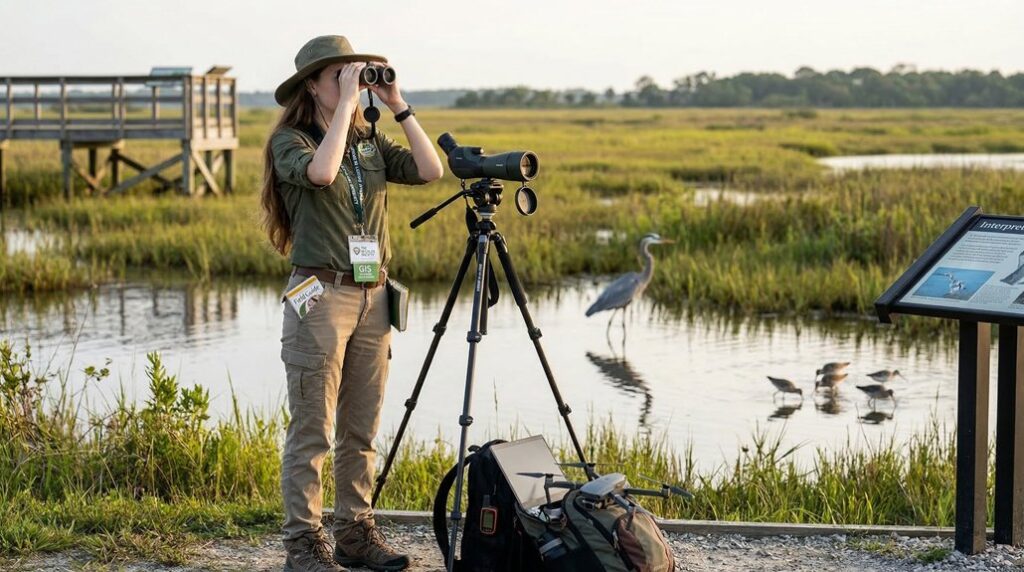
Wildlife biology students boost employability by earning the Certified Wildlife Biologist® (CWB®) or its stepping stone, the Associate Wildlife Biologist® (AWB®), which require a bachelor’s degree, specific coursework, and five years of professional experience (or graduate research credits); you should also add practical certificates like GIS certification, Wilderness First Responder, Climbing, Diving, Fire management courses (S‑130/S‑190) to demonstrate field readiness.
For niche roles, the Qualified Airport Wildlife Biologist (QAWB) credential builds on CWB® and meets FAA standards, while Ducks Unlimited’s Ecology Conservation & Management certification targets waterfowl specialists.
Each certification involves a modest fee, a transcript and experience documentation, and a renewal cycle of 80 continuing‑education hours every five years, ensuring ongoing relevance.
Following these steps opens doors to internships, agency jobs, and consulting work, and the next sections explain how to select and maintain the right credentials.
Why Certifications Matter for Wildlife Biology Students

Earn certifications, such as the Certified Wildlife Biologist® (CWB®) or Associate Wildlife Biologist® (AWB®) offered by The Wildlife Society, signal that a student has met rigorous educational and ethical standards, which in turn boosts hiring prospects in wildlife management agencies, conservation NGOs, and private consulting firms.
Certified Wildlife Biologists often add technical credentials, Wilderness First Responder, CPR, S‑130/S‑190 fire qualifications, to demonstrate field readiness, while niche badges like Qualified Airport Wildlife Biologist or Ducks Unlimited’s Ecology Conservation & Management Certification showcase specialized expertise that opens targeted career tracks.
Continuing education, reflected in five year CWB® renewals requiring 80 CEU hours, sustains credibility and grants access to discounts, publications, and grant opportunities.
Mastery of GIS, R, small‑craft operation, and pesticide licensing quantifies employability, aligning graduates with common job requirements and reinforcing their professional profile.
Make sure that the certifications you obtain are aligned with your chosen career field. Many times field work can be in very remote places and harsh conditions, so being in shape is important. While I was a student, I finished a climbing course, a caving single rope technique, diving course. I wanted to be ready to explore different places.
Certified Wildlife Biologist (CWB®) – Core Requirements and Benefits
If you’re aiming for a credential that signals both scientific rigor and professional credibility, the Certified Wildlife Biologist® (CWB®) from The Wildlife Society offers exactly that, requiring a blend of formal education, ethical commitment, and real world experience.
Applicants must hold at least a bachelor’s degree, complete a prescribed set of coursework, one college or university class in each category, submit transcripts and course descriptions through their TWS membership account, and demonstrate five years of professional level work in conservation or wildlife management; graduate research can substitute up to two years for a Ph.D. or one year for a master’s, capping at three years.
Membership in TWS, adherence to its Code of Ethics, and a $25 renewal fee plus 80 continuing‑education hours every five years keep the Certified Wildlife Biologist® (CWB®) status current, while the $155 initial fee and CRB review make certain peer validated quality.
Associate Wildlife Biologist® (AWB®)
Begin by recognizing that the Associate Wildlife Biologist® (AWB®) serves as a practical stepping‑stone for recent graduates who’ve completed the required coursework, typically a college level class in each of the core categories such as ecology, wildlife management, and statistics, but who haven’t yet accumulated the five years of professional level experience demanded for the Certified Wildlife Biologist® (CWB®).
The AWB® credential, granted through the Wildlife Society (TWS), remains valid for ten years, during which holders must gain at least five years of qualifying experience to upgrade.
Applicants submit their application and transcripts via the TWS membership portal under “Certification,” and they may request an Associate Wildlife Biologist EXTENSION for three additional years by paying a $25 fee to the Certification Review Board.
Graduate theses can count toward one to two years of experience when documented, and CWB® applicants must provide a professional reference who already holds the CWB® title.
This structured pathway encourages early career biologists to build expertise while keeping clear, actionable steps toward full certification.
Qualified Airport Wildlife Biologist (QAWB) – Niche Expertise for Aviation Safety
The Certified Wildlife Biologist® (CWB®) credential opens the door to the Qualified Airport Wildlife Biologist (QAWB) designation, a niche qualification that equips biologists to protect aviation safety by managing wildlife hazards at airports.
To become a Qualified Airport Wildlife Biologist (QAWB), a candidate must already hold the CWB® and satisfy FAA Advisory Circular 150/5200‑36B requirements for education, training, and Wildlife Hazard Assessment (WHA). Applicants either complete a FAA‑acceptable WHA under a QAWB mentor or log one year of continuous FAA‑approved wildlife monitoring at a certified airport, then submit a $50 application to The Wildlife Society, where the Certification Review Board evaluates documentation and mentoring. QAWB status demands five year renewal through FAA‑approved coursework or Bird Strike Committee meetings, and continued TWS membership and training to stay current.
Ducks Unlimited Ecology Conservation & Management Certification – Overview
In the domain of wildlife conservation, the Ducks Unlimited Ecology Conservation & Management Certification serves as a thorough credential that validates a professional’s grasp of ecological principles, species identification, and habitat stewardship across diverse ecosystems such as forests, grasslands, and wetlands, with a particular emphasis on waterfowl habitats.
The program, delivered via the secure iCEV platform, tests candidates on 100 multiple‑choice questions covering Ecological Principles, Species Identification, Wildlife Conservation & Management, and Habitat Conservation & Management, ensuring they can translate theory into practice.
Study resources, including DU Magazine, the DU App, podcasts, and TV segments, supplement optional iCEV guides and responsive support, while the certification prepares graduates for roles like habitat manager, research ecologist, or waterfowl specialist, all of which demand cross ecosystem competence and a commitment to Wildlife Conservation.
GIS and Remote‑Sensing Certifications for Wildlife Biology
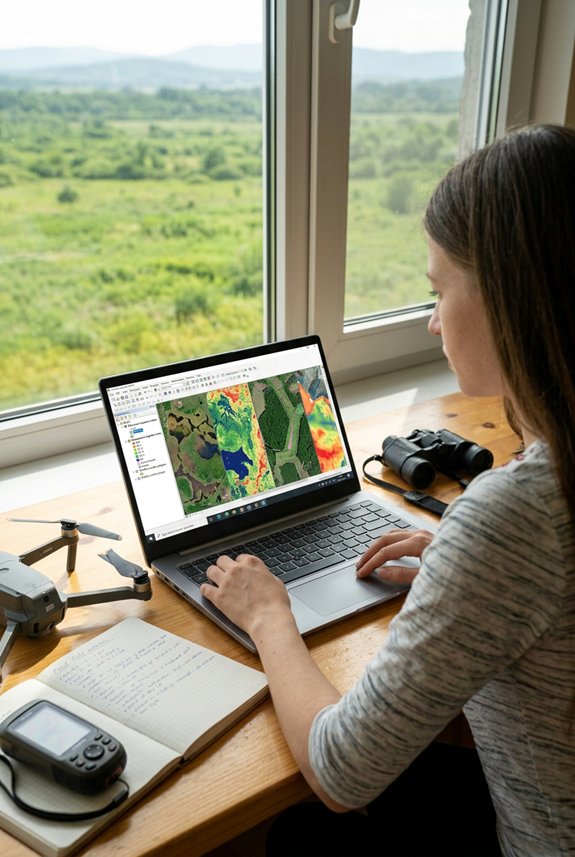
Mastering GIS and remote‑sensing tools opens doors for wildlife biology students, as certifications from Esri, the University of Colorado Boulder, and open source communities translate technical skill into marketable credentials. Employers prize demonstrable competence, so candidates should showcase map products, classification reports, and code notebooks alongside their certificates.
- Esri Technical Certification – ArcGIS Desktop Associate or Professional validates industry‑standard software proficiency.
- University of Colorado Boulder remote sensing certificates – Coursera “Fundamentals of GIS” and “Geospatial and Environmental Analysis” teach satellite imagery interpretation and NDVI indices.
- Open‑source training – QGIS workshops and R spatial packages courses provide reproducible, low‑cost workflows for field research.
- Short professional certificates – ESRI MOOC, FIA, or agency‑sponsored remote sensing workshops cover raster/vector analysis, GPS integration, and accuracy assessment in 10‑40 hours.
These pathways equip students with practical skills and recognizable credentials that enhance job prospects and research impact.
If you are interested in GIS make sure to read my blog posts BEST GIS BOOKS, as well as FREE GIS COURSES WITH CERTIFICATES.
Fire Management Certifications for Wildlife Biology Land Stewardship
Acquiring fire management certifications, such as the foundational S‑130 (Firefighter Type I) and its companion S‑190 (Introduction to Wildland Fire Behavior), equips wildlife biology stewards with the essential knowledge to safely conduct prescribed burns and respond to wildland fires, while the L‑180 (Human Factors in the Wildland Fire Service) course adds crucial crew resource management and decision‑making skills that reduce risk during complex burn operations.
Completing these courses, often offered by state forestry agencies or federal programs, gives students a solid grounding in fire behavior, suppression tactics, and safety protocols, all of which are directly applicable to wildlife management projects that rely on controlled fire to maintain habitat diversity.
Practical steps include enrolling in the S‑130/190 bundle, attending the L‑180 workshop, then gaining field experience as a burn‑boss trainee under a certified mentor, while maintaining qualifications through periodic refresher training to stay eligible for stewardship roles.
First‑Aid/CPR Certifications Required by Wildlife Biology Students
Typically, wildlife biology students must keep a current Basic First Aid and CPR certification, often issued by the American Heart Association or the Red Cross, because fieldwork frequently involves remote sites where immediate medical response is essential, and employers, internship supervisors, and university programs routinely require proof of these skills before granting access to research locations.
Maintaining this credential, usually renewed every one to two years, guarantees students can respond to injuries, animal bites, or sudden illness while traversing rugged terrain. A well‑rounded preparation plan includes:
- Enrolling in a Basic First Aid and CPR course that covers adult, child, and infant resuscitation.
- Adding AED (automated external defibrillator) training to meet most employer expectations.
- Keeping the certification card in a waterproof field kit and uploading a digital copy to university portals.
- Scheduling renewal before expiration to avoid gaps in eligibility for internships or field stations.
Wildlife Handling Certifications Essential for Biology Field Work
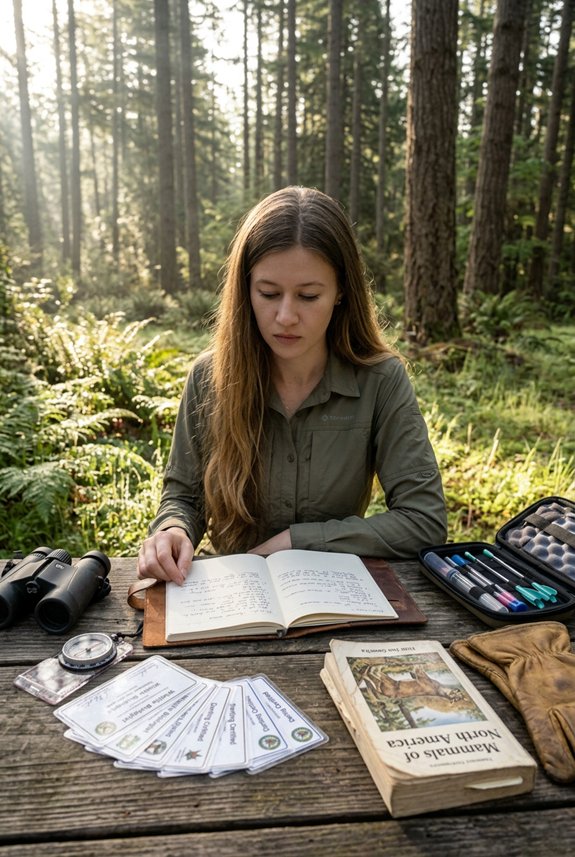
Often the most valuable credential for a wildlife‑biology student is a wildlife handling certification, because it equips them with the practical skills and regulatory knowledge needed to capture, restrain, and transport animals safely while complying with institutional and governmental permits.
The Wildlife Biologist Certification Program, which blends species specific handling modules with safety protocols, often pairs with Wilderness First Responder training to satisfy remote‑site emergency requirements.
Students typically complete a series of hands on workshops, ranging from small mammal trapping to avian banding, followed by a competency exam that demonstrates proficiency in humane restraint techniques and proper documentation for permit agencies.
Complementary credentials such as First Aid/CPR, S‑130 fire behavior, and small watercraft operation further broaden employability, ensuring graduates can navigate diverse field conditions and contribute confidently to research teams.
Ethics and Trademark Rules for Wildlife Biology Certifications
Because the Certified Wildlife Biologist® (CWB®) and Associate Wildlife Biologist® (AWB®) titles are trademarked, students must follow specific rules to use them correctly and to keep their credentials in good standing. Proper use hinges on three main obligations: displaying the ® symbol only when the certification is active, obtaining logo permission from The Wildlife Society (TWS) before any public use, and adhering to the TWS Code of Ethics, which governs professional conduct and can trigger revocation if violated.
Additionally, renewal every five years, requiring a $25 fee, continued education, and current membership—ensures ongoing trademark privileges.
- Add “®” after the title on resumes and business cards.
- Request logo approval via the TWS certification email.
- Keep TWS membership current to avoid loss of rights.
- Contact certification@wildlife.org for any ethical or trademark questions.
Application Fees for Wildlife Biology Certifications: What to Expect
When planning to become a Certified Wildlife Biologist® (CWB®) or an Associate Wildlife Biologist® (AWB®), students should first understand the fee structure, which varies by certification level and includes both initial application costs and periodic renewal charges.
The TWS Certified Wildlife Biologist® (CWB®) first‑time fee is $155, with a $75 upgrade fee for existing members, while the AWB® first‑time fee is $115 (or $95 with qualifying credentials) plus a $25 Wildlife Biologist EXTENSION Application.
The QAWB® fee stands at $50, and all certifications require a $25 renewal every five years, accompanied by 80 hours of continuing education.
Additional expenses may arise from specialized training, such as FAA‑acceptable airport wildlife hazard courses, and from mandatory TWS membership, which supports status maintenance.
Applicants should review eligibility for fee waivers, verify reduced rates, and budget for ancillary costs like course materials and CEUs to make certain a smooth application process.
Required Transcripts and Degree Verification for Wildlife Biology Applications
To begin the certification process, applicants should gather electronic copies of their original, electronically certified, or unofficial academic transcripts, ensuring each document clearly displays the degree conferral through a graduation date, a copy of the diploma, or an official letter from the institution; this verification step, which also applies to any transfer credits that must be listed by course on the accepting institution’s transcript or supported by the original institution’s record, is essential for both Certified Wildlife Biologist® (CWB®) and Associate Wildlife Biologist® (AWB®) applications.
Applicants must submit only unaltered official or original electronic copies, any alteration will trigger rejection and may be reported under the Code of Ethics. If a graduate thesis or dissertation is being used to replace professional experience, the transcript should be accompanied by a concise explanation of the study and a justification for the requested years of experience.
- Verify graduation date appears on each transcript.
- Include official letters or diploma scans when dates are missing.
- List transfer courses by title and credit on the receiving institution’s transcript.
- Attach a brief thesis summary if substituting experience.
Proving Professional Experience: Documentation and Substitution Rules
Gathering transcripts is only the first step; the next phase requires applicants to prove they’ve the professional experience that the Certified Wildlife Biologist® (CWB®) and Associate Wildlife Biologist® (AWB®) credentials demand, which means documenting work in conservation or wildlife management that follows graduation, providing written justification when a graduate thesis or dissertation is used as a substitute, and attaching supporting letters that clarify responsibilities and decision making authority.
The Certification Review Board (CRB) evaluates each submission, checking that undergraduate work is excluded and that wildlife technician roles include genuine management duties. Applicants may substitute up to three credits per category, capped at nine, with instructor letters and course syllabi.
For AWB® holders upgrading to CWB®, five post‑degree years are required, and QAWB candidates must present a mentor‑approved hazard assessment or a year of FAA‑approved monitoring.
They can replace up to three credits per category with relevant work, but the total substitution may not exceed nine credits across the whole application.
Coursework Credits, Limits, and Missing‑Class Allowances for Certification
Because the certification process hinges on a balanced mix of formal education and hands on experience, applicants must make certain they’ve at least one college or university course in each required category, and they should prioritize submitting official course descriptions, whether taken from catalog entries, syllabi, or, when those are unavailable, concise self‑written summaries that capture the essential content and learning outcomes.
One missing class is allowed if every other specific requirement is met, and transfer credits must appear as distinct courses on the transcript.
- List each required wildlife ecology course.
- Attach catalog or syllabus excerpts.
- Note any work‑experience credit substitutions (max 3 per category).
- Record any missing‑class allowance and how it’s satisfied.
Keeping Your TWS Membership Active for Wildlife Biology Certifications

Keeping your TWS membership active is essential for retaining any Wildlife Society certification, whether it’s the AWB®, CWB®, or QAWB, because the society’s rules tie membership status directly to the right to use the certification titles and logos.
TWS members must keep billing and contact details current in the membership portal, ensuring renewal notices and logo requests arrive promptly, and they should verify that their certification status appears under “Certification” in the account dashboard.
Regularly checking the portal also alerts members to upcoming five‑year renewal deadlines for CWB® and QAWB, which require documented continuing education or FAA‑approved training.
- Update billing information before the renewal date.
- Log in quarterly to confirm certification visibility.
- Track continuing education hours in a spreadsheet or app.
- Submit renewal applications with the $25 fee and required documentation.
Using the Official Certification Logo and Trademark Correctly
Because the Certified Wildlife Biologist® (CWB®) and Associate Wildlife Biologist® (AWB®) titles are trademarked, members must follow a clear set of steps to use the official logo and trademark correctly. The Wildlife Society requires that the ® symbol appear directly after the title, for example, Jane Doe, Certified Wildlife Biologist®, and that the logo be used only after obtaining written approval through the certification email, and that the member holds an active TWS membership.
Applicants should download the approved graphic file, place it on a business card or email signature according to the Society’s formatting guide, and make certain the logo remains proportionate, unobscured, and accompanied by the trademark notice.
Certification Review Board Interview: Prep & Pitfalls
Understanding the Certification Review Board (CRB) interview begins with recognizing that the eight‑member panel, comprised of Certified Wildlife Biologist®s appointed by the TWS Council—serves both as a gatekeeper and a resource, so candidates should be ready to reference their role when discussing application decisions and coursework judgments.
Candidates must organize their professional experience, including dates, duties, and supervisor letters, and bring official transcripts with course descriptions to substantiate equivalency claims.
They should also prepare to explain ethics commitments and TWS membership status, while avoiding any altered documents that could trigger a rejection.
- Summarize professional experience with clear timelines.
- Attach transcripts and syllabi for each relevant class.
- Provide letters confirming non‑traditional work credit.
- Review the TWS Code of Ethics and current membership details.
Quick Checklist for Any Wildlife‑Biology Certification Application
Start by confirming the membership requirements and fees early, since The Wildlife Society (TWS) mandates a current TWS membership before any certification, CWB®, AWB®, or QAWB can be processed, and the costs differ (first‑time CWB® $155, AWB® $115 or $95, QAWB $50, with renewals at $25).
After that, applicants should gather transcripts, degree verification, and course syllabi, then upload them to the certification portal; they must also document professional experience with dates, duties, and supervisor validation, noting that a graduate thesis can count toward experience.
Finally, they need to secure required references and keep copies of all uploads for CRB review.
- Verify TWS membership and fee schedule.
- Upload transcripts, diploma, and course descriptions.
- Itemize experience, include thesis substitution if applicable.
- Obtain references, save files, and monitor email for CRB requests.
Final Thoughts
Balancing the rigor of formal training with the flexibility of field experience, wildlife biology students can turn certifications into stepping stones that bridge academic theory and real world impact; by selecting credentials such as the Certified Wildlife Biologist, Associate Wildlife Biologist, or Qualified Airport Wildlife Biologist, you get credibility that opens internships, research positions, and conservation jobs.
If you’re wondering how to turn your coursework and volunteer work into a real opportunity, read my step-by-step guide on how to get a paid biology internship or job with no experience.

Erzsebet Frey (Eli Frey) is an ecologist and online entrepreneur with a Master of Science in Ecology from the University of Belgrade. Originally from Serbia, she has lived in Sri Lanka since 2017. Eli has worked internationally in countries like Oman, Brazil, Germany, and Sri Lanka. In 2018, she expanded into SEO and blogging, completing courses from UC Davis and Edinburgh. Eli has founded multiple websites focused on biology, ecology, environmental science, sustainable and simple living, and outdoor activities. She enjoys creating nature and simple living videos on YouTube and participates in speleology, diving, and hiking.
🌿 Explore the Wild Side!
Discover eBooks, guides, templates and stylish wildlife-themed T-shirts, notebooks, scrunchies, bandanas, and tote bags. Perfect for nature lovers and wildlife enthusiasts!
Visit My Shop →