
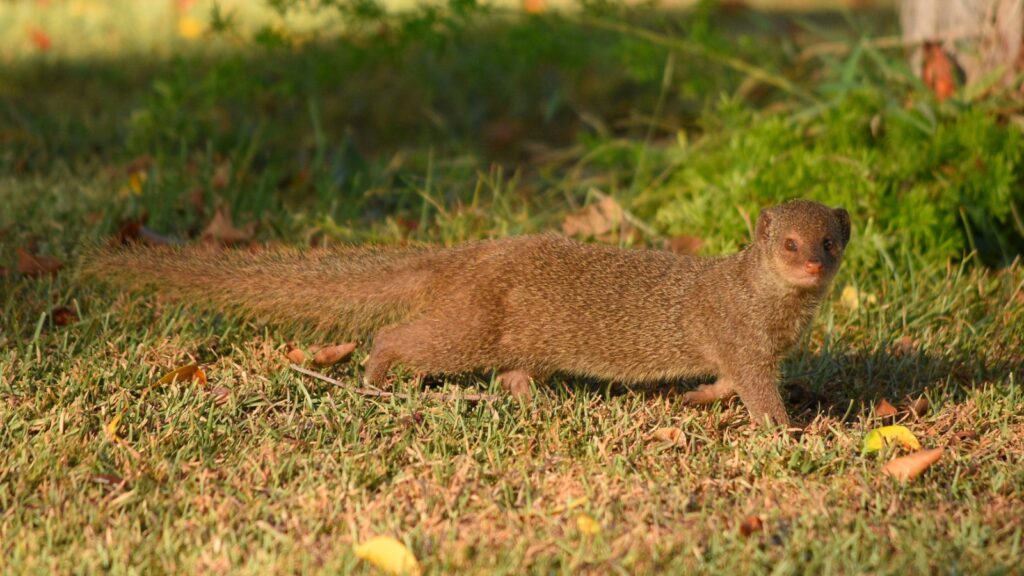
Every few months a clip goes around: a mongoose curled on a couch, taking food from someone’s hand, trotting after them across a yard like a cat. Lately those clips have been coming out of Jamaica, and the comments underneath them all ask the same thing. Where can I get one?
I am a wildlife biologist and I have spent years surveying small carnivores in the field. The mongoose is one of the rare animals where the pet question and the conservation question are the same question, so the answer matters more than usual. Here it is, followed by the reasoning.
Key takeaways
- You cannot legally keep a mongoose in the United States or India, and in the United States the federal ban on import and interstate transport means there is no lawful way to obtain one in the first place.
- No Jamaican law prohibits keeping a mongoose, which is exactly why the case against it has to be made on ecological grounds.
- A mongoose can be tamed as an individual but has never been domesticated as a species, and hand raised animals commonly turn territorial and bite prone at sexual maturity.
- There is no rabies vaccine licensed for mongooses anywhere, and in Puerto Rico and Grenada the species is the main wildlife reservoir of rabies.
- Nine mongooses released in Jamaica in 1872 are implicated in the loss of six endemic vertebrates, and the small Indian mongoose is on the IUCN list of the 100 worst invasive alien species.
Can you have a mongoose as a pet? The short answer
No. Three separate reasons stack on top of each other, and any one of them would be enough on its own.
- It is illegal in most of the world, including the entire United States and all of India.
- The mongoose is not a domesticated animal. A hand raised one is a tame wild carnivore, which is a very different thing.
- On islands like Jamaica, every captive mongoose is a future escapee in a place that has already lost six native species to them.
Is it legal to own a mongoose?
In almost every country the answer is no, though the legal route to that no differs depending on whether mongooses are native there.
United States
Mongooses have been listed as injurious wildlife under the Lacey Act since 1 January 1966. The listing covers the genera Atilax, Cynictis, Helogale, Herpestes, Ichneumia, Mungos and Suricata, which sweeps in meerkats as well. Importing live animals and moving them across state lines is prohibited without a federal permit, and those permits go to zoos and research institutions, not to private keepers.
That federal rule is the part most people miss. You do not need a state law banning mongooses for the answer to be no, because there is no legal route to acquiring one in the first place. A mongoose cannot lawfully be imported, and it cannot lawfully cross a state line, so any animal offered to a private buyer in the United States is already outside the law before the question of state possession arises.
Some states go further. Hawaii, where mongooses are established and doing damage, addresses the species by name: Hawaii Revised Statutes section 142 92 makes it unlawful to introduce, keep or breed a mongoose in the state except under written permit, with a fine of $250 to $1,000 for each animal, and permits cannot be issued at all in Kauai County or on Lanai. A companion section penalises harbouring one.
It is worth knowing what the alternatives cost too, because the legal ones are not free either. Ferrets, the closest domesticated match in temperament, are banned outright in California, Hawaii, New York City and Washington DC. And a bite from an unvaccinated wild carnivore is not a minor expense in the United States: the CDC puts a course of rabies post exposure prophylaxis at roughly $1,200 to $6,500, and patients have reported bills far above that once delivery and out of network charges are counted. There is no licensed rabies vaccine for mongooses, so a captive one gives you no way to rule that out.
India
All six Indian mongoose species are protected under Schedule II of the Wildlife Protection Act 1972, a listing confirmed by the Wildlife Trust of India and still cited by state forest departments after the 2022 amendment to that act. The CITES appendices add a further layer of trade control on top of it. Illegal trade in mongoose parts carries a prison sentence of three to seven years. The driver there is not the pet trade but the paintbrush trade: roughly 50 animals are killed for every kilogram of mongoose hair.
Jamaica and the wider Caribbean
Jamaica is the awkward case, and it is worth being straight about why. There is no legal pet trade in mongooses here, but there is also no statute to point at. Veterinarians and wildlife specialists interviewed about this exact trend have said plainly that no Jamaican law stops you from keeping one.
So the argument has to be made on ecology rather than paperwork, and on this island that argument is stronger than any law would be. The mongoose is not Jamaican. It is an introduced predator with a documented record of driving native species to extinction, and taking one into your home means feeding, sheltering and eventually losing track of an invasive carnivore.
That gap is also the reason this is worth writing about now rather than later. Rules tend to arrive after the damage, and a trend spreading through short video is faster than any legislative process.
The pattern is simple enough to remember. Where mongooses are native they are usually protected. Where they are not native they are usually banned as invasive. Either way, you cannot legally keep one.
| Where | Can you legally keep one? | What governs it | Penalty |
|---|---|---|---|
| United States | No | Lacey Act injurious wildlife listing since 1966, plus state law such as Hawaii Revised Statutes 142 92 | Federal permit violations; $250 to $1,000 per animal in Hawaii |
| India | No | Schedule II of the Wild Life (Protection) Act 1972, with CITES trade control on top | Three to seven years imprisonment for trade in mongoose parts |
| Jamaica | No law against it, and you still should not | No statute covering possession. The case rests on invasive species impact | None currently |
Can a mongoose be tamed?
An individual mongoose can be tamed. A mongoose cannot be domesticated. Those are two different words and the confusion between them is behind most exotic pet disasters.
Taming is what happens to one animal in one lifetime. Raise it from very young, handle it constantly, and it will lose its fear of you. Domestication is a change in the genetics of a whole population, selected over hundreds of generations for tolerance of humans, reduced fear responses and a longer window in which young animals will bond. Dogs went through that process over many thousands of years. Mongooses have never been through it at all.
The practical consequence shows up at sexual maturity. Hand raised mongooses that were affectionate as juveniles commonly become territorial, unpredictable and prone to biting once they mature. Nothing has gone wrong when this happens. The animal is simply doing what its species does, on the schedule its species keeps.
Are mongooses friendly?
They are bold and curious, which people read as friendly. Those are not the same signal. A mongoose approaching you is investigating, not bonding.
Social structure varies by species. Banded mongooses and dwarf mongooses live in cooperative groups and are genuinely social animals, though social with each other rather than with us. The small Indian mongoose, which is the species in Jamaica, Puerto Rico and Hawaii, is largely solitary outside of breeding and raising young. It has no evolutionary reason to want company.
Two things surprise people who get close to one. The bite is serious. These are carnivores built to kill rodents and snakes, with a jaw and a set of teeth to match, and a startled mongoose bites fast. The smell is also real. Mongooses have well developed anal scent glands and mark surfaces routinely. That is not something training removes.
What keeping one actually involves
- Diet. Whole prey. Insects, eggs, small vertebrates. Cat food does not meet the requirement and animals fed on it develop deficiencies.
- Space and activity. Mongooses dig, climb, and probe every gap they can reach. They are exceptional escape artists and a standard enclosure will not hold one for long.
- Veterinary care. Very few vets will treat a mongoose, and there is no rabies vaccine licensed for the species anywhere.
- Time. They live several years and often close to a decade in captivity, most of it after the tame juvenile phase is over.
- Risk to everyone else. One escape in the wrong place starts a population.
The rabies problem people do not expect
In Puerto Rico and Grenada the small Indian mongoose is the main wildlife reservoir of rabies, not a bystander to it. Mongooses also carry Leptospira, which infects humans through contact with urine contaminated water or soil.
Because there is no approved rabies vaccine for mongooses, a bite from a captive one cannot be dismissed the way a bite from a vaccinated dog can. It has to be treated as a potential exposure, with everything that follows from that.
Why Jamaica has more at stake than anywhere else
Jamaica is where this experiment was first run at scale, and the results are on the record.
On 13 February 1872, nine small Indian mongooses, Urva auropunctata, then classed as Herpestes, arrived from Calcutta: four males and five females, one of them believed to be pregnant. They were released on the Spring Garden Estate in the parish of Portland to control rats in the sugar cane. The idea spread from Jamaica across the Caribbean, to Hawaii, and to Fiji.
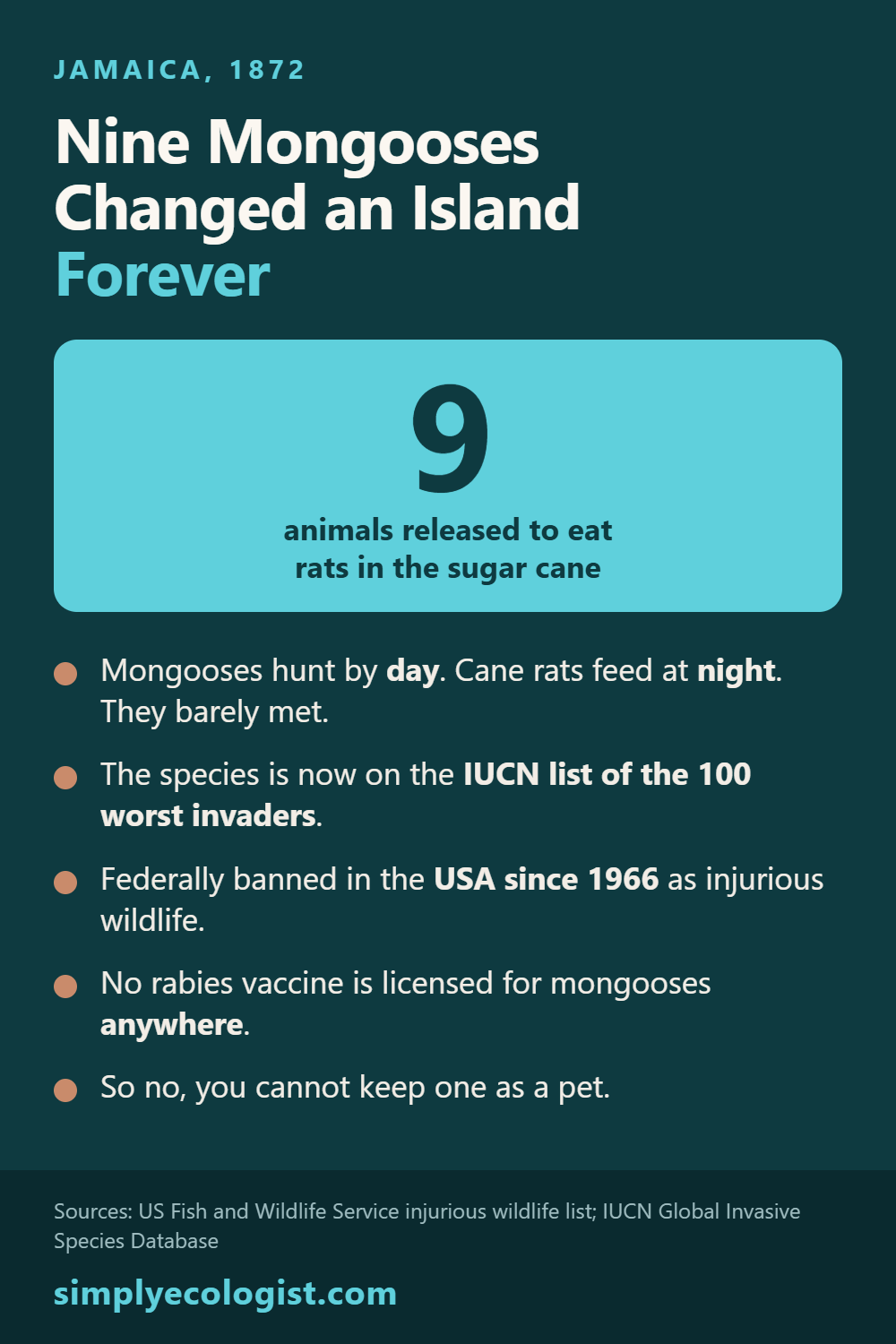
It failed on its own terms almost immediately. Rats in cane are largely nocturnal and climb well. Mongooses are diurnal and hunt on the ground. The two animals barely met. What the mongoose did find was an island fauna that had evolved with no mammalian ground predator at all, and therefore no defence against one.
Six endemic Jamaican vertebrates have been lost with the mongoose implicated in every case. Four are formally extinct. Two of them, the Jamaican petrel and the Jamaican poorwill, are still carried by the IUCN as critically endangered and possibly extinct rather than extinct, because nocturnal birds are hard to prove gone. Neither has been reliably recorded since the nineteenth century.
- Giant galliwasp, Celestus occiduus
- Jamaican black racer, Hypsirhynchus ater, long known as Alsophis ater
- Jamaican petrel, still listed as possibly extinct
- Jamaican uniform crake
- Jamaican poorwill, still listed as possibly extinct
- Jamaican rice rat, Oryzomys antillarum
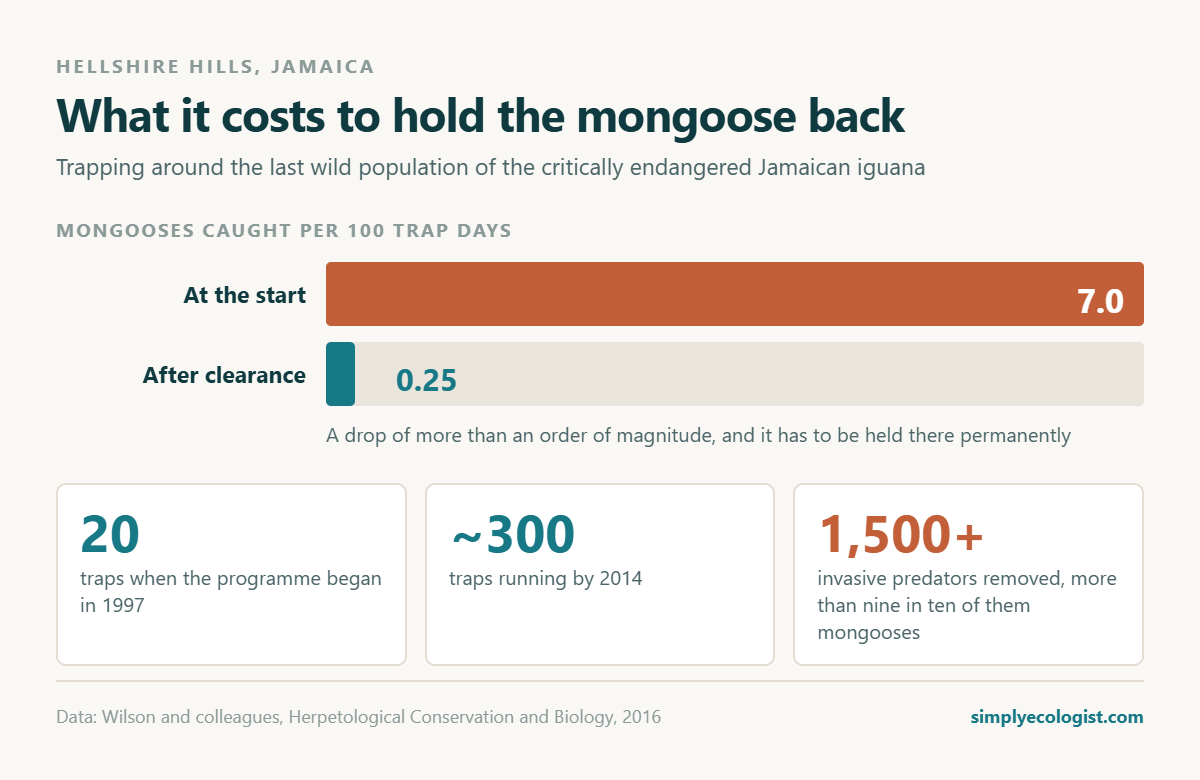
The pressure has not stopped. The critically endangered Jamaican iguana, Cyclura collei, and the blue tailed galliwasp, Celestus duquesneyi, are both still losing young to mongoose predation. The iguana was considered extinct for decades before a tiny population turned up in the Hellshire Hills, and what keeps it alive now is trapping, permanently.
The numbers from that programme are the clearest answer I know to the question of whether one pet mongoose really matters. Wilson and colleagues, writing in Herpetological Conservation and Biology in 2016, describe a trap line that began with 20 traps in 1997 and had grown to around 300 by 2014, removing well over 1,500 invasive predators, more than nine in ten of them mongooses. The capture rate started at about seven mongooses per 100 trap days and fell to 0.25 after the initial clearance, a drop of more than an order of magnitude. It has to be held there. Stop trapping and the animals come back, because the surrounding landscape is full of them.
The IUCN lists the small Indian mongoose among the 100 worst invasive alien species in the world. Nine animals did that in a century and a half.
So when someone in Jamaica keeps a mongoose as a pet, moves it across the island, and eventually loses it or lets it go, that is not a private decision with private consequences. It is a small new introduction into a landscape still absorbing the first one.
Where in the Caribbean is it actually illegal to keep one?
I could not find anyone who had compiled this, so I went and did it. Working from the establishment records in the United States Fish and Wildlife Service review of small Indian mongoose management, the species is established on sixteen Caribbean territories. I then went through what governs keeping one in each. The answer surprised me.
Four of those sixteen have a rule that actually stops a person keeping a mongoose. All four are governed from Washington or Paris.
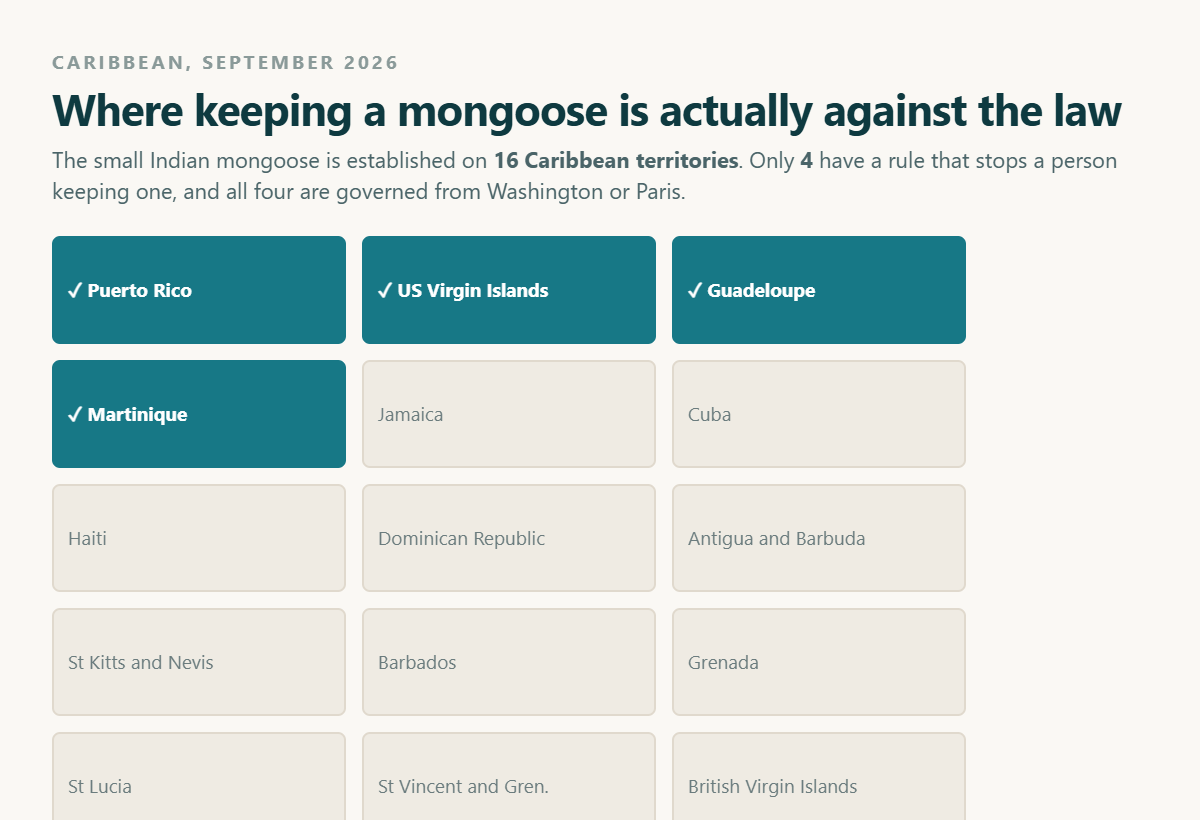
| Territory | Can you legally keep one? | What governs it |
|---|---|---|
| Puerto Rico | No lawful route to obtaining one | US federal injurious wildlife listing, in force since 1966 |
| US Virgin Islands | No lawful route to obtaining one | Same federal listing |
| Guadeloupe | No. Keeping a live specimen is prohibited outright | Arrêté of 7 July 2020, which names the Herpestidae |
| Martinique | No. Keeping a live specimen is prohibited outright | Arrêté of 7 July 2020, which names the Herpestidae |
| Jamaica | No law against it | No statute covering possession |
| Cuba, Haiti, Dominican Republic | No species specific provision found | General wildlife law only |
| Antigua and Barbuda, Saint Kitts and Nevis, Barbados, Grenada, Saint Lucia, Saint Vincent and the Grenadines | No species specific provision found | General wildlife law only |
| British Virgin Islands, Saint Martin | No species specific provision found | General wildlife law only |
The French case is the one worth dwelling on. The European Union added Herpestes javanicus to its list of invasive alien species of Union concern in August 2016, and that listing bans keeping, breeding, sale and release across the Union. Except that Article 6 of the underlying regulation exempts the outermost regions from precisely that provision, and the outermost regions are where the mongoose actually lives. France closed the gap itself, with separate orders for Guadeloupe and Martinique dated 7 July 2020, four years after the Union listing. Those orders prohibit détention, which is to say keeping one alive in your house.
Everywhere else I could find no provision naming the species. That is not the same as saying none exists, and I would be glad to be corrected by anyone who knows their own national wildlife legislation better than I do. But across most of the region, as far as I can establish, a pet mongoose is currently a matter of custom rather than law, at exactly the moment short video is spreading the idea faster than any legislature moves.
What about Rikki Tikki Tavi and the cobra?
Mongooses are resistant to snake venom, not immune to it. Barchan and colleagues showed in the Proceedings of the National Academy of Sciences in 1992 that the mongoose nicotinic acetylcholine receptor is shaped slightly differently from ours at the binding site, so the neurotoxins in elapid venom bind poorly. Combine that with real speed and a thick coat and you get an animal that wins a lot of these fights.
It also loses some of them, and dies. The story is a good story. It is not a safety rating, and it is certainly not a reason to keep one.
If it is the personality you want
Be honest with yourself about what is appealing. Usually it is the busyness: an intensely curious, quick, investigating little carnivore that treats a room as a problem to be solved.
There is no domesticated animal that is a true equivalent, but a ferret comes closest in temperament and is a genuinely domesticated species with veterinary support and a licensed rabies vaccine behind it. Check your local law first, because ferrets are banned in California, Hawaii and New York City among other places. A well socialised cat covers a surprising amount of the same ground.
If you find an orphaned or injured mongoose
In Jamaica, contact the National Environment and Planning Agency or a veterinarian rather than taking the animal in. Do not raise it, and above all do not release it somewhere else on the island. Relocating an invasive predator is how a local problem becomes a regional one. Handle it as little as possible in the meantime, for rabies and Leptospira reasons as much as anything else.
Frequently asked questions
Can mongooses be pets?
No. They are illegal to keep in most countries, they are not domesticated, and they carry disease risks with no licensed vaccine.
Are mongooses friendly to humans?
They are curious and bold rather than friendly. Hand raised individuals tolerate people while young and commonly become territorial and bite prone once mature.
Is it legal to own a mongoose in the United States?
No. Mongooses have been federally listed as injurious wildlife since 1966, which prohibits import and interstate transport without a permit, and states such as Hawaii ban possession outright.
Can you domesticate a mongoose?
Not within a human lifetime. Domestication is a genetic change across many generations of a population. Taming one individual does not begin that process.
Do mongooses make good pets?
No. They need whole prey, escape from most enclosures, scent mark indoors, bite hard, and almost no veterinarian will treat them.
Are there mongooses in Jamaica?
Yes, but they are not native. The small Indian mongoose, Urva auropunctata, was introduced in 1872 to control rats in sugar cane and is now established across the island, where it is implicated in the loss of six endemic vertebrates, two of which the IUCN still lists as critically endangered and possibly extinct.
Does a hand raised mongoose stay tame as an adult?
An individual can become tame if raised by hand, but that tameness is fragile, tends to break down at sexual maturity, and does not make the animal safe or legal to keep.
The bottom line
The pet mongoose trend is a small thing that sits on top of a very large one. Jamaica is still paying for a decision made by nine animals in 1872, and the species is on the global list of the hundred worst invaders precisely because people kept deciding it would be useful or charming to have around.
If you love mongooses, watch them. They are extraordinary animals to observe and they are not hard to find in Jamaica. Leave them outside.

Erzsebet Frey (Eli Frey) is an ecologist and online entrepreneur with a Master of Science in Ecology from the University of Belgrade. Originally from Serbia, she has lived in Sri Lanka since 2017. Eli has worked internationally in countries like Oman, Brazil, Germany, and Sri Lanka. In 2018, she expanded into SEO and blogging, completing courses from UC Davis and Edinburgh. Eli has founded multiple websites focused on biology, ecology, environmental science, sustainable and simple living, and outdoor activities. She enjoys creating nature and simple living videos on YouTube and participates in speleology, diving, and hiking.
From the shop
Gifts for people who love the wild
Wildlife themed t-shirts, notebooks, tote bags, bandanas and guides, designed by an ecologist.
Visit the shop