
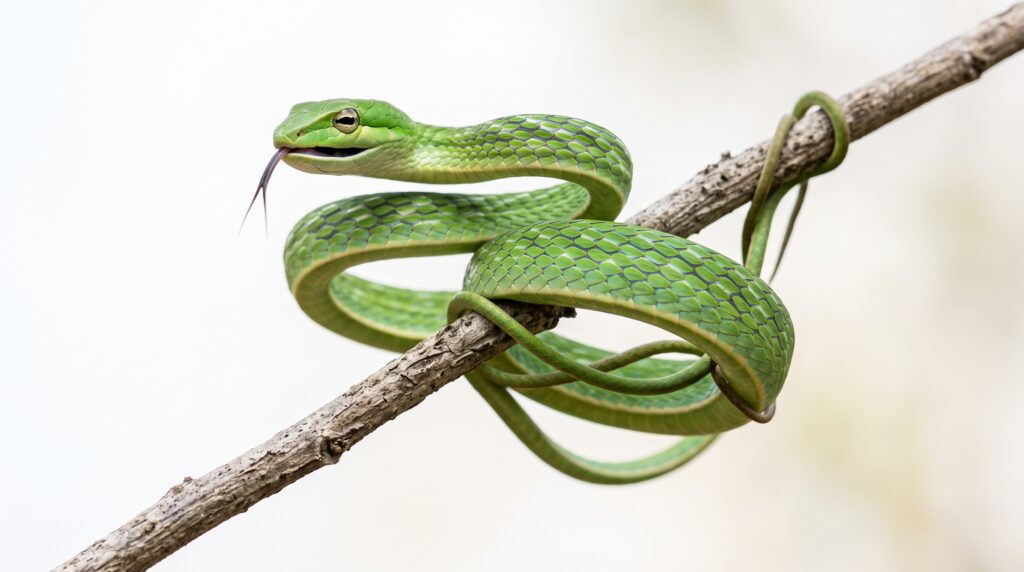
Several snakes produce whistle like sounds through cloacal popping, air forced from the cloaca, the single rear opening used for waste and reproduction. Corn snakes emit short, low frequency whistles when stressed. Ball pythons make brief pops during handling. Sonoran coral snakes whistle faintly, audible only up close, while western hook nosed snakes produce loud pops carrying several meters. Puff adders and related vipers expel short air bursts too. These sounds are warnings, and the details behind them matter more than most people expect.
A note before the list, because this topic is unusually full of repeated misinformation. I am an ecologist by training, with an MSc in ecology, and the honest position is that true cloacal popping has been documented in only two snake species. Almost every article that names a third is guessing. That distinction matters most for ball pythons, where a keeper who mistakes a sick animal for a noisy one can delay treatment, so this piece separates what is documented from what is repeated.
Key Takeaways
- Corn snakes (Pantherophis guttatus) and ball pythons (Python regius) both “whistle” during handling, though corn snakes sound windy and pythons pop like.
- Sonoran coral snakes (Micruroides euryxanthus) emit the faintest whistles, audible only at close range.
- Western hook nosed snakes (Gyalopion canum) produce the loudest whistles for their size, carrying several meters.
- Puff adders (Bitis arietans) and related Bitis vipers expel short bursts of air from the vent.
- The sound comes from air forced through the cloaca, not vocal cords, and serves as a defensive startle signal.
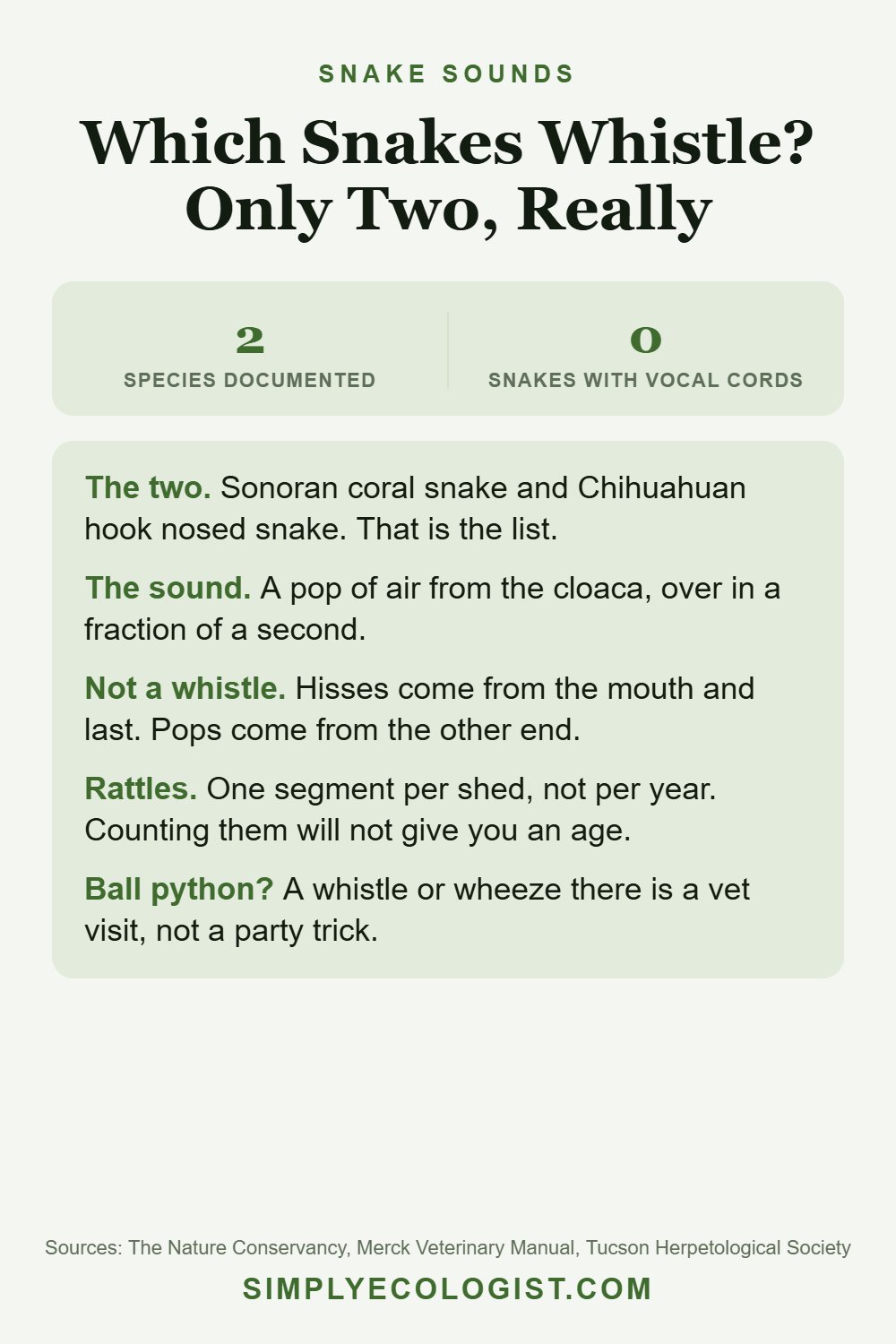
| Snake | Sound | How it is made | What it means |
|---|---|---|---|
| Sonoran coral snake | Cloacal pop | Air expelled from the vent | Documented. One of only two species |
| Chihuahuan hook nosed snake | Cloacal pop | Air expelled from the vent | Documented. The other of the two |
| Most snakes, including corn snakes | Hiss | Air through the glottis in the mouth | Normal defensive sound |
| Pine and bull snakes | Loud rasping shriek | Hiss amplified by a modified epiglottis | Normal, and startlingly loud |
| King cobra | Low growl | Resonating chambers off the trachea | Normal defensive sound |
| Rattlesnakes | Dry buzz | Keratin segments striking each other | One segment added per shed, not per year |
| Saw scaled vipers | Rasp | Serrated scales rubbed together | Stridulation, no air involved |
| Ball python making any of these | Wheeze, click or whistle | Fluid or swelling in the airway | Not a defence. See a vet |
Cloacal popping species per The Nature Conservancy. Respiratory signs per the Merck Veterinary Manual.
Do Snakes Actually Whistle?
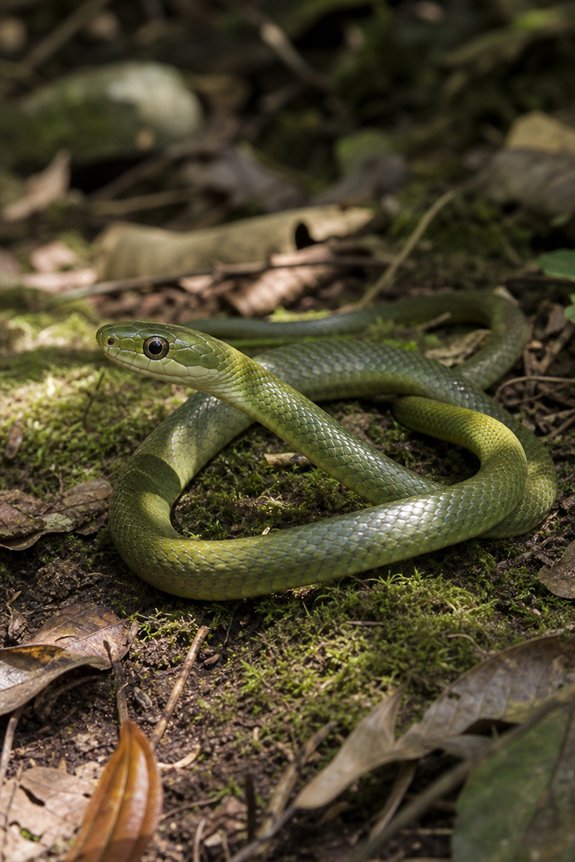
Although snakes lack the lips and vocal cords that people use to whistle, some species still produce a sound close to one. Biologists call this cloacal popping. The cloaca is the rear opening used for waste and reproduction. A snake forces air out through that vent, creating a short whistling sound that resembles a pop or a fart.
Corn snakes and ball pythons do it. Reports also include some vipers, Sonoran coral snakes, and western hook nosed snakes. The sound differs from hissing, which moves air through the mouth and nasal passages.
It works as a simple warning. A popping snake feels threatened, so observers should step back. The behavior is easy to overlook, and that may explain why so few published studies record it.
Cloacal Popping: Where the Whistle Comes From
Understanding cloacal popping starts with the vent itself. The cloaca is the single opening snakes use for waste and reproduction. The behaviour is far rarer than the internet suggests. The Nature Conservancy describes it as a defensive sound produced by two Arizona species, the Sonoran coral snake and the Chihuahuan hook nosed snake. Those two are the documented list.
When a snake feels threatened, it compresses its body and forces air through that opening, much like flatulence. The sphincter, a ring of muscle that controls the vent, shapes the escaping burst into a shrill sound. That’s why snakes whistle without using their mouths.
Corn snakes and Ball Pythons do this, as do some vipers, Sonoran coral snakes, and western hook nosed snakes. The pops are short and sharp, lasting a fraction of a second.
Blowing air this way startles predators rather than carrying any complex message. Recent feeding, defecation, or a cloacal infection can mute the sound entirely. It’s a modest defense, but effective.
Why a Whistle Scares Predators Off
A sudden whistle breaks the silence, and that break is the whole point. The noise startles a predator and signals that the snake knows it’s being watched. That warning raises the perceived risk of attack, so many predators simply leave. The sound is directional, meaning it travels outward from the snake’s body and reveals its exact position.
A coiled snake often whistles continuously while preparing to strike, which discourages a quiet approach. Venomous snakes such as some vipers pair the whistle with hissing, body inflation, and a raised striking posture. Together these signals form a multimodal display, or a warning that uses sound, sight, and sometimes smell at once. Predators that hunt by surprise lose their advantage. Over time, some learn to associate the whistle with a painful defense.
Corn Snakes: What They Actually Do
Corn snakes (Pantherophis guttatus) turn up constantly in lists of whistling snakes, and it is worth being straight about why that is a problem. Cloacal popping has only ever been documented in two species, and the corn snake is not one of them. What a corn snake actually produces is a hiss: air forced out through the glottis in the floor of the mouth, not through the vent. It is short, breathy and low, and to an unfamiliar ear it can sound thin enough to pass for a whistle.
Both sounds warn predators and make the snake seem larger or more dangerous than it is. Keepers hear it most often during handling, close encounters, or when a snake feels cornered. The behavior stays occasional, not constant. It’s easy to find the noise amusing, but it signals stress. A whistling corn snake is asking for space, and that request deserves respect.
Ball Pythons: When a Whistle Means Call a Vet
Ball pythons (Python regius) are the species where this myth does real harm, so it is worth separating carefully. The Merck Veterinary Manual sets out the clinical signs, and the environmental causes behind most of them.
Ball pythons are not among the species documented to pop from the cloaca. They hiss, from the mouth, like most snakes. What they also do, unfortunately often, is make abnormal breathing sounds when they are unwell.
This matters because a whistling, wheezing, clicking or bubbling sound from a ball python is one of the classic presentations of respiratory disease. The Merck Veterinary Manual lists open mouth breathing, discharge from the nose and laboured breathing among the signs, and the usual causes are the ones keepers can fix: temperatures too low, poor hygiene, or an animal already run down by something else.
So if your ball python is making a noise you would describe as a whistle, the useful response is not to be charmed by it. It is to check the enclosure temperatures and call an exotics vet. The purpose of a genuine defensive sound is purely defensive. That restraint seems worth respecting.
Sonoran Coral Snakes and Their Tiny Whistle
Sonoran coral snakes (genus *Micruroides*, chiefly *Micruroides euryxanthus*) make the faintest sound in this group. They force air through the cloacal vent, the single rear opening used for waste and reproduction. The result is a brief high pitched whistle. No vocal cords or laryngeal structures are involved, so the sound comes entirely from moving air. The Tucson Herpetological Society records the behaviour in this species when it is captured or otherwise threatened.
The whistle stays quiet. Adults reach only about 35 to 50 centimeters in total length, and observers usually hear the sound at close range or while watching the snake carefully. Handling or trapping the snake makes whistling more likely. Other defensive cues often appear alongside it, such as coiling, hiding the head, or releasing musk.
Rattlesnake rattles carry much farther. Still, it’s worth noting how many small warnings a person can walk past unnoticed.
Western Hook Nosed Snakes: Loudest Little Whistle
The western hook nosed snake (*Gyalopion canum*) turns the same trick into a much louder alarm. It lives in southwestern deserts and northern Mexico. Adults reach only 20 to 40 cm, yet the whistle carries several meters. The sound comes from air forced through the cloacal vent, the single opening snakes use for waste and reproduction. Biologists call it a “back end” sound, since no larynx or voice box is involved. Corn snakes and some vipers do something similar.
- A snake shorter than a ruler, facing predators
- A whistle louder than its small body suggests
- Arid scrub and sandy flats, where sound travels far
- Rapid cloacal extrusion paired with the alarm
The whistle deters predators, not prey capture or mating. Such small defenses deserve quiet respect.
Which Vipers Whistle When Threatened?
Although vipers rarely get credit for making noise, several species can force air out of the cloaca when they’re cornered. The cloaca is the single opening snakes use for waste and reproduction. The result sounds less like a melody and more like flatulence. Puff adders (Bitis arietans) show this behavior most clearly, and observers describe short bursts of air from the vent. Related Bitis species do the same. Saw scaled vipers usually rasp their keeled scales together instead, though a few individuals expel air as well.
The sound is short and low pitched. It doesn’t come from a larynx, so it isn’t a true voice. Many vipers pair it with coiling, hissing, and a striking posture. Researchers still know little about it, a gap worth filling.
Whistling vs. Hissing: Telling Them Apart
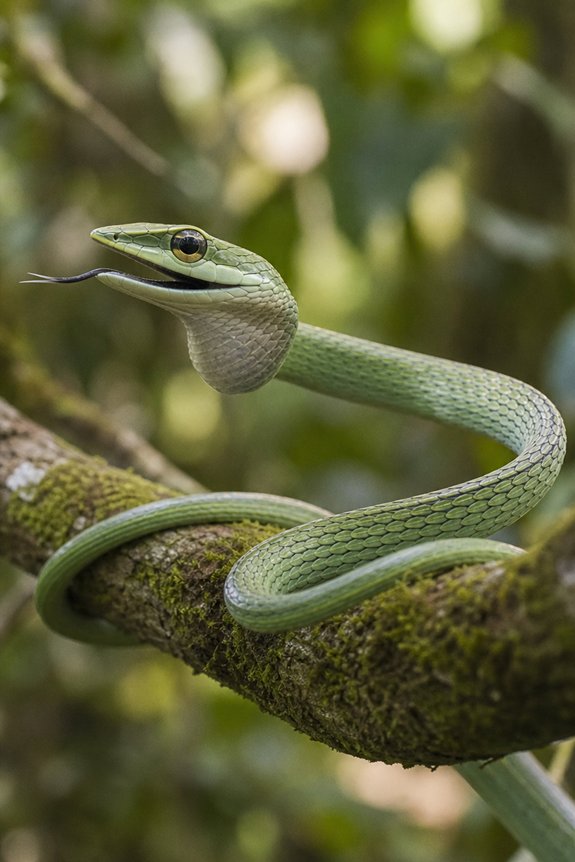
Two different openings make two different sounds. A hiss comes from the mouth, where air rushes past the glottis, the opening to the windpipe. A whistle comes from the cloaca, the single vent near the tail that handles waste and reproduction. Hisses are broadband, meaning they mix many frequencies, and they last several seconds. Cloacal whistles are short, high pitched, and sometimes resemble flatulence. Plenty of other animals genuinely do whistle, and we rounded them up in animals that whistle.
- Open mouth and a drawn back head usually mean a hiss.
- No mouth movement, with sound from the tail end, points to a whistle.
- Sudden handling or defecation raises cloacal pressure, then a whistle follows.
- A steady, continuous rasp signals one message: back off.
Observers who watch the body, not just listen, rarely confuse the two. It’s a small distinction that matters.
Rattles, Buzzes, and Rasps Beyond Whistling
Whistling isn’t the only warning snakes give. Rattlesnakes shake hollow keratin segments, keratin being the tough protein found in fingernails, and each shed usually adds one more segment to the rattle.
The eastern massasauga’s tail buzzes like a trapped wasp, while saw scaled vipers rasp by rubbing serrated scales together, a range of solutions worth respecting.
Keratin Rattles Grow With Every Shed
A rattlesnake builds its rattle one shed at a time. Each shed adds a hollow keratin segment: keratin is the same tough protein found in fingernails. The segments interlock loosely. A snake needs at least two sheds before the rattle can make noise, since sound comes from segments striking each other. Older snakes often carry longer rattles, though segments break off and reset the length. So counting segments won’t reveal a snake’s age.
- A newborn’s silent button, waiting for its second shed
- A broken rattle that starts its record over
- A dry buzz that warns before a strike
- Segments worn thin by years of stone and brush
Watching that quiet growth, one sees a slow, patient record of survival written in keratin over decades.
Massasauga’s Wasp Like Buzz
Hikers often mistake the sound for an insect. The eastern massasauga, Sistrurus catenatus, vibrates its rattle so quickly that the noise resembles a distressed bee or wasp. Field recordings show the buzz reaching peak frequencies of several kilohertz, matching the range of hymenopteran buzzing. Hymenopterans are the insect group that includes bees, wasps, and ants. That pitch startles predators.
Unlike the slower, deeper rattle of larger species, the massasauga’s buzz sounds shorter, higher, and more continuous, without long gaps between notes. The snake pairs the sound with a defensive posture. It coils and raises its head, warning threats at close range. At a distance the buzz blends into insect noise, which may keep larger mammals from noticing it. That tradeoff seems worth studying further.
Saw Scaled Vipers Rasping
Saw scaled vipers skip the tail entirely. These snakes live across Africa, the Middle East, and South Asia. They rub their keeled, serrated scales together to make sound. Keeled means each scale carries a raised ridge, and serrated means the ridge is notched like a saw blade. The rasp is mechanical, not air forced from the lungs. It resembles sandpaper dragged across wood.
- A coiled S shaped posture pairs with the rasp, warning before any strike.
- Dry, arid habitats carry the noise well over leaf litter and rock.
- No specialized tail organ is needed, so juveniles rasp too.
- Predators get a clear signal instead of a surprise bite.
It’s a clear warning worth heeding, and it asks only for distance. Listeners rarely forget the rasping sound.
Growling Cobras and Shrieking Pine Snakes
Although snakes don’t have vocal cords, a few species produce sounds that seem almost voiced. King cobras growl. They force air through the mouth, creating a low, cat like rumble that field researchers have recorded near cornered animals. The growl usually accompanies a threat posture, meaning a raised body and an expanded hood.
Pine snakes take a different route. A laryngeal septum, a thin flap of tissue in the throat, splits and shapes the airflow, turning an ordinary hiss into a high pitched shriek. Observers note this shriek carries higher frequencies and lasts longer than a hiss, which makes it startle predators more effectively.
Both sounds are warnings, not conversation. Someone hearing either should step back, because the snake is already agitated and defending itself.
Snail Eaters That Call Like Distressed Frogs
While most snake sounds push predators away, one South American species may use sound to pull prey closer. Catesby’s snail eater, Dipsas catesbyi, produces short calls that resemble the distress cries of frogs. The snake doesn’t use vocal cords. Instead, it forces air out through its mouth and nostrils, creating pulses of sound. Researchers suspect this is aggressive mimicry, meaning a predator imitates something harmless to draw prey within reach. Frogs may approach the sound and become ambush targets.
- The calls are rare, documented mainly in field notes and a few natural history studies.
- Observers usually record them during daylight, near places where amphibians gather.
- No defensive purpose has been identified, unlike typical hisses.
- Snakes were long assumed nearly silent hunters.
That assumption now seems incomplete.
When a Whistle Means a Sick Snake
Not every strange sound signals illness. Many snakes click or wheeze for several days before a shed, and the noise clears once the old skin peels away.
Sounds outside that cycle carry more weight, especially alongside lethargy, refused meals, nasal discharge, or bubbling at the nostrils, and those cases deserve a prompt visit to a reptile vet.
Shedding Versus Respiratory Infection
Distinguishing a harmless shed whistle from the sound of illness comes down to timing and company. Shed related noise is brief. It appears alongside ecdysis, the process of shedding old skin, and fades once the snake finishes. Owners see duller skin, cloudy eye caps, and a smaller appetite. Eating and activity stay normal.
- Open mouth breathing that doesn’t ease
- Bubbling or clicking sounds lasting days to weeks
- Nasal discharge, oral lesions, or vent discharge
- Weight loss, lethargy, or refusal to eat
These signs point toward respiratory infection, not shedding. A reptile experienced vet can culture samples and prescribe systemic antibiotics. Keepers should isolate the animal first. Progression can be prevented with prompt care. It’s hard to watch a quiet animal struggle, so early attention matters.
Warning Signs To Watch
Respiratory trouble isn’t the only illness a whistle can announce. Wheezing from the cloaca, the vent used for waste and breeding, can point to infection or parasites when it lasts past a few shedding days. Swelling, skin sores, or a foul odor deepen the concern. Intermittent whistles paired with lethargy, weight loss, or poor appetite raise the chance of illness.
Gurgling, open mouth breathing, or nasal discharge suggests respiratory infection or stomatitis, an infection of the mouth lining. Recently fed or gravid snakes need faster attention; gravid means carrying eggs, and new vent noise may signal impaction or egg retention. Isolation comes first.
A vet can run a physical exam, a fecal parasite screen, and radiographs, which are X rays. Careful keepers notice changes early.
What to Do When a Snake Whistles at You
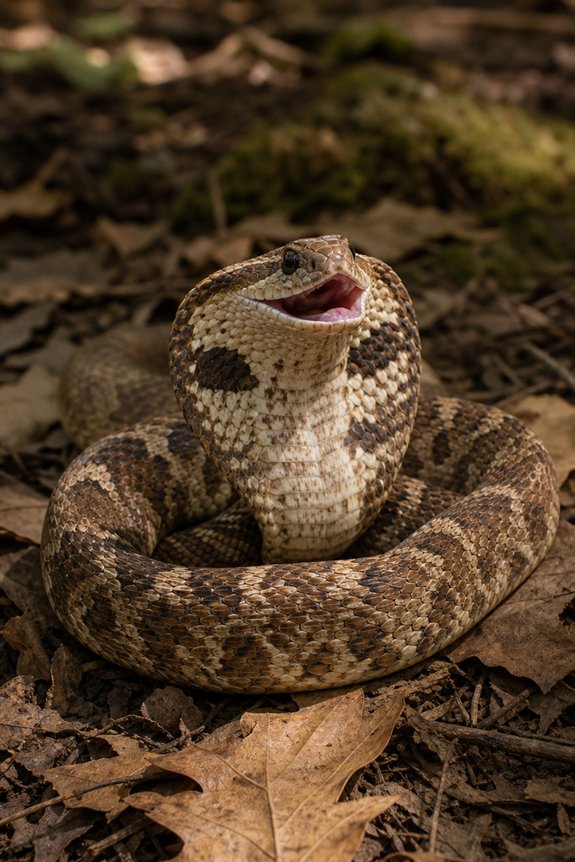
Back away slowly if you hear that thin, high pitched sound. The whistle comes from air pushed through the cloacal vent, the single opening a snake uses for waste and reproduction. It means what a hiss or rattle means. Move back several body lengths. Don’t turn your back or make sudden moves. Note the snake’s color, head shape, and posture from a distance, since wildlife officers or medical staff may need that description. If you are meeting snakes in the garden rather than a vivarium, our piece on whether snakes come out in the rain covers when you are most likely to run into one.
- Keep children and pets away; a startled snake strikes fast.
- Never corner or handle the animal.
- After a bite, immobilize the limb, keep the victim calm and still, and seek emergency care.
- Skip tourniquets and venom suction, and report the snake to wildlife authorities.
Space costs little. Most snakes just want distance.
Three Whistling Snake Myths to Drop
Two ideas about whistling snakes deserve correction. The first is the notion that snakes produce melodic calls like birds, when the actual sound is cloacal popping, a short burst of air forced through the vent that lasts a fraction of a second. The second is the belief that this noise signals aggression, though researchers describe it as defensive, a warning that works much like a rattlesnake’s rattle or a hiss.
Melodic Warning Calls Myth
Although stories describe snakes whistling tunes, no evidence supports melodic calls in any species. Recorded sounds are brief and flat. Corn snakes, ball pythons, some vipers and Sonoran coral snakes force air through the cloaca, the single opening used for waste and reproduction, or through the mouth. The burst lasts a moment. It holds no changing pitch, so listeners can’t hear a tune.
- A frightened snake’s air blast signals distress, not song.
- Mate attraction claims have no laboratory or field support.
- Photos of snakes appearing to purse lips prove nothing.
- Audio recordings and species identification remain the only reliable evidence.
Studies show snake sound repertoires stay simple and species specific. Many reported whistles were hisses or growls. Dropping the myth costs little; accuracy matters more.
Whistling Means Aggression Myth
When a snake forces air through its cloacal vent, the sound rarely means it plans to attack.
Researchers call this an antipredator signal, meaning a sound or display used to discourage something that might eat the snake. Corn snakes, ball pythons, and some vipers all produce it. The purpose is startle, not assault.
Field studies find no consistent link between whistle length or pitch and an imminent strike. Frequency and context vary widely across species. Many aggression reports come from anthropomorphism, which means reading human motives into animal behavior.
Most whistling snakes are preparing to flee or hold a defensive posture. That distinction matters. The practical rule stays simple. Treat the sound as a warning and step back, since risk climbs if approach continues.
Snake Sounds: Common Questions
Do snakes whistle?
Not in the way a bird or a person does. Snakes have no vocal cords. Two species, the Sonoran coral snake and the Chihuahuan hook nosed snake, produce a short popping sound by expelling air from the cloaca, and that is the closest thing to a whistle in snakes. Everything else described as whistling is either a hiss, a rasp, or a sick animal.
What is cloacal popping?
A defensive sound made by forcing air out of the cloaca, the single vent snakes use for waste and reproduction. It is brief, sounds like a pop or a small squeak, and it is documented in only two species.
Which snakes actually do cloacal popping?
The Sonoran coral snake, Micruroides euryxanthus, and the Chihuahuan or western hook nosed snake, Gyalopion canum. Both are small southwestern species. Claims about corn snakes, ball pythons and others are not supported by the literature.
Why is my ball python whistling or wheezing?
Most likely because it is unwell. Ball pythons do not cloacal pop. A whistle, wheeze, click or bubbling sound points to respiratory disease, and the Merck Veterinary Manual lists open mouth breathing, nasal discharge and laboured breathing alongside it. Check your enclosure temperatures and contact an exotics vet.
What is the difference between a snake hiss and a whistle?
A hiss comes from the mouth, made by air passing the glottis, and it is sustained. A cloacal pop comes from the vent at the other end of the animal, and it is over in a fraction of a second. If the sound is continuous, it is a hiss or a breathing problem, not a pop.
Do rattlesnakes add one rattle segment per year?
No. A rattlesnake adds a segment every time it sheds, which can be several times a year, and segments break off regularly. Counting them will not tell you the snake’s age.
Which snakes make the loudest sounds?
Pine and bull snakes, which have a modified epiglottis that turns an ordinary hiss into a loud rasping shriek, and king cobras, which growl at a much lower pitch using resonating chambers off the trachea.
Is a whistling snake about to strike?
Not necessarily. These are warning sounds, produced by an animal that would rather not fight. The correct response is to stop moving toward it and give it room to leave.
Final Thoughts
Snakes don’t whistle. They pop air from the cloaca, the single opening used for waste and reproduction, and the sound only resembles a whistle. The irony is plain: a noise people call musical is usually air forced from a stressed body, or lungs clogged by infection. Corn snakes and ball pythons make it when frightened, not friendly. Researchers still know little about the behavior. That gap seems worth noticing, and worth closing.

Erzsebet Frey (Eli Frey) is an ecologist and online entrepreneur with a Master of Science in Ecology from the University of Belgrade. Originally from Serbia, she has lived in Sri Lanka since 2017. Eli has worked internationally in countries like Oman, Brazil, Germany, and Sri Lanka. In 2018, she expanded into SEO and blogging, completing courses from UC Davis and Edinburgh. Eli has founded multiple websites focused on biology, ecology, environmental science, sustainable and simple living, and outdoor activities. She enjoys creating nature and simple living videos on YouTube and participates in speleology, diving, and hiking.
🌿 Explore the Wild Side!
Discover eBooks, guides, templates and stylish wildlife-themed T-shirts, notebooks, scrunchies, bandanas, and tote bags. Perfect for nature lovers and wildlife enthusiasts!
Visit My Shop →