
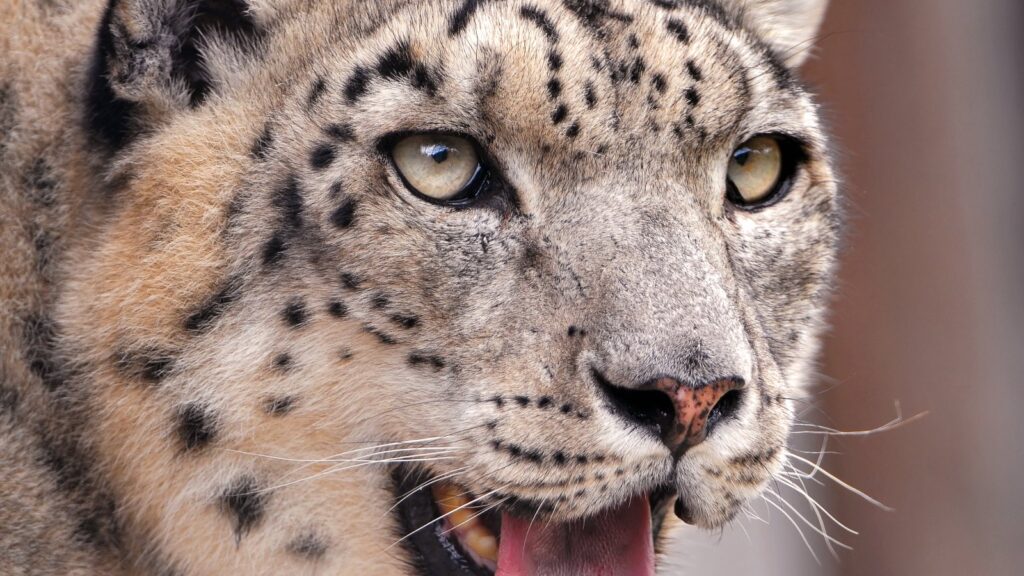
The mountain lion typically prevails over the snow leopard in direct confrontation. Adult male mountain lions typically weigh 50 to 80 kg (about 62 kg on average), while male snow leopards average 45 to 55 kg. That 10 to 20 kg advantage generates greater striking power and grappling force. Neither cat has a measured bite force, but mountain lion canines stretch ~5 cm versus the snow leopard’s ~2.9 cm, enabling deeper organ damage. Snow leopards leap farther and run faster in bursts, yet mountain lions excel at sustained wrestling. Terrain and surprise matter, yet mass usually decides these rare clashes. The full comparison reveals why size so often wins.
Key Takeaways
- Adult male mountain lions typically weigh 50 to 80 kg, while male snow leopards average 45 to 55 kg.
- Neither cat has a controlled bite force measurement, but the mountain lion’s canines are longer at roughly 5 cm versus 2.9 cm.
- Snow leopards leap nearly 9 meters across gaps; mountain lions jump about 5.5 meters straight up and around 12 meters across.
- Mountain lions tackle prey up to 150 kg; snow leopards hunt animals weighing 20 75 kg.
- The species occupy separate continents and never encounter each other naturally.
Snow Leopard vs Mountain Lion at a Glance
| Trait | Snow leopard (Panthera uncia) | Mountain lion (Puma concolor) |
|---|---|---|
| Adult male weight | 45 to 55 kg (up to 75 kg recorded) | 50 to 80 kg (heaviest verified 105 kg) |
| Canine length | About 2.9 cm | About 5 cm |
| Leaping | Up to 9 to 10 m (30 ft) across gaps | 5.5 m (18 ft) up, about 12 m (40 ft) across |
| Main prey | Blue sheep, ibex, argali (20 to 75 kg) | Deer and elk (60 to 150+ kg) |
| Range | 12 countries in Central and South Asia, 3,000 to 4,500 m | Yukon to Patagonia, sea level to high mountains |
| Recorded fatal attacks on humans | None (three attacks ever reported) | 29 in North America since 1868 |
| IUCN status | Vulnerable | Least Concern |
Who Wins and Why: The Short Answer
Both cats are thought to have similar bite strength, but the mountain lion’s canines stretch 5 cm versus 2.9 cm. Its larger skull delivers more crushing power. The mountain lion’s experience subduing larger deer builds fighting skill that the snow leopard, hunting smaller blue sheep and ibex, rarely matches.
The snow leopard leaps nearly 9 meters and maneuvers rocky terrain with exceptional agility. These alpine adaptations offer tactical options. Still, in open confrontation, the heavier mountain lion likely prevails. Terrain and circumstance matter, yet power favors the bigger cat.
Size and Weight: The Cougar’s 40 Pound Advantage
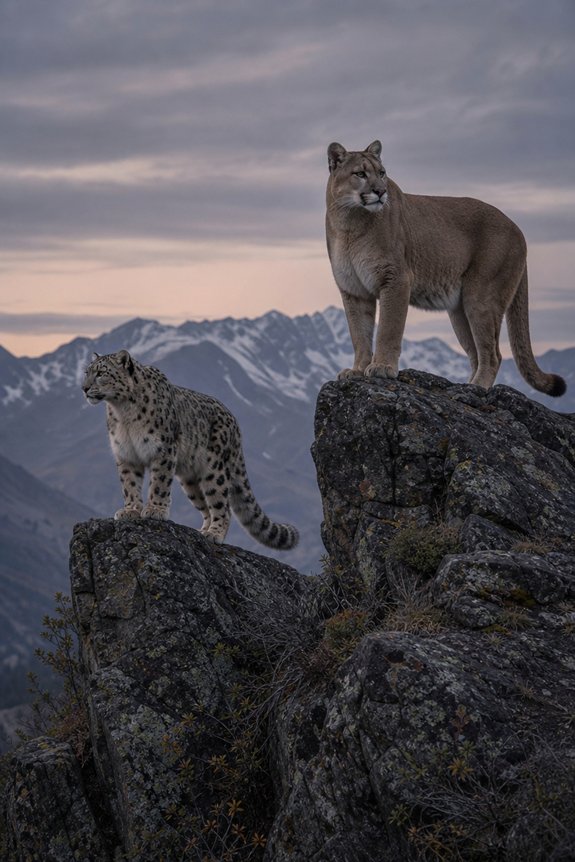
A mountain lion pads through the undergrowth, its muscles shifting beneath fur that conceals a substantial frame. Adult male mountain lions typically weigh 50 to 80 kilograms, while male snow leopards average 45 to 55 kilograms. This advantage of roughly forty pounds gives the cougar markedly more mass.
The heaviest verified mountain lion weighed 105 kilograms, whereas snow leopards rarely exceed 55 kilograms, with only a few males recorded near 75. Regional variation exists. Smaller snow leopards inhabit Central Asia, and larger cougars roam North America. Biologists stress that individual measurements matter more than averages when evaluating matchups, just as in the tiger vs lion size comparison. Greater mass provides more muscle and larger shoulder height. These physical traits help an animal win in a fight. The cougar’s weight advantage represents a measurable difference, not the only factor, but a notable one.
Bite Force vs. Canine Size: Which Kill Tool Matters More
When predators clash, their teeth become decisive weapons. Both cats are believed to wield comparable bite force, though neither has been measured under controlled conditions and the psi figures repeated online have no traceable source. Yet their canines differ sharply.
- Mountain lion canines stretch 5 cm, enabling deep puncture wounds
- Snow leopard canines measure 2.9 cm, favoring grip and bone crushing
- Longer teeth penetrate crucial organs faster for quick kills
- Shorter, sturdier canines withstand struggle without breaking
- Bite force alone doesn’t determine lethality; placement matters more
The mountain lion’s dental daggers offer killing reach. The snow leopard’s compact weapons resist damage during prolonged holds. Ultimately, neither tool guarantees victory. Jaw strength, tooth length, and precise targeting work together. The cat that controls its opponent’s position delivers the decisive strike.
Speed and Leaping: Can the Snow Leopard Outmaneuver?
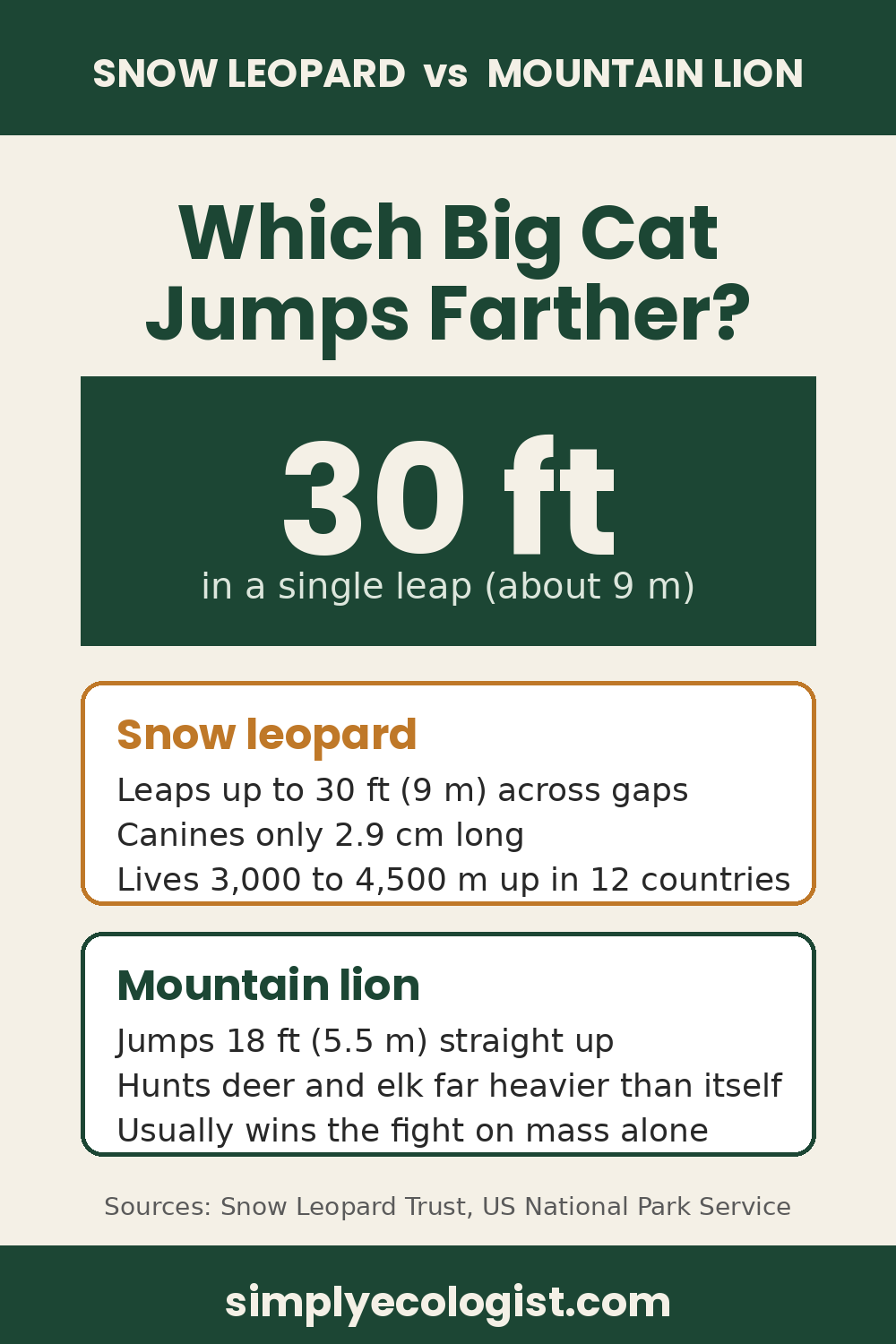
Snow leopards launch themselves across chasms that would break lesser hunters. They’re capable of horizontal leaps reaching about 9 m (30 ft), using their powerful hind legs and a long, thick tail for balance on steep terrain. This allows ambush attacks from above.
Mountain lions jump roughly 5.5 m (18 ft) straight up and about 12 m (40 ft) horizontally, launching with explosive force from all four legs.
Speed tells a similar story. No reliable top speed has ever been measured for snow leopards, which rely on short ambush rushes rather than chases. Mountain lions are commonly credited with sprints of 40 to 50 mph (64 to 80 km/h), though that figure comes from field estimates rather than controlled measurement.
Both cats employ their tails for mid air stabilization. The snow leopard gains advantages in vertical, rugged terrain. The mountain lion performs better on flatter ground. Environment determines which cat outmaneuvers.
Real Fights: What Happens When Big Cats Actually Clash
When these cats meet, the mountain lion’s weight and size edge usually prevails. Males often outweigh snow leopards by thirty to forty pounds. Their bite strength is thought to be similar, so victory hinges on bulk and hunting experience rather than jaw strength.
Such encounters remain exceptionally rare, however, and that scarcity reminds us how little we truly know about these solitary hunters.
Weight And Size Edge
Mountain lions frequently outweigh snow leopards by 30 40 pounds or more, and this mass difference shapes real confrontations between the two cats.
Weight and size edge matters when these cats clash. The heavier cat generates stronger momentum. This physical advantage proves decisive in close combat.
- Adult mountain lions range about 75 to 180 lbs; snow leopards about 60 to 120 lbs
- Larger body mass delivers greater grappling force
- Mountain lions wield longer canines, ~5 cm versus ~2.9 cm
- Snow leopards leap ~9 meters, but agility doesn’t offset bulk
- Heavier cougars taking deer show more dominant clash records
Outcomes hinge on securing position, not force alone. The heavier animal usually prevails, though terrain and condition matter.
One sees nature’s quiet arithmetic: mass confers advantage, yet individual fight dynamics can surprise.
Bite Force Comparison
Bite mechanics reveal more than numbers suggest. Both cats likely generate similar bite pressure, though no direct tests exist. Mountain lions possess larger skulls and longer canines, up to five centimeters versus the snow leopard’s 2.9 centimeters. This length creates greater mechanical advantage for penetrating thick hides.
Snow leopards employ powerful hindlimb pounces followed by suffocating throat bites on prey several times their weight. Mountain lions favor throat clamps and neck bites on deer. In real clashes, bite placement outweighs raw pressure. Sharp claws and agility control the engagement. A neck or skull bite proves decisive. Given the mountain lion’s superior mass and leverage, it typically dominates direct confrontations despite similar bite estimates.
Hunting Experience Advantage
Although both cats are skilled hunters, their experience differs sharply. Mountain lions routinely tackle deer and elk. These ungulates often outweigh snow leopard prey. This gives mountain lions frequent practice with large, struggling animals. Snow leopards hunt blue sheep and argali. They use powerful hind leg leaps, up to 9 meters, on steep slopes. Their tactics favor ambush over prolonged grappling.
Several factors play a significant role in real fights:
- Male mountain lions reach 50 to 80 kg, while male snow leopards average 45 to 55 kg
- Heavier felids with larger canines typically gain advantage in conflicts
- Both possess retractable claws and comparable bite strength
- Terrain and surprise often matter more than species averages
- Snow leopard agility favors rocks, mountain lion mass favors open ground
Outcomes remain context dependent.
How Each Cat Kills: Ambush Styles Compared
The mountain lion stalks quietly. It closes distance rapidly. Then it pounces from short range. It uses strong forelimbs to seize the neck or skull. Its canines, roughly 5 centimeters long, crush windpipes or break spines. It pins larger prey with bodyweight. It delivers repeated bites. It slashes with foreclaws. Both cats use retractable claws to grip. The snow leopard relies on one decisive leap. The mountain lion often grapples longer.
Prey Size Reveals True Fighting Power
Prey size matters because it directly shapes a predator’s fighting capabilities.
Mountain lions regularly kill deer weighing 60 100 kg (130 220 lb), which builds heavy grappling experience and absolute strength from their larger 50 to 80 kg bodies.
Snow leopards hunt smaller mountain ungulates like ibex (30 75 kg) using cliff ambush tactics, so they’re adapted for agility rather than sustained wrestling with very large opponents.
Prey Size Matters
Prey size shapes each predator’s combat capabilities in measurable ways. Prey size matters because it directly determines which skills each cat develops.
- Snow leopards hunt blue sheep and argali weighing 20 75 kg
- Mountain lions routinely tackle deer at 50 130+ kg
- Snow leopard anatomy supports explosive leaps on steep terrain
- Mountain lion morphology favors overpowering larger animals
- Different techniques emerge from these distinct hunting demands
Snow leopards develop precision and vertical mobility. Mountain lions build wrestling strength against struggling prey. This distinction reveals genuine fighting power.
One cat masters controlled dispatch on cliffs. The other specializes in subduing larger mammals through sustained force. The difference isn’t superiority. It’s adaptation to ecological reality. Each species demonstrates evolution’s practical solutions to survival challenges in their respective environments.
Larger Prey Advantage
The encounter between these two predators reveals which hunting background prepares a cat better for combat. Mountain lions demonstrate a clear larger prey advantage through their regular hunts. Adult males routinely subdue deer and ungulates weighing 50 150 kilograms. This practice trains them in sustained grappling and powerful forelimb control. They learn precise killing bite placement on struggling animals.
Snow leopards hunt smaller quarry. Blue sheep and argali typically range 20 75 kilograms. Their technique relies on ambush and agility. They use explosive leaps up to nine meters. Strong hind limbs allow precision strikes rather than prolonged struggles.
The mountain lion’s experience with heavier prey translates directly to combat effectiveness. This larger prey advantage provides relevant size and experience in direct confrontations.
Hunting Experience Counts
Hunting shapes fighting skill in measurable ways. Prey size differences between these cats play a pivotal role in combat readiness.
- Mountain lions routinely subdue deer sized prey, 70 to 100 kg animals that demand sustained wrestling
- Snow leopards target smaller ungulates, 20 to 75 kg blue sheep and argali, limiting heavy grappling practice
- Larger prey forces mountain lions to deploy forelimb strength, body weight, and 5 cm canines in prolonged struggles
- Snow leopards use leaping ability, up to 9 meters, and ambush tactics rather than extended physical contests
- Regular handling of heavy, resisting prey gives mountain lions more bite and hold combat experience
This disparity matters. Wrestling substantial animals builds transferable fighting skills. One might consider which background better prepares a predator for confrontation.
Coat Colors That Hide and Hinder Each Fighter
Snow leopards wear thick, pale gray to smoky white fur with dark rosettes. This pattern hides them against snowy rocky slopes. They approach prey from several dozen meters away. Their long, bushy tails break up their outline when curled around the body.
Mountain lions display uniform tawny to beige coats. This coloring blends with dry grasses, forests, and chaparral. It works best at dawn and dusk. Their plain coloring minimizes contrast during stalking. However, it lacks disruptive patterning. A snow leopard’s coat would stand out in grasslands. A mountain lion’s tawny fur would prove conspicuous on snow. Each adaptation fits its world precisely.
Where Snow Leopards and Cougars Roam (and Why They Never Meet)
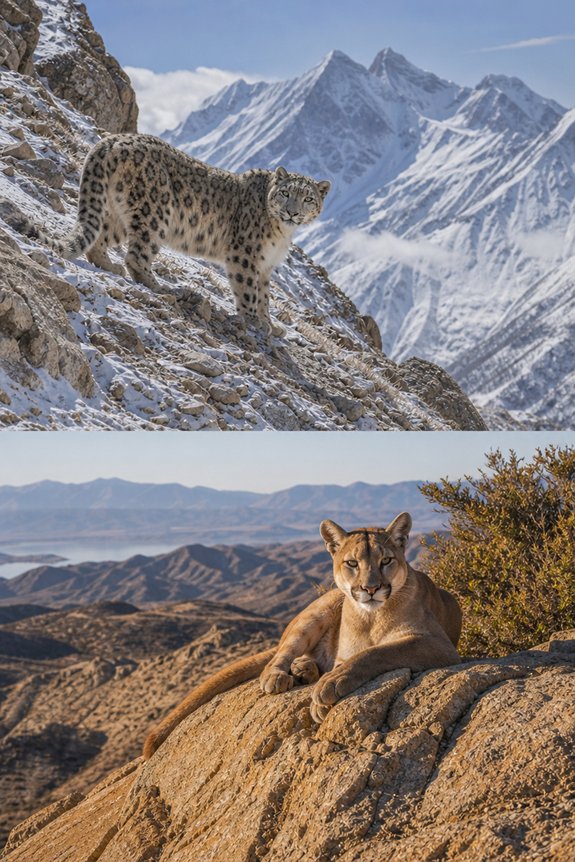
Snow leopards occupy the alpine zones of Central Asia’s great mountain ranges, typically between 3,000 and 4,500 meters elevation, while mountain lions roam the Americas from Canadian forests to Patagonian steppes.
The two cats never meet because continents separate them: snow leopards stay in Eurasia, cougars in the Western Hemisphere, with oceans and the Bering Strait blocking any natural dispersal.
Their habitats reflect distinct ecological niches. Snow leopards specialize in cold, rocky terrain with thick fur and powerful leaps, whereas cougars thrive as generalist predators across diverse lower elevations.
Habitat Distribution Overview
Although both have a reputation for elusive mountain living, snow leopards and mountain lions occupy entirely separate worlds. Despite the name, the snow leopard (Panthera uncia) is not a leopard, and the mountain lion (Puma concolor) is not a lion.
Snow leopards inhabit Central and South Asian ranges. They live at 3,000 to 4,500 meters elevation across 12 countries. Mountain lions roam the Americas from Canada to southern Chile. They adapt to forests, deserts, and edges of suburbs.
Their ranges never overlap. Continents and oceans divide them completely.
- Snow leopards: alpine Asia, 12 nations
- Mountain lions: the Americas, diverse terrain
- Elevation: leopards high, cougars variable
- Climate: thin cold air versus temperate zones
- Biodiversity: variety of life in each region
Each species faces unique threats. Snow leopards suffer poaching and fragmentation. Mountain lions encounter vehicles and human conflict. Both persist in shrinking wild spaces.
Isolation Factors Explained
The separation between snow leopards and mountain lions runs deeper than mere distance. These cats occupy entirely separate continents. Snow leopards inhabit Central and South Asian ranges at 3,000 to 4,500 meters. Mountain lions roam the Americas from Yukon to Patagonia. This geographic split means isolation factors explained here center on continental drift and independent evolution.
Each species evolved unique traits for their worlds. Snow leopards developed thick fur and short limbs for cold, steep terrain. Mountain lions grew larger and more flexible, adapting to forests, deserts, and suburbs alike. Their prey differs too: blue sheep and argali versus deer. No natural range overlap exists. Human pressures vary by region. Poaching threatens Asian peaks. Habitat loss endangers American populations. The cats remain strangers by geography, time, and adaptation.
Ecological Niche Comparisons
Distributed across entirely separate hemispheres, snow leopards and mountain lions occupy ecological niches shaped by altitude and continent alike.
Their habitat adaptations diverge sharply. Snow leopards endure extreme cold, thin air, and scarce prey. Mountain lions thrive across varied American terrain. These differences explain why they never meet.
- Snow leopards inhabit 3,000 to 4,500 meter elevations (occasionally higher) across 12 Central and South Asian countries
- Mountain lions range from Yukon to southern Andes in diverse ecosystems
- Snow leopards use long hind legs for leaping after cliff dwelling ungulates
- Mountain lions sprint at an estimated 40 to 50 mph and use powerful forelimbs to take deer
- Niche partitioning keeps them apart: specialized alpine predator versus adaptable generalist
Understanding these distinctions clarifies biodiversity, or the variety of life forms occupying distinct roles. Each species fits its environment precisely.
Solitary Lives: How Alone Time Builds Fighters
Because they live alone, snow leopards and mountain lions become self reliant predators. These solitary predators hunt and range without partners. Adults meet only to mate or raise young.
Snow leopards claim rugged Central Asian territories. They leave scent marks and scrape sites. These signals keep neighbors apart and reduce conflict.
Mountain lions roam the Americas with similar habits. Males control hundreds of square kilometers. They use calls and scent to mark boundaries.
Alone time sharpens their skills. Snow leopards develop stealth and camouflage. They leap nine meters using powerful hind legs.
Mountain lions build stalking ability and explosive pounce strength. They also gain endurance for larger prey.
Solo hunting demands problem solving. Both species deliver killing bites with precise forelimb control. They defend territories fiercely. This independence builds formidable fighters.
When These Cats Meet Humans: Risk and Reality
Solitary hunters evolve far from human settlements, yet shrinking wildlands now force rare crossings between these cats and people. Snow leopards remain elusive across Central Asia’s peaks, with documented attacks on humans extremely rare; most involve injured or habituated individuals. Mountain lions inhabit the Americas, and while generally avoidant, they’ve caused 29 recorded fatal attacks in North America since 1868, according to the running list compiled from wildlife agency and news reports, often targeting lone adults or children. Both species act alone.
Conflicts typically involve livestock predation. Farmers lose animals, then retaliate. Conservationists respond differently by region:
- Community based programs across 12 snow leopard range countries combine compensation with livestock protection
- Guard animals reduce losses markedly
- Predator proof enclosures prevent most predation events
- Public education shapes mountain lion management
- Habitat connectivity maintains population health
Ensuring the survival of both species demands practical coexistence, not elimination.
Reducing Human Big Cat Conflict: What Works
Living alongside predators demands practical solutions, not wishful thinking. Conservation efforts now center on proven methods. Community based compensation schemes (payments after verified livestock losses) have cut retaliatory killings in pilot programs. Herders tolerate big cats more readily when losses don’t destroy livelihoods.
Predator proof corrals and nighttime enclosures cut losses from 3.9 animals per family per winter to zero in a two year field trial. Guard animals and herders strengthen protection. Non lethal deterrents work too. Fladry, lights, loud noises, and motion activated alarms cut predation near settlements. Consistency matters.
Spatial planning preserves connected habitat and prey base, biodiversity, or the variety of living things in an area. Grazing limits in core predator zones reduce encounters. Community education builds understanding. Locally led monitoring with radio collars and camera traps improves reporting. Rapid response teams create trust. Science guides effective mitigation.
Final Breakdown: Why Size Usually Beats Bite
Physical contests between predators rarely favor the smaller fighter. In this final breakdown, we’ll explore why mass typically overcomes bite force.
- Mountain lions outweigh snow leopards by roughly 10 to 20 kg, adding serious striking power
- Both cats are thought to bite with similar force, so raw jaw strength isn’t decisive
- Heavier bodies generate more momentum in slams and grapples
- Larger canines (~5 cm versus ~2.9 cm) multiply damage from each bite
- Control favors the bigger animal over time, not the initial strike
Size creates advantages that compound. The snow leopard’s quick bite might end a brief clash.
Most fights drag on. Then mass, leverage, and sustained pressure take over. Biology rewards bulk. The mountain lion’s heavier frame usually proves decisive.
Frequently Asked Questions
Who would win, a snow leopard or a mountain lion?
In most scenarios the mountain lion wins. Adult males carry roughly 10 to 20 kg more mass, longer canines, and daily experience wrestling deer and elk. A snow leopard’s best chance is an ambush from above on steep rock.
Are snow leopards bigger than mountain lions?
No. Male snow leopards average 45 to 55 kg, while male mountain lions typically weigh 50 to 80 kg, with the heaviest verified individual at 105 kg.
Do snow leopards and mountain lions ever meet in the wild?
Never. Snow leopards live in the mountains of 12 Central and South Asian countries, while mountain lions range across the Americas from the Yukon to Patagonia. Oceans separate them completely.
Is a snow leopard a real leopard?
No. The snow leopard is its own species, Panthera uncia, and the mountain lion is Puma concolor. Neither is a leopard or a lion despite the common names.
Sources
- Wikipedia: Cougar and Snow leopard species accounts (weights, record weight, canine length, range countries, elevation)
- US National Park Service, Rocky Mountain National Park: Mountain Lion (18 ft vertical and 40 ft horizontal leap, prey)
- Snow Leopard Trust: Physical Features (30 ft leap)
- Mountain Lion Foundation: About Mountain Lions (weight ranges, elk predation)
- Samelius et al. 2020, Oryx: Keeping predators out, testing fences to reduce livestock depredation at night time corrals
- Wikipedia: List of fatal cougar attacks in North America
Final Thoughts
The snow leopard’s bite force cuts like a blade, but the mountain lion’s forty pound frame anchors it like stone. In nature’s ledger, mass tips the scale. These cats rarely meet; their ranges diverge across Asia’s spine. Both are only two of the 10 types of big cats found around the world, and both face shrinking habitats, meaning the variety of life in their ecosystems (biodiversity, the web of species keeping nature stable) frays daily. Conservation matters more than imagined matchups. The cats deserve survival, not spectacle.

Erzsebet Frey (Eli Frey) is an ecologist and online entrepreneur with a Master of Science in Ecology from the University of Belgrade. Originally from Serbia, she has lived in Sri Lanka since 2017. Eli has worked internationally in countries like Oman, Brazil, Germany, and Sri Lanka. In 2018, she expanded into SEO and blogging, completing courses from UC Davis and Edinburgh. Eli has founded multiple websites focused on biology, ecology, environmental science, sustainable and simple living, and outdoor activities. She enjoys creating nature and simple living videos on YouTube and participates in speleology, diving, and hiking.
🌿 Explore the Wild Side!
Discover eBooks, guides, templates and stylish wildlife-themed T-shirts, notebooks, scrunchies, bandanas, and tote bags. Perfect for nature lovers and wildlife enthusiasts!
Visit My Shop →