
Key Takeaways
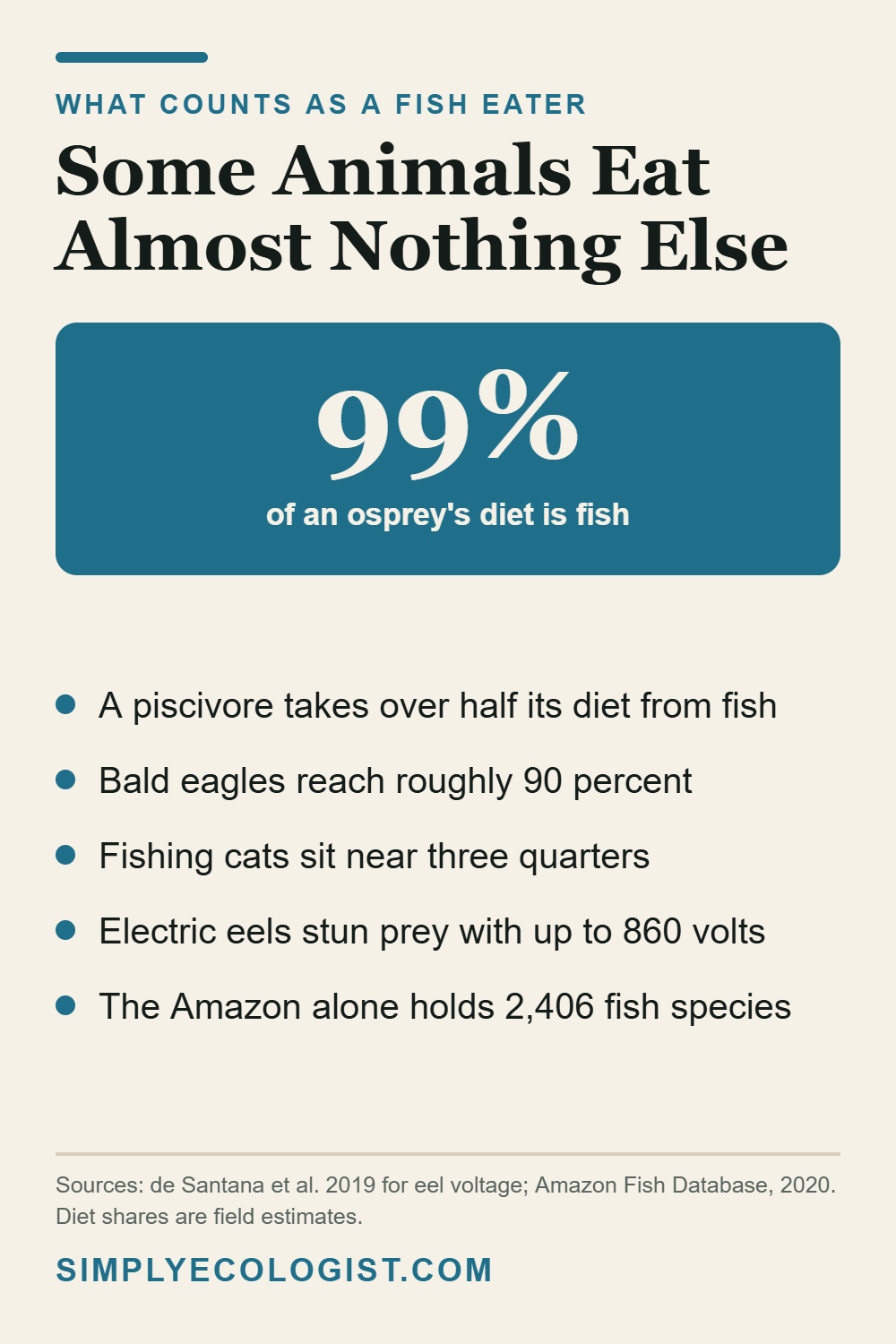
- Piscivores are animals whose diet is mainly fish, typically over 50%, like ospreys at 99% and bald eagles near 90%.
- Fish eaters share gripping and sensory adaptations: backward curving claws, foot spicules, reversible toes, nictitating membranes, and refraction correcting vision.
- Birds dominate the group: eagles snatch feet first, ospreys dive from 30 to 100 feet, herons wade motionless, kingfishers plunge headfirst at 25 mph.
- Pelicans scoop fish in gular pouches holding about three gallons, brown pelicans diving from 60 feet and white pelicans herding cooperatively.
- Penguins chase fish underwater at up to 22 mph, with emperors diving 500 meters and catching roughly six fish per minute.
What Makes an Animal a Fish Eater?
| Animal | Share of diet that is fish | How it catches them | Signature adaptation |
|---|---|---|---|
| Osprey | About 99 percent | Feet first dive from 30 to 100 feet | Outer toes reverse to grip both sides |
| Bald eagle | Up to 90 percent in salmon rivers | Snatches from the surface in flight | Talons close to two inches long |
| Great blue heron | Most of the diet | Stands motionless, then spears | About one pound of fish a day |
| Kingfisher | Most of the diet | Headfirst plunge from a perch | Enters the water near 25 mph |
| Brown pelican | Most of the diet | Plunge dive, then scoops | Pouch holds about three gallons |
| Emperor penguin | Most of the diet | Chases prey under sea ice | Dives to roughly 500 metres |
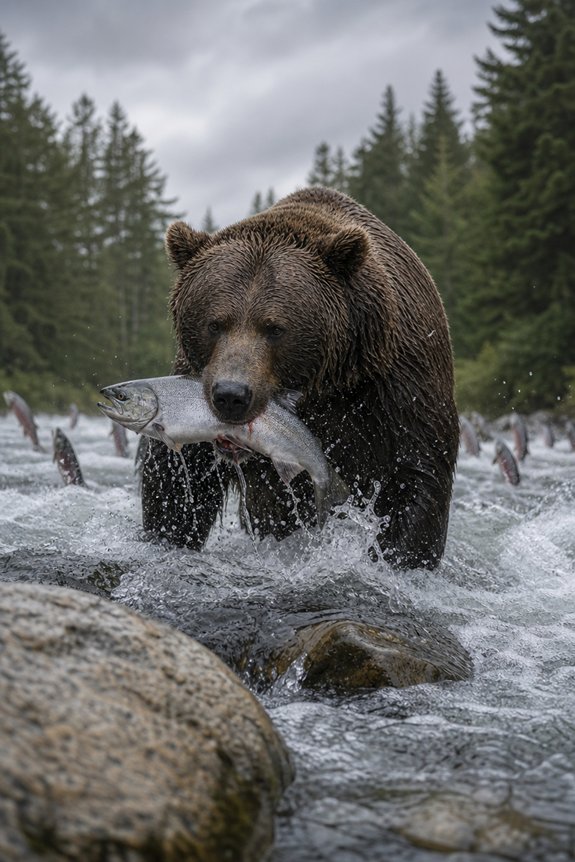
| Grizzly bear | Seasonal, during the run | Catches spawning salmon | Thirty or more fish in a day |
| River otter | Most of the diet | Underwater pursuit | Eight minutes on one breath |
| Fishing cat | About three quarters | Taps the surface to lure fish | Partly webbed paws |
| Greater bulldog bat | Most of the diet | Echolocation, then gaffs with claws | Detects ripples 2 mm high |
| Bottlenose dolphin | Most of the diet | Echolocation and cooperative herding | Up to 1,000 clicks a second |
| Electric eel | Most of the diet | Electric discharge | Up to 860 volts |
| Saltwater crocodile | Varies with age | Ambush, and herding in groups | Bite near 3,700 pounds of force |
| Sea snake | Eels and reef fish | Venom, then swallows headfirst | Around 70 species |
| Orca (resident populations) | Almost entirely, in fish eating populations | Cooperative pursuit with echolocation | Largest piscivore alive |
| Cormorant | Most of the diet | Underwater pursuit | Less waterproof feathers reduce buoyancy |
| Atlantic puffin | Most of the diet | Pursuit diving | Carries a row of fish crosswise in the bill |
| Common merganser | Most of the diet | Dives from the surface | Serrated bill grips like a bread knife |
Bald Eagles and Their Fish Snatching Talons
A bald eagle drops from its perch and hits the water feet first, snatching a fish without ever getting more than its legs wet. Its talons do the work. Each toe ends in a curved claw nearly two inches long, and rough pads called spicules grip slippery scales.Three features make the catch possible:- Grip strength estimated near 400 pounds per square inch, though no one has measured it directly.
- Eyesight often described as sharp enough to spot a fish half a mile away.
- A reversed rear toe that locks prey against the other three.
Ospreys, the Fish Hawks of Six Continents
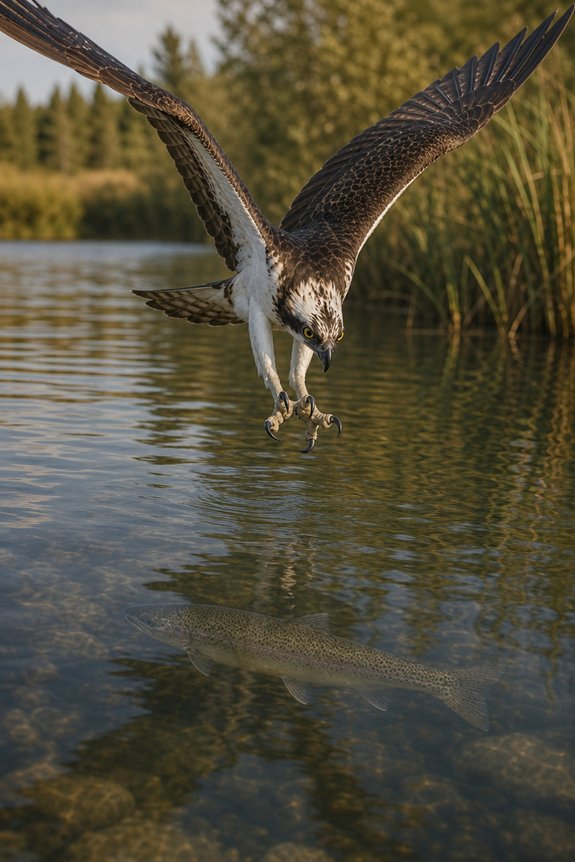
Ospreys hunt on every continent except Antarctica, which explains their other name: fish hawk. Fish make up about 99 percent of their diet. They hover 30 to 100 feet above water, then dive feet first and strike the surface hard. Their outer toes reverse, so they grip a slippery fish from both sides. Barbed pads called spicules line their soles, and a struggling fish can’t slide free.Ospreys also close a nictitating membrane, a clear third eyelid, to protect their eyes on impact. Dense oily feathers shed water when the bird lifts off again. Ospreys migrate thousands of miles.This wide range reflects biodiversity across a region. One species claims six continents. That’s an achievement worth a moment’s thought.Great Blue Herons That Spear Fish in Shallows
Patient Stalking Technique
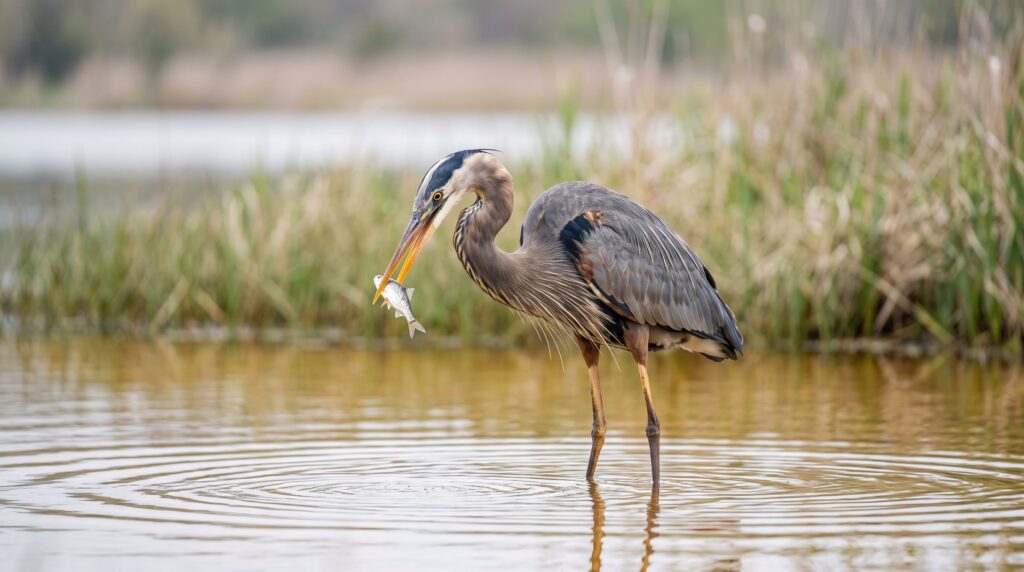
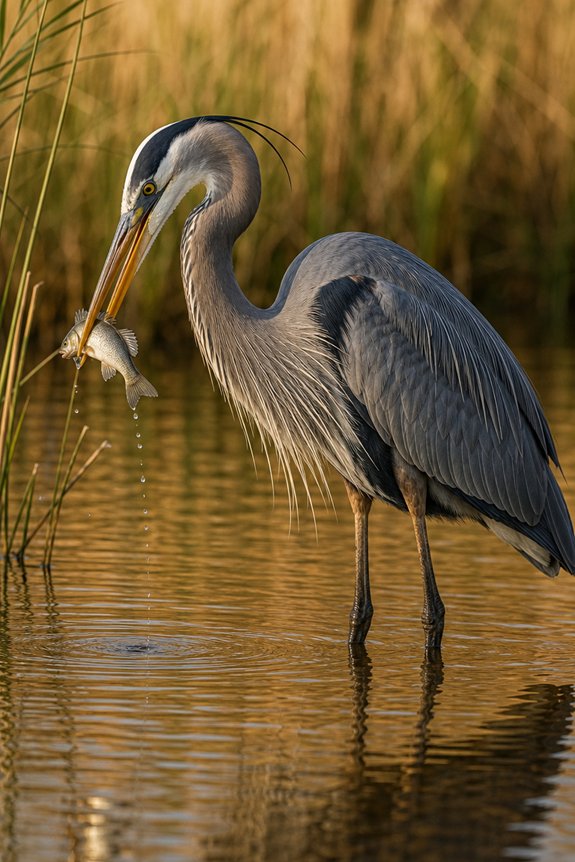
Standing perfectly still for minutes at a time, a great blue heron looks more like a piece of driftwood than a predator. That stillness is the strategy. Fish detect motion through the lateral line, a row of sensory pores along their sides that senses water movement. A motionless bird sends no signal.The hunt follows a predictable sequence:- The heron wades into water under a foot deep, moving one leg at a time.
- It freezes, neck folded, and waits for prey to drift within striking range.
- It uncoils its neck in under a third of a second, spearing or gripping the fish.
Lightning Fast Bill Strike
Uncoiling its neck, a great blue heron turns stillness into speed. The strike lasts under a third of a second, faster than a person can blink. Muscles in the S shaped neck store tension, then release it like a spring. The bill closes on the fish, though larger prey gets speared outright.Herons rely on binocular vision, meaning both eyes focus on one point to judge distance. Water bends light, so the bird corrects for that offset before striking. Adults swallow fish headfirst, letting the fins fold back instead of catching. A single heron can eat about a pound of fish a day. Even so, many strikes still miss their target. It’s a small reminder that patience and precision often matter more than raw strength.Kingfishers That Dive Headfirst for Fish
Precision Aerial Hunting Technique
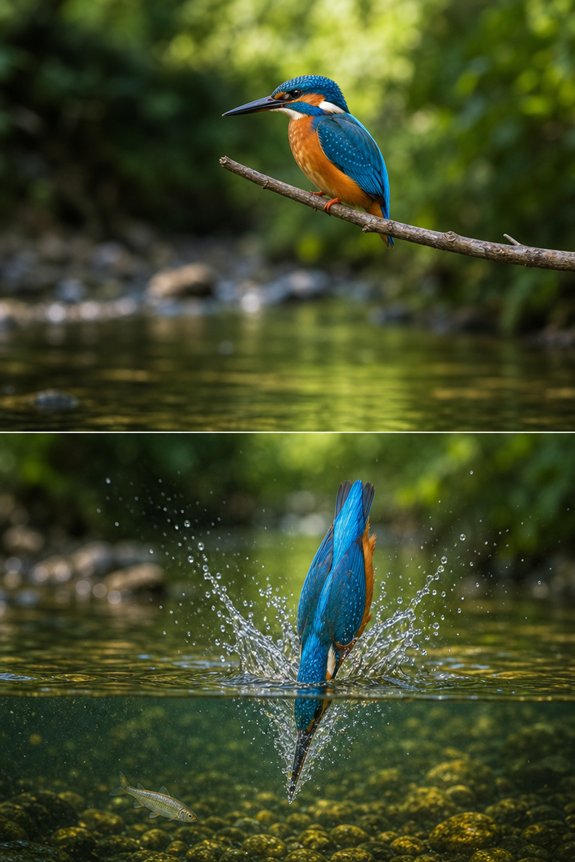
A kingfisher’s hunt begins long before the dive. The bird perches on a branch and watches the water below. It must correct for refraction, the bending of light as it passes from air into water, which makes a fish appear shallower than it is.Three steps define the strike:- The kingfisher hovers or perches, holding its head almost perfectly still.
- It folds its wings back and drops, entering the water at speeds near 25 miles per hour.
- A nictitating membrane, a clear third eyelid, slides over each eye for protection.
Specialized Beak and Vision
Look closely at the beak, and you’ll see a tool shaped by physics. It’s long, straight, and pointed, which lets it split water with almost no splash. A splash would scatter the fish.Vision matters just as much. A kingfisher’s eye holds two foveae, small pits in the retina, the light sensing layer at the back of the eye. One fovea handles clear vision in air, the other takes over underwater, where light bends and shifts an object’s apparent position. The bird switches between them mid dive.Water refracts light, so a fish looks displaced from its true spot, and the kingfisher corrects for that before striking. A clear third eyelid closes on impact, protecting the eye. It’s a small body that carries remarkable precision.Favored Riverside Hunting Perches
Perch choice shapes the whole hunt. A kingfisher hunts from a fixed spot, so the site must offer a clear view of shallow water. Most birds pick perches one to three meters above the surface. That height keeps the dive short and the aim accurate.Favored perches usually share three traits:- A bare branch or reed stem that overhangs slow, clear water.
- Shade behind the bird, which reduces glare and hides its outline from fish below.
- Nearby cover, such as a bank hollow or dense willow, for escape from hawks.
Pelicans and Their Built In Fishing Nets
When a pelican opens its bill underwater, it isn’t biting at fish so much as scooping them up. The lower bill holds a gular pouch, a stretchy flap of skin that expands like a net. In large species it can hold about three gallons of water, roughly two to three times what the stomach holds. The bird drains the water first, then swallows the fish whole.Brown pelicans dive from heights of 60 feet, stunning fish near the surface. American white pelicans work differently. They swim in coordinated lines and herd fish into shallow water, where scooping is easier. Both methods depend on schooling fish, so pelicans follow the water’s productivity. Watching a flock feed together, hunting looks less like a purely solitary act.Penguins That Chase Fish Through Icy Water
Penguins can’t fly, but they swim with real speed. Their tapered bodies and stiff flippers let some species reach 22 miles per hour, which is fast enough to run down fleeing prey.Beneath the ice, they hunt Antarctic silverfish and lanternfish, and their accuracy in that near darkness is genuinely remarkable.Streamlined Bodies Built for Speed
Diving beneath the ice, a penguin moves less like a bird and more like a small torpedo. Its body is fusiform, meaning thick in the middle and tapered at both ends. That shape reduces drag, the resistance water applies to a moving object. Streamlining saves energy too.Three features make this speed possible:- Stiff, flattened wings that work as flippers, pushing against water instead of air.
- Dense, overlapping feathers that trap a thin layer of air and smooth the surface.
- Solid, heavy bones, unlike the hollow bones most flying birds carry.
Hunting Techniques Beneath the Ice
Speed alone doesn’t fill a stomach. Penguins rely on tactics, and the ice above them shapes every hunt.Emperor penguins dive under sea ice to depths near 500 meters, and some stay submerged over twenty minutes. They hunt by looking up. Fish appear as dark shapes against the pale, sunlit underside of the ice, so the birds strike from below.Cracks and holes in the ice serve as breathing stations, which limits how far a penguin can range. Adélie penguins often forage (that means search for food) in groups, herding small fish and krill into tight clusters.Cameras attached to emperors have recorded roughly six catches per minute during good dives. Watching that footage, one gets a sense of how much practice such precision demands.Favorite Fish Species Targeted
Those catches aren’t random. Penguins favor fish that swim in dense schools, since chasing scattered prey burns more energy than it returns. Diet studies, which examine stomach contents, show clear patterns.- Antarctic silverfish, a slender polar fish, can make up over half of an Adélie penguin’s catch in some colonies.
- Lanternfish, small deep water fish with light producing organs, feed king penguins during long foraging trips.
- Anchovies and sardines support African and Humboldt penguins near coastal upwellings, where cold water rises and feeds plankton blooms.
Grizzly Bears and the Annual Salmon Run
River Otters, the Playful Fish Hunters
River otters usually hunt at dawn and dusk. Biologists call this crepuscular activity, meaning the animal stays busiest during twilight hours. Otters chase fish underwater and can hold their breath for about eight minutes. They eat two to three pounds of fish each day, mostly slow species like suckers and carp.A typical hunt looks like this:- The otter slips into the river, using its whiskers to sense movement in murky water.
- It corners a fish against rocks, then seizes it with sharp teeth.
- It surfaces and eats the fish headfirst on a log.
Fishing Cats and Other Fish Catching Felines
Most cats avoid water, but a few don’t. The fishing cat of South and Southeast Asia taps the water’s surface with a paw, imitating an insect, then snatches the fish that rises to investigate.Other species fish too, including the flat headed cat and the jaguar, and their methods deserve a closer look.Fishing Cat Hunting Techniques
Fishing cats hunt with a patience that looks almost deliberate.They crouch at the water’s edge and watch for movement below the surface.Their paws are partially webbed, meaning skin connects the toes, which aids swimming.A hunt usually follows three steps:- The cat taps the water lightly, mimicking insect movement, which draws curious fish closer to the surface.
- It waits motionless, sometimes for several minutes, tracking ripples with its eyes and whiskers.
- It strikes with a paw or plunges its head underwater, seizing the fish in its sharp teeth.
Other Fish Catching Cat Species
They aren’t the only cats that fish. The flat headed cat, a small species found in Borneo and Sumatra, hunts along streams at night. Its teeth angle backward, which helps it hold slippery prey. Researchers found fish in roughly three quarters of the stomachs they examined. Jaguars also fish, though they weigh up to 250 pounds. They swat fish from shallow water and sometimes hunt caiman and turtles. Tigers in the Sundarbans mangroves take fish and crabs when deer are scarce. Even domestic cats will scoop water for goldfish.These habits depend on wetlands, and wetlands they’re steadily shrinking worldwide. Watching a cat wait beside water, one senses how long these behaviors took to form.Raccoons That Grab Fish From the Riverbank
Raccoons wade into shallow water after dark, feeling around the streambed with their front paws for anything that moves. Their paws hold about four times more touch receptors than their hind feet, and they don’t need to see a fish to identify it. This makes them tactile foragers, meaning animals that hunt mainly by feel.A typical riverbank hunt follows three steps:- The raccoon walks the edge, pausing where water slows behind rocks.
- It dips both front paws in and sweeps them along the bottom.
- It pins a minnow or crayfish against the mud, then lifts it out.
Fishing Bats and Their Fish Detecting Sonar
Echolocation Above Water Surfaces
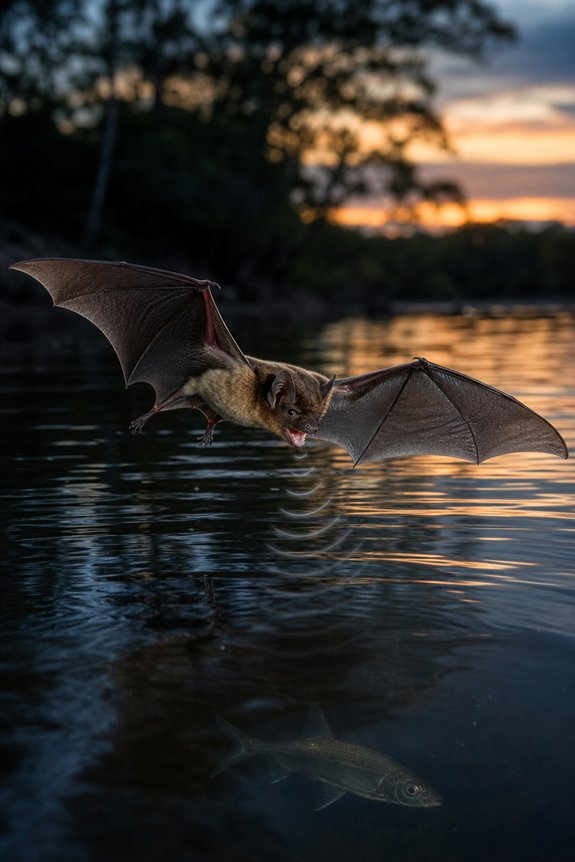
While most predators rely on sight to find fish, some bats hunt by listening to their own voices. Echolocation means sending out sound pulses and reading the echoes that bounce back. Calm water acts like a mirror, so sound slides across it and returns almost nothing. A fin or ripple breaks that pattern. The bat hears the difference and strikes.Researchers have measured what these bats detect:- Ripples as small as 2 millimeters high on an otherwise flat surface.
- Fins protruding just a few millimeters above the waterline.
- Prey located from roughly 30 to 50 centimeters above the water.
Specialized Claws and Feet
Detection is only half the hunt. A fishing bat still has to grab a slippery target moving beneath the surface. Its hind feet do that work. The greater bulldog bat has feet and claws far larger than those of insect eating bats, and its curved claws work like small hooks, or gaffs.The bat drags them through the water for a short stretch, sometimes a metre or more, then lifts the fish to its mouth. Long calcars, spurs of cartilage at the ankle, help spread the tail membrane clear of the water. The fish eating myotis of Mexico hunts the same way, taking prey up to eight centimetres long. The claws hold, the wings never stop beating. It’s a small set of tools, and it works.Dolphins That Hunt Fish With Echolocation
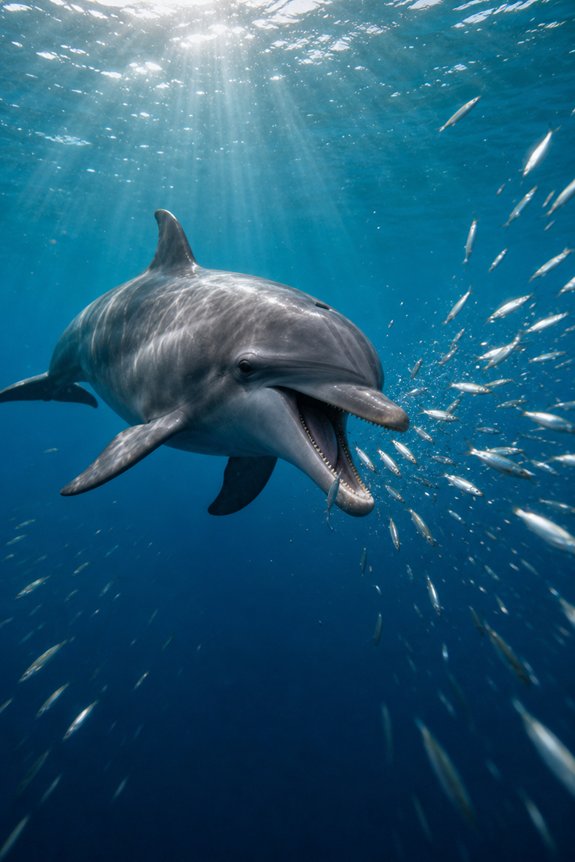
- The dolphin releases clicks from an organ in its forehead called the melon.
- Sound waves travel through water and strike a fish, then reflect back.
- The lower jaw receives the echoes and passes them to the inner ear.
Orcas, the Fish Eaters People Forget
Orcas have a reputation for hunting seals and whales, and some of them do. But whole populations eat almost nothing but fish, and they are the largest piscivores alive.The split runs along population lines rather than species lines. Resident orcas in the North Pacific are fish specialists. Southern Resident killer whales feed almost exclusively on Chinook salmon in summer, then broaden in winter and spring to chum and coho salmon, steelhead, halibut, lingcod and skates. Transient orcas in the same waters eat marine mammals and largely ignore fish.Their method is cooperative. Residents hunt in family groups, use echolocation to pick individual salmon out of open water, and share catches, which is unusual among fish eaters.The specialisation carries a cost. A population that eats one salmon species rises and falls with that species, and the Southern Residents are endangered largely because Chinook stocks have declined. Watching a fish eater that cannot switch prey, one sees how narrow expertise becomes a liability.Seals and Sea Lions Running Down Fish
Seals and sea lions chase their food down. They’re called pinnipeds, a group that includes seals, sea lions, and walruses. Speed does most of the work. California sea lions reach about 25 miles per hour in short bursts, which is fast enough to overtake anchovies and herring.Seals depend on their whiskers too. These stiff hairs, called vibrissae, sense the faint water movement a fleeing fish leaves behind, so a seal can track prey in dark or murky water. A harbor seal eats roughly 10 pounds of fish daily.Sea lions often hunt in groups. Several animals will herd a school of fish into a tight ball, then take turns feeding at the edges. Their hunting looks effortless, but it actually takes real endurance.Great White Sharks and Their Fish Heavy Diet
Those same seals become prey themselves, and the hunter they fear most is the great white shark.Still, fish make up most of a young great white’s diet. Juveniles under about 10 feet long feed mainly on rays, smaller sharks, and bony fish like hake and mackerel. Their teeth are narrow and pointed, built for gripping slippery bodies rather than tearing blubber.A typical hunt unfolds in three stages:- The shark cruises below its target, using dark coloring to stay hidden.
- It accelerates upward, reaching speeds near 25 miles per hour.
- It seizes the fish and swallows smaller prey whole.
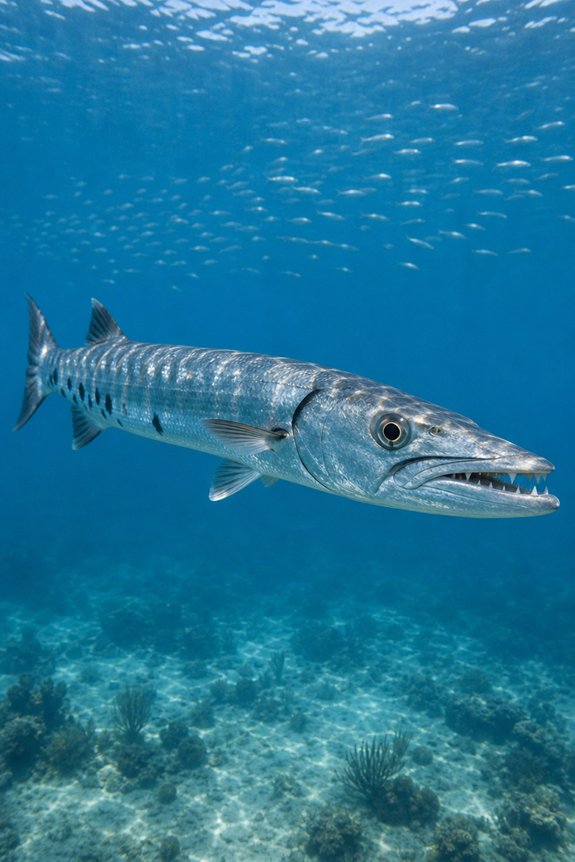
Barracuda, Pike, and Other Fish Eating Fish
Electric Eels That Shock Fish Into Stillness
Electric eels turn water itself into a weapon. They aren’t true eels. They’re knifefish native to South America’s Amazon and Orinoco basins. Most of an eel’s body holds electrocytes, cells stacked like batteries. One species, Electrophorus voltai, can discharge up to 860 volts, the highest ever recorded from a living animal. Enough to stun a horse.Researchers describe a hunting sequence with three parts:- A pair of high voltage pulses makes hidden fish twitch, revealing their location.
- A rapid volley locks the prey’s muscles, a condition called tetanus, meaning the muscles contract and can’t release.
- The eel swallows the motionless fish whole, usually within a second.
Crocodiles and Alligators That Snap Up Fish
Crocodilians take the opposite approach. They don’t stun their prey, and they rely instead on patience, camouflage, and sudden force. A saltwater crocodile’s bite has been measured at about 3,700 pounds of force, the strongest ever recorded in a living animal. Fish caught in that grip rarely escape.Many species use a hunting method called herding, which means driving fish into shallow water where escape routes narrow. American alligators do this in groups. Nile crocodiles sometimes form loose lines across a channel, then snap sideways as fish bump against their jaws. Their teeth interlock, gripping slippery bodies rather than slicing them. That grip is only half the story, since crocodile bite force is what makes escape so unlikely.Young alligators eat mostly small fish, insects, and snails. Adults take much larger prey. It’s worth noting how much of this behavior looks deliberate, even planned, in animals often dismissed as simple.Sea Snakes That Paralyze Fish With Venom
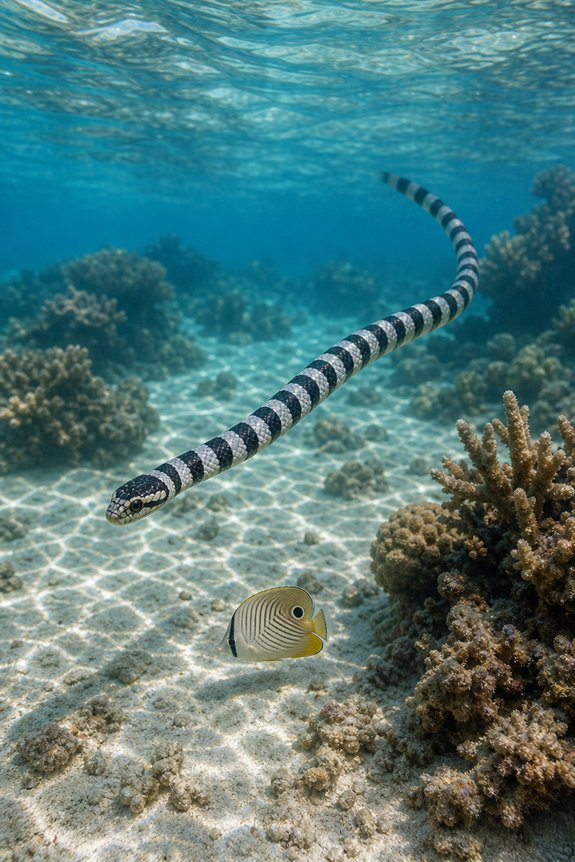
- The snake pushes its head into a reef crevice, searching for hidden prey.
- It bites once, releasing venom through short, fixed fangs.
- It waits for paralysis, then swallows the fish headfirst.
Other Birds That Live Almost Entirely on Fish
Several groups deserve at least a mention, since each solves the same problem differently.- Cormorants and anhingas swim underwater and chase fish down, then stand with wings spread to dry feathers that are deliberately less waterproof than most birds carry.
- Puffins hold a row of small fish crosswise in the bill, gripped by a hinged tongue against backward facing spines on the palate.
- Loons and mergansers dive from the surface; mergansers have serrated bills, which grip a fish the way a bread knife grips bread.
- Gulls and terns take fish from the surface, and gulls will steal from anything smaller than them.
- The shoebill stands motionless like a heron and drops its whole head onto lungfish.
Where the World’s Biggest Fish Eaters Live
Across the tropics, fish eating predators cluster where the water holds the most life. Biologists call this biodiversity, meaning the number of different species living in one place. The Coral Triangle, spanning Indonesia, Malaysia, Papua New Guinea, the Philippines, the Solomon Islands and Timor Leste, holds 2,228 reef fish species. Sea snakes, sea eagles and reef sharks all hunt there.The Amazon basin supports 2,406 validated freshwater fish species. Giant otters, caimans and river dolphins feed on them daily.Cold water matters too. Alaska’s salmon runs draw brown bears, bald eagles and seals each summer, sometimes thousands of animals to a single river.Africa’s Rift Valley lakes hold hundreds of cichlid species, and cormorants and otters follow. It’s worth remembering that these hunters don’t choose these places by chance. Food supply decides where they live.Why Fish Eaters Matter, and What Builds Up in Them
Fish eaters sit near the top of aquatic food chains, and that position has two consequences worth understanding.The first is control. Remove the top predator from a lake or a river and prey fish multiply, graze down the invertebrates below them, and the whole system shifts. Ecologists call this a trophic cascade, meaning a change at the top that ripples down through every level beneath.The second is accumulation. Mercury and similar pollutants concentrate as they move up a food chain, so a predator eating thousands of fish over a lifetime carries far more than any single fish did. Biologists call this biomagnification. It is why ospreys, otters and large predatory fish are monitored as indicators of water quality, and why advice about eating large predatory fish exists at all.A healthy fish eating population is a reasonable proxy for a healthy waterway. That is the practical reason to count them.Final Thoughts
Fish eaters work as living gauges. Each osprey or heron measures the water it hunts, since clean rivers hold fish, and fish hold predators. Scientists track this through biodiversity. When eagles disappear from a lake, the loss usually began below the surface. That’s worth remembering. A heron standing still in the shallows isn’t only hunting. It’s reading the water, and people can learn to read it too.
Erzsebet Frey (Eli Frey) is an ecologist and online entrepreneur with a Master of Science in Ecology from the University of Belgrade. Originally from Serbia, she has lived in Sri Lanka since 2017. Eli has worked internationally in countries like Oman, Brazil, Germany, and Sri Lanka. In 2018, she expanded into SEO and blogging, completing courses from UC Davis and Edinburgh. Eli has founded multiple websites focused on biology, ecology, environmental science, sustainable and simple living, and outdoor activities. She enjoys creating nature and simple living videos on YouTube and participates in speleology, diving, and hiking.
From the shop
Gifts for people who love the wild
Wildlife themed t-shirts, notebooks, tote bags, bandanas and guides, designed by an ecologist.
Visit the shop