

Quick answer: An ESG analyst evaluates companies on environmental, social, and governance criteria, using data platforms like Bloomberg ESG and MSCI to build scores that guide investment decisions. You typically need a finance or environmental degree, skills in Excel, SQL, and Python, and a certification such as CFA ESG or CESGA. Pay runs from about £35k (UK entry) to €60k to €90k+ (senior Europe), with US roles averaging near $71,500. Demand is rising fast as sustainability reporting rules expand.
You’ll evaluate companies across environmental, social, and governance criteria, essentially how well they manage climate impact, worker treatment, and ethical leadership, using data from Bloomberg ESG and MSCI to build scores that guide investment decisions.
Your days blend quantitative analysis with qualitative judgment: you’ll verify emissions data, track regulations like the EU’s reporting rules, and translate complex findings into clear recommendations for fund managers or corporate leaders.
Starting salaries in London range from £35,000 £53,000, while senior roles across Western Europe typically reach €60,000 €90,000, with certifications like CFA ESG or CESGA boosting your market value considerably.
Progression leads toward strategic positions, Head of ESG or Chief Sustainability Officer, where you’ll shape long-term sustainability programs after proving impact through early, measurable wins.
The work demands ethical clarity, diplomatic persistence, and comfort with incomplete data, but those who build trust through visible results find themselves steering broader organizational change.
What follows unpacks the daily rhythms, sector trade offs, and practical steps for entering this field.
Key Takeaways
- ESG analysts evaluate companies across environmental, social, and governance criteria using Bloomberg ESG, MSCI, and corporate disclosures to guide investment decisions.
- Sustainability analysts focus on operational interventions like carbon footprint reduction and energy efficiency, often holding environmental science backgrounds.
- Asset management roles offer higher pay but greater pressure, while corporate positions provide steadier advancement and longer term ownership of initiatives.
- Career progression requires 8+ years to reach senior roles like Chief Sustainability Officer, with advancement tied to delivering measurable early wins.
- Key certifications include CFA ESG, CESGA, and SASB FSA, which materially boost market value alongside skills in Excel, SQL, and Python.
What Does an ESG Analyst Actually Do?

If you’ve ever wondered how investors decide whether a company is truly responsible, or simply greenwashing, you’re already touching on the work of an ESG analyst.
You’ll evaluate companies across environmental, social, and governance criteria, things like carbon emissions, board diversity, and supply-chain ethics, using corporate disclosures, third-party databases such as Bloomberg ESG or MSCI, and industry benchmarks. You perform both quantitative and qualitative analysis, integrating findings with financial metrics to identify risks and opportunities, and you create scores or written reports that guide investment decisions.
Your daily tasks include collecting and verifying data, tracking regulatory changes like TCFD or EU reporting rules, and monitoring portfolio companies. You’ll conduct stakeholder interviewing, apply scenario modelling to forecast transformation risks such as carbon pricing exposure, and communicate recommendations that shape corporate strategy and sustainable product development.
ESG Analyst vs. Sustainability Analyst: What’s the Difference?
You’ve likely noticed job titles that sound nearly identical, ESG analyst here, sustainability analyst there, and perhaps you’ve wondered whether they represent the same path with different packaging, or genuinely distinct roles. The difference lies in where you focus your energy and whom you serve: ESG analysts evaluate companies using standardized metrics, GRI, SASB, TCFD, to guide investment decisions, tapping into investor psychology about risk and return, while sustainability analysts design operational interventions, like reducing carbon footprints and improving energy efficiency, embedded within corporate teams.
There’s operational overlap, certainly, you’ll find both roles analyzing data and reporting on environmental impact, but your tools and training diverge. ESG analysts lean on finance degrees and credentials like CFA ESG or CESGA, using databases such as Bloomberg ESG and MSCI, whereas sustainability analysts often carry environmental science backgrounds with technical carbon accounting skills.
Is the ESG Analyst Role Right For You?
How, then, do you know whether this path truly suits you? Start with values alignment, ask yourself if you genuinely care about measuring environmental and social impact alongside profit, because you’ll spend hours buried in data collection, statistical modeling, and benchmarking using tools like Excel, Bloomberg ESG, or MSCI.
Your career fit depends on tolerating rapid regulatory change and continuous learning, as disclosure standards evolve constantly. Consider your personality traits: do you enjoy translating complex findings into clear recommendations, and can you engage stakeholders patiently?
Think about work life balance too, early deadlines and market pressures can stretch your hours, though specialization after 3 8 years brings more control. If quantitative thinking, ethical conviction, and adaptability describe you, this role welcomes your contribution.
Asset Management, Corporate or Consultancy: Which Sector Fits You?

Once you’ve considered which setting suits you, the three main environments differ sharply: asset management, corporate teams, and consultancy.
In asset management, you’ll focus on investment stewardship: scoring companies using data providers like MSCI, advising fund managers on portfolio risks, and engaging directly with corporations you invest in. It’s where financial materiality meets purpose, though the pressure runs high.
Corporate roles ground you in operational reality, measuring emissions, auditing suppliers, building internal policies, offering steadier ladders and longer-term ownership of change.
Consultancies deliver the steepest learning curves: you’ll advise many clients on disclosures and changeover plans, gaining breadth fast, yet swapping stability for career mobility and faster promotion potential.
Ask yourself: do you crave portfolio impact, operational depth, or varied advisory intensity?
How to Become an ESG Analyst (Even With Zero Experience)
Breaking into ESG analysis without prior experience is entirely possible, what matters most is building a credible foundation through intentional steps, rather than waiting for permission. You begin with a relevant bachelor’s degree, finance, environmental science, economics, or sustainability, and strengthen it with a short professional certificate, such as the CFA Certificate in ESG Investing, which demonstrates core competencies to employers.
These entry pathways multiply when you build a practical portfolio: seek internships, volunteer roles, or pro-bono projects like carbon footprint calculations or sustainability reporting support, creating tangible evidence of your capabilities. You learn key frameworks (GRI, SASB/ISSB, TCFD, and UN SDGs) alongside tools like Bloomberg ESG or MSCI, and you develop quantitative skills in Excel, Power BI, or basic Python. Network deliberately, target junior roles across sectors, and highlight your transferable experience with quiet confidence.
What Do ESG Analysts Earn? UK and Global Salary Breakdowns
While salaries are never the full measure of a career’s worth, understanding what ESG analysts earn helps you navigate your path with clear-eyed confidence, and you’ll find that compensation reflects both your growing expertise and the market’s deepening commitment to sustainable finance.
In London, you’ll typically start around £35,000 £53,000 with under five years’ experience, though this stretches to £82,000 depending on your employer and benefits package.
Across Western Europe, senior roles (eight-plus years) generally pay €60,000 €90,000, with top positions exceeding this in major financial centres.
In the US, you’ll see average pay near $71,500 (some sources cite up to $86,000), ranging from roughly $60,000 to over $150,000 based on sector and location.
Salary transparency remains limited, yet regional disparities are pronounced, asset management and green finance consistently outpay corporate sustainability or NGO tracks.
Your certifications, particularly CESGA or CFA ESG credentials, and quantitative abilities materially boost your market value.
| Region | Entry level | Senior (8+ years) |
|---|---|---|
| UK (London) | £35k to £53k | Up to £82k+ |
| Western Europe | €35k to €45k | €60k to €90k+ |
| United States | $60k to $85k | $90k to $150k+ |
Technical Skills ESG Analysts Actually Use

At your desk you sift through thousands of data points that reveal a company’s true impact, and this is where your technical toolkit becomes indispensable.
You’ll clean raw data in Excel, using pivot tables, lookups, and macros to find patterns, then query vast emissions datasets with SQL, a language that lets you ask specific questions of complex databases. Data lineage matters here: you must trace each figure to its original source, ensuring you understand exactly where numbers come from and what they mean. Automated validation becomes your safeguard, catching errors before they reach investors. You’ll navigate platforms like Bloomberg ESG and MSCI to pull standardized scores, map disclosures to frameworks, GRI, SASB/ISSB, TCFD, and build dashboards in Tableau or Power BI that make trends visible, turning complexity into clarity.
Communication and Judgment: The Soft Skills That Matter
Your technical skills get the data right, but it’s your human judgment that makes it matter. You translate carbon metrics, those detailed measurements of greenhouse gas emissions, including Scope 1 3 (direct operations, purchased energy, and supply chain), into clear messaging that investors and board members actually grasp. You’re drafting TCFD-aligned reports (climate financial disclosures), explaining material risks to non-specialists, and knowing when complexity obscures rather than enlightens.
Ethical judgment anchors every recommendation: you spot greenwashing, false sustainability claims, maintain independence when rating corporate practices, and navigate incomplete data with quiet confidence. You weigh reputational risk, regulatory implications like the EU Corporate Sustainability Reporting Directive, and materiality, what actually matters financially, while negotiating across departments.
Your diplomacy secures data access. Your persuasion drives policy change. These soft skills aren’t secondary; they’re how you build trust, preserve credibility, and make certain your analysis shapes real decisions.
ESG Analyst Certifications Worth Getting
Building credibility in this field means staking your claim with credentials that signal more than good intentions, they show tested competence.
You’ll find several credential pathways worth your consideration, each serving different specializations within ESG work. The EFFAS Certified ESG Analyst (CESGA) offers practical investing skills recognized across Europe, while the CFA Institute Certificate in ESG Investing, requiring roughly 130 hours of study, helps you weave environmental, social, and governance factors into financial analysis globally.
For risk-focused roles, GARP’s Sustainability and Climate Risk Certificate teaches you to assess climate-related financial dangers using scenario analysis, which is a method for imagining different future conditions.
The SASB FSA Credential provides sector-specific guidance on materiality, identifying which ESG issues actually affect company performance.
Don’t overlook microcredentials value: shorter programs like the CFA UK Certificate in Climate and Investing deliver targeted expertise without demanding months of preparation, letting you build competence incrementally as your career evolves.
ESG Data Platforms and Frameworks Explained
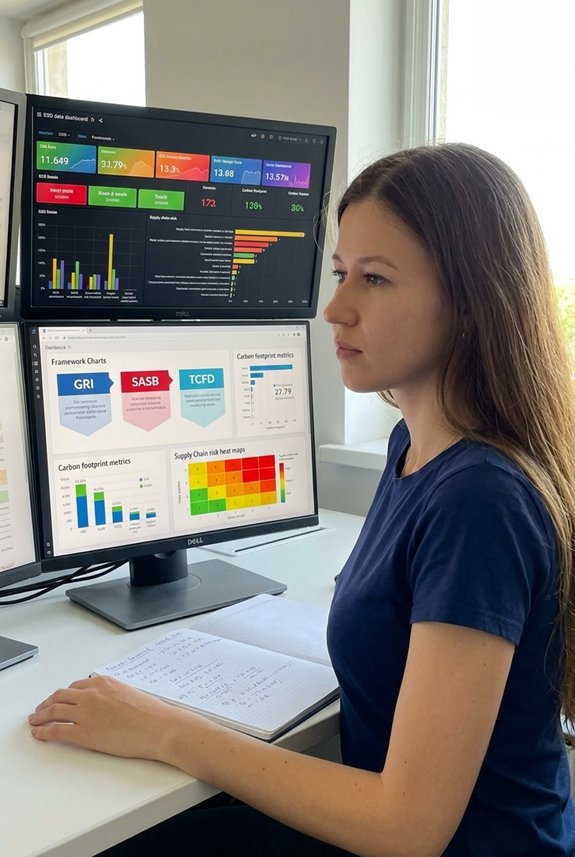
Because the ESG landscape shifts constantly beneath your feet, you’ll need reliable maps to navigate it, frameworks that organize scattered information into coherent stories, and platforms that transform raw data into insight you can act upon.
You’ll work daily with Bloomberg ESG, MSCI, Sustainalytics, or Refinitiv, each platform’s methodologies differ: MSCI weighs controversies, Sustainalytics measures unmanaged risk, Bloomberg blends ESG with financial data. Learn GRI for stakeholder disclosure, SASB/ISSB for investor materiality, and TCFD for climate risks, these are your compass points.
Data interoperability matters deeply: you’ll map GRI to SASB, tag against UN SDGs, or use XBRL taxonomies so information flows cleanly between systems. Supplement platform scores with satellite imagery, supplier records, and your own Python or Excel models to fill gaps and verify lineage.
How Analysts Work With SFDR, TCFD and CSRD
While frameworks like GRI and SASB give you the vocabulary to speak about sustainability, regulations like SFDR, TCFD, and CSRD are the grammar rules that bind your words into accountable action, standards you’re expected to follow, not merely consider.
Through SFDR integration, you’ll classify financial products as Article 6, 8, or 9, categories that determine how deeply sustainability is woven into investment strategies, while disclosing Principal Adverse Impacts, those specific harms investments might cause to people or planet.
For TCFD alignment, you’ll practice Scenario modelling: running projections against 2°C or 1.5°C warming pathways, translating abstract climate futures into concrete financial risks.
Under CSRD, you’ll gather double-materiality data, information showing both how sustainability issues affect companies and how companies affect society, building audit-ready pipelines for European Sustainability Reporting Standards.
You’re weaving these threads together, creating coherent narratives that satisfy regulators and investors alike.
A Day in the Life: From Morning Data Pulls to Client Meetings
Before the coffee’s gone cold, you’re already deep in dashboards, checking overnight data feeds that tell you whether a company’s carbon footprint spiked or if a new diversity disclosure shifted a supplier’s risk profile.
These morning rituals ground your work: quality-checking emissions data, flagging anomalies, and updating models that track how portfolio companies might fare under climate stress tests, which are scenarios that simulate future risks like rising temperatures or carbon taxes.
Why ESG Analysts Burn Out (and How to Avoid It)

Although the work can feel meaningful, connecting capital to cleaner energy, fairer labor practices, stronger governance, you’re also carrying a load that few job descriptions fully capture: the endless spreadsheets, the midnight scrambles when a new regulation drops, the quiet weight of knowing that your recommendations might help or harm real communities.
Role ambiguity feeds this exhaustion, as you’re often expected to jump between data modeling, stakeholder calls, and policy drafting without clear boundaries. You witness systemic harm, climate damage, labor exploitation, yet face pressure to soften findings for profit-minded clients, a tension that cultivates moral injury.
Fragmented data tools, meaning software that doesn’t connect smoothly, force tedious manual work that stretches 50-hour weeks further. To protect yourself, seek employers who automate repetitive tasks, define your scope clearly, and respect your time, your well-being sustains the work.
Senior ESG Roles: Where This Career Leads
If you’ve spent even a few years in ESG, poring over emissions data, negotiating reporting deadlines, explaining to skeptical colleagues why sustainability matters, you’re probably wondering what comes next, and whether the effort you’ve invested will open doors worth walking through.
Your path likely leads to titles like Head of ESG, ESG Director, or Chief Sustainability Officer, roles requiring 8+ years of deep expertise in frameworks like GRI and TCFD, which are standardized ways companies report their environmental and social impacts.
You’ll drive strategy across operations, manage analyst teams, and deliver Board Reporting that translates complex metrics into decisions executives actually use.
Your voice grows louder in Regulatory Lobbying, shaping how rules like the EU’s CSRD unfold, and you’ll find growing demand in Private Equity, where ESG due diligence directly shapes billion-dollar deals.
The Executive shift rewards those who’ve built cross-functional fluency: finance, risk, supply chain. Credentials like the CFA ESG Certificate or CESGA accelerate this climb.
European senior roles pay €60k €90k, with executive compensation exceeding €100k, far more in major financial centers.
You’ve already done the hard part; now the work scales with your influence.
Your First 90 Days: What New ESG Analysts Should Prioritize
You’ve seen where this path can lead, now you’re standing at its beginning, and those first weeks will shape everything that follows.
Treat onboarding rituals as foundations, not paperwork: master your company’s ESG disclosures, those public reports on environmental and social performance, and trace how Scope 1 3 emissions (direct and indirect carbon outputs) are calculated, so you can reproduce baseline metrics with confidence.
Cultivate stakeholder empathy by week six, mapping internal colleagues in legal, procurement, and HR alongside external voices like investors and suppliers, then identifying which ESG issues truly matter to them, this materiality check steers your priorities.
Prioritize data governance next: clean and validate core datasets in Excel, Python, or Power BI, documenting every assumption so audits reveal clarity, not confusion.
Finally, pursue quick wins, perhaps a supplier risk triage or energy-efficiency project, to demonstrate measurable impact within months, building trust that carries you forward.
About this guide: salary and regulatory figures are drawn from public sources including the Corporate Governance Institute, the CFA Institute, and the European Commission. Pay varies widely by market, employer, and year, so treat these figures as ranges and check current job postings. This guide is written for ecology and environmental-science readers exploring finance-adjacent careers.
Frequently Asked Questions
What does an ESG analyst do?
An ESG analyst evaluates companies on environmental, social, and governance criteria, collecting and verifying data, scoring companies using platforms like Bloomberg ESG and MSCI, and writing recommendations that guide investment or corporate strategy.
What qualifications do you need to become an ESG analyst?
Most roles expect a bachelor’s degree in finance, economics, environmental science, or sustainability, plus a certificate such as the CFA Certificate in ESG Investing or CESGA, and skills in Excel, SQL, and Python.
How much do ESG analysts earn?
UK roles start around £35k to £53k and reach £82k+; senior Western European roles pay €60k to €90k+; US roles average near $71,500, ranging from about $60k to over $150k by sector and seniority.
What is the difference between an ESG analyst and a sustainability analyst?
ESG analysts evaluate companies with standardized metrics to guide investment decisions, often from a finance background. Sustainability analysts design operational changes like cutting carbon footprints, usually from an environmental science background.
Is demand for ESG analysts growing?
Yes. Demand has risen sharply as disclosure rules such as SFDR, TCFD, and CSRD expand, increasing the need for analysts who can produce audit-ready sustainability data.

Erzsebet Frey (Eli Frey) is an ecologist and online entrepreneur with a Master of Science in Ecology from the University of Belgrade. Originally from Serbia, she has lived in Sri Lanka since 2017. Eli has worked internationally in countries like Oman, Brazil, Germany, and Sri Lanka. In 2018, she expanded into SEO and blogging, completing courses from UC Davis and Edinburgh. Eli has founded multiple websites focused on biology, ecology, environmental science, sustainable and simple living, and outdoor activities. She enjoys creating nature and simple living videos on YouTube and participates in speleology, diving, and hiking.
For your next application
Keep applying and hearing nothing back?
The Biology Job Application Kit shows you which stage of your applications is failing and how to fix it. 46 guides, 22 editable templates, an application tracker and an ATS CV Creator licence.
See the Job Application Kit