
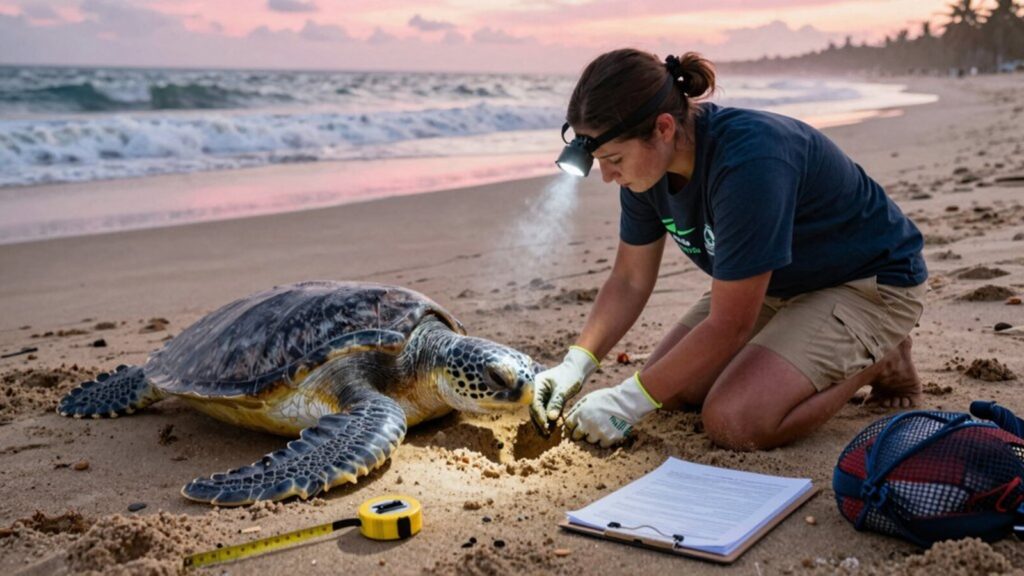
Costa Rica’s sea turtle conservation internship places volunteers on Junquillal Beach, where they walk rotating four-hour nightly patrols from 7:00 PM to 4:00 AM, guide nesting Olive Ridleys and Leatherbacks between sand and surf, relocate threatened clutches to protected hatcheries, and steer disoriented hatchlings away from artificial light. The all-inclusive program runs year-round, though August through October brings peak nesting activity, and placements span two to twelve weeks with shared housing, three daily meals, on-site training, and airport transfers included—while those who explore further will discover eligibility requirements, daily schedules, and the conservation threats volunteers help counter.
What Is the Costa Rica Sea Turtle Conservation Internship?
How does one step into the work of sea turtle conservation in a meaningful, hands-on way? The Costa Rica Sea Turtle Conservation Internship offers a structured entry point—a premium, all-inclusive volunteer placement with a vetted organization on Junquillal beach.
Interns protect nesting turtles and their hatchlings through direct fieldwork: evening and night shifts from 7:00 PM to 4:00 AM that include four-hour beach patrols, hatchery maintenance, nest relocation, and guiding mothers and hatchlings safely to and from the shore.
The program runs year-round, with peak activity from August to October when volunteers may encounter hundreds of turtles.
Each participant receives on-site training, an assigned Trip Coordinator, and continuous local supervision, ensuring both readiness and support throughout the experience.
Where You’ll Volunteer: Junquillal Beach Location
The Pacific coastline of Costa Rica curves northward from the country’s most famous surf towns and resort areas into quieter stretches of sand where conservation work takes precedence over tourism—and it’s here, at Junquillal Beach in the Guanacaste province, that volunteers begin their hands-on work protecting nesting sea turtles.
Volunteers arrive via San José, spending one night in San Ramón before reaching the project base on Day 2, where they’ll settle into shared houses near the beach—typically two to three people per room, six to eight per house. A local cook prepares three daily meals featuring fresh Costa Rican ingredients, while mornings remain free for rest or exploration.
The real work unfolds at night: beach patrols during evening and late-night shifts, nest monitoring, and guiding mothers and hatchlings safely back to sea.
How Long Most Volunteers Stay: 2 to 12 Weeks
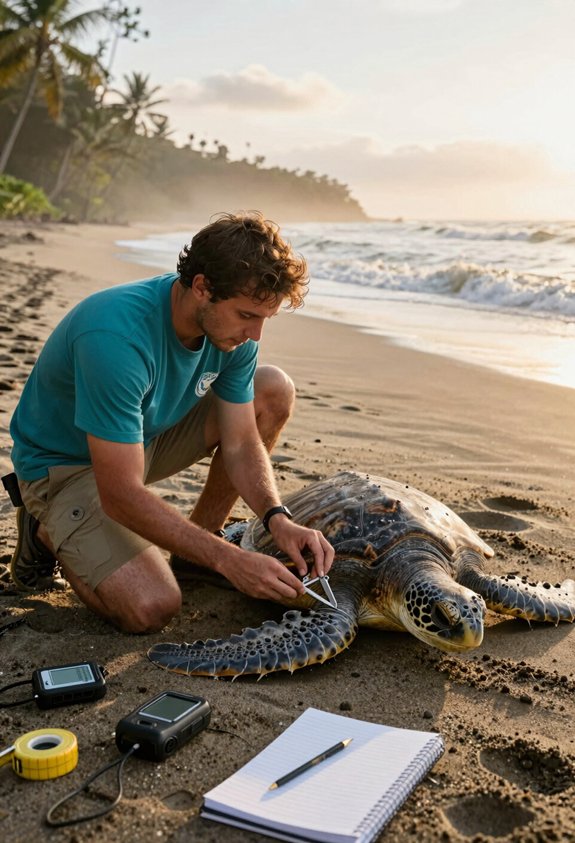
Once volunteers arrive and settle into the rhythm of beach patrols and shared meals, they’ll naturally begin to wonder how much time they need to make their contribution meaningful—and the answer depends on both personal schedules and conservation goals. Placements run from two up to twelve weeks, offering clear boundaries for planning.
Most participants choose three to four weeks, a duration that suits gap-year travelers seeking substantial involvement without extended commitment. Two-week stays provide short-term visitors a genuine taste of nest protection and hatchery work, while longer placements—approaching twelve weeks—allow deeper engagement with project continuity and seasonal patterns.
The program remains flexible: many extend their time on-site or combine conservation work with further travel throughout Costa Rica and neighboring countries, shaping experiences around personal timelines.
You’ll get $100 off automatically, and by adding the additional code ELI100 at checkout, you can save an extra $100, for a total of $200 off your Global Work & Travel wildlife internship adventure.
Best Time to Volunteer: August to October Peak Season
Timing one’s arrival to coincide with peak nesting season transforms a volunteer’s experience from educational to truly immersive, and for sea turtle conservation in Costa Rica, that window opens in August and closes at October’s end.
During these months, nesting frequency reaches its annual high, bringing hundreds of turtles ashore on particularly active nights—mass emergences that offer volunteers unparalleled opportunities for direct conservation impact.
Nightly patrols intensify, hatchery work multiplies, and the need to manage threats like beachfront light pollution and illegal poaching becomes critically important as hatchlings emerge in vast numbers.
Volunteers should expect humid tropical conditions and regular rainfall during evening-to-early-morning shifts, yet these weather patterns don’t halt conservation efforts—protection continues regardless, making August through October the season when commitment meets maximum ecological need.
What’s Included in Your All-Inclusive Program Fee
Understanding when to arrive matters deeply, yet knowing what awaits—what’s covered, what’s provided, and what remains the volunteer’s responsibility—shapes realistic expectations and eliminates last-minute surprises before departure. The program fee includes thorough pre-departure support with a dedicated Travel Concierge, plus an assigned Trip Coordinator managing placement and in-country logistics throughout the stay.
Accommodation begins with one night in a top-rated San Ramón hostel, then continues in shared volunteer houses near Junquillal beach—two to three participants per room. Three daily Costa Rican meals, prepared fresh on-site by a cook, sustain volunteers alongside select group excursions.
Secure airport transfers, local transport between San José, San Ramón, and the project site, on-site training, orientation, and ongoing supervision round out the inclusions. Flights and travel insurance remain the volunteer’s separate responsibility.
Additional Costs: Flights, Insurance, and Background Check
While the all-inclusive program fee covers nearly every logistical detail once a volunteer arrives in Costa Rica, three significant expenses fall outside that structure and require separate planning well before departure: international airfare, extensive travel insurance, and the mandatory criminal background check.
A dedicated Travel Concierge will assist with customizing and booking flights after registration, ensuring connections align with program dates.
Robust travel insurance—which the concierge can recommend and tailor—must be arranged independently to protect against unforeseen medical or travel disruptions.
Additionally, participants must complete and clear a criminal background check at their own expense before placement can be confirmed. Budget for personal extras like souvenirs and spending money as well, and confirm all cost estimates with your coordinator during pre-departure planning.
Who Can Join: Age Range and Vetting Process
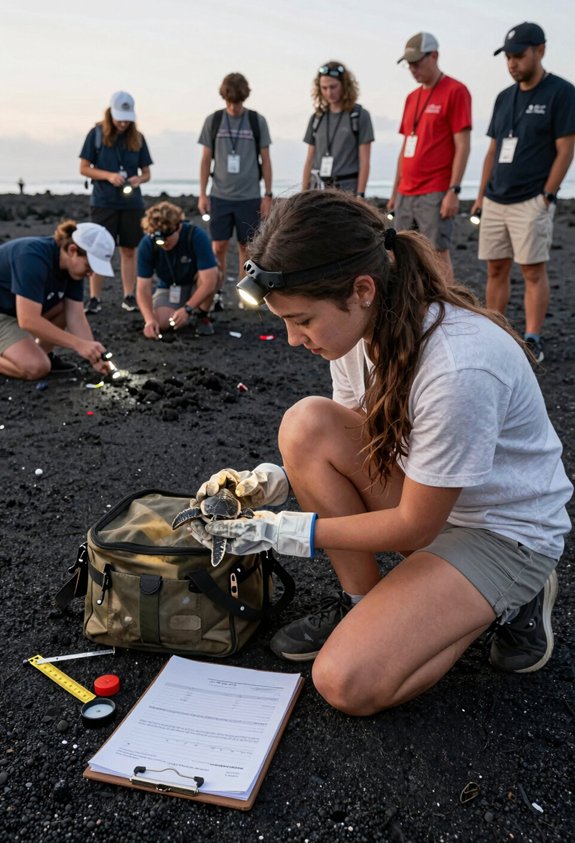
Once participants understand the financial framework and book their flights, they’ll naturally wonder whether they meet the baseline requirements for acceptance—and the answer depends on a straightforward but thorough vetting process that balances accessibility with the realities of conservation fieldwork.
Volunteers typically range from eighteen to eighty-five years old, with most placements filled by adults eighteen and older—minors may participate under special arrangements involving guardian coordination.
Every applicant undergoes screening by the partner sea turtle conservation organization, which includes passing a medical examination confirming physical capability for demanding labor in humid tropical conditions: night patrols, nest relocation, hatchling handling.
A criminal background check, paid by the applicant, forms part of safeguarding protocols. Final acceptance hinges on health clearance, physical readiness, and background verification—coordinators reserve the right to decline or reassign candidates who don’t meet these standards.
Physical Fitness Requirements for Sea Turtle Volunteers
Passing the vetting process opens the door, but sustaining the work itself demands a level of physical stamina that prospective volunteers should assess honestly before committing to a placement.
Nighttime shifts run from 7:00 PM to 4:00 AM and include four-hour beach patrols involving prolonged walking and standing on sand—a surface that requires more energy than pavement.
The tropical climate brings intense heat, humidity, and frequent rain, conditions volunteers must tolerate for several hours while performing manual labor: relocating nests, maintaining hatcheries, guiding mothers and hatchlings, and handling afternoon infrastructure tasks.
All participants must pass a medical examination confirming fitness for these laborious duties.
Disrupted sleep patterns and early-morning fatigue are inevitable, so prospective volunteers should consider whether their bodies can sustain alert, physically demanding work throughout consecutive overnight shifts.
Medical Exam: Required Health Checks and Clearances

Before candidates can set foot on the beach for their first patrol, they must obtain medical clearance that confirms their bodies are ready for the unique stresses of turtle conservation fieldwork. The examination assesses whether volunteers can safely handle labor-intensive duties in Costa Rica’s hot, humid tropical climate—conditions that test endurance and heat tolerance alike.
Physicians evaluate fitness for the program’s demanding schedule: night shifts stretching from 7:00 PM to 4:00 AM, including four-hour beach patrols conducted regardless of rain or challenging terrain. Volunteers must demonstrate they’re medically able to perform essential tasks such as relocating nests, managing hatchery operations, and guiding turtles or hatchlings without restriction.
Only after passing this health screening can placement be confirmed, ensuring every participant can contribute fully to the conservation mission.
Why Sea Turtles in Costa Rica Need Your Help
Survival itself hangs in the balance for Costa Rica’s sea turtles, ancient mariners whose lineage stretches back 230 million years yet whose nesting beaches now face pressures these creatures never encountered across eons of existence.
Coastal development has claimed vital habitat, while light pollution from streetlights and beachfront properties disorients hatchlings—sending them inland rather than toward the ocean, where their survival depends on reaching water quickly.
Illegal poaching and egg harvesting persist despite nearly 30% of Costa Rica being designated as national park, directly reducing the number of hatchlings that survive each season. Vehicle traffic, construction, and human footfall compact sand and destroy nests, forcing costly relocations or causing mass failures.
During peak nesting season—August through October—volunteer-led conservation becomes critical: on busy nights, hundreds of turtles and their hatchlings require protection and guidance.
The Threats Facing Costa Rica’s Nesting Populations
Costa Rica’s nesting populations face a convergence of dangers that operate simultaneously across beaches, in nearshore waters, and within the sand itself—each threat compounding the others in ways that make recovery increasingly difficult.
Illegal poaching and egg harvesting continue to reduce hatchling numbers, particularly where nests are stolen for local consumption or commercial sale. Coastal development eliminates historic nesting sites, forcing turtles into suboptimal locations or away from beaches altogether.
Artificial light from hotels, streetlights, and homes disorients emerging hatchlings—creatures that instinctively navigate toward the brightest horizon, which should be moonlight on open water—leading them inland instead, where mortality rates climb sharply. Climate change raises sand temperatures, skewing sex ratios toward females and killing embryos during heat waves, while marine threats including fisheries bycatch, boat strikes, and plastic pollution prevent adults from ever returning to nest.
How Illegal Poaching Endangers Mothers and Eggs
Poaching sea turtles on nesting beaches—whether for meat, shells, or the eggs themselves—strikes at the heart of population recovery because it removes the very individuals who’ve survived decades of ocean perils to reach reproductive maturity.
When poachers steal eggs from nests, they eliminate entire cohorts of hatchlings before they’ve had any chance to enter the ocean, cutting recruitment—the addition of young animals to a breeding population—by hundreds per clutch.
Killing nesting mothers ends their reproductive lifespan entirely and disrupts the site fidelity that brings females back to the same beaches year after year. Persistent poaching can erase local populations altogether, nullifying conservation work and forcing programs to redirect scarce resources toward patrol and protection rather than habitat restoration or hatchling guidance.
Why Light Pollution Disorients Hatchlings After Dark
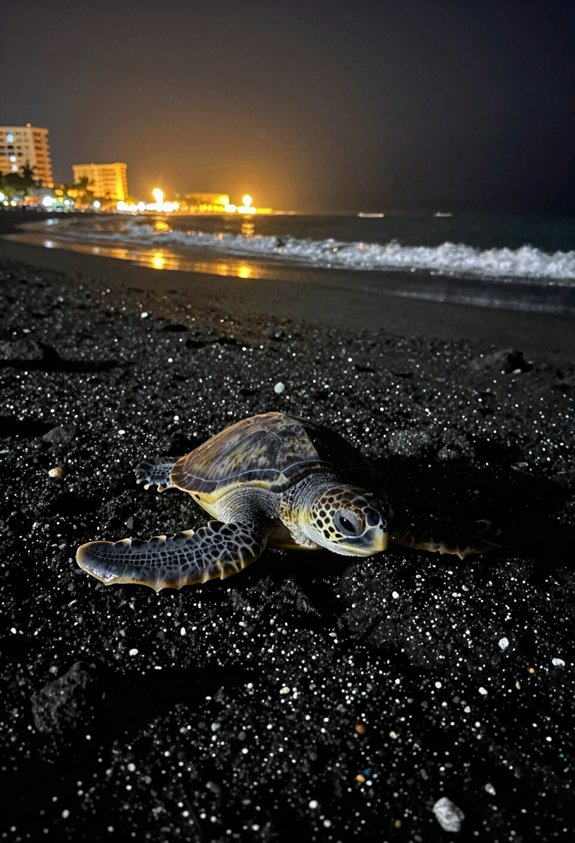
When hatchlings dig their way out of the sand after nightfall, their very first challenge isn’t finding food or avoiding waves—it’s simply choosing the right direction, and for millions of years that choice has been guided by a single, reliable cue: the brightest part of the horizon. Historically, that meant moonlight and starlight reflecting off open water, a dependable beacon pulling them seaward.
Today, however, artificial lights from beachfront properties, streetlights, and even distant vehicle headlights create competing horizons that override natural cues. Short-wavelength blue and white LEDs prove especially disorienting, while amber and red wavelengths cause less confusion.
Hatchlings who crawl inland face dehydration, predation, and vehicle strikes—consequences that drastically reduce survival during the critical imprinting window immediately after emergence.
What Species of Sea Turtles Will You Protect?
How many turtle species might you encounter during a conservation internship in Costa Rica? Interns typically work with five distinct species, each facing unique threats.
The Olive Ridley, recognized for its mass nesting events called arribadas—synchronized arrivals of hundreds or thousands of females—dominates Pacific beaches from August through October.
Leatherbacks, the largest sea turtles reaching over six feet in length, require urgent protection as eastern Pacific populations have declined drastically.
Green turtles, listed as Endangered, play crucial roles in maintaining healthy seagrass beds and reef systems.
Hawksbill turtles, Critically Endangered due to historic shell trade, need intensive anti-poaching patrols.
Loggerheads appear less frequently but receive monitoring when they nest, classified as Vulnerable across most populations.
When Sea Turtles Nest in Costa Rica’s Beaches
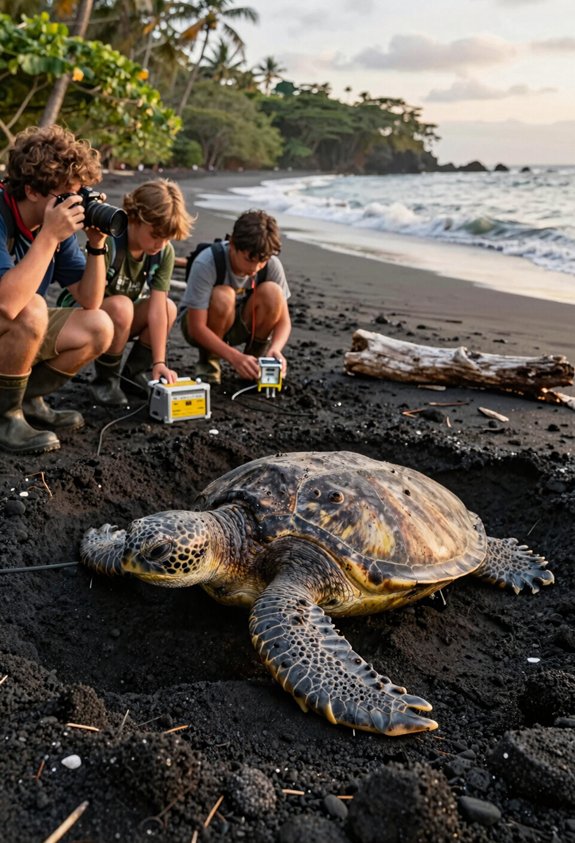
Understanding *when* sea turtles nest proves essential for anyone considering conservation work in Costa Rica, since the timing shapes every aspect of an intern’s daily schedule and fieldwork responsibilities.
Peak nesting season runs from August through October, when certain beaches welcome hundreds of turtles emerging from the surf each night.
Nesting occurs primarily after dark—most activity unfolds between dusk and dawn—which explains why conservation patrols operate during evening and late-night hours, typically from 7:00 PM until 4:00 AM in rotating four-hour shifts.
Interns locate nests, protect eggs, and sometimes relocate them to safer areas during these nighttime watches. Rain doesn’t halt the work: both nesting mothers and emerging hatchlings appear regardless of weather, so patrols continue through wet conditions to guarantee every vulnerable life receives protection.
Your Sea Turtle Conservation Duties: Night Beach Patrols
Knowing the nesting calendar prepares interns for the rhythm of conservation work, but the actual duties during night beach patrols form the heart of hands-on turtle protection—and these responsibilities demand both physical stamina and careful attention to detail.
Patrols typically run from 7:00 PM to 4:00 AM, divided into four-hour shifts that continue regardless of weather or turtle activity. Volunteers spot nesting females, guide mothers safely between sand and surf, record essential data about each nest, and shield eggs from poachers and predators.
They relocate vulnerable nests to protected hatcheries, assist tiny hatchlings toward the ocean, and maintain enclosures through regular checks. During peak season—August through October—hundreds of turtles can arrive on busy beaches, intensifying the workload but also magnifying conservation impact in humid tropical conditions.
Inside a Night Patrol: Your 7 PM to 4 AM Shift
When darkness settles over the beach at 7:00 PM, interns gather for roll call and receive their sector assignments—specific stretches of coastline they’ll monitor throughout the night—before heading out in pairs with headlamps, data sheets, and GPS units in hand.
Each four-hour shift brings tasks that vary with the turtles’ rhythms: watching for nesting females emerging from the surf, recording GPS coordinates and clutch data when a mother begins laying, relocating vulnerable nests to the protected hatchery enclosure, and guiding disoriented hatchlings away from artificial lights toward the ocean.
The humid tropical air clings to skin, and patrols continue through rain and quiet nights alike, demanding stamina and focus until the 4:00 AM shift change, when exhausted volunteers pass their sector notes to fresh teams.
How You’ll Relocate Nests to Protected Hatcheries
Among the many responsibilities volunteers shoulder during those long nocturnal patrols, one of the most hands-on—and perhaps most impactful—is the physical relocation of threatened nests from vulnerable stretches of beach into the project’s secure hatchery enclosure.
After completing orientation and training on Day 2, volunteers work under direct supervision to carefully transfer eggs endangered by poaching, predators, or disorienting artificial light.
The process unfolds during dedicated shifts within the typical 7:00 PM–4:00 AM patrol blocks, allowing teams to respond quickly whenever a nesting event occurs.
Throughout peak season—August through October, when hundreds of turtles may arrive—relocation and hatchery monitoring continue regardless of rain or hatching activity, demanding physical stamina in tropical conditions but delivering conservation outcomes through meticulous data recording and protection work that directly improves hatchling survival rates.
Guiding Mother Turtles Safely Back to the Ocean
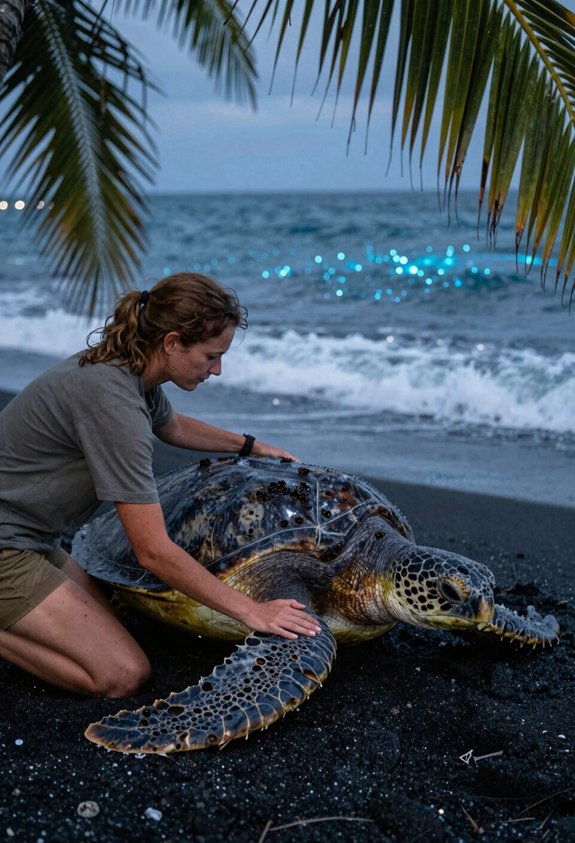
Watching a massive mother turtle lumber back toward the waves after hours of nesting might seem like a straightforward process—after all, sea turtles have been traversing this journey for millions of years—but modern beaches present hazards their ancient instincts weren’t designed to overcome.
During night patrols, volunteers learn to guide disoriented females using red-filtered lights and careful positioning, placing themselves between the turtle and shore obstacles to encourage a direct path. The technique requires minimal noise and movement, allowing the mother to reorient naturally.
White lights and flash photography remain strictly forbidden—light pollution confuses navigation instincts that evolved under starlight alone. Peak season months from August through October can bring hundreds of turtles nightly, demanding coordinated teamwork as patrol groups make sure each exhausted mother finds her way safely home.
Helping Hatchlings Reach the Water After Dark
Hours after the mother turtles have completed their nesting work and returned to sea, the beach reveals a new phase of the conservation effort—one measured in far smaller scales but equally demanding of volunteer attention.
When hatchlings emerge from their nests and instinctively seek the ocean, volunteers guide these tiny turtles toward the surf, shielding them from artificial light that can draw them dangerously inland—away from safety.
During peak season, hundreds of hatchlings may require assistance on particularly active nights.
The work demands quiet care: minimal handling reduces stress while ensuring each hatchling moves seaward rather than toward streetlights or development, substantially improving survival rates before they reach the water.
Afternoon Work: Beach Clean-Up and Habitat Maintenance
While mornings center on nest protection and nights on guiding hatchlings, the afternoon hours establish the physical foundation that allows both efforts to succeed—volunteers turn their attention to beach clean-ups and habitat maintenance, work that’s less visible than direct turtle contact but equally essential to conservation outcomes.
They remove plastic, debris, and vegetation from nesting zones, clearing obstacles that could trap or disorient turtles traversing the sand. Volunteers also repair hatchery enclosures, walkways, and signage, ensuring nests remain protected during patrols.
Eliminating artificial light sources near the shore reduces disorientation risks for hatchlings, who instinctively follow moonlight toward the water. These tasks demand physical stamina in humid tropical conditions—applicants must pass a medical check—but the effort directly improves hatch success rates and overall program effectiveness.
Why Patrols Continue Even When No Turtles Appear
Because sea turtles nest unpredictably across the breeding season—sometimes arriving in clusters, sometimes vanishing for days—nightly patrols continue regardless of whether volunteers spot a single female, ensuring that every potential nesting event receives protection when it matters most.
Even on quiet nights, teams search for fresh tracks, false crawls (abandoned nesting attempts), and recently deposited eggs that need marking or relocation before dawn exposes them to predators or rising tides.
Patrols also deter poaching, removing the opportunity for illegal harvest when human presence remains consistent.
Meanwhile, volunteers document environmental hazards—debris, erosion patterns, artificial light sources—that threaten incubation success or disorient hatchlings weeks later. This steady accumulation of data, recorded night after night, builds the long-term baseline scientists require to evaluate conservation strategies and adapt management practices effectively.
Ready to volunteer or intern abroad? Enter code ELI100 at checkout and get $100 OFF any internship or volunteer project worldwide.
Explore ProjectsWorking Through Rain and Challenging Tropical Conditions
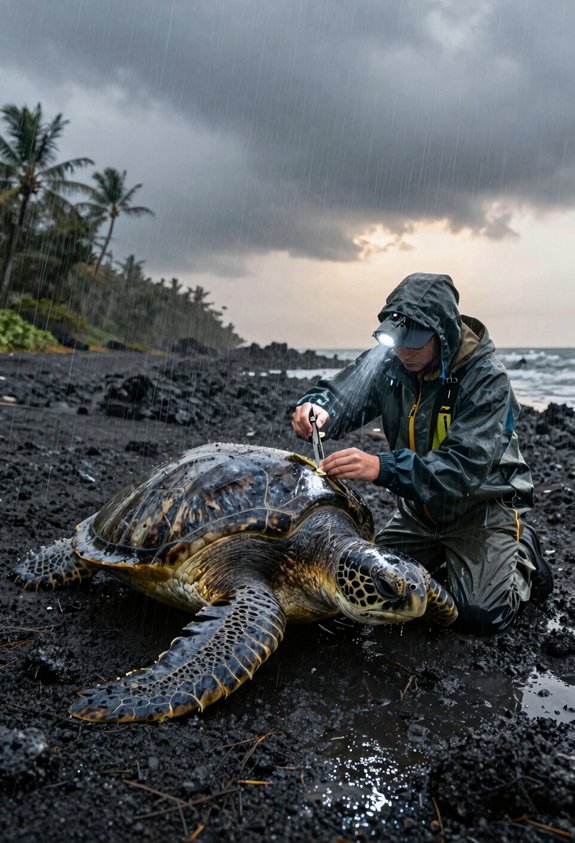
Rain doesn’t pause conservation work—it simply becomes another layer of the experience volunteers learn to navigate with the same steady attention they bring to moonless patrols or false-crawl surveys.
Night shifts from 19:00 to 04:00 continue through tropical downpours, and the rainy season—August through October—often coincides with peak nesting activity, meaning volunteers may document hundreds of turtles while working in wet, muddy conditions.
The physical demands intensify in high humidity and warm temperatures, requiring stamina for long hours on foot across sand and vegetation.
Programs conduct medical examinations beforehand to confirm participants can handle prolonged heat exposure and intermittent storms.
Waterproof clothing, sturdy footwear, headlamps with spare batteries, and quick-drying layers become essential tools—not optional comforts—for those committed to protecting nesting grounds regardless of weather.
Arrival Day: Your First Night in San Ramón Hostel
After clearing customs and retrieving your luggage, you’ll step into the arrivals hall at San José Airport to find a pre-arranged driver holding a sign with your name—a small but reassuring detail that marks the shift from independent traveler to program participant.
The drive to San Ramón takes roughly ninety minutes through mountain terrain, delivering you to a vetted hostel chosen specifically for its comfort and security. This first night provides essential rest before the longer journey to Junquillal beach the following morning.
Your Trip Coordinator confirms pickup times for Day 2, handling logistics so participants can focus on settling in, meeting fellow volunteers who’ve arrived that same evening, and mentally preparing for the conservation work ahead—a onboarding designed to ease newcomers into field rhythms without overwhelming them.
Day Two Transfer to Junquillal Beach Volunteer House
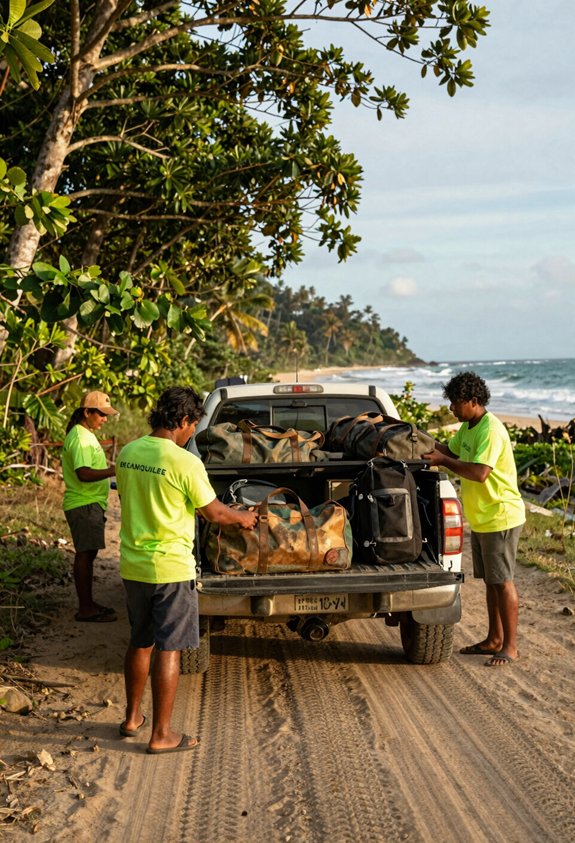
Morning light filters through the hostel windows as volunteers gather their packs for the second leg of the journey, a three-hour transfer that winds westward from San Ramón’s highland coffee country down to Guanacaste’s Pacific coast. The in-country team coordinates this scheduled departure, ensuring each participant boards the correct vehicle without needing to arrange independent transport.
As the van descends through cloud forest and into drier lowland habitat, the landscape shifts—emerald ridges give way to cattle pasture, then roadside palms signal proximity to the ocean.
Upon arrival at Junquillal, volunteers step directly into their shared accommodation: houses designed for six to eight residents, with two or three people per bedroom. Orientation begins immediately, grounding newcomers in daily routines, safety protocols, and the conservation work that will shape the weeks ahead.
Settling into the volunteer house at Junquillal means adapting to a rhythm shaped by shared spaces, practical amenities, and the rhythms of conservation work rather than the privacy of home.
Houses typically accommodate six to eight volunteers total, with bedrooms configured for two to three people per room—an arrangement that fosters camaraderie while maintaining reasonable personal space.
Each house has been screened and evaluated before volunteers arrive, ensuring basic comfort standards are met. An on-site cook prepares three fresh Costa Rican meals daily for all residents, removing the burden of food planning from volunteers’ schedules.
Day two includes orientation at the accommodation itself, where coordinators walk volunteers through house routines, expectations, and project logistics. Mornings at the house generally remain free for relaxation, beach visits, hiking, or socializing with fellow volunteers.
Living With 2 to 3 Roommates in Each House
Sharing a bedroom with two or three people throughout your internship changes the experience from a solo adventure into something inherently collaborative, where personal rhythms and daily habits intersect with those of strangers who quickly become familiar companions.
The arrangement naturally creates accountability—someone’s always awake when you return from dawn patrol on the beach, and morning routines require negotiation over limited mirror space and shower schedules.
Free mornings and weekends offer time to build these connections beyond work obligations, whether through shared meals prepared by the on-site cook or spontaneous beach walks between turtle shifts.
The house structure, designed for six to eight total residents, guarantees your small bedroom group remains part of a larger community while still maintaining intimate daily contact.
Daily Menu: Traditional Costa Rican Dishes and Fresh Ingredients
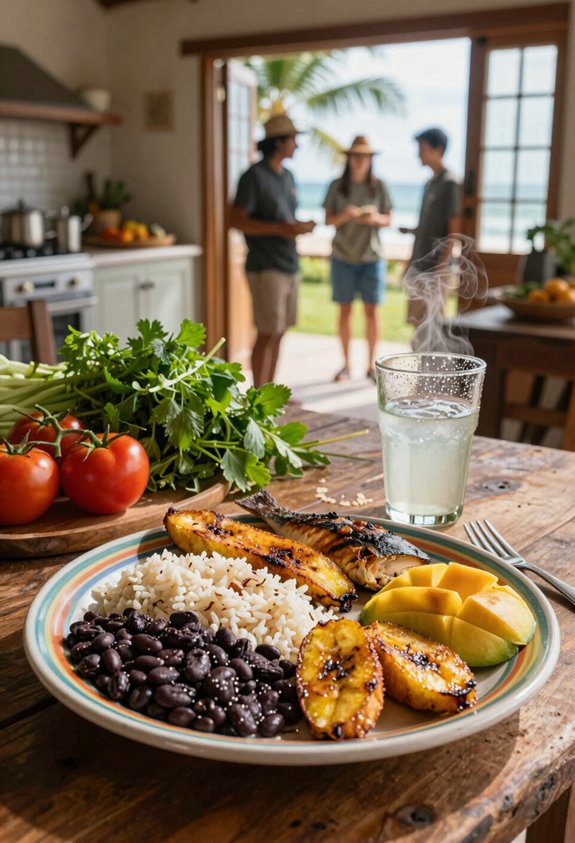
The aroma of sautéed onions and cilantro drifts from the kitchen each morning around six, signaling the start of a culinary routine grounded firmly in Costa Rican tradition.
Breakfast typically features gallo pinto—seasoned rice and beans cooked together—alongside fried eggs, sweet plantains, and robust locally grown coffee.
Lunch centers on the casado, a balanced plate combining white rice, black beans, fresh salad, plantain, and grilled protein such as fish, chicken, or beef.
Dinner offers lighter fare: hearty soups or ceviche made with just-caught fish marinated in lime juice and cilantro.
Throughout each meal, volunteers encounter ingredients pulled directly from the surrounding landscape—mangoes, papayas, yuca, coconut, tortillas, and seasonal vegetables—all prepared simply to honor their inherent freshness and flavor.
How Your Mornings Stay Free for Rest and Exploration
Because volunteer patrols run during the evening and late-night hours—typically from 7:00 PM until 4:00 AM, with four-hour beach rotations—mornings naturally become a quiet stretch of unscheduled time, a deliberate rhythm that honors the body’s need for rest after nocturnal work.
Upon returning to shared accommodation housing six to eight volunteers, participants can sleep in without pressure, allowing recovery from overnight shifts.
Those who wake earlier often walk to the beach, explore nearby hiking trails, or simply talk with housemates over coffee.
Weekend mornings and most weekdays remain open for independent exploration or organized excursions already included in the program fee.
Because an on-site cook prepares three daily meals, mornings don’t require shopping or meal preparation—volunteers can genuinely rest, wander, and recharge before afternoon duties resume.
Weekend Opportunities to Explore the Costa Rican Coast
What happens when the structured rhythm of nighttime patrols pauses for the weekend and mornings stretch into long, unscheduled afternoons? Interns discover that Junquillal and its neighboring beaches offer more than rest—they become laboratories for personal exploration.
Many volunteers spend weekend days learning to surf, renting boards and arranging lessons with local instructors who know the breaks intimately. Guided excursions, often included in the trip fee, transport participants to national parks where Costa Rica’s protected landscapes—nearly 30% of the country—reveal birdwatching trails, snorkeling sites, and rainforest canopies.
Short trips to Nicaragua or inland Guanacaste adventures can be coordinated through the Trip Coordinator or gWorld app. During peak nesting season (August–October), weekends also offer optional night patrols where hundreds of turtles arrive simultaneously, deepening understanding of cyclical natural phenomena.
On-Site Sea Turtle Conservation Training Included
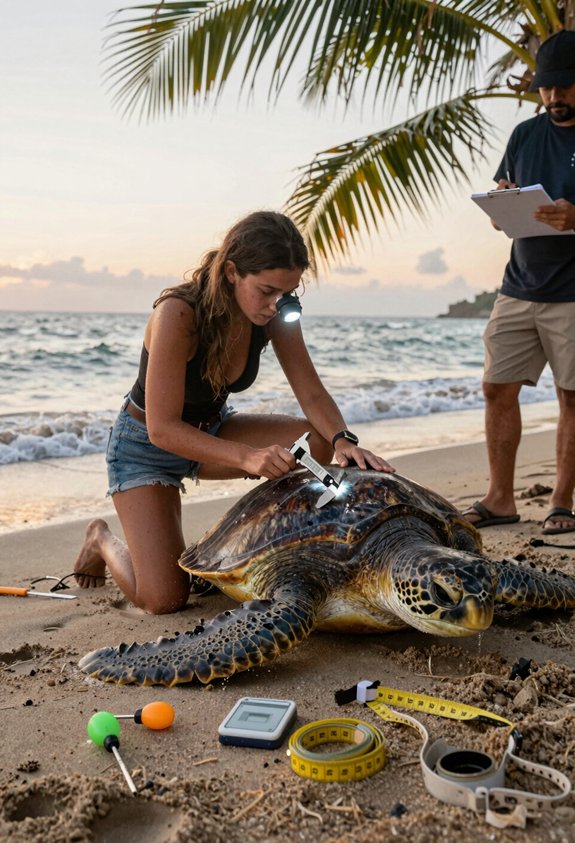
Coordinators gather the group under the rancho’s open-air roof on Day 2 to deliver a training session that transforms curious volunteers into competent field assistants, covering every skill needed to monitor nests, protect hatchlings, and collect reliable data across the weeks ahead.
Volunteers learn nest relocation criteria—the specific conditions that warrant moving eggs to protected hatcheries—plus construction techniques, data recording standards, and protocols for working in humid tropical conditions, rain, and darkness while minimizing light pollution that disorients young turtles.
Project staff and Trip Coordinators provide ongoing supervision and refresher coaching throughout the placement.
Ongoing Support From Local Project Supervisors
Local project supervisors anchor the volunteer experience from the first evening patrol through the final hatchling release, maintaining a steady presence that bridges initial training with weeks of hands-on fieldwork.
These experienced coordinators organize night-shift rotations for beach patrols, direct hatchery operations—the protected areas where eggs incubate safely—and oversee nest relocations when erosion or predation threaten clutches.
Day-to-day operational decisions rest with local staff who remain on standby, while a dedicated emergency team provides round-the-clock support Monday through Friday. Supervisors also monitor safety protocols and task performance in the field, ensuring that conservation standards protect both volunteers and the endangered species they’ve come to serve.
Your Assigned Trip Coordinator Before Departure

Once a volunteer completes registration, a dedicated Trip Coordinator steps into the planning process—a single point of contact who’ll shepherd every logistical detail from enrollment through the flight to San José.
This individual confirms the volunteer’s placement at the sea turtle project, arranges accommodation that meets safety and comfort standards, and coordinates ground transfers so arrivals run smoothly.
The Trip Coordinator answers questions about packing lists, vaccination requirements, and daily schedules, offering pre-departure support that builds confidence before leaving home.
If concerns arise about program fit, the coordinator can recommend adjustments or suggest alternative projects better aligned with the volunteer’s goals. They also liaise with Costa Rica’s partner team to confirm orientation sessions, on-site supervision, and airport pickups are ready when the volunteer lands.
Using the gWorld App to Connect With Other Volunteers
How will volunteers meet the teammates who’ll share their journey before stepping onto Costa Rican soil? The gWorld app—included with every trip—provides a social network designed specifically for volunteers headed to the same sea turtle project, allowing them to introduce themselves, exchange messages, and begin building connections during the weeks before departure.
Through pre-departure groups and community features, participants can practice relevant skills, work on Spanish language basics, and coordinate practical details like arrival times and shared transfers.
The app’s meet-ups section helps volunteers arrange group excursions or gear swaps, while the Marketplace Deals feature connects those seeking shared transport.
Trip documents, itinerary details, and coordinator contact information remain accessible throughout, ensuring seamless communication from home through the final day on-site.
Booking 6 to 12 Months in Advance for Best Availability
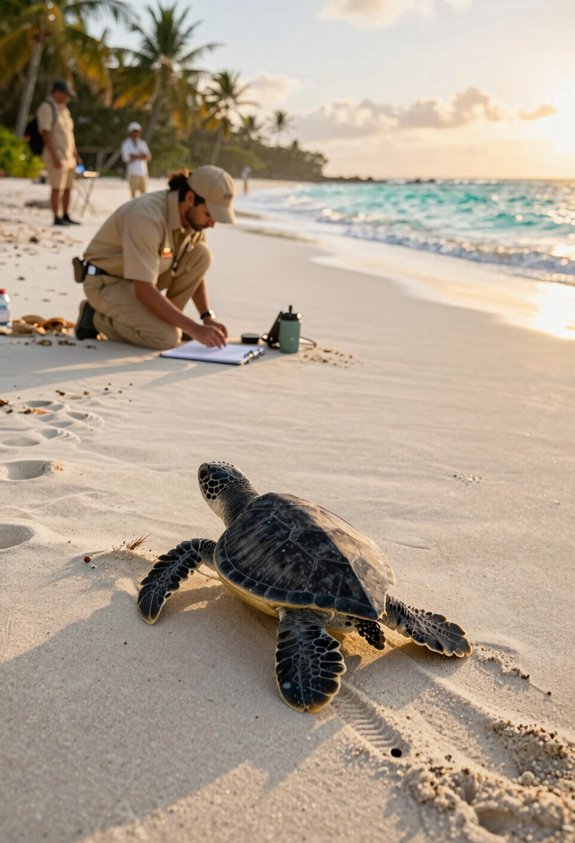
For those drawn to the idea of protecting nesting leatherbacks and greens along Costa Rica’s coastline, booking six to twelve months ahead isn’t merely a suggestion—it’s the most reliable way to secure a spot during the season that matters most. The program operates on a first-in-best-dressed basis, meaning availability is confirmed in the order applications arrive, and peak months—August through October, when turtle activity reaches its height—fill earliest.
A small, flexible deposit holds the placement and comes with a Lifetime Deposit Guarantee, allowing participants to swap dates, gift the booking, or save it for later if circumstances shift. Once confirmed, each volunteer receives a dedicated Trip Coordinator and Personal Travel Concierge who finalize transfers, flights, insurance, and all placement logistics before departure.
Flexible Deposit Options and Lifetime Deposit Guarantee
Knowing when to book matters, but so does understanding how the deposit itself works—and that’s where flexibility becomes most apparent.
Rather than paying the full trip fee upfront, participants can secure their spot with a low deposit that carries some genuine protection: the Lifetime Deposit Guarantee means they won’t simply lose that money if plans shift. They can swap it to a different program, gift it to someone else, or carry it forward to future trips—options that recognize life’s unpredictability.
There’s also a “Book Now, Decide Later” pathway, allowing up to one year to choose exact travel dates after placing the deposit. If circumstances prevent travel altogether, the trip can be placed on hold, preserving both the deposit and booking priority for when the timing improves.
Changing Your Trip Dates or Transferring Destinations
With flights confirmed and transfers in place, life sometimes has other plans—unexpected work obligations, health concerns, or family commitments can reshape even the most carefully laid itineraries.
When circumstances require flexibility, the program’s Trip Coordinator steps in to assist with date changes and destination transfers, working within the availability of partner projects and their capacity limits.
Travelers can shift their booking to another departure date, transfer the reservation to a friend or family member, or place the trip on hold temporarily. The Lifetime Deposit Guarantee guarantees that deposits aren’t forfeited but instead can be swapped for different destinations, gifted to others, or saved for future conservation work—a safeguard that honors both the traveler’s commitment and the unpredictable nature of planning meaningful service abroad.
Cancellation Policy and Store Credit Options
Sometimes the decision to cancel a trip feels less like a choice and more like a necessity—when personal circumstances shift too far to accommodate the original commitment, stepping back becomes the most responsible path forward.
If a participant cancels with 84 days’ notice, they’ll incur a 50% cancellation fee, and the refund will arrive as Store Credit rather than cash.
This credit remains valid for two years from the date of issue and can be redeemed for other trips, third-party tours, or DealsAway.com holidays—preserving value while offering flexibility.
Before cancelling outright, travelers should consider transferring their booking to a friend or family member, or changing their destination entirely, since these options allow the original plans to evolve rather than dissolve completely.
Safety Measures and Secure Airport Transfers Included
Arriving in a new country for the first time often brings a blend of excitement and uncertainty, especially when finding your way through unfamiliar airports and ground transportation—which is why this programme arranges secure airport transfers from the moment a volunteer lands at San José Airport. A driver meets each participant, transporting them to a top-rated hostel in San Ramón for the arrival night.
On Day 2, coordinated transfers move volunteers to shared accommodation near Junquillal beach, where dedicated Trip Coordinators and local project supervisors provide orientation and ongoing on-site support. The programme also maintains a 24/5 emergency phone line with staff on standby for immediate assistance, while full pre-departure support guarantees all logistics meet established safety standards through vetted partner placements.
24/5 Emergency Support While You’re Volunteering
Beyond the logistics of airport pickups and daily orientation, volunteers benefit from a multilayered emergency support system designed to respond quickly when unexpected situations arise during turtle patrols or anywhere else in the programme.
A 24/5 emergency line—staffed Monday through Friday—connects participants directly to experienced coordinators who can dispatch help, coordinate medical care, or arrange immediate programme swaps if circumstances require a change.
On-site project staff remain reachable overnight, especially during nocturnal beach shifts when turtles nest, ensuring that no volunteer faces an incident alone.
Your Trip Coordinator and Personal Travel Concierge monitor logistics throughout your stay, while vetted in-country partners provide local knowledge and rapid response.
This network operates continuously, offering reassurance that help is always within reach.
How Partner Vetting Ensures Safety and Ethical Practices
Because volunteers entrust their time, energy, and hopes for meaningful conservation work to an organisation they’ve never met, the programme requires that every partner undergo rigorous screening before a single placement is approved.
Vetting confirms that accommodation meets basic comfort standards, airport transfers follow verified routes, and coordinators remain present on-site throughout the project period—eliminating guesswork when volunteers arrive tired and unfamiliar with local geography.
Safety checks extend to mandatory medical examinations and criminal background clearances for each participant, plus nightly supervision during beach patrols when darkness and isolation increase vulnerability.
Ethical practice reviews assess conservation impact through nest protection protocols, hatchery management, and light pollution mitigation efforts, while performance history and traveller feedback reveal whether partners consistently deliver what they promise.
Program Credentials: 15 Years and 100,000+ Volunteers
Track record matters when conservation work takes place thousands of miles from home, and this sea turtle programme carries credentials that span fifteen years of continuous operation, more than 100,000 placements across gap-year and volunteer travel initiatives, and a global infrastructure of four international offices supported by roughly 100 staff members plus over 80 local field professionals.
These figures aren’t marketing polish—they represent systems tested across thousands of individual experiences, refined through feedback loops that identified what worked and what didn’t.
The organisation’s 4.6 out of 5 overall rating, built from over 10,000 combined four- and five-star reviews, reflects patterns rather than outliers: consistent partner vetting, transparent communication, and field support that responds when things go sideways, as they sometimes do in remote coastal settings.
Real Volunteer Reviews: 4.6 Out of 5 Stars
Numbers rarely lie when thousands of people share similar observations, and the 4.6-out-of-5-star rating for this Costa Rica sea turtle internship emerges from a broad base of participant feedback rather than a handful of enthusiastic outliers.
The company’s portfolio shows more than 10,000 four- and five-star reviews across all programs, with the turtle internship itself displaying 86 collected testimonials that volunteers can read before committing.
Participants from Australia, New Zealand, and Canada consistently mention the same strengths: reliable airport transfers, thorough orientation sessions, and attentive supervision by local project staff.
They also highlight practical comforts—secure accommodation, included meals, and round-the-clock emergency support five days each week—that remove daily worries and let interns focus on hands-on nest monitoring and hatchling release work that produces visible conservation results.
Costa Rica’s Conservation Culture: 30% Protected Parkland
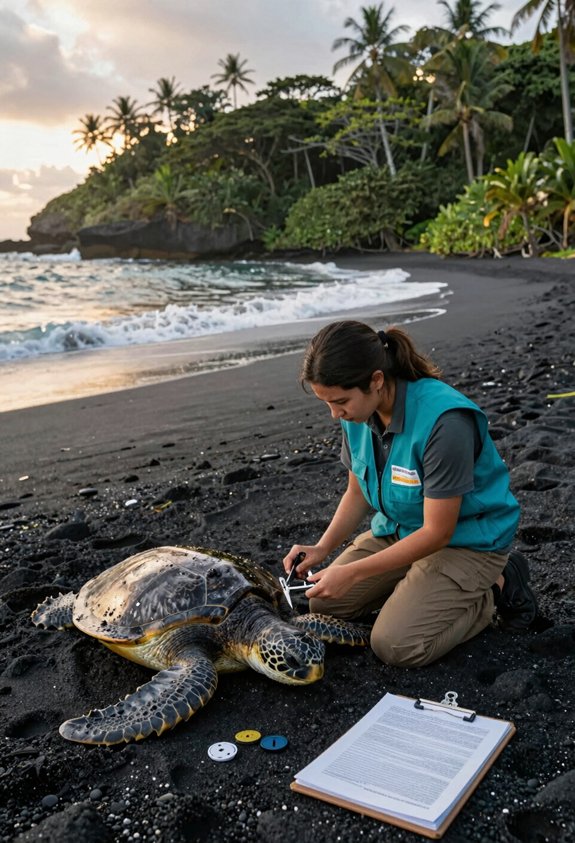
When a country sets aside nearly 30% of its territory as national parks and protected areas—a proportion among the highest in the world—it signals a conservation culture that runs deeper than policy alone, shaping how communities relate to forests, coastlines, and the species that depend on them.
Costa Rica’s approach combines government-managed parks with vetted local NGOs and community-run initiatives, creating a network where ecosystems receive consistent monitoring and active care. This structure allows sea turtle conservation projects and other habitat restoration efforts to draw on ecotourism revenue and volunteer staffing, turning public engagement into tangible protection.
Legal frameworks support this work, but the culture itself—expressed through sustained management, educational programs, and local stewardship—ensures that marine and terrestrial habitats remain viable for the species they harbor.
Why Conservation Fees Support Sustainable Sea Turtle Projects
Costa Rica’s protected parkland creates the legal foundation for conservation, yet daily operations—night patrols, hatchery maintenance, emergency response—require steady funding that keeps projects running year after year.
Conservation fees sustain the paid local staff and coordinators who supervise night patrols from 7:00 PM to 4:00 AM, directly protecting nests and guiding hatchlings to sea during peak nesting season in August through October.
These fees also cover essential logistics: secure airport transfers, volunteer accommodation, three fresh meals daily, and on-site training that allows participants to reliably support fieldwork.
Beyond immediate needs, fee income finances hatchery infrastructure, nest relocation efforts, and equipment needed to counter threats like illegal poaching and light pollution, while vetting partnerships guarantee volunteers join screened, reputable organizations that safeguard both wildlife welfare and participant safety.
Extending Your Stay to Explore Nicaragua and Panama
After weeks monitoring nests under moonlight and guiding hatchlings to the Pacific, volunteers often discover they’re not ready to leave Central America—and the internship program actively supports this impulse by offering extension options to Nicaragua and Panama, neighboring countries that lie within easy reach of Costa Rica’s borders.
The dedicated Travel Concierge and Trip Coordinator arrange onward flights, buses, accommodation, and excursions as part of pre-departure or in-trip support, handling visa paperwork and cross-border logistics so participants can focus on planning memorable experiences rather than administrative details.
Many volunteers use the flexible booking system and Lifetime Deposit Guarantee to secure extensions six to twelve months in advance, locking in better rates and guaranteed spaces.
On-site staff and the gWorld app help connect travelers with similar itineraries, turning solo extensions into shared adventures.
Ready to volunteer or intern abroad? Enter code ELI100 at checkout and get $100 OFF any internship or volunteer project worldwide.
Explore ProjectsIf you’re exploring hands-on experience in ecology or wildlife biology, don’t miss my complete guide to wildlife conservation internships with global work and travel, where I break down what’s worth your time, money, and long-term career goals.

Erzsebet Frey (Eli Frey) is an ecologist and online entrepreneur with a Master of Science in Ecology from the University of Belgrade. Originally from Serbia, she has lived in Sri Lanka since 2017. Eli has worked internationally in countries like Oman, Brazil, Germany, and Sri Lanka. In 2018, she expanded into SEO and blogging, completing courses from UC Davis and Edinburgh. Eli has founded multiple websites focused on biology, ecology, environmental science, sustainable and simple living, and outdoor activities. She enjoys creating nature and simple living videos on YouTube and participates in speleology, diving, and hiking.
For your next application
Keep applying and hearing nothing back?
The Biology Job Application Kit shows you which stage of your applications is failing and how to fix it. 46 guides, 22 editable templates, an application tracker and an ATS CV Creator licence.
See the Job Application Kit