
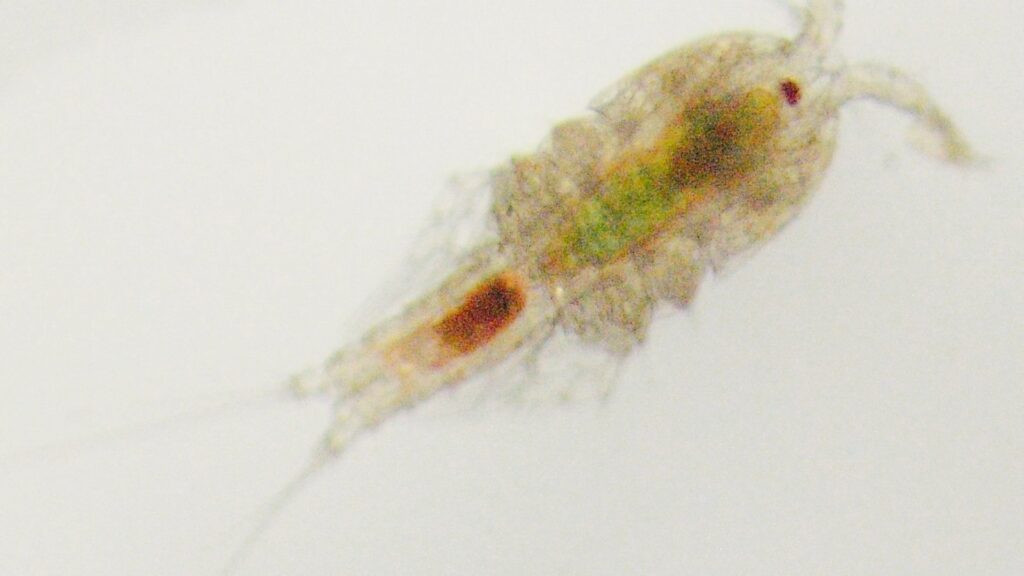
Zooplankton identification keys are essential tools for classifying these tiny aquatic drifters. This page is a working key rather than a description of one. It takes a live or preserved sample down to order or group, covers temperate freshwater ponds, lakes and reservoirs, and includes the marine and estuarine groups that turn up in coastal tows. You will key out copepods, cladocerans, rotifers, arrow worms, medusae, invertebrate larvae and shelled protists using body plan, eye number, antenna length and size in millimetres. Start at couplet 1.
Key Takeaways
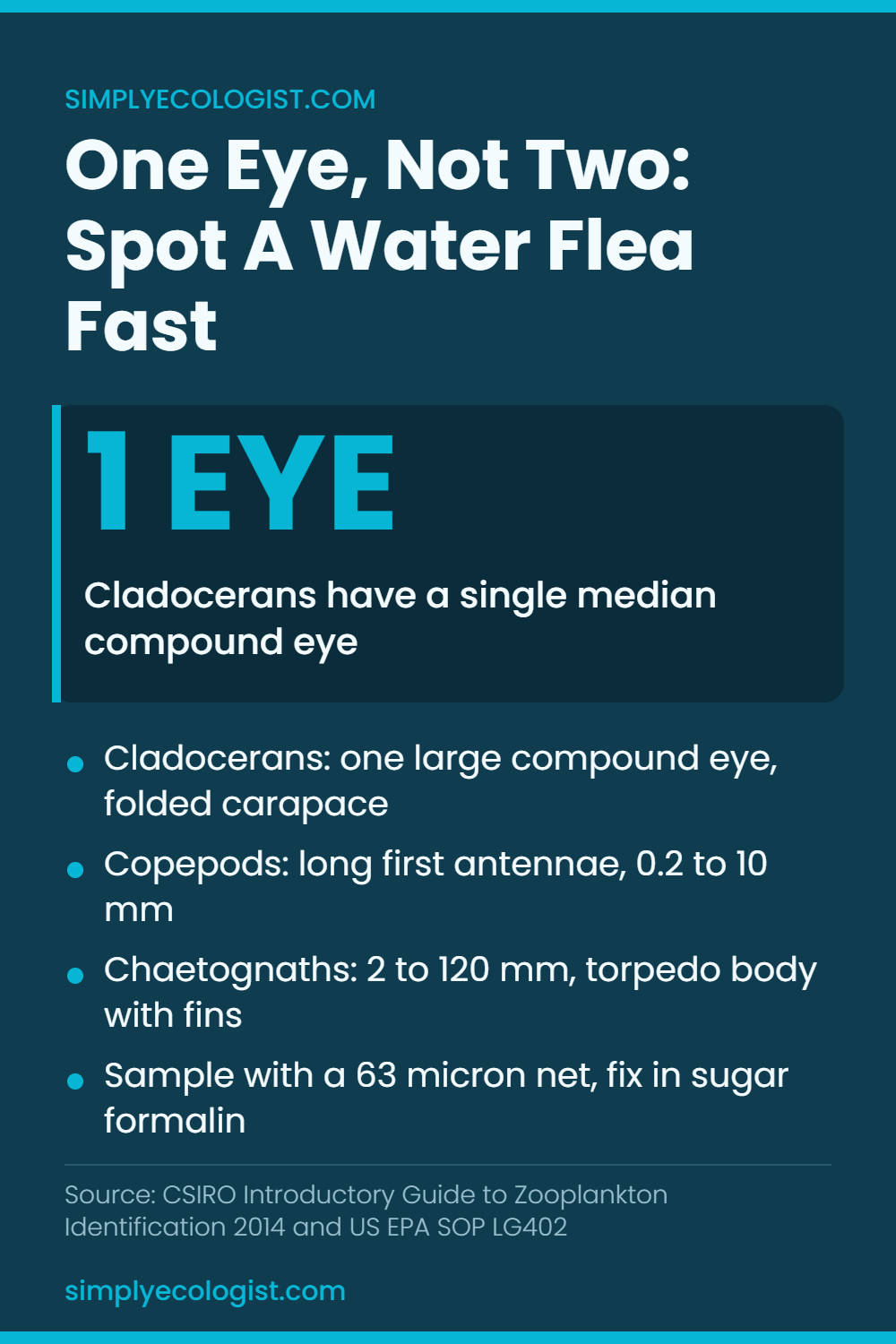
- Cladocerans carry a single large compound eye on the midline of the head, not a pair. Source: CSIRO and Australian Plankton Survey, Introductory Guide to Zooplankton Identification (Slotwinski, Coman and Richardson, 2014).
- Size sorts a sample faster than any other character. Marine copepods run 0.2 to 10 mm and arrow worms 2 to 120 mm, while cyclopoids and cladocerans stay under 1.3 mm and harpacticoids under 1 mm (CSIRO, 2014).
- Most microcrustacean characters can be scored on a dissecting scope at 10x to 50x. Setae and other fine characters need a compound scope at 100x to 1000x, and rotifers are worked at 100x (United States EPA Great Lakes zooplankton procedures).
- Sample with a 63 micron net for the small fraction and a 153 micron net for the larger crustacean fraction, and fix in sugar buffered formalin so cladoceran carapaces do not distort (US EPA SOP LG402).
- This key resolves to order or group. Species level work needs a regional monograph and a compound scope.
The Dichotomous Key: Ten Couplets To Order Or Group
Read one couplet at a time, pick the statement that matches your specimen, and follow the instruction in the right hand column. Score every character you can before you commit, because a wrong choice at couplet 1 or 2 sends you down the wrong branch and the key will still give you an answer.
Sizes below follow the CSIRO and Australian Plankton Survey Introductory Guide to Zooplankton Identification (2014), which covers Australian marine plankton, so treat them as general guidance rather than freshwater specific limits.
| Step | Character to score | Result |
|---|---|---|
| 1a | Body carries jointed appendages and a hardened, moulted exoskeleton. The animal is a crustacean. | Go to 2 |
| 1b | No jointed appendages and no moulted exoskeleton. | Go to 5 |
| 2a | Head and trunk enclosed in a folded, bivalved carapace, and a single large compound eye sits on the midline of the head. Usually under 1.3 mm. | Cladocera, the water fleas |
| 2b | Trunk not enclosed in a folded carapace. Body tapers to a forked tail and carries one small median eye. 0.2 to 10 mm. | Copepoda, go to 3 |
| 3a | Body cylindrical and worm like, with little or no narrowing between the front and rear sections. Usually under 1 mm, and usually taken from sediment or from surfaces rather than open water. | Harpacticoida |
| 3b | Front section of the body clearly broader than the rear section. | Go to 4 |
| 4a | First antennae long, reaching past the broad front section and often as long as the whole body. Females usually carry a single egg sac. | Calanoida |
| 4b | First antennae short, reaching no further than the middle of the broad front section. Females usually carry a pair of egg sacs. Usually under 1.3 mm. | Cyclopoida |
| 5a | Front end carries a ring of beating cilia, the corona, which looks like a turning wheel. | Rotifera |
| 5b | No ring of beating cilia at the front end. | Go to 6 |
| 6a | Body torpedo shaped and glassy, with paired side fins, a tail fin, and a fan of curved grasping spines each side of the mouth. 2 to 120 mm. | Chaetognatha, the arrow worms |
| 6b | Body not torpedo shaped and without fins. | Go to 7 |
| 7a | Body a transparent bell or disc with tentacles round the rim, swimming by pulsing the bell. | Cnidarian medusae and jellyfish larvae |
| 7b | Body not a bell or a disc. | Go to 8 |
| 8a | Single celled, no appendages, enclosed in a mineral shell or skeleton: chambered calcium carbonate, or an open lattice of silica or strontium sulphate. | Shelled protists: Foraminifera or Radiozoa |
| 8b | Many celled, soft bodied larva. | Go to 9 |
| 9a | Larva carries long paired arms stiffened by internal skeletal rods. | Pluteus larva of a sea urchin or a brittle star |
| 9b | Larva without stiffened arms. | Go to 10 |
| 10a | Larva has two hinged shell valves and a ciliated swimming lobe. | Bivalve veliger |
| 10b | Larva elongate and segmented, with bands of cilia and bundles of bristles. | Polychaete larva |
Three notes on the couplets
Couplet 2a is the one most often scored wrong. Cladocerans have one compound eye, not two. The CSIRO and Australian Plankton Survey Introductory Guide to Zooplankton Identification (2014) describes Cladocera as most with an anterior, single, large compound eye, and records a single black compound eye on the animal’s midline in all but two genera. If you can resolve two separate compound eyes, you are not looking at a cladoceran, and you should go back to couplet 1.
Couplet 9a covers sea urchins and brittle stars only. Pluteus is not a general echinoderm larva. Starfish pass through a bipinnaria that develops into a brachiolaria, sea cucumbers through an auricularia, and crinoids through a vitellaria. Keying an asteroid larva as a pluteus is a common and completely avoidable error.
A naming note on Cladocera. Freshwater limnology still uses Cladocera universally, and so does this key. The World Register of Marine Species lists Cladocera (AphiaID 1076), an order in class Branchiopoda, with the status unaccepted and Diplostraca as the valid name. Use Cladocera in your field notes and Diplostraca when you submit records to a database that follows WoRMS.
Size And Magnification At A Glance
The United States EPA Great Lakes zooplankton procedures set a dissecting scope at 10x to 50x for microcrustaceans, a compound scope at 100x to 1000x for finer characters, and 100x for rotifers. Size ranges are from the CSIRO and Australian Plankton Survey Introductory Guide to Zooplankton Identification (2014). Where no size is given, the sources cited on this page do not supply one, and inventing a range would be worse than leaving it blank.
| Group | Size range | First character to score | Scope and magnification |
|---|---|---|---|
| Cladocera (water fleas) | Under 1.3 mm | Single median compound eye, folded bivalved carapace | Dissecting, 10x to 50x |
| Copepoda (all) | 0.2 to 10 mm | Forked tail, then first antenna length | Dissecting, 10x to 50x |
| Calanoida | Within the copepod range above | First antennae as long as the body, single egg sac | Dissecting, 10x to 50x |
| Cyclopoida | Under 1.3 mm | Short first antennae, paired egg sacs | Dissecting, 10x to 50x |
| Harpacticoida | Under 1 mm | Cylindrical body with no clear waist | Dissecting at 10x to 50x, compound at 100x for setae |
| Rotifera | Not given by the sources cited here | Ciliated corona | Compound, 100x |
| Chaetognatha (arrow worms) | 2 to 120 mm | Side fins, tail fin, grasping spines | Naked eye, then dissecting at 10x |
| Cnidarian medusae | Not given by the sources cited here | Bell margin and tentacles | Dissecting, 10x to 50x |
| Meroplankton larvae | Not given by the sources cited here | Skeletal arms, shell valves or bristle bundles | Dissecting, then compound for detail |
| Shelled protists | Not given by the sources cited here | Mineral test or lattice skeleton | Compound, 100x and above |
What Are Zooplankton And Why Are They So Diverse?
Zooplankton are tiny aquatic organisms that drift with water currents. Zooplankton are incredibly diverse, comprising various species from different taxonomic groups. That diversity stems from their wide range of habitats, feeding strategies, and evolutionary adaptations. Zooplankton is an ecological category rather than a taxonomic one, which is why a single sample can hold crustaceans, rotifers, chaetognaths, cnidarians, larval molluscs and single celled protists at the same time.
You’ll find zooplankton in freshwater and marine environments, from surface waters to the deep sea. Zooplankton include both permanent members (holoplankton) that spend their entire lives as plankton, and temporary members (meroplankton) that are planktonic only during certain life stages.
The diversity of zooplankton is further enhanced by their varied feeding habits. Some are herbivores, feeding on phytoplankton, while others are carnivores or omnivores. You’ll encounter filter feeders, ambush predators, and even parasitic forms.
To identify zooplankton, you’ll need to recognize key features like body shape, appendages, and specialized structures. Common groups include copepods, cladocerans, rotifers, and larval stages of larger organisms.
Each group has distinct characteristics that you can use for identification, such as antennae length, eye placement, and locomotion methods.
For North American freshwater work, the best known free resource is the image based key to the zooplankton of North America published by the Center for Freshwater Biology at the University of New Hampshire, version 5.0, released in 2013. It is genuinely well referenced, drawing on Balcer, Korda and Dodson (1984) Zooplankton of the Great Lakes, Pennak (1989) and Edmondson (1959). One warning before you send a class to it: its index page still lists Flash and QuickTime among its multimedia requirements, and Adobe ended support for Flash on 31 December 2020, so parts of it will not run in a current browser. ACCESS THE KEY HERE
Which Type Of Identification Key Should You Use?
Identification keys guide you through a series of choices about an organism’s characteristics, ultimately leading to its identification. Five types are in common use for zooplankton classification, and they are not interchangeable.
| Key type | How it works | Best for | Limitation |
|---|---|---|---|
| Dichotomous | Two mutually exclusive options at each step, narrowing the field until one name is left | Reaching an answer you can defend, because every step names the character that got you there | Gets long for large groups, and one misread character early sends you down the wrong branch |
| Polytomous | Several options at each step rather than two | Moving quickly through a diverse sample | Harder to audit your own reasoning, because the steps constrain you less |
| Pictorial | Illustrations or photographs alongside the text descriptions | Beginners, and any group whose differences are hard to put into words | Only as good as its plates, and it encourages matching by overall impression rather than by character |
| Interactive digital | Software asks about features in any order and narrows the candidate list as you answer | Damaged specimens, where the one character you cannot see would stall a printed key | Depends on the software still running, which is a real problem for keys built in the 2000s |
| Tabular | Characters laid out in a matrix so several taxa can be compared side by side | Checking a batch of similar specimens against each other | Assumes you already know roughly what you are holding |
Here is a position rather than a shrug. If you are new to zooplankton and working on a dissecting scope, start with a pictorial key and use a dichotomous key to check yourself. The pictorial key gets you to a plausible group in seconds. The dichotomous key then forces you to name the character that puts it there, which is the part that turns a guess into an identification. Working the other way round means spending twenty minutes on couplets before discovering you misread step one.
Interactive digital keys are only as durable as the software behind them, so it is worth naming one that still works. Australian Marine Zooplankton, a taxonomic guide and atlas from the Institute for Marine and Antarctic Studies at the University of Tasmania, produced with CSIRO and AIMS, loads in a current browser with no plugins required.
Key Features for Classification
When you’re using any of these identification keys for zooplankton, you’ll need to focus on specific physical characteristics. Those characters are what the couplets above are asking you to score.
Body shape is a primary feature you’ll observe. Look for overall form, such as round, elongated, or segmented bodies. Size is another significant factor, so record the organism’s length in millimetres rather than describing it as small or large.
Appendages matter next, including antennae, legs, and tail structures. Their number, position, and shape can be distinguishing factors, and first antenna length alone separates the three copepod groups in couplets 3 and 4.
You’ll also need to examine the presence and arrangement of setae (hair like structures) on the body and appendages. Setae are scored on a compound scope at 100x or more, not on a dissecting scope: the United States EPA Great Lakes zooplankton procedures put the dissecting scope at 10x to 50x for microcrustaceans and the compound scope at 100x to 1000x for finer characters.
The shape and structure of the head are important, including the presence of eyes, rostrum, or specialized mouthparts. Eye number is the fastest single character in this whole key: one large compound eye on the midline means a cladoceran, one small median eye on a body with a forked tail means a copepod.
For some species, you’ll need to observe internal features like the digestive tract or reproductive organs.
Color and transparency can be helpful, but remember that these may vary based on environmental factors and on how the sample was fixed.
How Do You Tell The Common Zooplankton Groups Apart?
Copepods
Copepods usually dominate a net sample by number, although how strongly depends on the water body and on the mesh you towed. The CSIRO guide describes them as having a short, cylindrical body with a rounded or beaked head, which is a more useful description at the scope than pear shaped, and gives marine copepods as 0.2 to 10 mm. Look for the long first antennae and the forked tail. You’ll often spot them darting through water samples.
Cladocerans, the water fleas
Cladocerans are recognizable by their transparent bodies held inside a folded, bivalved carapace, and by a single large compound eye on the midline of the head. That single eye is worth reading twice, because the pair of eyes you may have seen described elsewhere does not exist. The CSIRO and Australian Plankton Survey Introductory Guide to Zooplankton Identification (2014) describes Cladocera as most with an anterior, single, large compound eye, present as one black midline eye in all but two genera. Cladocerans are common in freshwater environments and usually stay under 1.3 mm.
Arrow worms (chaetognaths)
Arrow worms have torpedo shaped bodies with paired side fins and a tail fin, and a fan of curved grasping spines beside the mouth. The CSIRO guide gives chaetognaths as 2 to 120 mm, which makes them the one group in this key you can often pick out of a jar without a microscope. Arrow worms are predators and are prevalent in marine samples.
Jellyfish larvae and small medusae
Jellyfish larvae and small medusae fall under the cnidarian group, characterized by their bell shaped bodies and tentacles. Score the bell and the tentacle ring at couplet 7 before you start looking for appendages, because cnidarians have none.
Rotifers
You’ll find rotifers in both fresh and saltwater, identifiable by their wheel like corona, a ring of cilia used for locomotion and feeding. Rotifera is an accepted phylum in kingdom Animalia (World Register of Marine Species, AphiaID 14260). Work rotifers at 100x on a compound scope, following the United States EPA Great Lakes zooplankton procedures, which also identify rotifers to genus and to species where possible.
Meroplankton, the larval stages
Larval stages of various marine invertebrates, collectively called meroplankton, are also common. These include bivalve veligers, polychaete larvae, and the pluteus larvae of sea urchins and brittle stars. Pluteus is not a general echinoderm larva: starfish pass through a bipinnaria that develops into a brachiolaria, sea cucumbers through an auricularia, and crinoids through a vitellaria.
Shelled protists (foraminifera and radiolarians)
Foraminifera and radiolarians construct intricate mineral skeletons and turn up regularly in marine samples, but calling them protozoans is out of date. Under the World Register of Marine Species, Foraminifera (AphiaID 1410) and Radiozoa (AphiaID 582421), the accepted name for the radiolarians, are both accepted phyla in kingdom Chromista. WoRMS does maintain a separate kingdom Protozoa (AphiaID 5), so these two groups are specifically not in it. Shelled protists is the wording that will not date.
How To Sample And Preserve Zooplankton Before You Key Them
Most identification problems start in the sampling gear rather than under the microscope. If the carapace is crushed or the antennae are stripped, no key will save the specimen, so the method belongs in the key rather than in a separate methods post.
The United States EPA standard operating procedure LG402, for Great Lakes zooplankton sampling, is the clearest free method document to copy. It specifies nets of 0.5 m mouth diameter in two mesh sizes: 63 micron for the small fraction, which retains rotifers and small nauplii, and 153 micron for the larger crustacean fraction. Counts from the two meshes are not directly comparable, which is exactly why the procedure runs both.
For fixative, LG402 uses a sucrose buffered formalin made up at 227.4 g of sucrose per gallon of formalin plus 34.1 g of borax. The sugar is not decoration. It stops cladoceran carapaces distorting, which means the carapace character at couplet 2a still reads a week after collection instead of collapsing into an unidentifiable blob.
LG402 also states the taxonomic rank it works to, and it is worth copying that habit: adult copepods to species, immature copepods to suborder or genus, cladocerans to species where possible, and rotifers to genus and to species where possible. Write your rank into your notes. An identification that does not say what rank it claims cannot be checked by anyone else.
Using Digital Identification Tools
These days, digital identification tools have changed zooplankton classification. You’ll find software and mobile apps designed to help you identify zooplankton quickly. Digital tools often use image recognition, allowing you to photograph the specimen and receive identification suggestions.
Name the tool when you report a result. ZooScan, FlowCam, EcoTaxa and the Plankton Imager are all documented imaging and classification systems used in plankton work, and stating which one produced a count tells a reader far more than the phrase image recognition ever will.
When using digital tools, you’ll need to guarantee your sample is well prepared and clearly visible. Many apps provide step by step guidance on capturing high quality images for best results.
You’ll also find interactive keys that ask you a series of questions about the specimen’s features, narrowing down potential matches as you progress.
Online databases and digital field guides are invaluable resources, offering extensive collections of zooplankton images and detailed information. You can compare your observations with these references to confirm your identifications.
Some advanced tools incorporate machine learning, improving their accuracy over time as more users contribute training data.
Challenges in Zooplankton Identification
Despite advances in technology, identifying zooplankton remains a challenging task. You’ll find that many species look similar, especially in their early life stages. Morphological differences can be subtle, requiring a trained eye and specialized equipment to discern.
Environmental factors like preservation methods and sample handling can alter organisms’ appearances, making identification more difficult. You’re also likely to encounter damaged specimens, further complicating the process. The vast diversity of zooplankton species presents another hurdle, as you’ll need to familiarize yourself with numerous taxa.
Seasonal variations and geographical differences in populations can lead to morphological changes within species, potentially causing misidentification. You’ll need to stay updated on taxonomic revisions and new species descriptions, as the field is constantly evolving. The Cladocera and Diplostraca situation described above is a live example.
When using molecular techniques, you may face challenges like contamination, PCR bias, or incomplete genetic databases. Contamination and reference gaps can lead to inconclusive or inaccurate results. Additionally, you’ll find that some groups lack reliable genetic markers for species level identification.
Ultimately, overcoming these challenges requires a combination of expertise, patience, and continuous learning in both traditional and modern identification techniques.
Frequently Asked Questions
How do you identify zooplankton?
Work from body plan down to fine characters. First ask whether the animal has jointed appendages, which separates the crustaceans from everything else. For crustaceans, score eye number, whether a folded bivalved carapace encloses the trunk, and first antenna length. For the rest, score the ciliated corona, the fins and grasping spines, the bell and tentacles, or the mineral shell. The ten couplets above take a sample to order or group, and most of the work can be done on a dissecting scope at 10x to 50x, per the United States EPA Great Lakes zooplankton procedures.
Do cladocerans have one eye or two?
One. Cladocerans carry a single large compound eye on the midline of the head, in all but two genera, according to the CSIRO and Australian Plankton Survey Introductory Guide to Zooplankton Identification (2014). Two separate compound eyes rules out a cladoceran.
How are zooplankton classified?
Zooplankton is an ecological grouping, not a taxonomic one, so classification cuts across several kingdoms at once. A single sample can hold crustaceans (Copepoda and Cladocera), Rotifera, Chaetognatha, Cnidaria, the larvae of molluscs, annelids and echinoderms, and single celled shelled protists in kingdom Chromista. Check every name against the World Register of Marine Species before you publish it.
What is the difference between zooplankton identification and zooplankton taxonomy?
Identification places a specimen in a named group using characters you can see. Taxonomy decides what the named groups are and what they are called, and it changes underneath you. Cladocera is the working example: WoRMS lists it (AphiaID 1076) as unaccepted with the valid name Diplostraca, while freshwater limnology carries on using Cladocera in every field notebook.
What magnification do you need to identify zooplankton?
A dissecting scope at 10x to 50x handles microcrustaceans. A compound scope at 100x to 1000x is needed for finer characters such as setae, and rotifers are worked at 100x. Source: United States EPA Great Lakes zooplankton procedures.
What is a good free freshwater zooplankton identification guide?
For North America, the image based key from the Center for Freshwater Biology at the University of New Hampshire, with the Flash caveat noted above. For general characters and size ranges, the CSIRO and Australian Plankton Survey Introductory Guide to Zooplankton Identification (2014) is marine in scope but broadly useful. For sampling and preservation method, use United States EPA standard operating procedure LG402.
Are foraminifera and radiolarians protozoans?
Not under current usage. The World Register of Marine Species places Foraminifera (AphiaID 1410) and Radiozoa (AphiaID 582421), the accepted name for the radiolarians, in kingdom Chromista, while maintaining a separate kingdom Protozoa (AphiaID 5). Shelled protists is the safe wording.

Erzsebet Frey (Eli Frey) is an ecologist and online entrepreneur with a Master of Science in Ecology from the University of Belgrade. Originally from Serbia, she has lived in Sri Lanka since 2017. Eli has worked internationally in countries like Oman, Brazil, Germany, and Sri Lanka. In 2018, she expanded into SEO and blogging, completing courses from UC Davis and Edinburgh. Eli has founded multiple websites focused on biology, ecology, environmental science, sustainable and simple living, and outdoor activities. She enjoys creating nature and simple living videos on YouTube and participates in speleology, diving, and hiking.
🌿 Explore the Wild Side!
Discover eBooks, guides, templates and stylish wildlife-themed T-shirts, notebooks, scrunchies, bandanas, and tote bags. Perfect for nature lovers and wildlife enthusiasts!
Visit My Shop →